Local libraries

There are two local libraries near my house, and the campus library at the college where I used to work. And yet, until just a couple of months ago, they were rather underutilized by yours truly. I had developed into a bit of a book hoarder. I had enough disposable income to purchase books, and as a writer myself I felt an obligation to buy books–from the authors or their publishers when possible (some books are out of print and then…Amazon or ThriftBooks). Buying books helps to keep authors and publishers afloat. Win-win.

I’m now on a fixed income, however, and also have much more ‘free time’ because I have stopped working 40 hours a week. I can get to the libraries at ten a.m. and browse the stacks and ask for interlibrary loans. The first time I borrowed from the library in town, I received a receipt that said: “You checked out the following items,” followed by the due dates of each item, and then this cheerful little notice: “You saved $65.96 by using your public library!” Look at me, the savvy saver.

Maybe libraries have been doing this for awhile and I never noticed because I haven’t been using them. But I thought it was an amusing reminder. I guess it also serves to let people know they ought to donate money and books since, after all, they are saving so much by opting for the library. And so, while I slowly cull my own shelves for –er– “downsizing” purposes, I’ve been borrowing weekly from my free public libraries, one of so-called civilization’s greatest boons. I am sorry it took me so long to return to the safe and welcoming space of a public library.

ann e michael
The South Whitley Library as it was in 1967, with my grandmother in her Story Lady attire.

~

In most public libraries, the hardest books to locate are small-press poetry titles; but the campus library has a good selection of those and, as a former employee, I can drive over there when searching out poetry collections. This means that I will still purchase the occasional new or hard-to-locate poetry books by writers whose work I feel I simply must possess. It’s a big challenge to get over that hurdle of needing to own books, though. A series of full bookshelves feels somehow comforting to me. I’d much rather divest myself of clothing, shoes, jewelry, electronic devices, furniture, craft supplies, maybe even artwork or gardening tools, than part with my books…especially the poetry collections and the philosophy texts.

I’ll keep those for now. But I will also return this $65.96-worth of books to my local library and borrow another $66-worth of books in their place.

~ And in the happy news department, P.S. see below! The issue should be live soon. Amazingly, this is my third Pushcart nomination this year. The last time I was nominated for this annual prize was 1997. So, kinda gobsmacked…and grateful.

Practice

I have been reading novels, which affects my state of mind, makes me dreamy and distracted, foggy-headed, and full of the conflicts in their plots. Or maybe the weather is what does it–too much lovely late autumn sun and not enough rain, which feels “off” for our region; and once the rain finally arrives, it is a dour and chilly dousing I have to convince myself to feel grateful for. Likely the news cycle has not helped my mood. My nine-year-old self emerges from a distant past, crying, “People are so mean!” My parents can no longer sit down beside me and offer comfort.

Time to switch to the poets. I’m finally getting around to reading Ocean Vuong’s Time Is a Mother, a collection that’s been on my to-read list for far too long. The very first poem, “The Bull,” startled me into reading it twice. “I reached–not the bull–/but the depths. Not an answer but/an entrance the shape of/an animal. Like me.” Enough to jolt me out of my fiction-induced haze, especially on a day like this one when I feel the anxious dreamy child in me more than I wish. The prose poems later in the book intrigue me, as well: a very different prose than is found in most novels.

~

“People are so mean!” –I said that often when I was a child. People were mean to me and mean to each other. The news was full of warfare and protest. Grownups were mean, kids were mean, teachers were mean. I had a few complaints, but I also possessed the clueless narcissism of a child. Needless to say, I was not one of those precocious, old-soul children I sometimes read about in books. My siblings could have pointed out a few examples of my own meanness. And I was too much of a coward to stand up for others who bore even more teasing than I did, or to advocate forcefully to right wrongs. As a result, I always feared that my life has been rife with sins of omission.

I wrote the following poem two years ago. I must have been in a similar frame of mind.

~

In Which I Give Myself a Scolding Concerning Compassion

While pruning the quince with its
	twisted thorny syntax of greenwood
	I reflect on errors, mine,
	in the arena of compassion—
the quality and behavior I value most
	and in which I am deficient.

Empathy I’ve got, but compassion requires
	motivating force toward good
	and needs, in my case, practice.
I haven’t practiced enough. I feel the prick
	of quince or conscience through
	my gloves damp from autumn drizzle, 
disentangle stems’ inventive turns, toss cuttings
	on the ground. I disappoint myself.

Perhaps meditation would avail, yet
	I’m incompetent at meditation
	though my friend in her monastery
	by the frigid bay once told me
everyone is bad at meditation for the first
	ten years or so.

Lopping off twigs and branches I imagine
	her sitting on her cushion while
	icebergs converge in saltwater cove
	a wash of pale gray during the short-day
months while she practices one kind of compassion.

My friend who always stops to help a stranger
	change a tire or rescues a loose dog
	from the side of a highway practices 
another form of compassion.

I lack it—that immediate impulse of outreaching,
	kindness. It strikes me as a flaw, the log
	in my own eye it took me years to see.
	So when the late-season mosquito
lands on my forearm to sup perhaps its last
	nourishment, I refrain from flattening it—

a microscopic act of compassion in a world so needy,
	but perhaps a start.
~


Untethering

I’ve read many memoirs and non-fiction books about cognitive decline and living with a beloved person who has a neurodegenerative condition; from Oliver Sacks to the recent biography of Terry Pratchett and many of the books we’ve read in my “morbid book group,” information in these texts connects with the personal emotions involved in deeply complicated human ways. There are also quite a few poetry collections themed around this type of loss, and I ought to compile a list one of these days, because poetry has been helpful to me as my family and I contend with elders dealing with forms of dementia (and there are many forms). That fact has led me to wonder whether readers even need another poetry collection centered around cognitive loss. Since so many of my poems during the past four or five years intersect with or explore that topic, I have considered making a manuscript of them. I hesitate. Too much sadness?

Yet while the circumstances that evoke such poems are usually sad, the disease progression differs, as do the personalities of the persons with cognition loss and the personalities of their loved ones. Perspectives on the persons and the diseases also vary a great deal. Similarities exist–enough to make a reader feel recognized–but situations and value systems mean there are as many ways to write about dementia as there are to write about anything else. My mother-in-law and my mother both were diagnosed with the same thing, vascular dementia, but their living situations, support, and the ways they responded to the aphasia and the cognitive effects create two different stories about the disease.

These days, my mother sometimes seems unmoored from the present moment, but not absorbed in memory either–just kind of lost in the ozone. Self, language, memory…sometimes they slip away from her physical body. In this process, though, she has things to teach me. Just as my hospice patients do, and as their families do, by helping me to widen my understanding of human beings and how we get by in the world. Or how we flounder differently from one another. Or how we rescue one another.

Adiamo unmoored photo: Thane Grauel, 2023

I take this gradual loss into myself–that’s what most of us do–and it’s hard, it’s painful to keep myself open to learning and love when what I first notice is untethering and loss. But yesterday when visiting my mother I noticed she has a cobbled-together notebook in which she sometimes writes (in tiny, indecipherable script). Some pages she had divided into three columns, some have scraps of letters or newspaper clippings stapled to them. Are her pages a record, or a practice? She cannot tell me. Yet it was kind of amazing to realize she does this with apparent intent. She has her reasons, if not her reason in the classic sense.

For all that visiting with her generally means a slow amble down the hall or sitting beside her while she sighs, eyes closed, drifting–despite the emptying hours–she is a Self, and she interests me. So I grieve the loss of who-she-has-been and anticipate the sorrow I’ll feel when she dies, but not everything either of us experiences is sadness. Of the poems I have read about losing a beloved person to neurodegenerative conditions, the range in scope covers a vast continuum of human existence, from misery and resentment and sorrow to revelation and even joy. Why would I avoid the full experience life offers?

Some awe

In 2015 (I think), I posted about the University of Berkeley’s professor Dacher Keltner‘s studies examining the experience and emotion of awe. Now he has a book, Awe: The New Science of Everyday Wonder and How It Can Transform Your Life. The subtitle’s unwieldy and promises a little much–I’m sensing a publisher’s or publicist’s input there. Keltner’s a psychologist, not a popular self-help author, but whatever…

The ways scientists attempt to study human emotions amaze me with their inventiveness. How does one conduct empirical experiments on anything so wildly subjective? (And honestly, I question whether empiricism is always as objective and reliable as scientists believe it is–though we haven’t developed a better method yet.) This book answers some of my questions about the “how” of studying emotion, which includes a good deal of physiology; after all, human emotions are based in human bodies. Qing Li’s book on forest bathing touches on some of these methods of study as well. Blood pressure, heart rate, breath rate: those can be measured, and there’s exhaustive research that shows how such aspects of our physiology connect with feelings of well-being, even before looking at the roles hormones and neurotransmitters play.

But what about awe? Isn’t that usually a feeling that takes your breath away? That might raise the pulse, that might be fear as easily as joy? Keltner writes about the line between fearful shivers of the Halloween-night kind and goosebumps that appear when humans feel awed. Also our tears–of joy, grief, physical pain, and those tears that we feel when we are “moved” by an act, a place, a work of art. He cites Rose-Lynn Fisher’s photos of tears, which I was happy to see mentioned because I love her work (a poem about those photos appears in my book The Red Queen Hypothesis). He cites Ross Gay’s poems and prose poems/essays of joy and gratitude, in books I happen to love. And Keltner offers an anecdote about poet laureate Robert Hass and the “whoa moment” that arises in “myriad cultural forms.”

Among those forms is poetry, and here’s where this text got me considering what I love in reading poetry and what I may be aiming for when writing it: the term he uses is everyday awe.

Deep awe–I’m not enough of a genius with words to create a sense of deep awe with a poem, though I admire the geniuses who have been capable of such art. But everyday awe? That’s a feeling with which I’ve been familiar since my childhood and which I have never lost sight of. For me, it arises from my favorite pastime: observation. The fog-mantled tent-spider web in tall grass, the sparrows sipping from city-street potholes, the toddler showering his baby sister with dandelion flowers, the smell of honeysuckle early in June, or campfires or cinnamon. Sea spray in my face. Sand in my shoes. The way my mother’s 90-year-old skin stretches and smooths when I stroke her arm. Skunk cabbage unfurling with the morning sun behind it. These things I can write about; the words are everyday words, and this is my everyday world. That, for me, is where the art of poetry and the experience of living intersect.

Alien

Last week I attended a local book festival that offered a day of independent and small press books (Easton Book Festival) and came away with Lanternfly August by Robin Gow. The poems fascinate me on a number of levels, especially as I love poetry that interconnects with science–biology in particular–and with the diverse experiences that make up a human life.

But first, some context or references. Gow hails from eastern PA, from a rural area north of me, and now lives in Allentown. This region of Pennsylvania was port-of-entry for the spotted lanternfly, a recent scourge for gardeners and landscapers, that made its way from Asia–where it feeds on Ailanthus altissima (tree of heaven). Well, in fact, it did not “make its way” here; it was brought here, inadvertently I assume, through global trade and human intervention. It isn’t the lanternfly’s fault that it is an invasive species. It is human beings’ fault. What if we were to view the lanternfly from other perspectives? What metaphors might it offer us, particularly about being alien, the Other? This is one way to read Gow’s collection.

Gow, who is not yet 30, identifies as an “autistic bisexual genderqueer person” but says they didn’t come out until college. Life in rural Pennsylvania as a person with autism and a sense of being different in terms of mind and gender? There have to be feelings of alienation, or of feeling like an alien. Gow also writes for YA readers, where compassionate understanding of how it feels to be part of, or left out of, peer groups matters; in the lanternfly poems, readers get a sense of empathy even for this damaging leafhopper. That amazes me, and I appreciate it deeply.

When the bugs first appeared, I read as much as I could about how to discourage them from our trees, how to trap them and what their various stages (egg masses, instars) looked like. Mostly I was bent on eradication, with a bit of resignation in the mix–see this post from 2018. After we got them reasonably under control here, they began to move north and west, just as the brown marmorated stinkbugs did shortly after their arrival in 1998. Both insects feed on sap or fruit. They are foreign to our shores but find much to suck upon here and have damaged fruit crops and trees. Although some people find them beautiful–they are much prettier in flight than at rest, brightly translucent red with the sun behind their wings, and their second instar stage resembles ladybugs–they have gained the reputation of being a Bad Bug. Gow writes:

When I called you “host” I meant,
“I love you in a ruinous way.”

That’s from the poem “Third Instar.” In the poem “First Instar,” the speaker wonders how long before “this becomes wreckage? I don’t even know yet what I am.” The creature could be some type of cryptid, developing into something no one can explain or understand. Society offers solutions that don’t necessarily work–ways to eradicate the insect demonstrated on TikTok, laid out on government websites, posted on Pennsylvania Department of Agriculture’s pages. Also the inquiry, in “Home Remedies,” of totally re-imagining one’s body: “Have you tried becoming a different species? Have you really given mammals a try yet?” Wry humor, of a bleak but wildly intelligent sort, pervades many of these pieces. In “Stop the Spread” (pandemic/plague allusion definitely intended):

...I cannot stop myself
from lanterflying: verb meaning to exist ardently
despite not belonging. How did I become so contagious?
Spores, like fireworks, floated from my gills.

I’m not really writing a review here, just sharing my enthusiasm; otherwise I’d have written about the varieties of form/text/layout Gow employs and the structure of the collection, and much more. Anyway, this is the reason I love going to conferences, seminars, readings, small press, and literary events–always something new to me to explore and learn from. Gow’s poems have helped me to develop a kind of compassion for “alien invasives.” The parallels to how society treats its Others–those aliens and distraught foreigners (not colonizers) arrive almost inescapably from the collection. That those who do not fit in nonetheless have value and need appreciation and respect comes through as given. There’s deep heart in these poems.

A bit of awe from me to this poet. (I happen to be reading about awe right now, which may figure in my next post). To find out more about Robin Gow: They have a website with a daily poetry blog at https://robingow.com/dailypoetry/, definitely worth checking out, and their books are listed there.

Once again, ambition

Dave Bonta, he of the Poetry Blog Digest, Moving Poems, via negativa, Dave Bonta blog, and more, recently posted a thoughtful essay about personal poetic ambitions vs. careers in the poetry field (see https://davebonta.com/2023/10/ambition-without-careerism/). The link’s here because I encourage you to read it! It is a topic many of us poets return to occasionally, especially when we find ourselves wondering things like why bother and who cares whether we write or not or whether we ever get any good at writing poetry…and whether poets should be paid better, or at all…and whether or not poets benefit by being attached to universities.

In fact, when I read Dave’s post I immediately recalled having written similar ideas, though from a different perspective, on this very blog some years back–and probably more than once. The concept of ambition in poetry, and how one defines that word in relation to poetry, is something I first encountered in Donald Hall’s 1988 book Poetry and Ambition–still in print from University of Michigan. I read this book of essays in 1991, in between changing diapers and coordinating naptimes for two children under the age of four. It was difficult to feel ambition about career at that time, and a career in poetry was ever a pipe dream; but the notion that a writer could feel ambitious about the work she might be doing in learning about and endeavoring to craft really good poems, even should she fail most of the time, felt encouraging to me. I recommend this book, as there’s also a good deal one can find to disagree with in it, and debate is useful for thinking.

Fast-forward to today (time does seem to move in fast-forward), and I find myself retired from a career on the fringes of academia, where I taught composition to students less-prepared for college and ran the writing center at a university. But I did not teach poetry or creative writing and was staff, not professorial/tenured; so the need to be career-ambitious through poetry was null. That suited my personality well. Maybe too well. Yet somehow I managed to get a reasonable amount of my work published (see the sidebar of this page) and to get several chapbooks and books into print (see the My Books tab here). I had my own form of ambition.

What now, I wonder? I have so much work to revise! Recently, I submitted an experimental, historically-based chapbook to a publisher, and I’m working on getting a new book of older work, though not as old as The Red Queen Hypothesis‘ poems, into print. Will I spend the next few years just catching up? Possibly. Is that “ambitious”? Nah, just means I wasn’t ambitious enough to get to it earlier!

Poets, horses

My local public library’s poetry section is on the sparse side. However, after renewing my card today, I felt determined to borrow a poetry book. I considered taking out one of Louise Glück’s collections, but I already own copies of the two on the library’s shelves (Wild Iris and Meadowlands). I chose Maxine Kumin’s 1992 book Looking for Luck instead. When I returned home, I learned that Glück has died (age 80). There will be time to return to her books and to seek out her most recent collection, which I have not read; but hers is a voice readers of poetry will miss.

One thing that her poems do is to face, without shying away from, sorrow or grief. They seldom offer sociably-conventional consolations. The consolation is in the spare beauty of her observation, her control of language. That is difficult to do. When I write from despair or deep grief, I find I want to bring some kind of–call it hope?–into the last few lines. I wonder whether I’ve a tendency to want to comfort; maybe my readers, maybe myself.

I haven’t gotten very far into the Kumin book yet, but it’s clear that this collection includes numerous poems featuring horses, one of Kumin’s lifelong joys (she and her husband raised quarterhorses in New Hampshire). Her poems have taken me back in time, so to speak, to when my daughter was learning to ride. I have had a sensible regard for horses’ size, prey instincts, teeth, and hooves from early childhood–not quite a fear of horses, but pretty close–so when my then-tiny nine-year-old expressed an unwavering and stubborn interest in riding lessons, I held off until persuaded to let her “just try it.” Of course she knew what she was interested in, and of course she loved riding, despite frustrations and beasts who didn’t want to cooperate and being pitched off and stepped on while I watched and encouraged and soothed, swallowing my fears for her safety.

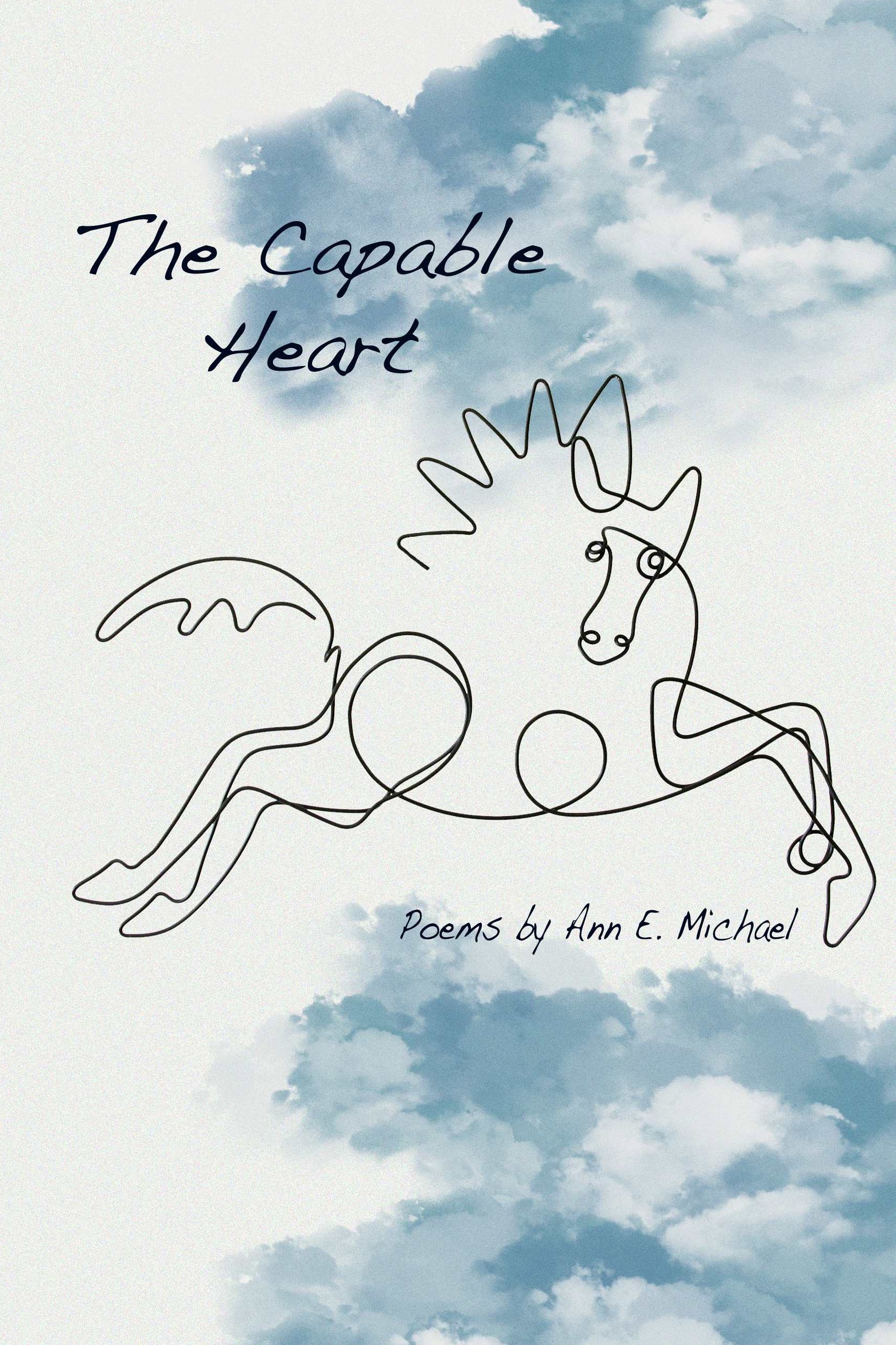
Equine grace, strength, personality did not quite win me over; I’ll never be much of a rider myself. But contending with horses and learning to love and commune with them was good for my child, and reading Kumin’s poems brings back how human animals can have relationships with other animals. I never quite got over horses being an “Other” for me, but observing how my daughter loved being with them inspired me to write quite a few poems of my own [see my chapbook The Capable Heart]. Reading Kumin’s work takes me to a familiar and important place in my own life.

Restorative

I often start a post with a mini-weather report; I guess that’s one way I prepare myself to write, centering myself in the environment I inhabit. Our region received much-needed rain this weekend, but I was out of town–and the weather in Chicago was glorious: cloudless, crisp, mild, a light breeze. Odd, though, how weather conditions can evoke strong memories for me. The amazing clarity of the sky and air reminded me vividly of September 11, 2001, and the two days following it when we had a run of glorious weather and a mood of intense disturbance all around us…and no plane traffic at all. It took a few moments for that recall to settle in, and a few minutes more to let the memory go so I could enjoy the present moment.

~

I was in the Chicago area–Highland Park– for the book launch of The Red Queen Hypothesis. Many thanks to my publisher, Julie Dotson, and the welcoming and supportive group of poets and audience; the reading went well, and we sold some books (always a satisfying thing). I met quite a few interesting people and learned a bit about the city of Highland Park, its relatively long history, its parks, architecture, the storied Ravinia Festival, and how the city’s been coping since the July 4 tragedy last year. Travel always offers perspective. In this case, travel offered community as well: a lively community of people who support the literary arts.

~

I even got to be recorded, with Jennifer Dotson as the interviewer–a first for me. Here’s the link:

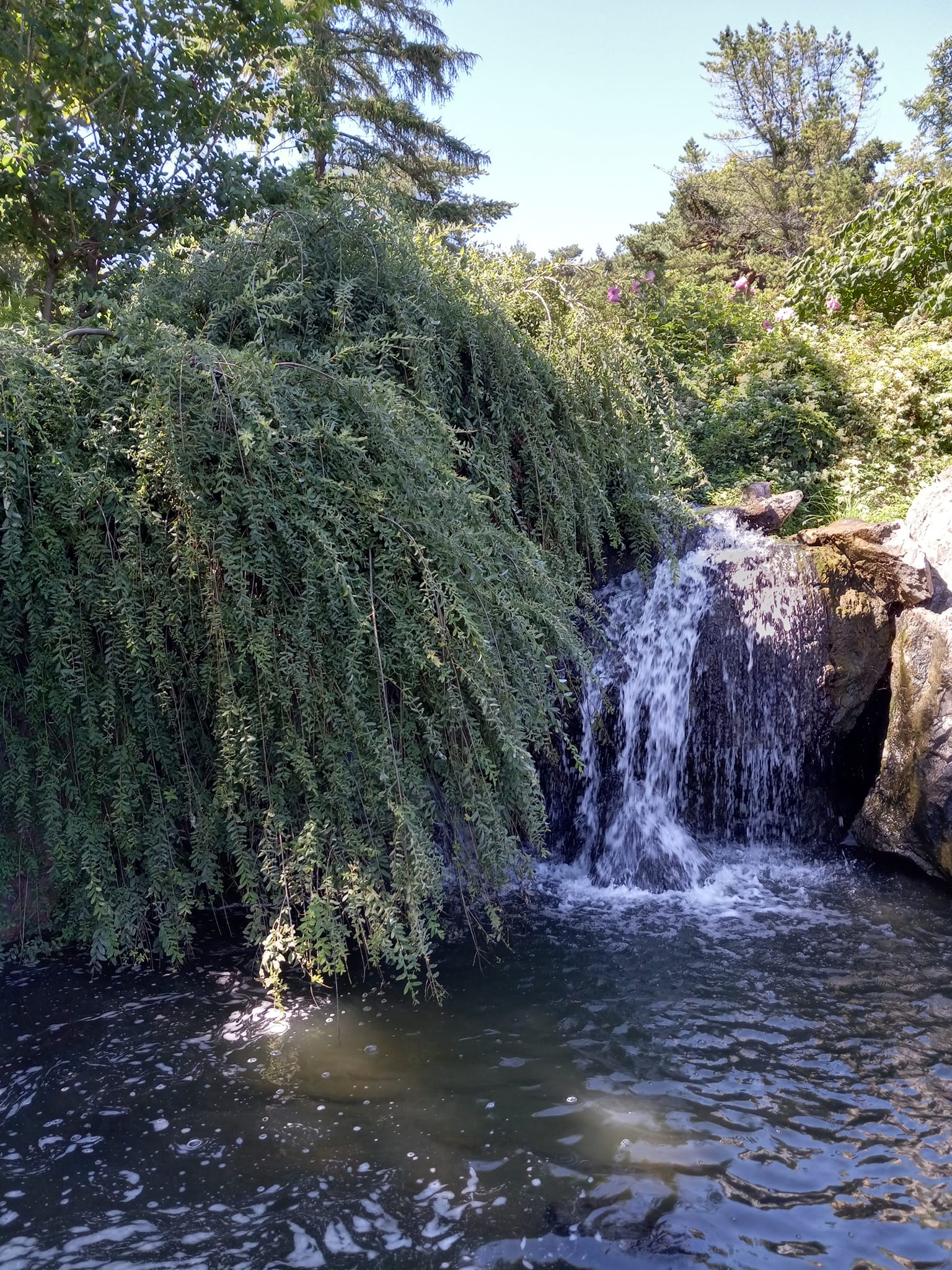
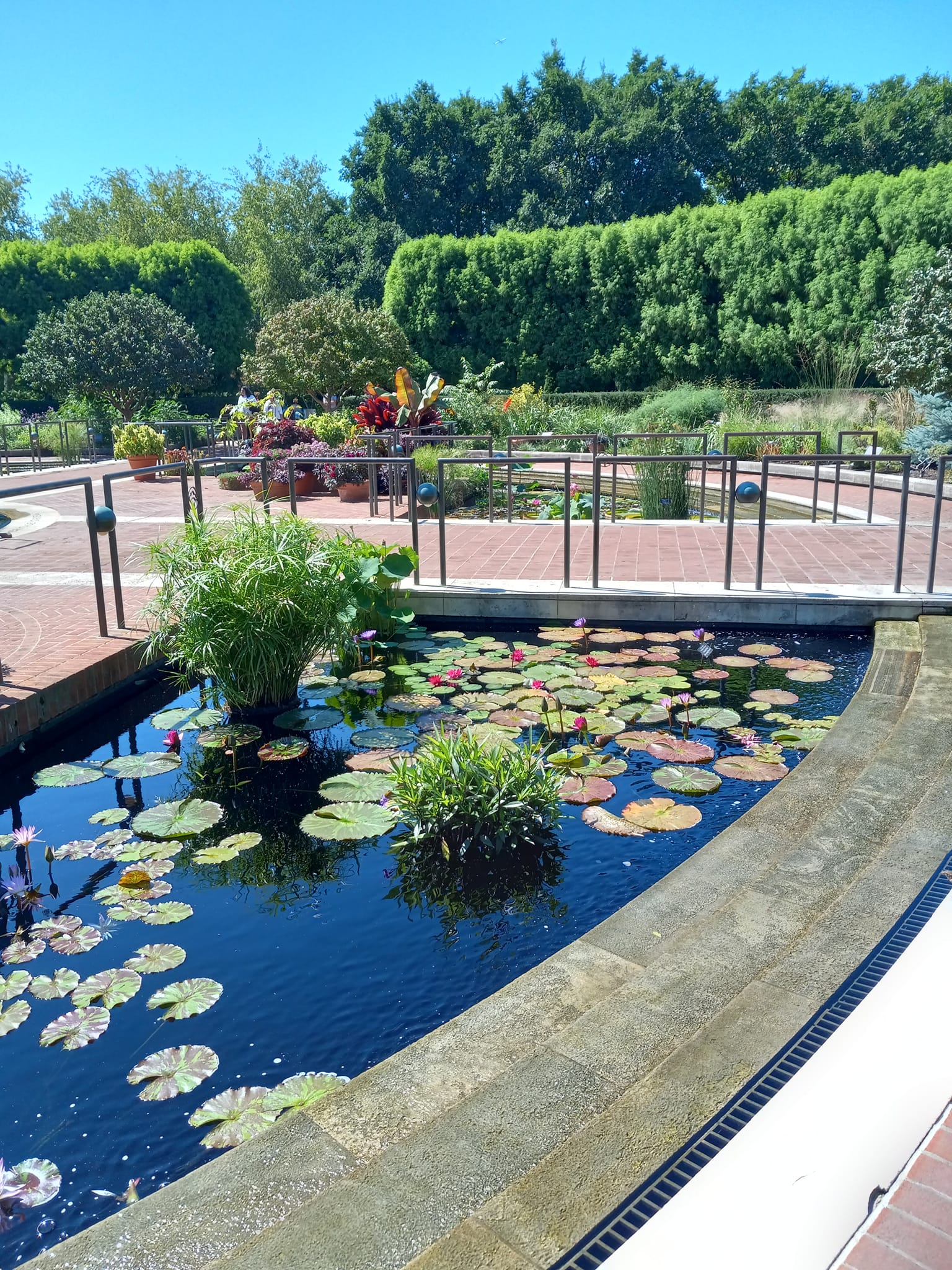
My generous poet-host, Julie Isaacson, knew from my writing and my biography that I would enjoy a walk around the Chicago Botanic Gardens–and she was so right! The gardens offered just the respite I needed after airplane travel. We hadn’t the time to stroll all 280+ acres, but the chance to walk amid trees and beside water in the middle of an urban expanse was genuinely restorative.

Now I am pulling weeds and pruning for the approaching autumn, activities that allow me to settle into myself internally and which sometimes result in poem drafts. Please wish me luck on both endeavors!

Language power

In advance of my reading this weekend, Jennifer Dotson of Highland Park Poetry asked a few questions and created the flyer below. I especially like the last question and have more to say about it below.

~

The graffiti on the NJ and NY Palisades sent a thrill through my childish mind and body. I first recall seeing words spray-painted on the cliffs when I was under age five and barely cognizant of letter forms. The view puzzled and frightened me, partly because of the heights (I was acrophobic from a very early age) and partly because I had no idea what those huge, high-up letters signified. When I got to kindergarten and began deciphering letters, the graffiti confused me because it contained signs that weren’t in the alphabet I was learning at school: Ω, Φ, the scary-looking Ψ; θ, Δ, and Σ, which resembled a capital E but clearly wasn’t. Once I could read and still could not understand them, I asked my father what those letters were and why they were up there on the rocks. They reminded me of the embroidered on some of the altar cloths in church, but I didn’t know what that stood for, either.

Frat boys from the colleges painted their Greek symbols on the rocks long before spray paint was invented, my dad said, possibly as part of hazing rituals. By the time I was a child, the 50s-era “greasers” had begun announcing their love for Nancy or Tina through daring feats of rock and bridge painting; then the graffiti era came into full swing after the mid-sixties, and the process got colorful–the Greek symbols vanished, replaced by “tags.” All of which just reinforces the importance of words in the world.

I will never climb up high to write or declaim my own words, as heights continue to terrify me. But I continue to push ideas, words, arguments, pleas, elegies, and gratitude into the world. Writing is the only way I know how to do that. It’ll have to be enough.

Classification

An admission: I’m barely competent at the promotional aspect of The Writing Life and would prefer to hole up in my house and garden and just… write. But writers need readers, and writers benefit by meeting other writers (and readers); and I’ve always been interested in learning new things, even things that are not particularly fun or that I am not naturally adept at. Such as educational learning management systems (ie, “portals”). Such as recording audiofiles of my poems. Such as contacting potential poetry-reading venues or reviewers. Or coming up with clever ways to let people know about my book.

I got a couple of responses from my initial forays, which is lucky. One of these sent me a sort of writer’s questionnaire about my book, and one of the responses I’m supposed to give is to say how I would classify my latest poetry collection. That got me mulling over the whole idea of categorization, classifying, and stereotypes. Genre–that’s easy. It’s poetry. But the sub-category of this book? uh…

~

At the beach earlier this week, we found a much-broken up rock jetty that teemed with creatures. As I sat back on my heels and peered into the mixture of sand-water-rock-mullosk-kelp, I found myself thinking about Aristotle’s immanent realism (epistemology/natural philosophy), ideas he likely nurtured while examining the tide pools of Lesbos. Or I imagine that he may have done so. We humans observe, and then classify or categorize based upon these observations: similarities, differences, various adaptations–in environment, habit, behavior, construction of the being or entity itself.

I think if I had known as a child and young woman that there was a career path called “a naturalist,” I would have pursued it.

~

Unclassifiable doesn’t strike me as much of a selling point. However, there are always art forms that are, to use a current term, intersectional or interdisciplinary, and creations that repurpose, alter, or reimagine the known or customary into something new and intriguing. Fellow blogger and talented poet and novelist Lesley Wheeler‘s books come to mind, as do works by Anne Carson and books from Coffeehouse Press and Tarpaulin Sky (among others).

My poetry is not experimental nor groundbreaking, though it is a little quirky; so here is my recent attempt to classify The Red Queen Hypothesis and Other Poems:

Touching on a range of topics and employing variety in poetic craft—free verse, metrical verse, rhyme, and classic forms—the poems in The Red Queen Hypothesis play with invention, science, and the environment of the everyday.  One example of these juxtapositions is the title poem: a villanelle, based on an evolutionary theory named for an episode in Alice through the Looking Glass, that sums up the corporate rat race. Sometimes tongue-in-cheek, sometimes disturbing, the poems urge readers to observe and to reconsider what is beautiful.

~

I dunno. Does that seem like a remotely interesting description?

(Really not adept at the promotional biz.)

Aristotle, supposedly.
from https://www.nytimes.com/2016/05/27/world/europe/greece-aristotle-tomb.html