Practice makes poetry

I’ve been challenging myself to write 7-line poems lately. Half-sonnets? Not necessarily. Just an exercise in writing a poem in brief. I have used haiku and tanka as brevity/image exercises in the past, and that work has been helpful. While I seldom write poems that are longer than, say, 30-35 lines, practice with conciseness never hurts, especially when my inclination is to go narrative.

I’m not knocking narrative poetry: I love it. Love reading it, love writing it–especially the lyrical narrative. In addition, I’m a big fan of the discursive and tangential in poems and essays (looking at you, Ross Gay). But one does tend to fall into familiar territory, and it’s useful to push away at what’s easy. That means, every now and again, trying something unusual: persona poem, aphorism poem, Spencerian sonnet, cadralor, surrealism, slant rhyme, golden shovel, or an invention of one’s own…something to freshen up the craft.

Many writers I know rely on prompts for imagery, language use, theme, or topic. For some reason, that sort of prompt seldom gets me really working in a new vein, though I can get a poem draft or two that way. Using a form, trying something new with how the words land on the page, is much harder to do (for me)–and therefore, more useful. I honestly want to feel as though I am working at poetry, doing the good and rewarding sort of work during which I learn new techniques and rediscover how craft can deepen meaning.

Real work takes practice. And real practice doesn’t actually lead to perfection. It leads to new explorations and revelations. There’s my wisdom-for-the-day to poets who are just starting out.

practice doesn’t make perfect…

Throwing mud

This week, I got the potatoes in the ground; last week, it was spinach. In between, a lengthy late-March cold snap and yes, more rain. But also a visit from a Dear One and a trip to parts of Pennsylvania I seldom have had reason to explore. Although I have lived in PA’s Lehigh Valley for nearly 40 years–longer than I have lived anywhere else–I confess a lack of familiarity with many areas of the Keystone State. Philadelphia and its suburbs I know well, and Reading and Lancaster, to a lesser degree; and our family often visits Gettysburg. We travel west and north to go camping now and then. I’ve been to Pittsburgh a few times and seen Falling Water and the Cathedral Trees and both branches of the Susquehanna River. Penn State just twice, once when I was chaperoning high school sophomores to History Day competitions.

Pennsylvania is a big commonwealth: 46,055 sq miles. It’s a good place for poetry, though I leave it to poets such as Harry Humes and Jerry Wemple (among others–looking at you, Dave Bonta) to explore its varied climate, geography, history, and culture. Mostly I stay within the confines of my own back yard, which is large and varied enough to inform me for a lifetime.

But the Dear One had planned to give her dad a pottery workshop with a well-known potter, Simon Leach, as a 70th birthday gift. That birthday fell during covid, however; the long-delayed weekend in Millheim PA thus did not take place until this past week. I have never placed my hands on a potter’s wheel (though I ought to try it sometime) and just went along for family togetherness and to visit the arboretum at Penn State, slightly out of season but still a very pleasant place to walk, by myself, on a cold but sunny Sunday. It rained on Saturday, so I sat by the fireplace at our B&B and read novels. Could anything be more perfect?

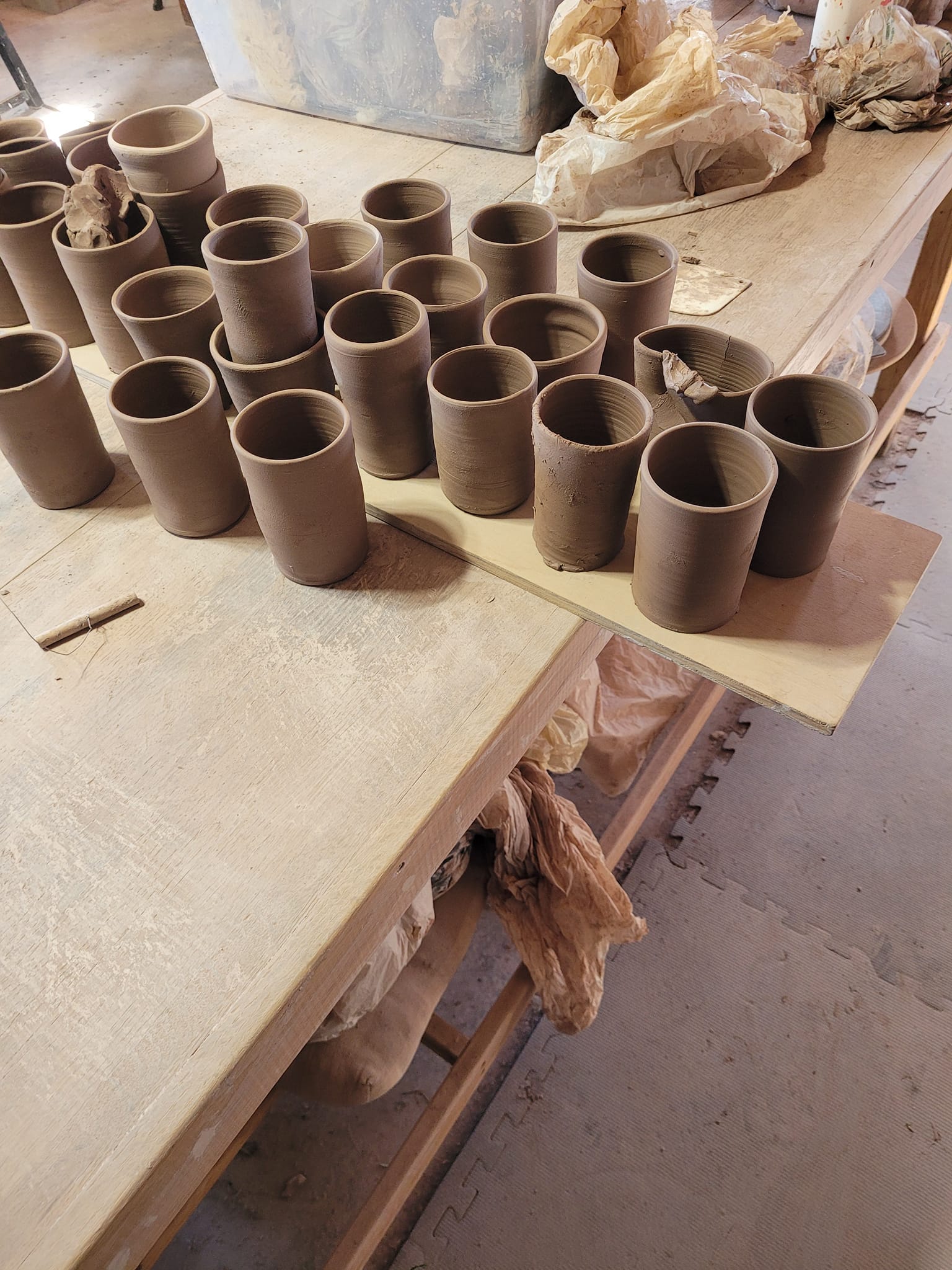
The task of Leach’s workshop was to practice making cylinders. It was a muddy job indeed. Here’s a photo of some of the student results. Dear One is quite adept at cylinders; indeed, she’s a good potter and sells much of her work, a skill she enjoys when she’s not providing emergency medical care to dogs and cats.

Leach uses the slogan “Keep practicing!” Yeah, that’s how you get to Carnegie Hall, right? But it is also how people get better at any skill, even those who are preternaturally talented in music, art, dance, etc. That includes writers. I have to remind myself that it is now time I got back to my routine of writing, revising, and the practice practice practice part of composing poems. The garden, the daughter, the travel, and the novel-reading have been splendid distractions, but as National Poetry Month approaches (April!), I ought to get myself back into routine.

A routine’s generally looked at as mundane–a tedious necessity. It needn’t be that way, I keep reminding myself. It can be as fun and messy and surprising (or frustrating) as throwing mud.

clay cylinder practice in Leach studio

Practice

I have been reading novels, which affects my state of mind, makes me dreamy and distracted, foggy-headed, and full of the conflicts in their plots. Or maybe the weather is what does it–too much lovely late autumn sun and not enough rain, which feels “off” for our region; and once the rain finally arrives, it is a dour and chilly dousing I have to convince myself to feel grateful for. Likely the news cycle has not helped my mood. My nine-year-old self emerges from a distant past, crying, “People are so mean!” My parents can no longer sit down beside me and offer comfort.

Time to switch to the poets. I’m finally getting around to reading Ocean Vuong’s Time Is a Mother, a collection that’s been on my to-read list for far too long. The very first poem, “The Bull,” startled me into reading it twice. “I reached–not the bull–/but the depths. Not an answer but/an entrance the shape of/an animal. Like me.” Enough to jolt me out of my fiction-induced haze, especially on a day like this one when I feel the anxious dreamy child in me more than I wish. The prose poems later in the book intrigue me, as well: a very different prose than is found in most novels.

~

“People are so mean!” –I said that often when I was a child. People were mean to me and mean to each other. The news was full of warfare and protest. Grownups were mean, kids were mean, teachers were mean. I had a few complaints, but I also possessed the clueless narcissism of a child. Needless to say, I was not one of those precocious, old-soul children I sometimes read about in books. My siblings could have pointed out a few examples of my own meanness. And I was too much of a coward to stand up for others who bore even more teasing than I did, or to advocate forcefully to right wrongs. As a result, I always feared that my life has been rife with sins of omission.

I wrote the following poem two years ago. I must have been in a similar frame of mind.

~

In Which I Give Myself a Scolding Concerning Compassion

While pruning the quince with its
	twisted thorny syntax of greenwood
	I reflect on errors, mine,
	in the arena of compassion—
the quality and behavior I value most
	and in which I am deficient.

Empathy I’ve got, but compassion requires
	motivating force toward good
	and needs, in my case, practice.
I haven’t practiced enough. I feel the prick
	of quince or conscience through
	my gloves damp from autumn drizzle, 
disentangle stems’ inventive turns, toss cuttings
	on the ground. I disappoint myself.

Perhaps meditation would avail, yet
	I’m incompetent at meditation
	though my friend in her monastery
	by the frigid bay once told me
everyone is bad at meditation for the first
	ten years or so.

Lopping off twigs and branches I imagine
	her sitting on her cushion while
	icebergs converge in saltwater cove
	a wash of pale gray during the short-day
months while she practices one kind of compassion.

My friend who always stops to help a stranger
	change a tire or rescues a loose dog
	from the side of a highway practices 
another form of compassion.

I lack it—that immediate impulse of outreaching,
	kindness. It strikes me as a flaw, the log
	in my own eye it took me years to see.
	So when the late-season mosquito
lands on my forearm to sup perhaps its last
	nourishment, I refrain from flattening it—

a microscopic act of compassion in a world so needy,
	but perhaps a start.
~


Process parallels

The weather warmed and got windy, and that bodes reasonably well for garden prepping even if the last frost date is still almost a month away. I got digging, sowed more spinach and carrots, cheered on the lettuce sprouts, and–with some help from Best Beloved–pried most of the winter weeds out of the veg patch and set up a raised bed or two.

While I was out there pulling creeping charlie and clover and reviewing my garden plan for this year, it occurred to me that my process in gardening parallels my process in writing. My approach to each has similarities, probably due to my temperament though perhaps due to the way I go about problem solving. The process is part habituation or practice and part experiment, with failure posing challenges I investigate with inquiry, curiosity–rather than ongoing frustration. And sometimes, I just give up and move on without a need to succeed for the sake of winning.

I have no need to develop a new variety of green bean nor to nurture the prize-winning cucumber or dahlia. My yard looks more lived-in than landscaped; on occasion, we’ve managed to really spruce the place up, but it never stays that way for long. I admire gorgeous, showy gardens but am just as happy to have to crawl under a tree to find spring beauties, mayapples, efts, rabbit nests, mushrooms. My perennials and my veg patch grow from years of experimentation: half-price columbines that looked as though they might never recover, clumps of irises from friends’ gardens, heirloom varieties I start from seed. The failures are many, but I learn from them. Mostly I learn what won’t grow here without special tending I haven’t energy to expend, or I learn which things deer, rabbits, groundhogs, and squirrels eat and decide how or whether to balance my yearning for food or flora with the creatures that live here and the weather I can’t control. There are a few things I’ve learned to grow reliably and with confidence–ah, the standbys! But the others are so interesting, I keep trying.

Writing poems? Kind of similar. After so many years of working on free-verse lyrical narrative, I feel confident in my control of those poems and can usually tell when they’re not operating the way I want them to. Then I wait and revise and rethink, but there’s a familiarity to the process. Whereas I am far less confident with sonnets–nonetheless, sometimes a poem really works best in a form like that. So I know I have to expend more energy on it. Other times I find myself needing to experiment. I try mimicking another poem, tearing apart my line breaks, or revising in a form I barely know. I play with puns or alliteration, alter punctuation to stir up the rhythm or surprise the reader (or myself). Breaking my habitual approach to starting or revising a poem leads to curious results, sometimes intriguing ones.

But, like my garden ambitions, my writing ambitions exist more as a means to learn and experiment. I do not set out to produce the decade’s best poem or to develop a unique style or form that academics will admire and study. (I just made myself chuckle.) Heck, most of my work has not yet seen print–and with good reason. Not every rose is an RHS Garden Merit award winner.

For now, here’s a poem I wrote over a decade ago, one that will be appearing in a forthcoming chapbook. More on that when I know more myself.

~

STILL LIFE WITH WOMAN

Loose sleeve envelopes her brown hand
which rests upon an apple or a secret 
cupped beneath; only the stem shows,
fruit’s oblate body intimated by
the solidity of her skin against
the table’s plane.
This is a moment undiscovered,
a painting by Vermeer—
blue, white, quince-yellow, poised—
her palpably-dimpled wrist sloping
toward the precise, thumbnail shadows of
her relaxed fingers. We know
blood imperceptibly alters the shape of her veins
every second her heart beats, we know her womb
continues its cyclical pulse, that she inhales
and exhales, a living form, yet—
still: an inclination of the white, loose sleeve,
half an eye open, she covers some promise.
This is only one second before
surprise or boredom, a miniature:
one of those moments we find ourselves
in parity with every other thing,
equal in being to quince, fan, mirror,
that pitcher of water on the sideboard,
that window, full of light.

~

Revision practice

It is National Poetry Month again, and this year, in recognition of the celebration, I have started a practice to experiment with, just out of curiosity and to give myself a nudge. Many of my poetry colleagues invest a month in writing a poem a day or reading a poetry book each week or posting a poem daily on their social media platforms. It’s important to remind ourselves why we treasure and delight in poetry.

I chose a simple project that requires frequent re-imagining/re-imaging. For my starting point, I picked a poem at random from a collection of Fernando Pessoa’s work. I copied the poem, by hand, into my journal and re-read it a few times. Then I turned the page and rewrote it, “revising” it in the way I might revise a poem of my own. My plan is to repeat this process after a day or so, each time revising from the most recent version. In a short time, the poem will have moved away from being Pessoa’s piece–perhaps bearing little to no resemblance to the original…a sort of whisper-down-the-lane approach. The intention is to consciously alter image and voice in each re-imagining of the draft, though I’m not sure how well I can hew to my intentions. We shall see.

from City Lights Books.

Why I decided on Pessoa for this project, I don’t really know; but I think there’s something perfect about using one of his pieces as springboard. Because Pessoa was kind of a springboard for himself–he created several writer-selves who wrote poems and critical prose: heteronyms, he termed them. The poem I used was “by” his persona named Ricardo Reis. Adam Kirsch wrote a good introduction to Pessoa’s peculiar obsession with being a non-person in a 2017 New Yorker article. By revising something by Pessoa in my own voice and through my own images, perhaps I nurture his pursuit of dissolving the self.

It occurs to me now that the poems of several contemporary writers may have induced me to try this writing prompt, most recently Daisy Fried in The Year the City Emptied (which I highly recommend). Her collection consists of “loose translations” of Baudelaire, reimagined in Philadelphia during the covid outbreak while her husband was dying. It’s not a cheerful read–but then, neither is Baudelaire–nevertheless, the resulting poems are powerful and vividly interesting.

So, back to my little project for April: I figure this need not be a daily practice, though I have managed to get to revision three by now–so it is moving apace. The deepest challenge is not the revision, as I enjoy revising and wish I had more time and energy for it. The challenge is just that: time and energy! As the semester sidles past mid-terms into the final stretch, I get busier at work; in addition, my chronic health conditions have moved into a frustrating flare lately, leaving me fatigued and feeling as though my brain were swaddled in cottonwool and embroidery floss. The news from Ukraine drags on sadly in the background of my day-to-day. My mother’s aphasia worsens. I am dealing by plodding away, sometimes without much brilliance, at the revision challenge. Also by watching the goldfinches as they molt into their yellow plumage… and urging my tomato seedlings to flourish in their little indoor pots.

Then I pluck daffodils and set them in vases. There’s nothing like fresh flowers on the dining table to cheer a low mood. Onward to revision four…

~

daffodil photo Ann E. Michael

Practice

When students struggle, I nod as kindly as I can. Do they need to know they’re not alone? Seven billion of us, each with struggles of our own. It takes practice, I tell them, and practice takes time. But persistent patience isn’t common among young folk, who seek strategies, shortcuts, miracles.

They yearn to know what I know so easily, are astonished that words and thoughts can spool smoothly–they think so, bless them–as though there were dictionaries and references in my mind. If they would believe me when I say: it’s possible to learn–

They never realize I haven’t always been old or knowledgeable, that practice continues and, dear students, so does struggle.

We can practice that, too.

~

You noisy jays!
scattering
       the mourning doves

Practicing

When I was 15 years old and learning to type on my dad’s old manual typewriter, I decided to write my memories; I was composing memoir before I knew what memoir was, under the influence of fiction (David Copperfield). I lost track long ago of where those pages are, but I do recall that I wrote page after page. What on earth would an adolescent who was raised in loving and non-traumatic circumstances in a middle-class New Jersey suburb have had to say that was worth recording?

I wrote about losing a toy bear, and learning to read; receiving second-hand books with joy, reading voraciously, wondering what it would be like to be an orphan, and feeling terrified of dying. I wrote about the attic of our old house and learning to ride a bicycle. There were other things, too, that I can’t remember now. Generally, mundane and typical 1960s-childhood events–and descriptions galore. It felt important to write down the small details.

Perhaps I should have gone into journalism.

These days I’ve no interest in writing memoir. I have kept a journal since I was ten years old, and that constitutes enough self-indulgent scribbling on its own. I treasure, however, the practice all that writing gave me: practice in constructing sentences, employing vocabulary words, creating metaphors, using punctuation in various ways, expressing abstract ideas and describing concrete objects. Writing, learning to write, critique, and revision have been immensely valuable to me.

I’m not sure who I would be if I hadn’t been constantly writing (and reading). Maybe I’d have been a contemplative.

~~

All of which is to report to my readers, who may be experiencing their own obstacles to their art, that –yes– the writing continues in the face of loss and grief, anxiety, and the work of the body in the world, in the mundane spaces of daily grind and in the wakeful hours, and in the containers of dreamwork and consciousness. Right now, the writing is not “good,” not crafted, aware of itself, ready to speak to others than the self. It is, at present, more akin to what the Buddhists call practice.

Photo by Donald Macauley on Flickr | https://tricy.cl/2DSmsmY

~

Keep working, keep practicing, keep breathing.

Epistle as writing practice

I am often asked by my peers why “young people” do not come to college with exemplary writing skills. Because I feel protective of my students, I wish to defend them–not always an easy task. My first response is that they have not had enough practice in writing to develop adequate fluency, and I generally follow that by admitting that many of my students have never really read books for leisure or out of passionate interest and that they are quite adept at other forms of communication (social media, looking at you!). Last year, I decided to spend one class period on epistolary writing. I recognized that one way I developed confidence in expressive writing was by writing letters. Lots of them. Every week to my parents, almost as often to my sister, to my best friends, to sweethearts, grandparents, anyone I cared about. Probably 30 years of letters, which later morphed into lengthy emails as the technology developed. Letters. Who writes them any more? Certainly not today’s college freshmen, if my students offer any objective measurement of their generation. The epistolary mode offers students a chance to exercise the use of second-person as a governing pronoun, a style that formal academic writing shies away from except in certain forms of persuasive writing–the opinion column, for example. Teaching my students NOT to employ “you” is such a constant effort that I thought letting them write letters would give them a much-needed break from prescribed academic conventions and allow them to loosen up their sentences a bit. Before I assigned in-class letter-writing, I asked whether any of them ever writes letters. Not one hand went up. I withdrew from my tote bag a clutch of old correspondence (yes, of course I would be that person who keeps the letters people write to me). After flourishing an envelope–with a 29-cent stamp–I disclosed the contents, a ten-page, handwritten letter from a dear friend. The students audibly gasped. “How long did that take to write?” “Did you read all of that?” Sure! When long-distance phone calls were expensive, letters were social media. We couldn’t just snapchat a photo of ourselves standing on a pile of snow and caption it “Snow!” We’d have to send a photo. Or we’d have to describe without the visual–and this is a practice my students have almost never had to employ. Lack of informal writing practice translates into lack of writing practice, period. I even read passages from three letters aloud, and the students were impressed with the vivid writing…writing by “non-writers.” “You could write like this, too,” I told them. “You just haven’t needed to do it, and therefore you think you can’t do it.” Then I asked them to think of a person, a specific person, and come up with a reason or purpose to write to that person, and then just write. The response was amazing. Some of these students wrote more in 15 minutes than they ever have for an in-class assignment. Most of them enjoyed it! One student even said that “this old style of long form texting intrigues me” and plans to start writing letters to a sibling once a week. Success! ~ Letter Writers Alliance is an informal site promoting the hand-written, postal-mail delivered epistolary correspondence. Members can sign up to find a pen pal or just browse the site for stationery, pens, letter-writing tips, etc.