Source material

Creative writers are often asked where they get their ideas from. In my own case, the answer to that varies a great deal. Sometimes ideas arise from personal experience, of course, but one’s life offers only so much material if you are a relatively staid person like me. Topics for poems can arise from recent headlines or from histories, written or oral; from conversations overheard in a grocery line; from stories other people tell me; from folk tales; from science books; from dreams; from works of art, and numerous other sources. It’s this wide array of possibilities that make the concept of the creative-writing prompt so popular. A quick Google search for “creative writing prompts” offered well over 20+ pages of entries, in several languages.

Photo by Pixabay on Pexels.com

I have written pieces based upon prompts, especially when in a workshop or class, or when I feel rather tapped out of my own imaginative source material. I’m especially fond of writing that stems from viewing or experiencing a work of art–sculpture, painting, musical composition, dance, installation art (ekphrastic poems). Generally speaking, though, that’s not from whence my poems originate.

I can’t really say why I feel an urge to put down in writing specific reflections about something that’s caught my attention–or even what sort of experience evokes my response. Maybe I feel intrigued by an image, a detail, or an ambiguity–a question arises in my mind that I tussle with for awhile. Then, I may compose a draft and let it sit. Two days. Two years. Longer. Lately I’ve been revising some old poems and have realized I no longer recall what their incipience was. Which can be a good thing, because I am no longer wedded to the “reason” I wrote them and can instead consider whether they can be crafted into decent poems.

I am also working on a manuscript that I let sit for at least six years. An idea got into my mind after reading Robert Burton’s 17th-century book on depression, The Anatomy of Melancholy, quite some time ago (2017, perhaps?). I took a stab at writing what seemed to be evolving into a historical fiction story, which is not my usual approach (I have zero practice at plot and dialogue). Then, I stopped. As one does. But the topic lodged in me somewhere, I suppose, and early this year I returned to it. What if, I wondered, the draft could be restructured into a series of prose poems? There might be a sort of hybrid novella-poem in the earlier draft.

That’s more or less what I’m developing, at least for now, and we’ll see what if anything emerges. It’s keeping me interested, which I like, and the experiment feels fresh compared with “writing what I know,” or writing “how” I know. Because yes, of course we ought to write what we know; but we also know about human beings, and we have imaginations, and anything is possible.

By Robert Burton – Burton’s Anatomy of Melancholy, 1628, in the British Library, Public Domain, https://commons.wikimedia.org/w/index.php?curid=84390857

Breathe

2024 closed with “thundersnow” in my neck of the woods, a weather phenomenon that I find rather thrilling in its strangeness. And the year commenced with the conflagrations in California, not to mention everything else that goes on daily in the cosmos. Oh, the difficulties of life in interesting times.

Photo by Sabian Symbols on Pexels.com

It so happens that I had made plans, and purchased plane tickets, to visit my son in Los Angeles during the week that AWP is holding its annual conference there, in March–that is, assuming the situation in Los Angeles County doesn’t get even worse and assuming his apartment building survives the fires; it hasn’t been easy to keep myself from doom-scrolling and watching updated fire maps. I remind myself that there is not a thing I can do beyond sending money to charities and such, perhaps, and waiting for the winds to change, and that making myself stressed will actually do harm. But I am not one of those Pollyanna types (now termed a “toxic positivity” person, I have recently learned). I’m aware that the world can be hard, and that we may suffer. So, as my yoga and tai chi instructors would tell me:

Breathe.

There’s no point in trying to decide whether this start to the year is auspicious or inauspicious, though if I’m going to go with signs and auguries, I might choose to follow the Chinese year and move my year’s start to January 29, Year of the Wood Snake–and get all this awful stuff (including January 20th) packed into LAST year.

As I noted in my year-end post, a year’s end–or beginning–is arbitrary.

~

As for writing-related resolutions, I make them all the time, not just at the beginning of the year. But in that one respect, the first dozen days of January are going surprisingly well. I’ve been spending more time on revising older–sometimes much older–work, and I have been drafting some new poems. I even submitted just a few things to lit journals and have been making minor progress in the monumental task of culling and organizing my writing files.

Best of all, I enrolled in an online poetry workshop with Anita Skeen through the Friends of Theodore Roethke Foundation, which starts this week. And I registered for an art class in February, so my plans to focus more on my creative work post-retirement are proceeding more or less apace. We balance fear and misery with art.

~

Cloud sketch in acrylics

Year-end with raven

Last day of the year. Though when the year ends or begins is an arbitrary thing, calendars being a human invention so far as we know, this is my culture’s end date for the approximately 365-day cycle Earth makes around the sun–so I may as well stick with it. Here’s what the close of the year has brought me so far:

A sunny and mild morning post-frost, not uncommon at this time of year.

A Cooper’s hawk calling, hassling the songbirds, as they do. This one’s been hanging about our yard for a week now, sometimes perching right next to the leafless shrubs–it is amazing to watch how they can maneuver through the branches to grab at a finch or sparrow. A lithe and handsome raptor.

A solo Northern mockingbird, boldly eying me as I stood watching it (six feet away) while it gobbled up oriental bittersweet berries.

This surprised-looking tree, framed by horizontal branches–

Mutual disturbance among me and the mourning doves huddled on the ground amid the hedgerow’s vines and leaf-rot. Their sudden flurry startled me as much as I startled them.

Walking along with my Merlin Bird App turned to “sound identification,” I expected to hear the usual characters this time of year: finches, song sparrow, field sparrow, mourning doves, bluejays, crows, starlings, nuthatches, chickadees. Then I heard what sounded like…a raven? Indeed! The app noted “Common Raven,” with the little icon that indicates the bird is a vagrant or may be misidentified. I watched it fly north, over the house. Solo, (whereas early in my walk there was an entire “murder” of crows and they tend to hang about in groups this time of year). This bird was also very large, but too far off to see its beak or the color of its eyes. However, it sounded exactly like the third call recording here. I’m gonna call it a raven.

I found some collages the environment made on its own, much more lively and well-composed than any collage I might try to make.

~

The inner environment today has been focused on yet more revision. I much prefer it to sending poems to journals. It’s playful and creative, if occasionally irritating when a poem refuses my attempted improvements. At present I’m wrestling with a sonnet. Not a bad way to end the year, I reckon.

Whatever works

My last post (here) generated some intriguing feedback and was cause for further reflection about revisions, at least on my part. Because I was writing a poem for a specific person–my son–I got useful information from his response, as well as responses from other readers; so I had the chance to hear back from my audience, however small, and to compare reactions. My son, the “you” in the poem, told me he liked the descriptions and that the piece did a good job evoking the atmosphere of the experience he’d had. He liked the closing lines, too. However, he said that while he had some moments of anxiety during his stint on the military ship, his overwhelming feelings cantered more toward frustration and an almost-constant irritation. He thought I had focused over-much on the anxiety aspect. “Though a person certainly could be feeling exactly that way in those conditions,” he added.

And that’s fascinating, because in earlier drafts I did not work toward evoking anxiety; I was trying to get the details right and to create a sense of annoyance, even anger, at the situation. (Apparently, that is closer to how he responded.) Here’s the “BUT”–but those revisions weren’t making the poem work any better. This is a challenge for many of us writers: when the impetus for writing the poem, and the initial intentions of the writer, don’t resolve into a good poem…and then some alterations–some “fictionalization”–make a better poem, but maybe not the poem the poet set out to write. Do we stay with our initial idea and keep whaling away to make it work as we initially imagined, or do we let the poem move into new territory somewhat removed from initial inspiration if the resultant revisions are more powerful, more believable?

I’m inclined to go with whatever works to make a stronger poem, most of the time. There are other options, though. Sometimes I end up with two or more poems stemming from the same initial idea. A bonus! One prompt I have occasionally used for myself is to re-write an earlier, less-satisfactory poem from a different viewpoint or to focus on a different aspect of the experience. This practice has been awfully helpful, and it keeps me from getting over-invested in the more obscure, personal components of a writing piece.

Photo by Leon Ardho on Pexels.com

Strengthening one’s work takes practice, and possibly a kind of discipline–not to suggest that I am a very disciplined poet, although I wish I were. I do take my practice seriously, though, and revision is a major aspect of my practice, always has been, even when I was a “baby poet” starting out. I never could quite agree with Ginsberg’s famous “first thought best thought,” since my first thoughts are seldom deep, reflective, or in any way excellent; and my first words set on paper are generally equally weak. For me, writing is thinking, in the way of E. M. Forster’s famous quote “How do I know what I think until I see what I say?” Thinking is often flawed, so analysis and critique and revision? They’re required.

Finally, whatever makes the poem better as a poem is worth doing. That’s my opinion: whatever works.

Revising for the personal

I’ve been working on the poem below for 11 months now, and the process has made me think about the purpose(s) of revision, the why of why artists and writers do it. In the case of this poem, I’m revising for entirely personal reasons. My revisions have little to do with creating a stand-out poem that strangers will read and appreciate; I want to tell a particular story about someone I love in a way that might demonstrate, to that person, compassion and some understanding of his feelings. I believe this is a valid purpose for making art, even if it is subjectively personal–ie, not “universal,” not groundbreaking, not timeless.

Certainly, the classic lyric poem, and many narrative lyrical poems, often are addressed to a particular someone. It seems to me that the classic lyrical poem is less based in context, however, and can therefore be read, aesthetically, as more universal. The narrative poem by nature relates its story in a time or place, using contextual descriptions that can become obscure in different eras or locations.

Such is the poem below; it may benefit from some backstory, which I will supply afterward. But read the poem first and maybe let me know if I’m correct. Maybe it will “work” for other readers, maybe not; but it is something I have been wanting to write for my son for awhile now. And he “gets it,” so my purpose has been achieved. 🙂

~

In the Warship’s Belly

How you hated those five days in harbor,
amid steel and cable, fearful each minute but
constrained from showing it.

You prefer to see shoreline and sky.
Discomfort pervaded every hour you spent
on board, walking through hazards,

noting construction, rewiring, repairs;
how you hated the low-ceilinged passages
through which you half-crawled,

wearing neoprene-soled boots and a hard
hat, as anxiety, hyper-alert, worked its
wormy way through your body.

There were power outages that canceled
light completely for unexpected
seconds deep below decks,

then generators’ earthquake roars would
rumble and shake so every wall threatened,
sparks lit up and light returned—

your breath rapid and near wheezing,
tremulous, you inhaled the stale, acrid
diesel-fumed air pushed by industrial fans

through that beast’s belly, that machine
of men’s work, war’s work. Built to threaten
and combat, it felt nothing like a boat, nothing

like the small wooden dinghy of your heart
that sailed the cove, with your little sister,
one summer years ago.
~

Context: When my son was employed doing navigational software de-bugging for a US Navy contractor, the job required a week on board a military ship that was being retrofitted and overhauled in drydock. The assignment took place during covid. He hated almost every minute of the experience and left the job soon after the on-board stint. Due to non-disclosure agreements and national security stuff, he couldn’t really tell us much about why he was so miserable; but he described the circumstances and gave us some idea of how anxiety-producing the tasks were, given the environment and his temperament (which does lean toward the anxious). He was a grown man and quite responsible for himself, so this poem is really about my feelings for him. When those we love are going through unpleasant things, we feel for them.

And here is the dinghy, though it is technically a pram–poetic license.

Persistence & belief

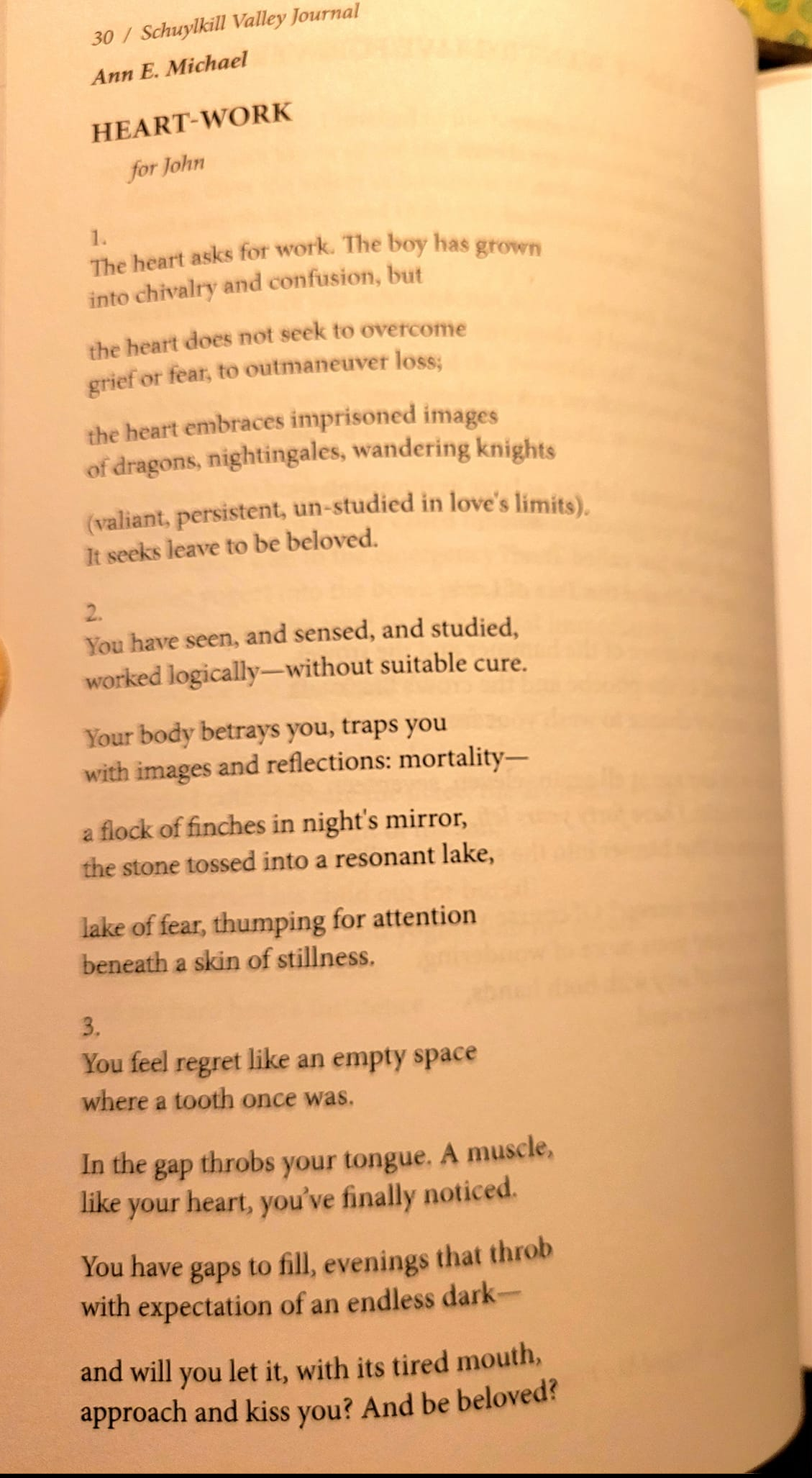
I wrote a poem for my brother 25 years ago or more, when he was in his early 30s and having mysterious and frightening cardiac issues. He was working on geological and wetlands surveys for the county and feeling fairly uncertain about his career, as often occurs when one is in early mid-life. My initial drafts included a quote from a Rilke poem and some geological terminology. That poem draft, as a whole, didn’t quite “work,” however. I gnawed on it for well over a year, tweaking and revising. I showed it to Ariel Dawson, a friend (alas, now gone) whose critique and suggestions I respected. She gave me some ideas for revision and told me she thought this was a poem with real possibility. I just hadn’t quite gotten to the final possibility yet. She told me it was a poem I should believe in, keep working on.

Some years later, after a major reworking, I sent it out. Several times. No one accepted it; a couple of years later, I realized where it was in need of a change. Tried that. It felt better to me. But no one accepted it for publication. Fast-forward about 18 years, and I made yet another change in the poem. I thought maybe it was still worth submitting to journals. Nope. But, last year, reassessing some older work, I came across this poem and thought it was actually a pretty good poem, worth sending out a few more times. One might say I believed in the poem.

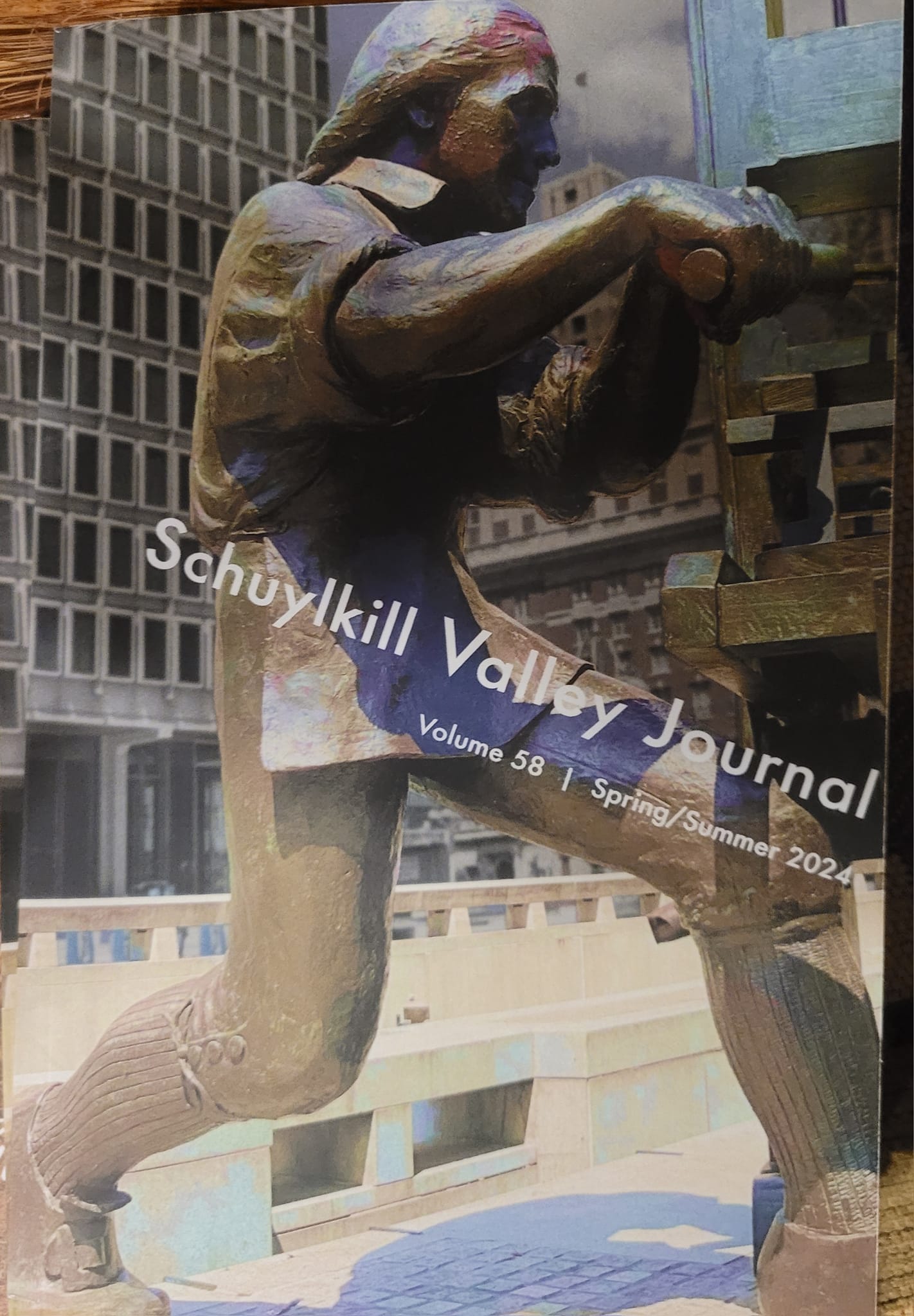
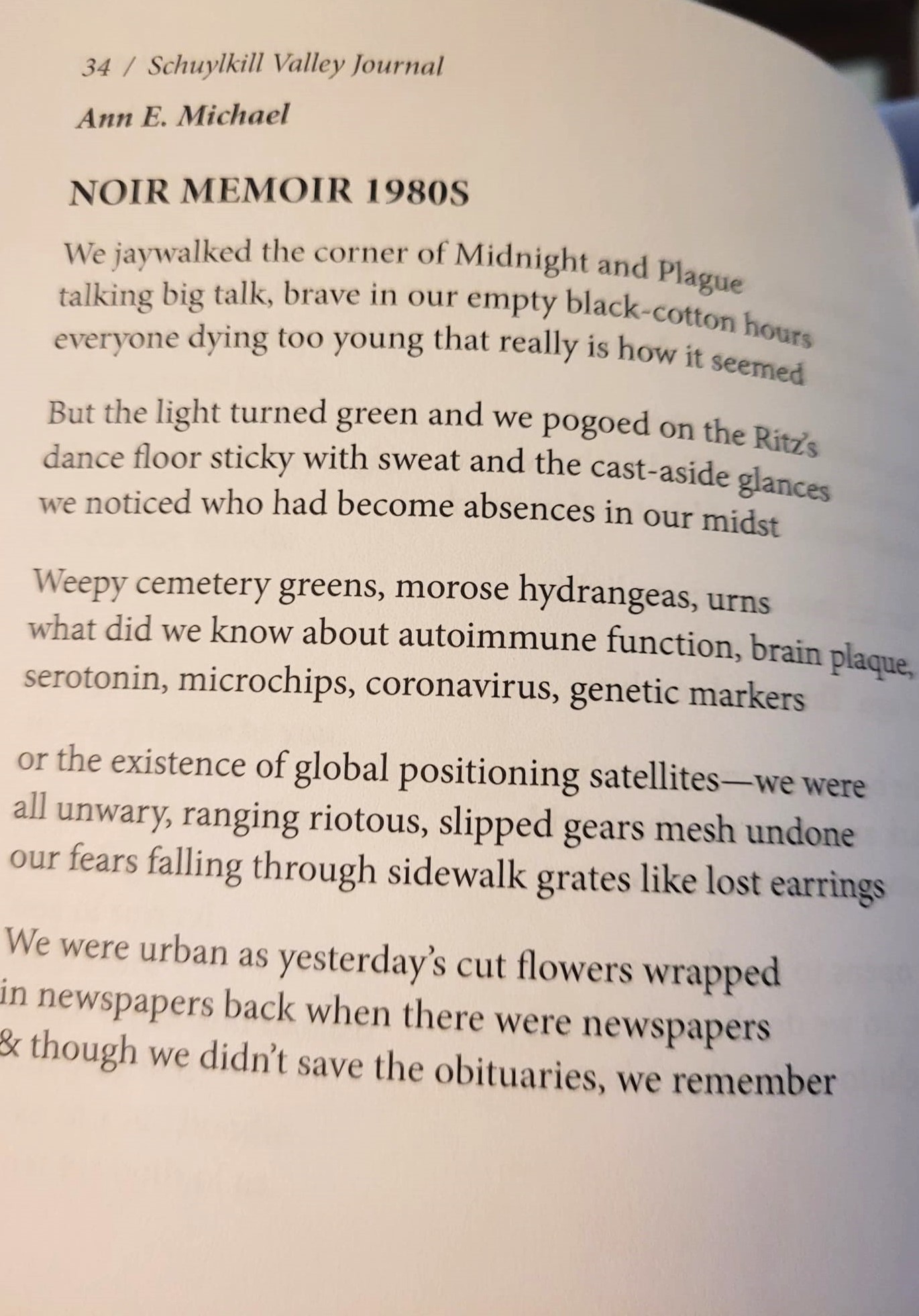
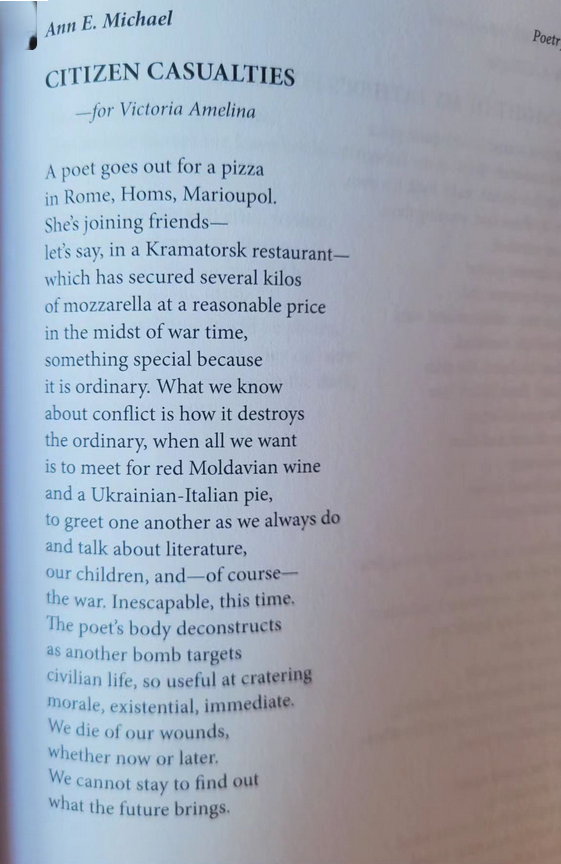
This post is to say: Be persistent, writers, and do believe in your work! Because Jane Edna Mohler at Schuylkill Valley Journal chose “Heart-Work” and two of my other poems for the issue that just came out in print (and I do love print journals!). [Purchase the issue by clicking here]

That poem found its way into print 25 years after I first drafted it.

Something equally as nice occurred when I received the print copy in my mailbox. Peter Krok, the long-time editor in chief at SVJ (since 1990) and a long-time colleague-in-poetry, sent along a lovely note in which he praised Jane Edna’s editorial sensibilities and then kindly said he felt that my poem “Heart-Work” was exceptional. How frequently does that happen? Not often, I can promise you–although I suspect such comments are more likely from small independent journal editors and presses. Those lovely people are involved in the arts for the love of poetry and the humanities. When they find time, they can be marvelously encouraging. Let us thank them personally and to the world!

~

Useful avoidance

Trapped inside with the air conditioner on for over a week, I sat by my bookshelves going through the poetry books in my library. I’m re-reading, assessing which books I truly want to keep because I turn to them often or learn something each time I read them, which books I keep for sentimental reasons (maybe I know the author personally), which ones to keep because they are signed copies, which ones are long out of print and I would never be able to replace them. Some of them remind me strongly of places or eras in my life: I bought this one in a small bookshop in Grand Rapids MI, or this one at Barnes & Noble when it was just one store on a NYC street corner, or these at the storied and much-mourned Gotham Book Mart or St. Mark’s Bookshop. What are good reasons to keep books when I really have to downsize? It’s not an easy task, and the first of many in the process of getting rid of stuff so my kids won’t be stuck doing it. Besides, I enjoy re-reading these books. My children are not as enthusiastic about poetry as I am, so it makes sense that someone who loves the works on the shelves be the one who makes such decisions. It feels good to be surrounded by the words of wonderful writers when the outdoors is brutally hot and humid, and every joint in my body aches.

Surrounding myself with other people’s books also acted as one more way of avoiding my own creative work. Sometimes, though, waiting around and doing nothing on a project ends up bringing clarification or new ideas. It can prove useful. I have been stalled on my in-progress manuscript, so a month or so back I asked someone to take a look at it–and then I got caught up in doing other things. Like getting cataract surgery and having covid, and then it was gardening in full swing under sweltering weather, and then the bookshelves… I wasn’t exactly procrastinating, but neither was I actively working on, or even thinking about, the collection.

Acquired when I was much younger, and cool bookshops abounded.

And one night recently–during a much-needed rainstorm–I got a brainstorm! I realized I was trying to pack too many topics into what really should be a manuscript more closely focused on how people who love one another vary in their relationships to old age and death, and on how the contemporary social and medical aspects of the aging process pull us in uncomfortable directions, often distancing us from those relationships. So yes, there should be family poems, hospice poems, biblically-influenced poems, and dealing-with-everyday observation poems. Also some poems of hope and love, poems reminding me (and readers) of the need for compassion in all dealings. But the draft had 92 poems in it, far too many; and some were there just because I like them or they’d been published in a good journal. Which are actually not good enough reasons to include a poem in a collection, according to most of the editors I know.

I am back to thinking about the manuscript and digging up potatoes–a nice crop this year–instead of culling the poetry books because, thank goodness, the heat wave’s subsided a bit. But in the process of this non-routine summer I have allowed numerous weeds to flourish and set seed; all the more work for NEXT year’s gardening, but it’s been too hot to deal with said interlopers. I like to believe the weeds and I are reaching a sort of understanding, but it is not really a compromise. All the concessions have been on my part. [Note: weeding a personal library is less physically taxing but not really any easier.]

Vision/revision

Although the word “vision” derives from the Latin visionem, it first appeared in English with the definition of things seen in the mind or via the supernatural. Vision as simply the sense of sight is a later meaning (late 15th c.), and vision referring to foresight dates only to 100 years ago [see https://www.etymonline.com/word/vision#etymonline_v_7835]. The cliché “a vision of loveliness” provides an example of the early, 13th century meaning, as does the phrase “visions of sugarplums.” Poets have long been known for writing about, or being under the influence of, such vision.

When the first flush of poetic vision inspires work that later needs some adjustment, writers turn to revision. According to Etymology Online, revision’s history in English first showed up as a noun in the 1610s: “act of looking over again, re-examination and correction,” from French révision, from Late Latin revisionem (nominative revisio) “a seeing again” … the meaning “that which is revised, a product of revision” is from 1845.” This noun, and its verb form (the act/work/verb-sense of revising), keep me occupied a good bit of the time, especially lately while I’m trying to catch up with a large backlog–20 years of poetry drafts.

And then there’s this: https://www.hopkinsmedicine.org/health/conditions-and-diseases/cataracts#vm_A_20f6f6e1… blurred vision, leading to eye strain, drier eyes, halos around lights at night, trouble reading street signs. Yes, time to get a cataract evaluation, suggests my optometrist. “It’s our legacy,” my brother says, because our dad and most of his siblings got cataracts before age 70; Dad was only 48.

Efforts to correct cataracts apparently date as far back as 600 BCE in India, reports the American Academy of Ophthalmology, but the “father of modern cataract extraction surgery” was Jacques Daviel in 1747; since then, the surgery’s come a long way. I’m not worried about having it done and actually rather eager to see better and not need glasses all the time, though it could be over a year before that happens. In the meantime, the symptoms are irritating but not too significant. I can read books (and drafts of poems) just fine. I just might want to avoid driving in the dark, rainy nights of midwinter.

Johns Hopkins Medicine

Anticipating removal of the thickening, cloudy lens that blurs my visual outlook offers a metaphor for the revision process in my writing. Observation, reflection, critical analysis, problem-solving, intervention, re-envisioning, repair. And perhaps: clarity, if I’m lucky.

Other forms of gleaning

Of the many tasks that lie before me as I work toward restructuring my routine, the past drafts pile must be the most engaging long-term project. Other kinds of odd jobs can be done in brief segments; it doesn’t take more than half an hour to clean out a drawer or closet, throw laundry in the washing machine, or cut back the ornamental grass for the season. Even a big job, like uncluttering the attic, can be done bit by bit once we get the motivation. Those tasks don’t require much critical thinking, no analysis beyond “Do I need this anymore? Can I get rid of it? Can I consolidate it with other items of its kind? What will take this stain off?”

While I can’t say I love organizing and clearing out stuff, it is not really taxing work. Just tedious.

Sorting through the drafts pile isn’t tedious, but it’s monumental and a bit intimidating. The pile of poems dates back as far as 2001 and is made up of probably two reams of paper. It includes hundreds of fairly terrible poems and, if I am lucky, maybe 80-100 poems that have the potential to be meaningful, beautiful, or at least not embarrassingly bad. This pile’s the result of 20 years of procrastination, lack of time, lack of motivation, and generalized disorganization. I admit it! Now I must roll up the proverbial shirtsleeves and get to work: work which requires analysis, criticism, revision, sorting, culling, and–that precious commodity–time. I find I’m unable to accomplish much if I attempt the work in small bits, (though I do break it up into sections, more or less). If I don’t spend at least two hours at a go, I get distracted and indecisive. I read each draft carefully, several times, to assess.

So we’re looking at weeks and weeks here. Maybe months and months, though I hope not.

The way I choose to understand the process is as a type of gleaning and sifting. I’ve got the harvest in–a big pile of poem drafts, maybe ur-poems, maybe seeds of poems, maybe crap. My efforts help me to decide which ideas are interesting, even if the poems themselves are not pulling the weight of an intriguing possibility; which lines and images are worthwhile, even if they don’t operate too well in their current context; which pieces suffer from thoughtless lineation, weird syntax, clunky form, form that doesn’t suit the content, and the like; which poems are far too wordy or else missing vital words for clarity; and which poems are basically not worth putting any effort into because: Boring! Obscure! Derivative! Sentimental! Awkward! Meh! What was I thinking?!

And then, every once in awhile, I find a poem I like and had forgotten about, one that only needs a bit of appropriate tweaking. Eureka moments while wading through my own creative work.

Yes, I should have been doing this sort of gleaning and sifting all along, the way I did when I was first starting out as a poet, 45 years ago. It probably would have made things easier. I notice myself noticing myself, though…noticing my changes as a writer, my little obsessions and my past enthusiasms glimmering in the work, noticing the different ways I have approached Big Themes and smaller ones. There may be something useful in that offshoot of my major poetry drafts excavation. Who can tell?

~

The Gleaners, Jean-François Millet, 1857; image, Los Angeles County Museum of Art

Language power

In advance of my reading this weekend, Jennifer Dotson of Highland Park Poetry asked a few questions and created the flyer below. I especially like the last question and have more to say about it below.

~

The graffiti on the NJ and NY Palisades sent a thrill through my childish mind and body. I first recall seeing words spray-painted on the cliffs when I was under age five and barely cognizant of letter forms. The view puzzled and frightened me, partly because of the heights (I was acrophobic from a very early age) and partly because I had no idea what those huge, high-up letters signified. When I got to kindergarten and began deciphering letters, the graffiti confused me because it contained signs that weren’t in the alphabet I was learning at school: Ω, Φ, the scary-looking Ψ; θ, Δ, and Σ, which resembled a capital E but clearly wasn’t. Once I could read and still could not understand them, I asked my father what those letters were and why they were up there on the rocks. They reminded me of the embroidered on some of the altar cloths in church, but I didn’t know what that stood for, either.

Frat boys from the colleges painted their Greek symbols on the rocks long before spray paint was invented, my dad said, possibly as part of hazing rituals. By the time I was a child, the 50s-era “greasers” had begun announcing their love for Nancy or Tina through daring feats of rock and bridge painting; then the graffiti era came into full swing after the mid-sixties, and the process got colorful–the Greek symbols vanished, replaced by “tags.” All of which just reinforces the importance of words in the world.

I will never climb up high to write or declaim my own words, as heights continue to terrify me. But I continue to push ideas, words, arguments, pleas, elegies, and gratitude into the world. Writing is the only way I know how to do that. It’ll have to be enough.