Perfumes and tunes

This time of year, certain blooms and fragrances evoke my childhood memories. I spent most of my childhood and all of my adolescence in southern New Jersey, along the Delaware Bay; the swampy coastal plains have now largely burgeoned into suburban housing developments, but in the late 1960s there were actual townships with old-fashioned suburbs–the kind with sidewalks–and many a privet hedge that bloomed in early June with small, white spires that gave off a faint scent. In overgrown areas of meadow and scrub, the sweet smell of Japanese honeysuckle perfumed muggy evenings. And while I don’t recall much scent from the mimosa trees in bloom on Harvey Avenue, once those fallen pink blossoms began to rot on the sidewalk, they added a distinct punk that meant summertime. The honeysuckle is blooming here now, making me wonder about the neuroscience behind the sense of smell. Gotta check out these books, perhaps: Kiser reviews four recent books on olfaction.

On a side note, none of these evocative plants are native to the Americas: Ligustrum vulgare, Lonicera japonica, Albizia julibrissin–and yet I associate them with South Jersey. It is almost like a refrain in my memory-mind.

To speak of associations reminds me of Alexis de Tocqueville. I’ll post a quote of his below, one that makes me think of language and poetry and science. But back to refrains:

Musical refrains also run through my brain, evoking memories and nostalgia, or just being irritating “earworms.” At any given time such tunes may include Tchaikovsky’s Serenade for Strings, strains from a late Haydn quartet, one of many Springsteen songs, Marvin Gaye’s version of “I Heard It Through the Grapevine,” or–most confounding of all–the Chock-full-o’Nuts jingle from the 1960s or some similar commercial sloganeering. Why such things wear a familiar groove in the gray matter I don’t know, though Oliver Sacks’ book on music (Musicophilia) and Daniel Levitin’s This Is Your Brain on Music offer some insights, and I’m thinking of reading this one by Samuel Markind when it comes out later this year.

Alas, I’m not gardening because once again the garden is awash in mud, so I entertain myself with endeavoring to discover how/why my brain works (and yours, and anyone else’s), since that’s one of my favorite lines of inquiry when I can’t work outside. I will take a sodden walk later and dwell on possibilities while enjoying the scent of the invasives; I’ll work on some poetry revisions; maybe I’ll listen to music…and freely associate with any and all possibilities. Here, as promised, Alexis de Tocqueville:

“When citizens can associate only in certain cases, they regard association as a rare and singular process, and they hardly think of it.

When you allow them to associate freely in everything, they end up seeing in association the universal and, so to speak, unique means that men can use to attain the various ends that they propose. Each new need immediately awakens the idea of association. The art of association then becomes, as I said above, the mother science; everyone studies it and applies it.”

Honeysuckle photo by Nadiye dabau015fu0131 on Pexels.com

Just reading

Sunday evening, my weeding stirred up so much dust and chaff that I needed to wear a bandanna around my nose and mouth. A continuous late-summer drought. There are still tomatoes and basil, sunflowers and zinnias, but the avian migration has been going on for some weeks and the days are getting shorter. Just after equinox, three weeks without rain; at last the sky clouds over and drops a little moisture on the parched soil. Yellow leaves sift onto the lawn. Small flocks of robins rejoice in the softer top layer of dirt, pull at grubs and worms, then fly off.

~

The rain’s necessary, and I’m grateful. Rainy days, however, take issue with my body–or, probably, the other way around. The need to take NSAIDs and rest offers the opportunity for just reading. This isn’t a bad thing, especially as I had Richard Powers’ novel The Gold Bug Variations to hand. It’s a tour de force of pattern, structure, code-breaking, DNA-building, relationships, love, chemistry, music, art, literature, and much more. I love the references (the narrator is a reference librarian), the minutia, history, alliteration, lists, compilations*, the whole thread of the novel’s dramatic arc, its relationship (mathematically, metaphorically, structurally) to music and the work of the gene-sequencing science. The book tells the parallel stories of couples who fall in love 25 years apart, the coincidences and randomness, the patterns that may not be patterns. I’m thoroughly wowed by an author who puts so much research into his writing and makes everything fit somehow.

Powers must have been about 33 when he completed this novel. I can’t imagine being so wise about human behavior and so informed about the sciences and music theory at that young age. Well, for one, I’m not as brilliant as he is; and two, I was raising toddlers when I was 33, which is a science unto itself and as revelatory as any book I could have been reading or writing in early mid-life.

But I digress. This book interests me on so many levels that I’ll be thinking about it for weeks. I may have to re-read it, take notes next time. I kept wanting to underline passages–it’s a library book, and marginalia is a no-no. I can imagine reading it again to the strains of the Goldberg Variations–indeed, I read a few chapters to said accompaniment this time. This is not a swift and easy read: it took me awhile to feel warmed up about the narrator, though she’s funny and smart. By the end, I loved her like a friend.

Honestly, novels seldom get me this excited or inspired. I’m glad I had a crappy day so I could justify lying around and “just reading.” As if “just reading” is not a worthwhile endeavor. The weeds can wait.

~

* re compilations: a word Powers employs often in this novel is the neologism/computer programming term “kludge.” I wasn’t familiar with it. But it’s a terrific word! https://www.etymonline.com/search?q=kludge

Physics, poetry, notes

In a discussion among some of my poetry-reading friends, two readers said they feel “stopped” when they encounter unfamiliar words or terms in a poem. They feel poets should avoid writing work that uses specialized knowledge as metaphor, in imagery, or to establish the poem’s context. Their argument is that when a reader feels stopped by anything in the poem–from an unusual line break or stanza structure to an unfamiliar word–a kind of alienation occurs between reader and text, and that when poets choose to employ the unfamiliar they need to explain somehow/somewhere (notes? prose headings?) to guide the reader. But then they added that referring to notes is, in poetry, distracting.

“Some vocabulary and allusions just make me feel inferior,” one friend says. I don’t think they’ve spent much time with Ezra Pound’s later work but imagine this statement by Sam O’Dell applies: “Now, whether or not Ezra Pound intended to make others feel less intelligent while pulling obscure outside references into his poems and essays is up for debate. The guy seems the type who may have enjoyed making sure others knew he was smarter than they were.” (Read the rest here).

Nerdy autodidact that I am, I rather like those stop-the-reader moments in poems–if there’s a payoff. If I learn something new, and if that thing I have learned enriches the poem’s meaning and also enriches me, then I don’t mind feeling surprised or puzzled or even interrupted. Some poems take more work to read than others, and that’s ok. Some novels prove less easy to read than others, and some movies make the audience-experience fraught, unnerving, or strange. For me, the essential work that artistic endeavor does is open new perspectives, present puzzles, invite inquiry. Make me curious!

Example: Recently I re-encountered the work of poet Daniel Tobin, whose collection From Nothing speculatively examines the life–the interior, intellectual, and spiritual life–of the Belgian priest and cosmological physicist Georges Lemaître. In the process, this series of poems covers war, genocide, the atomic bomb, physics. I haven’t read anything by Tobin since his book The Narrows (2005), and the Lemaître poems take considerably more work to comprehend. That work on the part of the reader is rewarded, I should add, especially a reader with more than a passing interest in cosmology and the cosmos itself. A reader who doesn’t mind a bit of theology or physics or history and quite lengthy notes at the end of the book, and who will actually read said notes. And then refer to her books on the expanding universe theory and Hubble Effect and look up more about Lemaître. [That reader would be me; but Tobin has many readers with all kinds of interests and expectations about poetry.]

In Tobin’s lovely poem “(Origin),” I found the word marver, and while looking up the definition learned that when molten glass is poured onto a slab for cooling, the process is called gathering the glass–and I love that use of the word gather. Maybe it will make its way into one of my poems someday. Even if it does not, I feel happier knowing that little fact.

But most of From Nothing contains allusions to cosmology, to Einstein and Planck, to World War II and conflicts of many other kinds, internal as well as external. I kept being wowed by Tobin’s research into Lemaître and by the poet’s imagination as he plumbs his subject’s complicated world of math, motion, and a conceptual physical universe that could also have room for God. I mostly remembered his earlier work that was so tightly crafted, often rhyming (or employing surprising and delightful assonance). In this collection, I didn’t notice the craft aspect until I went back and did some re-reading. I was too caught up in the complexities of physics and the momentum of the subject’s life-as-scientist/life-as-priest. The lines each have six strong beats, the stanzas are tercets, and there are eight stanzas in each poem. There’s more to the craft than that, but what I like is that–unlike some of Tobin’s earlier work–the craft takes a backseat to the narrative (though I think that’s also true in The Narrows, to some extent.)

Maybe this “difficult” book appeals to me because I like difficult books. Maybe it appeals because it reminds me of my father, a person invested in the world of reason and fascinated by science…who yet believed there can be faith, that god exists. Here’s an excerpt of Tobin’s “(Cinema)”:

You, who chose two ways equally at once, circuit 
the conferences, meetings fueled by enigma, mixing 
with the eminent and their sidereal regard,   

your morning Masses before library and lab.

~

My dad was not a Catholic, but the balance between faith and reason was one he wrestled with, too.


Evolution

Evolution

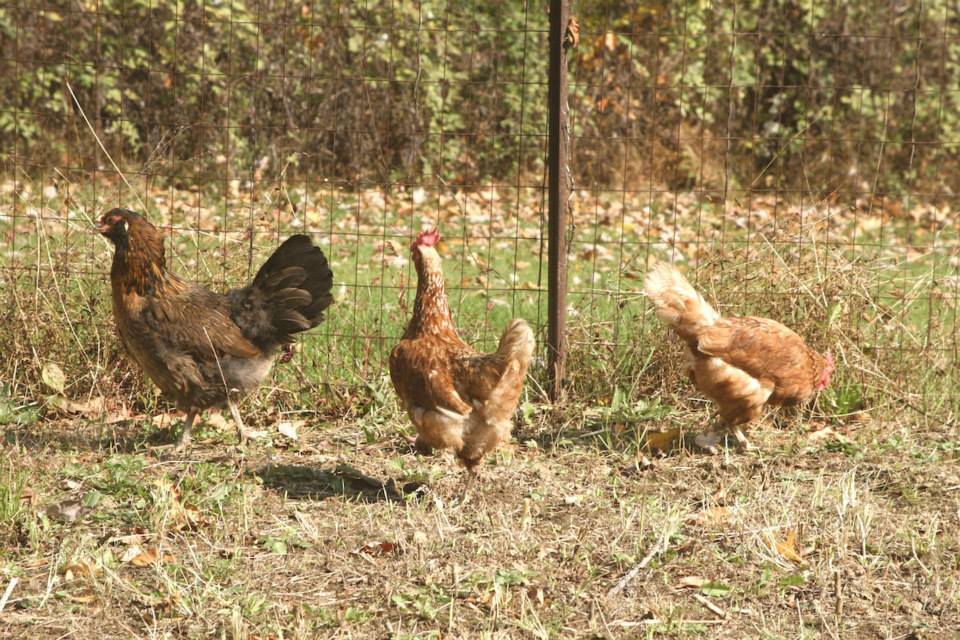
The chickens mill and scratch;
what do they know of their theropod ancestry,
how many millennia it took
to evolve a brain, without neocortex,
capable of amodal completion
immediately upon hatching, a brain
that supplies all they need for survival
until the hatchet, predatory snag, parasite, virus?
Hens in the garden stride through scythed weeds,
make an unhurried ambit of the dead
and dying remainders—
Stumps of stalks, twisted beige grasses
the color of birds’ tail and breast feathers,
brown-speckled hens, rumps dun, red combs.
They cluster in a fence corner,
step on each other’s heads,
snap up bees and beetles during autumn’s
short-limbed days. The clawed foot
extends, grasps, clings to roost.
A Jurassic hinge, rusting, its vitality immured
in the muttered musing of hens.
Dry leaves, blooms gone to seed.
How the mighty have fallen.

~

This is an older poem, going back at least ten years. It seemed suitable for the end of autumn and the looming solstice today. I love that I could use the terms amodal and neocortex in a poem. That kind of poetic vocabulary isn’t everybody’s “jam,” but the thwarted scientist in me enjoys playing around with this sort of fact-meets-art interdisciplinary terminology. And yes, there’s an opportunity for metaphor here, in the virus and in the chances evolution randomly develops as to who’s on top or who thinks they are on top. A lesson for us all.

Marvelous anomalies

“Human consciousness has at least as great an impact on the planet as any force of nature, yet its existence is in doubt because science does not know how to describe it.” —Marilynne Robinson

~

One of the things I most enjoy when reading Marilynne Robinson’s essays is her earnest yet delighted devotion to the preciousness of being a human on the Earth. “The sheer plenitude of things a mortal encounters is a marvel in itself,” she writes, and her prose illustrates how all that she encounters deserves attention and compassion. Humanity, in particular, is a marvelous anomaly (“What a piece of work…”) which she lovingly defends while noting our “propensity to error” leads us into great evils but also to the kind of wide-latitude indeterminancy within which “we construct our minds and our civilizations.”

With clear logic and complex ideas and sentences, Robinson dismantles the logic that dehumanizes us. She demonstrates “that much influential thought is fundamentally incoherent” (this thought includes philosophy, psychology, and scientific theory) but nonetheless informs our norms, our behaviors, the tenor of our beliefs and our entire lives. Too often we are reflexive rather than reflective. Too often we dismiss feelings as irrational, when they originate in our bodies and minds and often work to alter what we regard as facts, thus biasing our perspectives. Emotions are part of our beings as humans. So are questions, especially the unanswerable questions.

Robinson says science “exploits accidents and relishes surprise”–something that poetry does, too (my aside, not hers, though I doubt she would disagree). But scientific method does not “provide an all-sufficient test for the reality of everything.” By implication, the biblical texts and so-called creation myths offer people a method of grasping the awesome that science cannot answer for and may never yield to, as each marvel reveals new mysteries and new questions.

We cannot say that the stars were arrayed to instruct us in the glory of God, to dispose our minds to wonder, to make us feel our finitude within an order of Being for which millennia are more transient than breath. This, for all we know, is the accidental consequence of the accidental emergence of the constellations, the fortuitous interaction of our unfathomable brains and senses with dazzling reality…We must step back and acknowledge that any accounts of the initial moments that make the event seem straightforward and comprehensible are deeply wrong. Nothing else could be true, considering what it has yielded.

I have not mentioned the words theology or philosophy in conjunction with Robinson, because so many readers would be less inclined to read her work. She’s not afraid to use those words and to examine, often rigorously, what they have meant to societies. Don’t be put off. In the final chapter of her book What Are We Doing Here?, Robinson writes about slander. It’s a short essay I wish all of us would read and think about, especially relevant to our current moment.


“Syntax” by Steve Tobin. Copper, bronze.

Cosmogenic questioning & play

“We may note in passing that the cosmogenic question as to how the world came about is one of the prime pre-occupations of the human mind…a large part of the questions put by a six-year-old are actually of a cosmogenic nature, as for instance: What makes water run? Where does the wind come from? What is dead?” (Johan Huizinga, Homo Ludens, p. 107)

We have, for many such questions, science-as-answer; but scientific answers do not always satisfy the ontological inquiry of the child. I recall hearing adult answers to my own questions–similar to these–and feeling that I was now supposed to consider the matter closed, the problem solved.

But it wasn’t. Not to my mind. I just was not able to express my dissatisfaction in a way that grownups would understand, and perhaps they would have been unable to respond to me at any rate. It was so frustrating, the problem of communicating perspective.

Rather like a riddle.

Which is what Huizinga gets to in this book: riddles, games, play, and how these activities grow into and perhaps structure (or underpin) culture. If humans are the story-telling animal, it’s also possible we are the questioning animal, that play turns into contest through the practice of making riddles.

Creating our own problems, as it were. “Just throwing that out there,” as a friend of mind says when playing Devils’ advocate. (Note in that common phrase: “playing…”) (See the etymology, literally “thing put forward,” below!)

We question origins, and we pose problematic questions–and we do these things as soon as we can speak!

πρόβλημα

Online Etymology Dictionary says: late 14c., “a difficult question proposed for solution,” from Old French problème (14c.) and directly from Latin problema, from Greek problema “a task, that which is proposed, a question;” also “anything projecting, headland, promontory; fence, barrier;” also “a problem in geometry,” literally “thing put forward,” from proballein “propose,” from pro “forward” (from PIE root *per- (1) “forward”) + ballein “to throw” (from PIE root *gwele- “to throw, reach”)…Meaning “a difficulty” is mid-15c. Mathematical sense is from 1560s in English.

Philosophy, Huizinga posits–and religion–developed out of this human need to structure language into language games, to pose problems, thus creating space for wordplay and riddle or secret-knowledge contests. *

Poetry soon grabbed onto wordplay because poetry has a way of taking on all of culture, incorporating and resisting social norms and practices, reflecting society back to itself, asking cosmogenic and problematic questions. Indeed, do a brief scan of anthropology or history and it’s easy to find cultures in which poetry features in the games of noblemen and warriors and gods. (See Huizinga’s book, which enumerates many).

Also, wordplay, puns, connotations and allusions are fun.

This weekend, I want to get back to playing with words.words-from-letters-magnetic-poetry-kit-geek-words-letters-for-refrigerators-words-with-letters-maker


~ ~ ~

* ie, Descartes, boy, did he have problems! Both mathematical and mind-body problems, though he was better at the former. (Sorry for the silliness).


Weight of words

Words are making the news again–this time, the list of seven words that the Centers for Disease Control has been told may make the Center’s research proposals less likely to be approved by the government’s budgeting agencies and which should be avoided in reports to Congress.

Futurism and The Washington Post reported on the purported ban, and a CDC official responded to clarify that the words’ negative connotations were discussed as “part of a suggestion to use words and phrases that ‘might be more likely to win support for the CDC’s budget in the current Congress.’ The idea is that favorable word choice could help ease the budget’s passage through Congress.” Watch your words, scientists!

Words matter. Anyone who has ever written a grant proposal has first of all to learn the appropriate jargon and phrases that the funders expect. Job applicants need to suss out the keywords that a potential employer has submitted to its application software.

~

Then there are euphemisms–a pernicious variety of jargon that obscures, elides, or otherwise weakens meaning--misleading, mostly, euphemisms take the punch out of a sentence. I heard just this morning the term “fatals” in the description of a train accident: “There were three fatals and numerous injuries we haven’t yet accounted for,” said a safety official. Fatals used in this way is a “functional shift” (see Oxford blog). The adjective has become a noun, and the noun has become a euphemism for “deaths.”

Officials may rationalize that language used this way softens the blow somehow. I see it as another method of obfuscating fact and in particular, minimizing or hiding death. Deaths are too real, too weighty; the fact of death is a thing we would rather deny. Just as we might deny that there are vulnerable populations in our citizenry. Or that the scientific method requires evidence.

For some poetry that responds to the use of words, check the cdcpoems blog here.  And Paul E. Nelson’s poem in Rattle, here.


Self as social

I’m an introvert. I need and, indeed, quite enjoy people–but in small groups and short doses. Much as I love you, I may still need to retire alone with a book or journal or a long walk in the meadow by myself to re-charge my energies, which are low enough to begin with these days.

card_one_hedgehog2

Potter’s curled-tight hedgehog, my animal totem

I think of that as alone with my Self. But recent reading along neurological, evolutionary, and psychological lines has me questioning this Self that seems to own its singular consciousness, and makes me consider the self-less consciousness of, say, Zen Buddhism.

~


From Carl Zimmer’s book Soul Made Flesh:


Finding the mechanisms of consciousness will not mean we lack a true self. It’s just that this self looks less and less like what most of us picture in our heads–an autonomous, unchanging being that has a will all its own, that is the sole, conscious source of our actions, and that distinguishes humans from animals. All animals probably create some kind of representation of their bodies in their brains, and humans simply create a particularly complicated model…

The human self did not reach this complicated state on its own. Thought is more like a node in the social network of our species…The human brain can make a series of unconscious judgments about people…in a fraction of a second. In recent years, neuroscientists have been mapping our the networks that make this social intelligence possible, and one of their most astonishing discoveries is that a picture of the brain thinking about others is not all that different from a picture of the brain thinking about oneself. Some neuroscientists think the best explanation for this overlap is that early hominids were able to understand others before they could understand themselves.      [italics mine]

In the foregoing passage, Zimmer cites Damasio, M. D. Lieberman, and an academic-philosophical article by Endel Tulving (2001) titled “Episodic Memory and Common Sense: How Far Apart?” that basically shows how little we can depend upon our own memories as “fact” and how deeply we engage in forms of storytelling to connect our memory episodes. It is possible that our general knowledge of things-as-they-are (including the behavior and “minds” of other beings) evolved before our ability to recall episodes of experience. Tulving writes:

…when we wonder which came first, episodic memory (experiences) or semantic memory (facts), common sense tells us that the answer is episodic memory. Information gets into semantic memory “through” episodic memory: First an individual has a particular experience in the course of which he, say, learns a new fact, and later on he can use the knowledge thus acquired independently of any remembering of the original learning episode as such.

This is what many experts in the area of memory have believed (and many still do) ever since the distinction between episodic and semantic memory was drawn. The careful reader of papers in this issue will be able to spot statements to this effect in various chapters. Nevertheless, although the jury is still out on this question, and although the final answer may turn out to be of a kind that almost always is reached at the end of debates (“well, it all depends”), I believe that the correct view is the reverse of common sense: information gets into episodic memory through semantic [general knowledge] memory.

He closes with the observation that “evolution is an exceedingly clever tinkerer who can make its creatures perform spectacular feats without necessarily endowing them with sophisticated powers of conscious awareness.” Darwin would not disagree.

Now to mull over the idea that my self is part of a wide-ranging network of human relationships, and hence not so entirely my “own.” Ha–I find myself of two minds (or more!) on this one.  😀

Science & philosophy

The small, religiously-affiliated university at which I work graduates, percentage-wise, a large number of baccalaureates in the sciences although it offers a liberal arts-based core curriculum. How does that affect what coursework students must do? For starters, two Theology courses and one Philosophy course are required for graduation.

Three critical-thinking method, scholarly courses ought not to be more than a student in the sciences–or any other discipline–can handle; but I hear a bit of resentment among the undergrads. They question the necessity of abstract ethics classwork, wondering how such material will be applicable to a fast-paced, technologically-advanced, science-oriented career or life. Philosophy doesn’t seem to be a skill set to them.

SocratesWhile I fundamentally disagree, I take their point. With so much new information coming at them, info-savvy young people might well feel skeptical about what they can gain from reading texts by Plato, Aristotle, Augustine, or Aquinas.

Philosophy has been around for millennia, though; empirical science as we know it–with electron microscopes, satellite-mounted telescopes, petri dishes and x-rays–is brand-spanking new by comparison. The techniques we use today seem concrete and tool-like rather than theoretical; yet as every real scientist knows, the only way developments occur is through hypothesis–theory–claim–assertion–question–pushing the envelope of the known.

Which is what philosophers have been doing for thousands of years.

The budding scientists and medical-studies researchers I encounter seldom realize that without philosophy, science would not exist. Philosophers asked the “why” questions, came up with theories and categories, tried to see into a future that might someday have the technology to confirm or refute the theories they came to solely through human observation and deduction. Problem-solving skills. They were the scientists of their day, and the methods of thinking they came up with are those that contemporary scientists in all disciplines continue to employ.

http://www.isys.ucl.ac.be/descartes/images/Descartes.gif Descartes

Descartes, 1640s

A wonderful book on the way philosophy developed into biology (to take just one of the scientific disciplines) is Marjorie Grene and David Depew’s The Philosophy of Biology: An Episodic History.

The authors–a philosophy professor and a rhetoric professor–provide a history lesson in science, taking us by steps and by leaps into the development of a scientific (empirical) skill set as derived from insightful cognitive understandings of those Dead White Guys on whose thinking Western philosophy is based.

finch beaks

Darwin’s finches, 1840s

Now, I am not an advocate for a strict return to the Western Civ canon; I think university education should diversify into exploring (and questioning) other modes of cognition, culture, and philosophical approaches. Yet it seems to me imperative that students continue to study, and learn to value, the history of human thought. You can be a nurse without a thorough background in Aristotle’s categorical concepts; you can learn the drill about washing hands, donning gloves, and inserting catheters–all practical, concrete skills. You can understand the rationale for all of those skills; that’s true, and practical.

beautifulbrain01-1080x1373

Cajal’s drawing of a pyramidal neural cell, 1913

Nurses today, however, should have the thinking skills to solve unexpected problems rapidly and rationally, which is how things play out “in real life,” to deduce that something’s going wrong even when the readouts look stable, to recognize that the hurried intern added an extra zero to the number of milligrams of medicine prescribed. They need enough background in the history of medical care-giving to question a doctor or administrator when the ethics of a patient’s care seem to be at risk. These problem-solving skills are not only crucial, they are philosophically-based.

~


I will dismount from my high horse now. With all the disorienting information being bombarded at me these days, I need a poem to reorient myself. Here’s one by Mary Oliver.

Snowy Egret (by Mary Oliver)

A late summer night and the snowy egret
has come again to the shallows in front of my house

as he has for forty years.
Don’t think he is a casual part of my life,

that white stroke in the dark.

==

We shake with joy, we shake with grief.
What a time they have, these two
housed as they are in the same body.


Coincidence & synthesis

I adore random synthesis. I love how coincident information, ideas, and experiences connect to enrich my understanding or pique my interest.

Today, a friend sent me a link to a chapter from the Dalai Lama’s book and another friend sent me to New York Magazine‘s Science of Us blog to read Cody Delistraty’s piece on the neurology of poetry reading. Meanwhile, I have been cleaning my bookshelves and reading Jane Hirshfield’s Ten Windows.

books1Delistraty’s essay reports on a study (in Germany) conducted by Eugen Wassiliwizky, a researcher at the Max Planck Institute for Empirical Aesthetics, on what happens in the human brain when people read or hear poetry. The Institute has sponsored quite a few studies on the neurological responses to the arts, which offers researchers not just the findings from one area of aesthetics but the opportunity to compare responses across artistic disciplines.
For example:

…[Neurological] responses… seemed to be unique to poetry: Scans taken during the study showed that listening to the poems activated parts of participants’ brains that, as other studies have shown, are not activated when listening to music or watching films.

The authors also found evidence to support the idea of poetry’s pleasure as a slow-building experience, or what they called a “pre-chill”: While listening to poems they found particularly evocative, the listeners subconsciously anticipated the coming emotional arousal in a way that was neurologically similar to the reward anticipation one might get from, for instance, unwrapping a chocolate bar.

Delistraty notes that in this study, “the poetic lines that most emotionally stirred people were also most memorable for them later.”

Our brains ready themselves for surprise, delight, arousal, some emotional leap in the poem–even before the poem ends–anticipation. I know that feeling well. We are anticipating some kind of surprise or delight as the poem unfolds in our reading or listening real-time imaginations: a kind of freedom that we anticipate but cannot expect (the poem may surprise us in ways we had not anticipated; or it may disappoint our hopes).

Hirshfield writes:

On the one hand…poetic transformation occurs by what might be called the paradox of intimate distance. The freedom inherent in art to choose stance, attitude, approach, form, word, is in itself an act of emancipation. When distance increases…we often feel more, not less, because we are able to take in the whole.

What we “take in” as whole includes the phenomenon of reality, even though the poem operates in the imagination–another paradox. Reading a good poem, then, opens consciousness. bkmk-violet

I realize that in the years keeping this blog, I have never yet found a satisfactory understanding of what makes human beings conscious or from whence consciousness originates; but that’s one reason I keep reading and writing, Socratic gadfly that I am. And that brings me to the third random reading that, to my mind, synthesizes well with the essays I’ve mentioned. Here’s an excerpt from one of the Dalia Lama’s books that was posted on Lion’s Roar, a Buddhist-oriented website. In this chapter, His Holiness has been visiting with neurosurgeons and brain researchers at the cutting edge of medical science–people deeply, empirically engaged with the science of the human mind:

~

The Buddhist understanding of mind is primarily derived from empirical observations grounded in the phenomenology of experience, which includes the contemplative techniques of meditation…

The view that all mental processes are necessarily physical processes is a metaphysical assumption, not a scientific fact. I feel that, in the spirit of scientific inquiry, it is critical that we allow the question to remain open, and not conflate our assumptions with empirical fact…A crucial point about the study of consciousness, as opposed to the study of the physical world, relates to the personal perspective. In examining the physical world, leaving aside the problematic issue of quantum mechanics, we are dealing with phenomena that lend themselves well to the dominant scientific method of the objective, third-person method of inquiry… In the realm of subjective experiences, however, the story is completely different. *

~

Part of what makes poetry, or any art form, “work” is that appeal to the subjective. Subjectivity excludes the empirical; there’s always, somehow, more to art than science can explain–wonderful as science is. Delistraty writes, “poetry transcends…methodical scrutiny. It valorizes the unconscious, opening us up to new perspectives; it implies the possibility of unlimited pleasure.”

Hirshfield names that pleasure, that surprise, that alteration within the reader “hope” –a wonderful synthesis.

snowdrops

~

* The Universe in a Single Atom by His Holiness The Dalai Lama; full discussion on https://www.lionsroar.com/studying-mind-from-the-inside/