About that death/writing thing

Driving the road that clings to the south side of our hill I notice the round bright moon over newly-gleaned cornfields and find myself thinking about the last essay in Margaret Atwood‘s book Negotiating with the Dead. I finished reading the book some days back, but the title essay worries at me somehow; I can’t let it go. Maybe it is because I perceive connections between her ideas on the ontology of story-making and Boyd’s evolutionary premise for narrative, or between conscious mind and story-making arising from the cthonic, the deeps, the under-earth “hells” to which our myth-makers and shamans, goddesses, musicians, poets and heroes journeyed in order to bring back–if nothing else–the story of the trek and the resulting wisdom. Maybe it is because “negotiating” with the dead raises the problem of consciousness in peculiar and challenging ways as well as the problem of communicating with people of the past and of the future. Or maybe because of that bogeyman that awaits us all: Death.

When I was quite a young child, age seven or perhaps earlier, I was seized with an insomnia-inducing fear of death that kept me in agonies as soon as darkness fell. I wonder if that had anything to do with my later need to “be a writer.”

Atwood suggests that all writers truck with the dead. We read the work of our ancestors-in-the-craft; they are often our first teachers. That important aspect of craft so many of us struggle to attain–the ever-illusive quality of “voice”–is what we notice in many of our beloved writers. Voice, perfect example of metonymy. It stands in for the departed body, the dispersed consciousness.

Here is Atwood holding forth at a dinner party of fellow writers:

Gilgamesh was the first writer…He wants the secret of life and death, he goes through hell, he comes back, but he hasn’t got immortality, all he’s got is two stories–the one about his trip, and the other, extra one about the flood. So the only thing he really brings back with him is a couple of stories…and then he writes the whole thing down on a stone.

She adds that going “into the narrative process–is a dark road. The poets know this too.” So inspiration is not so much a clearing in the clouds but a kind of rappelling into a cave. At any rate, darkness, even with a full moon to light the road, seems as likely as a bolt of lightning to produce emotionally-resonant work. Maybe more so, because it’s harder work and more ambiguous (Lord knows, writing is both of those!). Darkness requires more interpretation. The audience has to listen, not simply see; the darker path gets traversed by both writer and reader.
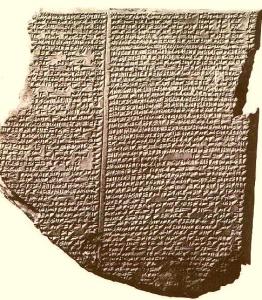
The Flood

The Flood

Atwood also makes note of the threshold concept, that edge or invisible boundary line between the realms, any pair of realms. Life/death, yin/yang, heaven/earth, day/night. The one who seeks knowledge or magic or treasure (or lost love, viz Orpheus) at some point crosses the threshold, and then nothing is certain. He or she may not be able to return, for example. Edges are the interesting places, where all manner of things mesh and overlap–good spots for inspiration even if one opts not to take the stairway to the underworld; but they also pose danger. We humans, with our need for communities, invent parallel communities for our dead, not just physical cemeteries but supernatural abodes, and create all manner of “rules and procedures…for ensuring that the dead stay in their place and the living in theirs, and that communication between the two spheres will take place only when we want it to,” says Atwood.

I wonder if that is one reason I felt so unsettled by the idea of death when I was seven. I did not personally know anyone who had died (yet), but I knew the stories; certainly, I’d been taught about Jesus, though I was told he had defeated death. So why the early-onset angst? Did I fear that edge between the realms, being too inexperienced either to navigate it or to allow communication on my own terms? And maybe the fear is precisely what has led me to my ongoing inquiries into philosophy, consciousness, art, and mind.

Or was I precociously aware that I would have to venture into the darkness, into the coffin-holes and the caves and the seas’ depths, if I wanted to come back with a story to tell?



Consciousness as story

Some recent questions to myself:

Reading philosophy and psychology for so many years, was I looking all along for an explanation of consciousness?

Through neurological and evolutionary science, and more philosophy and more psychology and, in addition, some anthropology, some history. And fiction. And rhetoric. Trying, perhaps, to understand the self? Through criticism, through art, through literature?

Looking carefully at art, reading literature closely: were those also endeavors to comprehend what mind is? Other minds? My own mind? Through the creative act, perhaps?

Is the ars poetica a kind of manifesto of human consciousness from an individual perspective, yet open to interpretation by other human minds? And the beautiful–what is it that even makes beauty a significant concept? Where did that come from? Evolution and the sexual drive (see Dutton riffing on Darwin)? Society? Synthesis? Ego? Inspiration? Angels?

Is every story a scaffold to consciousness? A hedge against oblivion? (Self-oblivion, the hardest navigation act there is: depression, hopelessness, loss of self-knowledge, coma).

I wonder if the stories we tell to others and to ourselves, employing memory selectively whether or not we realize it, act as a kind of (modern-day, metaphorical) Chain of Being through which we develop Theory of Mind and, beyond that, a sense not just of ego but of neurological consciousness. If stories are what make us human.

~

The chain of being, from Charles Bonnet, Œuvres d'histoire naturelle et de philosophie, 1779-83

The chain of being, from Charles Bonnet, Œuvres d’histoire naturelle et de philosophie, 1779-83

[Note: I do not hold the medieval concept of a hierarchy in which Man, angels, and God stand above all other things; the stone and the plankton have as much value–likely more–than I do in the workings of the cosmos, as far as I am concerned. I post this Enlightenment-Era engraving here for metaphorical and aesthetic reasons because I take pleasure in the delightful monkey.]

~

Stories have tremendous value to human beings in ways we are still discovering; see my previous posts here, here, here, and here (among others). I keep coming across claims for the significance of story in surprising places–most recently in Dutton’s The Art Instinct and in Atul Gawande’s latest book, Being Mortal. Widely different texts, similar observations.

How is it we know who it is we are?

Possibly, in the process of inventing the story of ourselves, we become human. Perhaps the story of ourselves is fundamental to conscious “human” minds.

Speculation. But I love recalling that my children, when they were very very young, consistently made one particular demand of me: “Mama, tell me a story!”

~

Introspection & narcissism

In August 2014, New York Times writer David Brooks wrote about the differences, if any, between narcissism and introspection. His opinion column explored whether self-questioning and rumination might lead to self-centeredness rather than self-discovery; he begins the column with the concept of the personal journal or diary and whether that practice has value or not. (Certainly there are other methods of introspection, but for a literate society it is writing that first comes to mind).

Citing research from several psychological studies, Brooks states:

We are better self-perceivers if we can create distance and see the general contours of our emergent system selves — rather than trying to unpack constituent parts.

Interestingly, this suggestion more or less jibes with the multiple-levels-of-self version of consciousness as theorized by Douglas Hofstadter and Daniel Dennett.

Writing as a means to recover from trauma or to “make sense of the world” seems most effective when the writer puts some reflective distance between experience and feeling (see The Writing Cure), although James Pennebaker’s research argues that even immediate expressive writing can help psyches and bodies to heal. Brooks outlines three ways, different from the microscopic introspection of the narcissistic diary-entry, that self-reflection can develop into something other than self-absorption.

One of them is narrative, which makes perfect sense to me–human beings are story-makers. In fact, all three approaches to introspection Brooks mentions find expression in poetry, storytelling, fiction-writing, creative nonfiction, and in good journalism.

Creating our narratives from a reflective “step away” from intense analysis helps human beings to navigate the inner and the outer worlds.

I’m seeing this approach in action with my college freshmen this semester. More on that in a later post.

Story of an object

In a previous post, I quoted Edmund de Waal about the stories that objects can “tell” us. In his book, those objects were things made by human beings; the story of the netsuke was not separate from the stories of the people who acquired them. His book did not examine the stories of the people who sculpted the netsuke, as there was no way to trace them that would not have required years of research. A fiction writer or poet might speculate on the possibilities of the lives of the ‘makers,’ however. That is part of what creative writers do.

There are also those “natural” objects that surround us and which can tell stories–or inspire human beings to imagine and tell their stories. For example, every origin myth contains some aspect of telling the story of the earth or sun, stars or mountains, seas, skies, moon.

After some online discussion with artist and writer Deborah Barlow, I considered the story of an object as having tactile and temporal aspects in some cases, and the object as “residue” of an event–or life. Ephemera, correspondence, tokens…many potential stories.

And, of course, works of art. If you follow this blog at all regularly, or check the archives or the Art[s] tab/page, you can tell I think often about art, its stories, artists, and their stories.

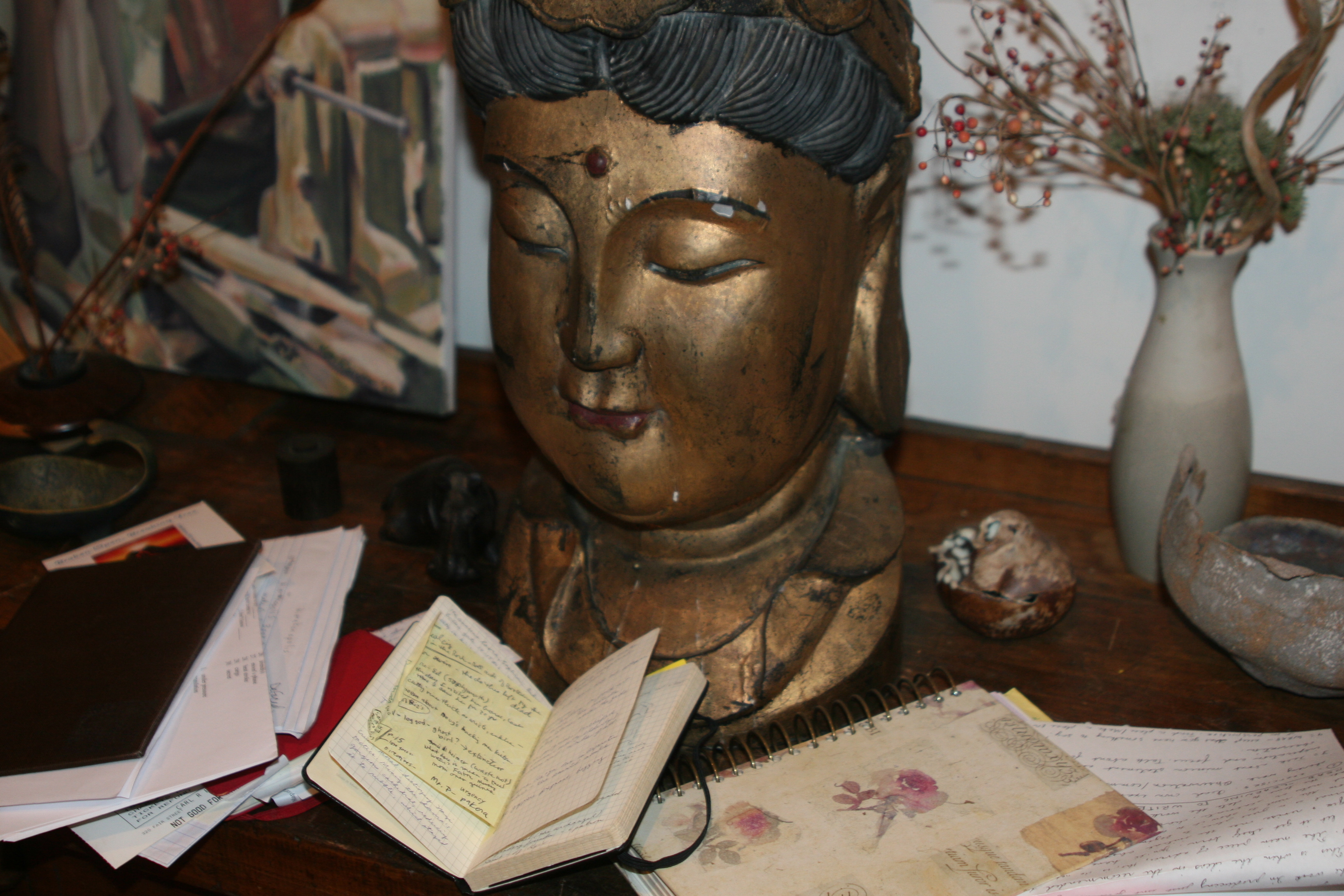
For example, a journal or notebook that an artist or writer uses can be a tool, repository, memory-jogger, inspiration-minder, sketchbook, Rolodex

It occurred to me that my poetry journals, which I’ve been keeping for decades, contain potential stories/poems but are also objects with their own stories to tell–which may or may not be “my” stories, though they necessarily intersect with whatever my story is.

objects, stories

objects, stories

~
Some examples. Tactile, visual, textual.
Inspiration, possibly.

Images captured in several ways.

Necessary–yes. For me.

~

Where do your stories reside? What object or objects seem to require the act of story-making? By which I mean, which objects fire that urge in you?

Objects and stories

I’ve been occupied with many things lately that take me away from blogging and even from poetry. I have been re-reading Hard Times which seems, suddenly, relevant and appropriate to life. I deeply value my world of the imagination, which is not bi-modal, black-and-white, straight facts, simple storyline, no diversions. It is rich and complex and worthy of exploration. It is mysterious and loving and paradoxical, a puzzle and a joyful muddle and a pool of sorrows. It loves to divulge and elaborate and dwells in velvety ambiguities.

I post herein a quote not from Dickens, however, but from Edmund deWaal’s book The Hare with Amber Eyes–in hopes that it will jog my memory for a further post on this topic eventually.

“It is not just things that carry stories with them. Stories are a kind of thing, too. Stories and objects share something, a patina….perhaps patina is a process of rubbing back so that the essential is revealed, the way that a striated stone tumbled in a river feels irreducible, the way that this netsuke of a fox has become more than a memory of a nose and a tail. But it also seems additive, in the way that a piece of oak furniture gains over years and years of polishing…

You take an object from your pocket and put it down in front of you and you start. You begin to tell a story.”

ipomoea

Or something that is not in your pocket. Something you may see along the road, on a path in a park or forest, reflected in a window. The story, perhaps, of a story you thought you knew well–one your father told you, which his father told him, and to which there is truth but also layers and about which you may be able to weave another tale.

Art, story, story, art

Yesterday, I attended a reading by former US Poet Laureate Kay Ryan in a more intimate setting (a luncheon) than I’ve ever been privileged to hear her at in the past. An audience member asked her how she would define art. Alas that I don’t write quickly enough to have taken her words down verbatim, but she offered a lovely answer.

She said that if a person cannot really be happy without doing it, and cannot keep from needing to do it, and if it nourishes or gives back to that person in ways nothing else can–then that “it” is art, in her opinion.

~

I suppose art also ought to speak to others, but I am not sure that is as necessary as art critics think it is.

~

Speaking of critics, and of art, I was impressed with Hilary Mantel’s 1998 novel The Giant, O’Brien for reasons that made a few critics rather lukewarm about it. The author is best known for her amazing historical works, well-researched and full of believably human perspective. O’Brien is a departure in several respects although still historical fiction. I read this book as an ambiguous moral tale, a myth, a story about stories (and art) and a depiction of ways the Enlightenment created significant losses in the midst of its gains. So I was less bothered by the exaggeration of certain personalities or minor plot gaps. O’Brien, a storyteller of the most shamanistic/primitive sort, also possesses a modern (Enlightenment) intellect and an artist’s “intuition.” But he never achieves fame, or the goal of restoring a beloved pub–the place he learned his craft–and dies painfully and slowly, impoverished and nearly abandoned.

As O’Brien nears death, Mantel writes that there comes “a point in fatigue or pain when logic slowly crumbles from the world, where reason’s bricks sieve to crumb. Where content flits from language…and departs.” And her character, the giant–who embodies in his hugeness the epitome of mythical narrative, the kind that sustains us even in dire poverty–eventually comes to the conclusion that the poor among us lose all. Of the poor man, he muses:

Stories cannot save him. When human memory runs out, there is the memory of animals; behind that, the memory of the plants, and behind that the memory of rocks. But the wind and the sea wear the rocks away; and the cell-line runs to its limit, where meaning falls away from it, and it loses knowledge of its own nature. Unless we plead on our knees with history, we are done for, we are lost. We must step sideways, into that country where space plaits and knots, where time folds and twists: where the years pass in a day.

What within us plaits and knots and folds and twists but the brain itself? We pass along our knowledge and, more importantly, our stories. That is done from brain to brain through language and music and art, even as the individual brain comes to the end of its viability and vitality. We step sideways into another person’s brain, just as O’Brien’s listeners memorize his tales, his cadence, his figurative speech. So, in the end, O’Brien is wrong.

~

I attended a funeral today at which the officiant encouraged us to keep the departed alive in our hearts and for the future by telling stories he had told or by relating stories about him to anyone who might listen. I know I have previously written about this idea in conjunction with readings and philosophers and art and literature. The more I encounter it, the truer it seems to me.

The bereaved spouse at this funeral is a person who is losing her own story through senile dementia, though she has some occasional awareness of her memory loss. Her ability to carry on her husband’s narrative is already deeply diminished or perhaps completely gone.

These are among our risks.

~

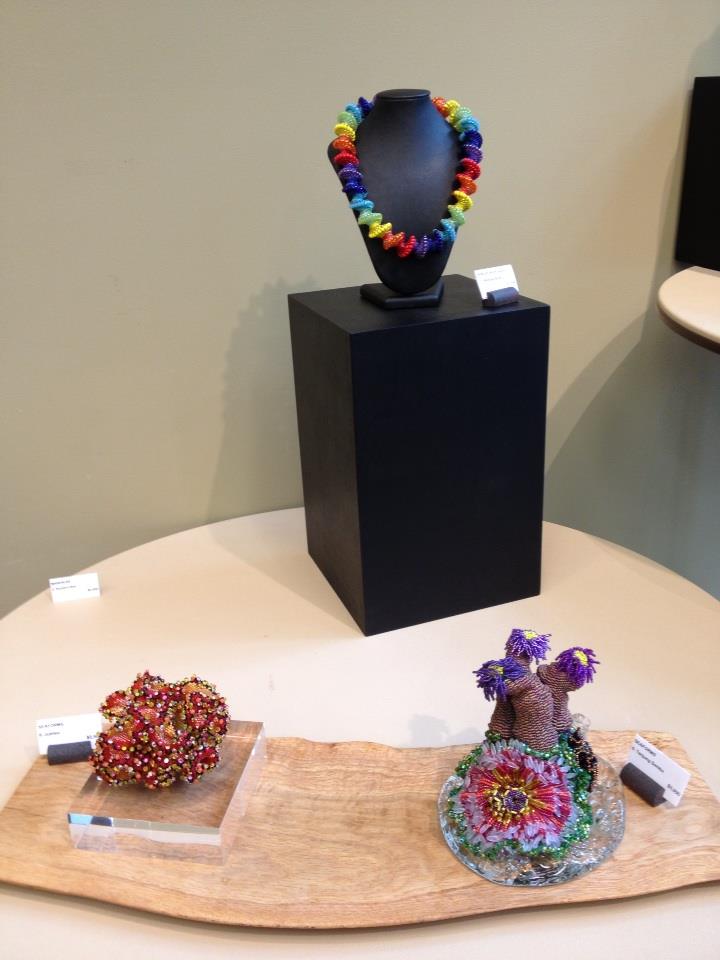
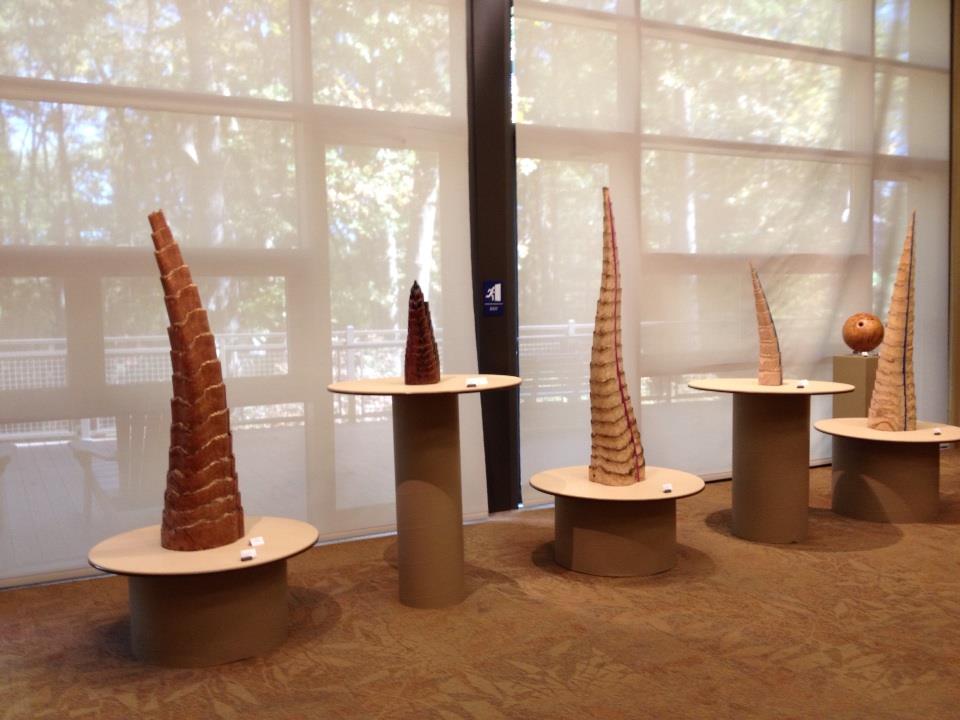
These words brought to mind my long-time friends, the craft-artists David Ellsworth (turned and other wooden forms) and Wendy Ellsworth (beaded forms). This month, for the first time in their many years together, they have a joint exhibit in the gallery space at Jenkins Arboretum (Devon, PA). The photos below are snapshots Wendy took, and their individual work is best viewed in person or on their studio website. [Contact the artists for permissions, photos, information about workshops and talks.]

Wendy Ellsworth's seaforms, and a necklace

Wendy Ellsworth’s seaforms, and a necklace

Wendy's "Sunset" (with David's turned-wood frame/container)

Wendy’s “Sunset” (with David’s turned-wood frame/container)

David Ellsworth's "Emergence" series

David Ellsworth’s “Emergence” series

I have known Wendy and David for over 25 years, and I can testify that the work each of them does fits Kay Ryan’s description of art. They are artists, and their work nourishes both of them–and nourishes us, the beneficiaries, as well.

~

For today, these are my stories.

www.ellworthstudios.com

Proofreading

Every Living Thing–The Life & Times of a Glasgow Vet Student has a cute anecdote regarding the value of careful proofreading and how small mistakes can be inconvenient and costly at the customs line. Who thinks to proofread a passport or visa? Well…

Proofreading is how I began my so-called career many years ago, and the habits I learned follow or perhaps plague me still. For example, I’m currently reading Hilary Mantel’s 1992 novel A Place of Greater Safety and finding the text riddled with typos. The most common error is a missed quotation mark–not surprising because Mantel takes a unique approach to setting  up dialogue. But it’s dismaying to find that a major publisher allowed so many mistakes to slip through, and it interrupts my reading pleasure.

Years ago, I saw Edna O’Brien reading at the 92nd Street Y in New York City. She read from one of her short story collections, and at one point she paused, adjusted her reading glasses, and stated: “Typographical error, Farrar, Straus, Giroux.” Called out on the podium, publishers!

Online sites host the largest number of typos and outright grammatical or mechanical mistakes, but paper texts aren’t as reliably correct as they once were. The New York Times has become quite lax lately; three months ago, I even found a typo in The New Yorker!

Proofreading services

I understand why there are so many more typos these days–there are so many fewer proofreaders. It gets expensive, hiring all those human beings to inspect the small details of every text, and publishers are not making as much money as they once did. How many picky readers like me exist? Probably not enough of us that we could stage a book-buying boycott demanding that Random House hire more proofreaders (people like me could never really stage such a boycott–we’re too addicted to books).

Computers, however, are not yet intelligent enough to catch the shimmery, shifting nuances of the English language and its attendant finery in the shape of punctuation and capitalization, footnoting and italicization. So there will be mistakes, and I guess I can live with that. “To err is human,” and all that. And Mantel is a fine writer.

Autodidacts & higher education

An early-morning drive to work, low sun gleaming through the remnants of fog, Vivaldi on the radio: Concerto for Two Cellos, a deeply mellow, haunting work of music…and I tried to recall my first encounter with Vivaldi’s music. I am quite sure it was an old Angel Records LP of The Four Seasons in my parents’ modest record collection. When I was old enough to read, I was curious enough about the music to study the record cover, where I learned that Vivaldi was born in 1678 in Italy and had red hair. Our ancient set of encyclopedias (The Book of Knowledge) said he taught music to little girls in convent school. These details, which taught me little about baroque music itself, nonetheless appealed to me as a child who wanted stories. The music seemed to tell me stories, as well–thunderstorms, blizzards, birds at daybreak, mountain streams, slow rivers in the summer sun.

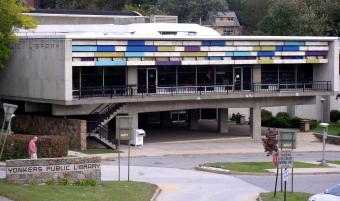
Because I wanted stories, because I sought information and details, I turned to what seemed to me the most obvious place: the library. For three years of my early reading life, that was the Yonkers Public Library’s “new” branch, which seemed impressively modern at the time and which had a fabulous children’s area.

Why I associate Vivaldi with colored light filtering through the clerestories of the library, I don’t know. That’s just how memory works. I also associate my visits to the children’s room at the library with the beginnings of a lifetime of self-teaching through books, music, museum-going, travel, art, conversation, observation, research, and writing. That connection is a little easier to make. Because I was an introverted child, I watched more than participated in the events going on around me. When I wanted to know more, I was often too shy to ask–so I tried to find the answers myself in the place I imagined to be the best repository of stories and information. It was also the only place I knew that could offer such knowledge.

This brief explanation suggests that I became an autodidact because I was socially maladaptive. Or maybe because I was passionately curious about the world. Or because the library room was so magical.

Any of which may be at least partially true. But what I want to say in this post–far too briefly because the idea deserves further reflection–is that while I work in an institution of higher learning and while I believe in the value of higher education, I also believe we can educate ourselves exceedingly well without college degrees. Lack of a degree can limit people in the job market, no doubt; yet some of the most intelligent, interesting, best-educated people I know happen to be largely self-educated. The autodidact has the motivation of personal passion and the ability to be directed by chance and interest, not just to be guided through coursework considered culturally or economically valuable. Most of my older friends have become wise and clever by attending the school of hard knocks and through their personal curiosity and inventiveness; they are true autodidacts, even the ones who actually do have PhDs…but especially the ones who don’t.

Can I go so far as to suggest that we need our libraries more than we need our universities? Why not? I think I started my “college education” when I was six or seven years old because I had the desire to know, the curiosity, the interest. My parents encouraged me, which helped. (For one thing, I could not have gotten to the library if my mother hadn’t taken me there!) Some of my school teachers were also encouraging, but their encouragement mattered surprisingly little. What made the difference was the reward of finding something new, learning a new story, adding details to a foundation of things that interested me.

One of my tasks as a teacher, a poet, and as a mother is to foster that element of excitement when I sense it in someone and to encourage self-directness in each person’s education. Delight: a crucial ingredient in learning that can take awhile to locate but that will motivate a lifetime of knowledge-gathering. Maybe you can find it at the library, too.

Just-so

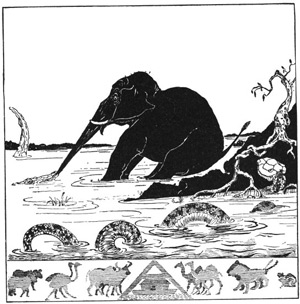
This classic illustration was posted here: http://www.jwoolfden.com/classics.html

OKAY, cynics, I know this may be a bit of a gloss; but here is another older post which is the keynote speech I gave for DeSales’ Sigma Tau Delta induction (Honors society of English majors), April 2010.

~

Why the English Major Is So Adaptable: A ‘Just-So’ Story

When I was an undergraduate, Oh Best Beloved, I was not at all certain of my life path. I attended an alternative, seminar-college program that—gasp—did not require me to proclaim an academic major. In my first two years of college, I wandered through classes in studio art, Renaissance history, feminist literature, social anthropology, psych, physics, dance, and philosophy. Then, I began reading in earnest. Previously, reading had been merely an obsessively entertaining hobby; as a junior, I wanted to learn the “how” of writing. I graduated with enough credits in both English and Philosophy to have been a double-major, if my institution had required majors, or to have received an undergraduate creative writing degree, if such a thing had existed in days of yore.

And then, I was out in the world. The world was in a terrible recession. Jobs were scarce. Inflation was in the double digits. Gas prices were skyrocketing. The sky was falling, and I was a newly-minted English major.

All my Wise Elders advised me to specialize. That meant going to graduate school, which I probably should have done a little sooner, or learning a trade. I thought I could survive outside of academia despite the economic woes, the scarce want-ads. My reasoning was that I had four years of humanities training in critical thinking, research, and problem-solving and that at 21 years old it was time to put those theories into application. I thought I had learned to be adaptable.

And what do you think, O My Children?

I was right.

You are likewise English majors, and you are also facing a time of recession and a paucity of careers in your chosen area of interest. This will not hinder your success, though it may make your career journey a little more…circuitous. Or shall we say: intriguing. But you like a challenge, don’t you? That’s the most terrific thing about choosing creative writing, or English, or rhetoric, or literature—the more you study them, the more intricate and complex and revealing these subjects are. I have never met an English major who wasn’t also a dedicated life-long learner. But I have met English majors who are lawyers, and psychologists, and social workers, and business executives, and filmmakers, and visual artists, and physicians, and ecologists, and diplomats, even computer geeks, not to mention those other careers: screenwriters, playwrights, poets, novelists, journalists, bloggers, teachers…

So, Best Beloved, do not sell yourself short. Furthermore, do not expect a “Reader, I married him” moment with your career. Allow yourself room to transform. Carpe diem.

What that meant for me back in 1979 was a temp job for the legal discovery department of a large law firm. From there, I signed on as a member of the International Union of Typographers No. 6 and learned a specialty: typographical proofreading. That field went extinct with the advent of desktop publishing. But by then, I’d jumped to advertising, which I hated, and into magazine work, which wasn’t so bad. There’s a Darwinian term for this: co-adaptation. I was finally getting close to a more specialist use of my English major background as the economy improved; and I married and had children and, in time, went to graduate school for the scholarly pursuits I’d missed so much.

I didn’t starve. Neither will you. You can do research. You can make yourself clear. You know your audiences may require different modes or styles of you, and you’ve learned how to adapt yourself and your arguments to those audiences. You can be persuasive. That’s how I got my first job after the temp work wound down; I was inexperienced but convincing. Even in a tight job market, employers are seeking people like you—adaptable, well-educated people. My husband recently directed me to an article in the New York Times that stated today’s businesspeople want employees who are clear communicators, especially in writing. This is partly because executives do their own writing nowadays. Fewer secretaries to rely on; each person’s expected to make herself clear—on her own written merits. Even if it’s email instead of the paper memos of my day.

English majors can write.

The jobs I’ve briefly mentioned paid my bills and got me medical insurance but did not satisfy my urge to practice the how and why of writing, so I did what writers generally do: I wrote. I cannot emphasize enough the role that constant practice of craft plays in the development of a writer. It doesn’t matter if no one sees your work—though I encourage you to share it with others and get feedback and critique—what matters is that you continually practice what you’ve learned in college and extend your education through application and extension of those principles.

If you find yourself in a day job that has little, apparently, to do with your major, don’t despair. Because writing is portable. I still write most of my drafts with pen or pencil in a small notebook, and laptops are pretty easy to transport—you can, with a little self-discipline, write anywhere. In my day, I have written in small dingy office warrens, in the waiting rooms of doctors and music teachers, in the parking lot while the high school band wrapped up its practice, in the sun beside the dressage ring at the horse farm, while my babies were napping, while the laundry was cycling, in the wee hours of the morning before anyone else wakens. The poems and essays I drafted under these circumstances sometimes reflected the places of their composition—but not always. I have waxed metaphysical in playgrounds. Another example of becoming adaptable out of necessity, Best Beloved, when the Great Magician or the Djinn of All Deserts or the small god Nqa tried me with obstacles to test my persistence.

Make the time to write, because writers can get rusty. Above all, make the time to read, because after you graduate, reading is the best way to continue your literary education.

But you knew that.

Of course, there is graduate school. And there are writing seminars and getaways and retreats and conferences. If you haven’t got the time or money to get to writers’ conferences or workshops, you can adapt by exchanging literary emails with a few like-minded friends or gathering in a library or coffee shop to exchange work or discuss books that excite you. Scholarship may seem like a solitary pursuit, but it benefits from lively interactions with other human beings.

Yes, Oh Best Beloved, do remember other human beings. We do not, after all, write only for ourselves; we write in and of and for a community of people. If our work is obscure, obtuse, or unclear, we are not taking part in this communication. The most fundamental purpose of language is to make clear our intent to another person who is, after all, not inside our brain but functioning under his or her own neurological system. Language—in our case, English—is the most formidable tool for demanding, commanding, sharing, expressing. Those in this room are understandably passionate about it. I am pleased to be among you. The world badly needs your talents, enthusiasm, and the abilities you possess to analyze the facts and transform yourselves and others because, My Children, the English Major somehow became adaptable, and that is all to the good.