Favorite poems

In my last post, when writing about reading poems of grief, I mentioned Robert Pinsky–former US Poet Laureate. When Pinsky was Laureate, he promoted the program now called “The Favorite Poem Project.” The concept was to demonstrate that poetry appeals to a diverse audience; there are so many styles and types of poetry, on so many topics, that anyone can find a poem that appeals. Teachers, plumbers, teenagers, soldiers, business executives, mail carriers, truckers, grandparents, schoolchildren–anyone who had a poem that had special meaning was invited to say a bit about why or how that poem meant so much and then to read the poem aloud to an audience. Pinsky’s project included favorite poem reading events, and videorecordings of such events, now archived at the site…and a book.

This year–this past Tuesday, to be quite exact–I took part in a favorite poem reading at the college where I work. I find these readings rejuvenating. Sometimes the stories that surround the poem choice are heartwarming, sad, or funny. Some readers tell an anecdote about a favorite teacher, relative, friend, or book; it’s wonderful how those stories “work” with the chosen poem. The director of information technology related the story of how, when her mother was in labor with her, her mother was taken to the hospital by hearse because taxis in the south did not serve her “black neighborhood.” A dance professor offered the romantic story of his long-distance courtship with his (now) wife via letters and poems…and Neruda. An instructor spoke of his fascination with attics and his father’s estrangement from the family and then read Stanley Kunitz‘s amazing poem “The Portrait.”

The poem I read was also a Kunitz poem, “The Snakes of September,” one of his later works. I am not sure this is my favorite poem–indeed, I would be hard pressed to come up with one only, and I might choose Ben Johnson’s “On My First Son” or Mary Oliver’s “Wild Geese” or Li-Young Lee’s “The Gift” or…well, there are dozens. I just chose one I thought would suit the evening, a poem with a garden in it, and an allusion to Eden, and the lovely phrase “the wild/braid of creation/trembles.” It speaks to me.

Look for poems that speak to  you. Keep them near  you, on the fridge or by your desk, in a notebook by your bed, or in your heart. Share them if you feel the urge; you will be doing good.

Blessings for National Poetry Month and always.

Judging poems

During National Poetry Month, a local newspaper (Lehigh Valley Press) sponsors, with a local public radio station (WDIY), a poetry contest for children ages 6-17. This year I was one of seven people, most of us educators, on the judging panel.

Judging poetry is always a rather fraught endeavor, and when one is reading the work of novices–particularly very young ones–setting standards can be challenging. What were we looking for, exactly? How could we decide whether the writing of one 14-year-old was “better” than the work of another? How to assess the poetry of 8-year-olds?

Our coordinator and organizer began with such questions and by asking us to describe what each of us seeks in any poem–not poems by children, but any good poem. Would children’s work feature any of these attributes? Successful attempts at poetic strategies or craft, for example–we may be able to determine that a 10-year-old’s work shows signs of poetic craft. Imagery that moves beyond the expected or clichéd? Young people often prove quite capable of that part of writing.

We are experienced in the classroom, too, and can usually tell when a child’s work shows signs of being ‘overly-coached’ by a well-meaning adult. Alas, all too often an adult’s interference deadens the imaginative if occasionally grammatically-incorrect approach children take. We can also tell which poems come of a classroom assignment when we get submissions of numerous 7-line poems on “snow.” This is not to suggest that none of the poems are worthy of note: an imaginative writer of any age can probably create a lovely piece conforming to the assigned framework. But, as teachers, we found ourselves responding to the assignments themselves (“That’s clever and would work well with third-graders, too;” “They must be studying the Black Plague;” “Looks as though they made a word bank for this one;” and so on). We had to remind ourselves to look at the work itself for the earmarks of imaginative ideas and use of language.

Interestingly, first-place poems seemed obvious and agreement was usually unanimous. This was true for elementary school, middle school, and high school writers: the best work does stand out.

Choosing the second and third place poems was more difficult and resulted in lively conversation about what makes a good poem, what matters more: authenticity of experience? discernible voice? vivid imagery? clear use of craft? emotional expression? imagination? Each of the judges had useful insights that reminded me of the value of thoughtful criticism and the value of poetry-as-art.

It was also heartening to read the work of so many young people who showed a willingness to play with words, to think about aesthetics and feelings and language, and to show their work to others. I’m grateful to the teachers who took the time to introduce their students to poetry and to encourage their pupils to write.

AWP follow-up

photo Ann E. Michael

winterhazel

Snow fell on Boston. Not a big snow, however, and rather typical for a late-winter storm: damp, swirling but not biting, swift-melting once the sun appeared two days later. Early Friday morning, I trudged with a friend over the as-yet unshoveled sidewalks to breakfast on Newbury Street at Steve’s. We met with conference buddies who are all members of the WOM-PO [women’s poetry] listserv. It is lovely to meet face-to-face people who have been virtual colleagues and splendid to discuss poetry over a good breakfast.

~

It is also a relief to realize that I have finally learned how to manage conference-going. It is all a matter of pacing and, I suppose, of taking poet William Stafford’s advice and lowering one’s expectations. The hardest challenge is making the choice between blowing the budget on terrific food (in a big city, wonderful restaurants abound) or on books, because the bookfair at the Associated Writing Programs’ annual conference is enough to inspire swooning among literary bibliophiles.

In three huge exhibit rooms, small presses and literary and university presses displayed chapbooks, literary journals, and books that range from minuscule to tabloid-sized, books that are handmade, letter-pressed, offset, print-on-demand, stapled, ribbon-sewn, die-cut, fancy-boxed, reprinted, spare, florid, illustrated, edgy, deckle-edged, marbled, second-hand, one-of-a-kind, limited-edition, mass produced, commercial, educational…in all genres including mixed-genre, collaborative, collage, anthology, with an emphasis more on the literary than the commercial text. These books can be devilishly hard to locate, even with the existence of Amazon and online sellers; and holding them in your hands is a far more convincing sell than seeing a picture file on your computer screen.

Heaven for poetry-readers, there are also wonderful creative non-fiction books, collections of short stories, novels, books on prosody and poetics, the craft of writing, on creativity and inspiration and toil and revision and on the complex and controversial topic of teaching writing. Oh, and there are people, too. Most of the attendees are writers of one stripe or another who are congenial and curious or else walking about with the glazed expression of the overwhelmed.

Or some combination of the two.

~

I exercised considerable restraint and managed not to load my bedside table with two months or more of reading material (see a related post here). And I got some terrific ideas for teaching writing to college students and found some wonderful poets whose work I want to study. The last night of the conference, I listened to the mesmerizing Anne Carson read an indescribable take-down of the fifth book of Proust’s À la recherche du temps perdu, the section titled The Captive (Albertine). It’s been years since I read Proust, which I did almost out of stubbornness in my junior year of college, but the book came back vividly enhanced by Carson’s peculiar approach to pacing, language, scholarship, whimsy and satire. I like what the Poetry Foundation’s biography says about her after the release of her text The Autobiography of Red:

According to John D’Agata in the Boston Review, the book “first stunned the classics community as a work of Greek scholarship; then it stunned the nonfiction community as an inspired return to the lyrically based essays once produced by Seneca, Montaigne, and Emerson; and then, and only then, deep into the 1990s, reissued as “literature”and redesigned for an entirely new audience, it finally stunned the poets.” D’Agata sees Carson’s earlier work as an essayist everywhere in her poetry, along with her deep absorption in Classical languages. Carson’s work, D’Agata alleges, asks one to consider “how prosaic, rhetorical, or argumentative can a poem be before it becomes something else altogether, before it reverts to prose, to essay?”

~

Altogether, Boston provided nourishment of many kinds: gustatory, intellectual, emotional, poetical…food for thought.

Exhaustion & bloom

Isak Dinesen: “I write a little every day, without hope and without despair.”

~

Some days, the little is…quite little. I am not exactly taking a break from reading and writing, but a great deal of my reading these days is student-written work; and the writing tends to be corrective.

There are also events in one’s life that tend to push back against the time needed to dwell on creative things.

Kurt Vonnegut: “So it goes.”

~

I’m re-reading Descartes. The best part of his philosophical writing, in my opinion, deals with his conscious desire to remove all prejudicial thinking from his mind. I have my doubts as to his success in that regard, but I love the splendidness of trying to attain the mental tabula rasa. Open-mindedness, a virtue more human beings should strive to embrace.

~

And there is also exhaustion, pure and simple. Some days, I need my rest.

February: awaiting the snowdrops’ blooms. (They’re nearing…the white tips are visible, enclosed in the deep green spathes.) Meanwhile, fragrant yellow winterhazel.

corylopsis

winter hazel

Philosophy & English are friends

At my day job, I do a great deal of tutoring in writing at the college level. Most students who sit down to work with me expect that I will help them learn to use commas and apostrophes, to write thesis statements and to unclutter their sentences. I do that, but the most important part of tutoring writing at the college level is actually rhetoric. One of the things I constantly tell my students is that Philosophy and English are friends.

Many freshmen have no idea why either course is required for a bachelor’s degree. I hope that the ones who find their way to my office for writing help finally understand–however reluctantly–that composing essays and learning critical thinking skills do merit their attention and do, in fact, transfer to whatever set of skills their majors may require of them.

This past week, my sessions featured the “Analysis for Rhetoric” paper and papers for several different Philosophy professors, including essays based upon readings of Garrett Hardin (the famous “Lifeboat Ethics” essay) and Mortimer Adler. Most of the time, I helped my students read rather than write. It isn’t possible to write effectively about a text one does not understand, and rhetorical analysis is new to most college freshmen. Between the not-knowing-how and the not-understanding, most of the student attempts at paper-writing end up weak and wordy.

With no foundation in rhetoric, essay structure disintegrates. Even sentences often operate with a rhetorical function that few 18-year-olds understand until it is pointed out to them: sentences that offer parallels, for example, or if/then speculative structures, or the this-therefore-that causative rhetoric. If the student hasn’t yet figured out how to analyze a text for rhetorical strategies, he or she certainly cannot structure a credible paper about it. What I have learned is that many people know what they want to say but cannot relay it to a reader who isn’t psychic. I have to keep reminding narcissistic young people that, amazingly, the professor does not share their assumptions or “know what they mean.” Sometimes I use Lego blocks to give a visual, concrete example of linking, scaffolding, and therefore building an essay in a fashion the reader can follow.

After years of tutoring, I often do know what the student is trying to say; but I pretend I don’t. If I say it for them, they don’t learn how to say it themselves–and that isn’t teaching.

~

Two excellent books to study regarding how grammar structure relates to elegant writing are Virginia Tufte’s Artful Sentences and Sister Miriam Joseph’s classic work The Trivium.

Language & teaching

I’ll be teaching a new crop of freshman writing students tomorrow morning. A thought lingering in my mind as I prepare myself mentally for the first classroom contact with these 17- to 19-year-olds concerns language, and an ongoing argument about its uses and origins. The argument is part semiotics, part linguistics, part sociological, part neurological, part cultural, part philosophical: what is the relationship between language and the human thought process? It’s sort of a chicken-and-egg question. Bruner, Goodnow & Austin, in 1956, characterized the two main theories at that time as “mould theories” in which language is “a mould in terms of which thought categories are cast” and “cloak theories” that hypothesize language is “a cloak conforming to the customary categories of thought of its speakers.”

In other words, does the language make us who we are/how we think (culturally), or does our culture make our languages reflect the cultures in which we live?

The famous Sapir-Whorf hypothesis theorizes that we experience the things we do, and speak about them to others in our community, because our language habits incline us towards certain interpretations. It is therefore a mold theory. Whorf wrote, in 1940, that “We dissect nature along lines laid down by our native languages.” Ie, if our culture values, say, coloration, our metaphors and cliches and descriptions would be largely based on color-values. In a more recent essay by David Chandler,* the author points out that this sort of interpretation of what language is can be interpreted in so relative a fashion that every form of linguistic communication, even with in a culture, becomes a kind of translation. Chandler finds this situation “problematic.”

Problematic, perhaps. But incorrect? I’m not so sure. It seems to me that our very individualist U.S. culture offers so many personal and sub-cultural perspectives that even everyday commerce and chit-chat involve constant translation. One of the most challenging things I have to teach to my students is how to understand what their college professors want from them, which is largely demanded in terms of a vocabulary that is not necessarily academic jargon but which is connotative in ways most incoming freshmen cannot know; they have seldom or never been exposed to that perspective. It is not part of their culture.

So does that make language a cloak or a mold?

Probably–as in most things–moderation serves best. The answer is not either-or, but a bit of both, because the human brain–and human culture–is so commodious and adaptable and complex. Chandler promotes “moderate Whorfianism.” That’s another one of those rather irritating academic –isms, but what he means is: “Meaning does not reside in a text but arises in its interpretation, and interpretation is shaped by sociocultural contexts.” This theory affects my role as educator even when I am teaching the introduction to academic writing and rhetoric class rather than some higher-level analysis course. More so, in some ways, because the introductory course is where students learn to question their socio-cultural assumptions as they read and write. I have to learn their slang, their habits, their leisure activities and distractions in order to make compelling analogies that work for them. They have to learn to transition into academic and business-world conventions from their peer-oriented and narcissistic teen environments.

It is a form of translation.

It is also an opportunity for new perspectives, for my students and for me. Wish us luck!

~

*David Chandler, “The Sapir-Whorf Hypothesis” UWA 1994 (from The Act of Writing)

Just-so

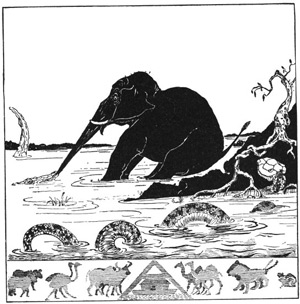
This classic illustration was posted here: http://www.jwoolfden.com/classics.html

OKAY, cynics, I know this may be a bit of a gloss; but here is another older post which is the keynote speech I gave for DeSales’ Sigma Tau Delta induction (Honors society of English majors), April 2010.

~

Why the English Major Is So Adaptable: A ‘Just-So’ Story

When I was an undergraduate, Oh Best Beloved, I was not at all certain of my life path. I attended an alternative, seminar-college program that—gasp—did not require me to proclaim an academic major. In my first two years of college, I wandered through classes in studio art, Renaissance history, feminist literature, social anthropology, psych, physics, dance, and philosophy. Then, I began reading in earnest. Previously, reading had been merely an obsessively entertaining hobby; as a junior, I wanted to learn the “how” of writing. I graduated with enough credits in both English and Philosophy to have been a double-major, if my institution had required majors, or to have received an undergraduate creative writing degree, if such a thing had existed in days of yore.

And then, I was out in the world. The world was in a terrible recession. Jobs were scarce. Inflation was in the double digits. Gas prices were skyrocketing. The sky was falling, and I was a newly-minted English major.

All my Wise Elders advised me to specialize. That meant going to graduate school, which I probably should have done a little sooner, or learning a trade. I thought I could survive outside of academia despite the economic woes, the scarce want-ads. My reasoning was that I had four years of humanities training in critical thinking, research, and problem-solving and that at 21 years old it was time to put those theories into application. I thought I had learned to be adaptable.

And what do you think, O My Children?

I was right.

You are likewise English majors, and you are also facing a time of recession and a paucity of careers in your chosen area of interest. This will not hinder your success, though it may make your career journey a little more…circuitous. Or shall we say: intriguing. But you like a challenge, don’t you? That’s the most terrific thing about choosing creative writing, or English, or rhetoric, or literature—the more you study them, the more intricate and complex and revealing these subjects are. I have never met an English major who wasn’t also a dedicated life-long learner. But I have met English majors who are lawyers, and psychologists, and social workers, and business executives, and filmmakers, and visual artists, and physicians, and ecologists, and diplomats, even computer geeks, not to mention those other careers: screenwriters, playwrights, poets, novelists, journalists, bloggers, teachers…

So, Best Beloved, do not sell yourself short. Furthermore, do not expect a “Reader, I married him” moment with your career. Allow yourself room to transform. Carpe diem.

What that meant for me back in 1979 was a temp job for the legal discovery department of a large law firm. From there, I signed on as a member of the International Union of Typographers No. 6 and learned a specialty: typographical proofreading. That field went extinct with the advent of desktop publishing. But by then, I’d jumped to advertising, which I hated, and into magazine work, which wasn’t so bad. There’s a Darwinian term for this: co-adaptation. I was finally getting close to a more specialist use of my English major background as the economy improved; and I married and had children and, in time, went to graduate school for the scholarly pursuits I’d missed so much.

I didn’t starve. Neither will you. You can do research. You can make yourself clear. You know your audiences may require different modes or styles of you, and you’ve learned how to adapt yourself and your arguments to those audiences. You can be persuasive. That’s how I got my first job after the temp work wound down; I was inexperienced but convincing. Even in a tight job market, employers are seeking people like you—adaptable, well-educated people. My husband recently directed me to an article in the New York Times that stated today’s businesspeople want employees who are clear communicators, especially in writing. This is partly because executives do their own writing nowadays. Fewer secretaries to rely on; each person’s expected to make herself clear—on her own written merits. Even if it’s email instead of the paper memos of my day.

English majors can write.

The jobs I’ve briefly mentioned paid my bills and got me medical insurance but did not satisfy my urge to practice the how and why of writing, so I did what writers generally do: I wrote. I cannot emphasize enough the role that constant practice of craft plays in the development of a writer. It doesn’t matter if no one sees your work—though I encourage you to share it with others and get feedback and critique—what matters is that you continually practice what you’ve learned in college and extend your education through application and extension of those principles.

If you find yourself in a day job that has little, apparently, to do with your major, don’t despair. Because writing is portable. I still write most of my drafts with pen or pencil in a small notebook, and laptops are pretty easy to transport—you can, with a little self-discipline, write anywhere. In my day, I have written in small dingy office warrens, in the waiting rooms of doctors and music teachers, in the parking lot while the high school band wrapped up its practice, in the sun beside the dressage ring at the horse farm, while my babies were napping, while the laundry was cycling, in the wee hours of the morning before anyone else wakens. The poems and essays I drafted under these circumstances sometimes reflected the places of their composition—but not always. I have waxed metaphysical in playgrounds. Another example of becoming adaptable out of necessity, Best Beloved, when the Great Magician or the Djinn of All Deserts or the small god Nqa tried me with obstacles to test my persistence.

Make the time to write, because writers can get rusty. Above all, make the time to read, because after you graduate, reading is the best way to continue your literary education.

But you knew that.

Of course, there is graduate school. And there are writing seminars and getaways and retreats and conferences. If you haven’t got the time or money to get to writers’ conferences or workshops, you can adapt by exchanging literary emails with a few like-minded friends or gathering in a library or coffee shop to exchange work or discuss books that excite you. Scholarship may seem like a solitary pursuit, but it benefits from lively interactions with other human beings.

Yes, Oh Best Beloved, do remember other human beings. We do not, after all, write only for ourselves; we write in and of and for a community of people. If our work is obscure, obtuse, or unclear, we are not taking part in this communication. The most fundamental purpose of language is to make clear our intent to another person who is, after all, not inside our brain but functioning under his or her own neurological system. Language—in our case, English—is the most formidable tool for demanding, commanding, sharing, expressing. Those in this room are understandably passionate about it. I am pleased to be among you. The world badly needs your talents, enthusiasm, and the abilities you possess to analyze the facts and transform yourselves and others because, My Children, the English Major somehow became adaptable, and that is all to the good.

AWP conference

I got back from Chicago on Monday and have been trying to catch up ever since. Chicago hosted the 2012 Associated Writing Programs conference, where nearly 10,000 writers, aspiring writers, teachers, publishers, and students (often these categories overlap) converge to interact, interface, synthesize, network, inform themselves, and idol-worship.

For an introverted, reflective, crowd-shy person, the event can be overwhelming. I speak from experience.

Nevertheless, the conference generally provides me with tremendous food for thought in the form of books to read, authors to discover, concepts to familiarize myself with, pedagogies to explore, and considerable re-assessment of why I do what I do. Also, I meet people.

At a wonderful presentation called “Literature and Evil,” for example, I was seated next to poet James McKean. We had an amiable discussion about teaching composition prep to freshmen before I figured out who he was. Here is one of his poems: “Bindweed” up at The Poetry Foundation site. For poetry people, that’s big-time. The thing is, I hadn’t read any of his books; it would have been really weird to say, “Oh, I recognize your name. I don’t know your work at all, though. Sorry.” So we chatted about an area of common ground: teaching.

I tracked down McKean’s books via Iowa’s Writing Program and did a bit of internet sleuthing for samples of his poetry. Turns out I really like his work. So I’m going to be reading James McKean’s poems and meanwhile be thinking, what a nice man he is! Such a devoted teacher, down-to-earth. He shared some of his classroom approaches and I shared my teaching experiences with similar students. We talked about the differences between community college adult students and 18-year-old freshmen. We didn’t talk about teaching creative writing, but we did talk about the low-residency MFA and his current crop of students. He is much younger than my dad, but he reminded me of my father, a midwesterner and professor interested in what Marilynne Robinson, Ha Jin, and Paul Harding had to say about evil and literature.

They had lovely and compassionate and interesting things to say, in my opinion. I suggest you read their books. And, while you are at it, pick up a collection of James McKean’s poems. He’s a terrific poet–and a very nice man.