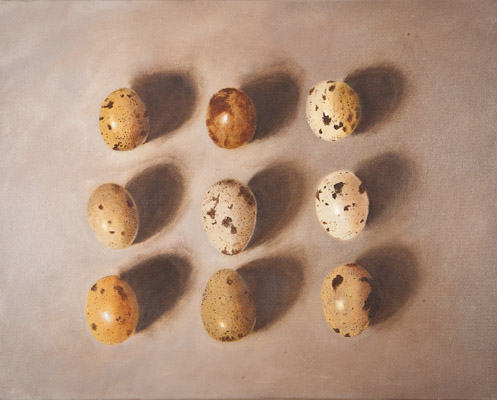
“The Atlantic”

 Atlantic by John Sevcik

A few years back, I was privileged to join John Sevcik, his wife Lynne Campbell–who is also a marvelous painter–and a few art students and friends for three lovely days of art talk and plein air painting sessions and terrific food at a beach house in NJ. This painting, by John Sevcik, inspired the following poem, which appears in Water-Rites.

The Atlantic

She and her mother
are knee-deep in water
their backs to the shore

What they discuss
as they look eastward
you cannot hear–

breakers, the wind,
the natter of laughing gulls
cover their conversation

Besides, you are busy
fathoming the sea’s tones
and mixing the sky–

Trying to stake claim
to the reflective shallows
between you and them

At this hour
they are your subjects
as the sea is

and what they say
she will share with you
later. Or she won’t.

It doesn’t matter, you
have set down on canvas
their communion

And your own conversation–
the one between mind’s eye
and artist’s hand.

~~~

Many thanks to John Sevcik for allowing me to post his painting here on my blog. To see John’s other works and find out about gallery showings, visit him at his web page. He is also a teacher, poet, playwright and actor.

Generous community of writers

Lately, my days have been busy with gardening and household chores and efforts to promote my book Water-Rites. I find I can jot ideas into my notebooks but that more sustained creative writing efforts are not possible at this time. That’s okay. Writing, for me, often comes cyclically, with the slow periods acting as collecting points and reflective opportunities that may result in poetry later on. Also, when I am not writing much, I have time to read.

On this blog, I have a page devoted to ART which featured links to work by painters, sculptors, and other artists of my acquaintance. Today, I’m posting links to websites of and books by friends. One thing about the solitary life of writers is that we still require community of some kind: readership, first and foremost; but also reviewers, friendly but useful critique, emotional and career support, and misery-loves-company ranting and hilarity. This community develops many ways–face-to-face, mentorship, virtual collegiality, networking, even postal mail–and sustains the generous community of writers over years and miles.

The event that precipitated my desire to post these links was reconnection with poet Alfred Encarnacion, whose first chapbook, At Winter’s End, David Dunn and I published in the early 1980s when we were running LiMbo bar&grill books. You can find Alfred’s 2012 collection The Outskirts of Karma here.

One poet who has quietly been disseminating poetry for 25 years from his tiny press in Kanona, NY is Michael Czarnecki of FootHills Publishing. From his website, you can order books by many of the people in my writing community: Michael himself, and also Craig Czury, Heather Thomas, Karen Bashkirew, Paul Martin (whose beautiful 2009 full-length collection is available here), Steve Myers, Kelley Jean White, Elizabeth Bodein and many others…including two of my own chapbooks.

Finishing Line Press, which sells through Amazon as well as its own site, has published many of my colleagues in the poetry community and particularly supports female writers; I urge you to purchase books by Celia Lisset Alvarez, Kelley Jean White, Nancy Scott, Elizabeth Bodein. Finishing Line also sells my book The Minor Fauna.

Through Dave Bonta, I met the folks behind Phoenicia Publishing and, through Dave and through the Women’s Poetry Listserv, met Ren Powell. Dave’s book and Ren’s book are available through Phoenicia, and so are print issues of Dave’s online blog literary journal, qarrtsiluni. Also through Dave, my literary community grew through meeting Luisa Igloria, whose books you should definitely check out. Another connection with the inimitable Dave Bonta? That would be Ron Mohring of Seven Kitchens Press, which will be publishing Dave’s next collection and which advocates for the work of Pennsylvania-based poets such as the late Lou McKee and another of my colleagues-in-writing, Harry Humes. August Evening with Trumpet is a particularly lovely book, and Harry is a master. Other Pennsylvania poets to whose tribe I am happy to belong include my much-lauded friend Barbara Crooker, the unpredictable and enthusiastic Barbara DeCesare, Patricia Goodrich (sculptor and poet), and that magnificent woman of letters, Elaine Terranova.

Attending an MFA program at Goddard College granted me an immediate community for which I continue to be grateful many years later. Books by my fellow students and by my mentors include but are not limited to the following (really, there are too many to recall!):

Alan Smerdjian, Jessamyn Johnston-Smyth, Elena Georgiou, Christian Peet, Bea Gates, Ian Haight, Barbara DeCesare, Jan Clausen, Janice Goveas, Bill Moser, Jen McConnell, and forgive me for running short on time or forgetting others…and from my long-ago days at The New School, the amazing Maurice Eidelsberg, whose poems in Shit, Sex, Love, Palsy will have you viewing life from a perspective you may never have imagined.

Through the Women’s Poetry Listserv I mentioned earlier and through conferences and festivals, the generous community of writers has led me to Diane Lockward, Pat Valdata, Elizabeth Raby, Rosemary Starace, Julie Kane, Elaine Heveron, Lori May, Juilene Osborne-McKnight and Steven Allen May of Plan B Press; Ned Balbo, Jane Satterfield, April Lindner among many others. Wendy Ellsworth has written a book on beading and spirituality; my cousin Scott entered the world of book writing with a children’s book you can find here. And my brother, a true Renaissance man, has published a novel and is working away at a non-fiction Rip Van Winkle-type story of archeology, empiricism, Stephen Jay Gould and Samuel Morton.

So  you see, the life of a writer need not be–and seldom is–solitary. Writers love to read, and they therefore support one another inadvertently. My community also includes Shakespeare, Mark Twain, Charles Dickens, Emily Dickinson, Jane Austen, Vladimir Nabokov, Elizabeth Bishop, Robinson Jeffers, Dante, and Dostoevsky. To name a few.

Ephemera

My collection Water-Rites was begun in response to a drought and a death. Interesting that the book’s release appears during an unusually wet spring here in my valley. On my morning walk through the meadow today, I saw quite a few species of dragonflies, generally a sign of a damp period in my region. Two days ago, mantis cases hatched; now there are tiny praying mantises on the patio slates, in the lawn, and among the grassy flora where we seldom mow.

The bees are out; the cabbage moths and early butterflies busy themselves with knapweed, eupatoria, penstemon, golden alexanders, honeysuckle, milkweed. The fragrance settles above the dewy grasses.

Most people are aware of honeysuckle’s scent. Few people know how lovely the aroma of milkweed blossom is. You have to time it just right–there’s no perceptible scent when the buds are furled, and the blooms are open only briefly. Almost at once, the blossoms ripen into pale knobs that will produce the familiar pods full of seeds packed cone-like into the pointed cases, silks battened tightly until autumn dries the pods and they burst.

But in early or mid-June, when the butterflies begin to arrive, those blooms are pale purple clusters of fragrance on a stem.

milkweed bloom

~

Ephemera intrigues me. Human ephemera usually is just that: brief, transitory, “lasting a day” (the Latin name for daylily, hemerocallis, comes from the same root: ἐφήμερα). Our letters, our emails, our YouTube videos and Hallmark greeting cards and shopping receipts.

Biological ephemera, however, is part and parcel of the cycle of life.

And poetry? Perhaps it’s an effort on the part of human beings to contribute to the lasting sort of ephemera.


~


milkweed in autumn Ann E. Michael


Fruition

In 1999, my beloved friend and fellow poet David Dunn died of a diabetes-related embolism. A few years later, some of the poems I had written as I worked my way through my grief made their way into my graduate school (MFA) thesis. After more years of writing and revision, that manuscript became Water-Rites

which is now a book. Many thanks to Keith Badowski and Ron Self of Brick Road Poetry Press and to the friends and colleagues who helped me to work on these poems and who encouraged me to persist in finding a publisher for the book. Link to purchase is here: Water-Rites.

water-rites by Ann E Michael

Thanks also to sculptor Steve Tobin, whose sculpture “Retretti River” as photographed by George Erml gives Water-Rites a striking cover image.

Thanks to my writing group for almost 20 years of critique and support, and to my mentors and instructors at Goddard College, and to colleagues who have written kind words about the poems. Here’s a quote from Barbara Crooker (whose poetry & website can be found here):

Ann Michael says, “There is nothing wonderful here,” but clearly, she’s wrong, as Water-Rites contains many wonders:  goldfinches, “lovely in the lost way of beautiful things,” the richness of beans that “lie warm / one inch below the earth; uncounted yet,” an ordinary robin’s egg, a yellow-shafted flicker in black and gold tail feathers. This is the natural world Ann Michael inhabits and explores: her home, her garden, the landscape of eastern Pennsylvania that surrounds it. Michael takes us on a journey through the woods of loss and grief in poems that are as clean and clear as water running over stone. “And what is as beautiful as water?” she writes.  These poems are unencumbered by unnecessary wordiness, enhanced by careful word choice and a richly varied vocabulary. “I know what I daily know,” says Ann Michael, and now we, her readers, know these things, too.

     ~Barbara Crooker, author of Radiance, Line Dance, and More

More thanks to my non-writing friends who have enriched my life in so many ways, and to my wonderful and supportive family members.

And to David Dunn, who is with me still wherever he is.

Winnowing books

My adult daughter began her clearing out of the childhood bedroom last week. After some fairly easy culling of bits of craft projects, 6th-grade ceramics efforts, broken sea shells, pencil stubs, dried-up bright-colored shaped erasers and outgrown clothing, the bookshelves had to be tackled.

She had no idea how many books she really had. We found them overflowing the shelves, under the bed, on the bedstand, in the toy box and in the closet. Reviewing the stacks was a journey back to her childhood, from YA paperbacks to Goodnight Moon; no fewer than ten oversized books claiming to be The Complete Guide to Horses, the Horse, Horsemanship, Care and Treatment of the Horse…not to mention similar books on dogs, cats, and guinea pigs. All of the Harry Potters and two sets of Chronicles of Narnia, the Time Garden books by Edward Eager, Rumer Godden’s Doll stories and Dover reprints of classic E. Nesbitt books, picture books for toddlers and collections of short stories and poems for children of all ages. Black Stallion novels and Marguerite Henry’s works and the animal novels by Felix Salten.

This experience was a physical and emotional and, I suppose, intellectual transition for her as she begins to look at what her life ahead may be and what texts she will want to keep as guides and as talismans.

A battered copy of The Phantom Tollbooth. Yes. The Runaway Bunny. Yes. Centered Riding. Yes. All of Laurie R. King’s mystery and adventure novels. Yes.

We moved about a third of her books into the give-away pile. Wrenching! Yet of course, what she saved still overflows the available shelf space.

What is the old saying about apples not falling far from the tree?

Art and “human intelligence”

I’ve gotten almost to the end of Brian Boyd’s intriguing and well-argued book On the Origin of Stories, which makes fairly large claims about sociality, cognition, theory of mind, art, and storytelling (ie, fiction) given an evolutionary perspective (art as adaptation). The first 200 pages lay the foundation for his claims; he provides evidence from the “hard” sciences, most often biology and neurology, and from archeology, anthropology, and psychology, to back up his theory that art is an evolutionary adaptation humans developed in order to live as social animals. And that art is necessary for human cognition in terms of further developing intelligence and the ability to communicate among our peers: it is cognitive play, practice and skill strengthening for mind and muscle.

Big claims, and occasionally hard to “prove” from the hard sciences. I believe he does a good job with that set of proofs, but I’m not a scientist. His claims based on social sciences—anthropology, sociology, psychology—are very convincing; but many people have arguments with those fields because they are so apparently subjective. Most exciting to me is the way Boyd synthesizes neurological findings with evolutionary developments.

Actually, most exciting to me are his chapters on the Odyssey, but that may be because I am a literature geek. He essentially writes a literary analysis of the Odyssey based upon the inferences and findings in the first half of this book (evolution) rather than the customary literary analysis grounded in, say, context or culture of style or theme, ad infinitum. The resulting analysis is, for me, a truly exciting way to look at Homer’s work and why it matters now, as well as why it mattered then.

Boyd comes close to making the assertion that Homer made Socrates possible, and hence all of Western civilization’s philosophy and social intelligence. Of course, he is careful not to go that far in his argument—he steers as far as he can from logical fallacies— but the thought certainly feels planted in the reader’s mind. His argument does suggest that metacognition in human beings is the definer that makes us human, and art as more-than-play separates human from not-human. He also demonstrates that the Odyssey offers great leaps beyond older epics and posits that the author(s) composed the epic for contemporary audiences that were capable of intelligent, sophisticated, “modern” thought processes; the piece is therefore not primitive literature, as some critics claim.

Boyd’s work has also turned my thoughts to how the attributes of attention, perspective and foreknowledge, overturned expectations, audience-sociality, false belief, cooperation and competition work in the poem as well as in narrative. Granted, many poems have a narrative framework, however thinly sketched, but not all of them do. When there is no narrative frame, these other aspects of storytelling (audience expectations in particular) take precedence and can be employed in almost infinite ways, bounded only by imagination and the willingness of the reader to pay attention as the writer earns that attention through a host of innovative or traditional skills.

A last thought…I spent the long weekend visiting octogenarian friends, both of whom are wonderful tellers of stories. The value of such people to human society is priceless:

“Story by its nature invites us to shift from our own perspective to that of another, and perhaps another and another.”  ~Brian Boyd

Just-so

This classic illustration was posted here: http://www.jwoolfden.com/classics.html

OKAY, cynics, I know this may be a bit of a gloss; but here is another older post which is the keynote speech I gave for DeSales’ Sigma Tau Delta induction (Honors society of English majors), April 2010.

~

Why the English Major Is So Adaptable: A ‘Just-So’ Story

When I was an undergraduate, Oh Best Beloved, I was not at all certain of my life path. I attended an alternative, seminar-college program that—gasp—did not require me to proclaim an academic major. In my first two years of college, I wandered through classes in studio art, Renaissance history, feminist literature, social anthropology, psych, physics, dance, and philosophy. Then, I began reading in earnest. Previously, reading had been merely an obsessively entertaining hobby; as a junior, I wanted to learn the “how” of writing. I graduated with enough credits in both English and Philosophy to have been a double-major, if my institution had required majors, or to have received an undergraduate creative writing degree, if such a thing had existed in days of yore.

And then, I was out in the world. The world was in a terrible recession. Jobs were scarce. Inflation was in the double digits. Gas prices were skyrocketing. The sky was falling, and I was a newly-minted English major.

All my Wise Elders advised me to specialize. That meant going to graduate school, which I probably should have done a little sooner, or learning a trade. I thought I could survive outside of academia despite the economic woes, the scarce want-ads. My reasoning was that I had four years of humanities training in critical thinking, research, and problem-solving and that at 21 years old it was time to put those theories into application. I thought I had learned to be adaptable.

And what do you think, O My Children?

I was right.

You are likewise English majors, and you are also facing a time of recession and a paucity of careers in your chosen area of interest. This will not hinder your success, though it may make your career journey a little more…circuitous. Or shall we say: intriguing. But you like a challenge, don’t you? That’s the most terrific thing about choosing creative writing, or English, or rhetoric, or literature—the more you study them, the more intricate and complex and revealing these subjects are. I have never met an English major who wasn’t also a dedicated life-long learner. But I have met English majors who are lawyers, and psychologists, and social workers, and business executives, and filmmakers, and visual artists, and physicians, and ecologists, and diplomats, even computer geeks, not to mention those other careers: screenwriters, playwrights, poets, novelists, journalists, bloggers, teachers…

So, Best Beloved, do not sell yourself short. Furthermore, do not expect a “Reader, I married him” moment with your career. Allow yourself room to transform. Carpe diem.

What that meant for me back in 1979 was a temp job for the legal discovery department of a large law firm. From there, I signed on as a member of the International Union of Typographers No. 6 and learned a specialty: typographical proofreading. That field went extinct with the advent of desktop publishing. But by then, I’d jumped to advertising, which I hated, and into magazine work, which wasn’t so bad. There’s a Darwinian term for this: co-adaptation. I was finally getting close to a more specialist use of my English major background as the economy improved; and I married and had children and, in time, went to graduate school for the scholarly pursuits I’d missed so much.

I didn’t starve. Neither will you. You can do research. You can make yourself clear. You know your audiences may require different modes or styles of you, and you’ve learned how to adapt yourself and your arguments to those audiences. You can be persuasive. That’s how I got my first job after the temp work wound down; I was inexperienced but convincing. Even in a tight job market, employers are seeking people like you—adaptable, well-educated people. My husband recently directed me to an article in the New York Times that stated today’s businesspeople want employees who are clear communicators, especially in writing. This is partly because executives do their own writing nowadays. Fewer secretaries to rely on; each person’s expected to make herself clear—on her own written merits. Even if it’s email instead of the paper memos of my day.

English majors can write.

The jobs I’ve briefly mentioned paid my bills and got me medical insurance but did not satisfy my urge to practice the how and why of writing, so I did what writers generally do: I wrote. I cannot emphasize enough the role that constant practice of craft plays in the development of a writer. It doesn’t matter if no one sees your work—though I encourage you to share it with others and get feedback and critique—what matters is that you continually practice what you’ve learned in college and extend your education through application and extension of those principles.

If you find yourself in a day job that has little, apparently, to do with your major, don’t despair. Because writing is portable. I still write most of my drafts with pen or pencil in a small notebook, and laptops are pretty easy to transport—you can, with a little self-discipline, write anywhere. In my day, I have written in small dingy office warrens, in the waiting rooms of doctors and music teachers, in the parking lot while the high school band wrapped up its practice, in the sun beside the dressage ring at the horse farm, while my babies were napping, while the laundry was cycling, in the wee hours of the morning before anyone else wakens. The poems and essays I drafted under these circumstances sometimes reflected the places of their composition—but not always. I have waxed metaphysical in playgrounds. Another example of becoming adaptable out of necessity, Best Beloved, when the Great Magician or the Djinn of All Deserts or the small god Nqa tried me with obstacles to test my persistence.

Make the time to write, because writers can get rusty. Above all, make the time to read, because after you graduate, reading is the best way to continue your literary education.

But you knew that.

Of course, there is graduate school. And there are writing seminars and getaways and retreats and conferences. If you haven’t got the time or money to get to writers’ conferences or workshops, you can adapt by exchanging literary emails with a few like-minded friends or gathering in a library or coffee shop to exchange work or discuss books that excite you. Scholarship may seem like a solitary pursuit, but it benefits from lively interactions with other human beings.

Yes, Oh Best Beloved, do remember other human beings. We do not, after all, write only for ourselves; we write in and of and for a community of people. If our work is obscure, obtuse, or unclear, we are not taking part in this communication. The most fundamental purpose of language is to make clear our intent to another person who is, after all, not inside our brain but functioning under his or her own neurological system. Language—in our case, English—is the most formidable tool for demanding, commanding, sharing, expressing. Those in this room are understandably passionate about it. I am pleased to be among you. The world badly needs your talents, enthusiasm, and the abilities you possess to analyze the facts and transform yourselves and others because, My Children, the English Major somehow became adaptable, and that is all to the good.

Reveries toward childhood

My childhood was happy and full of isolation—bored, lonely, occasionally melancholy daydreams and reflections. Some readers will find contradiction in that opening sentence, but Gaston Bachelard would have understood. His chapter (in The Poetics of Reverie) on Childhood and Reverie resonates deeply with me.

The claims Bachelard makes for the crucial importance of childhood reverie are that the child, solitary, daydreaming, finds happiness as the “master” of his or her reveries and that poetry is the way adults can return to the deep daydreams of childhood in which humans are—briefly—free beings and fully receptive: “Poets convince us that all our childhood reveries are worth starting over again.”

He further claims that images “reveal the intimacy of the world” and that all poetic images are a kind of remembering. I suppose this particular claim for poetry puts Bachelard in the “deep image” arena of poetry—Rilke, for example, as filtered through the concepts of Carl Jung, whose influence appears everywhere in The Poetics of Reverie. I waver in my complete acceptance of this claim, though I can’t yet articulate why—because I do agree image can evoke, or even be part and parcel of, intimacy. It may not be the sole method of achieving the shock of recognition or the tug of familiarity among readers, however. I’d assert that Ammons, Menashe, even Ponsot (in her tiny poems in Springing) get there by other means.

What I love about Bachelard’s philosophy on childhood reveries is the idea of “reveries toward childhood.” Interesting phrase, and I wonder if the translator (Daniel Russell) struggled with it. To dream toward childhood denotes an intentional action, a moving forward in order to reach back, a paradox. He claims we can almost reach (regain) the child’s “astonishment of being,” our “world of the first time,” through reading poems. We daydream with the poem itself…not with the poet, who remains a distinct individual with his or her own being and past.

I’ve experienced this feeling, and now Bachelard has described it for me.

The philosopher was late in his life when he composed these reflections; this is his last book. As he explores the “uselessness” of childhood memories, the flashes of recall through sensory stimuli, he posits that reveries toward childhood nourish the person who is in “the second half of life.” Combining memory and reverie can restore us, he says; and to do so, we first beautify our pasts—even our tragic episodes are reconsidered, reconstructed, through the lens of distant memory. (Hence the opportunity for sentiment). I think he means that once we have dealt with vivid past traumas earlier in adulthood, older people are able to recall the amazement of having once been new to the world. Perhaps this is merely sentiment, but it is certainly a phenomenon that appears in many works of drama, fiction, even memoir.

Bachelard describes such experiences as “the strange synthesis of regret and consolation” and adds that “a beautiful poem makes us pardon a very ancient grief.” (I love that sentence.)

In this way—among other ways, I might add—poetry’s images help us believe in the world, revive “abolished” reveries in a fresh light; the poet’s images may not be our images at all, yet they work to move the reader toward childhood, by which I mean toward a seeing-afresh of human experience. I may be parting ways with Msr. Bachelard here, for he classifies these images as almost wholly archetypal, and I do not; nonetheless, I don’t think our differences negate his claims nor hurt my general agreement with his insights. The amazement that took off the top of Emily Dickinson’s head when she read a great poem, the astonishment of being that arrives via the poem, strikes me (and the pun is intended) as exactly like the Zen whisk: “Wake up!”

And what is a child but a being who is wholly awake to the world?

“When we are children, people show us so many things that we lose the profound sense of seeing, Bachelard says. Yes, like Whitman when he “heard the learnéd astronomer”… Whitman’s speaker—the child in him—ventures outside to see the stars. He does not need to be shown.

This is a long blog entry, I know. But if you’ve gotten this far, I hope you are eager to go read some poems now.

Wake up and dream!

Still daydreaming in adolescence…(Switzerland, 1974)

Outside the (type) box

Many years ago, back when there was a career called typographer, I was one. I apprenticed to typographers because I had superior proofreading skills, a background in art and design, there was a recession, jobs were few, and I was a quick learner. In an essentially blue-collar job, I was decidedly outside the box: I was a 21-year-old female with a BPhil in philosophy and literature. But I was a terrible waitress. So, in desperation, I essentially talked my way into a job at a typeshop in New York.

A voracious reader all my life, I felt attracted to the potential type offered for expression via the medium of words. I’d studied art since the second grade, so the aesthetic side of typography fascinated me, too. I got into the business just as the field was waning due to the innovations offered by phototype methods, digital typography, and the invention of desktop publishing. Nevertheless, typography kept me fed and housed for a few years while I learned to discern the differences between various counters, serifs, descenders, dashes,  x-heights, weights and the rest. I read books on the history of type design and the history of the alphabet itself. My obsession with words and letters kept me inside the typography box, though I suppose I was often more like a stray Caslon e in the Helvetica drawer.

Wood type was no longer in use, but I used to purchase wooden type fonts–the individual letters–and type cases, because they are so folk-art-appealing and so potentially useful. As collectors began to scour flea markets for wooden type, I bought metal fonts and slugs instead; I’m particularly fond of ampersands and dingbats. (If you’re in Wisconsin and you want to see what the age of wooden type in the USA was like, check out the Hamilton Wood Type and Printing Museum.)

Two of the shops I worked at still used metal type occasionally, though they had mostly switched to digitally-mastered film type; and one shop boasted three Linotype machines. Two of the machines worked. The other was there for parts. The typesetters were all WWII veterans, and the smell of molten lead wafted through the building…it really felt like the end of an era. And it was.

Mergenthaler’s Linotype machine

Working at typeshops engaged my brain in novel kinds of problem-solving and detailed observation, taught me about the lives and careers of men who could have been my great-uncles, satisfied–sometimes–my yearning for aesthetics in the workaday world. An elegant logo or headline still pleases me. I learned about all kinds of odd and wide-ranging things while proofreading, too, while I marked up thousands upon thousands of proof pages; and during my breaks, I read novels. One old-timer at a shop I used to work at told me, “Every proofreader I ever knew read books on his break.” He shook his head as if that were sheer lunacy.

Today, I might note that every computer programmer I know spends his or her break time (and post-work hours) at a computer. It is nice to love something about the work one does for a living.

Typographers today are designers and computer graphics folks who understand how to digitize and digitally set and “cut” fonts for virtual pages. The design tolerances are different, though the challenges of readability and clarity and appropriateness remain. As for proofreaders, there are fewer every year, even though we certainly could use them. AutoCorrect and SpellCheck are woefully inadequate proofreading systems, as I constantly remind my students who don’t know your from you’re or their from there or then from than.

And as for me, I have moved from proofreader and typographer to tutor, instructor, poet…jobs that suit me a bit better, where my quirkiness is more tolerated and thus more conventionally acceptable. I continue to admire thinking and being that is outside of the box, however, and in that spirit I offer you some artwork that moves type outside of its outmoded, old-fashioned box. Click on the cityscapes link to find metal-type cityscapes by Hong Seon Jang. For what artists can do with letters, see also my earlier post on Steve Tobin’s sculpture, “Syntax.”

Creative reading

“There is then creative reading as well as creative writing. When the mind is braced by labor and invention, the page of whatever book we read becomes luminous with manifold allusion.” —Ralph Waldo Emerson

~

There’s a difference between simple literacy and genuine reading; that difference is partly discovery, partly imagination, partly hard work, and largely enthusiasm.

“To have great poets, there must be great audiences too,” said Walt Whitman.

Yes, I know I have covered this ground in previous posts. What interests me, though, is the way working on my writing has made me a more active and imaginative reader than I once was. Which may seem an odd thing for a lifelong bookworm to say, but as Stephen King has observed, “If you don’t have time to read, you don’t have the time (or the tools) to write.” The implication here suggests these skills–or crafts, or tools, or processes–are conspecific. Conspecific is a science term meaning belonging to the same species, and I think it’s an apt word to describe what I am trying to say here. We can have stories without writing, but we cannot have writing without context, whether it is grocery lists or epic narratives; in the literate world, our texts provide us with practically boundless context if we use our imaginations to proceed beyond our physical, past, or immediate experiences into hitherto unknown worlds. When writing imaginatively, we have to engage with what we’ve learned through reading. The writer must be a reader.

Perhaps there are other forms of reading: listening, observation. But we are basically still within the taxa of story. My latest reading material is Brain Boyd’s immense and intriguing volume On the Origin of Stories. This book and Bachelard’s The Poetics of Reverie are producing quite an intellectual and creative mash-up in my mind and firing up some slower synapses that tend to lead to writing of one kind or another. I think there will be poems…sprung from luminous manifold allusions…because these authors have forced my mind into working while I explore the depths of their invention.

O, let us labor over our books with joy! For one never knows what will result.