“Local” artists & genius loci

Recently, a friend and I visited our small, local art museum (Allentown Art Museum). The permanent collection there has a few real highlights, which for me include the Frank Lloyd Wright-designed library from the Francis Little House and a limited but fine collection of glass and ceramic decorative arts. Like many smaller US museums, the Allentown Art Museum hosts traveling exhibits that can be eye-opening (last year’s exhibit of Lautrec’s works on paper, currently at Washington Pavilion in Sioux Falls, SD, was one of these).

Currently, Allentown’s museum is featuring work by two artists who employ very different methods, and their styles are so different that it seems silly to compare them: Matthew Daub and Paul Harryn. Both of them live in the region, however, and both might be considered painters of place.

Harryn says he is enthralled by the concept of genius loci, and there’s a decidedly spiritual aspect to his work (as well as a philosophical and poetic aspect; view his site for inklings of these). His “Changing Seasons” series stretched along one wall of the museum gallery, initially seeming like a seamless continuum, though more careful observation proved otherwise. The seasons series anchors the viewer in a temperate region in which the hues and moods of four distinct seasons are markedly obvious by color and light. In these works, the layering and erasing methods he employs are subtle, but some of the larger works depend upon a more visible shifting and experimental approach to media manipulation. The image of “Pacificus” on his website doesn’t begin to convey the experience of his assemblage paintings, which are textural, shifting, very large, and compellingly active. These three “Transcripts” were charming, if less powerful than some of the more layered works:

Transcript series by Paul Harryn

~

The near-monochrome, panoramic watercolors of Matthew Daub’s Maiden Creek series also appealed to me because of place, specific–definite–“realistic” place, if not as obviously spirit of place. This is because I know the roads and streams he depicts very well, have traveled them often; but I have seldom considered them “beautiful” enough for plein air views or photographic compositions (without omitting, say, road signage, utilitarian concrete bridges, highway off-ramps, minivans, and the like).

Daub portrays those items in his photorealistic paintings. What I found revelatory in these works is how genuinely beautiful those familiar roads are when the view or frame changes. The thin horizontal rectangle of Daub’s place-paintings accentuates parts of the composition such as bare tree branches, shadows on the curved roads, the rough texture of municipal concrete next to embankments. Daub’s choice of subject matter reminds me a bit of the later paintings of Charles Demuth, but Daub’s paintings include more of the natural environment surrounding the silos, stairs, and industrial objects.

Aucassiu and Nicolette (1921) by Charles Demuth [public domain, Wikimedia Commons]

Next time I am driving Route 143 near Kempton, I will appreciate the scenery more for having acquired, through Daub, a new perspective on the dull, drab, too-familiar landscape. The aesthetics of road-building, New Jersey barriers, highway ramps, creekside roads, and galvanized silos blend surprisingly well with the brushy trees, gentle hills, and stone barns of Berks County.

~

I’ll close with a poem by Maggie Anderson, from her now, alas, out-of-print book Cold Comfort (1986). Daub’s paintings made me think of this one, though the river is different.

Gray

Driving through the Monongahela Valley in winter
is like driving through the gray matter
of someone not too bright but conscientious,
a hard-working undergraduate who barely passes.
Everybody knows how hard he tries. I’m driving up
into gray mountains and there, it may be snowing
gray, little flecks like pigeon feathers, or what
used to sift down onto the now abandoned slag piles,
like what seems to sift across the faces
of the jobless in the gray afternoons.

At Johnstown I stop, look down the straight line
of the Incline, closed for repairs, to the gray heart
of the steel mills with For Sale signs on them. Behind me,
is the last street of disease-free Dutch elms in America,
below me, a city rebuilt three times after floods.
Gray is a lesson in the poise of affliction. Disaster
by disaster, we learn insouciance, begin to wear
colors bright as the red and yellow sashes on
elephants, whose gray hides cover, like this sky,
an enormity none of us can fathom, though we try.

(© 1986 Maggie Anderson)
Psychobiology & art

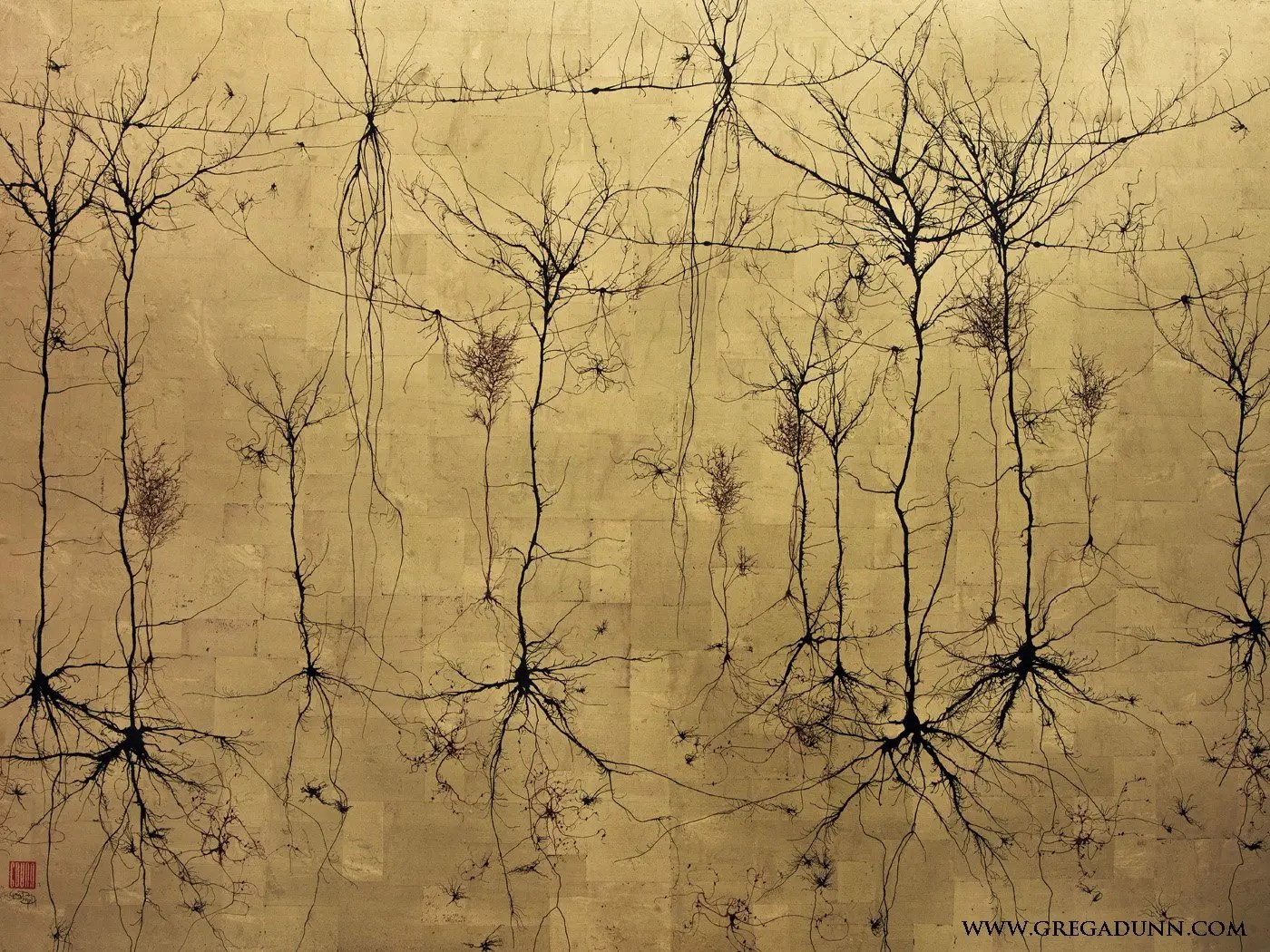
Greg Dunn’s gold-leaf neuroscience art: “Gold Cortex”

~

Howard Gardner once said aesthetics is considered the “dismal branch of philosophy” and that psychobiology, the scientific examination of art, might therefore be called the “dismal psychology.” This view derives from the difficulty of pinning down what qualifies as art, the artistic process, the artistic personality, and the like–especially the challenge of trying to categorize, measure, and in any genuine way evaluate art. Psychobiology as a discipline is new to me; is it merely an earlier form of behavioral neuroscience? How does aesthetics play a role? I went looking.

~

Here is an excerpt from D.E. Berlyne’s abstract of his exploration into stimulus behavior and art (including humor), Conflict, Arousal, and Curiosity, written in 1960:

The highly variegated human activities that are classed as art form a unique testing ground for hypotheses about stimulus selection. They consist of operations through which certain stimulus patterns are made available, and so they must unhesitatingly be placed in the category of exploratory behavior. The creative artist originates these patterns, the performing artist reproduces them, and the spectator, listener, or reader secures access to them and performs the perceptual and intellectual activities that will enable him to experience their full impact.

It’s intriguing to note the different ways a social scientist (Berlyne was a psychobiologist) uses language to write about a generally-considered subjective subject: art. Different in tone and terminology than the language a philosopher or artist would employ, the description characterizes yet another inquiry into the ontology and the exercise of art and the artistic process:

The content of art can range over virtually the whole scope of human communication. It may be used as a source of information about the appearances of objects, the course of historical events, the workings of human nature, as a means of effecting moral improvement, as a vehicle for propagating religious, political, or philosophical ideologies. Art is, however, distinguished from other forms of communication by …the communication of evaluation. While human beings may produce art and expose themselves to it for an endless variety of reasons, collative variables must play their part, as they do in all forms of exploratory behavior. They underlie, in fact, what is commonly called the “formal” or “structural” aspect of art.

The author is interested in whether psychosocial behaviors, culture-building, and communication all derive from exploratory behavior and stimulus-response and what role evaluation plays in the assessment of art, its social or moral value, artistic merit, “timeless” art, and to some extent the very making of art.

The psychology of aesthetics offers intriguing insights–if one can get past the jargon. From the little I have read about it so far, the science seems to share a few points with phenomenology: its task, according to Dr. William Blizer, is to “describe observable phenomena and to note associations and correlations among them which enable such phenomena to be predicted, controlled, and explained.” In psychobiology, the “observable phenomena” are “the behavior of the creative…artist and the appreciator.” Philosophy and psychology are strange bedfellows, though; throw aesthetics into the mix and the entire project begins to seem suspect. I am not at all sure that these inquiries end up explaining–certainly not predicting or controlling–anything about art.

I admit I prefer to read such musings when the makers themselves are doing the exploring. Nonetheless, this little intellectual excursion led to my discovery of Greg Dunn‘s amazing neuroscience designs, one of which appears above. Who knew the brain was so gorgeous?

Negotiating the storm

I have lived and driven vehicles in regions that receive a great deal of snow, but it has been awhile–and I am not as spry as I once was–and I don’t even own a pair of cross-country skis anymore (a favorite winter activity). Being responsible for keeping a house and property and cars and pets maintained while the ice comes down and the snow piles up and the heat stops working and the power goes off has also somewhat dampened my enthusiasm for snowy winters. Plowing and shoveling are no substitute for XC skiing, and harder on the back. Worries about possible frozen pipes or whether the oil truck can get down the driveway (which resembles a bobsled run) shove more leisurely, more inspired thinking out of mind.

iceimage~

Nonetheless, I cannot ignore the beauty of fields and trees in snow or branches rimmed with ice or–as tonight–the cold, bright moon above the cold, white earth. I remind myself that snow is the best mulch. I think of the crocus and narcissus bulbs snug and dormant below the deep drifts. The house we built does its job of upholding us and protecting us. The house, wearing its white hat…

~

A poem from 2007, an experiment in sapphics, that seems appropriate.

Negotiating the Storm

Dawn. I curl away from the ice storm toward you,
your breath cools my face and my hair, the warm room;
Love, we’ve had too few of these moments lately—
other storms plague us.

Ice assaults the windows with droves of needles,
gusts shove over pines and flatten the birches.
I am glad for the weather’s impersonal aspect:
nothing to blame there.

Sleep. The sleet does not suffer indecision.
You don’t have to touch me, just breathing is plenty.
Walls and roof are stolidly doing their jobs,
power is on yet.

Let’s recuse ourselves from the task of judging
guilt or merits the past twelve moths have garnered,
forge a drowsy peace between us and also the
guileless brute outside.

~

© 2007 Ann E. Michael

Studio. Space.

Contemporary artist and blogger Deborah Barlow writes: “A studio, like a womb, is a vesseled space, a geolocation from which one’s work, intentionally free of its context, can emerge.” http://www.slowmuse.com/2013/11/25/up-stairs-in-sight/

In another recent post, she talks about artists’ decisions about whether or not to offer studio tours, and art critics’ decisions about whether or not to visit studios. The critics she mentions (Saltz and Smith) prefer not to see the studios of artists whose work they are reviewing. The sense I get is that the critic needs more objectivity–a disinterestedness–and that a working artist’s studio is a personal space, one through which perhaps the critic might learn too much (context? biography? vulnerability? …one wonders).

I wrote my graduate thesis on how time works in poems, and for a long time I considered writing a followup on space in the poem, particularly the kind of vesseled, nested, interior space to which Barlow alludes (and Bachelard, in The Poetics of Space).

What spaces are conducive to the creative process? Such variety! I have friends who love to write in diner booths or cafes, and others who need complete silence, no distraction (Annie Dillard wrote in a closet; Robert Frost in a shed). One writer I know must be in bed to write. Another must be outdoors. The place matters to many people–but not to all of them.

Writing’s different from painting, sculpting–arts that require at least a few tools at hand.

But some of my writing friends need a computer, or a candle; a pencil and a legal pad, or a fountain pen and a spiral notebook; a bookshelf; darkness; classical music, or the blues.

I don’t really have a studio these days. Maybe it is time I lent my mind to carving out a creative space? –Somewhere nestled, vesseled, interior: (A Room of Her Own).

Below: A location…space, intentionally free of context.  🙂

IMG_0252

Sublime beauty

In his book Survival of the Beautiful, David Rothenberg says perhaps it was the evolution of an abstract aesthetics in art (abstract work as beautiful) that enabled human beings to begin to see natural things as beautiful in themselves–as opposed to the Romantic view that human yearning and elevated sensibility could best be encountered while experiencing Nature or Classicist ideas that found natural things corrupt and irregular, in need of perfection into better-proportioned objectification. In History of Beauty, Eco allows the Romantics their view of the sublime but says that in the late 17th c “the Sublime established itself in an entirely original way, because it concerns the way we feel about nature, and not art.” His text offers the paintings of Caspar David Friedrich as an excellent example, paintings that depict people as observers of the Sublime:

The people are portrayed from behind, in such a way that we must not look at them, but through them, putting ourselves in their place, seeing what they see and sharing their feeling of being negligible elements in the great spectacle of nature…more than portraying nature in a moment of sublimity, the painter has tried to portray (with our collaboration) what we feel on experiencing the Sublime.

I love the idea Eco parenthetically notes here: with the viewer’s collaboration. These paintings permit us to enter into the experience as the great preponderance of the artistic canon did not. Some critics suggest the environmental “movement” (in the USA, at least) owes its lineage to Leopold via Thoreau through Darwin, Wordsworth, and the German Romantics.

Friedrich’s work tends a bit over the top for my personal tastes, but I do think some of his best work (notably The Wanderer above the Mists, Woman on the Beach of Rugen, Moonrise by the Sea) does exemplify a sense I have experienced myself in natural surroundings when I feel myself a “negligible element” amid the remarkable scope of the cosmos and the world.

In the USA, at about the same time as the German Romantics, the paintings of the Hudson River school evoke some of the same sense of nature-as-sublime. (Frankly, I prefer Thomas Cole to Friedrich.)

~

This, too:

“The sense of the Sublime is a mixed emotion. It is composed of a sense of sorrow whose extreme expression is manifested as a shudder, and a feeling of joy that can mount to rapturous enthusiasm…while it is not actually pleasure…”   Friedrich von Schiller, On the Sublime (tr. Alastair McEwen)

~

“Poetry might be defined as the clear expression of mixed feelings.” I am pretty sure W.H. Auden said that. Which, by the way, gets us into the territory of the Sublime as described by Schiller.

~

In Japan, in the 17th century, Matsuo Basho composed haiku, some of which demonstrate the sense of the Sublime (without being Romantic at all)–i.e. that sense of rapture tinged with the shudder of grief or the feeling of awareness of one’s negligibility:

A wild sea-
in the distance over Sado
the Milky Way.

~

paintdaub
I stand on my back porch; I am small and negligible, the sky is large and Sublime.

Abstraction, evolution, & sky-beauty

I awakened this morning to a sunrise of surpassing beauty. As I drove to work, I remembered that the first poems I recall ever writing were about the wind and about dawn–perhaps I wrote other poems as a child, but these two are the only ones I remember: poems that celebrated something I found lovely in nature.

After the vivid morning sky, we had a day of rain; and on my commute home, a compelling sunset bookended the working day. I call these skies “beautiful” and would definitely regard my experience of looking at them as aesthetic.

And yet, it’s only the sky, some clouds, the sun, phenomena that science has explained. What makes it beautiful?

photo: Beejay Grob

photo: Beejay Grob (North Carolina coastal sky)

David Rothenberg’s 2011 book Survival of the Beautiful: Art, Science, and Evolution has accompanied me for the past week; I have been reading it when I can find time to read and to cogitate. Rothenberg speaks directly to the question of what makes us experience beauty, whether beauty is a human-only construct, and from where the qualities of aesthetic experience arise. He explores among other things whether beauty (especially in the form of art) evolved along with us, what makes it timeless (if it is indeed timeless), and whether our grounding in nature as earthly beings formed the grounding for what we deem beautiful.

And he considers symmetry and biology and abstract art and math and music. There’s quite a good deal of synthesis and speculation going on in this book.

~

Rothenberg writes that he is interested in whether humans’ developing education in abstractions–concepts and abstract arts–might produce an outcome that increases our appreciation of things in nature and the cosmos. He writes:

It might seem this century has freed us from interest in any kind of constricting form or function in art, but I want to test out a different theory: that abstraction in the arts has made us find more possible beauty in the natural world…as art exalts pure form and shape, the laws of symmetry and chaos found in mathematics and science seem ever more directly inspirational. Aesthetically, we become more prepared to see beauty where before we saw only the clues of beauty, its glimmers or possibilities…our minds are more attentive to an abstract kind of beauty that we can discover but not necessarily build or create.

It takes him several chapters to braid together the many strings of his interdisciplinary inquiries; but the upshot is that while I feel he does not answer the questions he begins with, he does deepen the reader’s thought process about art, beauty, and the evolution of ideas as well as of organisms. He says the interesting discussion lies not with what is or is not art, nor how to evaluate the individual merit of works, but rather “how artistic expression changes how we think in ways only art can accomplish.”

~

In light of Rothenberg’s musings on how natural-feeling abstract art can be, here are some examples: Barlow, Ellis, (contemporary) and Klee (modern).

Rothenberg concludes with some ambiguity about aesthetics and evolution, which suits his book-length and life-long explorations on the interweavings of these ideas; but he adds with certainty that “[b]iology is not here to explain away all that we love in terms of the practical and rational. That is not how nature works. Nor should we shrink from our natural astonishment at the magnificence evolution has produced.”

~

He mentions John Cage’s work and approach to composing, and I think Cage’s main point in so much of his work is getting us to listen, to see, getting us to be attentive. Viz Rothenberg’s words quoted above, maybe an integration of abstraction does open us to be more attentive to the beauty that exists in the world without any artist making it. We could not, in the past, have appreciated the fractal values of river deltas viewed from airplanes; and perhaps only natural (or trained) artists noticed how the twigs of a tree reiterate the shapes, angles, and curves of the branches, boughs, sometimes even bark. Now we know about Mandelbrot sets and fractal geometry, and those abstractions can generate beautiful patterns. Now we know the Fibonacci sequence of numbers–an abstraction–appears in snail shells and sunflower seed-heads.

We do not have to be mathematicians, chemists, art critics, environmental scientists, physicists, sculptors, violinists, composers, dancers, college professors or biologists to recognize patterns and symmetries, or to find that slight variations in the pattern enhance the experience through the kind of surprise and delight that I discover in great poems.

We just have to be attentive.

~

sunset1

Autumn, time transfixed

IMG_0127

When we were initially landscaping our property, I chose to plant a particular species of zelkova known for its lovely fall foliage color. I cannot recall the variety now, although I am sure I recorded it in my garden journal 16 years ago. The leaf color is challenging to capture in a photograph. If only I were a painter, then I might manage. Of course, the color varies depending upon time of day, cloudiness, and atmospheric changes.

It is a lovely tree that announces the equinox quite articulately.

~

Equinox, autumnal: a slowing of crickets, the brief visits of migratory birds, quieter dawns, fewer bats at dusk, longer shadows. Time is far from transfixed.

~

I visited the Museum of Modern Art, New York City, on a warm October day to see the René Magritte exhibit. Magritte’s work is so easy to parody, so graphically amusing, that my brother–who was not all that familiar with the artist–at first said, “This reminds me of mediocre high school art.” After viewing the entire gallery, however, he had changed his mind about Magritte.

Magritte did a great deal of commercial art and, like Warhol years later, felt comfortable with the kind of graphic representation to which wide audiences respond. And then he played with that audience’s expectations, sometimes more effectively than others. One painting which certainly upends expectations and which I was glad to see again is La Durée poignardée, on loan from the Art Institute of Chicago; it was a favorite of my late friend David Dunn.

La Durée poignardée (1938)

time-transfixed-1938(1).jpg!BlogThis image of the painting appears at http://www.wikipaintings.org/en/rene-magritte#supersized-featured-211652

~

Here’s some playfulness concerning the title. The French word poignarder means to stab, and the implication is to stab with something pointed, ie, a dagger, since the verb is transitive. It interests me that the accepted English translation for this painting is “Time Transfixed.” The meaning I associate with transfixed in terms of, say, holding in one place (pointedly?) is that of pinning insects to a board as in lepidoptery displays. In this painting, the “stabbing” seems to be reversed: the pointy end emerges rather menacingly from the static, domesticated mantelpiece. If this image depicts the verso side of the display, it could be time itself that has been killed, spread open, and pinned, invisible from this aspect. Or perhaps the translation should be “Time Stabbed through Its Continual Duration,” stabbed with a poniard in the shape of something almost as ongoing, the contemporary barreling locomotive engine.

As it is a genuine surrealist painting, no particular meaning can be assumed. The images are random; make of them what you will. Magritte came up with wonderful, mysterious titles for his work–his paintings and their titles have inspired quite a few poets over the years. David Dunn was among them.

No wonder, really; this artist was quoted as saying, “The function of painting is to make poetry visible.”

~

Meanwhile, since I am not a painter, I will let the zelkova tree make poetry visible to me for a few days…and then get back to writing some myself.

Tension or rebellion?

In my few available moments during which I can write about being intellectually engaged and curious, I’ve been working on this post. It’s been a “draft” on my dashboard for some time as I work on it. For background, recall that I was reading Octavio Paz’s prose and Dave Hickey’s essays in The Invisible Dragon.

~

Rubber-Band-Shooter_preview_featured

~

Both writers take up the concept of beauty in art. They approach the topic in different ways, of course, but both make note of the requirement for tension in the work of art. The tension can be of anticipation, expectation, surprise, or of opposition and rebellion. The need for anticipation and turns or surprise in poetry reminds me of Robert Bly’s idea of the “leap” in poetry–in fact, Paz is one of the poets Bly uses as an example of “leaping poetry” in Bly’s classic 1972 tract, Leaping Poetry. I infer that these emotion-forms are related to one another and that aesthetics involves at least some connection between experience (physical, emotional) and mind.

[For now, I will not take up the possibility of calm, contemplative, no-tension beauty.]

Instead, it is intriguing to consider the ways Paz and Hickey interconnect regarding the idea of rebellious art. Also, there’s an agreement between them–not literally, as they are not responding to one another at all–concerning art that is funded by governments. Both critics contend that way lies danger.

Hickey’s essays in The Invisible Dragon were sparked by the controversy of Robert Mapplethorpe’s U.S. NEA-funded photographs. These photographs are beautiful, Hickey says, though art critics of the 1990s dismissed the “beautiful” aspect of the work and concentrated on its “message,” while many other viewers considered the images pornographic and offensive. Hickey says, essentially, to hell with the message; look at the art: is it beautiful, or not?

Hickey writes:

My point here is that there are issues worth advancing in images that are worth admiring–that the truth is never plain nor appearances sincere. To try to make them so is to neutralize the primary, gorgeous eccentricity of imagery in Western culture since the Reformation: the fact that it cannot be trusted, that images are always presumed to be proposing something contestable and controversial. his is the sheer, ebullient, slithering, dangerous fun of it. No image is inviolable in our dance hall of visual politics. All images are potentially powerful. Bad graphics topple good governments and occlude good ideas. Good graphics sustain bad governments and worse governments. The fluid nuancing of pleasure, power, and beauty is serious business in this culture.

Hickey’s prose is such fun! And so provocative. He asserts that Senator Jesse Helms (who began the noisy movement to de-fund the NEA’s support of work such as Mapplethorpe’s) was the only public figure who really “got” what Mapplethorpe’s homoerotic pictures were saying: they really were a rebellion, a transgression–a purposeful confrontation with social norms. That’s what many artists and poets do: throw a wrench into the usual mundanities of life and make viewers or readers pause, react, reflect.

Mapplethorpe’s choice of images just happened to be considered sexually transgressive; and Hickey says that because the USA is a democracy, Helms’ right to protest was as valid as the photographer’s right to make the images in the first place. Hickey loved that there was potential for real discovery in that moment, and gives art critics and academics a hard time for retreating into ideas of First Amendment and artistic self-expression and meaning over beauty. He claims that when it comes to the US democratic culture of the arts, “whatever we get, we deserve–and what we get most prominently is ignored, disenfranchised, and instructed. Then we are told it is ‘good’ for us.” But what is good for us by the standards of a bureaucratic culture is not the original contract between the image and its viewer, even though that is the interaction that ignites the spark of awe we feel when we encounter great art.

“In fact, nothing redeems but beauty, its generous permission, its gorgeous celebration of all that has previously been uncelebrated.”

Hickey lambasts Americans for somewhat mindlessly appreciating what we are told is great art. “In our mild appreciation,” he writes, “we refuse to engage the argument of images that deal so intimately with trust, pain, love, and the giving up of the self.”

Paz’s chapter on the image in poetry dovetails with the argument of images and the intimacy thereof. That’s the contract the viewer or reader makes with the artwork or the poem: we agree to be, potentially, moved; to make ourselves possibly vulnerable to rhetoric, to pain, to love, to beauty, to sudden awareness of what has been overlooked, ignored, oppressed, made alien.

Through image. Through tension. Through a state of contrariness and forbidden looking: rebellion.

~

In a week or so I do plan to spend more time on Paz, because I find his essays on poetry enlightening on an intellectual and on a more basic/fundamental level. Hickey’s work on beauty relates to writing but is more specific to the visual and plastic arts. I do recommend Hickey for his humorous but incredibly observant role as a socio-cultural commentator on contemporary USAmerican pop culture, academic culture, political culture, and democratic-capitalist thinking. He’s accurate and insightful even when I don’t completely agree with him. He believes whole-heartedly in discourse and discovery through democratic discussion of multiple viewpoints. Check him out. You will want to argue with him.

Critique: an anecdote

A group of friends gathers once a month to read and share and critique one another’s poems. They know one another well enough that they can be empathic, honest, and helpful; also, they are trusting enough to bring poems that really aren’t “working.” The critique’s the best way to get some understanding of why a poem is not working.

Recently, one member shared a poem that was somewhat philosophical in its overtones. The rhetoric of the poem was shifting, getting away from her, and she knew it. But she couldn’t figure out why, or how to correct the problem.

The talk moved away from critique and into values–for awhile. So the group was no longer exactly discussing the poem, or poetry, at all.

And yet, through the conversation, the writer recognized where at least part of the poem’s problem lay…which was in image and in structure (as illuminated, perhaps, by value and by rhetoric).

Reason can lead to beauty.

Beauty & awe–briefly

I have been reading lately (currently Leonard Shlain’s Art & Physics and Donald Revell’s The Art of Attention: A Poet’s Eye), but not much inspired to write. Instead, I work in the garden or sit on the porch and listen to birdsong.

I muse upon beauty. Partly such musing falls under the pursuit of aesthetics: the world of my garden becomes especially beautiful in spring. The sounds birds make seem beautiful to my ears. Water droplets on emerging leaves appear beautiful in the morning light.

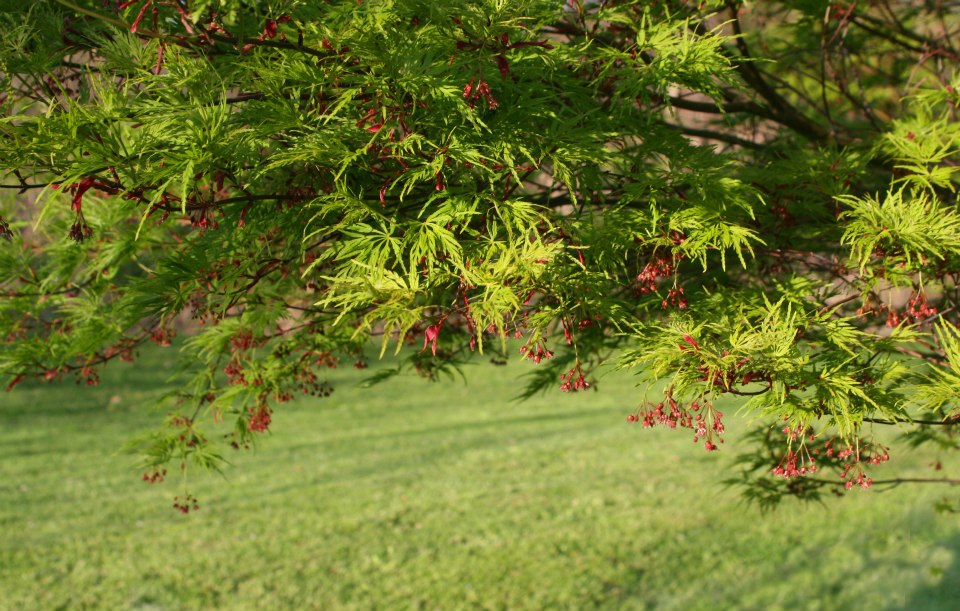
japanese mapleThese are phenomena. The world of things I can take in with my senses, process through my body and brain, and create–out of whatever “mind” may be–a concept of the beautiful. The phenomena are not physically affected by my categorization. It is I who am changed, I suppose, by virtue of my aesthetic appreciation of the beautiful.

I am reminded of Kierkegaard:

“Love does not alter the beloved, it alters itself.”

Aesthetic appreciation does not alter the thing-in-itself, it alters the person who finds beauty in the thing-in-itself. If this is so, I am altered by my love of what I deem beautiful.

~

While I was searching the web to find the quote above–I couldn’t quite recall it exactly–I found the Kierkegaard quote on the blog of pastor Jonathan Martin, whose theology I can’t completely get my mind around but whose words (below) reminded me of the Bhagavad Gita:

The most beautiful thing a person will ever see may well also be the most terrifying.

Is this not the nature of true beauty? To not just be soft and delicate, but to be so powerful, so overwhelming, so altogether other from ourselves as to threaten? Beauty does not intimidate, but it can overpower. Beauty is a coup to our senses. It holds an unruly power over us. Beauty can move us, haunt us, carry us, compel us. To feel ourselves beholden to the raw power of something beautiful is to be upended, not just inspired but assaulted.

On the lines of such thinking, we might find beauty in a tsunami, hurricane, earthquake, meteor strike the same way Arjuna feels paralyzed by the awesome beauty of the revealed godhead Krishna.

Perhaps that is why we often find ourselves fascinated by photos of natural disasters. Having lived for a couple of years along the northern end of Tornado Alley in the USA, I fear tornadoes. But they possess a kind of beauty in their awesomeness, if we can remove ourselves from the anguish we feel for people whose livelihoods, homes, and lives are destroyed by the big winds.

I wonder if human beings can ever bear that kind of awe; Martin says it transfigures us, Kierkegaard implies something similar, the Mahabharata and other sacred literature suggest that our bodies and our minds can withstand such revelation but cannot describe or truly comprehend it. It seems to me a kind of spiritual post-traumatic stress disorder! This is the “fear and trembling” of the psyche, whether the mind decides the experience is physical, mental, spiritual, or religious.

And that manner of beauty is not aesthetic.

Martin later writes, “Objectively speaking, the beauty of God is already present in our beloved, whether we recognize it or not. Rather, when we encounter beauty in another person, we are changed–we are transfigured…[those we love] do not become beautiful because we recognize their beauty; rather their beauty makes us beautiful.”

Is this experience awesome or aesthetic? Does the beauty of the azalea, the lilac, make me beautiful because I recognize it as such? Am I altered, fundamentally, in my admiration for an artist’s work, a poet’s words?

~