Back in time

At Şanlıurfa in the Urfa region, a Kurdish area in eastern Turkey, we stayed two nights after our visit to two amazing, ancient monuments that are really out in the middle of nowhere: Mt Nemrut Dağ (the tomb of Antiochus I) and Göbekli Tepe, a Neolithic site of the Stone Mound Culture, both Unesco World Heritage sites. I remember reading about the discovery of Göbekli Tepe in the early 1990s, when German archaeologist Klaus Schmidt began excavations there; the “buzz” at the time was that these megaliths mark the earliest temple or place of community worship ever recorded [ca. 9000 BC]. Since then, new discoveries unearthed at Göbekli Tepe, as well as discoveries of similar sites (such as Karahan Tepe, which we later visited) in the region, have somewhat altered Schmidt’s original speculations.

It appears now that people lived here at least part of the time, though until these discoveries, historians assumed humans in the pre-pottery Neolithic Era were hunter-gatherer nomads who did not build permanent structures. Our guide told us the current thinking is that the buildings here played some sort of role in preparing young men for adulthood–almost all of the reliefs and statuary portray male figures and male animals. But it is early yet to guess, and besides, we can never know for certain.

But there are cisterns, a system that distributed water through tunnels, containers that have traces of grains and, yes, beer. Back to the argument of which came first to humans: Bread or beer. My money is on beer. *

But to back up a few hours–first, we rose at 5 am so that we could take the circuitous drive up the mountainside to Nemrut Dağ, a relatively youthful site built around 60 BC, presumably by Antiochus I, who was connecting a slew of peoples and cultures together in a kind of Iranian-Hellenic-Armenian-etc. aggregation in a move toward empire at a time of Roman ascendancy. Commagene is the Romanized name used for this ancient region, which was a merger of Persian and Hellenic areas once Alexander the Great’s empire had disintegrated. Antiochus married a Cappadocian princess and had big plans, but his empire did not last long after his death; by 29 BC, his sons had died or been executed.

The path we walked up to get to the tumulus, 6:45am; my photo

And then over time, this huge tomb monument was forgotten until its rediscovery in the 1880s. The region feels deserted and surreal, and the climb up to the tumulus–though there is now a partially paved path–is long, the wind swirling around, full of dust. My sunhat blew off my head even though I had a neck strap. I guess that was my offering to the ancient king.

What an astonishing place it is, especially at dawn, and despite a fair but not overwhelming number of tourists.

~

Monuments are a step toward writing: they tell stories, written in stone with picture images, because the stories we tell or sing with our human voices don’t leave much of a record for cultures other than our own. I found myself wondering what the poets of these ancient places said or sang, and how their language sounded, and whether I would feel exhilarated or moved by those lays had I been there.

And at Göbekli Tepe, when I learned about the cisterns that contained beer, I thought of a poem I’d written some years ago after visiting a Mesopotamian exhibit at the Penn Museum in Philadelphia. So with a bit of awe and a bit of tongue in cheek, I’ll post it here. [It initially appeared in Mezzo Cammin.]

~

*Porter, Stout, & Mesopotamian Deity

Sisters, let us raise a glass
to agriculture, to dark brew
made possible by wooden hoes,
by seed-gatherers: me and you,
our aunts, foremothers, those
who stayed, patient, and grew
grains, diverted rain, winnowed,
boiled, fermented mash, who
certainly invented ale. For we
descend from goddess Ninkasi
who nourished babies through
breast milk fortified by beer
and whose forgotten virtue
we revive, consuming her.

~~

Thanks to copyright-free photos from Pexels since my own photos are snapshots taken with an out of date cell phone.

Illusions, connections

Reading Proust again returned me to some of my own past reflections on memory and self, the capital-S Self. A decade or so ago I spent considerable time reading in philosophy, physics, and neuroscience in an endeavor to get a grip on human consciousness and, perhaps, behavior. I posted about some of these texts on this here blog, in between writing about poetry, the garden, and my teaching job. Recent coincidences of reading returned me to this topic, “the hard problem of consciousness,” and made me consider how our embodied selves/minds/awareness: use shortcuts to manage the overwhelming inputs of our environments; define who we are using subjective if physically-based perceptions; and fail to see the obvious because of habituation and the apparent need to confirm what we believe we know. Illusions! The Vedic concept of Māyā, Plato’s Theory of Forms…propaganda, Penn & Teller, quantum physics, complexity theory, Marcel Proust, complementarity. I have a lot on my mind.

If it IS on (or in) “my” “mind.” For there’s even some question about that, as proposed by Neil Theise in his book Notes on Complexity. Just as light can be a wave or a particle, depending upon perspective and viewer (see: complementarity), it’s possible that our minds or selves can be individual and separate but also connected and boundary-less. The subtitle of this text is what appealed to me: “A Scientific Theory of Connection, Consciousness, and Being;” so far, I’m enjoying it and finding inspiration.

It’s needed, inspiration. Despite a few plunges into new drafts (see here), I have not been writing much for at least two months, and I miss it. The ideas from physics and neuroscience that intrigue me include potential metaphors and terms such as quenched disorder, endosymbiosis theory, and holarchy. These–along with the hard problem of consciousness–all have some relationship to complexity theory, and Theise does an elegant job of writing about complicated science concepts for the non-expert.

I ran across Notes on Complexity right after finishing Sleights of Mind, a book about the neuroscience behind the sort of illusion we call entertainment magic: sleight of hand, sawing people in two, mentalist “mind-reading,” and other performances; the authors, Susana Martinez-Conde, Stephen Macknik, and Sandra Blakeslee, are trying to discover more about how brains work (or filter, and sometimes don’t work so well) by studying how we get fooled by illusionists. This is a fun book, even more fun for me because one of my Best Beloveds has long been an enthusiast of magic shows and magicians. Martinez-Conde and Macknik are neurologists, so–unlike Theise’s text–this book is very body-mechanics in its basis. Their work reminded me of how amazing the human physiological system is. And it’s entertaining.

Before these non-fiction reads, I was finishing up with Proust who, in his own creative way, was exploring the interiority of the human self and carefully observing human interactions, behaviors, assumptions, prejudices, and aesthetics. Not neuroscience, because there is no science to it, but definitely related to how our brains and bodies process experience. My sense is that poetry works that that way for me: it’s not an abstract stream of thought but something inextricable from bodily experience, maybe even, through the environment in which we exist, something deeply connected to everything, a global being-there.

The way we process experience (and is this consciousness?) is largely what leads us to the arts, to make art or to appreciate it, and to decide what feels compelling, important, beautiful. And it’s not all in our heads.

Heaven, hell, & halos

After 30 years, my husband and I still take part in the Goschenhoppen Festival each August. You will find I have mentioned it in many an August blog.

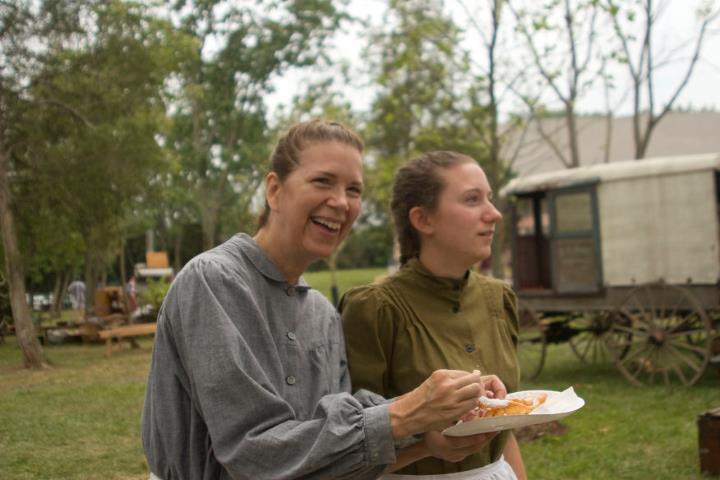
The photo at left is from 2010 or thereabouts, when the festival had newly moved to the park in Perkiomenville, PA, which is where the beautiful Antes House (ca. 1736) is located. My daughter and I were enjoying funnel cake. The park’s trees have grown considerably since then, and there’s more shade for demonstrators (and visitors). We were grateful this past weekend that the sunny days were not as humid as some years and that there haven’t been downpours to churn the parking areas into mud. And though neither of my own offspring could participate this year, it was lovely to see their festival-friends now grown, married–some having kids of their own–and still showing up to volunteer at the two-day reenactment of Pennsylvania German folk life of the 18th & 19th centuries.

My demonstration is in the 19th-c household and foods area, and each year I am assigned a couple of young “apprentices,” girls ages from 12-17 in gingham work-dresses. This year a friend’s daughter was thrilled to be old enough to officially participate. She is full of wondering about life and is the sort of child who poses her questions and speculations aloud. She’s also at the age when she’s taking church classes for confirmation, and she’s interesting to talk with when she wades into her thoughts about Big Subjects. I often find myself telling her that the things she wonders about are puzzling even to grownups. Because it’s true.

Yesterday she asked about someone we knew who had died: “Do you suppose they went to heaven?” Yikes. While it might have been a good opportunity to throw a wrench into religious indoctrination, I felt her parents might not appreciate that. I merely responded that I didn’t see why not. But this little exchange reminded me of my own wrestling with the idea of heaven and hell when I was her age. From fairly early on, I just couldn’t imagine that the cartoonish heaven of winged souls wearing halos was in any way real; and though hell was also mentioned frequently in church liturgy, prayers, and hymns, my dad’s belief in a god who was forgiving made hell seem unlikely. So the information I took in was confusing.

It is no less confusing to me now, but I no longer sweat over it the way I did as a child. Anyway, the conversation with my little friend called to mind a poem I’d drafted after returning from a visit to the Metropolitan Museum of Art’s exhibit “Siena: The Rise of Painting, 1300-1350” which reminded me of how I loved Medieval and early Renaissance art when I was a youngster. All those saints and crucifixions. All that gold and iconography. I must have had a gothic tendency!

This draft may be more about art than about heaven, and more about envisioning than about anything else. It's not a finished poem, but who cares on this bright, late-summer morning?
~


Halos

What interested me most about
paintings of Jesus was
the glow around his head
because I saw such auras everywhere
when sun silhouetted our cat
in the dining room window
or lit up dew on tall grasses.

In later years I studied art
and learned the problem of cheating
light from solid pigments
the paradox of density layered
so some artists applied gold dust
to depict the nimbus gleam.

Yet even my little sister’s
fine blonde curls or the hairs
on my own skin could shine
that way illuminated like crowns
of hickory trees some autumn
morning long in brightness
no art to it at all.

Blue

At one of our local used book stores,* I found a copy of William Gass’ 1976 On Being Blue: A Philosophical Inquiry. Gass writes in a style one might term prolix; but if you are like me and sometimes appreciate lists, wordplay, allusions, lengthy sentences, and fine distinctions in your sentences–as well as humor–while exploring the limits and the stretches of words and language, this book-length essay on the word/concept/color/iconography/sexual innuendo/moody attitude and conflicting meanings of the word blue might appeal. I’ve been feeling a bit on the blue side lately, hence my attraction to the book (though I do like Gass as a writer, as long as I don’t have to read too much of him at one time). And guess? It cheered me! [I will caution the reader who avoids the use of “bad language” that Gass employs such words in this essay, for purely intellectual reasons…]

Granted, my feeling blue has a different tone from other uses of the word: blue postcards, sexual meanings of blue–I’m reminded of the movie “I Am Curious (Blue)” which was considered racy and given an X rating when I was a kid, though the blue in that title referred to the Swedish flag, apparently. My blue is the blue of songs like “Baby’s in Black” or Joni Mitchell’s “Blue” album. Or just that classic music form, the blues.

And I’ll get over feeling this way. That’s what moods are: feelings that come and go, transitory. It always seems as though low moods stay around longer than neutral or cheerful ones, but many scientific studies show that it is our perception and memory of the negatives that make us think we are sadder for longer. Even Wikipedia has an entry on negativity bias, with some sources if you want to check things out yourself. As I age, I realize that bad moods and sad events and past mistakes don’t need to stick around as much as I used to think. A bit of mediation, some practice and readings in Zen and in psychology, a lengthening perspective on life’s vicissitudes, some counseling and even some medicine; whatever it is that’s brought me here, I recognize that before long the depressive hours will lift. Also I know some methods of thinking that assist me to move to more neutral ground.

I will note there are many kinds and hues of blue, enough for Gass to write 112 pages on it and for the word to appear in 85 files of my own poetry during the past 12 years–I did a quick word search just to find out. That is in the files alone, and each file contains many poems. so I can only imagine how much I have over-used the word in my writing life! Certainly, not all of those blues are sad. Many are beautiful, sunny, the blues of blueberries and balloon flowers, the New Mexico sky, mountains and oceans; teal-blues and turquoise, the bright royal blue I like to wear, the pale color of robin’s eggs.

Blue. It has always been my favorite color.

~~

*The bookstore is Apport, in Emmaus, PA. Ben has an active Instagram feed and really cool catalogues of odd books, art, and ephemera.

*The first “blue” above is an encaustic painting by Deborah Barlow; the second is at Bandolier National Monument; the third is of the Blue Ridge Mountains; the last was taken at an inlet bay, maybe in Delaware–I’ve forgotten.

Behind the arts

The regional drought has officially ended, and the rain continues. Ironic, then, that the online site Feed the Holy just posted a poem I wrote near the close of a droughty August: “Zen Gold.” Fireflies and bats, while not abundant, manage to enjoy the recent dampness. The monarch butterflies have returned to our meadow, though I don’t catch sight of them on rainy days. But the moist conditions didn’t dampen the turnout or enthusiasm of local citizens who came out in droves for peaceful “No Kings” protests here…in a decidedly “purple-red” area of Pennsylvania.

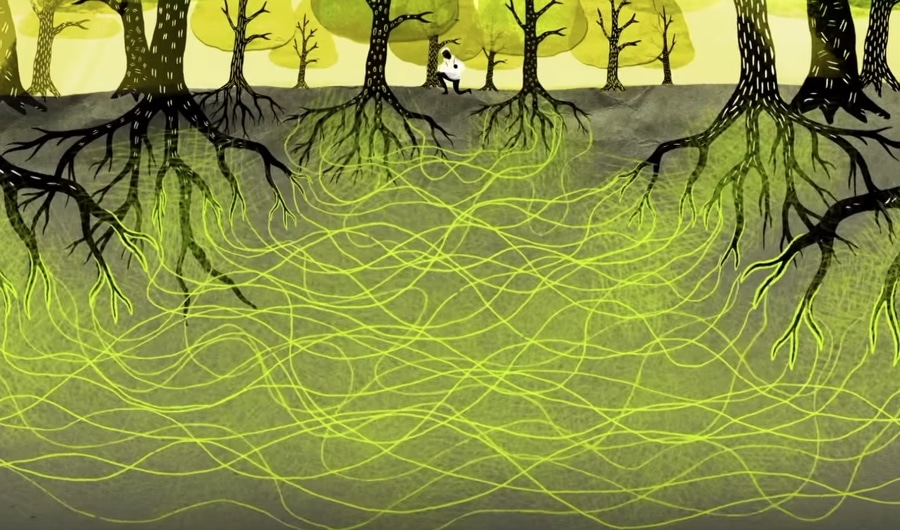
Speaking of regional, this weekend I also attended the debut showing of a documentary film about the performing arts community in Bethlehem, PA, formerly famous for Bethlehem Steel Corporation. The film is titled “Rooted,” and it follows that “roots” idea with the planting of trees at arts sites, the metaphor of the mycorrhizal network (see my references to Lesley Wheeler’s latest book–so much overlap!) and the concept of community development. Especially through works of imagination. In the 1970s, when the steelworks was beginning to slow production and lose employees to retirement and business to competitors, small groups of young, talented artists in theater, dance, music, and puppetry started performing in parks, churches, etc…and gradually found inexpensive space in the city to establish themselves and pursue their dreams. Some of those little startups, such as Touchstone Theatre, have been operating, teaching groups of children, entertaining the community, and advocating for the arts for over 50 years.

Godfrey Daniels coffeehouse/listening room and The Ice House (home of Mock Turtle Productions) have been sites for poetry as well as for music and theater-craft. I have participated in and attended poetry and one-act play readings at both of those venues. I don’t live in Bethlehem, but it isn’t too far away from me–still in the Lehigh Valley region. And I deeply appreciate the work that pioneering arts-folks have done, and that arts advocates and teaching artists continue to do, for our area. The people behind the arts deserve recognition.

I’m not the sort of person who networks well; event-planning exhausts me, and preparing for committee meetings and writing grants are not my forte–though I gladly proofread grants and PR materials for local non-profits. Thus I admire the types of people who not only create in the arts but also find creative ways to keep the arts alive through outreach and planning, often in the face of very steep odds (yes, I’m talking funding here, and board membership, and organizing the necessary minutia, and the grind of public relations). God bless them for making space for actors, musicians, dancers, visual artists, sculptors, installation artists, poets, and visionaries of numerous kinds. It’s because of folks like these that I don’t have to travel all the way to New York or Philadelphia to experience lively contemporary arts of many kinds.

You can think of local arts organizations as the independent booksellers of the performance world. You go there to discover stuff that you won’t find on best-sellers lists, for work that’s by new artists, or work that’s been rediscovered, or cool perspectives on the familiar canon of major works by the famous. That has value. That offers inspiration. That gives you the courage to keep on doing whatever kind of art it is you do. Which in my case is poetry, not generally thought of as as performance art–though it once was, and slam poetry events prove it can still be. Maybe I’m a little more of a hermit-in-the-woods writer, but that doesn’t mean I never want to venture out into the wider arts community. And when I do? I’m grateful for the people who have established the beautiful network under my feet.

image: https://truetimber.net/TrueTimber arborists

A little green

Summer arrived rather suddenly here in the valley. After a rainy May that was a bit cooler than average, June has slapped us with 80° days and sunshine. Not that I am complaining, but it does throw a curve at the vegetable garden’s usual progression.

And all that rain burgeoned into so much verdancy–my eyes almost ache from all the green! We’ve needed the rain (the wettest May on record) to make up for the driest October on record (2024). Nature appears to be doing its best with balancing things out in the face of all we humans have been doing to unbalance it.

Quite a switch from the spring greenery in the mountains of New Mexico, greens that are far less chartreuse in hue, the kind of green you have to be looking for amid the deep jades of pines and the brownish-green cholla. Prickly pears are a bright shade of green but don’t evoke any sensation of lushness. The little-leaf oaks start out with a fresh hue but become very dark, nearly black, as the season progresses.

I was thinking about the hues of the high desert because of our visit to the Georgia O’Keeffe Museum in Santa Fe. One of the galleries there is a display of the artist’s pastel chalks, brushes, and color chips she created for herself to get the palette she felt best represented the landscape she knew. Many shades of ochre, browns, dull oranges, sandy yellow, and that famous turquoise blue of the New Mexico skies–but also the green of cottonwoods in spring, the green of pinyon and ponderosa, the sage green so common among low-growing plants like sage and rabbitbrush.

Try defining the word green.

A little Joni Mitchell to accompany that request:

Riches

The past week gave me riches galore; though I am somewhat poorer in the pocket for it, my cup runneth over in about every other way. It’s true that often, lately, I’ve felt that I am living in “interesting times” that are all too much and too awful to contemplate for long. Then again, I could have been alive (possibly quite briefly!) during Boccaccio’s time and weathering the bubonic plague. Thanks to The Decameron, readers later in history have been able to get a picture of what people were thinking about and imagining–or trying to escape–when things were truly terrible all around. And while I’m not pollyanna-ish about the present, I do feel grateful that I live during an era when travel to distant places is possible and rather speedy, that books are readily available, and that some of the wealthy people of the not-too-distant past decided that philanthropy included funding libraries, gardens, and museums for the average citizen to visit and enjoy. Current billionaires, please take note!

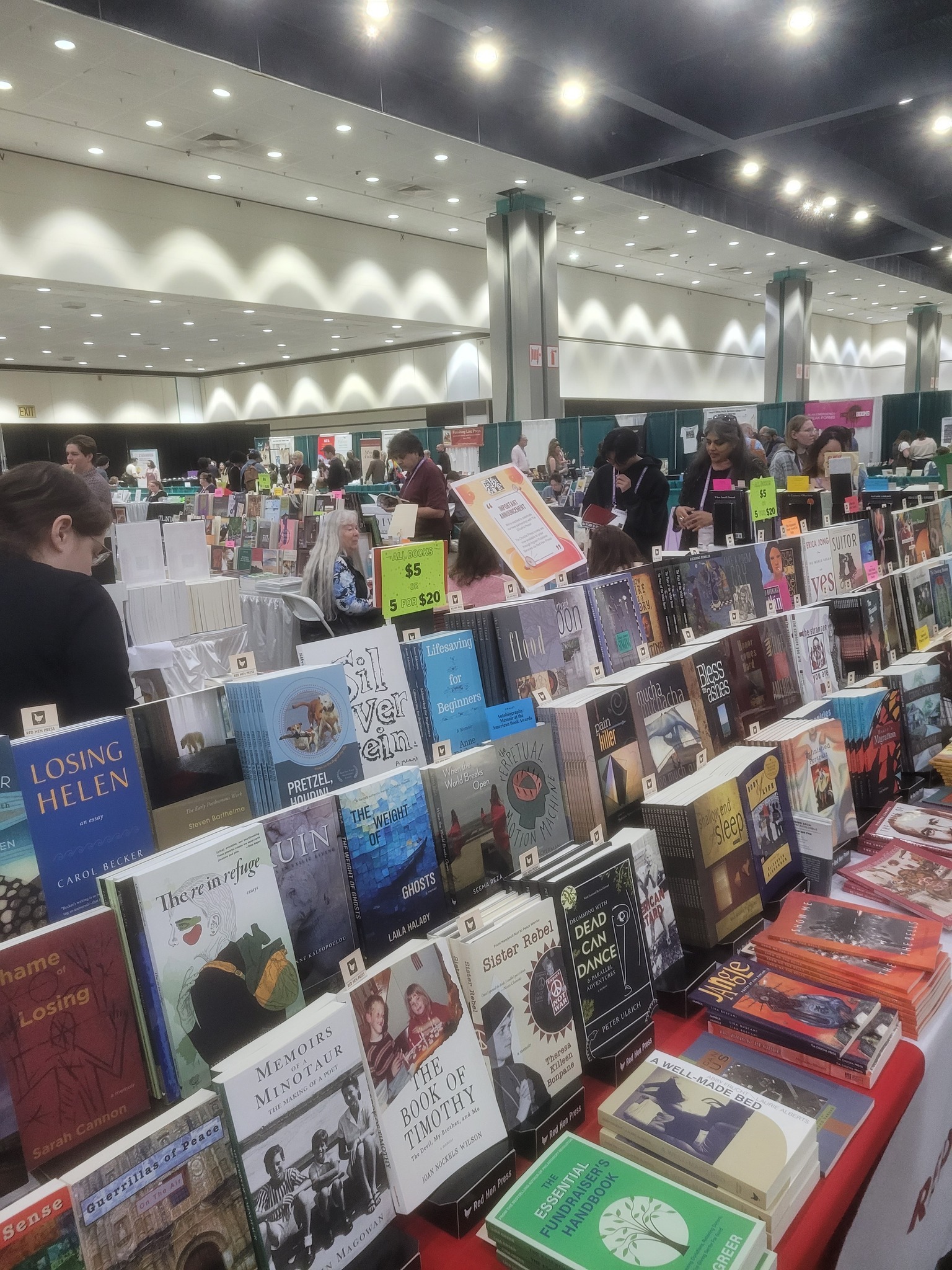
What the week entailed was a trip to Los Angeles to visit my eldest child and, while there, to spend a morning at the AWP conference book fair. Riches indeed! I “packed light” to be sure I had space in my carry-on for poetry books, which thankfully tend to be slim paperback volumes. I bought almost 20 books, I confess. So I came home weighted with literary riches, and while at the convention managed to connect (however briefly) with numerous poet colleagues. A shout-out here to Lesley Wheeler, whose book I had to purchase online because Mycocosmic had sold out! Congratulations, and I cannot wait to read it.

My days in LA were limited to four, but my son had curated a things-Mom-would-like-to-do list that included Mom’s necessary down time. It’s terrific to have offspring who are now old enough to respect my limits. [They have not always been so accommodating.]

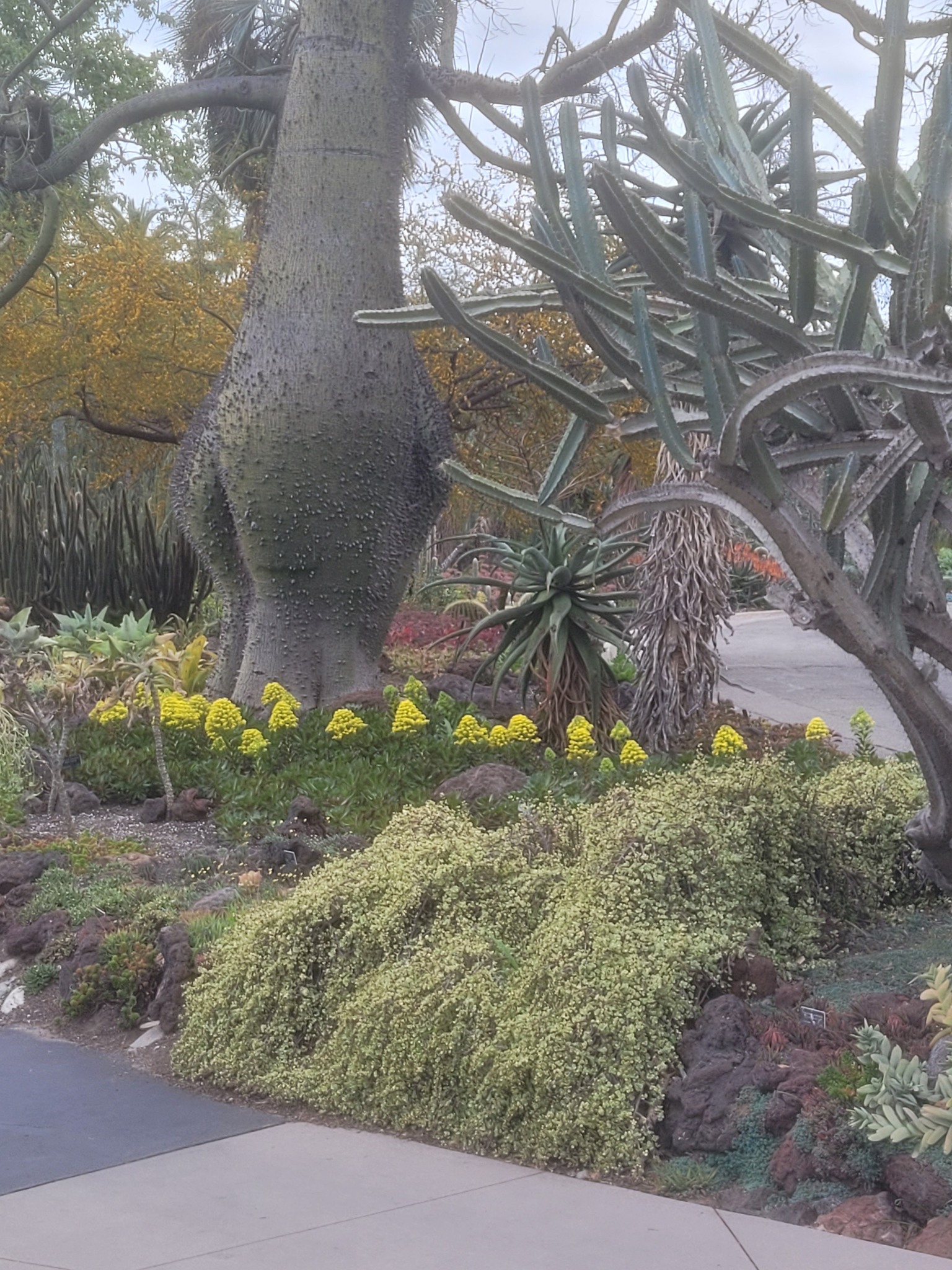
The list included several lovely meals out, a full day at Huntington Gardens and Library, a day trip up to Santa Barbara, a visit to LACMA to get an “art fix” for me and for my son’s best beloved, who loves art and architecture, and a visit to the amazing Museum of Jurassic Technology which, as far as I am concerned, is basically a series of amazing poetry prompts. I cannot possibly explain it; and the museum’s website is purposely a bit obscure and limited, compared to the immersive experience of going to the place in person. I am still thinking about it and will be for weeks.

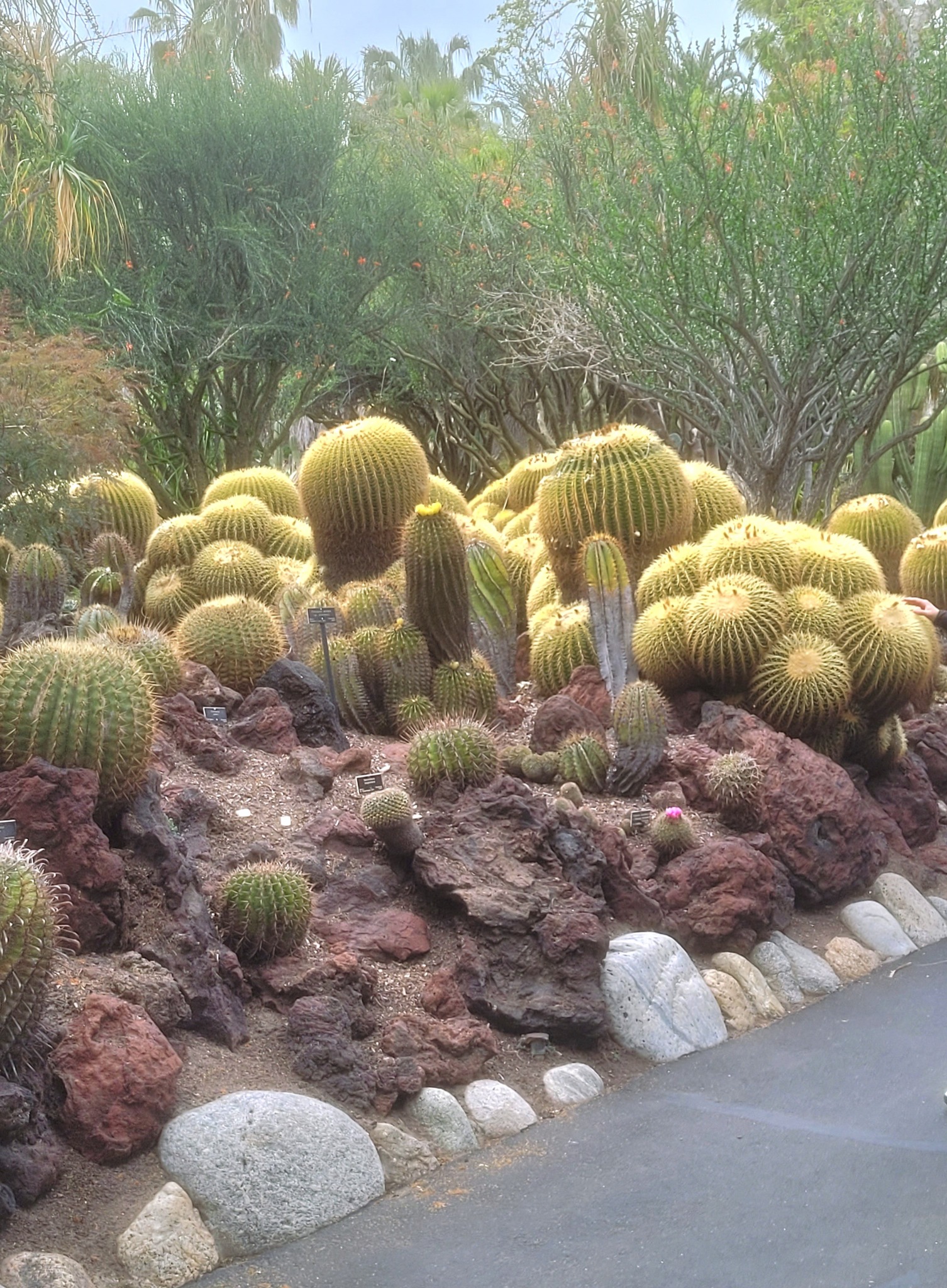
The barrel cacti at Huntington

While photo ops abound at the gardens, no photos are permitted in the Museum of Jurassic Technology; I will lead you to the website and just keep you guessing. But among the riches of the last week are germs of new poem drafts. We shall see what emerges.

Four+ days away, and I returned to spring in eastern PA: narcissus, magnolias, glory-of-the-snow, squill, bloodroot, forsythia, ornamental plum. Even more richness. Gratitude for the glory.

Febru-dreary

I try not to hate on February. The days do get longer; there’s often some early blooming or greening, a little more birdsong in the mornings, days that aren’t too miserable for walking. But. A lingering malaise of the spirit often natters about in the background of my days. This year, I am trying an infusion of art.

I’ve enrolled in an art class–visual art–drawing, sketching, experimenting with different media such as gouache, watercolors, pastels, colored pencils. I just want something to do with my eyes and hands that isn’t reading, writing, photography, social media/texting. I think of it as an exploration. The workshop I took with Anita Skeen and Cindy Morgan Hunter in October made me realize that using other forms of art might feel good to me, body and soul. This year, starting now (February), I’m taking an 8-week art class with Helene Parnell of Blue Church Art. We shall see how that goes. I am not doing this to create a good “product” but to enjoy the less-intellectual, more freeing aspects of the art as process…the way I did with the collages and book-making in the New Mexico workshop.

In that frame of mind, I accompanied my Best Beloved to Philadelphia to visit PAFA, Pennsylvania Academy of Fine Art. It’s something I have been meaning to do for, literally, decades–even though we are often in the city, somehow I haven’t gone back to PAFA which I recall from a visit (in my teens!) and kept meaning to see again.

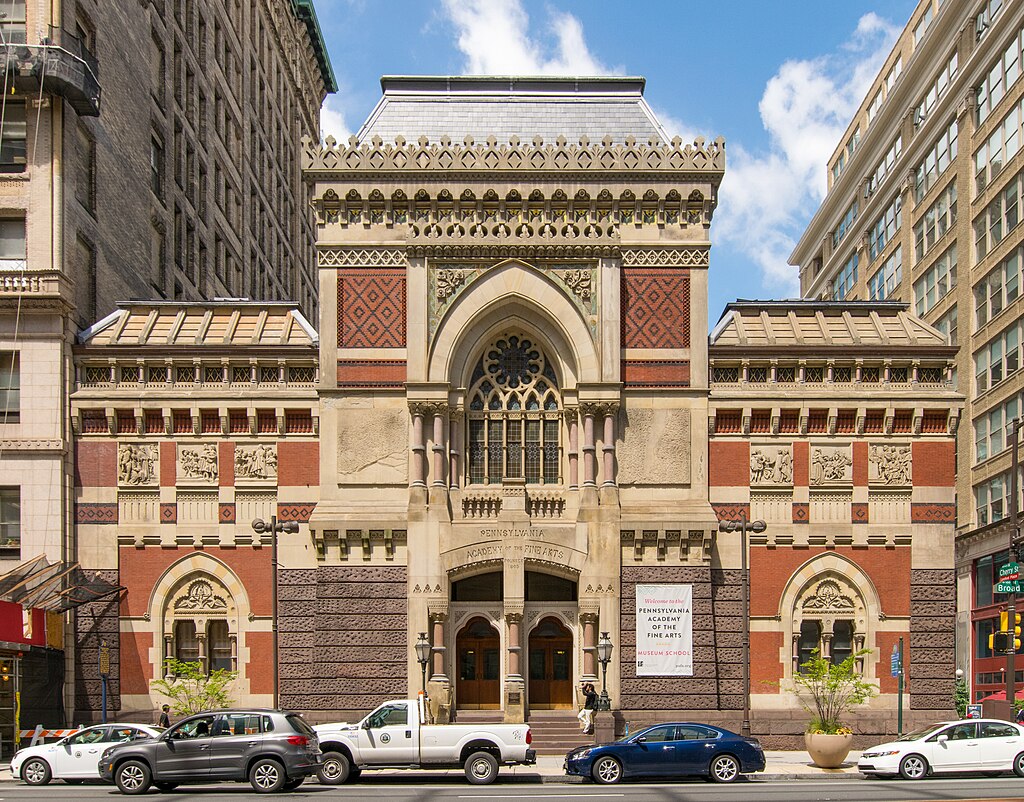
Pennsylvania Academy of the Fine Arts

Here’s irony! The historic 1805 building I recall so well is closed for renovation until next year, and many of the paintings are “traveling,” i.e., on loan to other museums, through a show called “Making American Artists.” Most recently, to Albuquerque NM, though the exhibit closed there in September. The Academy, however, has employed the large, windowed, modern gallery spaces across the alley from the old building as temporary museum space and curated some fascinating exhibits for viewing and learning from. We enjoyed the Philadelphia-themed historical and cultural arts, crafts, and objects that came from the Atwater-Kent Museum. The mix of mostly-20th c. American paintings, prints, and sculptures in the upstairs galleries showed us how little we know about more contemporary US artists (outside of the super-famous ones like Hopper, Hockney, de Kooning etc). The plaster casts of famous European sculptures which students used–and still use–for drawing practice are now located in the lower level.

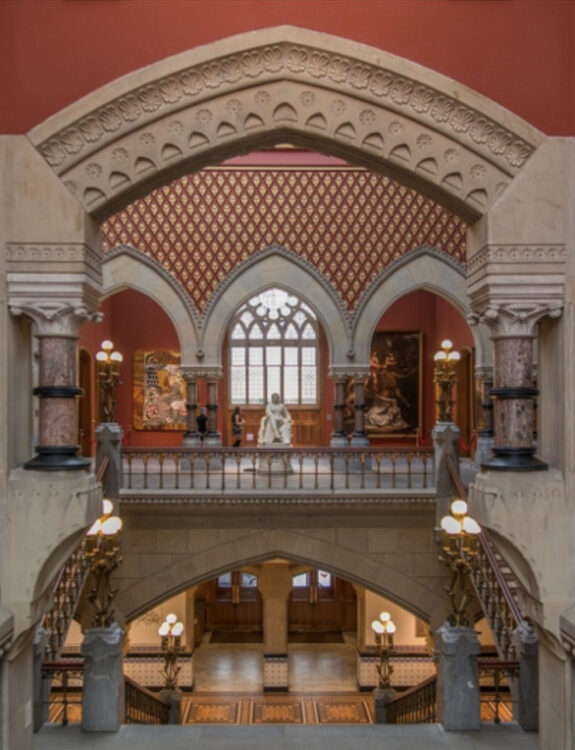
That brought back memories of when I was a teenager in love with art. I will have to go back once the renovations are done, because I remember the building as I visited it in the early 1970s, a strangely decorative place where students could be found sketching one of Michelangelo’s carvings or painstakingly drafting the composition of a painting by Winslow Homer. How I longed to be one of those art students!

PAFA interior, pre-renovations

That desire has been much altered by time, but my love of “the visual and plastic arts” stays with me. I enjoy writing ekphrastic poems; perhaps my foray into making artwork will energize me these last weeks of February and keep me going into spring.

Something like hope

Wintry weeks grind along like the noisy snowplows tearing through sheets of ice this morning. At least we are having a winter, unlike some years. I may not love winter–especially the short, grey days–yet I live in a region that needs it. Indeed, it is February (alas); but in a few weeks I’m liable to notice snowdrops emerging from the dirt. Anticipation stirs my heart. It feels something like hope, although hope is something I feel less inclined to believe in every year. I guess my problem with hope is that it feels like there is human agency invested in the concept, and as I age I recognize how little effect our wishes, hopes, and prayers have upon anything.

Photo from Feb. 9th of last year; as of now, no blossoms yet!

The snowdrops emerge all the same, until such time as they can no longer withstand changes in their environment. There is some comfort in that, for me.

~

Dave Bonta recently reposted (on his Substack and Bluesky accounts) a post by Guy LeCharles Gonzalez called “Why Keep Blogging in 2025?” It’s a lengthy piece (for a post) but brings up some worthy points. He closes with this paragraph, one that I find I heartily agree with–it is why I do what I do:

“Before they became walled gardens, social networks were great places for discovery, and although posts with links don’t get the visibility they used to on the bigger platforms, you shouldn’t be blogging or socializing for scale anyway. Defy Big Social and share those links to your own posts, and to posts you’ve enjoyed. Blogs only die when they’re abandoned by their owners.”

~

Not all of us need to be blogging for scale. That’s a capitalist, celebrity- and status-focused thing that sucks the love and beauty out of poetry, prose, and the arts. We shouldn’t be creating for Big Bucks or Pulitzers but because writing/art is what we love and what we do.

~

Speaking of art…here are three ekphrastic poems of mine, just published in Unleash Lit, which is an online journal that uses a Substack platform.

https://www.unleashlit.com/p/ekphrastic-poems-by-ann-e-michael

Breathe

2024 closed with “thundersnow” in my neck of the woods, a weather phenomenon that I find rather thrilling in its strangeness. And the year commenced with the conflagrations in California, not to mention everything else that goes on daily in the cosmos. Oh, the difficulties of life in interesting times.

Photo by Sabian Symbols on Pexels.com

It so happens that I had made plans, and purchased plane tickets, to visit my son in Los Angeles during the week that AWP is holding its annual conference there, in March–that is, assuming the situation in Los Angeles County doesn’t get even worse and assuming his apartment building survives the fires; it hasn’t been easy to keep myself from doom-scrolling and watching updated fire maps. I remind myself that there is not a thing I can do beyond sending money to charities and such, perhaps, and waiting for the winds to change, and that making myself stressed will actually do harm. But I am not one of those Pollyanna types (now termed a “toxic positivity” person, I have recently learned). I’m aware that the world can be hard, and that we may suffer. So, as my yoga and tai chi instructors would tell me:

Breathe.

There’s no point in trying to decide whether this start to the year is auspicious or inauspicious, though if I’m going to go with signs and auguries, I might choose to follow the Chinese year and move my year’s start to January 29, Year of the Wood Snake–and get all this awful stuff (including January 20th) packed into LAST year.

As I noted in my year-end post, a year’s end–or beginning–is arbitrary.

~

As for writing-related resolutions, I make them all the time, not just at the beginning of the year. But in that one respect, the first dozen days of January are going surprisingly well. I’ve been spending more time on revising older–sometimes much older–work, and I have been drafting some new poems. I even submitted just a few things to lit journals and have been making minor progress in the monumental task of culling and organizing my writing files.

Best of all, I enrolled in an online poetry workshop with Anita Skeen through the Friends of Theodore Roethke Foundation, which starts this week. And I registered for an art class in February, so my plans to focus more on my creative work post-retirement are proceeding more or less apace. We balance fear and misery with art.

~

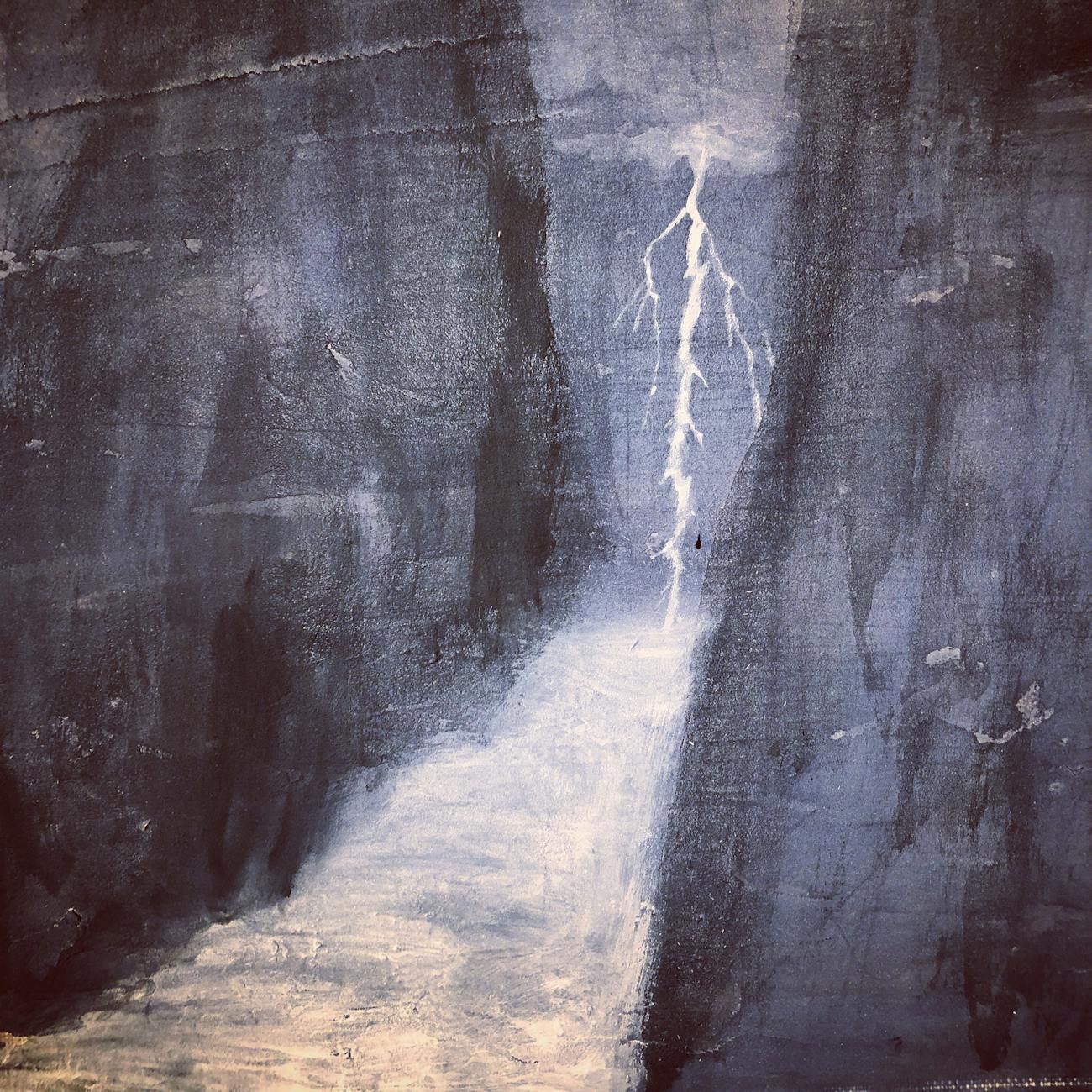
Cloud sketch in acrylics