My trip to Baltimore for the AWP Conference Book Fair didn’t happen; my immune system decided otherwise, with a resurgence of a nasty respiratory virus and a flare of fibromyalgia. I guess I can look on the positive side and say I saved a lot of money, right? Plus I can purchase most of those poetry collections online, I suppose. Still, there really is nothing like browsing through thousands of luscious books for something that grabs me, that takes the top of my head off, to paraphrase Ms. Dickinson. Through social media platforms, I can see colleagues-in-literature making connections and meeting one another face-to-face, which is what conferences are for. Another year, maybe.
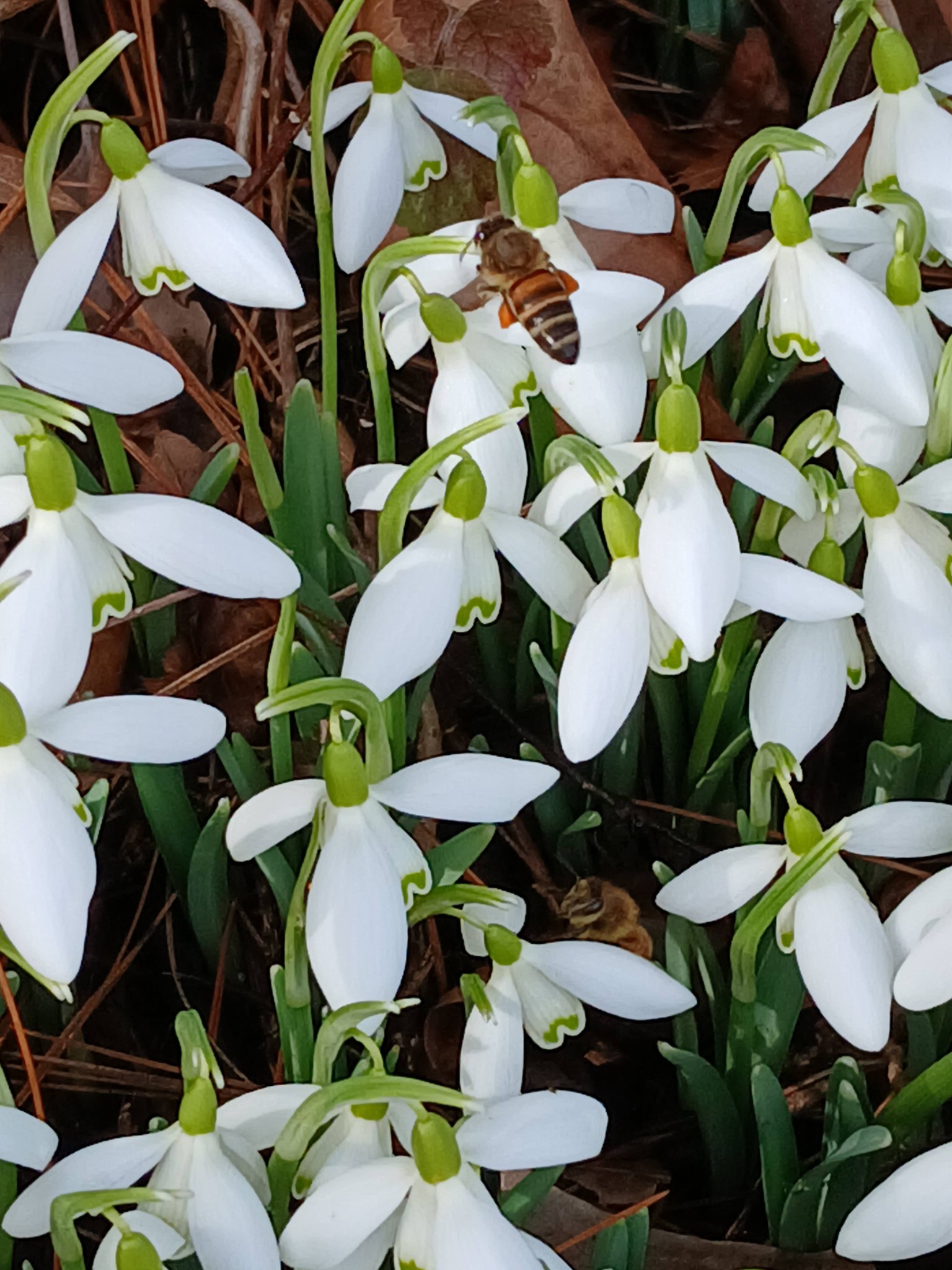
And after days of necessary spring rain, drizzle, and fog, the long-awaited thaw eradicated most of our snow. Crocuses bloomed, and bees came out to visit the snowdrops.
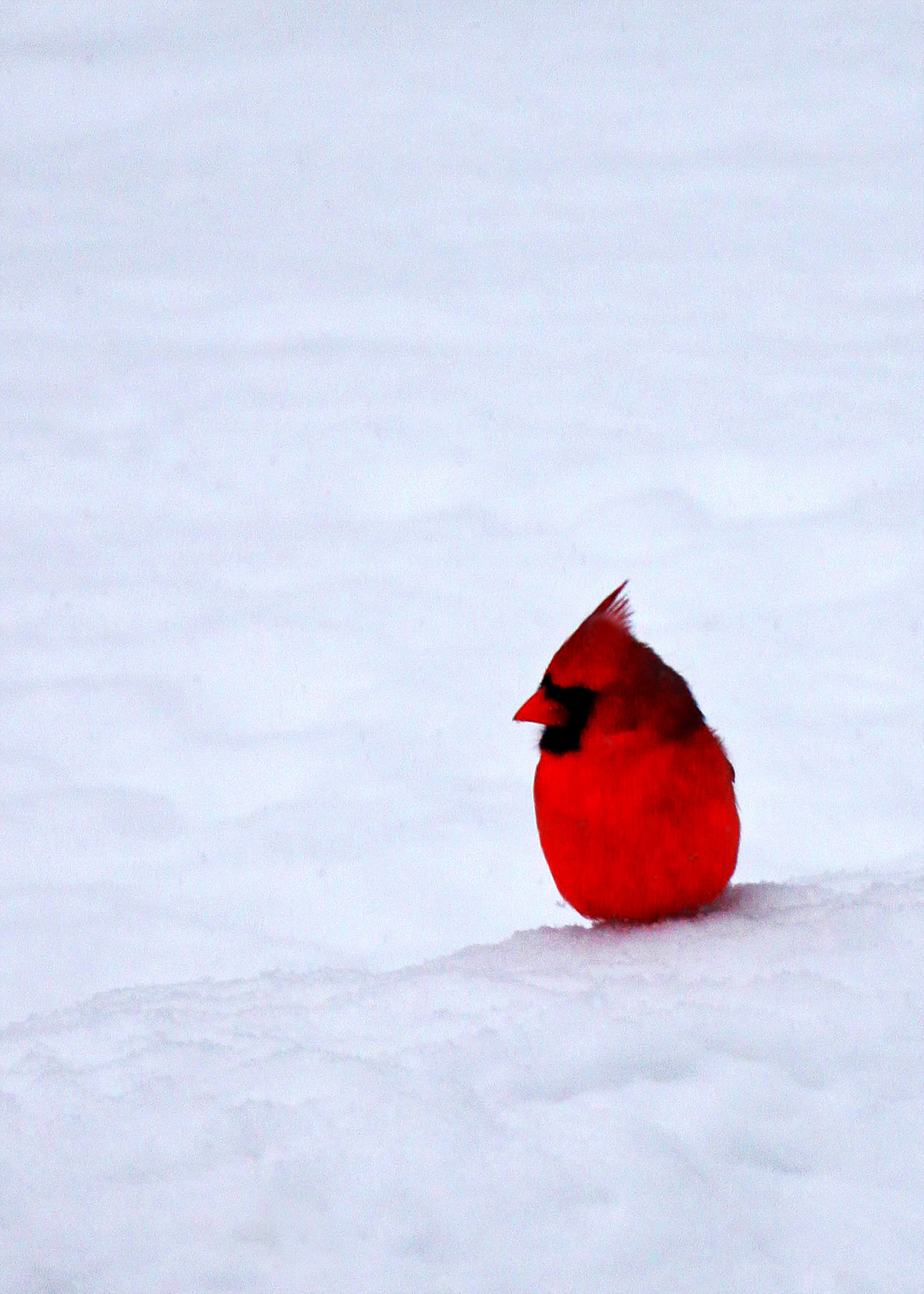
I felt much better today and was able to take a walk in the mild sun, listening to robins, mourning doves, song sparrows, woodpeckers, redwing blackbirds, bluebirds, house finches, Carolina chickadees, American crows, Canada geese, mockingbirds, cardinals, bluejays, masses of starlings…I watched the high-flown antics of redtail hawks and turkey vultures.
In other regions of the world today, people listen and watch for fighter jets, torpedoes, drones. There but for fortune may go you or I (Phil Ochs). Meanwhile I remain grateful for feeling slightly better as the days lengthen into spring. It’s March–we could still get snow! But the spring peepers sense the warmer temperature and trilled a bit last evening while the great horned owl was hooting. Here’s a poem I wrote in 2012 about DST.
~
Daylight Savings Time

In the 21st century it seems
a bootless custom, a cultural exercise,
useless gill of the railroad era.
Yet as I sit on my porch
long past the 6 o’clock hour,
dinner already consumed, dishes cleaned,
feeling the breeze of mild late winter
raise the hairs on my bare arms,
I am glad for the extra hour
among long shadows as my dog
chases a woodchuck, as the wood-
pecker pounds in metrical progressions:
trochee, trochee, spondee.
The path the dog follows
is greener than it was yesterday,
coltsfoot blooming and the scent
of winter-blooming hazel in the air,
available to my senses because
the day’s now one hour further skewed
toward spring, a brief and welcome turn
in the nature of things,
however imposed and arbitrary.
~
~~~
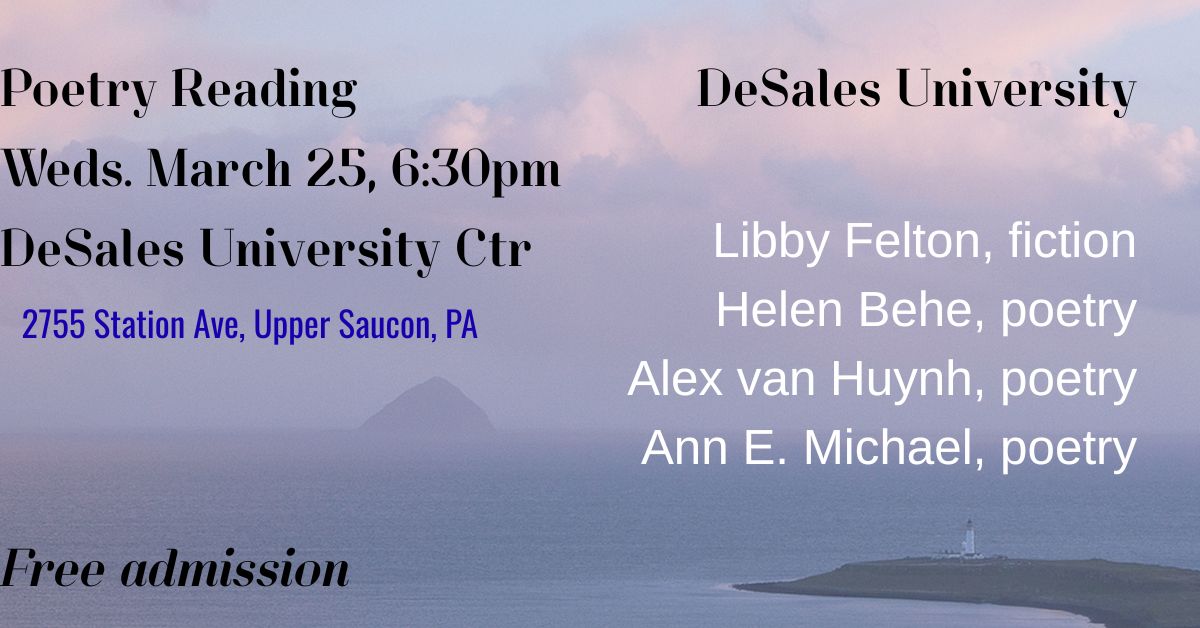
A week before National Poetry Month, I’ll be reading at this event in Center Valley PA.
I keep a day-by-day garden journal, ten years at a time (the one I use is here, from Lee Valley). This record often proves useful and is an interesting way to compare how the seasons unfurl from year to year. After 30 years of record-keeping, for example, I can see that the summers here are hotter and drier than they used to be, and that winters are far less consistent. I note which plants thrive and which fail, and observe when invasive species arrive and when certain plants or animals seem to experience a die-off–or a flourishing. As I used to tell my students in composition and rhetoric classes, basic comparisons are a toe-in-the-water way to begin learning how to do full-fledged analysis. In what ways are things alike? In what ways do they differ?
Let’s look at February, surely my least-favorite month. In 1997, the month was mild, even warm; snowdrops bloomed on the 21st (in 1996, the bloom was the 23rd, in 2000, the 24th). Fast-forward: in 2023, they blossomed on February 13th, in 2024 on February 8th. Similarly for the bloom times of iris reticulata and witchhazel. Last year, however–2025–we had arctic air pushing through due to warming at the poles and other effects. The snowdrops opened late, on February 25th. This year, we’ve had a colder-than-average midwinter. Today, after yet another snowstorm, there’s an additional 5″ of snow cover over existing snow. I doubt I’ll see snowdrops for another week or so. But you never know. Galanthus are resourceful, having originated possibly in the Pyrenees or even Thracia, and they have adapted to many regions quite happily. They can even bloom under a light snow cover.
Comparing seasons from year to year has helped me to plan my garden, but it’s always a bit of a crap shoot. Earth’s varying meteorological systems mean that humans endeavoring to grow crops or plan for weather events will often be surprised. Nature is unpredictable, no matter how many analyses we project. The recent snowstorm here was, if not wildly inaccurately predicted, at least not following the most expected computer models. Which is as it should be. Artificial intelligence and algorithms are far from foolproof.
~~
What will the weather be like on March 7th? I’m planning to attend the book fair day at AWP in Baltimore that day, but always “weather permitting.” Last year in Los Angeles, I liked having the option of just attending one day of the event–sans panels and such, which overload my introvert personality. But Baltimore is a 3-hour drive from here, so weather must permit! The past five years, March 6-8 has been mild and reasonably fair; so says my garden journal, so maybe I will get there. If so, I’ll return bearing poetry collections…
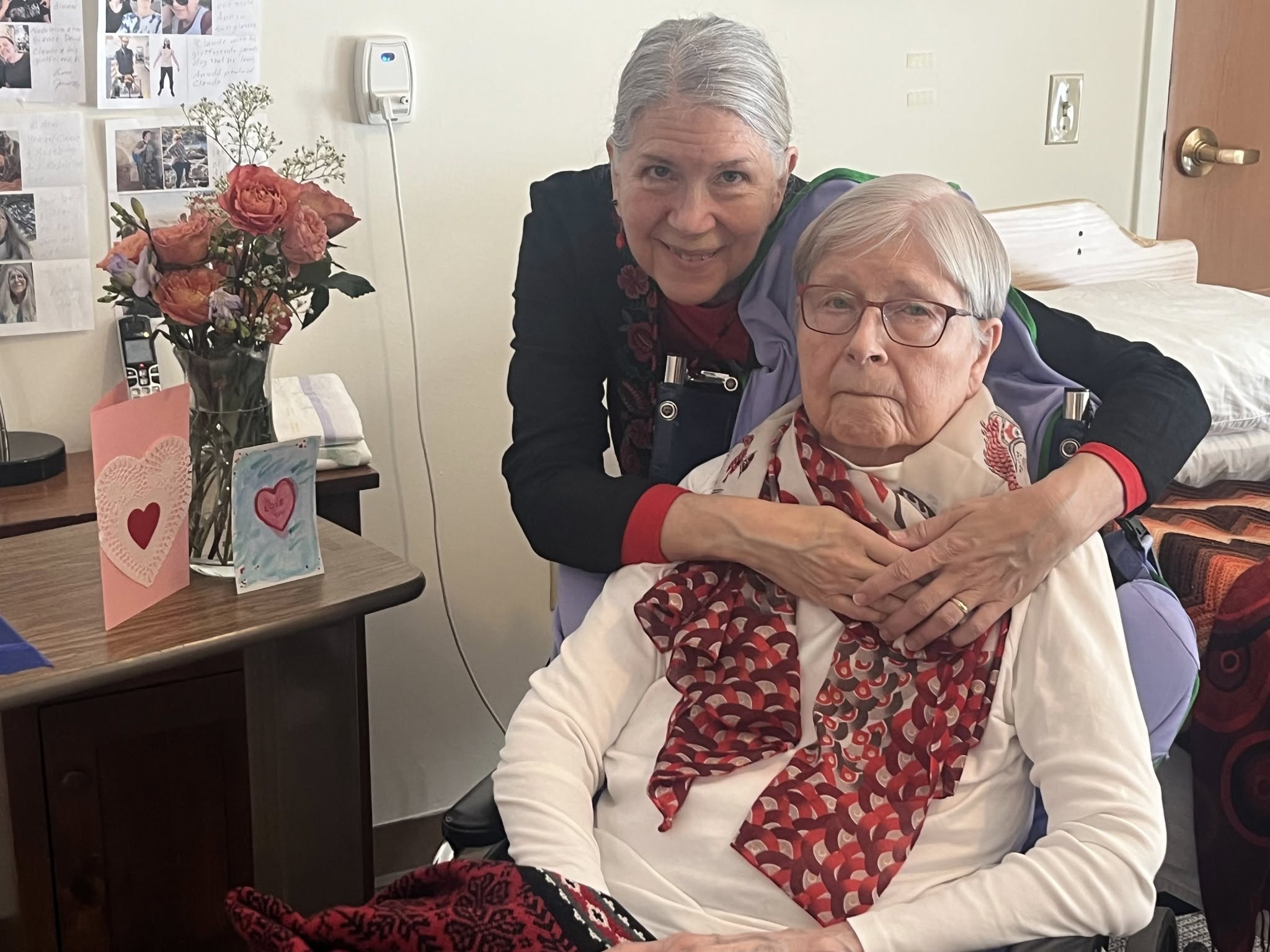
Meantime, my mother will turn 93 this week. I wish celebration were in order, but she seems to be retreating into a zoning world of her own, less familiar to us and less aware of her surroundings. Once again, comparisons: who she was for most of my life and who she is (or is not) now. She’s weathered much in her lifetime. The analysis: I don’t love her any less.
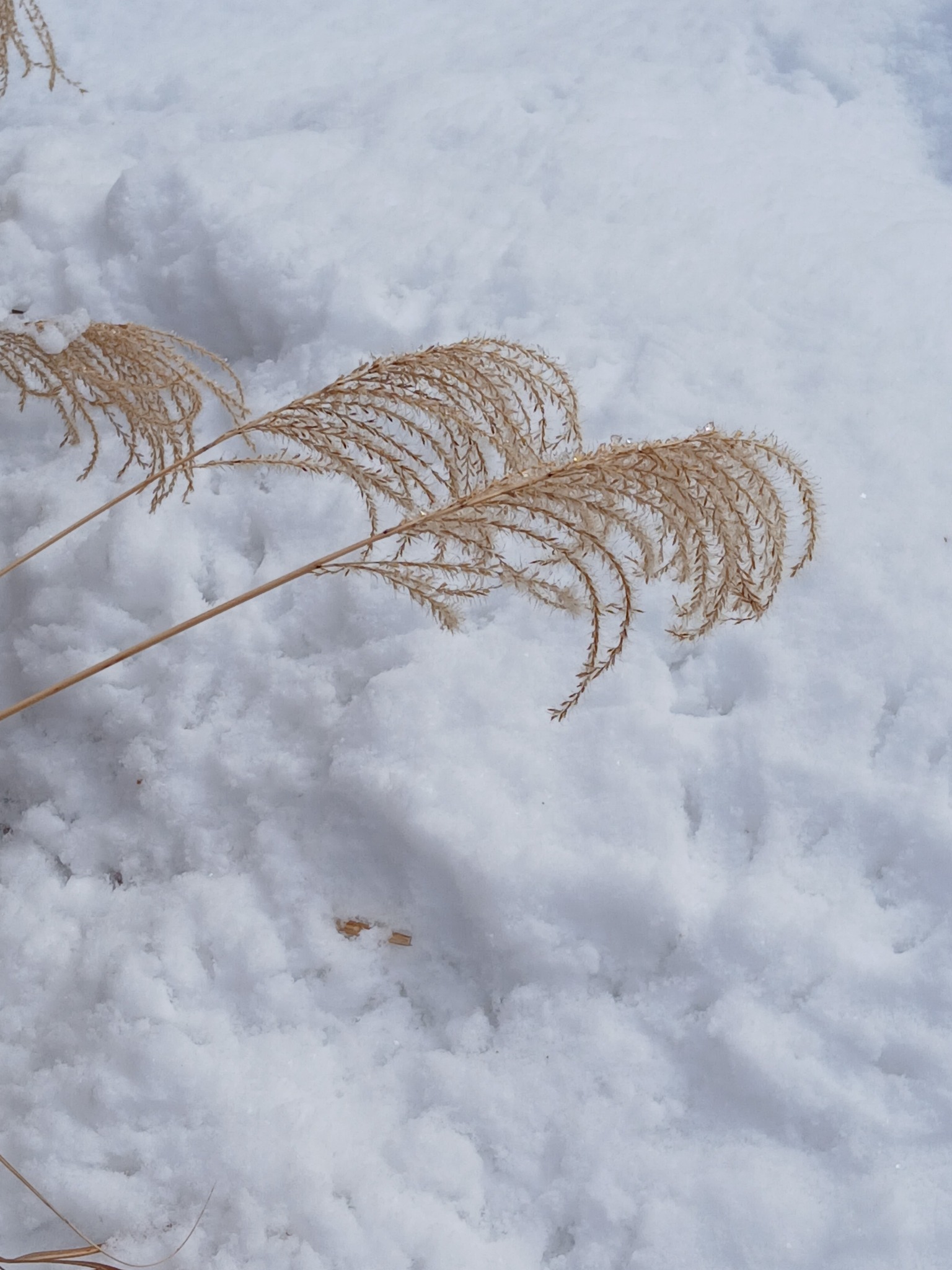
Midwinter thaw. Hints that underneath all the snow, spring awakening could eventually occur; also, a distinct likelihood that once the snow melts, the air will again get frigid because winter’s not over.
Lately, I’m trying to find enough mojo to send out some poems. My thinking is that given current circumstances, having poems in (mostly) online journals offers more possibility that someone, anyone, will read them. Poetry like most arts is communicative, so poets need readers; I treasure my readers, but they are few. I love books, but my books do not sell well. That means the poems don’t reach an audience. This blog doesn’t have a host of regular readers, either, though there are some stalwart followers for whom I am immensely grateful. Then what are a poet’s options? Small-press publication (let’s hear it for those wonderful folks!) and self-publishing can get you the physical book, but for readers you have to do a ton of self-promotion. This is a skill I have never developed and that I do not, at my age, wish to learn. Besides, I am out of the job market now and have no need for a CV full of publication credits.
But I read literary journals. My colleagues in creative writing read literary journals. Some lit journals continue to produce paper issues, bless them, but more of them post poems on various social media platforms, where casual viewers might run across a poem and–who knows?–read it! Therefore, it seems to me that’s what I ought to be doing: getting my work in magazines, large and small, local and international, professional and amateur, one poem at a time as a kind and careful editor decides my poem suits the journal. I think that in 2026, more poems reach people online than in books. Am I wrong about that? I guess I could research that question if I really want to know.
Of course I love books and will never stop reading them, poetry books and other kinds. Of course I would be thrilled to have another book in print if the manuscripts I send out ever were to find homes. However, probably my focus this year will be on the more ephemeral but wider-reaching media forms. I want to remind myself that I write because what I want to say may be valuable to someone other than myself; might strike someone as beautiful, sad, or wise; might make someone think in a different way or learn something new. Poetry has always done that for me, after all.
I have been missing my dad, so today I put on his old cotton knit sweater, the one that’s developing holes in the weave, the one I kept because his scent lingered in its fibers. It’s been over five years since his death and, alas, that familiar scent has finally vanished from the sweater. Though I like to think that it has been absorbed into the other items in my closet, maybe the hoodie my daughter knitted, maybe the flannel pjs, maybe the four old pairs of jeans I wear continually or the one full-length gown I’ve seldom donned but have kept for reasons not entirely rational. I’m hoping my dad has somehow permeated my closet, the things I wear next to my skin, my life.
And I came across this poem recently in Gary Whited’s Having Listened. Indeed, it resonates in the way a poem can, a sort of slanted parallel of feeling, affinity, relationship. I love the idea of “shirt knowledge,” the thought that inanimate objects might “know” in ways humans cannot perceive. Those last lines: “how to be private and patient,/how to be unbuttoned,/how to carry the scent of what has worn me,/and to know myself by the wrinkles” seem accurate to my current state. Comfortable, comforting.
Like an old shirt. Like a good poem. Like a memory of my dad.
~
My Blue Shirt
hangs in the closet of this small room, collar open, sleeves empty, tail wrinkled. Nothing fills the shirt but air and my faint scent. It waits, all seven buttons undone, button holes slack, the soft fabric with its square white pattern, all of it waiting for a body. It would take any body, though it knows, in its shirt way of knowing, only mine has my shape in its wrinkles, my bend in the elbows. Outside this room birds hunt for food, young leaves drink in morning sunlight, people pass on their way to breakfast. Yet here, in this closet, the blue shirt needs nothing, expects nothing, knows only its shirt knowledge, that I am now learning—how to be private and patient, how to be unbuttoned, how to carry the scent of what has worn me, and to know myself by the wrinkles.
We got some rain on Saturday, which we’ve needed, and dismal cold rainy January days are perfect for settling down with a book. I’m reading The Unsettling of America, Culture & Agriculture (1977) by poet, writer, farmer, educator, activist Wendell Berry, still working at 91–his book Sabbath Poems was published in 2024. I’m much more familiar with Berry’s poetry than his prose, though he’s written at least half a dozen novels and many books of nonfiction. This text, I’ve since learned, is one of his more famous–it’s been revised and re-issued six times. The copy I got from the library is the original version and features cover blurbs by Gary Snyder, Wallace Stegner, Edward Abbey, and Stewart Brand, among others; Publishers Weekly summed up the book as “a cool, reasoned, lucid and at times poetic explanation of what agribusiness and the mechanization of farming are doing to the American fabric.”
Which is a fairly good one-sentence précis, though Berry’s wording often strikes me as more passionate than “cool,” and agribusiness is only one aspect of his critique. I was in high school in the 1970s, and at the time it seemed average Americans were beginning to recognize that pollution and overpopulation could be problematic, that maybe we needed to eat more natural and wholesome foods, and that establishing an Earth Day might help people turn focus toward the planet. Simultaneously, we had Earl Butz as Agriculture Secretary, a man who ended many New Deal programs to help “small” farmers and who encouraged large (eventually, corporate) farms. Butz appears several times in this book, and no wonder; he and Berry debated the topic in public and in print, and their thinking was almost diametrically opposed concerning the philosophy behind agriculture. Berry’s book is a social and philosophical argument that is only somewhat dated and really quite prescient, though he might come off as mildly curmudgeonly to today’s readers. Or maybe not so prescient. He was simply paying attention.
The sections of the book that most resonate with me are those in which he writes of nurturing and relationships, and points out that good relationships involve responsible actions and collaborative, mutual care whether they are marital, family, or social relationships or relationships with the soil, the flora and fauna, the whole planet. He predicts a future in which people live in their houses and not with the land, or even within their communities, and where wilderness is “conserved” so that it can be exploited for entertainment and scenic views. People in the US, he says, don’t feel responsible for the land on which they live; they don’t understand its cycles, its weather patterns, its waterways; their property is merely property–a commodity for convenience and investment. I’d say that future is already upon us.
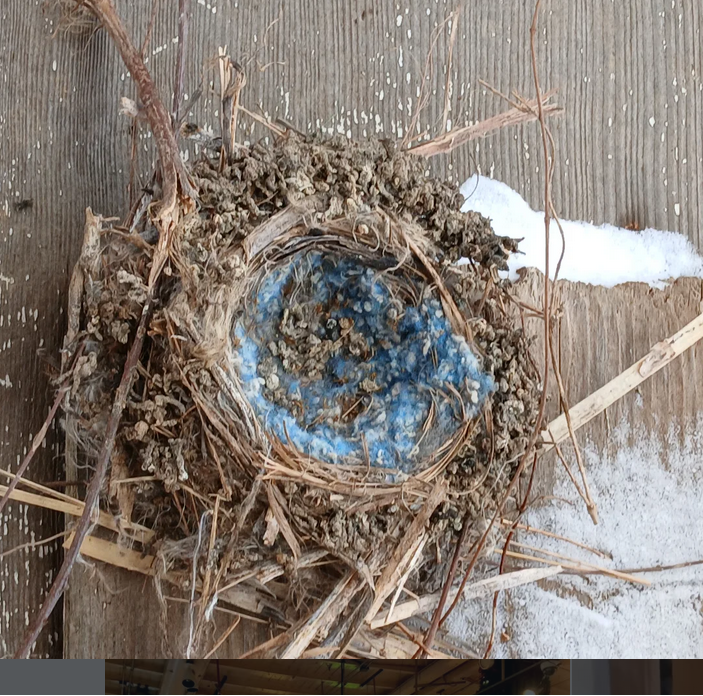
Thus, Berry has made me think more deeply about my relationship with “my” property. If you’ve read this blog for awhile, you may notice how often I consider weather, dirt, local animals, insects (especially invasive or non-native ones), plants, tree diseases, water–I’m no farmer, but I am a gardener and do feed myself at least partly from my own backyard. I take almost daily walks around the perimeter of our 6+ acres, poking around in the hedgerows, scanning the sky, looking down at walnuts and animal scat, watching for new buds or coloring leaves or bird nests or wildflowers. I worry over droughts and hailstorms and flooding. Climate change concerns me in very local and specific ways, not just in general.
One could say I’m at least trying to nurture the earth. I’ve made many mistakes along the way and done some damage that I’m learning how to rectify; I have also realized that I have to accept some changes, such as incursions by invasive species, because they are beyond my control. Through the almost 30 years we’ve lived on this land, I’ve tried to understand it better. After all, we built a house on it. The soil was hard-packed, acidic, overused from previous decades of corn-growing, full of stones, sumac, and asiatic rose bushes, a fallow field that hadn’t been planted or farmed in decades but didn’t necessarily need me to tend it. It wasn’t my family’s land, and I didn’t intend to end my days here; however, I figured if I was going to live on this spot, I had better do whatever tending and nurturing it might require.
Which is about the best I can do as far as a relationship with the land in which I dwell, and about the best any of us can do in any long-term relationship: try to understand it, get acquainted, do some research, make plenty of observations (maybe take notes), and nurture what seems to need special attention and care. The land has given me much more than I’ve ever given it. It’s offered shelter, beauty, an education, food, the companionship of animal life, cricket sounds, tree frog songs, firefly lights on long summer nights, open spaces for my children to play in, owl calls and fox kenning, the grace of leaping whitetails, dead-fall wood we can burn in winter, forest-bathing, hammock-swaying, inspiration for writing. The wonderful porch here, where I often sit to write in my journal, opens a view to the meadow out back. So many poems started on that porch, with that view…
That’s how the earth nurtures me. May I be somehow worthy of it.
Another day. One that the calendar claims occurs in 2026, although at times I disregard the calendar–another human-made thing, and I find so many human-made things destructive and frustrating. It’s not as though a “new” year puts away what has happened the previous 365 days the way I can put away the holiday decor. Which I haven’t actually done as yet. Anyway, we’re still in the first week of January, and Twelfth Night has barely arrived, so if I do want to acknowledge the calendar I can excuse my lack of clearing-away. But I can’t clear away the losses of the past year, and I don’t want to. I want to remember my friends for as long as I can.
It’s true that wintry walks offer quiet splendor (sometimes) and a chance to reflect, but mostly winter affords the chance to stay inside, curled up with a book or browsing through garden catalogs. Theoretically, it’s a good time to revise and submit my work; often, however, I don’t get to that process because winter is also a low-energy time for me. I powered through a fibromyalgia flare two days after New Year’s Eve because loved ones were visiting, but there’s a bit of fallout as a result–worth it, though; and I’m chuffed about taking poetry workshops later in the month. Meanwhile, reading books! I got a Samuel Hazo collection from my local library, I’m reading Wendell Berry and Richard McCann, and Ada Limón’s You Are Here is on my to-read pile. I’ve also felt inspired by the start-of-a-new-year blog posts Dave Bonta has curated on his Poetry Blog Digest. Many writers and books there I want to check out, and many writers and poets feeling some of the same things I’ve been feeling about the past year and what to make of the years ahead.
So to recharge, as it were, I’ll do small, refreshing things this January: take photos, doodle with watercolors, read books, tromp about in boots, meet pals for morning coffee, draft poems, play with images, as per Johan Huizinga–“To call poetry, as Paul Valery has done, a playing with words and language is no metaphor: it is the precise and literal truth…What poetic language does with images is to play with them.”
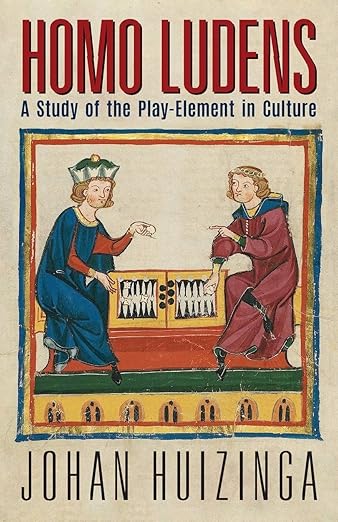
My freshman humanities professor, the brilliant, late Larry Fuchsberg, assigned Johan Huizinga‘s The Waning of the Middle Ages as one of the texts for our course…an unusual choice for American teens in 1975, as was another of our books, Burckhardt’s The Civilization of the Renaissance in Italy. At 17, I found Burckhardt rather slow going stylistically (it was published in 1860, after all); by comparison, Huizinga (circa 1919) was refreshingly clear. I really enjoyed it and learned a great deal. I kept meaning to read his 1938 book Homo Ludens, but for awhile it was difficult to find in libraries or bookstores. Also, I lacked the time to track it down or read it. The premise interested me, though–that we humans evolved our culture from the “pointless, imaginative” urge to play, and that play is fundamental to our learning and our social structures. Also, we are not mechanical beings–the messy frolicsome-ness of people is as necessary for our survival as food, water, and shelter.
“Animals play, so they must be more than merely mechanical things. We play and know that we play, so we must be more than merely rational beings, for play is irrational.”
Finally, I’ve begun to read Homo Ludens, and it’s even on Amazon now; also I discovered that it exists online here thanks to Yale University. Fifty years after my initial encounter with the author, I find his thinking just as interesting as I did in college, and just as difficult. As in his other books, Huizinga uses etymology as one of his methods of examining the meaning and culture of play. He was writing for an audience that he assumed was well-educated in the classics, so there are passages in Greek, Latin, and French that neither he nor the English translator bothers to translate for less linguistically-adept readers like me. Fortunately, such passages are brief and are used as sources for his argument, and I’m not reading to find fault with his material. I’m interested in his argument and insights as a whole, and intrigued by his thinking. He apologizes for his lack of sources (ha! There are hundreds of them) because he was “working in haste.” He composed this book in the Netherlands as Germany began to be a serious threat to Europe, and he wanted to get his ideas in print before he was silenced. In fact, his last few years were difficult. He had used his standing as a well-known cultural historian to criticize the Nazis and was arrested in 1942, basically house arrest; he died in 1945 just before the war was over.
I’m only on Chapter 4 but am finding, in the etymological tracings of the words that intersect in meaning(s) for play–game, contest, gambol, gamble, dallying, tournament, match, riddle, performance, frolic, pretending, folly, fun, sport, etc.–fruitful stuff for poetry, for thinking about poems and about how poems work as craft, as poems, and as works of art and imagination. And also, what roles poems may play in culture today, and whether that differs at all from the role poetry played in ancient times. Huizinga writes:
“In the making of speech and language the spirit is continually ‘sparking’ between matter and mind, as it were, playing with this wondrous nominative faculty. Behind every abstract expression there lie the boldest of metaphors, and every metaphor is a play upon words. Thus in giving expression to life man creates second, poetic world alongside the world of nature.”
Language may not be necessary for play but can easily be incorporated into it, and language can become play. Or playful. I don’t know much about Wittgenstein, but I find myself thinking of his theory about words having “family resemblances” that often connect, overlap, shade meanings. So we get jokes, puns, flirting, mocking, and new “rules” for our language use that culture constantly shifts in all kinds of directions. Language is a game-changer, and poets make use of that.
I thank Larry Fuchsberg, musicologist, book-lover, and educator, for introducing me to Johan H. Teachers, you never know how much you may have influenced a student’s life, even decades later.
Creative writers are often asked where they get their ideas from. In my own case, the answer to that varies a great deal. Sometimes ideas arise from personal experience, of course, but one’s life offers only so much material if you are a relatively staid person like me. Topics for poems can arise from recent headlines or from histories, written or oral; from conversations overheard in a grocery line; from stories other people tell me; from folk tales; from science books; from dreams; from works of art, and numerous other sources. It’s this wide array of possibilities that make the concept of the creative-writing prompt so popular. A quick Google search for “creative writing prompts” offered well over 20+ pages of entries, in several languages.
I have written pieces based upon prompts, especially when in a workshop or class, or when I feel rather tapped out of my own imaginative source material. I’m especially fond of writing that stems from viewing or experiencing a work of art–sculpture, painting, musical composition, dance, installation art (ekphrastic poems). Generally speaking, though, that’s not from whence my poems originate.
I can’t really say why I feel an urge to put down in writing specific reflections about something that’s caught my attention–or even what sort of experience evokes my response. Maybe I feel intrigued by an image, a detail, or an ambiguity–a question arises in my mind that I tussle with for awhile. Then, I may compose a draft and let it sit. Two days. Two years. Longer. Lately I’ve been revising some old poems and have realized I no longer recall what their incipience was. Which can be a good thing, because I am no longer wedded to the “reason” I wrote them and can instead consider whether they can be crafted into decent poems.
I am also working on a manuscript that I let sit for at least six years. An idea got into my mind after reading Robert Burton’s 17th-century book on depression, The Anatomy of Melancholy, quite some time ago (2017, perhaps?). I took a stab at writing what seemed to be evolving into a historical fiction story, which is not my usual approach (I have zero practice at plot and dialogue). Then, I stopped. As one does. But the topic lodged in me somewhere, I suppose, and early this year I returned to it. What if, I wondered, the draft could be restructured into a series of prose poems? There might be a sort of hybrid novella-poem in the earlier draft.
That’s more or less what I’m developing, at least for now, and we’ll see what if anything emerges. It’s keeping me interested, which I like, and the experiment feels fresh compared with “writing what I know,” or writing “how” I know. Because yes, of course we ought to write what we know; but we also know about human beings, and we have imaginations, and anything is possible.
I ran across something online that made me shudder–and it wasn’t politics or global tragedies but something sillier and more personal. Apparently there was a trend a decade ago of adults reading their adolescent diaries, aloud, in public (see “Mortified”). Ugh. The few times I have been tempted to read any of my old diaries or journals, I’ve stopped after a few sentences. Shuddering. This is less likely to happen with journal entries I wrote in my 30s or later; at least I hear my younger adult self in those words. But hearing the adolescent me, or the young woman of college age? No, thank you. I embarrass too easily.
Yet I found I was thinking today of this passage of Proust’s, which he gives to the character of the artist Elstir:
“There is no man,” he began, “however wise, who has not at some period of his youth said things, or lived a life, the memory of which is so unpleasant to him that he would gladly expunge it. And yet he ought not entirely to regret it, because he cannot be certain that he has indeed become a wise man–so far as it is possible for any of us to be wise–unless he has passed through all the fatuous and unwholesome incarnations by which that ultimate stage must be preceded…We do not receive wisdom, we discover it for ourselves, after a journey through a wilderness no one else can make for us, which no one can spare us, for our wisdom is the point of view from which we come at last to regard the world.”
There’s some comfort in that. I would not call myself wise, but I’m definitely wiser than I was at 15 or 21. I suppose I’m still sometimes “fatuous and unwholesome” (whatever Elstir meant by that), awkward in society, and mistaken in some of my intuitions. But I have discovered myself for myself, with all the pain, sorrow, embarrassment, and joys that such discovery requires, and have developed my own point of view. In addition, I’ve learned that each person holds their own point of view. We don’t all think alike or in concert and may never fully understand one another. That makes the world contentious, yes. And interesting.
Reading Old Diaries

When I wrote about the city
it was as though I knew
I didn’t belong there,
would not thrive—as though
I wouldn’t stay long
and so pressed each line
on page urgently, camera
shutter clicks, each image
framed in fractioned seconds
as people jaywalked and
side-walked, as pigeons
or sparrows alighted to peck
at civilization’s least crumbs,
as young men lovely and
unattainable grew ill, as city
failed to succor any of us,
as my ambition floundered.
Years back. So that what
I recall is what I photographed
or wrote, however inconsistent.
Naively urbane, the city
my youth inhabits lies brittle
in the pages. The past undoes
itself at last. Or I do.

~~
I'm embarrassed to note that I've forgotten where this poem was published. My files are elsewhere at the moment. I'll update if I remember... *It appeared in Loch Raven Review!
Reading Proust again returned me to some of my own past reflections on memory and self, the capital-S Self. A decade or so ago I spent considerable time reading in philosophy, physics, and neuroscience in an endeavor to get a grip on human consciousness and, perhaps, behavior. I posted about some of these texts on this here blog, in between writing about poetry, the garden, and my teaching job. Recent coincidences of reading returned me to this topic, “the hard problem of consciousness,” and made me consider how our embodied selves/minds/awareness: use shortcuts to manage the overwhelming inputs of our environments; define who we are using subjective if physically-based perceptions; and fail to see the obvious because of habituation and the apparent need to confirm what we believe we know. Illusions! The Vedic concept of Māyā, Plato’s Theory of Forms…propaganda, Penn & Teller, quantum physics, complexity theory, Marcel Proust, complementarity. I have a lot on my mind.
If it IS on (or in) “my” “mind.” For there’s even some question about that, as proposed by Neil Theise in his book Notes on Complexity. Just as light can be a wave or a particle, depending upon perspective and viewer (see: complementarity), it’s possible that our minds or selves can be individual and separate but also connected and boundary-less. The subtitle of this text is what appealed to me: “A Scientific Theory of Connection, Consciousness, and Being;” so far, I’m enjoying it and finding inspiration.
It’s needed, inspiration. Despite a few plunges into new drafts (see here), I have not been writing much for at least two months, and I miss it. The ideas from physics and neuroscience that intrigue me include potential metaphors and terms such as quenched disorder, endosymbiosis theory, and holarchy. These–along with the hard problem of consciousness–all have some relationship to complexity theory, and Theise does an elegant job of writing about complicated science concepts for the non-expert.
I ran across Notes on Complexity right after finishing Sleights of Mind, a book about the neuroscience behind the sort of illusion we call entertainment magic: sleight of hand, sawing people in two, mentalist “mind-reading,” and other performances; the authors, Susana Martinez-Conde, Stephen Macknik, and Sandra Blakeslee, are trying to discover more about how brains work (or filter, and sometimes don’t work so well) by studying how we get fooled by illusionists. This is a fun book, even more fun for me because one of my Best Beloveds has long been an enthusiast of magic shows and magicians. Martinez-Conde and Macknik are neurologists, so–unlike Theise’s text–this book is very body-mechanics in its basis. Their work reminded me of how amazing the human physiological system is. And it’s entertaining.
Before these non-fiction reads, I was finishing up with Proust who, in his own creative way, was exploring the interiority of the human self and carefully observing human interactions, behaviors, assumptions, prejudices, and aesthetics. Not neuroscience, because there is no science to it, but definitely related to how our brains and bodies process experience. My sense is that poetry works that that way for me: it’s not an abstract stream of thought but something inextricable from bodily experience, maybe even, through the environment in which we exist, something deeply connected to everything, a global being-there.
The way we process experience (and is this consciousness?) is largely what leads us to the arts, to make art or to appreciate it, and to decide what feels compelling, important, beautiful. And it’s not all in our heads.






 ann e michael