Blogs

The snow’s receded, and the crocuses open; yet another wintry storm looms. Nonetheless, the past three days have felt less like thaws and more like spring itself. Today, I’m listing some great blogs to browse, breeze through, or peruse…as I am at present falling a bit behind on the Blog Tour (among other things).

muscari


There may be a hiatus to follow…in the meantime, follow these!

~

Good blogs on what it means to be a poet, in or out of academia, and to keep slugging away at the job:

Jeannine Hall Gailey, who has a new book about promoting & marketing one’s poetry (available from Two Sylvias Press): http://webbish6.com/

Diane Lockward: http://dianelockward.blogspot.com/

Lesley Wheeler: https://lesleywheeler.org/author/thecavethehive/

Grant Clauser: https://uniambic.com/

Donna Vorreyer: https://djvorreyer.wordpress.com/author/djvorreyer/

Kelli Russell Agodon: http://ofkells.blogspot.com/

Dedicated poem-a-day or nearly a-poem-a-day bloggers who actually write good poems:

Lou Faber: https://anoldwriter.com/

Luisa Igloria, whose fine book The Buddha Wonders If She Is Having a Mid-life Crisis just came out from Beth Adams’ (15+ years of blogging! @ Cassandra Pages) Phoenicia Publishing: https://www.vianegativa.us/author/luisa/

And Dave Bonta, also 15 years blogging, who does a mighty job of crowdsourcing poetry and poets: https://www.vianegativa.us/author/dave/

Then these blogs, which often blend visual art with poetry, or poetry with visual art, such as:

Marilyn McCabe: https://marilynonaroll.wordpress.com/

Art critic and artist Sigrun Omstreifer: https://omstreifer.com/

Artist Deborah Barlow: http://www.slowmuse.com/

And finally, a field biologist (specialty: entomology, bees in particular, but she photographs omnivorously) who loves poetry and posts the occasional poem amid her informative essays on birds, bugs, landscapes, hikes, travel, dogs, and all things lively and worth investigating: https://standingoutinmyfield.wordpress.com

~

That should keep readers busy for National Poetry Month and beyond!
 

Blooms, books, buddies

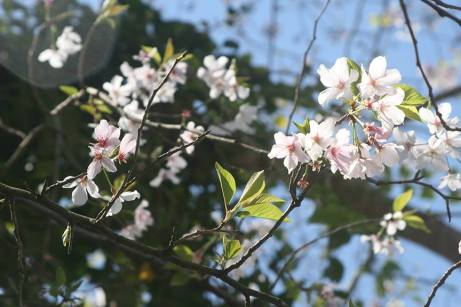
I headed southward on a recent trip to visit a friend and to see if I could find spring, since my Pennsylvania valley has been extensively clobbered by late-winter/early spring snow storms. In southeastern North Carolina, the air was cool but the plants were blooming. Spring at last! May it head northward soon.

springblooms

~

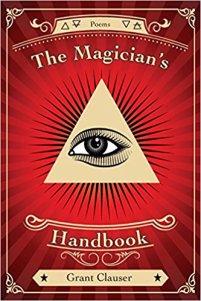
On my travels, I took along Grant Clauser‘s collection The Magician’s Handbook. One of my best-beloveds has been learning sleight-of-hand and card tricks lately, and as a result I found it especially fun to “get” Clauser’s references to trick names and magicians’ moves in these poems. The poems demonstrate Clauser’s sense of humor, balanced with insights about contemporary life and a good use of metaphor, sound (nice alliteration in particular), and poignancy that never teeters into sentiment.

I thought my hostess in North Carolina would enjoy The Magician’s Handbook; she randomly read a few pages and liked the book so much that I gave it to her.

~MH poems

Poetry collections are terrific gifts for poet friends, of course; but it is particularly rewarding to introduce a friend to a poet’s work. I would not have discovered half of the writers whose work I love if it had not been for friends and fellow writers’ recommendations, although various public libraries and many a bookstore browsing session have been places of discovery, as well.

I like to read poems while traveling. On the one hand, it proves difficult to keep from being distracted by crowds, announcements, and departure times–which can make it hard to focus on the challenges a poem presents to its readers. On the other hand, poems tend to be brief enough that the inevitable interruptions do not completely disrupt the flow or content of the page; for that reason, I tend to struggle to read fiction while traveling. The brevity lends itself to gesture, so I can pick up on mood and tone and the sound of the poem (in my head–I don’t read aloud in airport terminal lounges). Later, when I am home again, I re-read the poems. That gives me a different perspective on the work.

So…I guess I will have to purchase another copy of The Magician’s Handbook for my re-reading pleasure. Meanwhile, my friend in North Carolina has something to read as a start to National Poetry Month, which is April!

Hey, that’s what friends are for! [And many thanks to BJG for her hospitality, Southern and South Jersey style.]

Manuscripts

A draft, inspired by the book Meetings with Remarkable Manuscripts and related to a series of poems titled “Self Portrait as…”

Self Portrait as Illuminated Manuscript

This one exhibits some damage:
a missing folio, signs of mildew
and rodent chewing—calfskin a protein
and rats inevitably hungry.

It lacks signs of eminence (even books
have breeding), meant for use
and not for show. No burnished gold
for the initial letters, no sign of patronage

or dedication, though the illustrator
had a talent for small birds and
winsome sheep. The marginalia’s
interesting for what it doesn’t record–

genealogy absent, no list of relics
or property. The uncial style, workman-
like and unremarkable; the parchment
rough, irregularly cut; the binding,

late 18th century, carelessly done.
Yet any medieval manuscript is rare,
expensive in its era, product of cutting,
scraping, grinding, sewing, economies

of the book. Scribe correcting his copying
error, following his exemplar. Illuminator
in his carrel, sketching foliage and dove,
flair of alphabet and the glory of god.

If somewhat the worse for wear after
six or seven centuries, anonymous,
modest, pedestrian, this manuscript’s
survived. That is one of its merits.


Honestly, I originally wrote the last line as “That is its only merit.” But I felt that was disingenuous, particularly given the title and the series of poems I’ve composed on this semi-ekphrastic self-portrait theme. Probably I possess other merits. As would any surviving medieval book.    🙂


Cosmogenic questioning & play

“We may note in passing that the cosmogenic question as to how the world came about is one of the prime pre-occupations of the human mind…a large part of the questions put by a six-year-old are actually of a cosmogenic nature, as for instance: What makes water run? Where does the wind come from? What is dead?” (Johan Huizinga, Homo Ludens, p. 107)

We have, for many such questions, science-as-answer; but scientific answers do not always satisfy the ontological inquiry of the child. I recall hearing adult answers to my own questions–similar to these–and feeling that I was now supposed to consider the matter closed, the problem solved.

But it wasn’t. Not to my mind. I just was not able to express my dissatisfaction in a way that grownups would understand, and perhaps they would have been unable to respond to me at any rate. It was so frustrating, the problem of communicating perspective.

Rather like a riddle.

Which is what Huizinga gets to in this book: riddles, games, play, and how these activities grow into and perhaps structure (or underpin) culture. If humans are the story-telling animal, it’s also possible we are the questioning animal, that play turns into contest through the practice of making riddles.

Creating our own problems, as it were. “Just throwing that out there,” as a friend of mind says when playing Devils’ advocate. (Note in that common phrase: “playing…”) (See the etymology, literally “thing put forward,” below!)

We question origins, and we pose problematic questions–and we do these things as soon as we can speak!

πρόβλημα

Online Etymology Dictionary says: late 14c., “a difficult question proposed for solution,” from Old French problème (14c.) and directly from Latin problema, from Greek problema “a task, that which is proposed, a question;” also “anything projecting, headland, promontory; fence, barrier;” also “a problem in geometry,” literally “thing put forward,” from proballein “propose,” from pro “forward” (from PIE root *per- (1) “forward”) + ballein “to throw” (from PIE root *gwele- “to throw, reach”)…Meaning “a difficulty” is mid-15c. Mathematical sense is from 1560s in English.

Philosophy, Huizinga posits–and religion–developed out of this human need to structure language into language games, to pose problems, thus creating space for wordplay and riddle or secret-knowledge contests. *

Poetry soon grabbed onto wordplay because poetry has a way of taking on all of culture, incorporating and resisting social norms and practices, reflecting society back to itself, asking cosmogenic and problematic questions. Indeed, do a brief scan of anthropology or history and it’s easy to find cultures in which poetry features in the games of noblemen and warriors and gods. (See Huizinga’s book, which enumerates many).

Also, wordplay, puns, connotations and allusions are fun.

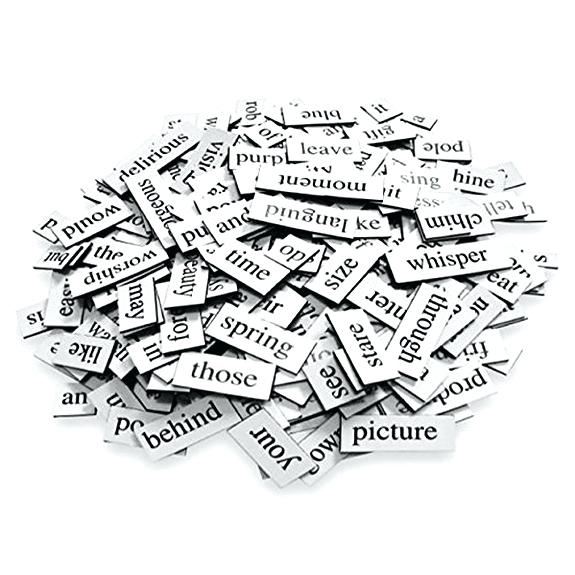
This weekend, I want to get back to playing with words.words-from-letters-magnetic-poetry-kit-geek-words-letters-for-refrigerators-words-with-letters-maker


~ ~ ~

* ie, Descartes, boy, did he have problems! Both mathematical and mind-body problems, though he was better at the former. (Sorry for the silliness).


Edges & outcomes

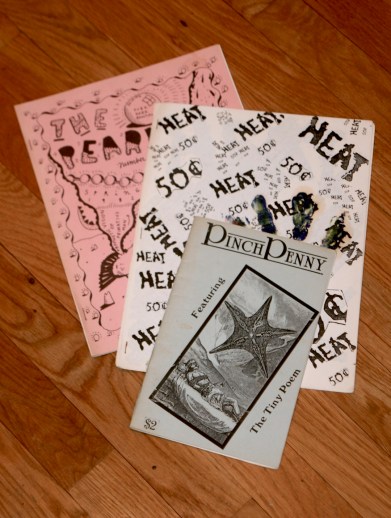
One outcome of participating in a “blog tour” is the opportunity to listen in on what writers younger than I–or newer to the act of being-a-poet–experience in the literary environment of the 21st century. In some ways that has become quite a changed adventure from the early 1980s when the alternatives to major presses and established print journals were little fly-by-night xerox-zines, copied and stapled in runs of under 100. But perhaps not so different from free blogs with just a few dedicated followers; those miniature publications gave me my first print credentials as a poet. Today, I read Lissa Clouser writing of “all the things I’m not” and recalled my own early and uncertain forays at the edges of the literary world.

IMG_5106

xerox-zines, ca. 1982-ish

I now enjoy being outside, observing the edges. It’s more interesting than I realized when I was in my 20s–when edginess was cool, but one might wish to belong with the edgy newcomers. [The paradox of being in the tribe of outsiders.]

Also, I found the garden and the woods and meadows intriguing, and also child-raising, teaching, neuroscience, philosophy. I became a nominal member of many tribes. Including, more recently, the tribe of the aging person and the tribe of the chronically ill–communities that range widely, encompass much, and are fraught with delicious and difficult complexity.

It took me 20 years to get to Arthur W. Frank’s book The Wounded Storyteller, and I might not have found it so useful and illuminating if I’d read it twenty years ago. Now, however, the book’s insights are relevant to my life and to the current moment. Frank powerfully reminds us that as members of the human collective, we need to listen to people; that in time, all of us become wounded storytellers; and, therefore, each of us benefits by learning how to bear human living with a kind of “intransitive hope.” By intransitive hope, Frank means finding a way to be with our suffering in life, recognize that suffering happens, but also to recognize that there are ways to be human that do not end in miraculous cures–that may (and will, eventually) end in death.

And that’s okay. He suggests that healing is a project, not an outcome.

Kind of like writing, you know?

~

“As far as I’m concerned, poetry is the best thing that exists in the universe.”             –-Kaveh Akbar

~

~
~

Curation

Recently, I spent awhile browsing the Walter Kerr collection of books in the library of the college that employs me. Kerr and his wife Jean were writers in New York in the 1950s, 60s, and 70s; he was best known as a theater critic and she as a playwright and essayist. His family donated his books to the school, and it occurred to me during my perusal that this section of the stacks seems more personal than the collection as a whole. Here are Kerr’s quirky book choices, his favored influences, his academic interests with a place among the trendier tomes on movies and Broadway.

A personal library acts as a unit, books that are kept together rather than disbursed upon the death (or before-death donation) of the book collector. It therefore parallels–and predates, of course–the social media concept of the curated self:

Through the ongoing process of organizing content and media elements which create personal profiles for specific audiences, social media users inadvertently curate versions of themselves. Social media turns users into curators as they create distinct incarnations that are separate, yet become the objectified digital presentation of one’s physical self. [definition from socialcurators at weebly]

“Curating” seems to be a trending concept these days, so I naturally checked the etymology:

derives from cure: c. 1300, “care, heed,” from Latin cura “care, concern, trouble,” with many figurative extensions, such as “study; administration; a mistress,” and also “means of healing, remedy,” from Old Latin coira, a noun of unknown origin. Meaning “medical care” is late 14c. (https://www.etymonline.com)

Among those “many figurative extensions” is the curator in the sense of library science or museum administration. Now we can add social media users to the extension metaphors.

Perhaps curating oneself is more natural than I initially thought. My library probably offers a means of knowing who I am, or at any rate what I choose to value given what I have learned in my past; what we leave behind–as in Mr. Kerr’s library collection–becomes who we may be to others.

If they study, if they speculate, if they care.

While I was at the library, I borrowed a few books (of course). I will write about Arthur Frank’s classic book The Wounded Storyteller soon, I hope, in conjunction with some poems I’ve been working on. I also borrowed poetry collections by Matthea Harvey, Rachel Hadas, and Larry Levis.

Am I curating my life?

~~

~~


Poetry on chilly days

The region in which I live has been experiencing a lengthy spate of below-freezing weather, many a chilly day. When I do not feel like concentrating too much, I browse seed catalogues. But I am also reading poetry.

Today, I’ve begun reading a 2011 collection of poems by Rachel Hadas, The Golden Road, poems that are dense and beautiful and often elegiac in tone. I took a workshop with Hadas quite a few years ago and had enjoyed her work since long before the class; it was a pleasure to have her as a reader/instructor. And it is, so far, an excellent book. I’ve been keeping her poem “The Study” in my mind for hours now.

Good news, though–I have commenced the year with new poems of my own. I have three drafts as of January 7, which is a good start.

But for today–yet another chilly day–I’m posting this little verse by William Carlos Williams.

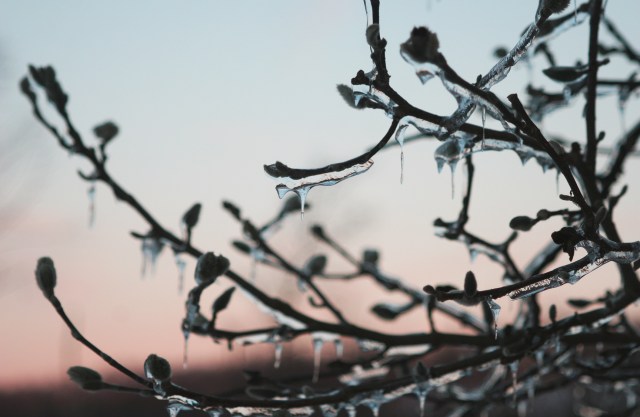
Winter Trees

All the complicated details
of the attiring and
the disattiring are completed!
A liquid moon
moves gently among
the long branches.
Thus having prepared their buds
against a sure winter
the wise trees
stand sleeping in the cold.
                              –William Carlos Williams
~
IMG_0516
~~
~~

Poetry as a value

If individual consciousness exists among human beings, and I believe it does, it is however the collective consciousness that has the longest-ranging impact. We are social mammals. We crave some object or objective with which we can connect and form relationships around in order to create community. Humans cannot survive without communities.

Those communities can be centered around almost anything as long as the focus keeps social members busy with the process of group-forming, skill-sharing, skill-teaching, communication and, ultimately, the development of a shared history. Hence family, tribe, language, or religion–among many other social magnets–keep us cohesive. Until we bicker and subdivide. Society works in ways analogous to the brain and body: through complex systems and nearly-random relationships and long, twisty networks.

I’ve been thinking about the things we “worship”–things we value and therefore believe are inherent among good human beings–and how such perspectives affect the consciousness of entire civilizations. Simon A. May, in Love: A History, suggests that in the early 21st century, “Western” societies have been elevating the idea of love to that socializing focus. An interesting premise, and I suppose there are worse rallying concepts than love, though May points out ways in which even love can be transformed into an ideology rather than an emotion.ann e. michael

In a large society are many sub-societies, each with its own locus of organizing a human collective; these may often overlap or coexist with the vast variety of human interests. Reflecting on this, I consider myself as part of the society of educators, and of book-readers and book-learners, and of art lovers; and also a member of those people who feel that poetry assists in the lifelong endeavor to engage meaningfully and attentively to life.

Here is a list of people like me who subscribe to the necessity of poetry and who write about it on their blogs. Donna Vorreyer has compiled a listing of poetry-related blogs to follow. I will be following some of them, too.

https://djvorreyer.wordpress.com/2017/12/26/it-feels-just-like-starting-over/

The beloveds

In my last post, which featured a draft of a new poem, I should have mentioned my indebtedness to Gregory Orr and to the King James version of the Bible, as well as to Rudyard Kipling for the affectionate phrase “O Best Belovéd.” *

It’s fascinating, the inflections of English–and the way some of our archaic forms of speech still show up, such as the extra syllable pronunciation option for a word like beloved. I appreciate, too, the connotation of one whose emotional being feels connected to another person. We nurture those connections when our children are young, when we fall in love, when we feel intense compassion for another person–sometimes, even, when the person has died and the feeling of being a beloved and having that beloved near linger.

My own best-beloveds fall into all of those categories. I believe I can say I have a full heart.

~

As my last two posts featured poems of sadness, I wish to change things up. This one’s a love poem and a food poem, a cozy piece for the approaching darker weeks.

stewcook


Says the Stew Cook to Her Belovéd

Cat’s leaped on the kitchen counter, pawed a walnut from the bowl.
Liter of red wine waits for dinnertime—can’t say I’m not tempted, though.

Low sun highlights the bottle’s deep maroon while I make stew:
turnips, potatoes, garlic’s liquor, bay-leaf—needs only you.

Cool weather calls for firelight and whatever cooks long.
This cook longs to influence your taste, your tongue.

Since night’s expanded its acreage, taking over December,
we can build upon the dark, fill nooks with aromatic hours.

Come taste soup, share coriander scent, sip from this spoon.
Lick clean the bowl, my love, cover pots, come to bed soon.


~


~~  * I recognize, however, that for many many readers, the word Beloved will most closely be associated with Toni Morrison’s daring, beautiful, wrenching novel by that title–a work I highly recommend.

Transitions & ambition

letter I
have maintained this blog pretty regularly, for years now, writing about books and poems and gardens and teaching, examining the concept of consciousness and trying to plumb–from a novice’s perspective–the brain’s wiring and functions. I suppose I am seeking a kind of “interdisciplinary” approach in these posts and in life: a philosophy of values that considers the arts, aesthetics, evolution, biology, social structures, neurology, consciousness, physics, etymology, pedagogy, ecology, and compassion (have I forgotten anything?) in a distinct but expansive method of living in which I can situate myself and which might guide my behavior as I make my life-long way through the world. If, by some chance, my words influence a reader–so much the better; this is, after all, a public space (WordPress.com).

Like many people who use social media platforms for their writing, though, I have a mixed view of its suitability as a medium and of its perceived necessity for contemporary writers. My purpose, originally, was to practice writing prose and to promote the arts and the natural environment as necessary complements to and instruction for the development of empathy (compassion) and metacognition in human beings.

The blog has been reasonably suitable for practice; it gets me writing what is basically a brief essay on a more-or-less weekly basis. It has several thousand “followers,” but only a handful of readers. [I can discern this through the statistics page on WordPress, though I don’t check often.] In general, I use this platform mostly as a way of “seeing what I think,” and it serves that purpose, too.

IMG_0127

I have come to some conclusions about the problem of consciousness (and about whether it actually is a problem) through the reading and experiences of the past ten years or so. Those conclusions are, however, private ones. While the process of discovery and inquisitiveness works in a public forum, the takeaway remains, for this blogger, a thing carried within.

But.

~~

But other blogger-writers have influenced my thinking about what a public forum such as blogging or Facebook can do for the writing process. Dave Bonta and Luisa Igloria, as well as Michael Czarnecki and Lou Faber–among others–promote by example the option, and value, of publishing new or unedited, unfinished, partially-revised work. Granted, not all of them have thousands of readers who weigh in on criticism or encouragement; but the very process of making public the work-in-progress seems to me to be courageous. This may be because I am a wimp, or it may be because the social aspects of the vaunted “po-biz” have dampened my willingness to show a kind of transparency in my writing methods.

I am not on the tenure track and will not be teaching in an MFA program, however, so why would it matter?

Therefore: be prepared, oh limited but blesséd audience. I may begin to foist upon you the recent sad, sad poems I’ve been writing–in draft form. Or I may begin to reveal the poems from my seven-years’-unpublished manuscript online. Or I may, like Luisa and Michael, begin to blog “a poem a day” (unlikely, but…). It seems to me that a transition is in order here. And that stands as my writing ambition for the moment, as autumn makes its way toward the solstice and I face another stack of student essays to grade.