There & back again, with weeding

I have traveled to the American Southwest and back again, over a fortnight away from the humid valley where my gardens languished toward autumn, pounded by rain, while we were gone. For two weeks, we lived among the terpene-scented (pinene, not cannabis…though we did notice cannabis when in downtown Albuquerque…) environment of the Sandia Mountains, where humidity is “not a thing.” I embraced my beloved family members, not quite often enough to make up for the distance between us, but enough to feel contented for awhile. And we explored some of the northwestern/north-central parts of the state that we haven’t seen before and were awed. I have not yet tired of the geology there. It’s easy to imagine New Mexico as the benthic floor of an ancient sea!

En route home, we encountered flight cancellations and re-routing, which is practically to be expected (our checked bag arrived 20 hours after our arrival in Albuquerque, also not an unsurprising development). I hear many complaints about air travel these days. I may even have added to said complaints. While it may feel almost as inconvenient, unreliable, and uncomfortable as traveling by Conestoga wagon, you must admit it’s much faster–even if it doesn’t seem that way while you’re waiting for the bus to the economy long-term parking lot at 11 pm. If my beloveds had taken Horace Greeley’s advice in the 1850s, I might never have seen them again. So, I am grateful. Even to American Airlines.

~

Upon a (slightly delayed) return, I found that the valley in which we live had experienced considerable rain but mild temperatures; as I expected, the garden weeds were thriving. Some of that is fine with me: annual weeds can go crazy in October and I don’t mind. But the perennial vines, little shrubs, and weedy biennials and perennials? I dig those out in fall, along with the tomato vines, sunflower and corn stalks, and amaranth plants. That has been my job upon my return; and the cooler weather, with soil moist from all the rain, has been a boon. I have to admit that adjusting to the lower elevation and the higher humidity has put some strain on my ol’ body. But we did a good bit of hiking and walking in the Sandias and Bandolier and Jemez, so I was somewhat prepared for the workout.

My beloved doesn’t understand my enthusiasm for “putting the gardens to bed for winter.” It seems like boring, hard work. Yet I don’t clean everything up–I always leave cover for bees and other creatures that need leaf litter and old stems in order to winter over. However, taking down the stalks and cutting back the peonies (etc) feels satisfying to me. I work in the cooler weather and sense the difference in the air. I recognize the annuals are dying and the perennials are going dormant, the trees let go of their coloring leaves; walnuts, oaks, and hickories seem to fling their mast upon the earth with every gust of wind. There’s nothing sad or somber about the changing of seasons. Winter must arrive in order for spring to do its thing. I like to think of daffodils, muscari, and irises huddled quietly in soil and taking much-required rest before the warmth unthaws the earth. I feel the same.

Restorative

I often start a post with a mini-weather report; I guess that’s one way I prepare myself to write, centering myself in the environment I inhabit. Our region received much-needed rain this weekend, but I was out of town–and the weather in Chicago was glorious: cloudless, crisp, mild, a light breeze. Odd, though, how weather conditions can evoke strong memories for me. The amazing clarity of the sky and air reminded me vividly of September 11, 2001, and the two days following it when we had a run of glorious weather and a mood of intense disturbance all around us…and no plane traffic at all. It took a few moments for that recall to settle in, and a few minutes more to let the memory go so I could enjoy the present moment.

~

I was in the Chicago area–Highland Park– for the book launch of The Red Queen Hypothesis. Many thanks to my publisher, Julie Dotson, and the welcoming and supportive group of poets and audience; the reading went well, and we sold some books (always a satisfying thing). I met quite a few interesting people and learned a bit about the city of Highland Park, its relatively long history, its parks, architecture, the storied Ravinia Festival, and how the city’s been coping since the July 4 tragedy last year. Travel always offers perspective. In this case, travel offered community as well: a lively community of people who support the literary arts.

~

I even got to be recorded, with Jennifer Dotson as the interviewer–a first for me. Here’s the link:

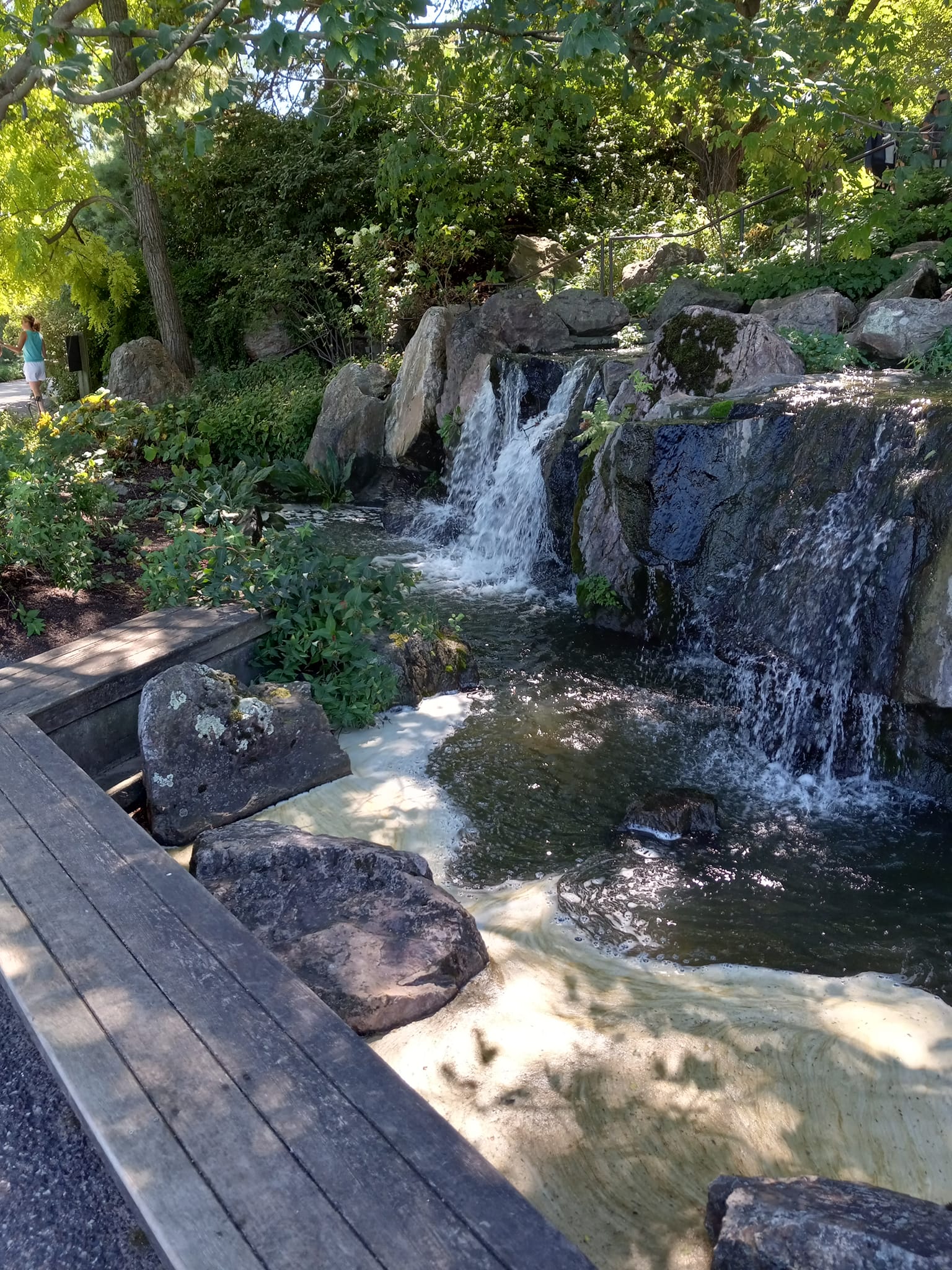
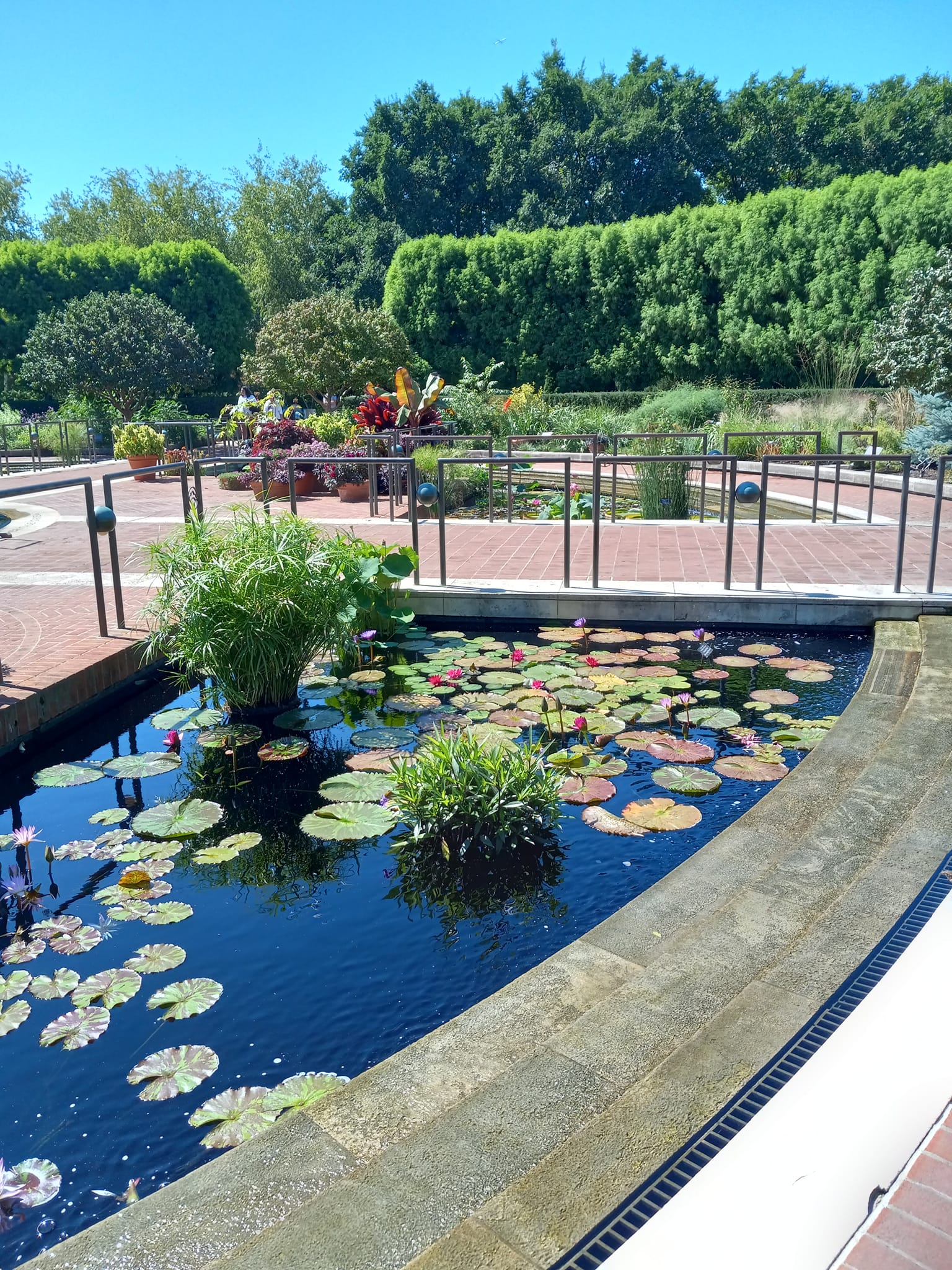
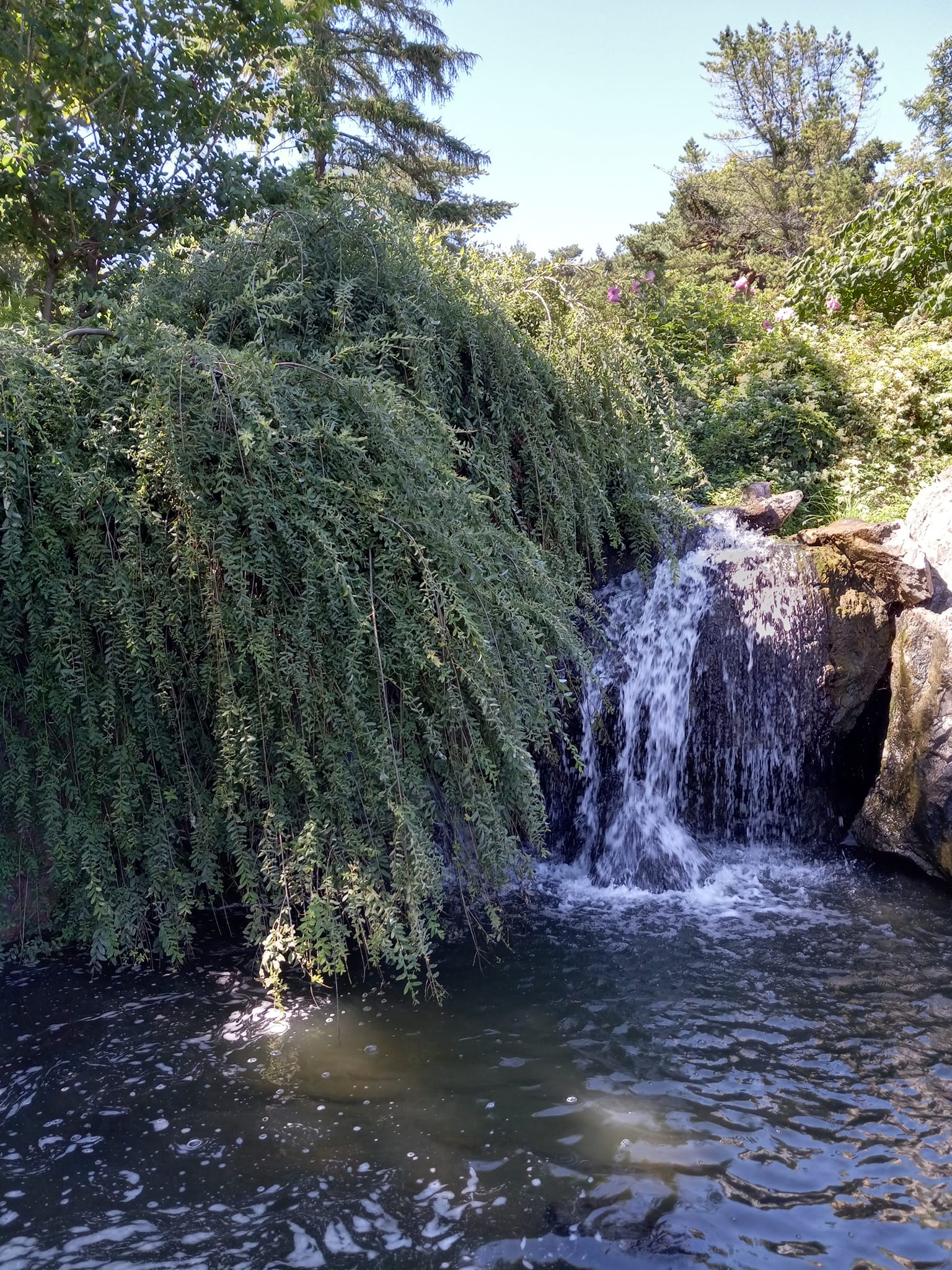
My generous poet-host, Julie Isaacson, knew from my writing and my biography that I would enjoy a walk around the Chicago Botanic Gardens–and she was so right! The gardens offered just the respite I needed after airplane travel. We hadn’t the time to stroll all 280+ acres, but the chance to walk amid trees and beside water in the middle of an urban expanse was genuinely restorative.

Now I am pulling weeds and pruning for the approaching autumn, activities that allow me to settle into myself internally and which sometimes result in poem drafts. Please wish me luck on both endeavors!

Script, postscript

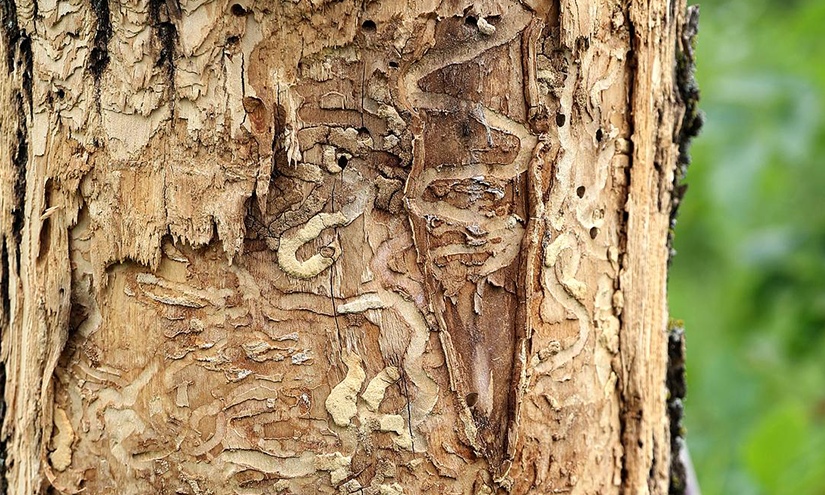
The weather has been glorious lately, which has the downside of getting rather droughty. No rain in the forecast, either, so it is time for supplemental watering if I want to keep harvesting from the vegetable garden. There’s not much left there, though; I may just wait things out and save the water. Meanwhile, some of our days have recently been punctuated by the sound of green ash limbs crashing in the nearby woods. When I investigate the trees, there are the telltale scribbles of ash borer on the trunks. The marks look like script.

I learned, while teaching college freshmen the past few years, that many younger adults do not know how to write or even to read script. Many children never get the lessons in handwriting in the second through fourth grades the way I did. Instead, they learn keyboarding–a skill I got to in my junior year of high school but never really have mastered (yes, even now I use a self-developed version that’s sort of an advanced hunt-and-peck method). It’s hard to believe that reading script is a task that will be relegated to specialists in years to come, but I shouldn’t be surprised if that’s what happens. To many of my college age students, handwritten script in English is almost indistinguishable from the marks of ash borers. They don’t see the need for that particular skill. Handwriting is going the way of letter-writing.

Perhaps we live in a post-script world?

I have been thinking about the handwritten word recently because of a recent incident while visiting my mother. She received a small refund check from an insurer, and though she understood what it was and that she no longer uses her checking account–we siblings take care of that through power of attorney–she was confused about what to do with it. “Sign it, Mom,” I told her, offering her a pen. “We’ll deposit it for you.” I turned the check over and pointed to the line for signature on the back.

She wavered, pen in the air. “I don’t…I don’t,” she said (her aphasia has advanced past the point of expressing full sentences). It took me a moment to realize that she could not recall how to sign her name. I placed my hand around hers and helped her start with the capital B.

I didn’t cry, but the experience hasn’t left me alone. I suppose there may be a poem in this incident, but if so, it’s a sorrowful one.

Aft a-gley

Today marked the first day of the Fall semester at the college, but I had no reason to be there. Instead, I enjoyed the surprisingly fine August weather, harvested tomatoes and basil, and began the much-delayed task of weeding our numerous perennial beds. At 4 pm, I rested in the hammock after a walk and spent a few minutes reveling in retirement; though generally I’ve been too busy to find myself in reflective or relaxation mode, it was nice to pretend for awhile.

Yes–I wanted to read books in that hammock, and get to the community pool, and hang out with friends on the patio until the bats came out and the last fireflies gleamed over the meadow. Ah, but Robert Burns nailed it: “The best laid schemes o’ mice an’ men / Gang aft a-gley.” There were so many other things to do.

That said, while I did not do the Sealey Challenge this August, I managed to read several really terrific poetry books–and the month’s not over yet! To keep this post brief, I’ll just mention the book I’m reading now, Jennifer Franklin’s stellar new collection If Some God Shakes Your House. Lots of (mostly) non-rhyming sonnets, a series of memento mori poems, and lyrically linked poems titled “As Antigone–” connect anger, grief, and suggest that anti-authoritarian acts are often more about love than bravery. The speaker keeps denying that bravery’s behind her disobedience, but these poems are brave. I found many of them utterly heart-breaking, so it may not be an “easy read” if you want something cheerful to uplift a low mood. Nonetheless, Franklin’s poems secure hope to love so intensely I could not look away and keep returning to them even before I have finished the book.

I grew up confusing opinion
with oracle. She reminded me
all men are dangerous, each time
I left the house alone….

Jennifer Franklin

It can be difficult to avoid comparing such strong poetry with…well, with what I write. I think that most writers do this occasionally, some more than others. If one is a competitive or ambitious person, analysis and comparisons may be second nature; I have known poets who feel dismayed by their own inadequacy compared to the “greats,” and poets who felt bitterly overlooked because they didn’t get the attention or lauding other writers garnered. Either way is a trap, though. In general, I look to admirable literature as something to enjoy, learn from, admire, and to analyze to figure out how it can be done. If I have ambition, it is the ambition to learn. Oh yeah, the autodidact in me again!

And speaking of ambition, or lack thereof, I am far behind in promoting my book. Next post should contain details of the book launch in the Chicago area (September 9), and perhaps other writing-related newsiness.

Acclimating

A few weeks back, a black and white cat appeared in our yard and took up residence behind the garage, near the compost pile. He’s neutered and acclimated to human beings, friendly, not feral by any means–but a hunter. I didn’t mind having him there to keep mice and voles out of the compost, but let’s face it: outdoor cats are a menace to wildlife. And we live in a semi-rural area of former fields and old barns, which certain unethical folks deem “good places” to drop off unwanted kitties.

We have kept cats as family companions for years, but over time have altered our feelings about cats being outside; our current pair stay indoors. Our previous cats have killed bats, birds, snakes, toads, cicadas, voles (okay, I have mixed feelings about the voles). This interloper has already killed a small garden snake and is harassing the wrens and a pair of nesting catbirds. After hearing a series of alarm calls from the catbirds, I caught him in the burning bush where they reside and gave him a dousing with the hose; but now he knows where they are and that he can climb up and reach them. I don’t see this ending well for the birds. We have several options here, one of which is to catch him–once he trusts us enough–and take him to a cat rescue center, though in our region the no-kill places are filled to the max already. Or we can catch him and adopt him, which means vet bills and the challenging period of introducing him to our cats, and then acclimating him to staying inside. Other options are less humane.

Cats are cats, and he merely does what cats do. I can’t blame him (though I want to!). The real problem, as usual, comes down to humans altering the environment and being careless about spay/neuter. Plus we could be more responsible cat owners: I have a friend who keeps her cats indoors during nesting season, for example. That’s a good start. It means becoming more “mindful”–by which I mean not doing so many things without even thinking first–and recognizing that even fairly small changes in habits can, cumulatively, make a difference.

Two simple examples. A second or two of thinking first, and caring a little, would have stopped dozens of cigarette-, firework-, and campfire-caused wildfires over the past decades. Would have meant fewer people killed or injured by humans driving while intoxicated. We have brains and can acclimate ourselves to using them by developing less harmful habits.

I hear many birds making their alarm cries this time of year when I take walks. Today, I saw a doe and heard her alarm noise, which sounds very like a person sneezing (she probably had a fawn hiding nearby). These creatures don’t believe my assurances that I am not a threat; I’m human. Inherently threatening.

Lightning bugs

We didn’t call them fireflies when I was a child, though now I kind of prefer that name for the flittery flashers that decorate the summer nights. There are fewer this year, probably due to variances seasonally–that drought we’re still not completely recovered from, followed by some rain and hail, and slightly cooler June temperatures than usual thanks to the haze of smoke from wildfires to our north. Peak season for fireflies in my region has typically been right at the solstice. Looking out my window this evening, I remark on a paucity of flashes in the meadow and over the lawn. Fewer Lampyridae this June. Things can change from one year to the next.

Change equals living: no life without alterations of one kind or another. My current situation is one of those so-called Life Events: I have retired from my position at the university where I worked for about 17 years. I suppose it is A Big Deal (see how I’m capitalizing?), but I must admit that so far it doesn’t feel terribly fraught, major, or even bittersweet. It just feels appropriate. Part of the reason for that is that I’m not a person who has defined herself by her career. Thank goodness, since it was a fairly modest career. I enjoyed my work with students; and I was part of a terrific team of earnest, funny, and supportive folks. So yes, that’s something to miss. However, I have many interests beyond work at the college. Time to pursue those, methinks. Time to spend with my mother as she wanes. Time to travel with my husband and on my own and to visit our far-away offspring. Of course, there are all those things that will keep me unexpectedly busy…gardening, house maintenance, trying to get the metaphorical ducks to line up (as if they ever will). And then, poetry; I want to devote some serious brainpower to revising, reorganizing, drafting, reading, learning more about the art I love. Maybe even submitting more work, putting together another manuscript or two. Who knows what changes are ahead?

~

When I note the fewer numbers of fireflies, I do not mean there are none. It’s just that some years, by June 18th, the back of our yard simply dazzles; we don’t need fireworks! Because they pupate in dampness, such as in rotting logs or underground, and because they need moist earth in order to feed (on soft-bodied invertebrates, according to the Xerxes Society’s informative page here), a spring drought can limit their numbers. And I miss them, the way I miss the little brown bats and the green ash trees. Those types of changes may be more or less inevitable, but I can’t help thinking that such transitions feel less timely than my departure from running the university’s writing center. The ash and the bats are still around, but in vastly decreased numbers. I hope the lightning bugs bounce back.

~

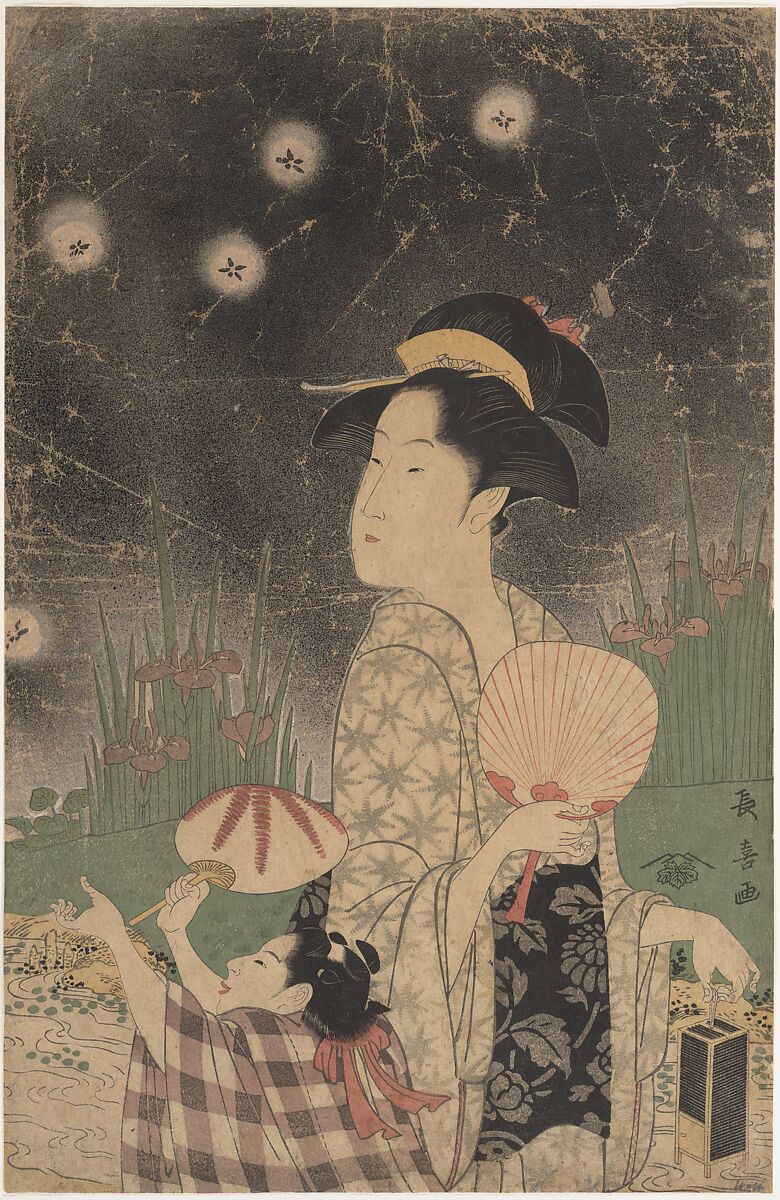
Art from the Metropolitan Museum: Eishōsai Chōki ca. 1763

Goals, sort of

Our regional drought continues. I sometimes entertain the idea that the universe is telling me I might as well consider moving to the Southwest–where my children now reside–since the Mid-Atlantic area currently has less rainfall, higher temperatures, and lower humidity than where they are. Granted, this is likely to be a temporary situation; but for the present, I get the chance to walk on crunchy grass and hard soil daily and see how I like it. And to see blue skies for days on end, and see how I like that. What next?

Speculating on “what next” comes rather naturally to me, a reflective sort of human being; but making goals and ambitions toward accomplishment–not so much. Lately, though, the years-ahead thinking has been moved the forefront of my thoughts. It’s all those dang Medicare and Social Security and AARP mailings, in part, and my peers and I heading into the so-called retirement years. Inescapable: the conversations crop up around the dinner party table, while having coffee with a pal, or on a phone call with siblings. People keep asking me what my new goals are. I suppose, having reached the age Social Security (used to) kick in, I was expected to come up with new goals? Must have missed that memo.

Goal: the word is of uncertain origin, says Etymology Online, but appears in the 14th c “with an apparent sense of ‘boundary, limit.’ Perhaps from Old English *gal ‘obstacle, barrier,’ a word implied by gælan ‘to hinder’ and also found in compounds (singal, widgal). That would make it a variant or figurative use of Middle English gale ‘a way, course’…” And there’s the further meaning of a stake that signals the end point of a game. Interesting that goal can be an obstacle, a limitation, an end-point, or a pathway.

If I think of it as a pathway, the question is, what do I want to do? After many years as an educator…do I throw all that experience away and take up something else? My guess is that I’ll find myself imparting information of some kind, one way or another, regardless of employment status. So no major change of course, just a change of scenery, situation, or audience. After all, I will still be writing.

Or are we talking aspirations? What is it I would like to plan for…self care? travel? conferences and retreats? Time to do–what, exactly, and with whom? Here there are perhaps barriers and limitations: can we ever stop worrying about how much will it cost and how much time it will take to achieve the specified goals? And obstacles–you cannot plan for them. Maybe I go blind or get cancer or get hit by a bus. Maybe the apocalypse occurs in my lifetime. That would certainly be the stake that signifies “game over!”

Then again, what if my plans are to get into the woods more, sit under trees more, take more walks, read more books, tend to plants and animals, hang out with my beloveds, write poems? Those things, I want to do in future. But it isn’t as though I am not already doing them now.

Photo by Michael Heinrich on Pexels.com

Information from poems

I tried to attend a poetry event on Saturday afternoon, but the weather was against me.

The rain came accompanied by lightning strikes, high winds, falling branches, flash-flooded roads, sleet, and a little hail, all in the space of two and a half hours. I left home only to turn around after three miles. The highway was blocked with traffic piled up due to various “storm-related events” (said the weather sites). Actually, I was grateful for the storm, since our region has been unusually dry and even warm for April–my trees, shrubs, meadow, and perennials needed rain. And upon my return, I got back to reading books of poetry. This past week these included collections by Marilyn Chin, Elizabeth Metzger, Grant Clauser, Jennifer Franklin, and Natalie Diaz. Some wonderful work there.

Through these books of poems, I also gleaned lots of interesting information. That’s something many people who claim not to like poetry don’t understand: you can learn about so many things through poetry! Poems contain fascinating facts, intriguing perspectives, tons of social and cultural observations, vocabulary and terms I would not have known about otherwise…poems have been the impetus for me to learn more about astronomy, theology, historical events and people, the geography and topography of the earth and its oceans, the life cycles of insects and plants, how metal shops operate, how to catch fish or tie a fly, what it is like to “live with a disability,” how the process of dying has differed from era to era and place to place, what it is like to reside in a war zone, the traditions of people whose backgrounds differ from my own, and other so-called “non-fictional” information.

Facts, in other words. Poems may inhere in the emotional or intellectual realm in many ways, but they also can–and often do–inform. They contain facts as well as multitudes. If people did not get so hung up on trying to decode a secret meaning behind everything they encounter that appears to be a poem, they might be surprised at how much they could learn from such (usually) brief texts. Yes, it might help to look up a word or a reference or two. That can get a reader started on a whole trail of interesting and valuable knowledge, widening the worldview, changing the perspective.

It may even lead a person to recognize that facts can change depending on point of view. Contemporary science acknowledges this, but most human beings haven’t accepted it yet. Anyway, this points to one reason poetry has often been considered unconventional, subversive, even dangerous or radical: Poems can challenge the status quo of what is accepted, received, unquestioned in society’s knowledge base. Terrifying the authorities by means of information.

Go for it. Read a book of poems.

~

Coming up in May, I’ll be featured once again at GoggleWorks in Reading PA, 6 pm on May 4th…it has been awhile since I was there (2012), and I look forward to it!

Morning birds

Every year, late March, starting at dawn, the cardinal thumps against our basement window, reminding me of a bored bear I saw long ago in a too-small cage–that repetitious sway and stomp–poor thing. But the bird’s unfettered and the window’s behind a large bush, a spindle tree we planted too close to the house–what’s driving that bird? Territoriality? We think perhaps it sees its reflection, so we’ve tried bird scare tape, opening the window, curtaining. Some years there are nests in that bush, but it’s never been cardinals nesting there. Thunk! Thunk!

My son used to stay up playing League of Legends until 3 am in that room, only to be awakened at 5:45 with irritating regularity by “Morning Bird.” He has left the nest, but the bird or its genetically programmed-to-thunk offspring returns annually. So it must be Spring.

Finally we got some good rain, about 3″, but the feeder stream behind our property lies pretty low and swampy after a mostly snowless winter and a dry autumn. Times have been when that stream flowed four feet deeper, rushing to meet Saucon Creek and head to the Lehigh River basin. I walked there this morning looking for frog eggs and salamanders, found two of the latter in a vernal pool where the skunk cabbage drills up from the swamp. Skunk cabbage doesn’t have much of a reputation for beauty but looks lovely with the sun behind its unfurling leaves.

I’m not a birder and can only identify about 25 birds by sight, fewer by sound. I noted mourning doves, mockingbirds and turkey buzzards, robins and redwings as I headed toward the creek. I have loaded Cornell’s “Merlin” bird app on my phone, though, and spent some quiet time sitting back on my heels in the sunshine while recording birdsong. The field sparrows weren’t in the field as yet, but other sparrows were calling: white-throated, song, and house sparrows (the house sparrows love to hide in the thick English ivy bush near the back of our house). Cardinals, of course, house finches, American crow, bluejay, red-bellied woodpecker, hairy woodpecker, tufted titmouse. Deeper in the woods, the white-breasted nuthatch got noisy, and an Eastern phoebe scolded me quite insistently from a beech tree. I was scouting around the largest beeches to see if I could find any dry beechdrop stems, but likely these trees aren’t quite old enough for beechdrops. I was happy to find some partridge-berry leaves, though; ten days ago, when my husband mowed the meadow, he saw a bobwhite–and left some cover standing for it.

I heard the Carolina wren as “Merlin” identified it, and was interested to note the bird app also recorded the presence of black-capped chickadee, bluebird, and Eastern towhee. It’s a bit early for towhees, but I’ve seen them here in past years, usually in April. And just before this recent rainstorm, I spied a killdeer in the meadow. I feel like an amateur naturalist! Anyway, forsythia are blooming. Even if we get more cold spells, I call Spring as having sprung.

~

By 10 am I was assessing the vegetable patch, where I moved a couple of perennial herbs and tore out as much shotweed as I could find. Some winter weeds can stay in the soil for later season removal, but shotweed flowers early, bolts fast, and sends out thousands of seeds so effectively that winter weeding is essential. I can’t keep it out of my lawn, but I can keep it under control in the garden. Redwings, robins, and woodpeckers kept up their calling while I worked. Good to get sun on my hair and dirt under my nails–feels like the first real spring day.

Bookish decisions

In the past two weeks, I’ve read two contemporary poetry collections that I didn’t, er…love…or perhaps what I mean is I did not respond to them the way I enjoy responding to poems (and no, I will not be naming titles, though I will be giving these books away). While that is a let-down of sorts, I also started reading naturalist Marcia Bonta‘s Appalachian Autumn–which I do love. The book takes an environmental-diary approach that I have enjoyed in other naturalist writers’ work and which, no doubt, I relate to partly because I am also a near-daily diarist of my own backyard; Bonta has much to teach me, because she has a naturalist’s education and long experience. This is one of four Appalachian Seasons books she’s authored, and maybe I should have started with Spring, since that equinox has just passed. I found myself interested in the story this book tells of her family’s legal struggles with local lumbermen and absentee landlords, however. It’s an experience with which, sadly, my beloveds and I are familiar.

And I also began reading a book of poetry I have found exceptionally compelling–Rebecca Elson’s A Responsibility to Awe. Perhaps more on that in a future post. So books continue to enrich my life. I hope that is always the case, but I’ve seen how changes in human neuroplasticity can affect even the most bookish among us. More reason never to take the joys of reading for granted–and to keep my library card current.

~

In future, I plan to use the library card more than the credit card when it comes to books; but I know I’m weak. Besides, many of the small or indie press poetry books I relish are not easy to find in public library collections. One of my priorities this year is to winnow the home bookshelf stacks, to keep only what I really cannot bear to part with or am sure I will read or refer to again. But how can I be sure? The book lover’s dilemma, isn’t it? Nonetheless, there are definitely texts I can part with if I just take the necessary time to go through the collection. I can donate them to a public library, and even though many of them won’t get curated onto those shelves, at least I will be supporting an institution I value. I have been referring to this process of lightening my bookshelf loads as “culling,” but that word tends to have a negative connotation. I’d like to remind myself of the positive aspects of giving some of my books away: good for me, good for other readers, good for the authors of these books whose work may be discovered by other readers. Less to pack if we ever move, less for my children to deal with when that time comes. Yeah, I’m thinking ahead.