Information from poems

I tried to attend a poetry event on Saturday afternoon, but the weather was against me.

The rain came accompanied by lightning strikes, high winds, falling branches, flash-flooded roads, sleet, and a little hail, all in the space of two and a half hours. I left home only to turn around after three miles. The highway was blocked with traffic piled up due to various “storm-related events” (said the weather sites). Actually, I was grateful for the storm, since our region has been unusually dry and even warm for April–my trees, shrubs, meadow, and perennials needed rain. And upon my return, I got back to reading books of poetry. This past week these included collections by Marilyn Chin, Elizabeth Metzger, Grant Clauser, Jennifer Franklin, and Natalie Diaz. Some wonderful work there.

Through these books of poems, I also gleaned lots of interesting information. That’s something many people who claim not to like poetry don’t understand: you can learn about so many things through poetry! Poems contain fascinating facts, intriguing perspectives, tons of social and cultural observations, vocabulary and terms I would not have known about otherwise…poems have been the impetus for me to learn more about astronomy, theology, historical events and people, the geography and topography of the earth and its oceans, the life cycles of insects and plants, how metal shops operate, how to catch fish or tie a fly, what it is like to “live with a disability,” how the process of dying has differed from era to era and place to place, what it is like to reside in a war zone, the traditions of people whose backgrounds differ from my own, and other so-called “non-fictional” information.

Facts, in other words. Poems may inhere in the emotional or intellectual realm in many ways, but they also can–and often do–inform. They contain facts as well as multitudes. If people did not get so hung up on trying to decode a secret meaning behind everything they encounter that appears to be a poem, they might be surprised at how much they could learn from such (usually) brief texts. Yes, it might help to look up a word or a reference or two. That can get a reader started on a whole trail of interesting and valuable knowledge, widening the worldview, changing the perspective.

It may even lead a person to recognize that facts can change depending on point of view. Contemporary science acknowledges this, but most human beings haven’t accepted it yet. Anyway, this points to one reason poetry has often been considered unconventional, subversive, even dangerous or radical: Poems can challenge the status quo of what is accepted, received, unquestioned in society’s knowledge base. Terrifying the authorities by means of information.

Go for it. Read a book of poems.

~

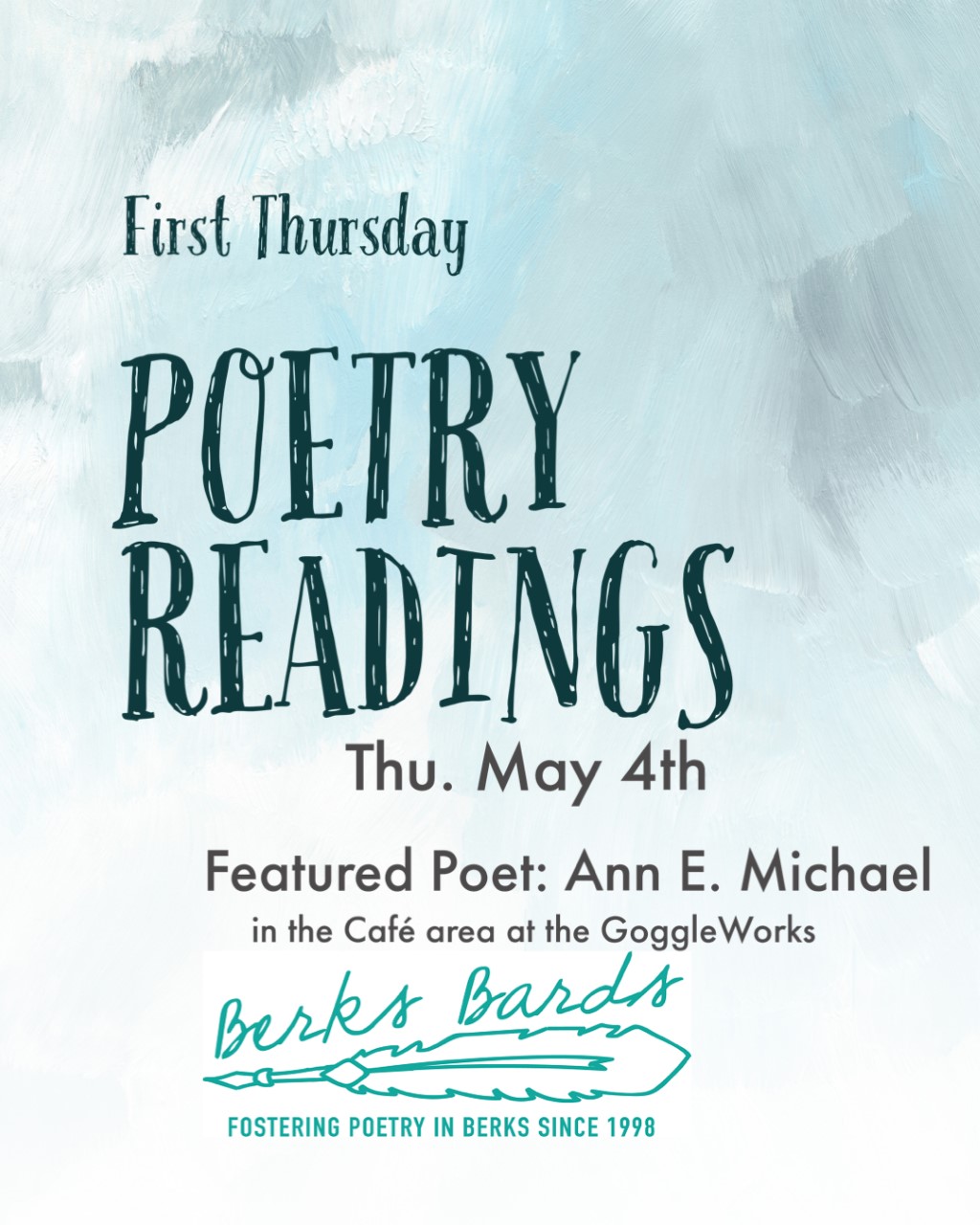
Coming up in May, I’ll be featured once again at GoggleWorks in Reading PA, 6 pm on May 4th…it has been awhile since I was there (2012), and I look forward to it!

Morning birds

Every year, late March, starting at dawn, the cardinal thumps against our basement window, reminding me of a bored bear I saw long ago in a too-small cage–that repetitious sway and stomp–poor thing. But the bird’s unfettered and the window’s behind a large bush, a spindle tree we planted too close to the house–what’s driving that bird? Territoriality? We think perhaps it sees its reflection, so we’ve tried bird scare tape, opening the window, curtaining. Some years there are nests in that bush, but it’s never been cardinals nesting there. Thunk! Thunk!

My son used to stay up playing League of Legends until 3 am in that room, only to be awakened at 5:45 with irritating regularity by “Morning Bird.” He has left the nest, but the bird or its genetically programmed-to-thunk offspring returns annually. So it must be Spring.

Finally we got some good rain, about 3″, but the feeder stream behind our property lies pretty low and swampy after a mostly snowless winter and a dry autumn. Times have been when that stream flowed four feet deeper, rushing to meet Saucon Creek and head to the Lehigh River basin. I walked there this morning looking for frog eggs and salamanders, found two of the latter in a vernal pool where the skunk cabbage drills up from the swamp. Skunk cabbage doesn’t have much of a reputation for beauty but looks lovely with the sun behind its unfurling leaves.

I’m not a birder and can only identify about 25 birds by sight, fewer by sound. I noted mourning doves, mockingbirds and turkey buzzards, robins and redwings as I headed toward the creek. I have loaded Cornell’s “Merlin” bird app on my phone, though, and spent some quiet time sitting back on my heels in the sunshine while recording birdsong. The field sparrows weren’t in the field as yet, but other sparrows were calling: white-throated, song, and house sparrows (the house sparrows love to hide in the thick English ivy bush near the back of our house). Cardinals, of course, house finches, American crow, bluejay, red-bellied woodpecker, hairy woodpecker, tufted titmouse. Deeper in the woods, the white-breasted nuthatch got noisy, and an Eastern phoebe scolded me quite insistently from a beech tree. I was scouting around the largest beeches to see if I could find any dry beechdrop stems, but likely these trees aren’t quite old enough for beechdrops. I was happy to find some partridge-berry leaves, though; ten days ago, when my husband mowed the meadow, he saw a bobwhite–and left some cover standing for it.

I heard the Carolina wren as “Merlin” identified it, and was interested to note the bird app also recorded the presence of black-capped chickadee, bluebird, and Eastern towhee. It’s a bit early for towhees, but I’ve seen them here in past years, usually in April. And just before this recent rainstorm, I spied a killdeer in the meadow. I feel like an amateur naturalist! Anyway, forsythia are blooming. Even if we get more cold spells, I call Spring as having sprung.

~

By 10 am I was assessing the vegetable patch, where I moved a couple of perennial herbs and tore out as much shotweed as I could find. Some winter weeds can stay in the soil for later season removal, but shotweed flowers early, bolts fast, and sends out thousands of seeds so effectively that winter weeding is essential. I can’t keep it out of my lawn, but I can keep it under control in the garden. Redwings, robins, and woodpeckers kept up their calling while I worked. Good to get sun on my hair and dirt under my nails–feels like the first real spring day.

Bookish decisions

In the past two weeks, I’ve read two contemporary poetry collections that I didn’t, er…love…or perhaps what I mean is I did not respond to them the way I enjoy responding to poems (and no, I will not be naming titles, though I will be giving these books away). While that is a let-down of sorts, I also started reading naturalist Marcia Bonta‘s Appalachian Autumn–which I do love. The book takes an environmental-diary approach that I have enjoyed in other naturalist writers’ work and which, no doubt, I relate to partly because I am also a near-daily diarist of my own backyard; Bonta has much to teach me, because she has a naturalist’s education and long experience. This is one of four Appalachian Seasons books she’s authored, and maybe I should have started with Spring, since that equinox has just passed. I found myself interested in the story this book tells of her family’s legal struggles with local lumbermen and absentee landlords, however. It’s an experience with which, sadly, my beloveds and I are familiar.

And I also began reading a book of poetry I have found exceptionally compelling–Rebecca Elson’s A Responsibility to Awe. Perhaps more on that in a future post. So books continue to enrich my life. I hope that is always the case, but I’ve seen how changes in human neuroplasticity can affect even the most bookish among us. More reason never to take the joys of reading for granted–and to keep my library card current.

~

In future, I plan to use the library card more than the credit card when it comes to books; but I know I’m weak. Besides, many of the small or indie press poetry books I relish are not easy to find in public library collections. One of my priorities this year is to winnow the home bookshelf stacks, to keep only what I really cannot bear to part with or am sure I will read or refer to again. But how can I be sure? The book lover’s dilemma, isn’t it? Nonetheless, there are definitely texts I can part with if I just take the necessary time to go through the collection. I can donate them to a public library, and even though many of them won’t get curated onto those shelves, at least I will be supporting an institution I value. I have been referring to this process of lightening my bookshelf loads as “culling,” but that word tends to have a negative connotation. I’d like to remind myself of the positive aspects of giving some of my books away: good for me, good for other readers, good for the authors of these books whose work may be discovered by other readers. Less to pack if we ever move, less for my children to deal with when that time comes. Yeah, I’m thinking ahead.

In deepest fog

Autumn here was a bit dry, but as we approach the winter solstice–mild temperatures, rain, and many days of fog. Fog seems apropos. My mind has been fuzzy lately, clarity of intent and expression lacking. It’s one reason I have not been blogging.

When the air temperature gets up to 45° or 50° F, stinkbugs come out of their torpor and slowly climb up the window screens where they have been hiding or buzz noisily about the rooms, acting as sleepy and undirected as I feel. True, the daylight’s dwindling, and that makes many of us go into a sort of hibernating mode, mentally if not physically (likely a bit of both). True, the Fall semester at the university is in its last week or two and, as usual, is wearing on me.

Also true, it’s hunting season until the 10th, and the deer may be grateful for the fog…at any rate, taking advantage of it. It’s not all negative. Water molecules in the air can be good for plants, hydrating them after a dry autumn. Fog means less dry skin for those of us who wander around outside.

But let’s face it: fog encourages molds and increases the chance of traffic accidents and tends to head people into a low-barometer frame of mind. Foggy-headed. Brain fog. Here’s an informative breakdown of fog’s kinds and outcomes (yes! of course there are categories of fog!) https://mrcc.purdue.edu/living_wx/fog/index.html Some of my readers may find poetry in these categories.

Just before dusk this afternoon, I stood at my window and marveled at the dense cloudiness of the valley, at the stark bare trees snaking their way up through the pale damp air. I felt a twinge of European Romanticism: Caspar Friedrich’s “Wanderer above the Sea of Fog” and all that. The view was analogous to my fusty mind. All sorts of possibilities out there in the mist, nothing to strike toward, no path, potential risk. But beautiful in its way. I thought to myself, “There is something hidden in all this, and among the hidden-ness, things that are dear and familiar to me, not just fearful unknowns.”

The garden is there. The deer. The beech tree, some of its leaves still clinging. The bank voles and the red squirrels, the holly bush, the daffodils underground that will emerge in April. My fog will clear.

Then darkness overtook fog, and the coyotes called their carols in the moist air.

Break-taking

It is a particularly lovely autumn in the region, colorful, clear, dry and mild. This evening at 5 pm: 70 degrees F, crickets and frogs singing. My mood has, however, been unsettled–and I have not been writing much. Indeed, this feels like a good time for a hiatus on a number of fronts and in a number of ways. I recently read Katherine May’s Wintering, which was not terribly memorable but which offers the reader support for, well, resting. Resting one’s bones, mind, endeavors…seasonally apropos.

Mostly I’ve been on a Murakami kick, reading three books that a recently-departed friend had with him in his hospice room. Novels take the place of doing my own creative thinking. I get wrapped up in their worlds and can rest from my own. Thus reading is a form of wintering. (May agrees.)

My poetry output has been minimal recently, and I have hardly sent out any work; mostly, I feel tired and eager for the semester to come to a close (one month or so hence). There are reasons for this it is not necessary to go into. But I miss the writing.

I will return to the “best words in the best order” in my own time. So if you follow this blog, don’t think that I have fallen off a cliff–I have merely oriented differently, for a time.

Meanwhile, please remember that there are books for sale you can find on my ‘My Books’ tab. Support the small-business publishers of poetry now, for poetry is as necessary as ever, and not a luxury.

Autumnal

I have been re-reading Allen Lacy’s charming and informative book The Garden in Autumn. I first read it years ago and enjoyed his writing as much as I appreciated his useful ideas about landscaping with autumn in mind. I treasure books that offer more than information–well-written and inspirational texts which in this case includes attractive photographs, as well. I am outside in the clear, cool weekend days and doing some garden cleanup, but I don’t tidy things up as neatly as I used to: many insects and other small animals need some vegetative cover, and incautious hoeing can disturb nesting bees. I was almost 40 years old before I learned that most bees don’t live in hives and that our precious pollinators of many varieties need winter shelter.

Meanwhile, haiku drafts. Meant to kick myself back into creative writing gear. Practice/Zen practice.

~

So hot!
drinking the last of my morning coffee
with ice...


cicadas whirring.
under my bare feet
	dry grass.


Fall semester
remember to practice 
resting Buddha face


Jays and chickadees call—
louder but not as constant as
crickets in the dew


four cantaloupes
on the vine
I didn’t plant!

~

In the profusion 
of morning glories:
		one gold leaf


good morning, cicadas!
	at least some of us
feel wide awake

~

in the tulip poplar
red squirrel scolds 
a Carolina wren


dew
on crabgrass is 
still dew


farm stand:
fresh eggs for
a dying friend


late summer
six young sparrows—
empty birdfeeder


Three bats flit
at dusk the doe huffs, sneezes—
bedtime for fawns.

I don’t need
the word September
I see the spider’s orb

Volunteers

This evening, a steady rain at last, one I hope continues for hours. It is too late to save my vegetable garden but will help trees, shrubs, flowers as they set seeds, birds as they migrate.

Earlier today, I harvested a few remaining veggies. I cut some zinnias for bouquets and watched as a newly-emerged monarch butterfly unfurled its antennae and proboscis and dried its new wings. As often happens in the late-summer weeks, I pondered what to do for the next year’s garden. A surprising thought took shape: letting the garden go fallow for a year. After all, the patch has been working hard for over two decades now–shouldn’t it get a break?

My thought process then admonished me about weeds. The majority of the weeds that would crop up in a fallow patch well-composted over the years will be non-native plants. Those are what mostly come up in our meadow, though we do have many natives as well. But the meadow isn’t rich soil like the garden is. True, I have nurtured some natives even in the vegetable garden. I grow three varieties of milkweed as well as native asters, rudbeckia, and goldenrod (not to mention the native vine poison ivy, despite my best efforts to eradicate it). The milkweed was, this year, much appreciated and eagerly consumed by monarch caterpillars. Still, if I do nothing in spring but let the patch go fallow, I’m likely to find it has been claimed by white clover, dandelion, purslane, Canadian thistle, mugwort, garlic mustard, Japanese knotweed, Amur honeysuckle, and other common weeds that originated in Europe, the Caucasus, or Asia.

Okay, but I’m a champion at weeding in the springtime. I could pull out many of the invaders just as they are getting started. What if, however, I allowed some sprouts to grow? The volunteers, as gardeners call them, that come up on their own after wintering as seeds in the ground or in the compost–I could let them stay wherever they popped up. In this way, the garden would design itself, instead of me being the designer. It would be a year of surprises! I like that idea. I love a good experiment…why not find out what my garden wants to do, after 25 years of me trying to tell it what to do?

Hasn’t yet taken its first flight!

I can make some good guesses as to what I might find: morning glories, zinnias, some variety of squash, tomatoes of mixed parentage, nicotiana, sunflowers. Basil, possibly; chives and cilantro and dill, almost certainly.

Anything else really would be surprising, but this year I had a cantaloupe volunteer, and its fruit was quite tasty. It gets below freezing here for months in winter, and I have never had lettuce volunteer; however, I haven’t let it go to seed, either. It might survive, as the radishes seem to do.

The more I mull it over, the more I like the idea. I like the experimental aspect of it, and the speculation and the surprise. It means that instead of preparing the soil in spring, all I’ll do is spread the compost out as usual–but not dig it in. I’ll water if the spring is dry, but mostly pay attention to the things that sprout and determine as early as possible whether those are edible or ornamental, or just weedy. The downside is that I’ll get all those marvelous seed catalogs and…will I be able to resist? Also, my spouse will complain. He likes a well-laid-out, well-delineated garden so he knows where he can step and where he shouldn’t, what to water, and what to pull out. He may also object initially to the aesthetics of an unplanned truck patch. But around mid-June, I will be admiring my volunteers. It will be beautiful.

~

Always I find metaphors and analogies between the gardening process and the writing process. The way I put my recent chapbook (Strange Ladies) together was similar to the theory of an all-volunteer garden. I drafted those poems at different times over many years and let them sprout even though they did not seem to fit in with my other writing projects or plans. After awhile, I realized they made their own kind of peculiar and surprising design.

I recognize that experimentation is a big part of my writing process. I love just playing around with words and ideas; when I first started writing more purposefully, my poems were often a bit surreal and strange. Over the decades, I’ve experimented with craft, prompts, natural world imagery, poetic form, philosophical and speculative concepts, and memory. It’s hard for me to say where my style or genre of poetry fits. I experiment, but most of my poems are not “experimental.” Much of my work uses observations of the natural world as major image and motivation, but I am not quite a “nature poet.” It doesn’t really matter how or whether my poetry fits an identifiable description. I weed as I go along, and I let anything that looks interesting (or familiar) show me its stuff.

That’s a natural process that reflects the way I think, the way I experience the world, and the various ways I find to express myself to readers. [Crafting and revising–that’s less spontaneous, though it can have outcomes just as surprising.]

As with my garden idea…wait and see.

Run dry

I think I prefer the lunisolar calendar to the solstice/equinox method of dividing the year into seasons. The Babylonians used it, and if you have that human need to count stuff and divide it into categories for planting and harvesting, the lunisolar calendar makes as much sense and is aesthetically pleasing, too. According to the Chinese calendar, August 23rd marked the “limit of heat.” The heat, and our current drought, may continue well into September; but as the days shorten, at least the nights cool down. The heat gets slightly less oppressive and humid. This coming week (around September 8) marks the 白露 báilù period, when “white dew appears.” I did see dew on the grass this morning.

Well, dew on the weeds. Dew on the clover and crabgrass, because the drought has killed off most of our lawn, and the tall grasses in the meadow do not get dewy. Instead, they are bedecked with spiderwebs. The red-winged blackbirds that perched on the tall grasses in June and July? They took off a little after the swallows did.

The bats, robins, hummingbirds, finches are still in evidence. There’s a distinct late-summer mood in the air, though. It is Labor Day weekend. Summer’s drought has not ended, but the slower pace of the university summer schedule has. Crickets are creaking, the swallows have departed, afternoon shadows grow longer, and the students are back on campus. I am busy.

Meanwhile, three sets of friends have had their elderly, beloved canine companions die. Dry leaves fall from the tulip poplars. Each week, my mother seems to lose a few more words from her lexicon. The jays scream every day at 4 pm.

I have been feeling a bit run dry myself. Like a small stream that needs a thunderstorm or, better still, a few good wet days to replenish it. As in: not writing. Yet I have found Charles Simic’s 1994 The Unemployed Fortune-Teller: Essays and Memoirs quite inspiring, if “inspiring” in this case means nourishment for the mind and heart without actively producing anything in terms of output. The book is part of the University of Michigan’s wonderful, decades-long series Poets on Poetry.

Simic writes, “A poem is an invitation to a voyage.”

Oh, let me never get so busy I cannot go on such voyages!

Adaptable

The squirrels have begun an assault on my vegetable garden, drawn by a stunning and unplanned stand of sunflowers starting to go to seed. I can’t say I blame them, and I don’t mind that they eat the sunflowers–the birds can grab plenty. It’s the intelligence of squirrels that rallies the assault: they find a food source, tell their friends, and then explore further into the garden. That’s where I get annoyed with them. In this dry, hot weather they seek out the juicy tomato fruits and, while there, sample everything else they can find.

But their appearance is due to human circumstance and intervention. The development of a suburban cul de sac next door instead of the cornfield of past years, for example, and the pressure that has led to fewer predators in our little environment. More deer in smaller acreage, and deer eat oak saplings, so we have fewer oak trees maturing along the woodlot. With less mast available, why not turn to sunflower seeds, tomatoes, pears, even squash? Squirrels will take advantage of those changes. Very adaptable creatures.

Adaptability is admirable, and required if beings are to stay alive, let alone evolve. When I visit my beloved, aphasic, widowed mother, I marvel that she can nevertheless, under enormous changes, navigate the world. Granted–she has assistance. But not all human beings with assistance manage to maintain a benign and compassionate sense of self as their bodies fall apart with age.

Which brings me to Lost and Found, a Memoir, by Kathryn Schulz. My book group read this one recently, and I started reading it without doing any research about the book or the author–too busy with other things, and sometimes I like to be surprised by a text. By page 60, I was teary-eyed, because the story Schulz tells resonates with me. This month marks the second anniversary of my dad’s death, and the book begins with the death of Schulz’s beloved, curious, intellectual, chatty father.

This is the “Lost” of Lost and Found. Schulz writes beautifully, and writes beautifully of how complex and fraught the impending death of a loved one can be–the decisions, the fears, memories, even the forms that must be filled out and submitted so that the insurance and medical bills get properly taken care of. Meanwhile, we grieve and remember and numbly try to keep on in our suddenly bereaved “normal lives.” Schulz describes the environment of grief accurately and poignantly.

The “Found” section of the book describes love: new love, romantic love, the thumping of the heart and surprise at finding a person who’s the person. Here, Schulz’s experience differs considerably from mine, yet her writing took me back to days of feeling the heady excitement of getting to know someone deeply, intimately. The memoir, though it begins in sorrow, ends with the vulnerable opening into the shared territory of long-term relationships, whether those are among families, friends, or spouses.

As wretched as the world often is, we–and the rodents, insects, plants, etc.–find ways to adapt for far longer than seems likely. In the face of war and climate catastrophe and the loss of what we love, some of us manage to change and stay resilient, teaching new skills to those who come after us. We do so through art, literature, dance, music, community, love. It isn’t easy and it isn’t certain. But it’s all we’ve got.

The Birdcatcher*

So many “heat bubbles” world-wide this summer. We happen to be in one of them–high temperatures, even at night, and barely any rain in the past three weeks. No rain in the forecast for days ahead. Drought. Temperatures in the 90s. It’s not even as humid here as it usually is in summer. But humid enough. I dislike air conditioning as a rule, but boy am I grateful for it and privileged to have it.

The sunflowers in my garden grew taller than average this year yet are now drooping from high temperatures and lack of water. Young deer show up outside of their usual territories while trying to find forage that isn’t crispy. They (and the birds) gobbled up the wild berries so quickly that I managed to pick only a pint or so of wineberries. The drought hit after blackberry season, though, so we did get a nice harvest of those.

Curled petals of a very dry sunflower.

It’s not just the deer behaving differently because of the weather. I notice that squirrels and some birds have altered their usual patterns as well. This evening, I got a panicked call from a friend who lives in a nearby city–a bird had found its way into her son’s attic room through a poorly-installed window air conditioner, and all the windows up there were stuck shut due to the humidity. The poor bird was fluttering crazily, and she had no idea how to free it. I’m guessing the bird (it appeared to be a juvenile catbird) was seeking shade and shelter, and saw the gap between the wall and the unit as a safe space as the sun began to go down.

I have not had a lot of experience rescuing caught birds, but this is the second time in a week I was summoned to assist a frightened avian. On Monday, one of our summer library assistants asked for help with a fledgling robin that was unable to clear the brick wall of our entry ramp in order to join its parents, who were chirping from a nearby shrub. That task was easier than rescuing an attic-trapped bird, but I succeeded in both cases.

I shall rename myself Papagena!

Meanwhile, we have finally taken steps to remove house sparrow nests from our damaged cedar siding, an eviction over which we have no regrets. The layers of nesting material in former woodpecker holes (which the house sparrows enlarged and populated) make an interesting study in avian biology; they also make a mess. More about the problematic house sparrow at this post. Suffice it to say, there’s a ton of work involved, including lift boom rental, that we must manage under lousy-hot conditions.

Bird-catcher, bird-rescuer, and bird-evictor. Here I am, keeping things in balance.

~

*The Birdcatcher is the title of a wonderful collection of poems by Marie Ponsot. I recommend finding a copy and reveling in her work.