Landscape, personal place

I’ve been enjoying Rachel Solnit’s prose lately, most recently her book As Eve Said to the Serpent, some of which derives from art criticism but which is also the kind of multidisciplinary approach to observing the relationships between things that intrigues me. What she notices about the environment, about art that engages with or alters place/landscape, and about environmentalists themselves piques my own inquisitiveness and gets me asking questions I might not otherwise have come up with. Place, particularly the personal “environment” that shelters, inspires, or calms me, is something I consider frequently.

31281_1488041725309_1074892_n

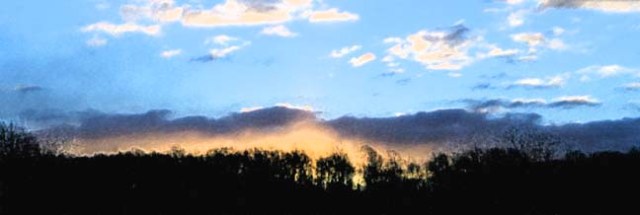
[one of my happy places]

Perhaps that’s because I am by nature an introvert; perhaps it has to do with being a poet. The personal aesthetics of place–a room or a landscape–exert significant effects upon my frame of mind and mode of thinking.

Why is that?

Maybe there is an evolutionary reason for the need to find a favorite spot, a hide-away, a happy place. We may still possess that ancient urge for security, the cave or treehouse we can use to hide from predators or from the weather.

And landscape itself can be a secret place, or a sacred place. A wide expanse of openness means it is easier to observe predators prowling in the distance, giving the prey animal time to flee. Or to explore, to survey, to run embracing what is far away and only imaginable.

12841317_10209081894708815_1677238824119852160_o

Neolithic stone circle, Castlerigg, Cumbria, UK

~

C.D. Wright: “What landscape is: not a closed space, not in fact capable of closure. With each survey the corners shift. Distance is the goal; groping the means.”

“Be critical, and sing”

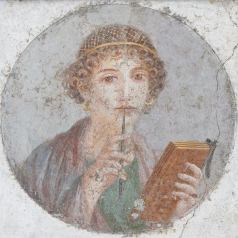
pompeiian woman-writer

The poet C. D. Wright died in January of this year. She was an American original. She was a critical thinker of the first order, an experimenter.

For no apparent reason, I thought of her when I saw this fresco painting (unearthed in Pompeii) of a woman with a stylus and book. Something in the thoughtful musing look in this portrait suggested a critical eye, analysis, consideration–a keen and penetrating intelligence. She will reflect before she writes, but she has opinions she  is not afraid to share.

A collection of Wright’s pronouncements, which she combined and arranged in a sort of extended prose poem, was published as “69 Hidebound Opinions.” The hidebound is both tongue-in-cheek and earnest; typical, really, of Wright’s work. I’ll post the link and also share a few that I find intriguing.

“69 Hidebound Opinions” by C. D. Wright.

Here’s #22:

“To opt to be a poet, is to have some resolve. It leaves you free–to sing as you will, with the lungs god gave you–even if no one but god might hear. It leaves you that naked and obligated to sing your best. Suzuki teaches that ‘in the beginner’s mind there are many possibilities; in the expert’s mind there are few.’ Beginner’s mind then, is not only where you start, but where you must remain. It is what will keep you–long after you have children, job, house, dog, too many keys on your ring–free.”

Number 27:

“An atmosphere of depression will arouse artists’ attention over an atmosphere of prosperity nearly every time. Because it derives from consciousness, art is critical. Also true, ruins are beautiful to us; the Blues make us feel good; it is through the wound that we perceive the body whole.”

Yet, #42 says, “It is left to the poets to point out the shining particulars in our blunted lives like the strands of blue lights Cotter, Arkansas, draped every haunting Christmas from one empty storefront to the empty storefront across the street for eight unoccupied blocks.”

Number 41 resonates deeply: “It is poetry that remarks on the barely perceptible disappearances from our world such as that of the sleeping porch or the root cellar. And poetry that notes the barely perceptible appearances.”

An aside: [I want to write about the sleeping porch, which I loved in my early childhood and which hardly exists anymore. I’d like to sleep on one again, build a house that has a sleeping porch. Also, my joy at discovering my former neighbor had–and used–a root cellar; his joy at discovering the young person new to the neighborhood was fervent about her truck patch.]

“53

Poetry is the language of intensity. Because we are going to die, an expression of intensity is a necessity.

Extended awareness, isn’t that central to the art?”

No. 67–

“Gradually one comes to fathom exactly what it is one has chosen–what is poetry. Poetry avails itself of the listener, the watcher. Whether called upon to emancipate, comfort or forecast, poetry responds. The possibility that the poem you were born to write, will not join you on the porch this summer or the next, looms taller than the sunflowers and the hollyhocks. It could have taken the fork to the river or ended up at the slaughterhouse. It could have died as quietly as the moth on the screen. Or just borne itself up on the breeze. Who can say. This is the poet’s choice: to attend a presence no one else was aware of, to spend the better part of a lifetime preparing for an arrival, that could not occur but for her attention, that would not in fact otherwise make its blaze on this world.”

waterpaper


I close with #51: “Now that I am beyond the initial paralysis of calling one’s first teachings into question, I am left with: be critical and sing.”


The morbid book group

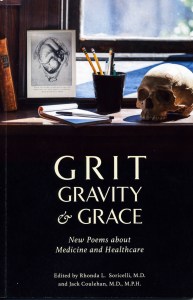
[FYI, readers, I have a poem in this anthology, which relates to this post.]

~

A little over a year ago, I was invited to participate in a book discussion group that  focuses on texts that offer varying perspectives concerning health, surviving cancer, different cultural views of aging, and dying; books on “dying well,” hospice and palliative care, and on hope and healing; books on chronic pain and on neurology and the medical establishment, on birth traditions, on the history of medicine. We have also read The Tibetan Book of Living and Dying by Sogyal Rinpoche, Still Here by Ram Dass, and discussed books that have topics such as placebo effects, psychology, alternative medicines, the pharmaceutical industry, hospitals, the training and practice of doctors, and the death & dying ‘industries,’ including works by authors with personal and moral perspectives on how to live (and how to die). The people involved have included a pediatric palliative care expert, a NICU nurse, a hospice team spiritual counselor, a minister, a former nurse and massage therapist who’s a tai chi instructor, and others–most of us “of a certain age,” by which euphemism I mean we have been living through the experience of having parents in extreme old age and of having long-time friends who now contend with chronic or potentially fatal illnesses. At least one of us has survived cancer.

For a perspective on how most Americans view a serious study of such topics, I offer my husband’s assessment. He calls this “the morbid book group.”

In fact whenever I mention that I participate in a book group (a popular American activity), people ask me if the group has a theme; I tell them, “The theme is medicine, and wellness, and how we die.” And there’s inevitably a pause, and usually my friend asks, “Isn’t that kind of depressing?”

No. It has not been depressing, in fact. I have gained more than I can say from these books and from our small group discussions: information, perspective, philosophy, insight, dare I say wisdom? Not to mention freedom to talk about those things we tend to evade in polite conversation, the space in which to say “This really sucks” or “This saddens me deeply” or to ask, “What can we do?” The book selections have led to great discussions–and have helped me to forge some new friendships as well as to confront and accept different points of view on controversial issues surrounding health care. And death, yes (hello morbid books!), and grief, and–most of all–compassion.

Difficult books? Challenging reading? Have I ever shied from it? I relish exploring this kind of non-fiction-fact-science-ethics-cultural criticism. Participating in this book group is one of the highlights of my current life experience; it’s up there with my long-running poetry critique group and my MFA years in terms of transformational engagement and exchange of ideas.

Below, a list of some of the books we have read and talked about. Just in case any of my readers wish to begin a morbid book group of their own.

~

Radical Remissions, Kelly A. Turner

Knocking on Heaven’s Door, Katy Butler

Buddha’s Brain, Rick Hanson

Death’s Door, Sandra Gilbert

Living with a Wild God, Barbara Ehrenreich

Still Here, Ram Dass

Being Mortal, Atul Gawande

The Anatomy of Hope, Jerome Groopman

The Tibetan Book of Living and Dying, Sogyal Rinpoche

Birth, Tina Cassidy

The Empathy Exams, Leslie Jamison

Counterclockwise, Ellen Langer

The Pain Chronicles, Melanie Thernstrom

Choosing Civility, P.M. Forni

Healing Spaces, Esther M. Sternberg

Die Wise, Stephen Jenkinson

…& more ahead, as we plumb consciousness, placebos, the medical hierarchy, and compassionate ways of living in the world. By the way, readers–suggestions for further readings are welcome!


Jisei

I have been re-reading a lovely anthology called Japanese Death Poems, edited by Yoel Hoffman. I purchased this book years ago when I was immersed in the study of haiku, haibun, and the early Chinese poetry forms and approaches that influenced many Japanese poets. Hoffman’s book offers excellent examples of jisei (poems composed near the moment of death) and his informational text places the poems in the context of various cultural, economic, power, and belief structures.

For a person raised in a contemporary western culture, the concept of death as a constant partner in our consciousness seems–while perhaps obvious–rather uncomfortable. We are not likely to approach our deaths with a sense of acceptance, let alone friendly understanding: “This is how it is.” But the death poems, as I read them, suggest that while death is universal, each person’s awareness of it is unique, even among people in the same culture who may hold similar beliefs.

Jisei intrigue curious folk, because death is A Big Thing to Be Curious About. Digital photographer Hank Frentz, a young artist who’s been inspired by Hoffman’s collection of jisei, has posted a series of mysterious and beautiful photos paired with the death poems, a sample of which can be viewed here. Please follow the link, as his photographs seem to me to be aesthetically and “spiritually” close to the poems he chooses, creating a kind of haiga (俳画) effect.

~~


I have also been revisiting Earl Miner’s translation of Shiki’s brief verse diary, “The Verse Record of My Peonies.” Written in 1899, when Shiki was suffering agonizing pain from spinal tuberculosis (he died in 1902 at the age of 35), the haiku and the prose of the diary recommend the reader to an understanding of physical pain, uncertainty–will I live, or die?–and humor, friendship, grieving. The diary is as layered as a peony blossom; each time I read it, I find something new to contemplate in its few pages: joy, aesthetics, nature, the human body, the solace of friendship and the isolation of illness, the nearness of death, the challenge of uncertainty, the many ways poetry can supply a place or grounding for a person struggling with ambiguities.

Two flakes fall
and the shape of the peonies
is wholly changed.

[tr. Earl Miner]


Composer Libby Larson has used Shiki’s verse diary as a text basis for a 7-minute composition for voice available here.


The skill of grieving

In a recent post, Sigrun of the blog sub rosa pointed me to Poetry Society of America’s page on Natalie Diaz; I’m even going to post the same paragraph she does, in which Diaz states:

When I write, I bring all of my truths, even the Judas-truths that make me feel like the betrayer whose dirty hands are resting on the table for everyone to see, including God. For me, writing is less a declaration of those truths than it is my interrogation of them. Uncovering the darkness in me that led to some of the poems about my brother also lights up the hard, bright way in which I love him and the small wars I wage to win him back…the truths that have built in me a strength and compassion that help me to survive this world. Truth is that little animal we chase and chase until we suddenly glance over our shoulder and realize it has been chasing us all along.

This passage about “uncovering the darkness” and the hard ways in which we sometimes love–maybe with some people, there is no other way to love–interestingly coincides with my recent reading of Stephen Jenkinson’s Die Wise, a manifesto on how we die and how we might die better (wiser) if we carried our darkness better, as Diaz suggests in the passage above. While I am reading Jenkinson for specific reasons around end-of-life concerns, there’s no doubt that there is often poetry in his philosophy that we need to learn the skill of how to grieve and to learn all that such a skill contains, including its “Judas-truths” and its unflinching confrontation with the ways in which death is a gift to us collectively and individually.

Most of us do not see death as any kind of gift, and Jenkinson admits it can be a challenging perspective; he endeavors to persuade the mostly-American or European reader that each of us and each of our societies or cultures would benefit by reclaiming death as a natural sequence in our being in the world.

Claiming or reclaiming death (you might read here: darkness), says Jenkinson, requires us to face the fact that we have no language for dying, not really. He says “we are taught almost nothing about what language to use or why when we are trained for the job [of tending to the dying].” The Dying, he writes, are “them,” meaning they are “not us.” Which makes them outsiders and invisible and yet all of us die; we are all of us dying–and we work so hard to distance ourselves from the fact.

Poetry is a language that, I think, sometimes guides us toward the hard truths, when poetry is well-made and conflicting and sundered with surprise. Poetry isn’t the language that gets us to dying, exactly; but it can do some of the hard work of teaching us how to grieve.

This is not to say that poets or artists are any better at dying than the rest of us. Sometimes the darkness uncovered in the fiction or poem or painting is true and authentic and deep, but the artist does the grief-working well in art and not so well in life’s physical dying process. Artists who choose suicide may be people who suffer pain and can express it artistically without actually learning the work of grief, which differs from suffering. If we learn that anything that does not last forever is meaningless (an idea drummed into many of us through the concept of “eternal life”), we are apt to feel bereft at every loss and may embrace a kind of horrible existentialism. Sometimes our artists strive to overcome the meaningless through lasting works of art, but their personal desire to be somehow immortal may bog them down as death nears.

We admire this artistic striving, but it is a kind of working against our darkness rather than confronting it with the love Diaz mentions. Jenkinson writes: “Dying isn’t the end of true things…It is one of the true things, that is all.” [My italics.]

However, I do believe that art–particularly the storytelling arts–can offer much in the way of teaching us the physical, on-the-level, hard work of grieving. Really good novels and plays can help teach us if no one in our “real lives” does. Even if we weep at the end of the book and wish the author had chosen a different way of ending it. Good poetry that leaves us excited and confused by complexity or blasted with gut-level sorrowing might be teaching us the ways of grief we aren’t learning from our culture.

When a loved one dies, we often get lost, pushed away from grief through the signing of papers and the bland condolences of marginal friends and the plea to move on with our lives. Good poems can keep us dangling in the now of real grief and force us to figure our way through the losses we incur–losses which do not exclude even our selves. Because “death waters the living.” And so does poetry.

http://www.philamuseum.org/collections/permanent/82820.html

Rain [La Pluie] Vincent van Gogh, 1889. Thanks to the Philadephia Museum of Art


To endure

I have been contemplating the word endure, particularly in relation to my continuing curiosity about consciousness and in relation to physical enduring when the body is in pain.

Reading an excerpt from Husserl (the first proponent of transcendental phenomenology) that–admittedly, taken out of context–places consciousness in relation to time, I realize endure implies the concept of time itself even though time doesn’t make an appearance in its etymology (see below). Husserl writes:

Every temporal object has a duration…but in the type that is duration we have a distinction between the expanding, flowing duration and the momentary durations.

He suggests that there are “filling-in” types of duration, or time-phases, that arise to create “a continuous consciousness of unity whose correlate is an unbroken unity,” giving us the impression of sensuous unity in time. I wonder if our sensations of  physical pain operate in the synapses of the brain in somewhat the same way: momentary (acute), and filling in over time or flowing (chronic).

When we suffer, we call upon endurance to sustain ourselves. The verb form connotes the negative more commonly, such as to endure oppression, abuse, harassment, pain, humiliation. It is an active verb.

etymology: late 14c., “to undergo or suffer” (especially without breaking); also “to continue in existence,” from Old French endurer (12c.) “make hard, harden; bear, tolerate; keep up, maintain,” from Latin indurare “make hard,” in Late Latin “harden (the heart) against,” from in- (see in- (2)) + durare “to harden,” from durus “hard,” from PIE *dru-ro-, from root *deru- “be firm, solid, steadfast”

Nonetheless, strength is also implied, a resilient firmness that people tend to value. What is the current perspective on being steadfast? Is it to harden (become stubborn and inflexible) or to be solid? Don’t we admire the person who has endured much and yet, one way or another, lived life as it presented itself however hard the circumstances? And are those positive or negative traits, as our culture views them? Customs endure. Prejudices endure. When we call someone a “hard person,” it is seldom a compliment. Yet being steadfast is generally considered a virtue.

It’s interesting to note that the adjective form of endure has a more positive connotation–

enduring (adj.) Look up enduring at Dictionary.com

“lasting,” 1530s, present participle adjective from endure.

An enduring work of art; an enduring love. Something that defies time by lasting through those temporary durations and through the fillings-in. We human beings wonder whether our consciousness, what many have called our souls, are enduring in the sense of expanding over time and past the demise of our corporeal selves. But great literature, great music, great art suggests there are many ways to endure.

In the New Year, my hope is to become attentive to what endures; to extend compassion and love more widely and more deeply; to read good books and take in good works of art; to be good at what I do reasonably well, tending to myself and to others with as much grace as I can muster. Some years challenge us more than other years. Let us choose to endure.

Love is all you need


Responses

The semester is over, and the juncos have returned to my back yard. One thing I have trouble assessing after teaching my class is whether the students have made any inroads into learning the difference between a fact and an opinion, and argument and a disagreement, an interpretation and an analysis. But a response can be any of these things.

Recently I have been entertained by Rebecca Solnit’s responses (as opinion). She’s made a bit of an earnest-minded internet buzz with her brief essay concerning Esquire magazine’s “80 Books All Men Should Read.” [As an aside, I really enjoyed her early book Wanderlust: A History of Walking.] Her opinion piece on Lithub is smart and funny, and she irked many readers; yet I do not see how anyone can argue with her final paragraph:

…that list would have you learn about women from James M. Cain and Philip Roth, who just aren’t the experts you should go to, not when the great oeuvres of Doris Lessing and Louise Erdrich and Elena Ferrante exist. I look over at my hero shelf and see Philip Levine, Rainer Maria Rilke, Virginia Woolf, Shunryu Suzuki, Adrienne Rich, Pablo Neruda, Subcomandante Marcos, Eduardo Galeano, Li Young Lee, Gary Snyder, James Baldwin, Annie Dillard, Barry Lopez. These books are, if they are instructions at all, instructions in extending our identities out into the world, human and nonhuman, in imagination as a great act of empathy that lifts you out of yourself, not locks you down into your gender.

Roth, Caine, Miller– “just aren’t the experts you should go to” if you want to understand half the human species; I love that tongue in cheek understatement. I also love her list of “heroes,” although it doesn’t hurt that she names among them many of my own heroes. She says she reads and re-reads work that she has opinions about–and admits her opinions may not align with the generally-accepted opinions. Which is fine, since she reminds us, quoting Arthur Danto, art can be dangerous, risky, uncomfortable, as long as it means something.

She does raise the point that “[y]ou read enough books in which people like you are disposable, or are dirt, or are silent, absent, or worthless, and it makes an impact on you. Because art makes the world, because it matters, because it makes us. Or breaks us.” In this way, she reminds us that readers are people who may have perspectives that vary from one another, particularly as to the social, psychological, or artistic merit of a piece of literature. Lolita, for example. That’s one book she mentions that evoked considerable response from Lithub commenters.

Rebecca Solnit’s response to her detractors–or “volunteer instructors,” as she calls them at one point–and her willingness to walk around the Himalayas with a medical team (recounted in a recent New Yorker piece) count as reasons her work has moved to the top of my to-read pile of books. I think I will start with Men Explain Things to Me and A Field Guide to Getting Lost.


Resilience & interpretation

I know many of the readers who follow this blog are not citizens of the United States. Perhaps you have been hearing about the contenders for our upcoming presidential election and feeling some dismay. Perhaps you are particularly concerned about calls for identifying citizens based upon their ethnic background and religious choice.

If so, I assure you that there is push-back here from people who recognize that persons such as Mr. Trump embarrass the nation. It appalls us to see a person who feels he can ignore the U.S. Constitution running for the presidential office simply because he has money and recognition…although the free and open laws of the country permit him to proceed.

Trump’s proposal to identify some of our citizens by creed or heritage violates the Constitution in several ways. It violates Amendment One’s provisions for freedom of religious expression, and Amendment Four, the right to privacy; and the section of Amendment Five that relates to being held answerable to a crime and deprived of liberties without due process of law; also, Amendment Fourteen Section 1. Many, many U.S. citizens know that such proposals are merely rabble-rousing slander and could not be enacted without completely controverting the Constitution. These people are not wealthy entertainers, and they do not make the news, but they exist and–with any luck–they will vote.

A person running for the highest office in his country should know its laws thoroughly, but nothing in our Constitution says he (or she) must. We citizens are to blame, as clearly many of us are not terribly familiar with the laws of the United States of America, either. U.S. citizens should become more aware of our responsibility to learn about the Constitution, the importance of the vote, and the need to be rational thinkers when we go to the polls. Our democracy’s founding documents were drafted by people who earnestly, if perhaps idealistically, believed that human beings are capable of rational decision-making.

Granted, they also thought they were granting voting rights to property-owning men. The Constitution has been altered over time; it is a resilient, flexible, and enduring piece of prose that’s been the source of frequent interpretation.USConstitution From a literary standpoint, resilience and interpretation are what keep “classics” alive and relevant as works of art, though close readers can also use context, history, and speculation about original intent to examine a piece of writing they love and respect.

I have no idea of how I will vote next November. But I do know I will consider, more than personal values, the values of the nation under whose laws I currently reside. I’m reminded of the wisdom-teachings of Jesus in the Gospel of Matthew–

He said to them, “Then render to Caesar the things that are Caesar’s; and to God the things that are God’s.” Matt. 22:21

The people listening to Jesus went away “amazed” (Matt. 22:22). There is something ambiguous in that response that speaks to me today, something worth meditating upon, something worth interpreting.

~

Slightly less difficult books

photo ann e. michaelI recently read Paul Bloom’s book Descartes’ Baby while simultaneously reading Daniel Dennett’s Content & Consciousness. Of these two, the latter falls a bit under the “difficult books” category, but it is not too hard to follow as philosophy goes. Dennett’s book is his first–the ideas that evolved as his PhD thesis–and in these arguments it is easy to see his trademark humor and his deep interest in the ways neurology and psychology have aspects useful to philosophy. Bloom’s book, a somewhat easier read, suggests that the mind-body problem evolved naturally from human development: young children are “essentialists” for whom dualism is innate; Descartes simply managed to write particularly well about the evolutionary project (with which, I should note, Bloom disagrees; as a cognitive psychologist, he maintains a more materialist stance).

It turns out that because I have read widely if shallowly in the areas of philosophy, cognitive psychology, evolution, art, aesthetics, and story-making, I find myself able to recognize the sources and allusions in texts such as these. Quine, Popper, Darwin, Pinker, and Wittgenstein; Schubert, Kant, Keats, Dostoevsky, Rilke…years of learning what to read next based on what I am currently reading have prepared me for potentially difficult books. [Next up, Gilbert Ryle and possibly Berkeley.] I don’t know why I feel so surprised and happy about this. It’s as though I finally realized I am a grownup!

And I am glad to discover I am not yet too old to learn new things, young enough to remember things I know, and intellectually flexible enough to apply the information to other topic areas. Synthesis! Building upon previously-laid foundations! Maslow’s theory of humanistic education! Bloom’s taxonomy! The autodidact at work in her solitary effort at a personal pedagogy.

If I ever really discover what consciousness is, I’ll let you know.


Change

finches-fall1

Goldfinches in winter attire

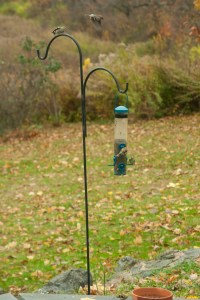
Two kinds of chickadees (black-capped and Carolina). White-breasted nuthatches. A tufted titmouse, bluejays, goldfinches in their brown-ish phase. The winter birds have arrived; despite a strangely warm November, the birds molt into dull plumage or migrate on schedule. I try to remember that when I feel worried about climate change: some forms of life are adaptable, change is normal, anxiety accomplishes nothing, and right action is possible.

I do not mean that we ought to ignore changes, especially those for which we have been responsible. When human beings get concerned enough to act, there’s a great deal of harm we can undo.

In the late 1960s and early 1970s, people in the USA became anxious about pollution. I am old enough to recall when New York City’s famous skyline was obscured by a yellowish-gray haze almost every day. Days we could see the Empire State Building shining in sunlight without smog were rare.The problems Chinese cities today are having with polluted air were happening for the citizens of Los Angeles and New York fifty years ago, but we took action–surprisingly enough–and eventually state and federal regulations required that technology be implemented to ease the problems technology had created.

This process was not speedy or easy, but it worked. I visit New York fairly frequently, and the sky is almost always smog-free. My now-grown children have never seen the skyline hidden under layers of air pollution.

Things changed.

Can humans undo the damages we have wrought to our oceans, air, rain forests, mountains, deserts, rivers, planet and its climate? Probably not–not all of it, certainly–and I doubt there is much we can do to stave off the “sixth extinction.” We have to accept we are part of the change, for good or ill, and to find ways to do less harm in whatever time remains to us–to activate compassion.

~

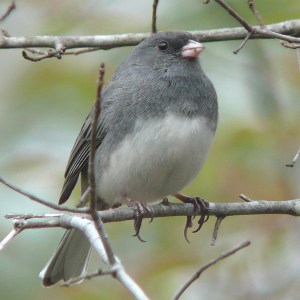
Meanwhile, I await the juncos. They usually arrive around the first week of December.