Hominid animals

Reading Frans de Waal’s books always gets me thinking about the use of anthropomorphism/personification in poems. When I was studying and first learning about poems, the general thinking from critics seemed to be to treat anthropomorphism, and even personification, as a “no-no” in contemporary poetry. We were not to make trees or grasses or wolves “humanized”–which does make a kind of sense; instead, we were told to observe and describe what we saw with less of a reflection on whether the non-human thing bore resemblance to human things.

For example, the bee was not to love the flower or the hive, nor the ostrich to love a fellow ostrich. A willow shouldn’t sway like a dancer. It should sway like a willow in the wind. There was science behind all this, maybe Skinner’s science but still; and there is Nagel’s bat: how can a person imagine being a bat the way a bat experiences being a bat? I’m not going into reductive materialism here, don’t worry. Just trying to provide some context outside of poetry to suggest there may be forces behind the trend away from anthropomorphism, some of which are valid.

I have always been tempted to title a book The Personification of Everything.

Now science is fairly certain that emotions preceded “rational intelligence” as life evolved and that animals possess traits and behaviors that aren’t so fundamentally different from ours; we are hominid animals. I would add that, as reflective hominids who employ language for reasons beyond basic information, human beings make connections (metaphor, simile, parallelism…) and can observe the “others” in our environs as not always so unlike ourselves. Or dream of inhabiting the lives of those others, or imagine telling stories from those vastly strange (to us) points of view.

So I’m coming around to appreciating anthropomorphism and personification as dwelling in the realm of the imagination that is not the domain of philosopher or scientist. After all, writers have been taking other perspectives on stories for quite some time, especially during the past century. Ophelia’s perspective (Hamlet), Persephone’s (The Odyssey)…Kazim Ali re-writing Icarus’ story (Sky Ward, 2013). Why not, then, write poems using the perspective of the spotted lanternfly, as Robin Gow has done?

One of my favorite short stories by Ursula Le Guin, “Direction of the Road,” takes the perspective of an oak tree. It is about the relativity of time and motion, but one thing the piece brings home–without any preaching–is that human lives are comparatively brief and, dare I add, not as important in the scheme of things as we may believe. Once we can accept that possibility, maybe we can more gently embrace the world and the things of the world.

Life story

My current slow-read is K. Setiya’s book Life Is Hard: How Philosophy Can Help Us Find Our Way. While there are many aspects of this philosophical book that interest me and pertain to current or recent experiences in my life, something that gained my attention regarding writing is the author’s suggestion that the concept of failure as a loss is bound up with cultural narratives. If we imagine our lives as arcs with the aim of goals, journeys’ ends, attainment of heart’s desires, finding true love, and the like, Setiya argues, it is too easy to feel that we are failures, and to despair or grieve. Maybe we should not be so caught up in narratives, he suggests.

Hmm. As a poet who writes a good deal of what may be termed “lyrical narrative” work and as a human who loves a good story, I’m more drawn to theories of story-as-essential-to-humans; I’m thinking here of Daniel Dennett and Brian Boyd, about whom I’ve blogged in the past (I will place those links at the end of this post). Nonetheless, poetry is often writing about what is NOT a story; some of my favorite poems have no story per se to tell, yet they move me to reflection and/or to emotional resonance. Hence they feel deeply significant.

Photo by Elliot Ogbeiwi on Pexels.com [Despair]

And if you have happened to click on the links to the right of this page that lead to my poetry online, or purchased and read my books (thank you, dear readers!), you are sure to find several pieces that are not even remotely narrative. As someone who has struggled with self esteem and ambition, and often felt myself a failure, Setiya’s philosophical undoing of the concept that a well-lived or meaningful life entails having “successes” comes as a relief. Whether one decides to accept his idea–I guess that’s up to you. It’s a book worth reading given how anxious contemporary American citizens seem to be and how powerless and despairing we often feel.

Colleagues have often asked why I don’t write fiction, and I respond that much as I love stories, I am no good with plots. It occurs to me that I cannot imagine writing a memoir, either. First, my life doesn’t strike me as being all that interesting, and second–I don’t think of my life in plot lines. It has been, instead, a series of experiences that mainly connect because my body and my ego-self are being carried more or less randomly through life on earth while I observe the world and participate in whatever moment I happen to find myself inhabiting. So it seems I need to locate a book Setiya mentions, Jane Alison’s Meander, Spiral, Explode. Whenever I get around to reading and reflecting on it, I’ll post here.

~

Here are links to posts about art, storytelling, narrative urges, etc.

~

Some awe

In 2015 (I think), I posted about the University of Berkeley’s professor Dacher Keltner‘s studies examining the experience and emotion of awe. Now he has a book, Awe: The New Science of Everyday Wonder and How It Can Transform Your Life. The subtitle’s unwieldy and promises a little much–I’m sensing a publisher’s or publicist’s input there. Keltner’s a psychologist, not a popular self-help author, but whatever…

The ways scientists attempt to study human emotions amaze me with their inventiveness. How does one conduct empirical experiments on anything so wildly subjective? (And honestly, I question whether empiricism is always as objective and reliable as scientists believe it is–though we haven’t developed a better method yet.) This book answers some of my questions about the “how” of studying emotion, which includes a good deal of physiology; after all, human emotions are based in human bodies. Qing Li’s book on forest bathing touches on some of these methods of study as well. Blood pressure, heart rate, breath rate: those can be measured, and there’s exhaustive research that shows how such aspects of our physiology connect with feelings of well-being, even before looking at the roles hormones and neurotransmitters play.

But what about awe? Isn’t that usually a feeling that takes your breath away? That might raise the pulse, that might be fear as easily as joy? Keltner writes about the line between fearful shivers of the Halloween-night kind and goosebumps that appear when humans feel awed. Also our tears–of joy, grief, physical pain, and those tears that we feel when we are “moved” by an act, a place, a work of art. He cites Rose-Lynn Fisher’s photos of tears, which I was happy to see mentioned because I love her work (a poem about those photos appears in my book The Red Queen Hypothesis). He cites Ross Gay’s poems and prose poems/essays of joy and gratitude, in books I happen to love. And Keltner offers an anecdote about poet laureate Robert Hass and the “whoa moment” that arises in “myriad cultural forms.”

Among those forms is poetry, and here’s where this text got me considering what I love in reading poetry and what I may be aiming for when writing it: the term he uses is everyday awe.

Deep awe–I’m not enough of a genius with words to create a sense of deep awe with a poem, though I admire the geniuses who have been capable of such art. But everyday awe? That’s a feeling with which I’ve been familiar since my childhood and which I have never lost sight of. For me, it arises from my favorite pastime: observation. The fog-mantled tent-spider web in tall grass, the sparrows sipping from city-street potholes, the toddler showering his baby sister with dandelion flowers, the smell of honeysuckle early in June, or campfires or cinnamon. Sea spray in my face. Sand in my shoes. The way my mother’s 90-year-old skin stretches and smooths when I stroke her arm. Skunk cabbage unfurling with the morning sun behind it. These things I can write about; the words are everyday words, and this is my everyday world. That, for me, is where the art of poetry and the experience of living intersect.

Classification

An admission: I’m barely competent at the promotional aspect of The Writing Life and would prefer to hole up in my house and garden and just… write. But writers need readers, and writers benefit by meeting other writers (and readers); and I’ve always been interested in learning new things, even things that are not particularly fun or that I am not naturally adept at. Such as educational learning management systems (ie, “portals”). Such as recording audiofiles of my poems. Such as contacting potential poetry-reading venues or reviewers. Or coming up with clever ways to let people know about my book.

I got a couple of responses from my initial forays, which is lucky. One of these sent me a sort of writer’s questionnaire about my book, and one of the responses I’m supposed to give is to say how I would classify my latest poetry collection. That got me mulling over the whole idea of categorization, classifying, and stereotypes. Genre–that’s easy. It’s poetry. But the sub-category of this book? uh…

~

At the beach earlier this week, we found a much-broken up rock jetty that teemed with creatures. As I sat back on my heels and peered into the mixture of sand-water-rock-mullosk-kelp, I found myself thinking about Aristotle’s immanent realism (epistemology/natural philosophy), ideas he likely nurtured while examining the tide pools of Lesbos. Or I imagine that he may have done so. We humans observe, and then classify or categorize based upon these observations: similarities, differences, various adaptations–in environment, habit, behavior, construction of the being or entity itself.

I think if I had known as a child and young woman that there was a career path called “a naturalist,” I would have pursued it.

~

Unclassifiable doesn’t strike me as much of a selling point. However, there are always art forms that are, to use a current term, intersectional or interdisciplinary, and creations that repurpose, alter, or reimagine the known or customary into something new and intriguing. Fellow blogger and talented poet and novelist Lesley Wheeler‘s books come to mind, as do works by Anne Carson and books from Coffeehouse Press and Tarpaulin Sky (among others).

My poetry is not experimental nor groundbreaking, though it is a little quirky; so here is my recent attempt to classify The Red Queen Hypothesis and Other Poems:

Touching on a range of topics and employing variety in poetic craft—free verse, metrical verse, rhyme, and classic forms—the poems in The Red Queen Hypothesis play with invention, science, and the environment of the everyday.  One example of these juxtapositions is the title poem: a villanelle, based on an evolutionary theory named for an episode in Alice through the Looking Glass, that sums up the corporate rat race. Sometimes tongue-in-cheek, sometimes disturbing, the poems urge readers to observe and to reconsider what is beautiful.

~

I dunno. Does that seem like a remotely interesting description?

(Really not adept at the promotional biz.)

Aristotle, supposedly.
from https://www.nytimes.com/2016/05/27/world/europe/greece-aristotle-tomb.html

Pastoral call

When my father put on his collar and his well-shined shoes but it wasn’t a Sunday, we knew he had meetings to attend or visits to parishioners to make and that sometimes, on coming home, he might seem quiet, which was unusual and meant he was turning things over in his mind. I try imagining him as he must have been then, younger than my son is now, counseling people through their griefs and doubts, encouraging the ill, attempting to comfort, confronting so much inequity and pain. What did he know?

Trouble came. His father died young. My little sister was stricken with pneumonia, gasping, feverish, hospitalized. My pregnant mother in such pain she could not climb the stairs to tuck us in at night. And so, with no one near to take me for the day, I was his visitation sidekick, dressed as though for church, carrying paper and pencil and a book I couldn’t yet read. People welcomed us into their homes in formal rooms sun never seemed to reach, seated us on sofas with doilies on the armrests or crocheted throws along the backs, or sometimes in carved wooden armchairs with lion-paw feet. There were often candies in a glass dish on a side table. The women gave my dad coffee and sometimes I got a glass of milk. Once, I had tea in a translucent cup decorated with pastel-colored flowers, and I took two sugar cubes and stirred carefully so as not to spill or make any noise.

Sometimes the parishioner offered me the run of a playroom or nursery–those children now grown, maybe as old as my father–and I rummaged through the old toys and imagined my own stories. It was important to make as little sound as possible, to be a presence invisible to grownups while my father took someone’s hands in his, prayed beside them, or listened to quiet sobbing. Indirectly, I was learning that adults cry, too, and that they were not always invincible, or even in charge.

It seemed a privilege to be with him being with people when they most needed something, Maybe not something he could give or grant them, true. He started to realize that very early in his ministry.

~

In early childhood, once I abandoned the idea of growing up to be a princess, I liked the idea of being an artist or a scientist when I got to be an adult. That hasn’t quite worked out the way I guess I expected, but my ambitions (if that’s what they were) indicate that I had begun the lifelong process of wanting to understand–well, everything, almost! I found the following passage in Rebecca Elson’s book A Responsibility to Awe, and I feel as she does, though in her case she’s talking about observing and studying the Large Magellanic Cloud and its star structures:

There are times when the enterprise seems mechanical, when the constraint to pursue the truth seems to suffocate the imagination, and the mysteries of the Universe seem irrelevant to the lives we humans lead down here. But on the whole, understanding the Universe seems a fundamental step in understanding our origins, and in establishing a perspective with respect to space and time that I find comforting.

Rebecca Elson, “From Stones to Stars”

~

It took my father quite some time to find a perspective on life, faith, and human behavior that comforted him. I do not possess the same perspective, but I believe he would be okay with that.

Received assumptions

Every once in awhile a book comes along that makes me totally rethink my received or assumed knowledge by shaking up the usual perceptions. The most recent book to have wrought such a rethinking on my part is The Dawn of Everything: A New History of Humanity, by David Graeber and David Wengrow. The effusive blurbs–and there are many–on the MacMillan page the preceding link takes you to strike me as accurate; on every page or two I find myself saying, “I have to look that up! I never heard about that! I need to read that book/author/article!”

Beyond the illuminating information, though, what excites me most about this book is how revelatory it is concerning human possibilities. These authors (unfortunately Graeber died in 2020) are drily funny and unrepentantly anarchists among the scholars of so-called pre-history. The research they gather and present, and their theories based upon what we now know about ancient peoples, upend the evolution of human society that I was taught and that seemed so logical I never thought to question–the foragers/hunter-gatherers/agriculturalists/city-makers “development” of human societies and cultures that Rousseau’s philosophical state-of-nature idea essentially founded. I was aware that archeological discoveries have been found that challenge the narrative, but I wasn’t aware of how many of these are being examined and the amazing data they reveal. I was aware that views of indigenous peoples, past and present, are most often through a lens of “Western civilization” and tainted by the assumptions of researchers but was not alert to my own blind spots and received assumptions.

Which makes me pretty much a human being, right? We do tend to short-cut to our beliefs and accept the “logical information” we learn from parents, teachers, and other authorities. Then, we use that framework to test out the logic of other assumptions. Sometimes that framework is not as strong, correct, or universal as we thought. And it feels marvelously disruptive, sometimes, to buck the system, make art, behave differently–illogically–and find that new ways of thinking about the world can be fun.

This is a very long book, and you really want to stop and read the footnotes, which are excellent and super-informative. I am a fast reader but am taking my time with this one, savoring each surprise and thrilled at the ingenuity of human beings. From a political and from an earth-stewardship perspective, Graeber and Wegrow say the societies of the past teach that the current structure of most cultures (greed- and power-based hierarchies that require property rights and that leave vast numbers of people starving) is not the only and inevitable outcome of human communities. We are not inherently in Hobbes’ world, but neither are we in Locke’s. Mills’, or Rousseau’s.

I love the commonsense approach that says human beings are adaptable, curious, inventive, and complicated–so it is unlikely that we spent most of 30,000 years “doing nothing” until suddenly: agriculture, writing, cities, technology, beer! (Not necessarily in that order.) Graeber and Wengrow find human beings endlessly fascinating, and their enthusiasm is contagious.

During cold days and long nights, when the world seems not entirely right and I wonder whether we have the motivation to make things better, this book has shown me many ways people can find solutions, get along together, find time to sing and play and maybe even live without money, boss men, and kings most of the time. We can be free to do what we want and still help others out, free to hang out and enjoy each other’s company, or get together and build a monument…it’s what people have been doing for thousands of years. Right now we’re kind of stuck in capitalism and oligarchies and warfare and pollution and climate change, and that won’t change in my lifetime. But it is good to know that this sort of thinking is not the peak of human development in a real sense. That gives me an odd sense of hope.

Also, books like this one provide so many stories and ideas and new concepts and terrific words that I am sure it’ll filter into my creative writing endeavors one way or another. Poems on the Jōmon sites or Mesolithic kelp-belt people? One never knows what will creep into my subconscious mind.

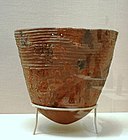
Jomon pottery, between 11000 and 7000 BC. Hinamiyama site, Japan.

Solo endeavor?

It was great fun to be back in person, in Philadelphia, reading poetry aloud. Prepping for the performance made me aware, though, that I have no current obsession to mull upon; that may be why I have not been writing many poems of late. However, I recently felt inspired by Lesley Wheeler’s blog post including some prompts from poets. Prompts! Of course. Those are ways into writing when writing has not supplied the writer with her own ways into writing.

Therefore, I’ll close another year of my blog with a piece I drafted using Lesley’s conjunctions prompt. What resulted from the free-write surprised me, which is a good thing (it’s fun when I surprise myself, though this gets a bit dark toward the close–but dark contains interesting objects). And many thanks to Lesley and to the other poets whose prompts she shared. It’s likely I will keep working with them until my next poetic preoccupation.

~

So I’m tired of hearing people start their sentences with “So” on podcasts and the radio and TV, “so” a verbal tic, a word instead of “um,” which serves the same purpose but admits, more humbly, of uncertainty, which says I am pausing to gather my thoughts before speaking; whereas “So” sets up an explanation leading to opinion or argument, or so it seems to me.

So I’m sitting on my back porch even though it is late December, clouds gathering over bare trees. I hear woodpeckers deepening holes in trees, a rat-a-tat drill, and white-breasted nuthatches loud along the woodlot, and I ponder emerald ash borers and climate change and how to handle human aging in a capitalist society.

So what I wonder is “Am I afraid?” Some questions possess a looming quality, I guess this is one such. In my wicker chair, in my own backyard, no. Not afraid. The mood’s serene, no tightness in my chest no racing heart, not even facing death–as we all must do, though most of us refuse. Where are you going with this, Writer?

So all I’m saying is, I have fears about the future yes but not about dying, because dying I will face alone. Even when loved ones can be beside us, we are not an us when death comes. Each dies to their ego alone, interior to the world, most alone at death no matter who surrounds us.

So why, then, do I volunteer for hospice work, where the goal is not only to alleviate some of the pain but also to keep people from dying unaccompanied? My reasons are complicated, people are complicated. So let me just say that having been present when human beings die, that passage may not necessarily be a lonely one. But it is accomplished alone.

Slowing time

I cannot recall where I learned of Byung-chul Han, but I’ve had the pleasure of reading one of his books of philosophical essays (The Scent of Time) recently, and seldom has a philosophy text resonated so immediately with my circumstances. In this book, Han argues for contemplative time. He says it is essential for humans and human society and claims the “acceleration” of everyday life robs us of the value of reflective thought and “slow time.”

Raised and educated in Germany, where he now teaches, Han invokes the works of several German philosophers to provide a starting-point regarding the acceleration of time. He draws on Nietzsche, Arendt, Husserl and, to a larger extent, Heidegger…but Derrida, Aquinas, Aristotle, and others as well. He also quotes from quite a few poets, such as Celan, Hölderlin, Büchner, Handke, Ch’iao Chi, and spends two chapters on Proust (but of course…).

Han posits that the point-like, algorithmic availability of information runs counter to knowledge and wisdom, which require experience, which in turn requires duration and connection rather than arbitrary retrieval: “Promising, commitment and fidelity, for instance, are genuinely temporal practices. They bind the future by continuing the present into the future…creating a temporal continuity.” He criticizes the very technology that permits a person like me to learn about his work (I am certain I heard of him online somewhere). That criticism says the faster we go, the further we are from our earthiness–the airplane removes us from earth’s gravitational field as well as from the soil, “estranging the human being from it.” He adds, “The internet and electronic mail let geography, even the earth itself, disappear…Modern technology de-terrestrializes human life.”

Strong opinions, large claims. But oh, I thought at once of Whitman and his long expansive drawling poems when I read, “Instead of leisurely strolling around, one rushes from one event to another. This haste and restlessness characterize neither the flâneur nor the vagabond.” The whizzing about leads to anxiety and a lack of durable relationships. People hover instead of connect, swiping left or doomscrolling, feeling bored–which is a kind of empty-mindedness. I observe this trend of rushing and hovering in my students and among my colleagues. I have not found much Whitman-like lounging in current poetry publications, but a great deal of anxiety appears in contemporary poems. Writers reflect the times. Context shapes us.

But of course, our culture urges us to keep active, as though activity of any kind is valuable and can somehow stave off boredom, loneliness, or death. “Addiction to distractions” and the via activa are the sort of socio-cultural pyschological behaviors Han would like us to slough off. He wants us to leave behind the “Calvinist” (as he terms it) belief that “Wasting time is the worst of all sins.”

“In the consumer society, one forgets how to linger,” he notes, correctly. While we may browse the sale rack at a store for many minutes, the pressure is to buy the next new, better, faster, brighter object before we leave. What about sitting quietly, noticing the scent of flowers or incense, taking in the sounds of the world each of us experiences differently, or walking for half an hour as aimlessly as possible–without a phone, or money, without pop music or podcasts, alone or with a companionable fellow stroller? The very thought makes some people uncomfortable; they aren’t at ease with their reflective selves in the world, with human experience. Why is this so? Has it always been so? These questions Han touches on.

I have felt the pressure of filling up my time with lists of things to do, people to see, things to purchase, jobs to fulfill, projects to complete. It’s been hard to make space for dawdling, daydreaming, drafting poems. I haven’t submitted work since July, and so few poems have come to mind lately that this begins to feel like writer’s block. The Scent of Time has reminded me to open up more space in my life for simple experience on the level of daily phenomena, which is the stuff out of which I write poetry.

Norway’s Philosopher

I first encountered Arne Naess’ work in 2012 (see this post), and I regret that I failed to follow up by reading more of his “ecosophy T” (deep ecology) and philosophy. I am finally getting around to his very late book Life’s Philosophy, and I love how it speaks to me on many levels. His claim that human emotions can and should be components of human reason makes so much sense that I wonder why so few researchers look into it; some folks on the edges of neuroscience and psychology seem to venture there, but few others. The concept of “relationism” resonates for me, too. It reminds me of the Dali Lama’s teachings that all things in the world are intertwined and valuable, even non-sentient beings.

Relationism, as Naess uses it, acknowledges the vast and impossibly infinite complexity of the universe, more strictly life on earth, and–can I use the word “celebrates”?–the interwoven strands of animal, vegetable, mineral, bacterial, cosmological, emotional, rational aspects of a life in the world: ecology on steroids (he would not have phrased it like that). My urge for balance in my own life makes this philosophy relevant: the opportunities for play and for imagination as well as for seriously abstract concepts, for the importance of emotions as felt in the human body and as interpreted or contained in the human intellect; the necessity of listening to even the tiniest sounds, of savoring the small moments, of not needing to be big or grand or successful but to be mature in how one feels with the world.

The incredible difficulty of saying any of this. Which Naess also acknowledges, saying the difficult job of conveying being felt in the world leads to music, to art, to sitting with the natural and sensing beauty. I might add: Poetry. Though poems are made of words, they often operate through images and felt moments rather than intellectual logic.

The wonderful paradoxes of this book delight me, but then, I always have enjoyed paradoxes. Naess was, indeed, a philosopher, a mathematician, a person who valued logic, reason, and analysis, an analysand himself and briefly a psychological researcher, a mountaineer, a teacher. What to do with the inherently analytical side of himself? Treasure and use it to find wonder! That’s what makes him different from so many thinkers. Wonder. He writes, “To me, the ability to analyze the experiences of the moment is a source of wonder: wonder at human creativity and the result of evolution during hundreds of millions of years. That which happens within us–in our minds and hearts–is so complicated that the psychoanalytical instruction to express everything that occurs to one becomes…and exhortation to to the impossible.”

He opposes Cartesian mind-body separation not just within the body itself (as medical science has proven) but in terms of landscape, natural environment, places. He posits that people need deep thinking about values that move us emotionally just as much as we need to think about rational, pragmatic, socially-pressured values that are based on intellect or the empirical. Place matters, and we need to consider our fundamental place, Earth. Naess’ oppositional stances are, however, never a fight. Instead, discourse, compassion, patience with what is complex. A sound life philosophy requires stillness sometimes, and listening, even–especially–to the “tiny, tiny things,” he urges: “The art of living is to be able to work with small things in a big way.”

How do you feel yourself and the world? is the title of one chapter. I read the question with emphasis on different words and began to realize what a complicated and interesting question it is, though it seems (at first) so simple. Naess says that humans have hewed to the idea that there’s a gap between reason and emotion, and that the gap is an artificial one; a change in perspective, and an understanding that the mind and the body live in a physical world where emotions play a huge role in human communication, might help us to enjoy our lives more–and maybe, while we are at it, treat the earth one which we depend with more love and respect. But we have to feel we are not just ourselves but the world: of it, from it, in it.

mapio.net/pic/tvergastein

Physics, poetry, notes

In a discussion among some of my poetry-reading friends, two readers said they feel “stopped” when they encounter unfamiliar words or terms in a poem. They feel poets should avoid writing work that uses specialized knowledge as metaphor, in imagery, or to establish the poem’s context. Their argument is that when a reader feels stopped by anything in the poem–from an unusual line break or stanza structure to an unfamiliar word–a kind of alienation occurs between reader and text, and that when poets choose to employ the unfamiliar they need to explain somehow/somewhere (notes? prose headings?) to guide the reader. But then they added that referring to notes is, in poetry, distracting.

“Some vocabulary and allusions just make me feel inferior,” one friend says. I don’t think they’ve spent much time with Ezra Pound’s later work but imagine this statement by Sam O’Dell applies: “Now, whether or not Ezra Pound intended to make others feel less intelligent while pulling obscure outside references into his poems and essays is up for debate. The guy seems the type who may have enjoyed making sure others knew he was smarter than they were.” (Read the rest here).

Nerdy autodidact that I am, I rather like those stop-the-reader moments in poems–if there’s a payoff. If I learn something new, and if that thing I have learned enriches the poem’s meaning and also enriches me, then I don’t mind feeling surprised or puzzled or even interrupted. Some poems take more work to read than others, and that’s ok. Some novels prove less easy to read than others, and some movies make the audience-experience fraught, unnerving, or strange. For me, the essential work that artistic endeavor does is open new perspectives, present puzzles, invite inquiry. Make me curious!

Example: Recently I re-encountered the work of poet Daniel Tobin, whose collection From Nothing speculatively examines the life–the interior, intellectual, and spiritual life–of the Belgian priest and cosmological physicist Georges Lemaître. In the process, this series of poems covers war, genocide, the atomic bomb, physics. I haven’t read anything by Tobin since his book The Narrows (2005), and the Lemaître poems take considerably more work to comprehend. That work on the part of the reader is rewarded, I should add, especially a reader with more than a passing interest in cosmology and the cosmos itself. A reader who doesn’t mind a bit of theology or physics or history and quite lengthy notes at the end of the book, and who will actually read said notes. And then refer to her books on the expanding universe theory and Hubble Effect and look up more about Lemaître. [That reader would be me; but Tobin has many readers with all kinds of interests and expectations about poetry.]

In Tobin’s lovely poem “(Origin),” I found the word marver, and while looking up the definition learned that when molten glass is poured onto a slab for cooling, the process is called gathering the glass–and I love that use of the word gather. Maybe it will make its way into one of my poems someday. Even if it does not, I feel happier knowing that little fact.

But most of From Nothing contains allusions to cosmology, to Einstein and Planck, to World War II and conflicts of many other kinds, internal as well as external. I kept being wowed by Tobin’s research into Lemaître and by the poet’s imagination as he plumbs his subject’s complicated world of math, motion, and a conceptual physical universe that could also have room for God. I mostly remembered his earlier work that was so tightly crafted, often rhyming (or employing surprising and delightful assonance). In this collection, I didn’t notice the craft aspect until I went back and did some re-reading. I was too caught up in the complexities of physics and the momentum of the subject’s life-as-scientist/life-as-priest. The lines each have six strong beats, the stanzas are tercets, and there are eight stanzas in each poem. There’s more to the craft than that, but what I like is that–unlike some of Tobin’s earlier work–the craft takes a backseat to the narrative (though I think that’s also true in The Narrows, to some extent.)

Maybe this “difficult” book appeals to me because I like difficult books. Maybe it appeals because it reminds me of my father, a person invested in the world of reason and fascinated by science…who yet believed there can be faith, that god exists. Here’s an excerpt of Tobin’s “(Cinema)”:

You, who chose two ways equally at once, circuit 
the conferences, meetings fueled by enigma, mixing 
with the eminent and their sidereal regard,   

your morning Masses before library and lab.

~

My dad was not a Catholic, but the balance between faith and reason was one he wrestled with, too.