Play’s the thing

My freshman humanities professor, the brilliant, late Larry Fuchsberg, assigned Johan Huizinga‘s The Waning of the Middle Ages as one of the texts for our course…an unusual choice for American teens in 1975, as was another of our books, Burckhardt’s The Civilization of the Renaissance in Italy. At 17, I found Burckhardt rather slow going stylistically (it was published in 1860, after all); by comparison, Huizinga (circa 1919) was refreshingly clear. I really enjoyed it and learned a great deal. I kept meaning to read his 1938 book Homo Ludens, but for awhile it was difficult to find in libraries or bookstores. Also, I lacked the time to track it down or read it. The premise interested me, though–that we humans evolved our culture from the “pointless, imaginative” urge to play, and that play is fundamental to our learning and our social structures. Also, we are not mechanical beings–the messy frolicsome-ness of people is as necessary for our survival as food, water, and shelter.

“Animals play, so they must be more than merely mechanical things. We play and know that we play, so we must be more than merely rational beings, for play is irrational.” 
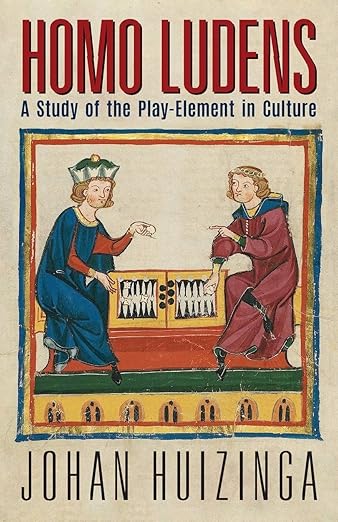
Finally, I’ve begun to read Homo Ludens, and it’s even on Amazon now; also I discovered that it exists online here thanks to Yale University. Fifty years after my initial encounter with the author, I find his thinking just as interesting as I did in college, and just as difficult. As in his other books, Huizinga uses etymology as one of his methods of examining the meaning and culture of play. He was writing for an audience that he assumed was well-educated in the classics, so there are passages in Greek, Latin, and French that neither he nor the English translator bothers to translate for less linguistically-adept readers like me. Fortunately, such passages are brief and are used as sources for his argument, and I’m not reading to find fault with his material. I’m interested in his argument and insights as a whole, and intrigued by his thinking. He apologizes for his lack of sources (ha! There are hundreds of them) because he was “working in haste.” He composed this book in the Netherlands as Germany began to be a serious threat to Europe, and he wanted to get his ideas in print before he was silenced. In fact, his last few years were difficult. He had used his standing as a well-known cultural historian to criticize the Nazis and was arrested in 1942, basically house arrest; he died in 1945 just before the war was over.

I’m only on Chapter 4 but am finding, in the etymological tracings of the words that intersect in meaning(s) for play–game, contest, gambol, gamble, dallying, tournament, match, riddle, performance, frolic, pretending, folly, fun, sport, etc.–fruitful stuff for poetry, for thinking about poems and about how poems work as craft, as poems, and as works of art and imagination. And also, what roles poems may play in culture today, and whether that differs at all from the role poetry played in ancient times. Huizinga writes:

“In the making of speech and language the spirit is continually ‘sparking’ between matter and mind, as it were, playing with this wondrous nominative faculty. Behind every abstract expression there lie the boldest of metaphors, and every metaphor is a play upon words. Thus in giving expression to life man creates second, poetic world alongside the world of nature.”

Language may not be necessary for play but can easily be incorporated into it, and language can become play. Or playful. I don’t know much about Wittgenstein, but I find myself thinking of his theory about words having “family resemblances” that often connect, overlap, shade meanings. So we get jokes, puns, flirting, mocking, and new “rules” for our language use that culture constantly shifts in all kinds of directions. Language is a game-changer, and poets make use of that.

I thank Larry Fuchsberg, musicologist, book-lover, and educator, for introducing me to Johan H. Teachers, you never know how much you may have influenced a student’s life, even decades later.

Back in PA

Last year at this time, I had covid and was languishing in bed, unable to tend to the garden. A regional drought meant I really should have been watering the new plants; and it also kept the weeds firmly rooted, fighting for dominance in the vegetable patch. This year, I timed a trip to New Mexico just when I ought to have been harvesting spinach and planting out tomatoes, beans, and squash. Oops. And then it rained buckets the whole time I was away (much-needed rain, but…). Therefore, the garden situation was not ideal. But garden situations seldom are ideal because Nature does its own thing regardless of my plans.

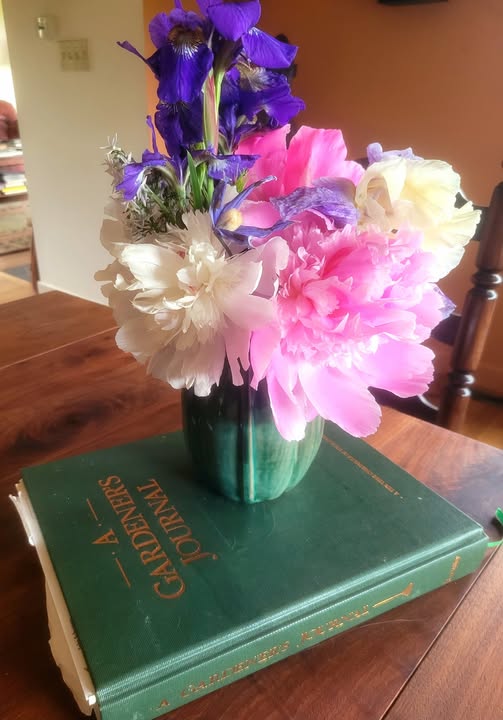
At any rate, eastern Pennsylvania finally moderated its weather enough that I got the weeds and the seeds and transplants more or less under control this past week–“control” being a general term subject to, well, Nature. The peonies bloomed gorgeously on schedule, as did the nefarious multiflora roses and Russian olives that plague the hedgerow. The catbirds and Eastern kingbirds are back; the robins’ first brood has hatched; the orioles are insistent in the walnut trees and brilliant in the garden, chasing the barn swallows. I’m not doing much writing, though I drafted one or two beginnings of poems. Outdoors takes precedence–not that I can’t write out of doors, I often do so. But poems can wait in a way the garden cannot.

And, speaking of poems (and Pennsylvania), I returned from my trip to find this Keystone Poetry anthology awaiting: https://www.psupress.org/books/titles/978-0-271-09990-3.html–the followup to 2005’s Common Wealth anthology, also edited by Marjorie Maddox and Jerry Wemple.

The new anthology, 20 years after the initial one, has poems by about 180 poets–yes, I am one of them–covering the corners and the center of the Keystone State. I like it even better than the first collection, and it is clear the editors learned much from the experience of curating poems and creating a cohesive “experience” of the regions. Granted, since I know both of the editors personally and appreciate their poetry and their visions, I may be biased. But that’s okay. Objectively, I truly get how huge an undertaking this was and how well it has turned out. For educators, there is a section at the close of the anthology full of suggestions for reading, writing critically, and writing creatively based on this anthology, and even in comparison with the previous one. As both editors are college professors who teach creative writing and critical writing, these appendices are well-thought out and worthwhile.

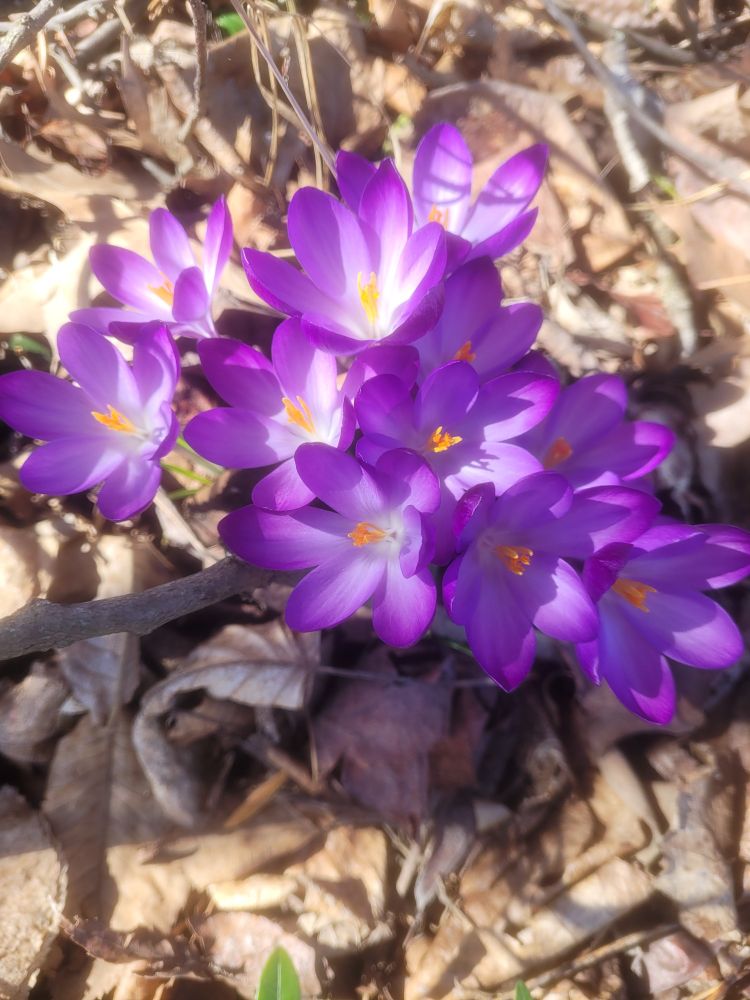
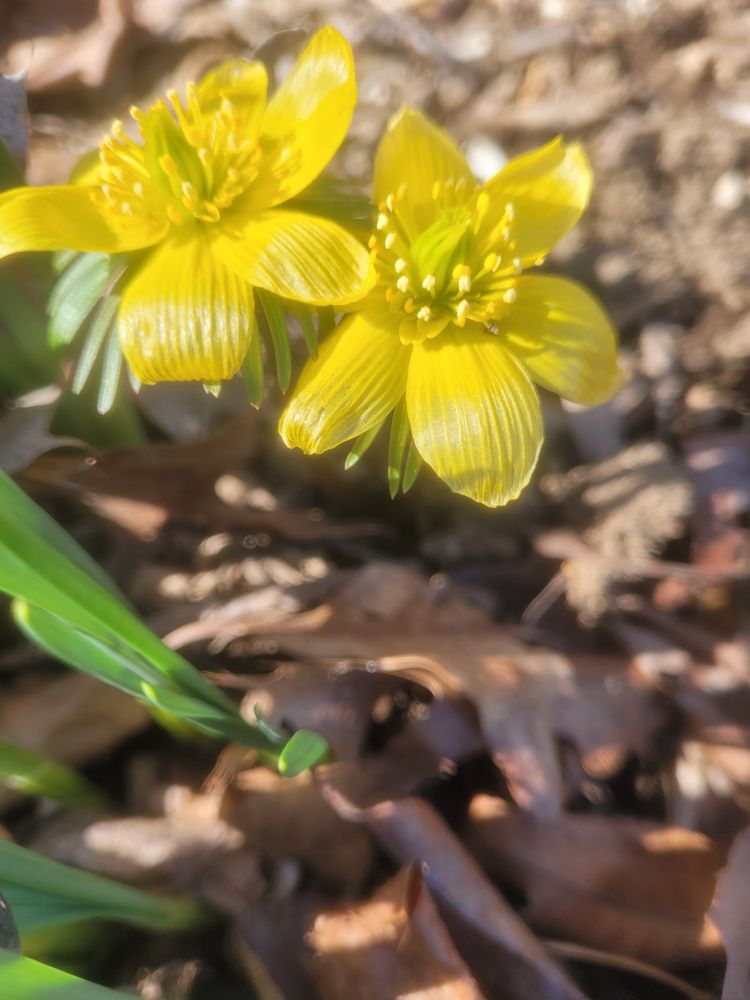
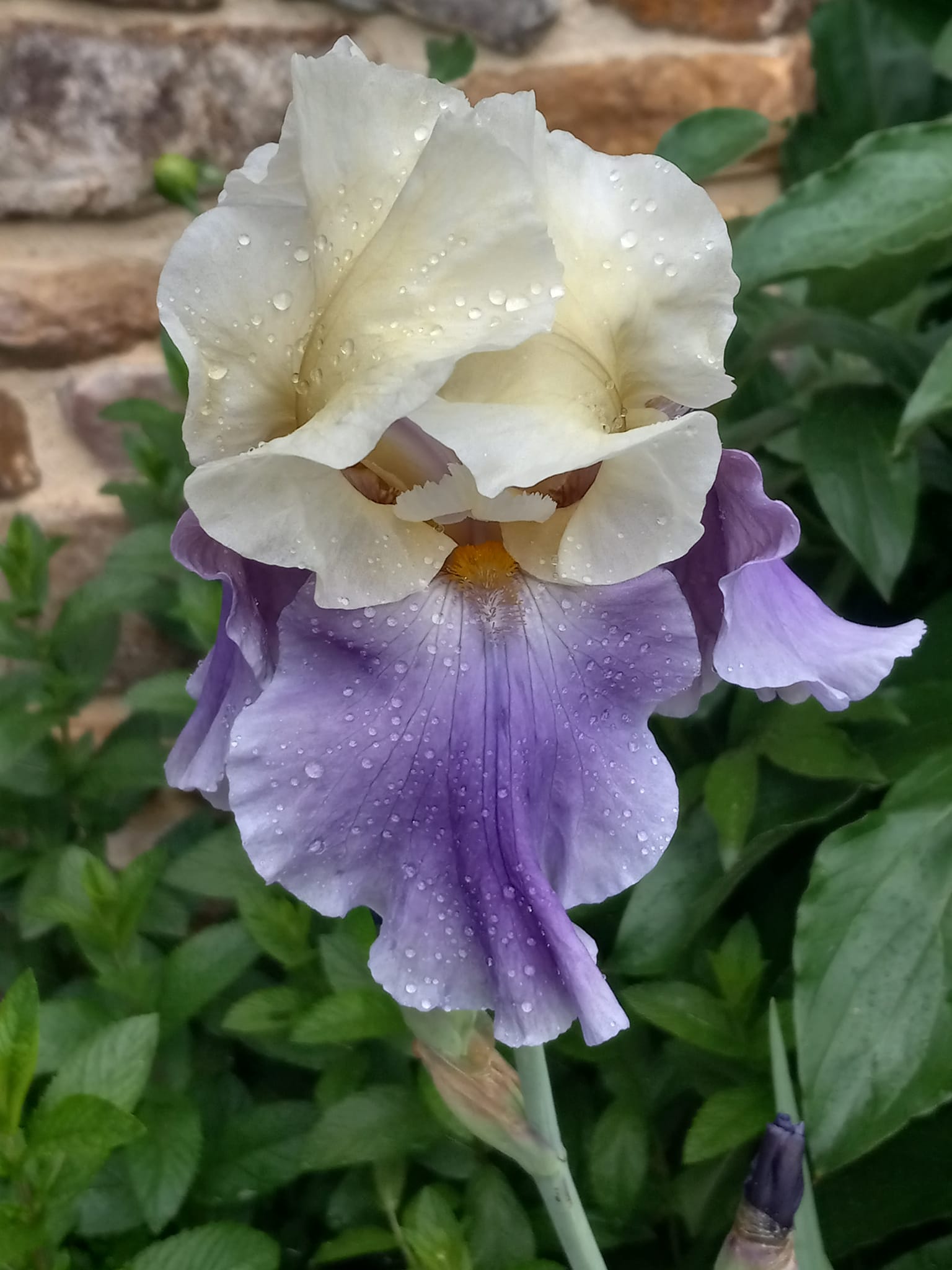
I miss the aridity of New Mexico, which seems to benefit my overall health. And I miss my daughter immensely. But springtime in eastern PA has many compensations, not the least of which are blooming even as I write.

Mud & connections

My region’s been unusually low on rainfall the past 18 months, but this year April showers seem almost to be compensating…my veg patch is mud. Weeding and more sowing will just have to wait. I walk around the neighborhood and my yard and the woods, squelching through muck and stopping now and again to upend a rock or rotten log and see who’s active now. Lots of worms and arthropods, the occasional spider, many ants.

In such moist circumstances, we get fungi; I’ve been enjoying Lesley Wheeler’s new book, Mycocosmic, which I’ve read twice now–once for content and sound, once to learn more from the poems’ craft structures, all the while fascinated by the science of fungus, which she incorporates into many of these poems. It’s a richly rewarding book, sometimes sorrowful, always intelligent, full of insightful poetry. The collection includes some poems that feel like spells, chants, divinations that suggest there are always imaginative methods for coping with anger, unfairness, and loss. Exploring the vein of how interconnected the natural world is, and the human world (with other humans and with the Earth) feels so vital to me, and Wheeler’s book pivots on this vitality. Look at the way Harry Humes threaded through my life, for example, in small but meaningful ways. The same goes for Lesley and for so many other people with whom I’ve shared intersections, interweavings, and connections over the years. That butterfly effect of influence. (Now that I think of it–Harry Humes has a book with that title: The Butterfly Effect). Or are those networks mycelial, as Lesley Wheeler suggests?

~

More connections: grad school was long ago now, but I’ve maintained a few colleagues from those days and will always treasure the fact that earning an MFA led to meeting fascinating people. For example, the recent issue of The Bookends Review features an interview my fellow Goddard alum Ian Haight conducted with me last summer. He asked me about teaching humanities, about higher ed in these fraught times, about AI and creative work, about my residency at Joya, and about poetry in general…https://thebookendsreview.com/2025/04/09/poetry-the-humanities-and-aesthetics-an-interview-with-ann-e-michael/. Some thought-provoking questions–thanks, Ian! And thanks to The Bookends Review for curating the interview into the journal.

Prose/poetry

In the first weeks of this year, I participated in a virtual poetry workshop with Anita Skeen. It was so useful to me that I signed up for another workshop, this one on writing the prose poem, with mixed-media artist and poet Lorette Luzajic. She is the editor of an online prose-poetry lit journal, The Mackinaw.

In this workshop, I’m returning to a form I learned early in my writing practice. My friend and mentor David Dunn may have introduced me to prose poems, I cannot recall anymore; but I do know he was writing them in 1980 and that some of the poems in our collaborative chapbook The Swan King are either prose poems or on the verge of being prose poems. Prose poetry was then considered a “new” form and was (& in some quarters, remains) controversial among poets and critics. It sounds self-conflicting: if it is prose, how can it be poetry?

In the decades since I was very new to poetry, reading everything I could find of contemporary work and experimenting all over the place, the prose poem has been much written-about in literary forums and academia and is–mostly–on pretty sturdy footing as a “form” of poetry. I never completely stopped writing prose poems, and a few appear in most of my books. I’ve been writing so many sad lyrical-narrative poems since 2018, however, that I haven’t spent much time really playing with poetry, and play is a huge part of creative thinking. So Lorette Luzajic’s workshop, which gives us a chance to experiment and play, appealed to me.

The workshop has got me thinking about versions and expansions of the form, turned up some exciting new poets to read, and offered amusing prompts that have moved me into ekphrastic, surrealistic, dream-based, and pop-culture themed poems. I have found some surprises in my own work, which is always a reviving feeling.

Also, we are almost at the vernal equinox. My environment is brightening in small ways, which tends to help with enduring the tough stuff.

Curriculum vitae

My year has begun with half a dozen literary journals declining my poems, but it has also begun with a proliferation of new poems–which makes me happy. There are several reasons for a prolific spurt, some of which involve sad events that have turned me toward reflection. While sorrow isn’t a reliable prod for writing in my case, reflection almost always is. Also, attending a workshop is generative for me.

In last week’s session, we read Lisel Mueller’s “Curriculum Vitae,” and Anita asked us to emulate the poem for our own life story. I encourage you to read Mueller’s poem if you are not familiar with it; it’s full of lovely imagery and is so concise and evocative that it stands as autobiography–quite an amazing piece. Also daunting: how to use that poem as a writing prompt? I needed a strategy, so to keep myself as brief and non-narrative as possible, I limited my version to 15 points instead of 20. Then I edited it down several times, taking out as much as possible while leaving things that feel “true.”

What I realized after this practice in form, and after revising it and tightening it up, is that if I were to start again rather than revise–and were to focus on different aspects of my life experience–I could write a completely different, but still true, poem. I could write a dozen completely true and completely different CV poems! I could have used national events that occurred during my life and had greater or lesser impact on me–the Kennedy assassination, the March on Montgomery, Viet Nam War on television, etc. all the way to 9/11 and since then; or I could have focused on friends and family, their appearances and disappearances from my life; or places I lived or traveled…easily a dozen CVs, curated to present a lifetime.

So while the piece I wrote isn’t a “keeper,” not something I would send out to literary journals, the practice of writing and revising it has been remarkably useful (thank you, Anita Skeen!); I’m more aware than ever of how perspective, focus, and image affect narrative. And of how many ways there are to “tell” an experience, which of course is something poets often do: revisit, re-frame, re-imagine an experience, loss/trauma, or relationship using numerous forms, images, perspectives, speakers, and so on.

Which is certainly one reason Anita asked us to try this exercise.

I did not manage to be as lyrical and concise as Mueller, but then I didn’t expect to; she was an amazing poet. From her poem cited above, I especially relate to the line: “At home the bookshelves connected heaven and earth.” It felt like that at my parents’ house, too.

I’ll be brave and post the practice poem, one of many versions of my autobiography.

~

CV, after Lisel Mueller

1. Three weeks before summer solstice, I enter the world. My father considers me the first perfect thing in his life.
2. Underfoot, meadow grass and church aisles.
3. We move from the manse to the city, where my sister goes twice to the hospital and I walk two blocks to school.
4. Suburban house, square and white as a die. We learn to ride bicycles in the street.
5. Bussing and gas shortage, algebra, barefoot girls in summer. My embarrassment at growing too tall, too thin, too bookish, too moody.
6. Early entry into college. When the only thing I wanted was to get away.
7. In Michigan, snow like I had never seen before.
8. Some years of misery, tedious, purposely omitted. But I meet the people who most encourage me to write.
9. Back to my parents’ kind embrace. Celibacy, recalibration, writing.
10. We meet one summer. I write you so many letters. It might be love.
11. Two children 18 months apart, vegetables in the backyard: it is love.
12. Autodidact in the garden, in the world of literature, in child-rearing. There are cats, chickens, guinea pigs, a beloved dog, but I need to return to study and poems.
13. Loss and joy keep me writing, teaching keeps me busy, children grow and travel far. My books see print.
14. Pandemic.
15. My father dies, my mother loses her power of speech, friends start failing, there are dark weeks. Many hours in the garden, growing and grieving. We hold on, uncertain, but whole.

~

Depth perception

In second grade, I could not see the blackboard from my desk. My teacher noticed; I went to the optometrist, and thereafter began my worsening nearsightedness. New specs annually for many years, broken frames, ugly frames, though–unlike many of my friends–I never lost my glasses because I could not see at all without them. Somewhere along the way, astigmatism kicked in. In high school, I blamed my ineptness at any sport involving a ball on my astigmatism (contact lenses corrected my nearsightedness but weren’t as effective on the misshapen cornea). But my ineptness was largely due to lack of interest in sports.

And now, encroaching cataract formations mean that I’m getting surgical procedures for the removal of those thickened “cascades” that make it hard to drive at night, read street signs, or discern a cat from a fox in the back meadow. I had my left eye operated on this past week, with the insertion of a medium-length lens that gives me 20/40 vision in that eye: a miracle to me after so many years of blur. I have to wait two weeks before the surgeon does the right eye, and in the meantime I’m discovering the true challenges of poor depth perception. My brain hasn’t adjusted to the changes in my eye, and simple things like walking downstairs or pouring tea into a cup pose unexpected difficulties.

Topping things off, I’ve contracted covid for the first time ever. So I am being extra careful as I walk through my house and into my yard–taking a fall due to bad depth perception would be one more problem I just don’t need.

So I have been considering vision lately, and what it means to perceive, to have differences in perspective, focus, framing. Or different cultural and social “lenses,” as we refer to them when we are teaching students to write compositions in college. It is as easy to trip oneself up metaphorically as physically if one pays no attention to such perceptions.

Today, I feel to ill to spend much time pondering. But I have enjoyed looking at the photos–taken from different vantage points and times of day–of the lovely tree on the other side of the riverbed from Joya. Very healing, as trees can be.

In residence

It’s been some time since I was away at a residency with other artists and writers. Conferences, yes, but residencies are different–more intimate in scope, less social-life activity, more one-to-one conversations, and a great many overlaps in interests, inspirations, and approaches. The intensity doesn’t feel at all like the intensity of a large conference such as AWP, where I often feel I must cram my schedule with panels, meet-ups, and attendance at presentations and where the exchanges, while often intellectual, generally require the context of careers and situational details. At a residency, we certainly don’t avoid topics like families and day jobs; but such getting-to-know-you chats are secondary to conversations about art, artists, reading, technical methods, responses to environment, discussions about intent and audience, aesthetic and artistic philosophy.

A residency also offers that key component of creativity: unstructured time (or, time one gets to structure to one’s own liking). I cannot stress enough the value of reflection, contemplation, and woolgathering; the residency I attended in Spain offered this to a degree I haven’t had in quite some time, and I relished it. I took along Olga Tokarczuk’s book Flights, perfect reading for a plane-bus-train trip, and Mark Doty’s Deep Lane, contemplative and fearless poems that urged me to spend the necessary time with my thoughts and my environment.

~

It was interesting to hear about the methods and processes of other participants who were there the week I was. While all of them write in some form, their creative work is visual: Photography, film, digital art (animation, 3D, comics), performance/performative art, painting, multimedia. At first, I felt a bit out of step since what I “produce” is…well, abstract, I guess? And the means a person uses to create poems is mostly invisible; it’s not as though you can see us at work. A person at a desk, sitting on a rock, or lying under a tree doesn’t appear to be in the process of making anything and, except when the written work appears in print/online, the “artwork” isn’t something one can show to others. As I began to converse more with the visual artists, however, once again I experienced the joy of discourse with fellow creatives, no matter their discipline. I certainly have friends who are sculptors, painters, photographers, ceramicists, dancers, musicians, actors, & craftspeople of all stripes–and I don’t feel out of step when talking with them. I suppose it is my initial hesitation around “strangers” that kicks in. Shortly into the residency, we were no longer strangers.

The word la joya is Spanish for “jewel,” and it can also refer to a geographic hollow–a bowl-like area, which is fitting since the cortijo is situated in a sort of high valley surrounded by the mountains of the Parque Nacional de Sierra Nevada. On my last day at Joya-AiR, we held an artist talk to inform one another of our creative work and processes, influences, and possible future directions we imagine our work going in. Some of the other participants will be working there for another week or two! Which would be lovely, but I could not extend my stay at this time. Nonetheless, the residency has been very useful and productive for me. I feel so grateful to the people at Joya and to my Best Beloved for encouraging me to attend.

Au revoir, institution

It was not a huge surprise–the proverbial writing has been on the metaphorical wall for some time–but the college I attended for graduate studies has announced that it is folding.

In January 2001, shortly after I won a grant in poetry from the PA Council on the Arts, I rallied myself and my work, packed a bag, and took the family car by myself to Vermont for two weeks. In a burst of confidence and enthusiasm post-grant, I’d applied to creative writing graduate programs. There were none nearby enough to commute to, and Goddard’s low-residency model seemed my only choice. Well, I could have abandoned my husband and young children and moved to another area, but that seemed untenable and unkind.

But Goddard was perfect. I met new people and made (so far) lifelong friends-in-writing and friends-in-feeling. The work challenged me; the reading was intense! When I look at the bibliography at the back of my thesis, I admit I wonder how I managed. Hard work, intellectually demanding work, constant revision. Well, I needed less sleep in those days. Many times I read and annotated while waiting for my kids while they took piano lessons or riding lessons or whatever they were doing in middle school.

Sometimes my parents or spouse spent a Saturday or Sunday with the children so Mama could study and write. It is kind of a blur, but the community of fellow students seemed so supportive at the time. It’s not that I was without supportive people in my life–but the folks at Goddard, students and faculty, deeply understood my passion for writing. I found I could spend hours talking about things that matter to writers (which is kind of everything, but also, WRITING), which wasn’t easy to do in other areas of my middle-aged, middle-class, mom-life existence.

The iconic Goddard College Clocktower

Goddard often has been termed an “experimental” college. That term covers a whole host of meanings in the world of education. No point in trying to define it, since one thing that experimental institutions tend to do is change and evolve. The program I attended in 2000-2003 differed from the programs of 1985 or 2015. Which is as it should be–education should not be a static set of activities even when some exploration of canonical texts is necessary. One reason I chose to pursue my education at experimental colleges (The New School, Thomas Jefferson College, Goddard) is that I am a slightly odd bird, an autodidact who did well enough in standard subjects but who got the most benefit from deep study of things I felt passionate about–literature, history, botany, poems, dance, philosophy, feminism, visual art. Experimental colleges offered mentors who could guide me in self-directed learning, recommend books and authors, feed my often-changing interests, offer personal, one-to-one advising and critique. I am 100% sure I would not have excelled in universities that followed more standard educational subjects and protocols, and I’m glad I received good guidance (usually) and a well-rounded, if eclectic, education.

Many of the poems in my book Water-Rites are from my time at Goddard, since Water-Rites in an earlier form was part of my graduate thesis. And a fair number of the poems in The Red Queen Hypothesis were first drafted during my years there, when I was experimenting with forms. So, having just learned for certain that Goddard will cease to function as an offbeat, transformative, self-directed institution of higher education–thus joining my undergraduate school, Thomas Jefferson College of Michigan, as defunct institutions–I will post a poem that I know for certain I drafted just before I graduated. It’s a response to the events of 9/11 and was not quite ready, nor suited, for inclusion in my first collection; it appears in The Red Queen Hypothesis and Other Poems.

~

Shreds
for Judith

We ran, leaves before a bitter wind,
& some ran headlong & some in circles,
we did not know what to do with ourselves,

& watched, pressed to our windows & could
do nothing: streets erupted with people
like clustered beetles wakened from dormancy.

We walked, in all directions but mostly north,
& we were silent and our mouths were dry.
Things like shoes and hats made us human.

We wept and it was not sufficient,
& swept, then, for months & recalled
mostly paper, the ways we occupy ourselves,
the mild wind carrying what lingered. Scraps.


(after “Exhibit 13,” Blue Man Group, 2002)


~

Gratitude

Fountains of gratitude are flowing in my heart today despite the gray, humid weather that seems to set off every imaginable ache my body could have. ❤

Wow, that was a sentence of hyperbole and cliché, for which I apologize; let me begin again. I’m grateful for a number of reasons that I want to mention so I can give appropriate and public thanks to the people who have added to today’s happiness. The list starts with Dave Fry of Godfrey Daniels Coffeehouse & Listening Room in Bethlehem PA, who hosted an evening of poetry–with musical interludes and conversation–this past Wednesday evening. Two members of my long-time writers group and I read our poems and talked about a few poetic forms (haiku, waka/tanka, tanka prose, and short forms generally). Dave supplied some comments to encourage audience reflection and performed interludes on guitar. One observation he made is that the classic blues song follows a structure that has similarities to a short poem form: Line, Repeated line, Commentary line (often like a poem’s “turn”).

It was a lovely event and great to share the writerly camaraderie of a long & successful critique group onstage: Marilyn Hazelton and Susan Weaver are often the first readers of my own poems. I’m grateful for their support and for the way Dave gave us the opportunity showcase poems and maybe teach a few audience members new things about poetry. Another plus was that I sold a few books! Grateful to those folks, too. That’s one way to support the arts.

Thank you as well to my Best Beloved, who attended despite feeling a little lousy from allergies, and to those of my local friends who came out to hear us. The venue charges a cover, and not everyone’s willing to shell out for poetry. Therefore, I bow deeply to you all who do.

Today I also received a kind gesture from poet, scholar, educator, and blogger Lesley Wheeler. On her blog (which you really might want to follow), Lesley wrote a mini-review of my book The Red Queen Hypothesis and Other Poems, last summer. I’m thrilled that this week she included a mini-review of my brand-new book, Abundance/Diminishment (“ectoplasmic micro poetry reviews“). My book was in such good company! See the link above, between parentheses, for her comments on books by Diane Suess, January Gill O’Neill, Elizabeth Savage, and Jen Karetnick.

For promotional reasons, (ha!), I’ll close with what Lesley says about the collection:

“I have a similarly eerie sense of connection with a sympathetic mind reading Ann E. Michael’s Abundance/ Diminishment. This book tallies losses and bounties: it’s full of mathematical and scientific language, but what it counts and categorizes is deeply emotionally freighted. In ‘Filling Out Forms at the Gynecologist’s Office,’ she subtracts the number of her children from the number of times she’s been pregnant. In ‘Tongues,’ a child of six, mocked by classmates for the tongue sandwich in her lunchbox, prices out peanut butter–even as she loses her immigrant mother’s language. Also like Seuss’s book, this is poetry of maturity, from a time of life when a person has to begin giving it all away. I’m especially grateful, these days, for books from midlife and beyond. I learn what I need to know by reading them.”

I’m grateful, too, Lesley!

Goals, sort of

Our regional drought continues. I sometimes entertain the idea that the universe is telling me I might as well consider moving to the Southwest–where my children now reside–since the Mid-Atlantic area currently has less rainfall, higher temperatures, and lower humidity than where they are. Granted, this is likely to be a temporary situation; but for the present, I get the chance to walk on crunchy grass and hard soil daily and see how I like it. And to see blue skies for days on end, and see how I like that. What next?

Speculating on “what next” comes rather naturally to me, a reflective sort of human being; but making goals and ambitions toward accomplishment–not so much. Lately, though, the years-ahead thinking has been moved the forefront of my thoughts. It’s all those dang Medicare and Social Security and AARP mailings, in part, and my peers and I heading into the so-called retirement years. Inescapable: the conversations crop up around the dinner party table, while having coffee with a pal, or on a phone call with siblings. People keep asking me what my new goals are. I suppose, having reached the age Social Security (used to) kick in, I was expected to come up with new goals? Must have missed that memo.

Goal: the word is of uncertain origin, says Etymology Online, but appears in the 14th c “with an apparent sense of ‘boundary, limit.’ Perhaps from Old English *gal ‘obstacle, barrier,’ a word implied by gælan ‘to hinder’ and also found in compounds (singal, widgal). That would make it a variant or figurative use of Middle English gale ‘a way, course’…” And there’s the further meaning of a stake that signals the end point of a game. Interesting that goal can be an obstacle, a limitation, an end-point, or a pathway.

If I think of it as a pathway, the question is, what do I want to do? After many years as an educator…do I throw all that experience away and take up something else? My guess is that I’ll find myself imparting information of some kind, one way or another, regardless of employment status. So no major change of course, just a change of scenery, situation, or audience. After all, I will still be writing.

Or are we talking aspirations? What is it I would like to plan for…self care? travel? conferences and retreats? Time to do–what, exactly, and with whom? Here there are perhaps barriers and limitations: can we ever stop worrying about how much will it cost and how much time it will take to achieve the specified goals? And obstacles–you cannot plan for them. Maybe I go blind or get cancer or get hit by a bus. Maybe the apocalypse occurs in my lifetime. That would certainly be the stake that signifies “game over!”

Then again, what if my plans are to get into the woods more, sit under trees more, take more walks, read more books, tend to plants and animals, hang out with my beloveds, write poems? Those things, I want to do in future. But it isn’t as though I am not already doing them now.

Photo by Michael Heinrich on Pexels.com