Play’s the thing

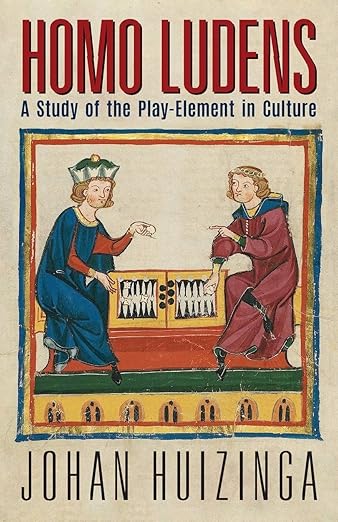
My freshman humanities professor, the brilliant, late Larry Fuchsberg, assigned Johan Huizinga‘s The Waning of the Middle Ages as one of the texts for our course…an unusual choice for American teens in 1975, as was another of our books, Burckhardt’s The Civilization of the Renaissance in Italy. At 17, I found Burckhardt rather slow going stylistically (it was published in 1860, after all); by comparison, Huizinga (circa 1919) was refreshingly clear. I really enjoyed it and learned a great deal. I kept meaning to read his 1938 book Homo Ludens, but for awhile it was difficult to find in libraries or bookstores. Also, I lacked the time to track it down or read it. The premise interested me, though–that we humans evolved our culture from the “pointless, imaginative” urge to play, and that play is fundamental to our learning and our social structures. Also, we are not mechanical beings–the messy frolicsome-ness of people is as necessary for our survival as food, water, and shelter.

“Animals play, so they must be more than merely mechanical things. We play and know that we play, so we must be more than merely rational beings, for play is irrational.” 

Finally, I’ve begun to read Homo Ludens, and it’s even on Amazon now; also I discovered that it exists online here thanks to Yale University. Fifty years after my initial encounter with the author, I find his thinking just as interesting as I did in college, and just as difficult. As in his other books, Huizinga uses etymology as one of his methods of examining the meaning and culture of play. He was writing for an audience that he assumed was well-educated in the classics, so there are passages in Greek, Latin, and French that neither he nor the English translator bothers to translate for less linguistically-adept readers like me. Fortunately, such passages are brief and are used as sources for his argument, and I’m not reading to find fault with his material. I’m interested in his argument and insights as a whole, and intrigued by his thinking. He apologizes for his lack of sources (ha! There are hundreds of them) because he was “working in haste.” He composed this book in the Netherlands as Germany began to be a serious threat to Europe, and he wanted to get his ideas in print before he was silenced. In fact, his last few years were difficult. He had used his standing as a well-known cultural historian to criticize the Nazis and was arrested in 1942, basically house arrest; he died in 1945 just before the war was over.

I’m only on Chapter 4 but am finding, in the etymological tracings of the words that intersect in meaning(s) for play–game, contest, gambol, gamble, dallying, tournament, match, riddle, performance, frolic, pretending, folly, fun, sport, etc.–fruitful stuff for poetry, for thinking about poems and about how poems work as craft, as poems, and as works of art and imagination. And also, what roles poems may play in culture today, and whether that differs at all from the role poetry played in ancient times. Huizinga writes:

“In the making of speech and language the spirit is continually ‘sparking’ between matter and mind, as it were, playing with this wondrous nominative faculty. Behind every abstract expression there lie the boldest of metaphors, and every metaphor is a play upon words. Thus in giving expression to life man creates second, poetic world alongside the world of nature.”

Language may not be necessary for play but can easily be incorporated into it, and language can become play. Or playful. I don’t know much about Wittgenstein, but I find myself thinking of his theory about words having “family resemblances” that often connect, overlap, shade meanings. So we get jokes, puns, flirting, mocking, and new “rules” for our language use that culture constantly shifts in all kinds of directions. Language is a game-changer, and poets make use of that.

I thank Larry Fuchsberg, musicologist, book-lover, and educator, for introducing me to Johan H. Teachers, you never know how much you may have influenced a student’s life, even decades later.

Magnificent

Qesra Îshaq Paşa or Ishak Pasha Palace, Ağrı Province, Turkey, Ottoman Empire, 17th c.

For a recent poem draft, I looked up the etymology of the word “magnificent” even though I was fairly sure I knew it. Like many words, its meaning has altered a bit over the centuries, but in this case less so than most: from the old French, from Latin, the root words for “great” and “make,” it formerly referred to great-mindedness, courage, nobility [per the Online Etymology Dictionary] and later gained the additional meaning of splendor or costliness; “Meaning ‘greatness of appearance or character, grandeur, glory’ in English is from late 14c.,” whereas later uses of the word carry connotations of architecture, expensive taste, grand works of a more human variety.

The draft I was working on was about Melville and whales, but of course thanks to stopping to look something up, I went down a research rabbit hole and ended up deciding that the magnificence whales possess would be more of the greatness of appearance sort and perhaps was not quite the way I want to describe whales. But the word did put me in mind of some of the monumental temples, mosaics, palaces, castles, and sculptures I saw in Turkey last month. Many of those are “magnificent,” but they act as reminders of how fleeting human magnificence is, in comparison to whales. Whales evolved into their modern form about 4 million years ago, long before humans were modern humans, let alone building palaces or temples to please the gods, intimidate their enemies or their subjects, or glorify and deify their kings.

The photo below is of the temple and perhaps the tomb of Antiochus I of Commagene (because archaeologists have so far discovered no actual tomb, the existence of said tomb is speculative, though the site is considered to be a hierothesion). The top of the hill is not natural but is a gravel tumulus. Human-made. Gravel hauled up the mountain to increase the size of the mountain and deter potential grave-robbers. Who else would do that work but slaves?

I know the theme’s been written into poetry before, but in these times it seems to bear repeating. Here’s an early draft I’ve been working on, in loose blank verse, in which I invoke a famous poet whose poem on the theme has lasted a mere two centuries. But that’s longer than many an empire has endured.

~

Hierothesion (Nemrut Dağ)

Tomb or temple, likely both, one king’s
angling for a pantheon he’d crafted
on his own, as kings will do when empire
hardens in their veins. They turn to stone.
Minions, memorize my name! (like
Ozymandias, as Shelley can attest).

Tourists scale the tumulus and find,
at sunrise, eagles, lions, and Apollo,
gods of brokenness, unhumbled despite
centuries of disregard. Extinct.

We know him not. And what has made us pause
speaks not of his glory but of our dismay:
how much purely human work, slaves’ toil and toll,
it took, interring him this way, high up
and rubble-laid, to raise him above all.

Where are those workers’ bones? We walk on them.
This we know without a temple or a tomb.


Zeugma

Zeugma, an ancient city in what is now Türkiye’s Gaziantep Province, is near where we began our tour of a 2000-km section of the Silk Road trade route. The city’s name comes from the ancient Greek word for “bridge,” (it means to join or yoke together); the city was located on the Euphrates, where there was likely a floating bridge, like a barge or pontoon bridge, that enabled people, largely traders, to cross. Most of the ancient city is now left to underwater archeologists to examine, alas, since it lies beneath the new Biricek Dam.

Photo [Euphrates] by Fu0131rat Gedikou011flu on Pexels.com

Turkey itself is, and has ever been, a bridge–for trade, cultures, conquests, languages, religions: a place of shifting allegiances and changing empires. Arab traders brought Islam from the south, while Seljuk Turks brought their version of Islam from the northeast (Kyrgyzstan and the Turkic Khaganate, a region of Medieval-era Muslim nomadic groups with substantial dynasties and a loose empire that spanned into what is now China, hence the Uyghurs of today’s China). Earlier, the Christian gospel had arrived along the Mediterranean shores from Jerusalem and then probably through Syria to Ephesus, a Hellenic city south of Istanbul. St. Jude the Apostle/St. Thaddeus supposedly got as far as Şanlıurfa, then known as Edessa, where an early Armenian king converted to Christianity before 100 AD. So they say.

~~~

Our tour guide was excited when I told him that the word zeugma is used in poetry terminology. It’s a figure of speech in which words or images in a phrase are connected, often for humorous or ironic effect, as in a sentence such as: He lost his heart and his wallet at the stage door cafe. The word “lost” joins both heart and wallet. It acts as the bridge. It’s an intriguing little literary device that’s seldom the first thing I notice in a poem, but when I do identify it, I appreciate it. I like knowing the etymology, and I like knowing that I’ve been where the city was.

Joining and breaking apart and rejoining in new ways, Turkey spans cities, rivers, and eons.

Back in time

At Şanlıurfa in the Urfa region, a Kurdish area in eastern Turkey, we stayed two nights after our visit to two amazing, ancient monuments that are really out in the middle of nowhere: Mt Nemrut Dağ (the tomb of Antiochus I) and Göbekli Tepe, a Neolithic site of the Stone Mound Culture, both Unesco World Heritage sites. I remember reading about the discovery of Göbekli Tepe in the early 1990s, when German archaeologist Klaus Schmidt began excavations there; the “buzz” at the time was that these megaliths mark the earliest temple or place of community worship ever recorded [ca. 9000 BC]. Since then, new discoveries unearthed at Göbekli Tepe, as well as discoveries of similar sites (such as Karahan Tepe, which we later visited) in the region, have somewhat altered Schmidt’s original speculations.

It appears now that people lived here at least part of the time, though until these discoveries, historians assumed humans in the pre-pottery Neolithic Era were hunter-gatherer nomads who did not build permanent structures. Our guide told us the current thinking is that the buildings here played some sort of role in preparing young men for adulthood–almost all of the reliefs and statuary portray male figures and male animals. But it is early yet to guess, and besides, we can never know for certain.

But there are cisterns, a system that distributed water through tunnels, containers that have traces of grains and, yes, beer. Back to the argument of which came first to humans: Bread or beer. My money is on beer. *

But to back up a few hours–first, we rose at 5 am so that we could take the circuitous drive up the mountainside to Nemrut Dağ, a relatively youthful site built around 60 BC, presumably by Antiochus I, who was connecting a slew of peoples and cultures together in a kind of Iranian-Hellenic-Armenian-etc. aggregation in a move toward empire at a time of Roman ascendancy. Commagene is the Romanized name used for this ancient region, which was a merger of Persian and Hellenic areas once Alexander the Great’s empire had disintegrated. Antiochus married a Cappadocian princess and had big plans, but his empire did not last long after his death; by 29 BC, his sons had died or been executed.

The path we walked up to get to the tumulus, 6:45am; my photo

And then over time, this huge tomb monument was forgotten until its rediscovery in the 1880s. The region feels deserted and surreal, and the climb up to the tumulus–though there is now a partially paved path–is long, the wind swirling around, full of dust. My sunhat blew off my head even though I had a neck strap. I guess that was my offering to the ancient king.

What an astonishing place it is, especially at dawn, and despite a fair but not overwhelming number of tourists.

~

Monuments are a step toward writing: they tell stories, written in stone with picture images, because the stories we tell or sing with our human voices don’t leave much of a record for cultures other than our own. I found myself wondering what the poets of these ancient places said or sang, and how their language sounded, and whether I would feel exhilarated or moved by those lays had I been there.

And at Göbekli Tepe, when I learned about the cisterns that contained beer, I thought of a poem I’d written some years ago after visiting a Mesopotamian exhibit at the Penn Museum in Philadelphia. So with a bit of awe and a bit of tongue in cheek, I’ll post it here. [It initially appeared in Mezzo Cammin.]

~

*Porter, Stout, & Mesopotamian Deity

Sisters, let us raise a glass
to agriculture, to dark brew
made possible by wooden hoes,
by seed-gatherers: me and you,
our aunts, foremothers, those
who stayed, patient, and grew
grains, diverted rain, winnowed,
boiled, fermented mash, who
certainly invented ale. For we
descend from goddess Ninkasi
who nourished babies through
breast milk fortified by beer
and whose forgotten virtue
we revive, consuming her.

~~

Thanks to copyright-free photos from Pexels since my own photos are snapshots taken with an out of date cell phone.

Reading Proust again

I’m embarrassed to note that the name of Proust evokes hilarity in my two (adult) children, since they immediately think of the Monty Python skit (see it here). Needless to say, neither of them has read Proust; but at least they have some familiarity with the famous writer, so I’m not a total failure as an educational model for my kids.

I read the novel(s) at age 19 or 20 and was entranced. Probably that indicates a kind of romantic nerdiness on my part as well as a love of words, of art and music, evocative sentences, descriptive prose, complex emotional situations, history, and confusion about the world of adults I was at that time entering. That I stuck it out through all seven volumes of the Scott Moncrieff translation says something about my persistence with literature and the beauty of that translation. [The Public Domain Review has a nice overview essay on Moncrieff here.] In the decades that followed, I kept meaning to re-read In Search of Lost Time; but it’s quite a commitment and, let’s face it, that is the sort of plan one tends to postpone.

But I began the task this summer with the Lydia Davis translation of Swann’s Way, though I may move on with the Moncrieff editions if that’s what I can find at the library. (Somewhere in my attic is the three-volume Mitchell edition, but I started that years ago and found I didn’t like his approach.) I suppose a first-time reader might want to experience the books all through the same translator, but even the Moncrieff doesn’t succeed in that since he died before he got to Time Regained. The new Penguin series, for example, has a different translator for each book.

Ah, the difficulties of translation. If only I could read French!

During the past decade, I have done a smattering of re-reading novels (and poetry collections) that I first read in my late teens or very early 20s: Tolstoy, Woolf, Dostoevsky, Dickens, Blake, Atwood, LeGuin, among others. It’s always interesting to re-read a book that I haven’t read in decades because, although the book has not changed, this reader has, to some extent at least. Fewer allusions and implications go over my head, for one thing. The motivations of mature characters make more sense now, and the yearnings and errors of youthful characters, while sentimental and familiar, seem distant; also, I have a better sense of the historical eras in which these novels were set or written. As a teenage girl in the USA in the late 1970s I had very little background in the social strata of fin de siècle France or of Russia during the Napoleonic Wars, or even of Victorian Britain, yet the authors swept me up in the petty striving and the political aspects of their worlds…and the difficulties involved in surmounting them, achieving them, or living outside of society’s expectations.

Photo, 1971 Opel Kadett: Rudolf Stricker, https://commons.wikimedia.org/w/index.php?curid=16078675

For all that I may be the wiser now, and can pick up more of the irony and humor, and more of the ‘adult themes’ (for example, until I was 17 or so I knew absolutely nothing about homosexuality), it is still the beauty of the prose and the rhythmic sweep of sentences and paragraphs that get me wrapped up in a book like this one. Besides, I love art and artists, architecture and music, and evocative descriptions of landscapes and gardens just as much now as I did then–possibly even more. Proust introduced me to so much when I was first reading these novels. Because of him, I read Racine, and Zola, and art criticism of the early 19th century, and looked at Impressionist painting in a new way, and recalled to mind the one trip I have ever taken to France (three years earlier, at age 16) as his novels described the Champs-Elysées, the Louvre, Versailles, the streets and parks of Paris’ arrondissements, and the villages in the countryside through which we had driven in a rented Opel.

Now, those recollections of France are dim. And the world has changed in 50 years. Proust knew: if I were to return, I would not be likely to reclaim my past–possibly not even remember it. France would be new to me, which is an idea I rather like. Possibly I’ll go back; in the meantime, I will relish the remembrance of reading what I have read in the past.

Blue

At one of our local used book stores,* I found a copy of William Gass’ 1976 On Being Blue: A Philosophical Inquiry. Gass writes in a style one might term prolix; but if you are like me and sometimes appreciate lists, wordplay, allusions, lengthy sentences, and fine distinctions in your sentences–as well as humor–while exploring the limits and the stretches of words and language, this book-length essay on the word/concept/color/iconography/sexual innuendo/moody attitude and conflicting meanings of the word blue might appeal. I’ve been feeling a bit on the blue side lately, hence my attraction to the book (though I do like Gass as a writer, as long as I don’t have to read too much of him at one time). And guess? It cheered me! [I will caution the reader who avoids the use of “bad language” that Gass employs such words in this essay, for purely intellectual reasons…]

Granted, my feeling blue has a different tone from other uses of the word: blue postcards, sexual meanings of blue–I’m reminded of the movie “I Am Curious (Blue)” which was considered racy and given an X rating when I was a kid, though the blue in that title referred to the Swedish flag, apparently. My blue is the blue of songs like “Baby’s in Black” or Joni Mitchell’s “Blue” album. Or just that classic music form, the blues.

And I’ll get over feeling this way. That’s what moods are: feelings that come and go, transitory. It always seems as though low moods stay around longer than neutral or cheerful ones, but many scientific studies show that it is our perception and memory of the negatives that make us think we are sadder for longer. Even Wikipedia has an entry on negativity bias, with some sources if you want to check things out yourself. As I age, I realize that bad moods and sad events and past mistakes don’t need to stick around as much as I used to think. A bit of mediation, some practice and readings in Zen and in psychology, a lengthening perspective on life’s vicissitudes, some counseling and even some medicine; whatever it is that’s brought me here, I recognize that before long the depressive hours will lift. Also I know some methods of thinking that assist me to move to more neutral ground.

I will note there are many kinds and hues of blue, enough for Gass to write 112 pages on it and for the word to appear in 85 files of my own poetry during the past 12 years–I did a quick word search just to find out. That is in the files alone, and each file contains many poems. so I can only imagine how much I have over-used the word in my writing life! Certainly, not all of those blues are sad. Many are beautiful, sunny, the blues of blueberries and balloon flowers, the New Mexico sky, mountains and oceans; teal-blues and turquoise, the bright royal blue I like to wear, the pale color of robin’s eggs.

Blue. It has always been my favorite color.

~~

*The bookstore is Apport, in Emmaus, PA. Ben has an active Instagram feed and really cool catalogues of odd books, art, and ephemera.

*The first “blue” above is an encaustic painting by Deborah Barlow; the second is at Bandolier National Monument; the third is of the Blue Ridge Mountains; the last was taken at an inlet bay, maybe in Delaware–I’ve forgotten.

Reading my contemporaries

The poetry collections I’ve been reading during much of the past year have largely been works of contemporary writers–books that were published during the past two decades, some during the past two years. My focus on such current work was not intentional. After all, there is still so much poetry from the past three or four thousand years that I haven’t yet explored! Grad school, however, was decades ago; that’s when I last studied both contemporary and classic/canonical/influential poems with a specific eye to learning from them. I continue to learn from the poems I read, though. I just don’t take as many notes or write any papers about them these days.

Three collections I read recently have got me thinking about the grittier sonic elements in poetry; the use of scientific, foreign, antiquated, and invented words; wordplay in general as a poetry component; and how sound can push both experiment and meaning in a poem. I’ve been mulling about the task of writing anything that feels “new,” to me or to my readers, and about the challenges more sonic wordplay would mean for me as a writer. I’m saying here I think it would be difficult to do, because it differs from my long-accustomed voice and style. I’m also saying I like a challenge in creative work, and that my style(s) go though changes always, so why not? In creative art of any kind, the passing of years makes a difference in many things. Content (because: experience). Situation (because: life happens). Methods (because: technology and materials). And influence–what I was reading in high school vs. grad school vs. today–though some favorites will always hold a place in my creative mind.

My poems tend to be plain-spoken, although I’ve never been shy about going beyond the standard vernacular to employ a geological term, a botanical name, or a somewhat archaic noun or adjective when it suits the feel and sound of the poem. Most of my poems don’t fall under the description of experimental or edgy. I’m not making waves with language, but some poets are. And my recent reading has me wanting to experiment more. It will mean failing a lot, because I’m working against my habitual methods of composition. I won’t be as good at it as these poets (below) are. What I’m hoping, though, is that the practice of trying more sonic wordplay in my work implants a tracery of that practice onto my poetic voice.

~

So which contemporaries do I mean? More than the three I’ll briefly mention here, for sure (and it is not as if the only poets playing with words and sound are my contemporaries–far from it). However, here’s a start with some examples that I particularly love.

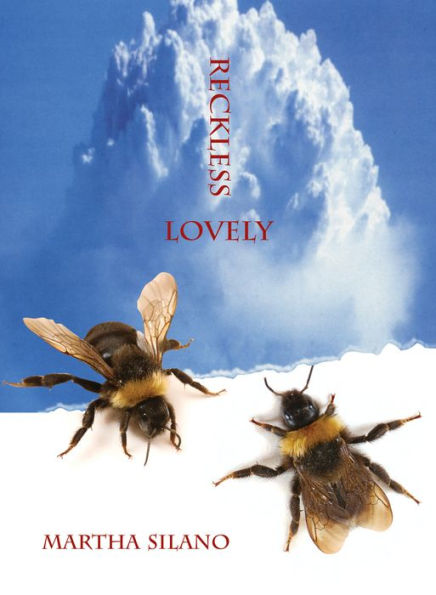
I mentioned Silano’s poetry in a recent post when I appreciated her scientific ideas that meld with an “everyday” life. Reckless Lovely contains many long-lined couplet verses that name objects such as a 64-ounce Big Gulp, Wells-Fargo, Italian Renaissance paintings, or the red spot on Jupiter as the poet observes and speculates on the cosmos that surrounds her. And she invents or alters words that suit her for rhythm, alliteration, sound: “the sfumato is sfumato-ing, the lute-r is lute-ing;” “when most of all that creep-eth/breath-eth buzz-eth/galump-eth sex-eth spar-eth/went AWOL/paving the avenue of asp/the boulevard of bee…” or the totally wild mashup Silano composes in “Summons and Petition for Name Change”:

Dim sum-my dilberry. Down there Daquiri.
Ear of Eden. Eminently Earthy. Empress Gensho.
Fandango-ing funnel. Fox foot. Flamingo.
Geranium in the Gate of the Gourd. Gentian's grin.

~

I find much to admire in Martha Silano’s work even though I often have to look up words (physics and geology nomenclature, usually).

Lesley Wheeler’s most recent book demonstrates her ability with form and sound in a different way, though in “Gran Torino Gigan” the alliteration is as snazzy as Silano’s abecedarian poem above: “Buzzes fade up front,/where beltless adults murmur and smoke//after unfurling musty sleeping bags…in rhizomatic zigzags, with a sharp zipper.” Contemporary technology gets into the poems and, with it, the sounds of our infrastructure, as in “I believe in utility poles, transformers,/lightning arrestors. Subtransmission lines/and static lines. The dead southern yellow pine…” and the theme of fungal connectivity means that we learn some useful and often beautiful mycology terms. Yet Wheeler often relies on shorter words when they suit the tone of the narrative. In a poem dealing with the aftermath of her mother’s death, she writes “No one’s grimmer inside/than me. My bully of a heart wears cheap/scuffed pumps and cusses like a mobster.” The repetition of the word “snow” in “Minus Time” establishes the poem’s pace. So many poems in the collection offer experiments in form!

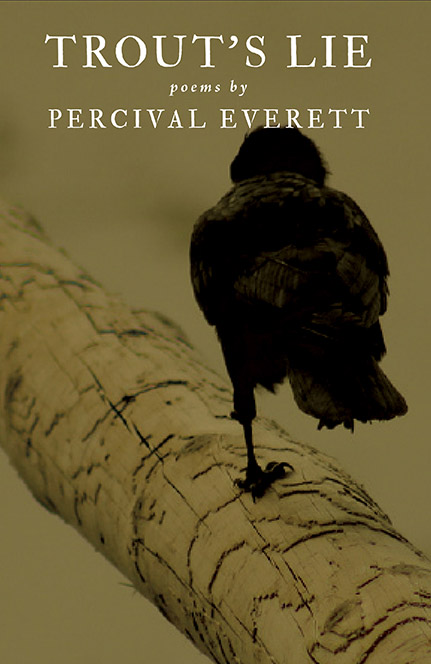
Percival Everett has gained an even stronger following thanks to his novel James, but he’s been writing poetry for years (Trout’s Lie is from 2015). This collection is deceptively simple in language and vernacular: there are surprises. Several poems make allusions to “great poetry of the past” by name or phrase; short lines build and build, twisting the lyric where we don’t think it would go. There are several examples I’d like to give, but this post is getting pretty long. I think I will close with an excerpt from Everett’s “Maybe Even Clouds,” the first section, which begins “Count the marines..”

They look like nice
Boys and bad boys,
From Vermont-and-Montana-
Following-orders-dumbshit-
Non-blinking-soon-
to-kill-soon-to-die boys,
Who might or might
Not, should or should
Not, but never would
Not and never can
not.
Not sure doesn't matter.
Doubt is a penniless
Customer, conscience
Waits for the weather
To change.


National Poetry Month may be almost over, but I’ll keep reading poems. And posting about them. And writing them. I encourage you to do the same, because there is no time in the history of the world when human beings haven’t benefited from poems.

báilù

白露 báilù is the section of the lunisolar calendar that refers to the two weeks before the autumnal equinox; the translation is “white dew.” Misty mornings here and there, damp grass, dew spangling the tent spider webs in the meadow, draping the grasses and goldenrod with white gauze. Brown crickets sing, but the cicadas have left off. Nuthatches return. Squirrels knock walnuts off the branches daily, so there’s a regular thump-thump sound along the treeline. My summer-loving acquaintances bemoan the cooler days and insist summer’s not over until the 21st. My fall-loving acquaintances are picking apples and celebrating the return of pumpkin-spice flavoring to their favorite beverages.

I like the in-between times, the verging of seasons, aspects of change. Change means life, even though the onset of autumn traditionally signals the dying of the year. On my walk this morning, I took photos and made a mental list of changes that are flags of the coming season: acorns on the bough; morning glory still open at noon (in Japanese literature, the morning glory is a signal of autumn’s approach); burning bush shrub going pink; pennants of yellow walnut leaves; ripe wild grapes–deep navy blue, quite sour, and full of seeds; sweet autumn clematis (terniflora) in its whirly seed state, swarming over the hedges; oak leaves, five-leaf vines, and sassafras starting to color; winterberries already red; acorn detritus on the tractor path; pin oak galls (probably thanks to the wasp Callirhytis furva) on a leaf. All of these are mid-September features in eastern PA.

If I were feeling more poetically creative, I might try writing haiku using each of these as the image word. But my current state is fretful. Pulling weeds and taking walks ease my mind a bit. Sitting down to write, not so much. However, reader, I encourage you to try the exercise.

~

Speaking joy

When my children were learning to talk, I remember finding the process of language acquisition so amazing that I briefly considered going back to college to study it. I have two children about 18 months apart in age; many of my friends had babies the same time I did, so I had a range of small children to listen to and be amazed by. Each child seemed to develop their own method of learning to talk, beyond the general similarities among human beings that many scientists and linguists have studied. I wondered what made those small differences–the way parents spoke to the child or to one another? The temperaments of the children? Exposure to music or grandparents, older siblings, the radio??

I can admit that I was an exhausted young(-ish) mother, but also so intrigued. I wanted to learn as my children were learning. There was such excitement and joy–it seemed as though every new day brought further leaps in communication as my kids discovered pronunciation, verbs, adjectives, vocal stresses, and body language to convey what they were noticing, experiencing, needing, complaining about. As a lifelong learner, autodidact, and amateur researcher, I found myself reading up on language and its acquisition and history.

A few moments stay vividly in my memory. One summer day when we had a sun shower, my barely two-year-old son pointed up to the sky and announced, “Sun out. Rain coming down.”

I think of that with joy every time we get a sun shower. Over 30 years later.

~

Now, I’m trying to find the same fascination, the same learning-endeavor, with my mother’s loss of speech. I want there to be some joy or benefit in this reversal of language, something I can take away from it other than a deep sense of losing the person she was. This has meant reading books about dementia, aphasia, aging, and all the rest. It’s meant trying ways to get her attention and jog her memories when visiting her; talking with her caregivers; and reminiscing with my siblings, as well as conferring with them about her current situation as it evolves.

It’s meant finding some humor in the inevitable mix-ups that happen when communication gets woefully impaired. It has also meant finding peace, or comfort, in just sitting beside my mother in silence, holding her hand in her quiet room. She was always a fairly reflective person–capable of hilarity and chattiness, but more often keeping things to herself. Maybe revealing her thoughts some time later. Now? Who can tell. I find that I return from my visits with her feeling increasingly reflective myself, wondering where she “goes” when her attention seems to wander, wondering what she would say, if she could. I find myself wanting to research, even more than I have, information on neurology and cognition and what happens when the neural synapses that lead us to language begin to get trimmed away.

Not everyone who gets past 90 experiences such neural shut-downs in the language-generating parts of the brain; I know several folks who were, and are, quite fine with speech and thinking into their late 90s! Alas that my mom isn’t one of them. My task is to find joy in whatever her moments of being are at present while she is still physically among us. Not always an easy task, it sometimes saddens me. But joy tempers sorrow, just as sorrow so often tempers joy.

Momma. If you could only read this, or understand me when I say it: I love you.

Back to the garden

Late spring weather, mild and pleasant; lettuce and spinach ready and quite tasty, strawberries, asparagus–all the early harvest, with mulberries ripening on the trees and tomatoes starting to blossom. I have weeding to do, and it’s a task I don’t mind when the weather cooperates. Later on in summer, when the days get humid, hot, and blazing–then I am no fan of weeding. But on perfect days in early June, weeding is one of those mindless puttering tasks I can attend to while half-daydreaming.

I’m thinking about task-oriented work and creative work as opposed to wage-based work thanks to Jenny Odell’s second book, Saving Time: Discovering a Life beyond the Clock. Weeding’s one of those forms of work one does when it is necessary–the time it takes, and the best time to do it, don’t conform to clock schedules but to environmental ‘schedules,’ which vary. Too rainy? I don’t weed. After the soil has dried a bit and the weeds are sprouting like crazy? Time to weed. Too dry and hot? Not time to weed. Yet if I were a wage-paid groundskeeper and my boss said, “Get weeding today, $14 an hour, don’t waste your time,” I would have to weed, to look busy, to keep busy. Even though it might be a poor time to accomplish that particular task.

I’m no longer on the clock, at least in terms of wage-earning, but that socially-ingrained urge to keep busy and accomplish things and meet deadlines? That’s hard to move away from. Ill with covid, I kept complaining to myself that I wasn’t accomplishing anything. By which I guess I meant housekeeping, gardening, laundry, cooking, submitting work to journals, making plans for summer events, visiting my mother, taking walks, going to the gym…but really, it’s rather strange to think of such things as accomplishments. They’re not even work, per se, just tasks. They don’t have time constraints; doing them only becomes necessary when I run out of clean clothes, or need to eat or harvest spinach before it bolts.

Odell later addresses the sort of care-giving work that can’t really be broken into wage-based tasks, though industries do try that. Nurturing children, caring for livestock, being a teacher, social worker, farmer, artist: sure, some people do wage-work for these jobs, but hourly accountability doesn’t suit such work well, tends to distort the varying needs of the moment and the fallow or less-busy times that are just as crucial to accomplishing “good work” as the more rushed times are.

An artist needs down time. So does a Certified Nursing Assistant. So do farmers and teachers. And parents!

…and gardeners. We have all winter to do less and plan more, and then we have to respond to the weather and the circumstances around us as the circumstances require. Warming trends from climate change, floods or droughts, invasive beetles, viruses, weeds. What cannot be changed must be adapted to; didn’t we learn that from Darwin? If I have a job, as far as the garden goes, it is learning to balance things so that my effects on the earth are sustainable, harming the earth’s balance as little as possible–providing for pollinators and birds and amphibians, and also for my family.

It’s a difficult task and not clock-measurable, but more rewarding than most jobs are.

~

Because I like this song, and Mitchell’s lines about being billion-year-old carbon and getting ourselves back to the garden, here she is:

~