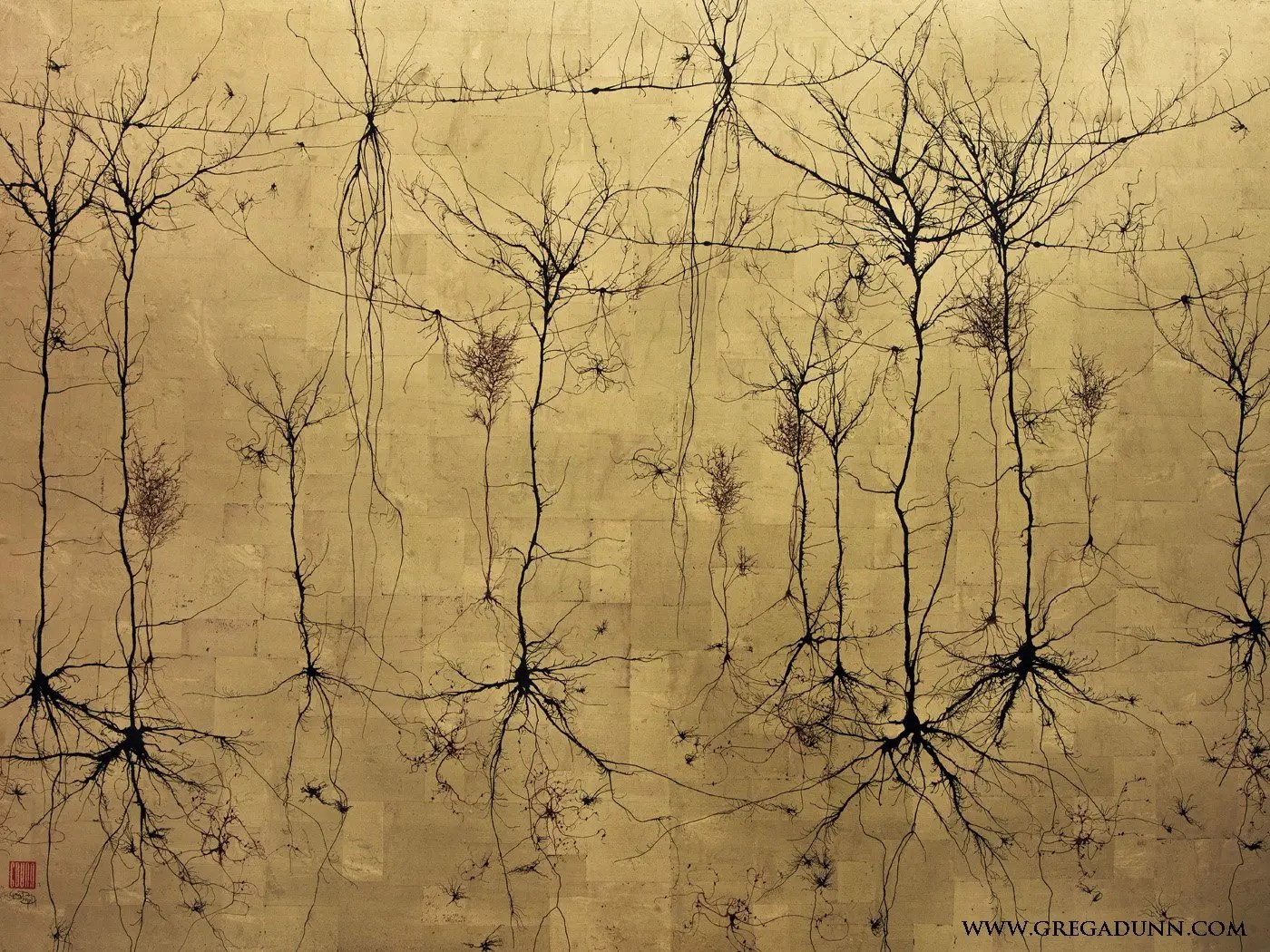
Psychobiology & art

Greg Dunn’s gold-leaf neuroscience art: “Gold Cortex”

~

Howard Gardner once said aesthetics is considered the “dismal branch of philosophy” and that psychobiology, the scientific examination of art, might therefore be called the “dismal psychology.” This view derives from the difficulty of pinning down what qualifies as art, the artistic process, the artistic personality, and the like–especially the challenge of trying to categorize, measure, and in any genuine way evaluate art. Psychobiology as a discipline is new to me; is it merely an earlier form of behavioral neuroscience? How does aesthetics play a role? I went looking.

~

Here is an excerpt from D.E. Berlyne’s abstract of his exploration into stimulus behavior and art (including humor), Conflict, Arousal, and Curiosity, written in 1960:

The highly variegated human activities that are classed as art form a unique testing ground for hypotheses about stimulus selection. They consist of operations through which certain stimulus patterns are made available, and so they must unhesitatingly be placed in the category of exploratory behavior. The creative artist originates these patterns, the performing artist reproduces them, and the spectator, listener, or reader secures access to them and performs the perceptual and intellectual activities that will enable him to experience their full impact.

It’s intriguing to note the different ways a social scientist (Berlyne was a psychobiologist) uses language to write about a generally-considered subjective subject: art. Different in tone and terminology than the language a philosopher or artist would employ, the description characterizes yet another inquiry into the ontology and the exercise of art and the artistic process:

The content of art can range over virtually the whole scope of human communication. It may be used as a source of information about the appearances of objects, the course of historical events, the workings of human nature, as a means of effecting moral improvement, as a vehicle for propagating religious, political, or philosophical ideologies. Art is, however, distinguished from other forms of communication by …the communication of evaluation. While human beings may produce art and expose themselves to it for an endless variety of reasons, collative variables must play their part, as they do in all forms of exploratory behavior. They underlie, in fact, what is commonly called the “formal” or “structural” aspect of art.

The author is interested in whether psychosocial behaviors, culture-building, and communication all derive from exploratory behavior and stimulus-response and what role evaluation plays in the assessment of art, its social or moral value, artistic merit, “timeless” art, and to some extent the very making of art.

The psychology of aesthetics offers intriguing insights–if one can get past the jargon. From the little I have read about it so far, the science seems to share a few points with phenomenology: its task, according to Dr. William Blizer, is to “describe observable phenomena and to note associations and correlations among them which enable such phenomena to be predicted, controlled, and explained.” In psychobiology, the “observable phenomena” are “the behavior of the creative…artist and the appreciator.” Philosophy and psychology are strange bedfellows, though; throw aesthetics into the mix and the entire project begins to seem suspect. I am not at all sure that these inquiries end up explaining–certainly not predicting or controlling–anything about art.

I admit I prefer to read such musings when the makers themselves are doing the exploring. Nonetheless, this little intellectual excursion led to my discovery of Greg Dunn‘s amazing neuroscience designs, one of which appears above. Who knew the brain was so gorgeous?

Turn! Turn! Turn!

I’m thinking of Pete Seeger, who died yesterday at 94 after a full and active life of song and advocacy for peace.

This is one of Seeger’s songs, as sung by the Byrds (1965); it was my favorite song when I was 9 years old. I recognized it was from Ecclesiastes, and I loved the simple tune.

A time to be born, a time to die. Elegy & celebration.

Autumn, time transfixed

IMG_0127

When we were initially landscaping our property, I chose to plant a particular species of zelkova known for its lovely fall foliage color. I cannot recall the variety now, although I am sure I recorded it in my garden journal 16 years ago. The leaf color is challenging to capture in a photograph. If only I were a painter, then I might manage. Of course, the color varies depending upon time of day, cloudiness, and atmospheric changes.

It is a lovely tree that announces the equinox quite articulately.

~

Equinox, autumnal: a slowing of crickets, the brief visits of migratory birds, quieter dawns, fewer bats at dusk, longer shadows. Time is far from transfixed.

~

I visited the Museum of Modern Art, New York City, on a warm October day to see the René Magritte exhibit. Magritte’s work is so easy to parody, so graphically amusing, that my brother–who was not all that familiar with the artist–at first said, “This reminds me of mediocre high school art.” After viewing the entire gallery, however, he had changed his mind about Magritte.

Magritte did a great deal of commercial art and, like Warhol years later, felt comfortable with the kind of graphic representation to which wide audiences respond. And then he played with that audience’s expectations, sometimes more effectively than others. One painting which certainly upends expectations and which I was glad to see again is La Durée poignardée, on loan from the Art Institute of Chicago; it was a favorite of my late friend David Dunn.

La Durée poignardée (1938)

time-transfixed-1938(1).jpg!BlogThis image of the painting appears at http://www.wikipaintings.org/en/rene-magritte#supersized-featured-211652

~

Here’s some playfulness concerning the title. The French word poignarder means to stab, and the implication is to stab with something pointed, ie, a dagger, since the verb is transitive. It interests me that the accepted English translation for this painting is “Time Transfixed.” The meaning I associate with transfixed in terms of, say, holding in one place (pointedly?) is that of pinning insects to a board as in lepidoptery displays. In this painting, the “stabbing” seems to be reversed: the pointy end emerges rather menacingly from the static, domesticated mantelpiece. If this image depicts the verso side of the display, it could be time itself that has been killed, spread open, and pinned, invisible from this aspect. Or perhaps the translation should be “Time Stabbed through Its Continual Duration,” stabbed with a poniard in the shape of something almost as ongoing, the contemporary barreling locomotive engine.

As it is a genuine surrealist painting, no particular meaning can be assumed. The images are random; make of them what you will. Magritte came up with wonderful, mysterious titles for his work–his paintings and their titles have inspired quite a few poets over the years. David Dunn was among them.

No wonder, really; this artist was quoted as saying, “The function of painting is to make poetry visible.”

~

Meanwhile, since I am not a painter, I will let the zelkova tree make poetry visible to me for a few days…and then get back to writing some myself.

Consciousness & cosmology

"Syntax" by Steve Tobin. Copper, bronze.

“Syntax” by Steve Tobin. Copper, bronze. What can be said about all the things we think make up an “I”?

~

I’ve completed I Am a Strange Loop and Why Does the World Exist? and found, not entirely to my surprise (but to my delight–braiding and synthesis!), that the existential, metaphysical, and cosmological aspects of both authors connect intriguingly. Thomas Nagel, an important “philosopher of mind,” appears as an influence in both of these writers’ books, and Einstein and Plato and Heidegger. Both authors end up citing Derek Parfit’s work, and Holt even interviews him! It turns out that trying to determine the “reason” the world exists at all is not that different from trying to understand what consciousness is made of and where it resides.

After taking up mathematical proofs and several philosophical arguments, as well as neurological science as a basis for the evolution of “mind,” Hofstadter’s book gradually takes apart the mind-body problem that Descartes made so iconic for Western civilization’s thinkers. He keeps returning–and that’s an appropriate word–to the metaphor of looping. He looks at the strange loops of Escher’s drawings and of string theorists’ rolled-up dimensions and alerts us to how crucial the concept of self-reference is to the theory of consciousness.

The need for self-referentiality in a fully “human” consciousness gets him to the idea of “small-souledness” (among, say, such beings as mosquitoes). What portion of our selves makes us able to think about thinking, for example? Is that identity, or consciousness? What’s the difference? Here is where Parfit comes in. Hofstadter writes that Parfit “staunchly resists the idea that the concept of ‘personal identity’ makes sense. To be sure, it makes sense in the everyday world we inhabit…we all more or less take for granted this notion of ‘Cartesian Ego’ in our daily lives; it is built into our common sense, into our languages, and into our cultural backgrounds.”

~

If we care at all about what there may be beyond our everyday lives–and certainly people like Hofstadter, Holt, Bachelard, and me, among others, do care–we need to get “meta” in our meditations, which invariably leads to paradoxes and thorny tangles. Hofstadter’s book also engages with his ‘personal life’ (if, indeed, a personal identity or personal life exists). When his wife died, he found himself engaged in the seemingly unanswerable question of “Where did Carol go?” Did “Doug-and-Carol,” the shared dreams and lives and understandings of two people who knew one another intimately, simply vanish when Carol’s body died? Hofstadter cannot fathom that this shared identity “goes poof” when the body stops. He, after all, still feels connected to the Doug-and-Carol shared consciousness.

It feels real to him. So–what is consciousness? From whence does it emanate, or originate? Is it real, or is it an illusion–is there no such thing as the personal identity we hold so dear that we cannot even imagine ourselves any other way than as an “I”? (Are feelings real?)

~

Jim Holt’s book likewise gets more personal as the chapters progress and as he wrestles with his existential inquiry through texts and interviews. That seems quite appropriate: how can we use language to untangle what language itself makes vague and confusing? (See Tobin’s sculpture “Syntax,” above, for a physical view of loopy entanglement and potential words). Holt’s inquiry initially seems based on the abstract, mathematical, physics of why/how the universe got here; but he ends on the metaphysical and philosophical…whereas Hofstadter entertains the metaphysical from the get-go but employs mathematics, psychology, and brain physiology as well as philosophy. And they encounter similar quandaries, paradoxes, and uncertainties. Both authors essentially come to a similar conclusion about the mystery of existence, though they accept or compromise with their conclusions in slightly different ways. Then again, they are different people who have lived different experiences. Reading both books has been, for me, a valuable experience and one that’s made me examine my own thinking about being.

~

Apropos of these musings, and thanks again to Popova of Brainpickings, here’s a few more words on some contemporary thinkers who have theorized as Holt has (in particular, Lawrence Kraus) in the debate on Something vs. Nothing: “What is Nothing”

~

…And, apropos of nothing in this post, but to lighten the mood, here’s an amusing little blog from The New Yorker about pilcrows & pound signs & ampersands.

Paz and poetic image

“The image is the key to the human condition.”

“Poetry is entry into being.”  ~Octavio Paz

All quotes in text below are from Paz, The Bow and the Lyre

~

Octavio Paz says all great works of art arouse in the spectator (or listener) “constellations of images” which “turn all works of art into poems.” In addition, what we find in the poem is something we already have within ourselves; we could not encounter it otherwise. What would that something within ourselves be? What do all of us possess in common, unique as we are? Paz doesn’t opt for a concept such as “soul” or “spirit” to define what all humans possess within ourselves. His answer is more mysterious but I think more accurate… “Poetry is nothing but time, rhythm perpetually creative.”

Some of us may protest we are not “creative.” But creative in this sense doesn’t mean that one has the ability to create art. It means one has the ability to create the imagined sensation, emotion, or context. All of us do this: the human concept of time, for example, takes considerable imagination–yet we all seem to have an understanding of time in our daily lives, even if our individual perceptions, or cultural perceptions, of time may vary a good deal. Give that idea of time, whatever it may be, a rhythm fueled by “rhythm as transformative change,” and perhaps that would be the origin of art. To encounter and be changed can only occur when something unexpected occurs through the experience.

~

“The image shocks because it defies the principle of contradiction: the heavy is the light. When it enunciates the identity of opposites, it attacks the foundations of our thinking. Therefore, the poem does not say what is, but what could be.”

“Since Parmenides our [Western] world has been the world of the clear and trenchant distinction between what is and what is not…Mysticism and poetry have thus lived a subsidiary, clandestine and diminished life. [As a result] man is in exile from the cosmic flux and from himself.”

(Here, I might suggest that Whitman made a significant attempt to bring those distinctions down.)

~books

Heidegger was still alive and writing when Paz was composing these essays, and Paz suggests that Heidegger had been no more able to reconcile the fact that “Western metaphysics ends in a solipsism” than were Husserl or Heraclitus. Paz adds: “Now, as some of his [Heidegger’s] writings show, he has turned to poetry,” and claims that “in losing our way in the world we have become estranged from ourselves. We have to begin again.”

And how to do so–except via image/imagination?

~

Well, we might examine Eastern thought, which “has not suffered this horror of the ‘other,’ of what is and is not at the same time…in the most ancient Upanishad the principle of the identity of opposites is plainly stated… ‘That art Thou.'”

Image as opposition, reconciled and unreconciled, inferred and stated, heavy and light: “of itself, language is an infinite possibility of meanings.”

This may be why writing good how-to instructions is as challenging as writing good poems. Yet according to Paz, “There are many ways to say the same thing in prose; there is only one in poetry.” Which brings us to a lovely seeming-paradox with which I will end this post:

“The poetic experience cannot be reduced to the word and, nevertheless, only the word expresses it. The image reconciles opposites, but this reconciliation cannot be explained by words…thus, the image is a desperate measure against the silence that invades us each time we try to express the terrible experience of that which surrounds us and ourselves. The poem is language in tension.”

(I might add that Emily Dickinson’s work provides excellent examples of the above.)

Proofreading

Every Living Thing–The Life & Times of a Glasgow Vet Student has a cute anecdote regarding the value of careful proofreading and how small mistakes can be inconvenient and costly at the customs line. Who thinks to proofread a passport or visa? Well…

Proofreading is how I began my so-called career many years ago, and the habits I learned follow or perhaps plague me still. For example, I’m currently reading Hilary Mantel’s 1992 novel A Place of Greater Safety and finding the text riddled with typos. The most common error is a missed quotation mark–not surprising because Mantel takes a unique approach to setting  up dialogue. But it’s dismaying to find that a major publisher allowed so many mistakes to slip through, and it interrupts my reading pleasure.

Years ago, I saw Edna O’Brien reading at the 92nd Street Y in New York City. She read from one of her short story collections, and at one point she paused, adjusted her reading glasses, and stated: “Typographical error, Farrar, Straus, Giroux.” Called out on the podium, publishers!

Online sites host the largest number of typos and outright grammatical or mechanical mistakes, but paper texts aren’t as reliably correct as they once were. The New York Times has become quite lax lately; three months ago, I even found a typo in The New Yorker!

Proofreading services

I understand why there are so many more typos these days–there are so many fewer proofreaders. It gets expensive, hiring all those human beings to inspect the small details of every text, and publishers are not making as much money as they once did. How many picky readers like me exist? Probably not enough of us that we could stage a book-buying boycott demanding that Random House hire more proofreaders (people like me could never really stage such a boycott–we’re too addicted to books).

Computers, however, are not yet intelligent enough to catch the shimmery, shifting nuances of the English language and its attendant finery in the shape of punctuation and capitalization, footnoting and italicization. So there will be mistakes, and I guess I can live with that. “To err is human,” and all that. And Mantel is a fine writer.

Creativity

It bothers me when people tell me they are not creative. Creativity, inborn in human beings, comes in so many forms. Just because a person does not identify as a recognizably creative person–artist, decorator, writer, teacher, etc.–that doesn’t mean he or she lacks creativity. We cannot solve problems without engaging our creativity, and most of us solve hundreds of small problems daily. We just tend not to consider those talents as “creative.”

One of my colleagues is a consummate problem-solver. Yet she constantly derides her work: “A monkey could do my job,” she claims. It would have to be one heck of a creative monkey! For years, I’ve been constantly amazed at her creative solutions to problems that students present to her…everything from advising to financial aid to family issues to roommate problems and issues that are once-in-a-career type peculiarities. She always says, “I’ll see what I can do;” 90% of the time, she finds a workable solution.

Another thing that intrigues me about her is the way she uses language. She reminds me of my grandmothers: sensible, smart women born and raised in one region and wedded to certain habits but possessing considerable grit and spunk and … creativity. Including marvelous slips of the tongue or twists on clichés. One of her most charming accidental neologisms is that instead of saying memento, she says “momento.” Educated well–with a Masters degree–she probably spells the word correctly when she writes. But I love hearing her say “momento,” because that’s one way of thinking about the word: a reminder of a moment. So apt! While the etymology of the word derives from the Latin (imperative of meminisse, to remember), the idea of recalling a moment through some sort of small souvenir strikes me as perfect.

Another creative use of language occurs when we are talking rapidly and the standard word or metaphor doesn’t come quickly to mind, so our brains substitute something else. My colleague’s creativity shows up at such times. I tend to stumble and say, “uh…um…” when that happens to me; but her mind comes up with alternatives (which occasionally make me laugh, but which always make me delighted). A recent example: during a freshman student program, there was an unexpected downpour which arrived just as the 18-year-olds were walking from breakfast in the cafeteria to a classroom building some distance away. Of course, none of them had umbrellas or rain jackets.

“Those poor kids!” said my friend. “They were all huddled in their soaked hoodies like wet mice. Like…like little wet mice, trying to get dry!”

I’d have resorted to the common phrase “drowned rats,” but little wet mice wearing soaked hoodies seems so much more vivid and elicits more sympathy. It’s also more creative–don’t  you agree?

~

“About as sharp as a sack of wet mice.” Foghorn Leghorn probably knew my grandparents….

More on the English major

The New York Times commentator Verlyn Klinkenborg recently wrote about the “decline of the English major” in an opinion piece titled “Why the Humanities Still Matter.” I am offering a link to the letters to the editor concerning that essay [which includes a link to the opinion piece as well]:

http://www.nytimes.com/2013/06/28/opinion/why-the-humanities-still-matter.html?emc=eta1&_r=0

Another article, this time in the Chronicle of Higher Education, makes the point that employers often want qualities in their employees that the English major supplies…but that employers may not realize that! (One commenter suggests students major in business or biology or whatever and minor in English).

Those of you new to my blog may wish to look at the archives here on this topic, which include:

“Reasonable, Calming” http://wp.me/p1RDyQ-go

“Just-so” http://wp.me/p1RDyQ-cI

“Defending the Poetry major” http://wp.me/p1RDyQ-6z

“Learning the literary analysis” http://wp.me/p1RDyQ-je

“Philosophy & English are friends” http://wp.me/p1RDyQ-hk

I’m a philosophy and literature major who is also a poet; and I’m not starving to death, and I like my job. Can the cynics please stand down? Learning matters. True education makes us into better thinkers. Society benefits.

End of story. Now, go read a book!

Myotonia congenita

Here’s the “Fainting Goats” poem I referenced in an earlier posting. It appears in the Spring 2013 issue of Philadelphia Poets.
~~

Fainting Goats

Next door, the neighbor’s raising goats.
I hear them bleating in the mornings while they wait
for feed, their stuttering punctuates the day.
Evenings, they murmur like a small crowd at a magic show.

The goats fall into a brief paralysis at any sign of danger:
they bleat and stiffen, roll onto their sides like live piñatas,
legs outstretched, then collect themselves and bolt
fast as they can, to the far side of the pen.

My neighbor says they’re bred by shepherds
to distract roving predators from the sheep,
sacrificed to the wolf or bobcat if the startle
lasts too long or if the predator’s swift.

Think of the white sheep fleeing in droves,
shunting themselves away from their fallen companion,
trammeling hillside toward safety while the goat
recovers, bellering, attempting its escape.

My neighbor chose them for their novelty,
chases them with an umbrella, makes certain
they maintain the reflex that causes their bodies
to seize and stumble. This is how

we keep our frailties alive, inbred, and how we fall,
sometimes luckily, sometimes into the jaws
of a starving winter day, asking ourselves if it’s destiny
or heredity, lost before we determine the answer.

~~

For other poems, see the Poems page here. Or buy my books–see the Books page here.

Thanks!

On being understood

I’ve just learned that a poem of mine, “Fainting Goats,” was awarded a prize from the journal in which it appears, Philadelphia Poets. Liz Abrams-Morley was the judge.

To my delight, the editor of Philadelphia Poets (the lovely and talented Rosemary Cappello) requests judges to write their rationale for choosing the poems as winners, and here’s what Abrams-Morley has to say about “Fainting Goats.” She understands the poem, and that feels deeply rewarding to me.

A very close third place, Ann Michael’s “Fainting Goats” is a poem which intrigues and engages from its unexpected title (and subject) to its terrific, enlarging and emotionally challenging final stanza.  The opening is conversational, a straightforward statement which addresses the reader, and introduces an unexpected fact: “Next door, the neighbor is raising goats.” This drew me right in to the detailed treatise on the quirky fainting behavior of goats, which are almost playfully and so perfectly described as murmuring “like a small crowd at a/magic show” and rolling on their sides “like live piñatas.”   The poem takes a darker turn as Michael reveals that the goats are living distractions, bred by shepherds to draw predators away from sheep. “Think of the white sheep fleeing in droves,// …toward safety while the goat/recovers, bellering, attempting its escape.”  The neighbor, meanwhile, simply “chose them for their novelty,” a statement which chilled this reader following, as it does, immediately on the heels of the harrowingly detailed description of the goat as potential sacrifice to some predator.  As a reader, I felt the panic of prey animals and heard that goat’s cry.

Structurally everything about this poem works.  The unrhymed quatrains, even meter,  conversational language and line breaks—all the poetic choices Michael makes support the poem’s content and feel “right,” even inevitable.

The final stanza opens out the poem, enlarges its vision magnificently, transforms the goat story from conversational tale into powerful metaphor.  Michael’s closing is flat- out gorgeous and provocative.  It leaves the reader, as many of the best poems do, with a question to ponder, rather than with commentary or answer.  I found myself returning and returning to these lines: “This is how//we keep our frailties alive, inbred, and how we fall/ sometimes luckily, sometimes into the jaws/of a starving winter day, asking ourselves if it’s destiny/or heredity.”

I am always interested in how other people interpret my work and appreciate it when they see things that I may not have had in mind; but Ms. Abrams-Morley gleaned from my poem the very things I intended.

Thank you!