Proofreading

Every Living Thing–The Life & Times of a Glasgow Vet Student has a cute anecdote regarding the value of careful proofreading and how small mistakes can be inconvenient and costly at the customs line. Who thinks to proofread a passport or visa? Well…

Proofreading is how I began my so-called career many years ago, and the habits I learned follow or perhaps plague me still. For example, I’m currently reading Hilary Mantel’s 1992 novel A Place of Greater Safety and finding the text riddled with typos. The most common error is a missed quotation mark–not surprising because Mantel takes a unique approach to setting  up dialogue. But it’s dismaying to find that a major publisher allowed so many mistakes to slip through, and it interrupts my reading pleasure.

Years ago, I saw Edna O’Brien reading at the 92nd Street Y in New York City. She read from one of her short story collections, and at one point she paused, adjusted her reading glasses, and stated: “Typographical error, Farrar, Straus, Giroux.” Called out on the podium, publishers!

Online sites host the largest number of typos and outright grammatical or mechanical mistakes, but paper texts aren’t as reliably correct as they once were. The New York Times has become quite lax lately; three months ago, I even found a typo in The New Yorker!

Proofreading services

I understand why there are so many more typos these days–there are so many fewer proofreaders. It gets expensive, hiring all those human beings to inspect the small details of every text, and publishers are not making as much money as they once did. How many picky readers like me exist? Probably not enough of us that we could stage a book-buying boycott demanding that Random House hire more proofreaders (people like me could never really stage such a boycott–we’re too addicted to books).

Computers, however, are not yet intelligent enough to catch the shimmery, shifting nuances of the English language and its attendant finery in the shape of punctuation and capitalization, footnoting and italicization. So there will be mistakes, and I guess I can live with that. “To err is human,” and all that. And Mantel is a fine writer.

Creativity

It bothers me when people tell me they are not creative. Creativity, inborn in human beings, comes in so many forms. Just because a person does not identify as a recognizably creative person–artist, decorator, writer, teacher, etc.–that doesn’t mean he or she lacks creativity. We cannot solve problems without engaging our creativity, and most of us solve hundreds of small problems daily. We just tend not to consider those talents as “creative.”

One of my colleagues is a consummate problem-solver. Yet she constantly derides her work: “A monkey could do my job,” she claims. It would have to be one heck of a creative monkey! For years, I’ve been constantly amazed at her creative solutions to problems that students present to her…everything from advising to financial aid to family issues to roommate problems and issues that are once-in-a-career type peculiarities. She always says, “I’ll see what I can do;” 90% of the time, she finds a workable solution.

Another thing that intrigues me about her is the way she uses language. She reminds me of my grandmothers: sensible, smart women born and raised in one region and wedded to certain habits but possessing considerable grit and spunk and … creativity. Including marvelous slips of the tongue or twists on clichés. One of her most charming accidental neologisms is that instead of saying memento, she says “momento.” Educated well–with a Masters degree–she probably spells the word correctly when she writes. But I love hearing her say “momento,” because that’s one way of thinking about the word: a reminder of a moment. So apt! While the etymology of the word derives from the Latin (imperative of meminisse, to remember), the idea of recalling a moment through some sort of small souvenir strikes me as perfect.

Another creative use of language occurs when we are talking rapidly and the standard word or metaphor doesn’t come quickly to mind, so our brains substitute something else. My colleague’s creativity shows up at such times. I tend to stumble and say, “uh…um…” when that happens to me; but her mind comes up with alternatives (which occasionally make me laugh, but which always make me delighted). A recent example: during a freshman student program, there was an unexpected downpour which arrived just as the 18-year-olds were walking from breakfast in the cafeteria to a classroom building some distance away. Of course, none of them had umbrellas or rain jackets.

“Those poor kids!” said my friend. “They were all huddled in their soaked hoodies like wet mice. Like…like little wet mice, trying to get dry!”

I’d have resorted to the common phrase “drowned rats,” but little wet mice wearing soaked hoodies seems so much more vivid and elicits more sympathy. It’s also more creative–don’t  you agree?

~

“About as sharp as a sack of wet mice.” Foghorn Leghorn probably knew my grandparents….

More on the English major

The New York Times commentator Verlyn Klinkenborg recently wrote about the “decline of the English major” in an opinion piece titled “Why the Humanities Still Matter.” I am offering a link to the letters to the editor concerning that essay [which includes a link to the opinion piece as well]:

http://www.nytimes.com/2013/06/28/opinion/why-the-humanities-still-matter.html?emc=eta1&_r=0

Another article, this time in the Chronicle of Higher Education, makes the point that employers often want qualities in their employees that the English major supplies…but that employers may not realize that! (One commenter suggests students major in business or biology or whatever and minor in English).

Those of you new to my blog may wish to look at the archives here on this topic, which include:

“Reasonable, Calming” http://wp.me/p1RDyQ-go

“Just-so” http://wp.me/p1RDyQ-cI

“Defending the Poetry major” http://wp.me/p1RDyQ-6z

“Learning the literary analysis” http://wp.me/p1RDyQ-je

“Philosophy & English are friends” http://wp.me/p1RDyQ-hk

I’m a philosophy and literature major who is also a poet; and I’m not starving to death, and I like my job. Can the cynics please stand down? Learning matters. True education makes us into better thinkers. Society benefits.

End of story. Now, go read a book!

Myotonia congenita

Here’s the “Fainting Goats” poem I referenced in an earlier posting. It appears in the Spring 2013 issue of Philadelphia Poets.
~~

Fainting Goats

Next door, the neighbor’s raising goats.
I hear them bleating in the mornings while they wait
for feed, their stuttering punctuates the day.
Evenings, they murmur like a small crowd at a magic show.

The goats fall into a brief paralysis at any sign of danger:
they bleat and stiffen, roll onto their sides like live piñatas,
legs outstretched, then collect themselves and bolt
fast as they can, to the far side of the pen.

My neighbor says they’re bred by shepherds
to distract roving predators from the sheep,
sacrificed to the wolf or bobcat if the startle
lasts too long or if the predator’s swift.

Think of the white sheep fleeing in droves,
shunting themselves away from their fallen companion,
trammeling hillside toward safety while the goat
recovers, bellering, attempting its escape.

My neighbor chose them for their novelty,
chases them with an umbrella, makes certain
they maintain the reflex that causes their bodies
to seize and stumble. This is how

we keep our frailties alive, inbred, and how we fall,
sometimes luckily, sometimes into the jaws
of a starving winter day, asking ourselves if it’s destiny
or heredity, lost before we determine the answer.

~~

For other poems, see the Poems page here. Or buy my books–see the Books page here.

Thanks!

On being understood

I’ve just learned that a poem of mine, “Fainting Goats,” was awarded a prize from the journal in which it appears, Philadelphia Poets. Liz Abrams-Morley was the judge.

To my delight, the editor of Philadelphia Poets (the lovely and talented Rosemary Cappello) requests judges to write their rationale for choosing the poems as winners, and here’s what Abrams-Morley has to say about “Fainting Goats.” She understands the poem, and that feels deeply rewarding to me.

A very close third place, Ann Michael’s “Fainting Goats” is a poem which intrigues and engages from its unexpected title (and subject) to its terrific, enlarging and emotionally challenging final stanza.  The opening is conversational, a straightforward statement which addresses the reader, and introduces an unexpected fact: “Next door, the neighbor is raising goats.” This drew me right in to the detailed treatise on the quirky fainting behavior of goats, which are almost playfully and so perfectly described as murmuring “like a small crowd at a/magic show” and rolling on their sides “like live piñatas.”   The poem takes a darker turn as Michael reveals that the goats are living distractions, bred by shepherds to draw predators away from sheep. “Think of the white sheep fleeing in droves,// …toward safety while the goat/recovers, bellering, attempting its escape.”  The neighbor, meanwhile, simply “chose them for their novelty,” a statement which chilled this reader following, as it does, immediately on the heels of the harrowingly detailed description of the goat as potential sacrifice to some predator.  As a reader, I felt the panic of prey animals and heard that goat’s cry.

Structurally everything about this poem works.  The unrhymed quatrains, even meter,  conversational language and line breaks—all the poetic choices Michael makes support the poem’s content and feel “right,” even inevitable.

The final stanza opens out the poem, enlarges its vision magnificently, transforms the goat story from conversational tale into powerful metaphor.  Michael’s closing is flat- out gorgeous and provocative.  It leaves the reader, as many of the best poems do, with a question to ponder, rather than with commentary or answer.  I found myself returning and returning to these lines: “This is how//we keep our frailties alive, inbred, and how we fall/ sometimes luckily, sometimes into the jaws/of a starving winter day, asking ourselves if it’s destiny/or heredity.”

I am always interested in how other people interpret my work and appreciate it when they see things that I may not have had in mind; but Ms. Abrams-Morley gleaned from my poem the very things I intended.

Thank you!

Concerning the apostrophe

I am not the sort of English enthusiast who makes a habit of ranting over bad grammar. I often feel annoyed at egregious errors; occasionally I go as far as to say “it drives me crazy when (insert common grammar mistake here),” but I understand that living languages change. Evolution is not just for finches, and stasis  cannot be maintained in a complex system of human communication when technology and society and culture constantly create and destroy not only our environments but our methods of communication. Communication takes many forms and reflects the influences of many stresses, common usage being foremost among them.

Common usage may be verbally-based or textually-based or may depend upon references to popular culture or recent history, and it alters language whether we want it to or not. This fluid, flexible aspect of language fascinates me. As a poet, I relish it. As a teacher, I have to allow for compromise now and then.

I am willing to predict, for example, that very soon the accepted pronoun for words such as everyone and anybody is likely to be “they.” The reference was acceptable to Jane Austen and her writing peers, then went out of fashion in the Victorian era, when “he” became the norm–the word “he” is singular, as anyone is; thereafter, educated writers and orators used “he” for the nonspecific singular antecedent.

Of course, such use omits half of the population. Non-gender-specific writing employs “he or she” as the correct pronoun for words like someone. That usage leads to many a tortuous sentence, however. I generally advise my students to change the antecedent noun to a plural form whenever possible and to keep “they” as the pronoun; yet almost all newspapers, many news journals, popular magazines, and certainly most of whatever text appears on the web now employs the pronoun “they” for nonspecific antecedents. I don’t really have a problem with that–Jane Austen was able to make it clear enough whom it was she meant by “they.” Clarity’s what matters.

I do have a beef with the misuse of apostrophes, though. The apostrophe I’m talking about is a punctuation mark, not the poetic apostrophe which addresses someone or something absent or metaphorical. I mean the little superscript mark  that is used for two main reasons:

1. To note an elision (the omission of letters)

2. To indicate the possessive case (barring the silly exceptions hers, theirs, ours, yours and its)

I understand the why behind a noticeable uptick in the number of times apostrophes go missing these days: texting, tweeting, and other shortcuts employed in social media communication. My students are vague about the comparatively simple rules of when to use the apostrophe largely because they never bother using it when they text one another. Furthermore, their customary “proofreader,” SpellCheck, doesn’t always alert its users to this type of error. Computer programs can recognize that dont is not a word, but cant means “sanctimonious talk” or, alternately, a tilt or slope (says Merriam Webster). It is a useful word, but it is not the elision for the word cannot. Furthermore, SpellCheck won’t (elision for will not; wont means habit or custom) be able to correct the typist who uses the wrong form of your/you’re or its/it’s.

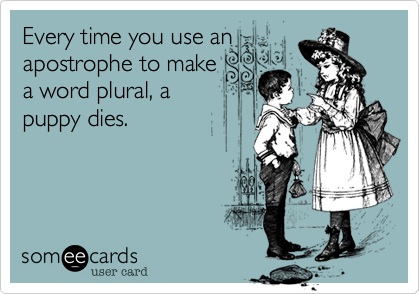
Irksome, yes. But most mystifying to me has been the ridiculously frequent use of the apostrophe to indicate the plural. Surely no one is teaching our second graders to pluralize by adding ‘s to the end of a word. (Teachers who do so should have their certifications revoked!) Recently, when working with a student, I learned one reason this mistake crops up so often in my students’ papers: AutoCorrect. When the typist gets sloppy and tries to add an s to a word that takes a different ending for the plural form (puppy, puppies), AutoCorrect defaults to possessive case. The computer is too dumb to detect the difference, because this is English, and English is damned difficult.

I suppose another reason may be character limits for tweets and texts, but that seems less likely. If people don’t bother to use the apostrophe for elisions, why bother for plurals? “Susie got 2 puppys” conveys the same information just as incorrectly.

Proper use of the apostrophe in English is actually pretty simple–even though computer programs cannot quite figure out the two rules above–and clears up a host of potential ambiguities and misunderstandings. The world could benefit from communication that isn’t studded with misunderstandings.

The warning below is one I use with my students. Sometimes, it even has the effect of becoming a useful reminder. Many thanks to the anonymous teacher who posted it on someecards.com.

puppy dies•NOTE  [Alas, just to complicate things, some editorial styles use the apostrophe to indicate plurals, but ONLY for letters or numbers, as in: “There are four 6’s in this statistical table.”]

I celebrate myself…

April is National Poetry Month in the USA, and I begin the month with Walt Whitman’s famous phrase and will attempt to duplicate the joyous urgency of his call to celebration. That means I am going to try to post just a little more frequently in April.

Poetry month began this year with a wonderful act of creative largesse on the part of a friend who sent me a poem…dedicated to me. Receiving a gift like this one is humbling; and it has been quite a long time since anyone’s written a piece for me. David Dunn, to whom my collection Water-Rites is dedicated, wrote a few poems for me or inspired (indirectly or directly) by our friendship or my family and surroundings. But he died over a decade ago, and since then I suppose I have had to learn to celebrate myself.

Not that this is a bad thing–celebrating the self–but for some of us it presents certain cultural or psychological obstacles. In this, Whitman has been an important teacher for me. As a great observer, loafer, lover of the world and all its beings, he was able to include himself among the beloved. My background, Protestant, agrarian, modest, surrounded by the biblical entreaty to remain always humble before God, combined with a natural shyness, means that I have had trouble admitting of self-celebration in any form and under any circumstances. I don’t take praise comfortably. The left hand shouldn’t know what the right hand is doing.

However, Whitman seems contented in his skin and in his world and follows a different parable as model: he does not hide his light under a bushel.

Walt Whitman in mid-life

Walt Whitman in mid-life

Furthermore, his passion admits of compassion and of aesthetic appreciation for all of the “Kosmos.” Each breath, scent, texture, color, hue, person, idea, object, sentient or non-, living or inert or dead long-past or recently, religious or scientific or imagined comes to life in language through line, syntax, lists, descriptions, words. I think there is a hint of zen-like acceptance in Whitman’s most lasting poetry, the vulnerable willingness to accept all that we experience and to do so non-judgmentally.

Thank you, Beejay, for the poem. I feel inspired anew. And as I celebrate all poets and the valuable, irreplaceable, gorgeous, ancient art of poetry this month, I shall endeavor to embark upon the celebration of myself (davening to ol’ Walt with humble pleasure). Therefore, a reminder:

My book Water-Rites is still in print, and Brick Road Poetry Press sells it (as does Amazon.com, where poetry-lovers can purchase the book in e-book form for Kindle). Dawn Leas reviews it at Poets Quarterly this month. Click for the link here!

May April be full of revelations in the form of poems for you.  water-rites by Ann E Michael

Endemophilia

This poem is sort of my version of endemophilia, describing (as Albrecht defines it) “the particular love of the locally and regionally distinctive in the people of that place. It is similar to what Relph … called “existential insideness” or the deep, satisfying feeling of being truly at home with one’s place and culture.” You might want to check out Glenn Albrecht’s site for more detailed definitions and philosophical/psychological reasons for inventing names for such concepts.

My long-poem in Water-Rites, “The Valley, the Whitetail: A History,” probably fits the term endemophilia more closely than the poem I’ve posted below–which may one day appear in print if I can find a publisher for my next manuscript. But the long-poem is a little too long for a blog post.

[I have an idea: buy a copy of Water-Rites from Brick Road Poetry Press, and read it there!]

~

Suburban Georgic

A mild day in February. Good chance
there’ll be more snow or ice. Walk slowly,

note the footprint of a hosta, dormant, or
the arrow-shaped deer hoof in hardened soil.

Look more closely for the ravages and burrows
of rodentia—woodchucks, voles and mice.

You may discover where squirrels have
hidden seeds or laid waste to crocus corms—

try to restrain your wrath. Decide
how best to counter such yearly looting;

strategy keeps the mind sharp. Grubs,
for instance, in your lawn—a different tack,

and this year you may succeed, and keep
the skunks from rooting through the grass.

Weigh, in your mind and pocketbook,
the relative costs of pesticide and herbicide.

It might be the year to go organic,
though there’s even odds the dandelions will thrive.

Ease your troubled breast from lawn woes.
Raise your eyes to forsythia, to witch-hazel,

observe critically the shrubs’ bare bones,
decide what needs the kindest cut,

find your saw and pruners, time to oil
and sharpen—your fingers itch—

but it’s a little soon. To assuage your
yearning, cut back the redtwig osier

so its new growth will flush crimson.
Consider forcing blooms indoors—

aren’t there soft, small swellings on
the slim wands of pussywillow?

When the next storm hits, dream of columbine
and narcissus. Get out your Horace, and wait.

ann e michael

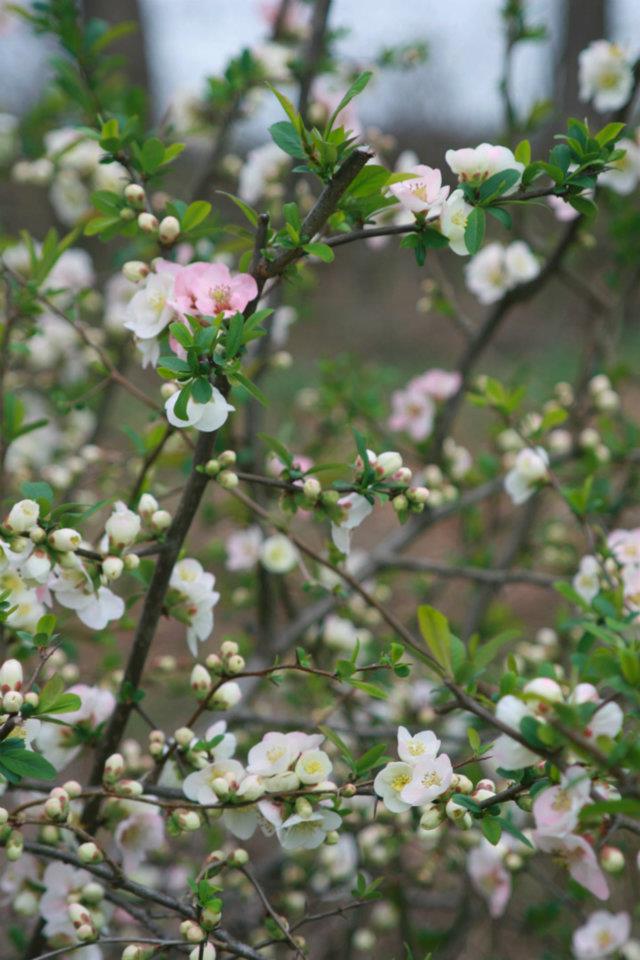
quince blossoms

~

© 2008 Ann E. Michael

~

Waiting, in the place I call home, for spring.

Endemophilia, toponesia, psychoterric states

Thanks to poet Annie Finch, I came across a thoughtful essay in Aeon magazine–an exercise in synthesis and interdisciplinary thinking that connects with Naess and his notion of ecosophy; and with Bachelard and others whose work I have lately been reading and thinking about. Liam Heneghan combines ecology, botany and topography with Winnie-the-Pooh and explores transience and trans-placement from several viewpoints. He looks at how so many of us are transplants, foreign “invaders,” culturally and biologically, and asks us to think about how we feel about place–home-place, in particular.

Not all of us connect with the concept of a home-dwelling anymore; but if we do so, that place is generally closely associated with childhood, observes Heneghan. He cites environmental philosopher Glenn Albrecht and says:

…we do not yet have an adequate vocabulary to address our ‘psychoterric’ states — or how the state of the Earth relates to our states of mind. To balance the negative psychological state of ‘nostalgia’, a couple of years ago Albrecht proposed ‘endemophilia’ (the sense of being truly at home within one’s place and culture — or ‘homewellness’). To balance the term ‘topophilia’, a love of place, Albrecht opposes ‘solastalgia’ — the desolate feeling associated with the chronic decline of a homescape. Solastalgia names the emotions we have at the loss of species and habitats through climate change and other environmental changes. We should all expect a lot more of it.

I do know those feelings, and I feel happy to have terms for them! Yet I argue that we do have an adequate vocabulary for how the state of the Earth relates to our states of mind, and that vocabulary is artistic. I believe the finest expression of these kinds of emotional-memory sensations can be found mainly through art. My task for myself in the coming weeks is to gather a few examples of endemophilia, solastalgia, and other “psychoterric states” in poetry. I’ve already got a few in mind.

Please read Heneghan’s essay if ecopoetics or the notion of homescape appeals to you.

Introversion as character?

Holy pop-psychology, Batman! Introverts are asserting themselves all over the place! At least, you might think so based on current media trending. There was that insightful and rather humorous  2003 article called “The Care and Feeding of Your Introvert” in The Atlantic magazine. More recently, Susan Cain has brought us the book Quiet: The Power of Introverts in a World that Can’t Stop Talking. When popular culture embraces an idea, parodies and simplifications and misinterpretations spawn in the stream of cultural consciousness. Some of these are charming, such as Dr. Carmella’s Guide to Understanding the Introverted, with its hamster-ball analogy. Mostly, the chatter masks any actual usefulness of categorization. Categorization as a method of understanding has had its pros and cons going all the way back to that master of the process, Aristotle.

Batman is copyrighted by DC Comics

Batman is copyrighted by DC Comics

Recently, I’ve been participating in discussions, virtual and face-to-face, around the topic of introversion and extraversion as personality or character traits, and the value or lack of value of the categories as well as the definitions of these words. Popular culture, which perhaps ought to be called majority culture, as usual flattens and simplifies the concepts. “Introverts” are shy and quiet, “extraverts” are sociable and talkative.

Or not. The current psychological meaning of introvert is based on the work of Isabel Briggs Myers and her colleagues and means, broadly speaking, a person “predominantly concerned” with his or her interior thoughts or sensations and less concerned with “external things.” An extravert (sometimes confused with the non-psychological, more general term extrovert), by contrast–naturally–is more concerned with life’s “practical realities” and gains more gratification from what is outside the self.

A friend of mine recently blasted the Myers-Briggs type indicator assessment as being responsible for promoting stereotyped ideas of introverts and extraverts and claimed the assessment is worthless (she used an earthier term). I don’t agree that Myers-Briggs is worthless; like any assessment tool, however, it cannot provide anything more than a snapshot of a personality. It can provide useful insight when combined with careful observation, professional knowledge, and other methods of determining character and personality. Just because Myers-Briggs is probably the most-applied or most-trusted personality assessment tool in the world does not mean it is always accurate or can be interpreted by laypeople…or even by experts. Brief forms of the test online are just that: brief forms, less complex, and therefore–as human beings and the mind and consciousness and personality are exceedingly complex–considerably less reliable as to results.

Then there is the whole concept on which the test, and others like it, are based. Carl Jung posited the notion of two dichotomous pairs of cognitive functions operating in the human psyche, and the test is derived from his initial explorations concerning those dichotomies. Well, that works–if you are a dualist. Not all of us buy into the categorization program, and many skeptics suggest that the world is far more interesting than just pairing opposites can explain.

Yin-Yang

I love the idea of harmony the taoist symbol represents, but my sense of the universe’s fractal and relational saved-from-chaos-by-a-thread “reality” tells me things are not that simple. We simplify them to attempt understanding at the human level, but oversimplification leads to stereotypes and fallacies, outcasts and enemies. Introverts and extraverts can face off and talk about how different they are; but Jung and Myers would remind us that these “types” exist on a continuum, despite the dichotomous origin of the concepts. Some people test out right near the middle of the two; some are only partway between the extreme ends of their type. Furthermore, how one defines these terms makes a big difference in how the types are perceived…and people do change as we develop along our own continua.

My father was an early proponent of the Myers-Briggs assessment and has administered the test to me three times (when I was 17, about 26, and in my late 30s). As I matured, my introversion factor changed slightly. Of course, I could have told him that without the test! I had more time for daydreaming at 17, and fewer external responsibilities. By the time I was nearing 40, I had to deal with some significant external realities: my young children and all the practicalities of external life that child-raising entails. The other aspects the indicator assesses changed a bit less, but there was movement; human beings are not stone carvings, and even stone carvings wear down, break, and change.

My own definition of what it means to be an introvert is that I “recharge” best when I am alone or with another person who is quietly reading or walking or daydreaming alongside me. I do not like being lonely; loneliness can occur even when surrounded by society, however, and solitary hours aren’t necessarily accompanied by a sense of loneliness. After spending a day at work, talking with students and colleagues–activities I enjoy–I need to go up to my room and get out of my work clothes and unwind without immediately chatting about my day. Parties can be fun, but afterwards, I need to spend a little time by myself. Concerts and tourist-clogged beaches can overwhelm me, yet that doesn’t mean I find no joy in attending them. I just need to pad the experience with some quiet time before and afterwards. Some of my family members, though, feel drained when they are quiet for too long. They recharge by socializing, or by making and doing things (ah, those “practical realities”!).

I was considered shy as a child and adolescent, but few of my current friends would say that shyness is one of my most obvious characteristics. These things are matters of environment and perception, not merely of some implacable temperament. In fact, I have several friends who appear much “shyer” than I am but who are extraverts, because they feel a sense of increased energy after social interactions or going to concerts or cities, whereas I need to retire, book in hand, to my quiet chair for recuperation. Ask anyone who knows me and you’ll learn that I love to talk and can be quite gregarious. Sometimes. And after awhile, my need to transmit and receive sort of slows down. After that, I don’t need to have anyone attend to me, converse, or ask me if I need anything. I don’t need interaction anymore–I’m like a cellphone nestled in its charger.

Even a cellphone needs a few minutes when no one is talking. That doesn’t negate its role as a conduit for communication, does it? As any reader can tell from this blog, I am concerned with “interior” thoughts and sensations but speculate on and relate these thoughts to the wider world, which is also my main impetus for thinking these thoughts in the first place.