Concerning the apostrophe

I am not the sort of English enthusiast who makes a habit of ranting over bad grammar. I often feel annoyed at egregious errors; occasionally I go as far as to say “it drives me crazy when (insert common grammar mistake here),” but I understand that living languages change. Evolution is not just for finches, and stasis  cannot be maintained in a complex system of human communication when technology and society and culture constantly create and destroy not only our environments but our methods of communication. Communication takes many forms and reflects the influences of many stresses, common usage being foremost among them.

Common usage may be verbally-based or textually-based or may depend upon references to popular culture or recent history, and it alters language whether we want it to or not. This fluid, flexible aspect of language fascinates me. As a poet, I relish it. As a teacher, I have to allow for compromise now and then.

I am willing to predict, for example, that very soon the accepted pronoun for words such as everyone and anybody is likely to be “they.” The reference was acceptable to Jane Austen and her writing peers, then went out of fashion in the Victorian era, when “he” became the norm–the word “he” is singular, as anyone is; thereafter, educated writers and orators used “he” for the nonspecific singular antecedent.

Of course, such use omits half of the population. Non-gender-specific writing employs “he or she” as the correct pronoun for words like someone. That usage leads to many a tortuous sentence, however. I generally advise my students to change the antecedent noun to a plural form whenever possible and to keep “they” as the pronoun; yet almost all newspapers, many news journals, popular magazines, and certainly most of whatever text appears on the web now employs the pronoun “they” for nonspecific antecedents. I don’t really have a problem with that–Jane Austen was able to make it clear enough whom it was she meant by “they.” Clarity’s what matters.

I do have a beef with the misuse of apostrophes, though. The apostrophe I’m talking about is a punctuation mark, not the poetic apostrophe which addresses someone or something absent or metaphorical. I mean the little superscript mark  that is used for two main reasons:

1. To note an elision (the omission of letters)

2. To indicate the possessive case (barring the silly exceptions hers, theirs, ours, yours and its)

I understand the why behind a noticeable uptick in the number of times apostrophes go missing these days: texting, tweeting, and other shortcuts employed in social media communication. My students are vague about the comparatively simple rules of when to use the apostrophe largely because they never bother using it when they text one another. Furthermore, their customary “proofreader,” SpellCheck, doesn’t always alert its users to this type of error. Computer programs can recognize that dont is not a word, but cant means “sanctimonious talk” or, alternately, a tilt or slope (says Merriam Webster). It is a useful word, but it is not the elision for the word cannot. Furthermore, SpellCheck won’t (elision for will not; wont means habit or custom) be able to correct the typist who uses the wrong form of your/you’re or its/it’s.

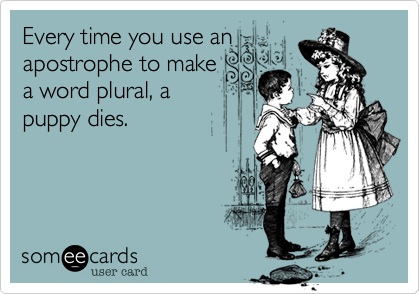
Irksome, yes. But most mystifying to me has been the ridiculously frequent use of the apostrophe to indicate the plural. Surely no one is teaching our second graders to pluralize by adding ‘s to the end of a word. (Teachers who do so should have their certifications revoked!) Recently, when working with a student, I learned one reason this mistake crops up so often in my students’ papers: AutoCorrect. When the typist gets sloppy and tries to add an s to a word that takes a different ending for the plural form (puppy, puppies), AutoCorrect defaults to possessive case. The computer is too dumb to detect the difference, because this is English, and English is damned difficult.

I suppose another reason may be character limits for tweets and texts, but that seems less likely. If people don’t bother to use the apostrophe for elisions, why bother for plurals? “Susie got 2 puppys” conveys the same information just as incorrectly.

Proper use of the apostrophe in English is actually pretty simple–even though computer programs cannot quite figure out the two rules above–and clears up a host of potential ambiguities and misunderstandings. The world could benefit from communication that isn’t studded with misunderstandings.

The warning below is one I use with my students. Sometimes, it even has the effect of becoming a useful reminder. Many thanks to the anonymous teacher who posted it on someecards.com.

puppy dies•NOTE  [Alas, just to complicate things, some editorial styles use the apostrophe to indicate plurals, but ONLY for letters or numbers, as in: “There are four 6’s in this statistical table.”]

I celebrate myself…

April is National Poetry Month in the USA, and I begin the month with Walt Whitman’s famous phrase and will attempt to duplicate the joyous urgency of his call to celebration. That means I am going to try to post just a little more frequently in April.

Poetry month began this year with a wonderful act of creative largesse on the part of a friend who sent me a poem…dedicated to me. Receiving a gift like this one is humbling; and it has been quite a long time since anyone’s written a piece for me. David Dunn, to whom my collection Water-Rites is dedicated, wrote a few poems for me or inspired (indirectly or directly) by our friendship or my family and surroundings. But he died over a decade ago, and since then I suppose I have had to learn to celebrate myself.

Not that this is a bad thing–celebrating the self–but for some of us it presents certain cultural or psychological obstacles. In this, Whitman has been an important teacher for me. As a great observer, loafer, lover of the world and all its beings, he was able to include himself among the beloved. My background, Protestant, agrarian, modest, surrounded by the biblical entreaty to remain always humble before God, combined with a natural shyness, means that I have had trouble admitting of self-celebration in any form and under any circumstances. I don’t take praise comfortably. The left hand shouldn’t know what the right hand is doing.

However, Whitman seems contented in his skin and in his world and follows a different parable as model: he does not hide his light under a bushel.

Walt Whitman in mid-life

Walt Whitman in mid-life

Furthermore, his passion admits of compassion and of aesthetic appreciation for all of the “Kosmos.” Each breath, scent, texture, color, hue, person, idea, object, sentient or non-, living or inert or dead long-past or recently, religious or scientific or imagined comes to life in language through line, syntax, lists, descriptions, words. I think there is a hint of zen-like acceptance in Whitman’s most lasting poetry, the vulnerable willingness to accept all that we experience and to do so non-judgmentally.

Thank you, Beejay, for the poem. I feel inspired anew. And as I celebrate all poets and the valuable, irreplaceable, gorgeous, ancient art of poetry this month, I shall endeavor to embark upon the celebration of myself (davening to ol’ Walt with humble pleasure). Therefore, a reminder:

My book Water-Rites is still in print, and Brick Road Poetry Press sells it (as does Amazon.com, where poetry-lovers can purchase the book in e-book form for Kindle). Dawn Leas reviews it at Poets Quarterly this month. Click for the link here!

May April be full of revelations in the form of poems for you.  water-rites by Ann E Michael

Endemophilia

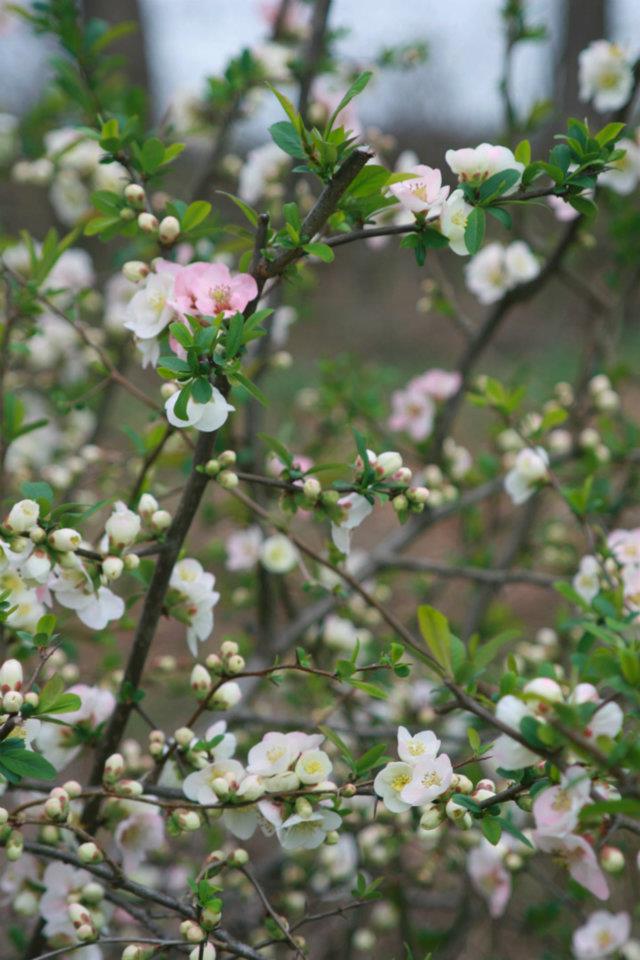
This poem is sort of my version of endemophilia, describing (as Albrecht defines it) “the particular love of the locally and regionally distinctive in the people of that place. It is similar to what Relph … called “existential insideness” or the deep, satisfying feeling of being truly at home with one’s place and culture.” You might want to check out Glenn Albrecht’s site for more detailed definitions and philosophical/psychological reasons for inventing names for such concepts.

My long-poem in Water-Rites, “The Valley, the Whitetail: A History,” probably fits the term endemophilia more closely than the poem I’ve posted below–which may one day appear in print if I can find a publisher for my next manuscript. But the long-poem is a little too long for a blog post.

[I have an idea: buy a copy of Water-Rites from Brick Road Poetry Press, and read it there!]

~

Suburban Georgic

A mild day in February. Good chance
there’ll be more snow or ice. Walk slowly,

note the footprint of a hosta, dormant, or
the arrow-shaped deer hoof in hardened soil.

Look more closely for the ravages and burrows
of rodentia—woodchucks, voles and mice.

You may discover where squirrels have
hidden seeds or laid waste to crocus corms—

try to restrain your wrath. Decide
how best to counter such yearly looting;

strategy keeps the mind sharp. Grubs,
for instance, in your lawn—a different tack,

and this year you may succeed, and keep
the skunks from rooting through the grass.

Weigh, in your mind and pocketbook,
the relative costs of pesticide and herbicide.

It might be the year to go organic,
though there’s even odds the dandelions will thrive.

Ease your troubled breast from lawn woes.
Raise your eyes to forsythia, to witch-hazel,

observe critically the shrubs’ bare bones,
decide what needs the kindest cut,

find your saw and pruners, time to oil
and sharpen—your fingers itch—

but it’s a little soon. To assuage your
yearning, cut back the redtwig osier

so its new growth will flush crimson.
Consider forcing blooms indoors—

aren’t there soft, small swellings on
the slim wands of pussywillow?

When the next storm hits, dream of columbine
and narcissus. Get out your Horace, and wait.

ann e michael

quince blossoms

~

© 2008 Ann E. Michael

~

Waiting, in the place I call home, for spring.

Endemophilia, toponesia, psychoterric states

Thanks to poet Annie Finch, I came across a thoughtful essay in Aeon magazine–an exercise in synthesis and interdisciplinary thinking that connects with Naess and his notion of ecosophy; and with Bachelard and others whose work I have lately been reading and thinking about. Liam Heneghan combines ecology, botany and topography with Winnie-the-Pooh and explores transience and trans-placement from several viewpoints. He looks at how so many of us are transplants, foreign “invaders,” culturally and biologically, and asks us to think about how we feel about place–home-place, in particular.

Not all of us connect with the concept of a home-dwelling anymore; but if we do so, that place is generally closely associated with childhood, observes Heneghan. He cites environmental philosopher Glenn Albrecht and says:

…we do not yet have an adequate vocabulary to address our ‘psychoterric’ states — or how the state of the Earth relates to our states of mind. To balance the negative psychological state of ‘nostalgia’, a couple of years ago Albrecht proposed ‘endemophilia’ (the sense of being truly at home within one’s place and culture — or ‘homewellness’). To balance the term ‘topophilia’, a love of place, Albrecht opposes ‘solastalgia’ — the desolate feeling associated with the chronic decline of a homescape. Solastalgia names the emotions we have at the loss of species and habitats through climate change and other environmental changes. We should all expect a lot more of it.

I do know those feelings, and I feel happy to have terms for them! Yet I argue that we do have an adequate vocabulary for how the state of the Earth relates to our states of mind, and that vocabulary is artistic. I believe the finest expression of these kinds of emotional-memory sensations can be found mainly through art. My task for myself in the coming weeks is to gather a few examples of endemophilia, solastalgia, and other “psychoterric states” in poetry. I’ve already got a few in mind.

Please read Heneghan’s essay if ecopoetics or the notion of homescape appeals to you.

Introversion as character?

Holy pop-psychology, Batman! Introverts are asserting themselves all over the place! At least, you might think so based on current media trending. There was that insightful and rather humorous  2003 article called “The Care and Feeding of Your Introvert” in The Atlantic magazine. More recently, Susan Cain has brought us the book Quiet: The Power of Introverts in a World that Can’t Stop Talking. When popular culture embraces an idea, parodies and simplifications and misinterpretations spawn in the stream of cultural consciousness. Some of these are charming, such as Dr. Carmella’s Guide to Understanding the Introverted, with its hamster-ball analogy. Mostly, the chatter masks any actual usefulness of categorization. Categorization as a method of understanding has had its pros and cons going all the way back to that master of the process, Aristotle.

Batman is copyrighted by DC Comics

Batman is copyrighted by DC Comics

Recently, I’ve been participating in discussions, virtual and face-to-face, around the topic of introversion and extraversion as personality or character traits, and the value or lack of value of the categories as well as the definitions of these words. Popular culture, which perhaps ought to be called majority culture, as usual flattens and simplifies the concepts. “Introverts” are shy and quiet, “extraverts” are sociable and talkative.

Or not. The current psychological meaning of introvert is based on the work of Isabel Briggs Myers and her colleagues and means, broadly speaking, a person “predominantly concerned” with his or her interior thoughts or sensations and less concerned with “external things.” An extravert (sometimes confused with the non-psychological, more general term extrovert), by contrast–naturally–is more concerned with life’s “practical realities” and gains more gratification from what is outside the self.

A friend of mine recently blasted the Myers-Briggs type indicator assessment as being responsible for promoting stereotyped ideas of introverts and extraverts and claimed the assessment is worthless (she used an earthier term). I don’t agree that Myers-Briggs is worthless; like any assessment tool, however, it cannot provide anything more than a snapshot of a personality. It can provide useful insight when combined with careful observation, professional knowledge, and other methods of determining character and personality. Just because Myers-Briggs is probably the most-applied or most-trusted personality assessment tool in the world does not mean it is always accurate or can be interpreted by laypeople…or even by experts. Brief forms of the test online are just that: brief forms, less complex, and therefore–as human beings and the mind and consciousness and personality are exceedingly complex–considerably less reliable as to results.

Then there is the whole concept on which the test, and others like it, are based. Carl Jung posited the notion of two dichotomous pairs of cognitive functions operating in the human psyche, and the test is derived from his initial explorations concerning those dichotomies. Well, that works–if you are a dualist. Not all of us buy into the categorization program, and many skeptics suggest that the world is far more interesting than just pairing opposites can explain.

Yin-Yang

I love the idea of harmony the taoist symbol represents, but my sense of the universe’s fractal and relational saved-from-chaos-by-a-thread “reality” tells me things are not that simple. We simplify them to attempt understanding at the human level, but oversimplification leads to stereotypes and fallacies, outcasts and enemies. Introverts and extraverts can face off and talk about how different they are; but Jung and Myers would remind us that these “types” exist on a continuum, despite the dichotomous origin of the concepts. Some people test out right near the middle of the two; some are only partway between the extreme ends of their type. Furthermore, how one defines these terms makes a big difference in how the types are perceived…and people do change as we develop along our own continua.

My father was an early proponent of the Myers-Briggs assessment and has administered the test to me three times (when I was 17, about 26, and in my late 30s). As I matured, my introversion factor changed slightly. Of course, I could have told him that without the test! I had more time for daydreaming at 17, and fewer external responsibilities. By the time I was nearing 40, I had to deal with some significant external realities: my young children and all the practicalities of external life that child-raising entails. The other aspects the indicator assesses changed a bit less, but there was movement; human beings are not stone carvings, and even stone carvings wear down, break, and change.

My own definition of what it means to be an introvert is that I “recharge” best when I am alone or with another person who is quietly reading or walking or daydreaming alongside me. I do not like being lonely; loneliness can occur even when surrounded by society, however, and solitary hours aren’t necessarily accompanied by a sense of loneliness. After spending a day at work, talking with students and colleagues–activities I enjoy–I need to go up to my room and get out of my work clothes and unwind without immediately chatting about my day. Parties can be fun, but afterwards, I need to spend a little time by myself. Concerts and tourist-clogged beaches can overwhelm me, yet that doesn’t mean I find no joy in attending them. I just need to pad the experience with some quiet time before and afterwards. Some of my family members, though, feel drained when they are quiet for too long. They recharge by socializing, or by making and doing things (ah, those “practical realities”!).

I was considered shy as a child and adolescent, but few of my current friends would say that shyness is one of my most obvious characteristics. These things are matters of environment and perception, not merely of some implacable temperament. In fact, I have several friends who appear much “shyer” than I am but who are extraverts, because they feel a sense of increased energy after social interactions or going to concerts or cities, whereas I need to retire, book in hand, to my quiet chair for recuperation. Ask anyone who knows me and you’ll learn that I love to talk and can be quite gregarious. Sometimes. And after awhile, my need to transmit and receive sort of slows down. After that, I don’t need to have anyone attend to me, converse, or ask me if I need anything. I don’t need interaction anymore–I’m like a cellphone nestled in its charger.

Even a cellphone needs a few minutes when no one is talking. That doesn’t negate its role as a conduit for communication, does it? As any reader can tell from this blog, I am concerned with “interior” thoughts and sensations but speculate on and relate these thoughts to the wider world, which is also my main impetus for thinking these thoughts in the first place.

Associating with allusions

Human beings use the power of association to create art; indeed, without association, it would be difficult to create or even to learn anything at all. Paolo Friere observed that all true learning is based on previous experiences and associations; Pavlov, in a different field, established the same thing while experimenting with instinctual responses. In literature, in the poem especially, the art of the work depends upon associations. The writer makes cultural, historical, linguistic and personal references and allusions, establishing imagery based upon place, time, art, experience, event. How would metaphor, or simile, operate without prior knowledge and associative power? Allusion’s a crucial tool for poets.

In his textbook/anthology To Read a Poem, Donald Hall notes that allusions can, however, be problematic in poems and may “act as a barrier to understanding.” Indeed, a common criticism in poetry workshops is that an image, word, or allusion is obscure. Such critiques often center around an indirect reference that readers “don’t get.” A poem no one can understand or appreciate is certainly a failed poem, but what if the failure is the fault of the reader’s lack of experience or education? Is the poet to blame for being elitist, or is the reader to blame for his or her innocence? What if the allusion is based on something integral to the author’s perception of life and is meant to further the understanding of the piece, not to build barriers? How is a writer to judge whether or not an allusion is working in the poem?

Let’s back up a bit and start with a definition: an allusion is simply an indirect, but meaningful, reference. It is not the same as writing a poem based on a quote or news article; not the same as direct referencing in a line, stanza or epigraph. It is not a symbol—it does not stand in for anything, merely points indirectly at an experience. Because of its indirectness, allusion operates on a more complex level than does other imagery; and because of that complexity, allusions deepen meaning. A good allusion works on several levels, dependently and independently.

But an allusion is also meant to be understood. Robert K. Miller, in his textbook The Informed Argument, defines allusion as “an unexplained reference that members of an audience are expected to understand because of their education or the culture in which they live.” That expectation—and the assumptions that go with it regarding culture and education—has the potential to make an allusion into a sandpit of obscurity. Yet great poems avoid getting mired. Great poems work even when history has intervened and allusions have been lost: one can read The Inferno with notes and explanations about politics in the city-states of medieval Italy and Biblical references; or one can read it naively uninitiated and still find it to be a fabulous, weird narrative, a guided anti-quest. The uninformed reader has lost some aspects of the poem (perhaps its irony, its parodies of important men, etc.). The uninformed reader has not lost everything in the text, however. He or she does not return impoverished from a reading of Dante by any means. The art is still in the poem, the narrative, the craft, the intention. In a good poem, the poet’s point of view and range of experience can transform the reader’s experience.

il_fullxfull.369385736_ddho

What if the contemporary writer’s experience includes a love of Ovid, a familiarity with Hindu cosmology, or twenty years as a coroner? Educated readers of a century ago would have caught allusions to Greek and Roman classics, but that’s less true today (a fact that has not stopped Billy Collins or Anthony Hecht from employing classical allusions or references, however). I’ve recently had students who were not able to recognize allusions that referenced Shakespeare, Wordsworth or the Bible. While this is dismaying to me as a teacher, it has not interfered with these students’ ability to enjoy—and understand—poems by such writers as Collins, Glück, Pastan and others: poems containing allusions to literature, history, art, and experiences beyond these readers’ ken. A good poem alluding to a coroner’s working knowledge of the body and its various means of demise (without directly referencing or explaining this knowledge) would certainly pique my curiosity, and that of my students. Maybe it is difficult to get the news from poems, but through poetry we can expand in other ways.

Besides, people read to learn, and each unfamiliar reference or allusion offers the chance to further that learning. Why bother to tell people what they already know? In my own experience, poems have led to the dictionary, the encyclopedia, to libraries, art museums, philosophers, scientific theories, and to other poems. Granted, I am the sort of reader willing to do that extra work; and this points out that deciding whether or not to use an allusion entails a couple of decisions. Who makes up the audience for a poet or poem? That’s the issue Miller addresses in his definition of allusion—who’s reading, and what experiences and education these people have access to. The recent interpretations of Wordsworth’s language of the “common man” have on the one hand encouraged accessibility in contemporary poetry but have also led to some ridiculous directives in poetry seminars. (Example: A student of mine was told by a conference instructor never to use the word “vermillion” in a poem because “people won’t know what it means.” While there are poems in which “red” is a better choice than “vermillion,” there are certain styles and subjects in poetry that benefit by the use of the “more obscure” word). The second question a writer must ask is: does the poem work even if the reader misses the allusion?

The first question is intellectual and is less important than the second one—but it can help the writer decide whether to keep the allusive image/phrase or to direct-reference, clarify, footnote, or delete it. In a culture as overwhelmed with media as our own, even contemporary allusions can be missed (what if your readers don’t watch commercial television? or keep up with CNN? or know what blogging is?), let alone well-considered indirect references to, say, American life in the 1950s, composers other than Beethoven and Mozart, or most writers once considered essential to the “classic canon.” So it does help to know who your audience is. This is as true for allusion as it is for vocabulary choice in the poem.

The second question is absolutely necessary for the poet to ask, for allusion often arises spontaneously if it is deeply grounded in a writer’s experience. Because the poet’s experience drives the poem, a writer who is dissuaded from, or afraid to harness and use her experience, risks losing her investment in the work. While obscurity is also a risk, too much concern over being democratically accessible may result in what one of my students called “the dumbing-down of the poem” (a phrase which is itself a contemporary, political allusion). The condensed complexity of poetry is possible thanks in large part to the associative powers of allusion. Strange and surprising associations and metaphors and multiple, list-built associations evoke fresh responses from the reader through transformative acts within the poem. If no one “gets” the allusion, but readers still “get” the poem—if they do not stumble over the language or the images, do not lose the narrative or miss the overall meaning of the piece—the poem has surely succeeded: some kind of transforming language, some synthesized meaning that leaps out of and past the accepted denotations of words, has occurred.

If a reader comes along who does catch the allusion, that reader will have an enriched perception of the poem, a deeper insight into the writer’s inspiration and purpose. That’s how a reader can tell the chosen allusion works. And that’s how the poet can tell, too.
A great din

My friend Ann sent me this link to an NPR story on cities (Adam Frank on “The City as Engine”).

Frank closes on a note similar to Mumford’s closing chapter: “We live at a moment when cities are poised to become the dominant mode of human habitation on the planet. But we don’t yet know if such a mode can be made sustainable for more than a century or two.”

An earlier observation of his got my attention, however. He says–

There is a word that applies to the sound of cities which almost never gets applied to nature: “Din.” The din of cities heard on the rooftop as a rising wall of noise is a testament to the true nature of cities as engines of organization and dynamos of disorder.

The first time I became aware of this din of acoustic entropy, I was sitting across from Manhattan on the cliffs of Weehawken, N.J. It was night and the great city was blazing from horizon to horizon. Its low rumble of noise flowed like a breeze blown at me from a mile away across the dark river.

The reason this stopped me is that just a fortnight ago, I heard the word “din” applied to nature.

One of my nephews had just arrived for a visit. He’s been living at Oxford, attending school for several years at that ancient and venerable British institution; and he grew up in England outside of London in the suburbs (Buckinghamshire). My husband retrieved Max at the airport in the evening, and they arrived at our place past dark. We live in a semi-rural area of eastern Pennsylvania where we are surrounded by fields, meadows, woodlots, state roads, and the inevitable housing development. And it is August, a lively time for insect life.

As we unloaded my nephew’s luggage from the car and walked him toward the door, he stopped and looked about curiously. “What is that great din?” he asked, “Is it birds, this time of night?”

Din?

He was referring to the cicadas and tree crickets (and probably a few tree frogs and the occasional flying squirrel). I suppose they do make quite a racket, though we are accustomed to the noise–the ‘dynamos of disorder,’ as Frank would say. When we explained, he remarked, “Oxford is quiet. But I do realize it is its own peculiar world.”

Nice to know there are pockets of organization somewhere: no acoustic entropy at Oxford.

Nonetheless, I treasure our noisy regional denizens and prefer their din to the roar of motorcycles, trucks, and  cars that speed past on the state road, although those noises have their own associations and dynamics and perhaps charm…the way I still find the sound of trains appealing because it reminds me of my childhood summers at my grandparents, I can imagine there are people who associate the rumble of vehicles and the great acoustic roar of cities with pleasant things.

Here is a photo of a cicada. A colleague says they are “the ugliest bugs in the world.” This one doesn’t look so awful to me.

Din, discord, or music. Ugly or appealing. To each his or her own.


Here’s a link to the tree cricket–one of several American varieties:

black horned tree cricket

Language & teaching

I’ll be teaching a new crop of freshman writing students tomorrow morning. A thought lingering in my mind as I prepare myself mentally for the first classroom contact with these 17- to 19-year-olds concerns language, and an ongoing argument about its uses and origins. The argument is part semiotics, part linguistics, part sociological, part neurological, part cultural, part philosophical: what is the relationship between language and the human thought process? It’s sort of a chicken-and-egg question. Bruner, Goodnow & Austin, in 1956, characterized the two main theories at that time as “mould theories” in which language is “a mould in terms of which thought categories are cast” and “cloak theories” that hypothesize language is “a cloak conforming to the customary categories of thought of its speakers.”

In other words, does the language make us who we are/how we think (culturally), or does our culture make our languages reflect the cultures in which we live?

The famous Sapir-Whorf hypothesis theorizes that we experience the things we do, and speak about them to others in our community, because our language habits incline us towards certain interpretations. It is therefore a mold theory. Whorf wrote, in 1940, that “We dissect nature along lines laid down by our native languages.” Ie, if our culture values, say, coloration, our metaphors and cliches and descriptions would be largely based on color-values. In a more recent essay by David Chandler,* the author points out that this sort of interpretation of what language is can be interpreted in so relative a fashion that every form of linguistic communication, even with in a culture, becomes a kind of translation. Chandler finds this situation “problematic.”

Problematic, perhaps. But incorrect? I’m not so sure. It seems to me that our very individualist U.S. culture offers so many personal and sub-cultural perspectives that even everyday commerce and chit-chat involve constant translation. One of the most challenging things I have to teach to my students is how to understand what their college professors want from them, which is largely demanded in terms of a vocabulary that is not necessarily academic jargon but which is connotative in ways most incoming freshmen cannot know; they have seldom or never been exposed to that perspective. It is not part of their culture.

So does that make language a cloak or a mold?

Probably–as in most things–moderation serves best. The answer is not either-or, but a bit of both, because the human brain–and human culture–is so commodious and adaptable and complex. Chandler promotes “moderate Whorfianism.” That’s another one of those rather irritating academic –isms, but what he means is: “Meaning does not reside in a text but arises in its interpretation, and interpretation is shaped by sociocultural contexts.” This theory affects my role as educator even when I am teaching the introduction to academic writing and rhetoric class rather than some higher-level analysis course. More so, in some ways, because the introductory course is where students learn to question their socio-cultural assumptions as they read and write. I have to learn their slang, their habits, their leisure activities and distractions in order to make compelling analogies that work for them. They have to learn to transition into academic and business-world conventions from their peer-oriented and narcissistic teen environments.

It is a form of translation.

It is also an opportunity for new perspectives, for my students and for me. Wish us luck!

~

*David Chandler, “The Sapir-Whorf Hypothesis” UWA 1994 (from The Act of Writing)

Short books and re-reading

~

clockWhen life gets busy and over-scheduled, even an inveterate reader may find she has to give up some of her precious book time to life’s other adventures and responsibilities. Philosophy and meditation require enough time for reflective, slow thinking; a hectic week precludes such activities. Creative thinking gets funneled into problem solving of a more mundane and practical variety. Creative writing? It may have to move, temporarily one hopes, to a back burner.

Last week was one of those over-scheduled periods when I take advantage of brief, unscheduled minutes to read short books. The beauty of reading short books is that the best short books reveal depths upon re-reading–one of the beauties of poetry as well. And if those short books happen to be books of poetry? “More’s the better,” as my great-aunt used to say.

During my crazy week, I managed to read three short collections of contemporary poetry, all by poets with whom I am personally (if marginally) acquainted. All three books are wonderful: layered, varied, well-crafted, interesting, moving, refreshing, surprising reflections on and of modern life with enough empathy and reach toward the “universal” to keep the poems valuable beyond today’s context. All three books are going on my re-read list so I can study and savor them again later, yet each collection is vivid and entertaining enough to read when crunched for time.

~

Will Greenway’s 1999 collection Simmer Dim was published by University of Akron Press and offers the reader a travelogue to many places in the world without as well as the more interior worlds of memory, relationships, and reflection. Greenway writes in both free verse and in rhyme, which he employs so well it seems natural even in the informal diction his work often takes.

April Lindner’s 2012 collection This Bed Our Bodies Shaped was published by Able Muse this summer. The poems offer the sense of a personal speaker, suggesting intimacy that is revealed subtly through well-crafted lines and images of flowers, scene-settings, and  allusions from the classic to the modern (rock n roll). Lindner presents the woman’s perspective as individual, surprising, and non-stereotypical; when she writes about jobs, a lover, motherhood, or menopause, her observations are often quirky but wonderfully observed.

Elaine Terranova’s 2012 collection Dames Rocket was published by Penstroke Press. I love Elaine’s work, steeped as it is in the natural world, plausible and tactile, yet positively ascendant in tone. Her memoir-type poems evoke the kind of childhood that is fast becoming historical, and her awareness of that fact–the fact of aging–gives these pieces poignancy and occasional irony.

~

All three books are also available on Amazon.com. Or ask your librarian to locate a copy for you.

Confidence redux

“When discussing confidence, for instance, I ask first what this confidence thing is that people want more of…I theorize that confidence isn’t something you feel internally, but rather a trait others ascribe to you when you’re focused and comfortable with what you’re doing. So you don’t need more confidence. You need less of something you already have in excess: caring what other people think about you.”  ~Augusten Burroughs, in 29 July 2012 New York Times Book Review.

~

In a recent post, I mentioned Madeleine Albright’s definition of a good leader as a person who is “confident but not certain.” It occurs to me, after reading Augusten Burroughs’ comments, that U.S. society tends to confuse self-confidence with self-esteem. And that his initial question is such a good one: what is this thing called confidence? Why is it considered to be such an excellent attribute? (Why do so many people bemoan their lack of it, or explain their “failures” to an absence of it?)

Many recent articles on parenting and child-raising complain that “we” have given our children too much of it, but I think that’s the difference between self-esteem and self-confidence. One can develop self-esteem even when there is no reason for it beyond the natural narcissism of human nature. But let’s go with Burroughs’ definition that confidence is something assigned to us by others when we are not worrying so much about what they think.

We can just go about being fairly competent, and others will find us confident; and if they don’t, but we are not overly invested in what others think, we will still be displaying confidence. And how do we gain confidence? By trying and failing, and by trying and succeeding, and by learning about the world in the moment without a freight train of anxieties looming behind us at all times.

~

Herewith, a brief essay I wrote in 1995 that speaks, in some ways, to this idea of confidence.

Sticks

It’s the time of year when my brush pile gets enormous, and I am thinking about sticks. Late winter winds bring down boughs; I get out my loppers and pruners. I cut back the grapevines and later, the roses. I prune the deadwood out of viburnums and rhododendrons. When my children’s playmates come to visit, at the end of an hour at least one child is running around with a stick, building a secret door with pine boughs or poking garden soil with the end of a branch. Branches with foliage become fans, palm trees, wings, walls. Bare sticks are generally swords or longbows; but they can also be barricades, horses, banners. No child is ever bored who has a yard full of sticks.

Stick–it was one of my son’s earliest vocabulary words. I remember how, at 16 months, he wandered about the yard learning names for things. I had already taught him about litter when he started picking up cigarette butts and candy wrappers on the street: “No,” I said. “Litter. Dirty. Dirty thing.” Litter went into a trash can.

“Doorty,” he acknowledged, “Doorty ting.” Then a stick caught his eye, a twig smooth, slim, just the right size to hold in his chubby hand. He stooped, then looked up at me.

“Doorty ting?” he enquired.

“No, stick!” I laughed. He grabbed it and smiled eagerly, examined it and waved it in the air while exclaiming, “Teek! Teek!”

He toddled about gathering and discarding sticks, fascinated by each on in turn. I watched nervously as he started to walk down our garden steps. In each hand he carried a small stick, as if for balance. Steps were, for him, still a new obstacle to encounter in an upright position–I wanted to run over and grab his hand. But I was enormously pregnant at the time and running was out of the question. I didn’t even call to him, “Be careful,” fearing I’d break his concentration. I held back, taming the voice inside that reprimanded me–stop him, he’ll poke his eye out!

He reached the bottom of the stairs safely, looked back at me and, waving both arms, called, “Teek, Mama, teek!” I felt proud of his confidence in  his newfound abilities. I felt I could perhaps begin the long process of letting him go–just a little–to explore the world more freely, without my needing to be quite so protective.

My son still loves to play with sticks, to collect them. Sometimes when I see him hauling a great branch out of the brushpile I think of that April day six years ago and of the impact small events may have upon our lives. For that day was the first time I really recognized that the time had come to allow him to experiment with life in h is own way. And that I could safely let him start on that adventure.

It’s a small thing, to walk down steps unaided, grasping sticks. A small thing, but a basic one. The desire to hang on, the need to let go, the discovery of a careful balance–all these things begin early in our lives, and we seldom recall them. Yet they are as basic as sticks, as the first tools we learn to manipulate and use for all of our future imaginings.

~

photo ann e. michaelIt has been many years since I made those observations. And it is not so easy to step back, let go–allow children to make their own decisions, their own mistakes, to experience their own failures and allow them space to feel their own joys.

Raising children taught me a great deal I might never have learned otherwise. I’ve never reflected before on whether I was confident as a mother, but reading this old essay makes me believe that I was. Certainly, if Burroughs’ definition is accurate, I was “focused and comfortable with what you’re doing.” That’s how I feel when I am truly engaged with an experience–writing, teaching, gardening…

Uncertainties and failures abound. But so do successes.