Hope & meaning

Hope. Meaning. Zen?

I have been thinking about hope lately for a number of reasons, due in part to a conversation with a person of my acquaintance who feels very strongly that humans have destroyed the planet irreparably, that civilization is past the tipping point, and that what many people term Armageddon or apocalypse is not merely inevitable but near. One might say she has no hope for the future.

This woman is generous, creative, happy; she is a lively activist who advocates for artistic and social justice causes–even though she has no hope for the future. Why does she bother? She might serve as a real-life example for a philosopher’s thought experiment or dilemma on the self-interest theory.

She seems quite sane. I think she illustrates how hope and meaning differ.

Hope leans inevitably toward the future. It signals a desire for a circumstance we do not have and may never attain. Even when stated in the present tense, it indicates a temporal shift, an implicit recognition of a future: “I hope things stay exactly as they are” implies there is a risk of change.

Hope is related to faith, unprovable yet deeply felt, something in which we believe (against all rational proofs).

Meaning, however, has more substance. We do not believe in meaning, we discover it. Meaning is a found thing which acts upon us by allowing us to take action…meaningful action. Meaning is temporal in the sense that it takes place in time as we understand it. It possesses an unusual characteristic in that it needs no outcome even as it operates in real time in our lives. Meaningful existence keeps us moving, and when we lose life-meaning we are likely to feel even more devastated than when we lose hope.

My acquaintance lives her life in a meaningful way, doing things that nurture a sense of meaning in her life even though she is fairly certain the outcome of her actions will be negligible. Her purpose is to share with or add meaning to the lives of others, knowing she cannot rescue everyone or steer the earth’s denizens toward utopia.

She is one of the more contented and least-anxious people I know.

After mulling these ideas over, I found myself returning to an overly-familiar Dickinson poem on this topic, the one in which she calls hope “the thing with feathers”:

Hope by Dickinson.

Consider her metaphor. Hope flies; it can escape us. I have held birds and know from experience they are not easy to catch nor to maintain a hold upon. Hope flies into its future without us even while it blesses us with its singing. What have we got then, earthbound beings that we are? A wordless tune, something that comforts without asking for anything in return–if we accept the tune as comfort enough (and we may not).

Perhaps what keeps us going, really, is not hope but the dailiness of our small but meaningful pursuits. Dickinson writing even when no one was reading. Each of us accomplishing whatever seems necessary, art or baking, advocacy or gardening, regardless of result.

Chop wood, carry water.


Multi-booking

Ah, the pile of books at my bedside. And the ones on my desk at work. And the one I left by the living room sofa.

When I was a younger bookworm, I was resolute about reading, or devouring, one book at a time—often one book at a sitting, in those less-busy days. I cannot indulge myself in that sort of approach to reading anymore, however; I have learned to multi-book.

Some books lend themselves to multi-booking more than others. I do not think I could re-read The Brothers Karamazov while reading other texts. In fact, novels are the one form of reading that I still try to read with my former one-book-at-a-time method. Various forms of non-fiction, though, are terrific for book meshing. It’s amazing how sometimes a synthesis occurs in my mind while reading multiple, randomly-unrelated texts: a book on typography, a philosophy book, a brief treatise on tree-pruning, the biography of a writer or artist.

I can also read poetry collections severally and simultaneously. Diversity of style or subject matter doesn’t matter much; I read poems more or less individually, anyway, and then go back and re-read for a sense of the collection as a whole. The first read is one I can pick and choose from to get a sense of the style, craft, strategies, and tone of the poems. The second read I may approach more wholly, to get a sense of the poet. But first, I like to read the poems.

Something I can do while reading other poets’ work, as I would in a literary journal.

The diversity, the styles, the differing contexts…the books, the poems, the subjects seem to begin a discourse with one another that is often inspirational. Taking a walk after reading both Nabokov’s Lectures on Literature and a few chapters of an entomology textbook resulted in my poem “Luminaries.”

Might I be interested in hearing a conversation between Whitman and Heaney? Sappho and Gregory Orr? Lorca and Kim Addonizio? Reading poetry puts them in touch with one another through their work and my imagination.

Sometimes, I still feel dismayed at how rarely I get the chance to curl up in a hammock or chair and allow myself the opportunity to plow through a book uninterrupted, undistracted. I have learned to adapt to other reading strategies, however, and have therefore never managed to stop gorging on books.

Which is all to the good.

Inspiration

The word “inspiration” is from the Latin inspiratio: to blow into, to inflame. I began musing on inspiration today while on a walk with Spouse and Dog, during which the idea of muse came up in conversation (with Spouse; Dog kept her own silent counsel). He observed that he had never had a muse and asked if I had ever had one. I said I cannot think of ever having a person serve as my muse, but perhaps other things have played that role.

“Isn’t a muse a person?” he asked. We discussed, then, the difference—as each of us saw it—between a muse and a mentor. He has had mentors at various stages of his life; I think most of us encounter someone along the way who serves as a sage, a guide, a teacher, or as a role model. That person certainly offers a kind of inspiration. A muse, however, seems to connote inspiration of a different character or quality from mentorship. The muse acts as trigger, someone or something whose mere presence elicits a creative urge. The muse inflames, blows on the spark of creativity and ignites it.

Richard Hugo’s book The Triggering Town is justifiably famous among creative writers, particularly poets, for its author’s sensitive explanation of a source for the creative process and his description of how inspiration percolates into the creative act. He uses the example of American towns that act as triggers for memories or conjure of specific details of place and personhood. The town becomes muse. In a similar way, works of ekphrastic poetry may employ art as muse (though not always). For other creative people, music provides that initial flicker of inspiration—which seems especially fitting, given the word “music” originates from the word for the Greek muses themselves: mousike techne “art of the muses” from mousa, “muse.”

Mousa itself derives from the ancient proto-indo-european linguistic base *mon-men-mn, most closely associated with the meaning “to think, to remember.” Inspiration, though we feel it emotionally, psychologically, even physically at times, takes us into our minds, where the creativity takes place and can be formulated into art.

Much of my inspiration over the years has come from what people tend to term “the natural world”—as if we humans were not a part of that. But other things spur my creativity, including art and things I read. Having finally completed Parfit’s Reasons and Persons, I am now consuming more easily-digestible fare and finding much to inflame my interests in Alberto Manguel’s 1995 book A History of Reading, which I highly recommend.

Perhaps I will later find time to discuss the joys and pitfalls of reading several books at once. Meanwhile, I plan to spend the last light of a late winter afternoon observing hawks and woodpeckers.

Kalliope or Calliope, Athenian-style, the muse of epic poetry.

Ratiocinatio

What ought I to be doing? Where do I really want to be? How shall I best spend my waking hours? Am I contributing to society? Do I want to? Does self-expression even matter? Is art important? If so, to whom, and why? What actions should I take? Can I ever justify my faith? Is there such a thing as hope? Is there a reason I’m not doing more with my time? Is there something valuable I am missing in my life? What do I want to do with myself from this moment on?

Is that all there is, my friend?

Discovering truths through a series of questions is supposed to be a rational, perhaps the most rational, way to approach the Big Questions. The rational truth-seeker ought not to stop at answers, even when the answers seem sufficient (logical).

The term for this method is, in rhetoric, ratiocinatio. Basically, it’s Socrates’ approach: keep asking. However, ratiocinatio as I understand the term does require more than just asking. It implies finding rational answers—or at least responses—to the questions. It also operates under the premise that the questions be rational…an idea against which the contrarian creative side of myself sometimes rebels. “Go ahead,” it urges, “Ask the nonsensical question!”

I invite you to ask the nonsensical question. It might be interesting to discover where this approach leads. Maybe even to…truth?

Texts

“Text” has taken on new meanings during the past 10 years or so, informally and formally. For one thing, in its techno-language sense, it has become a verb: “Text me later today.” It is a word that has likely undergone a huge uptick in frequency of usage in recent years.

Even in the realms of academe, “text” has for some time now been used to refer to things which are not, strictly speaking, texts: movies, advertisements, and art, for example. We can view archeological sites as texts, as palimpsests that layer one era upon another. Derrida offered us a method to using some of these concepts through deconstruction, “an effort to understand a text through its relationships to various contexts” (in a 1988 translation).

This post is not about deconstruction.

~

Context: it contains the word text (from the Latin texere, to weave; context, therefore: to join together, structure). When I tutor students in writing papers, I stress context. What are you writing about, what are your sources, what era, what place, which people or theories or machinations are involved? Give us a structure on which to layer your observations, research, or argument.

This post is not about composition or research papers, either. Well, not exactly.

~

What I want to write about—briefly, and perhaps more another time—is some old-fashioned texts recently unearthed from my parents’ house. My mother handed me a paper bag full of texts that includes letters I sent when I was a young adult living on my own for the first time, letters friends wrote to me and to my sister, high school transcripts, essays written my freshman year at college, poems composed in my junior year at college, as well as—amazingly enough—report cards not only from my childhood but from my parents’ elementary-school years and an essay my father wrote while he was a junior at Wabash College in, as near as I can calculate, 1953.
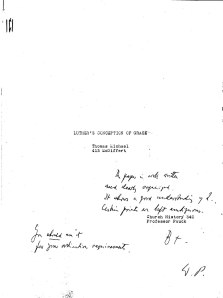
This last item fills me with a tenderness I find difficult to describe or explain. Typed on a manual typewriter I later used in my college years, on now-yellowed linen-content paper, stapled at the corner with four still-unrusted staples, “Luther’s Concept of Grace” is a 14-page essay for a class entitled Church History 340. The text on which his essay is based was Martin Luther’s A Commentary on Saint Paul’s Epistle to the Galatians from an anonymous translation into English dated 1575. The copy he read was published in London in 1830.

When my father composed this assignment, he was younger than my son is now. And my son seems so young to me as he wrestles with his own concerns about ethics and law and philosophical matters and moving on into adulthood. I imagine my young dad reading this 19th-century book, Bible beside him for reference (Gal. 2:19, etc.), wrestling with the theology Luther set forth in order to explain the complex relationship(s) Luther sees between faith and grace, or grace and law, or liberty and sin. My father wrote and revised by hand, taking notes, and—though he is an excellent typist—probably had to re-type several pages to be sure the final draft was error-free and that the end-of-page notes all fit. (Today’s students have no idea what a hassle formatting on a typewriter could be). He made one typing error, a stray “the” on page 7; Dr.  Pauck caught it, and also commented that though the paper is “well written and clearly organized…certain points are left ambiguous.”

I value my dad’s ambiguity on those points. Looking at the places in this text where his professor offered minor quibbles, I interpret that the writer was a young person who was eager to please but unwilling to accept doctrinal thinking without examination or, as may be, allowing some reasonable ambiguity. At one point, for example, my dad writes, “Luther has again come close to ascribing to grace a substantial status. But even though it must be felt, it is the feeling of an emotion…it is clear that relationships or states of being are meant, and not something substantial.” The professor faults him: “Is this the correct way of stating the matter?”

My father went on to pursue theology, pastoral care, psychology, and teaching; emotion mattered to him. At 21 years old, and in the context of an examination of Martin Luther, he didn’t know how to phrase the valuable emotional aspect of grace (substantial or not) he intuited as necessary. Perhaps Luther did not possess this characteristic—in fact, from my admittedly limited reading of his work, he seems not to have. My father does possess this trait.

I think what this text evokes in me is the awareness that he was who he is even when he was youthful and inexperienced and hadn’t read or learned a fraction of what he knows now. The context for this 60-year-old text matters to me personally in terms of its relationship to me and to the man who raised me, among other possible relationships tactile, historical, socio-cultural or otherwise, and—richly and often—ambiguous.

On Tolerance

Tolerance, as defined in the OED, means endurance, as of pain or treatments; it is also the tiny allowance of imperfection in coining or machinery, the acceptable out-of-round. But the term has become popular recently under its third definition, “freedom of bigotry or undue judgment upon the actions or behaviors of others.” It has indirectly become the target of people who complain about over-use of “politically-correct language.”

Tolerance is not one of the Virtues, but it tends to have a slightly virtuous connotation, sometimes with an irritating hint of self-righteousness. An acquaintance of mine said once, “Quakers! They’re so damned tolerant,” as if it were an attribute to be avoided by sparkling, sexy people who are analytical and quick to judge. I have known some mightily opinionated Quakers in my time and will attest that tolerant folks can hold strong opinions. The connotation of tolerance to mean somehow wishy-washy or evasive is an unfortunate one. And it’s wrong.

My parents taught tolerance. This was a necessary trait in a family full of passionate, witty, highly-opinionated and creative people. I learned that I could disagree with my sister completely and still love her and accept her point of view, even if I could never in a million years adopt her perspective. My father marched on Birmingham and Washington in the 1960s, and we learned that people who do not look like us are no less like us than our neighbors—and we learned to be polite to our neighbors, some of whose values and opinions we didn’t particularly care for, but whom we tolerated as members of the community. Tolerance is a component of empathy in two directions: empathy inspires in us the ability to practice tolerance of others, and the practice of tolerance itself enables us to feel empathy with others.

Without empathy, no altruism; without altruism, no society. Tolerance has an important place in human nature. The simplistic slogan “Teach tolerance” has value only if we can remove the negative slap-dash judgment of tolerance as some sort of liberal-PC value rather than as what it is, a practical behavior necessary for social interaction. Good manners, for one thing. And yes, that means that sometimes we must endure the psychic pain of listening to a person we desperately want to judge negatively, or bear with the person who is slightly “out of round.”

Practicing tolerance doesn’t mean giving up our own values, it merely forces us to withhold judgment a little longer than usual and to endeavor to discern, and acknowledge, another person’s perspective. Can we argue? Can we disagree? Certainly. Will we respect that perspective? Maybe not. But we can learn a great deal from the exercise.

Here is a poem from my collection The Capable Heart. Tolerance and an attempt to understand another perspective are not just for human beings. This poem looks at my daughter’s point of view, my own, and the horse’s. More broadly, the piece is about all of the things I’ve mentioned in this post—if that’s how my reader would like to interpret it. (Of course, I am ready to acknowledge other interpretations and perspectives!)

WAYS WE ARE ALIKE

I wanted a way to embrace
my daughter’s fascination.

To overcome my own fear, with carrots,
with a lead rope and a soft brush.

I touched the withers and the
warm, broad chest;

I held the lead. Let pulsing lips
explore my hands, my jacket.

The narrow nose stretched
under my fingers and

I rubbed the strong, shallow bone
above curious, sensing nostrils.

My daughter tells me the many ways
horses and I are alike.

They are beautiful, and
they understand fear.

Orri. Photo by Ann E. Michael

Why I read poetry

A few months ago, I posted a light-hearted look at mondegreens and malchichés. Clichés are useful to some extent because we believe we know what those phrases mean, and they serve the purpose of general communication. To confess “I’m feeling blue” can elicit compassion from a good friend, or help us to state a mood so that we might, possibly, move on from it. Popular song lyrics employ such figures of speech often, and often to good effect.

But clichés also leave something to be desired, don’t give a full enough account of the human situation. In the poem “Madame la Fleurie,” Wallace Stevens describes a man who looks into a mirror and believes what he sees depicts his actual life. But it is only a reflection; the image is “a page he found in the handbook of heartbreak.” A page in the handbook of heartbreak: that begins to express a more complex and specific feeling.

Poems can express every subtle shade of blue a person might feel. There is Emily Dickinson’s Hour of Lead and Elizabeth Bishop’s art of losing, Langston Hughes’ Weary Blues and Theodore Roethke’s desolation in immaculate places.  For thousands of years, poets have understood, and been able to convey, the vivid and expansive range of human emotions that our lively and energetic brains and souls experience—from unbearable grief to listless ennui, from a moment of surprising cheerfulness to the uplifting embrace of romantic or spiritual love. How poets accomplish this subtle connection between people, this empathy, amazes me. Especially as this mutual exchange of feelings takes place through the abstract medium of words.

This is why I read poetry. When a friend’s child died, I consoled myself with Ben Jonson’s words, “farewell, thou child of my right hand, and joy” and nothing else seemed as apropos, even though the poem was composed almost 400 years ago. When life gets tough, Andrew Marvel’s lines about how feeble hope has tinsel wings in the face of magnanimous Despair just about sum up my feelings. Such poems may offer little cheer, yet they can comfort. Through gorgeous language and imagery that is honest if sometimes fanciful, good poems remind us that we are not alone in our circumstances.

Poems identify feelings, places, situations, and allusions to which another human being—perhaps hundreds of years or thousands of miles away—can relate. That relationship has a wonderful effect, for poetry offers a way to connect the rich and complicated scope of our humanity with the lives and sympathies of others, especially during troubled times. I know that my own heart begins rebounding from stress and gloom when I read Neruda’s lines: “through me, freedom and the sea/will bring solace to my downcast heart.” As we navigate through political and economic and personal hassles, we might want to open a poetry anthology now and then, or call up a website such as A Poem a Day or Verse Daily for a fix of shared humanity in an increasingly virtual world. After all, “What the heart longs for,” says Gregory Orr, “the poem accomplishes.”

One person who has taken this poetry inspiration into the wider world is Nicelle Davis. Check out her year-long poetry project at The Bees Knees.

Yearning

For about as long as I can remember, my favorite Christmas carol has been “O Come, O Come, Emmanuel.”

Today, as I listened to an instrumental version scored in a baroque style, I had an insight as to why I have such fondness for the piece. Partly, the appeal is the antiquity of the tone: the carol is quite old, veni veni featuring in sacred songs as far back as 8th-century antiphons, though most sources I’ve checked cite the version we know as dating from the 12th-15th c.

Hence its minor key and simple “sing-ability.” I’m not a good singer myself, but I can sing this carol. The range works for most of us.

But that wasn’t what struck me this morning as the music surrounded me in my car en route to work. What I noticed—felt, in my marrow—is the sense of yearning in this carol. There is something particularly human in the minor-key longing for release, relief, joy, escape, liberty, union with a beloved other, desire that is both physical and spiritual, the yearning for renewal. Not hope but the desire, the longing for hope.

This sense resides in the tune itself, not just in the words of the carol whether Latin or French or English. “O Come, O Come, Emmanuel!” in the text I know best is translated by John Mason Neale and Henry Sloane Coffin, yet the heart-breaking anticipation this carol captures for me has less to do with the rephrasing of Isaiah than with the poignancy of the musical prayer it evokes in me. A sigh, a wisp of possible exultation that is not exactly a promise I can understand but which stays inside me waiting to be awakened.

For various reasons, that yearning for hope resonates with me this year. And always.

Ann E. Michael

Recitations

My brain still hurts, so I have decided to publish a radio commentary I did quite a few years back (for WDIY). If I can locate the mp3 file, I’ll post that, too.

I’ve chosen to post this essay for a number of reasons. The concept of having the time and the motivation to read, recall, and recite poetry seems like heaven to me at the moment. Then there’s the connection to rhythm, to pulse, that operates so fruitfully in metrical poetry. Finally, for sentimental reasons: it’s been ten years since my grandmother’s death, and now my parents have moved into an independent living community, and these events tend to lead to review, reflection, and—in my case—the desire to connect with poetry.

Recitations
to the memory of Lucille Bohnstedt

My grandmother was born in 1909. As a child, she lived on a small farm in the Midwest, rising early to do chores, after which she’d study her homework by kerosene lamp. I once asked her what subjects she most enjoyed in school, and her answers surprised me. “I liked doing sums,” she told me, “And Latin, and poetry—I always liked poetry.”

This was a revelation. My grandma always seemed such a practical person; I wondered what it was she liked about Latin and poetry. I was aware of her devotion to crossword puzzles—caught up in the crossword craze during the 1920s, she never gave up her love of solving word challenges. I’m sure her Latin helped her decipher many an obscure word. But puzzles involve a different part of the brain than poetry.

I love poetry, so I had to probe more, curious about what my grandmother had studied and learned in verse. Did she recall which poets she liked? No, she had pretty well forgotten, but she liked rhyme and recitation. She had been good at memorizing lines—she liked the rhythms. And those old poems, they told such good stories, some of them sad…

Recitations! Such an old-fashioned concept, but still very popular in the first two decades of the twentieth century. Schoolchildren stood at the head of the class reciting their pieces, and poetic ballads were popular recitations at community gatherings and amateur nights; heart-rending tragedies like Alfred Noyes’ “The Highwayman” (1906) were extremely popular. While most of these poems rhymed, their defining feature is the strong rhythm in the lines which carried listeners —who had never experienced the constant blare of television—into the powerful surge of words. Poems such as Wordsworth’s “Lines”:

Five years have passed; five summers, with the length
Of five long winters! and again I hear
These waters, rolling from their mountain-springs
With a soft inland murmur.—Once again
do I behold these steep and lofty cliffs…

Or Sir Henry Wotton’s ecstatic poem “On a Bank as I sat Fishing:”

And now all Nature seemed in love;
The lusty sap began to move;
New juice did stir the embracing vines;
And birds had drawn their Valentines…”

Many a schoolchild recited Emerson’s “Concord Hymn,” the fourth line of which has become so famous that few of today’s Americans could tell you its origin—

By the rude bridge that arched the flood,
Their flag to April’s breeze unfurled,
Here once the embattled farmers stood,
And fired the shot heard round the world.

The ballads of Edgar Allen Poe—Annabelle Lee was a favorite—and Phoebe Cary’s ballad of the Dutch boy whose finger stemmed a breach in the dike, and Longfellow’s classic poetic stories— “Listen, my children, and you shall hear/Of the midnight ride of Paul Revere…”—these were my grandmother’s texts, her introduction into poetry. I like to imagine my young grandmother milking cows in the darkness and murmuring “By the shores of Gitchie Gumee,/By the shining Big-Sea-Water,/Stood the wigwam of Nokomis,/Daughter of the Moon, Nokomis…” the sound of milk in the bucket echoing the rhythm of her hands as she milks. She earned an A in recitation from this practice. Maybe those resounding rhythms played some part in her steady endurance through a long lifetime that was not always easy.

My grandmother died in March of 2001, one less poetry-lover in the world. At her funeral I read Emily Dickinson’s “Farewell.”  This is the poem’s last verse—

Good-by to the life I used to live,
And the world I used to know;
And kiss the hills for me, just once;
Now I am ready to go.

~Here is a photo that shows Grandma’s less-practical side. She’s on the right (with her sister Faye), dressed in “flapper” style and riding side-saddle on a draft horse! I really ought to write a poem about this image.

Mondegreens and malclichés

According to Merriam-Webster, a mondegreen is:
a word or phrase that results from a mishearing of something said or sung [“very close veins” is a mondegreen for “varicose veins”]

A similar slip of the ear resulting in a mishap of the pen (or, more likely, keyboard) has been called “malcliché.” My teaching experience leads me to ascribe the uptick in these peculiar forms of malapropism to AutoCorrect and to a more aurally-based society. We have moved from ancient oral communication to text and back again to what we hear/see rather than what we read. As our media becomes a place where diversity abounds, the conventional structures of English–idioms and phrasings in particular–fall apart a bit as we speak with different speeds, different accents, and under different cultural, regional, rhetorical, and other authorities.

I have been collecting a few from student papers and from conversations I overhear. Yes, I eavesdrop–I’m a writer!

I supply a few here for your amusement and puzzlement, and as inspiration. A few of these phrases are potentially rich in imagery that’s strangely appropriate, such as “burning your britches,” “poor self of steam,” “rake him into the coals,” and “beg to defer.” I have successfully used mondegreens as poem prompts. I do not recommend using them in English comp papers, however, as they result in coffee spills produced by professorial giggles and rampant use of the red pen admonishing “sp” and “clarify!”

armed to the feet
above bored
stuck to me like a leash
all intensive purposes
board to death
buy the same token
queen of the crop
caught me on guard
don’t count your eggs before they hatch
a fool and his money are soon apart
give it a swirl
dead wait
leaving like flies
go out on a tree
grin and bare it
taking his name in vein
one fell sweep
in the nickel of time
hair-brained
last ditch effect
pearls before swans
unnecessary evil
no holds bard
on a role
past the buck
the past of least resistance
sharp as attack
he got just his desserts
what goes around must come down
on tender hooks
preaching to the chair
no ifs, ands, or butts
free rain