Script, postscript

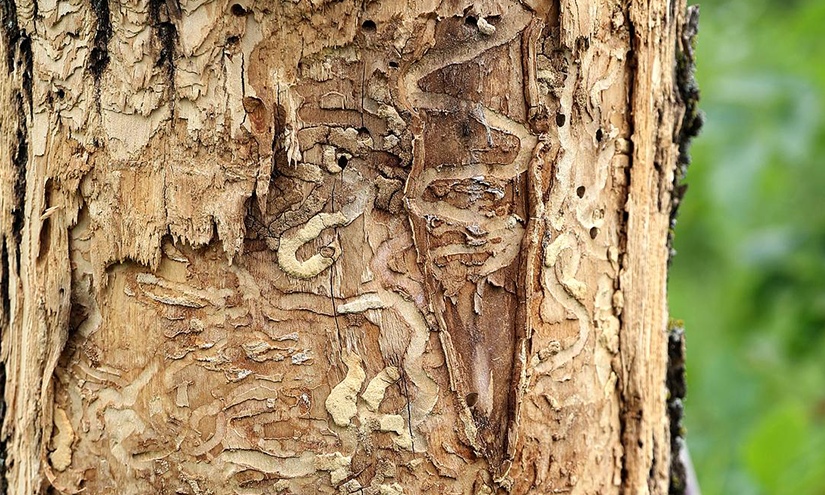
The weather has been glorious lately, which has the downside of getting rather droughty. No rain in the forecast, either, so it is time for supplemental watering if I want to keep harvesting from the vegetable garden. There’s not much left there, though; I may just wait things out and save the water. Meanwhile, some of our days have recently been punctuated by the sound of green ash limbs crashing in the nearby woods. When I investigate the trees, there are the telltale scribbles of ash borer on the trunks. The marks look like script.

I learned, while teaching college freshmen the past few years, that many younger adults do not know how to write or even to read script. Many children never get the lessons in handwriting in the second through fourth grades the way I did. Instead, they learn keyboarding–a skill I got to in my junior year of high school but never really have mastered (yes, even now I use a self-developed version that’s sort of an advanced hunt-and-peck method). It’s hard to believe that reading script is a task that will be relegated to specialists in years to come, but I shouldn’t be surprised if that’s what happens. To many of my college age students, handwritten script in English is almost indistinguishable from the marks of ash borers. They don’t see the need for that particular skill. Handwriting is going the way of letter-writing.

Perhaps we live in a post-script world?

I have been thinking about the handwritten word recently because of a recent incident while visiting my mother. She received a small refund check from an insurer, and though she understood what it was and that she no longer uses her checking account–we siblings take care of that through power of attorney–she was confused about what to do with it. “Sign it, Mom,” I told her, offering her a pen. “We’ll deposit it for you.” I turned the check over and pointed to the line for signature on the back.

She wavered, pen in the air. “I don’t…I don’t,” she said (her aphasia has advanced past the point of expressing full sentences). It took me a moment to realize that she could not recall how to sign her name. I placed my hand around hers and helped her start with the capital B.

I didn’t cry, but the experience hasn’t left me alone. I suppose there may be a poem in this incident, but if so, it’s a sorrowful one.

Book launch, travel, PR

Highland Park Poetry press has set up a book launch/poetry reading for The Red Queen Hypothesis (and me) with poet Rene Parks and an open mic to follow. This event takes place Saturday, September 9th at 5 pm, at Madame ZuZu’s, 1876 First Street, Highland Park IL. Here’s a link, and here’s another link. It’s a ways to travel from eastern Pennsylvania but a good reason for yours truly to visit a new place, meet new people–including the book’s publisher–and listen to other poets.

Too often, perhaps, I stay around the home front, indulge in my introversion by gardening and reading, and shy away from promoting my work. Lately, it’s been months since I did any submitting. There was my participation in the annual Goschenhoppen Festival, then a short but lovely week in North Carolina, camping and seeing friends. Now, the veggie season is starting to wind down–tomato sauce simmers on the burner–and I will have fewer excuses for why I am not sending out poems.

But my travel for the year is not quite done. In September there’s one more trip away from PA, and after that we can settle into autumn. I have writing plans, so once we return, I need to create a schedule that is flexible enough I can stick to it but framed clearly enough that it feels necessary and not difficult to integrate into my days and weeks. Every one of my writer friends knows how challenging that can be. Wish me luck. There’s a chapbook that’s been languishing in my desk area for quite a long time, but to which I’ve recently returned; there’s a ream of poems under 21 lines that might make up a collection, too. Then there’s the next manuscript, rather grief-heavy at present, that I need to re-think and revise.

Oh, and all those poem drafts I have not looked at in awhile…

Then there will be the next round of promotion, not just for RQH but for a collection for which I just signed a publishing contract! That book may be released as soon as April or May of 2024. We shall see. After the drawn-out publication wait for this last book, I will not be holding my breath. Still–it’s heartening news on the poetry front.

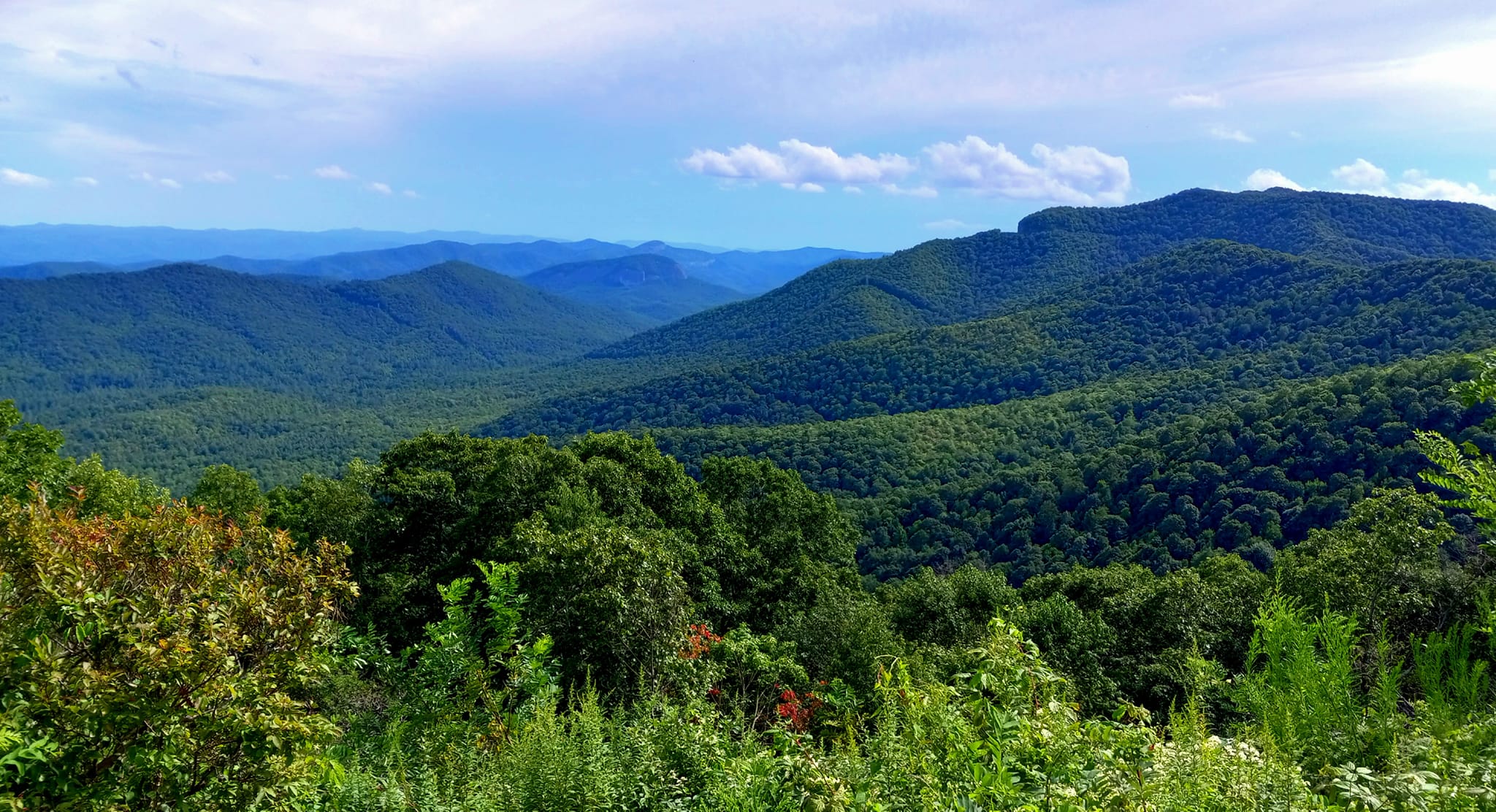
Above, Blue Ridge Mountains in August.

Classification

An admission: I’m barely competent at the promotional aspect of The Writing Life and would prefer to hole up in my house and garden and just… write. But writers need readers, and writers benefit by meeting other writers (and readers); and I’ve always been interested in learning new things, even things that are not particularly fun or that I am not naturally adept at. Such as educational learning management systems (ie, “portals”). Such as recording audiofiles of my poems. Such as contacting potential poetry-reading venues or reviewers. Or coming up with clever ways to let people know about my book.

I got a couple of responses from my initial forays, which is lucky. One of these sent me a sort of writer’s questionnaire about my book, and one of the responses I’m supposed to give is to say how I would classify my latest poetry collection. That got me mulling over the whole idea of categorization, classifying, and stereotypes. Genre–that’s easy. It’s poetry. But the sub-category of this book? uh…

~

At the beach earlier this week, we found a much-broken up rock jetty that teemed with creatures. As I sat back on my heels and peered into the mixture of sand-water-rock-mullosk-kelp, I found myself thinking about Aristotle’s immanent realism (epistemology/natural philosophy), ideas he likely nurtured while examining the tide pools of Lesbos. Or I imagine that he may have done so. We humans observe, and then classify or categorize based upon these observations: similarities, differences, various adaptations–in environment, habit, behavior, construction of the being or entity itself.

I think if I had known as a child and young woman that there was a career path called “a naturalist,” I would have pursued it.

~

Unclassifiable doesn’t strike me as much of a selling point. However, there are always art forms that are, to use a current term, intersectional or interdisciplinary, and creations that repurpose, alter, or reimagine the known or customary into something new and intriguing. Fellow blogger and talented poet and novelist Lesley Wheeler‘s books come to mind, as do works by Anne Carson and books from Coffeehouse Press and Tarpaulin Sky (among others).

My poetry is not experimental nor groundbreaking, though it is a little quirky; so here is my recent attempt to classify The Red Queen Hypothesis and Other Poems:

Touching on a range of topics and employing variety in poetic craft—free verse, metrical verse, rhyme, and classic forms—the poems in The Red Queen Hypothesis play with invention, science, and the environment of the everyday.  One example of these juxtapositions is the title poem: a villanelle, based on an evolutionary theory named for an episode in Alice through the Looking Glass, that sums up the corporate rat race. Sometimes tongue-in-cheek, sometimes disturbing, the poems urge readers to observe and to reconsider what is beautiful.

~

I dunno. Does that seem like a remotely interesting description?

(Really not adept at the promotional biz.)

Aristotle, supposedly.
from https://www.nytimes.com/2016/05/27/world/europe/greece-aristotle-tomb.html

Mindlessly

There are some necessary but mindless tasks that I’m good at and don’t mind doing. Weeding, for example (unless it’s raining, or disgustingly hot), or cleaning a bathroom. My morning chore today entailed removing staples that fastened carpet underlayment to the floor. There are dozens of these staples stuck in the subfloor, and most of them have bits of foam-like fabric wedged in them. The edges of the room are studded with tacking strips–annoying to remove when one is not a professional. Best Beloved and I did consider hiring someone to replace the floor, but since it is a job we can do ourselves…well, we have the time and are doing it.

There’s a difference between the mindless and the tedious. I don’t care for tedium; but a task I can mindlessly manage–something physical, but not too demanding, without a lot of surprises I need to problem-solve–those projects can be almost relaxing. When weeding, my thoughts can wander. The job is so familiar and repetitive that there is no need to devote much brainpower to it. Ideas, reflections, observations, images can float aimlessly in my mind. I can think about poems while weeding. Taking a walk in a woods or quiet countryside offers me the same sort of internal/external environment.

Proofreading was like that for me, back when I was a proofreader (when there were such things as proofreaders in every newspaper, type or print shop, publishing house, ad agency, and legal department). Editing takes some thought; but the less engaged a proofreader is with the text, the better. I was employed as a proofreader when I first recognized that I was truly serious about writing poetry, and I found value in the ’empty mind’ that my workaday job fostered. There was a bonus in that sometimes I did glean new information from the materials I read.

~

Composing this post, it strikes me that “mindless” is the wrong word, or not an accurate word to convey what it’s like to feel internally occupied while the physical body’s doing something else. “Reflection” implies more stillness. Something more akin to walking meditation?

At any rate, I can hope that the weeding and staple-removing might eventually get my poetry mojo re-booted. I have to work on my next manuscript and continue to promote my latest book, too. In the meantime at least I’m accomplishing something.

~

Aloft at last

My second full-length poetry collection is finally available. Whew! It took a good bit of patience, some frustration, and considerable persistence to get here, but I believed that this was a manuscript worth plugging away on. And thank you to Highland Park Poetry and to judge Cynthia Gallaher for choosing RQH as a prizewinner.

Persistence doesn’t always pay off, but when it does, we tend to focus on how important it is to keep on keeping on. However, I’m not sure I wholly believe in the process of sticking-to-it no matter what; there are times when you do need to let go of an unattainable goal or the pursuit of a not-terrific idea, and just–well, fail. I have let go of quite a few goals, plans, and previous manuscripts when I honestly evaluated my feelings about them and their possibilities for becoming realized. It’s okay to fail. You learn more from failure than from success. I have gained quite an education that way myself.

But I wanted this book to get into print. I like the poems in it. I like the things I learned as I played with meter and form and (mostly slant) rhyme. It was fun to find a range of topics that managed, one way or another, to work together. Mostly, I wanted an audience, to find out whether readers find it thought-provoking or entertaining or interesting. Also, I was starting to sense that it was getting in the way of my next manuscript. Yes, of course I have the next manuscript…

Do I wish the book had come out four or five years ago? Yes. My first collection, Water-Rites, came out way back in 2012; RQH was supposed to have followed more rapidly on that book’s appearance. Am I glad it has appeared at last? Also yes, very glad!

I am grateful to so many people for this book. And I will be grateful to anyone who buys it, reads it, and doesn’t find it a complete waste of time. Meanwhile, I’m working on getting some readings lined up. I know I will appear at the book launch September 9, 2023 in Highland Park, IL! I’d love to read at other venues, so if you know of one let me know.

And if you have a manuscript you really believe in–keep trying.

Transitions of one kind or another

Transitions require reflection and, quite often, reorganizing–and certainly that seems the case at present. I decided back in April to take a hiatus on submitting while I wound down at my college job, also recognizing that I need to put in some work on promoting my book (the cover should appear on my next post!). Besides, before I can send out poetry again, I need to assess what I have that might actually be worth sending out. It’s possible that much of the pile of not-yet self-evaluated poetry exists in unfinished form. That means further revision. While revising is an enjoyable task for me, at this point I confess to feeling overwhelmed. The first task, then, is one of organizing…which I admit I like a lot less than revision.

It was therefore with considerable resignation I faced the drawers, folders, computer files, and index cards that more or less make up my, uh, creative output. The project is nowhere near complete, but I got some cheer by realizing that I have been writing and revising more than I thought, a little at a time. The pile of papers on the chair pictured to the right is 16 months of revisions.

I would pat myself on the back more heartily if that stack had resulted in several damned fine pieces of poetry, but at least it means I’m doing the work that writers do and that I was doing it even when feeling taxed by situations not entirely within my control. Which is also what writers do. Sometimes you need to give yourself a little boost of validation.

A bigger boost of validation for writers is the publication of a book, and that ought to keep me buoyant for awhile even if I do dislike the promotional aspect of book publication (which falls more and more on the writer these days as the book industry contracts). My publisher says the book should be available in August– “Watch this space” –as advertisers used to urge.

Meanwhile, the anthology of contemporary Ukrainian literature published by Vogue Ukraine is now in print and available; it’s full of passionate creative work and includes some internationally notable writers, the best-known of whom is Oksana Zabuzhko, who wrote a reflection about the appearance of her debut novel 25 years ago; one of the most shattering pieces is an extremely current non-fiction text by Olia Rusina written, diary-form, as the assault began on Kyiv. Info here.

Autobiographical?

Although poems can be anything–philosophies, arguments, histories, internal monologues, passions, information, invention, dreamscapes, jokes, narratives, parodies, you name it–poems sometimes parallel a writer’s individual experiences in the world in a way that would, in prose, be termed memoir. When readers think of poems that are “from the heart,” they usually mean work that authentically describes what appears to be personal acquaintance with environments and behaviors: something autobiographical, or “true.” I have tussled with this perception in some of my own work, for example, my chapbook Barefoot Girls, in which the poems describe fictional experiences that in many cases were not my own but those I heard as a teen; and yet, some of them are memoir-ish.

How to decide what categorizes memoir-ish poetry collections? On the one hand, maybe everything ever written by any poet, since connecting the personal with the so-called universal has long been considered the job of poetry. Even narrative and heroic epics, when they are lasting and successful in their aims, contain some aspects we might call personal (motives and emotional responses to a situation, for example), though the writer’s life and its events may be obscured by centuries.

But memoir is not autobiography; readers should keep that in mind. Maybe it’s Vivian Gornick who said that autobiography is what happened and memoir is how it felt–I’m sure I am misremembering, so don’t quote me on that. In a past interview in the New York Times, Sharon Olds derided her own poems as narratives–even personal narratives–but sidestepped the term autobiography; she still refers to the first-person in her own work as “the speaker.”

…even though her poems have been called
diaries, “I don’t think of it as personal,”
she said. “These are not messages in a
bottle about me,” said Ms. Olds.

“The Examined Life, Without Punctuation” by Dinitia Smith, 1999 (New York Times)

Where does that leave us as readers? I don’t know–and I think it’s okay not to know. That said, I have recently read a number of poetry collections that fall decidedly on the memoir side of the continuum and found them interesting, informative, well-written, at times beautiful and also at times hard to read (i.e., profoundly sad). If you, my reader, are intrigued by the challenge of what is or is not memoir in poetic form and are open to experiencing the circumstances and knowledge of other lives and perspectives that such work offers, here are a few books you might investigate. There are many, many more–this list is just from my more recent perusals. Not one of them is anything like the others.

Edward Hirsch, Gabriel, a poem; Jeannine Hall Gailey, Flare, Corona; Emily Rose Cole, Thunderhead; Daisy Fried, The Year the City Emptied; Sean Hanrahan, Ghost Signs; Lisa DeVuono, This Time Roots, Next Time Wings.

is or isn’t is memoir?

Lightning bugs

We didn’t call them fireflies when I was a child, though now I kind of prefer that name for the flittery flashers that decorate the summer nights. There are fewer this year, probably due to variances seasonally–that drought we’re still not completely recovered from, followed by some rain and hail, and slightly cooler June temperatures than usual thanks to the haze of smoke from wildfires to our north. Peak season for fireflies in my region has typically been right at the solstice. Looking out my window this evening, I remark on a paucity of flashes in the meadow and over the lawn. Fewer Lampyridae this June. Things can change from one year to the next.

Change equals living: no life without alterations of one kind or another. My current situation is one of those so-called Life Events: I have retired from my position at the university where I worked for about 17 years. I suppose it is A Big Deal (see how I’m capitalizing?), but I must admit that so far it doesn’t feel terribly fraught, major, or even bittersweet. It just feels appropriate. Part of the reason for that is that I’m not a person who has defined herself by her career. Thank goodness, since it was a fairly modest career. I enjoyed my work with students; and I was part of a terrific team of earnest, funny, and supportive folks. So yes, that’s something to miss. However, I have many interests beyond work at the college. Time to pursue those, methinks. Time to spend with my mother as she wanes. Time to travel with my husband and on my own and to visit our far-away offspring. Of course, there are all those things that will keep me unexpectedly busy…gardening, house maintenance, trying to get the metaphorical ducks to line up (as if they ever will). And then, poetry; I want to devote some serious brainpower to revising, reorganizing, drafting, reading, learning more about the art I love. Maybe even submitting more work, putting together another manuscript or two. Who knows what changes are ahead?

~

When I note the fewer numbers of fireflies, I do not mean there are none. It’s just that some years, by June 18th, the back of our yard simply dazzles; we don’t need fireworks! Because they pupate in dampness, such as in rotting logs or underground, and because they need moist earth in order to feed (on soft-bodied invertebrates, according to the Xerxes Society’s informative page here), a spring drought can limit their numbers. And I miss them, the way I miss the little brown bats and the green ash trees. Those types of changes may be more or less inevitable, but I can’t help thinking that such transitions feel less timely than my departure from running the university’s writing center. The ash and the bats are still around, but in vastly decreased numbers. I hope the lightning bugs bounce back.

~

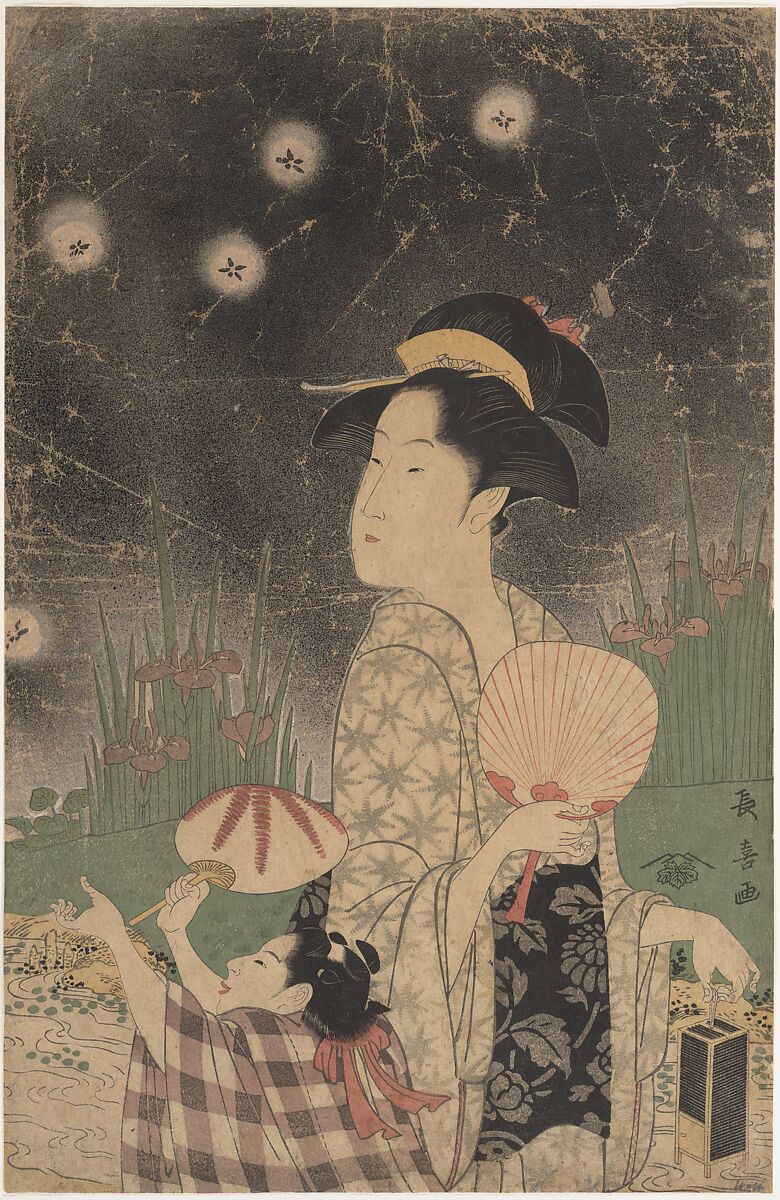
Art from the Metropolitan Museum: Eishōsai Chōki ca. 1763

Goals, sort of

Our regional drought continues. I sometimes entertain the idea that the universe is telling me I might as well consider moving to the Southwest–where my children now reside–since the Mid-Atlantic area currently has less rainfall, higher temperatures, and lower humidity than where they are. Granted, this is likely to be a temporary situation; but for the present, I get the chance to walk on crunchy grass and hard soil daily and see how I like it. And to see blue skies for days on end, and see how I like that. What next?

Speculating on “what next” comes rather naturally to me, a reflective sort of human being; but making goals and ambitions toward accomplishment–not so much. Lately, though, the years-ahead thinking has been moved the forefront of my thoughts. It’s all those dang Medicare and Social Security and AARP mailings, in part, and my peers and I heading into the so-called retirement years. Inescapable: the conversations crop up around the dinner party table, while having coffee with a pal, or on a phone call with siblings. People keep asking me what my new goals are. I suppose, having reached the age Social Security (used to) kick in, I was expected to come up with new goals? Must have missed that memo.

Goal: the word is of uncertain origin, says Etymology Online, but appears in the 14th c “with an apparent sense of ‘boundary, limit.’ Perhaps from Old English *gal ‘obstacle, barrier,’ a word implied by gælan ‘to hinder’ and also found in compounds (singal, widgal). That would make it a variant or figurative use of Middle English gale ‘a way, course’…” And there’s the further meaning of a stake that signals the end point of a game. Interesting that goal can be an obstacle, a limitation, an end-point, or a pathway.

If I think of it as a pathway, the question is, what do I want to do? After many years as an educator…do I throw all that experience away and take up something else? My guess is that I’ll find myself imparting information of some kind, one way or another, regardless of employment status. So no major change of course, just a change of scenery, situation, or audience. After all, I will still be writing.

Or are we talking aspirations? What is it I would like to plan for…self care? travel? conferences and retreats? Time to do–what, exactly, and with whom? Here there are perhaps barriers and limitations: can we ever stop worrying about how much will it cost and how much time it will take to achieve the specified goals? And obstacles–you cannot plan for them. Maybe I go blind or get cancer or get hit by a bus. Maybe the apocalypse occurs in my lifetime. That would certainly be the stake that signifies “game over!”

Then again, what if my plans are to get into the woods more, sit under trees more, take more walks, read more books, tend to plants and animals, hang out with my beloveds, write poems? Those things, I want to do in future. But it isn’t as though I am not already doing them now.

Photo by Michael Heinrich on Pexels.com

Reading friends’ books

One thing about being a writer is that, after awhile, you meet other writers one way or another: sometimes through social media, Zoom events, or in person at book signings and readings; sometimes through conferences, workshops, or various educational programs; sometimes by finding local writers groups or getting an introduction to someone through a friend. When you meet writers, you get the additional privilege of reading their work. It so happens that lately, many of my writerly friends and colleagues have published books, and I’ve been busy reading them!

First, I want to mention that whenever possible, readers should purchase literary volumes from the writers themselves or from their publishers, or–if it’s an option in your region–from an independent bookseller. I do resort to ABE and Thrift and Amazon when a book has gone out of print or when the publisher prints through Amazon, but I want to remind people that the other sources will support the writers themselves or the independent small bookshops and publishers who launch these books into the world.

Now that my virtuous aside has been accomplished, here are a few of the books-by-friends-&-colleagues I’ve been consuming lately–not all of them newly-published (it takes me awhile to get around to the reading).

~

The near-abstract imagery and the concrete place-names and lyricism in Heather H. Thomas’ 2018 Vortex Street appealed to me on several levels, from the scientific (a repeating pattern of swirling vortices, see “fluid dynamics”) to the particular: my husband grew up in Reading, PA, where some of these poems are suspended in recollection. I’ve also loved reading Grant Clauser’s latest, the 2021 Codhill prize-winner Muddy Dragon on the Road to Heaven, a collection of poems that strikes me as both deeply beautiful and tenderly sad. Poet Lynn Levin has published a terrific book of short stories, House Parties, that remind me of the wry sense of humor and wide-ranging knowledge her poems have while proving she’s also a deft hand at plot and character. Maureen Dunphy’s memoir Divining, A Memoir in Trees, brought to mind parallels with Lesley Wheeler’s memoir in poems, Poetry’s Possible Worlds. In both books, the authors have chosen a locus [an American tree, a contemporary poem] and used the exploration of that “trigger” to draw out something personal. What better way to connect with readers than through something we love and value? Which brings me to a shout-out to Jane Satterfield, whose poetry collection The Badass Brontës isn’t in this photo because I’ve already lent it to someone who’s a Brontë fan.

~

In addition to the above books, I am eagerly awaiting new works from a host of other poet-friends: chapbooks by Beejay Grob (forthcoming from Moonstone Publishing) and Lisa DeVuono, poetry collections from Jerry Wemple, Jeanine Hall Gailey, and others that slip my mind at the moment. My only regret is that I have all this reading to do just as gardening season gets really underway!