Squalls

It’s still March; and yes, a few daffodils had begun to bloom–and yesterday the weather was raw and today it is frigid, and both afternoons I got stuck in snow squalls while driving. Squall: a good word, apparently Old Norse in origin and related to squeal. My students were cursing the return to cold air. I put my mittens on and endeavored to teach myself patience. We do need the cooler currents, but the worst things about overall global warming are the meteorological extremes, the cold that is so cold and the snow that is oddly early or late and deep, the hurricanes, the hailstorms and tornadoes, the flooding.

Tree frogs know how to take care of themselves. They leave the trees and go back into amphibian dormancy until the weather breaks again. The shallow burrow where a tree frog waits out a spring freeze is called a hibernaculum. Days like this one, when the winter smacks back the warmth again, a hibernaculum appeals to me.

Having just returned from three days at a writers conference [the AWP], the concept of a solo burrow to recoup my energy fits the bill. The conference–largely due to covid 19– was not as well attended as those I have been to before (& required masks and a vaccine certificate); also, the Philadelphia Convention Center is vast, so I did not feel overly worried about the virus. The event felt as overwhelming as ever, though, and hard on an introvert. I did attend with writerly buddies, and met nice folks and learned new things. I remembered the lessons of past conferences in terms of pacing myself, purchasing books in a manageable fashion, and not lugging too much stuff around: general attending-a-conference navigation. One thing I will grouse about was my own inability to use a phone app to figure out what was going on where. My phone is small, and I am inept at its tech capacities. I prefer a paper guidebook, though I suppose that’s not as environmentally friendly.

Re-entry into my routine was bumpier than it used to be. I had post-conference physical aches and fatigue, and I felt oddly rattled intellectually, as if all those marvelous and interesting poems, concepts, people, theories, books, journals, programs, and voices had jumbled themselves into my brain and not finished synthesizing. I suppose that about describes it, too…it is a LOT to try to connect and to sort through. Worth it, however.

The upshot? I need my hibernaculum to screen me from the squall. But spring will come.

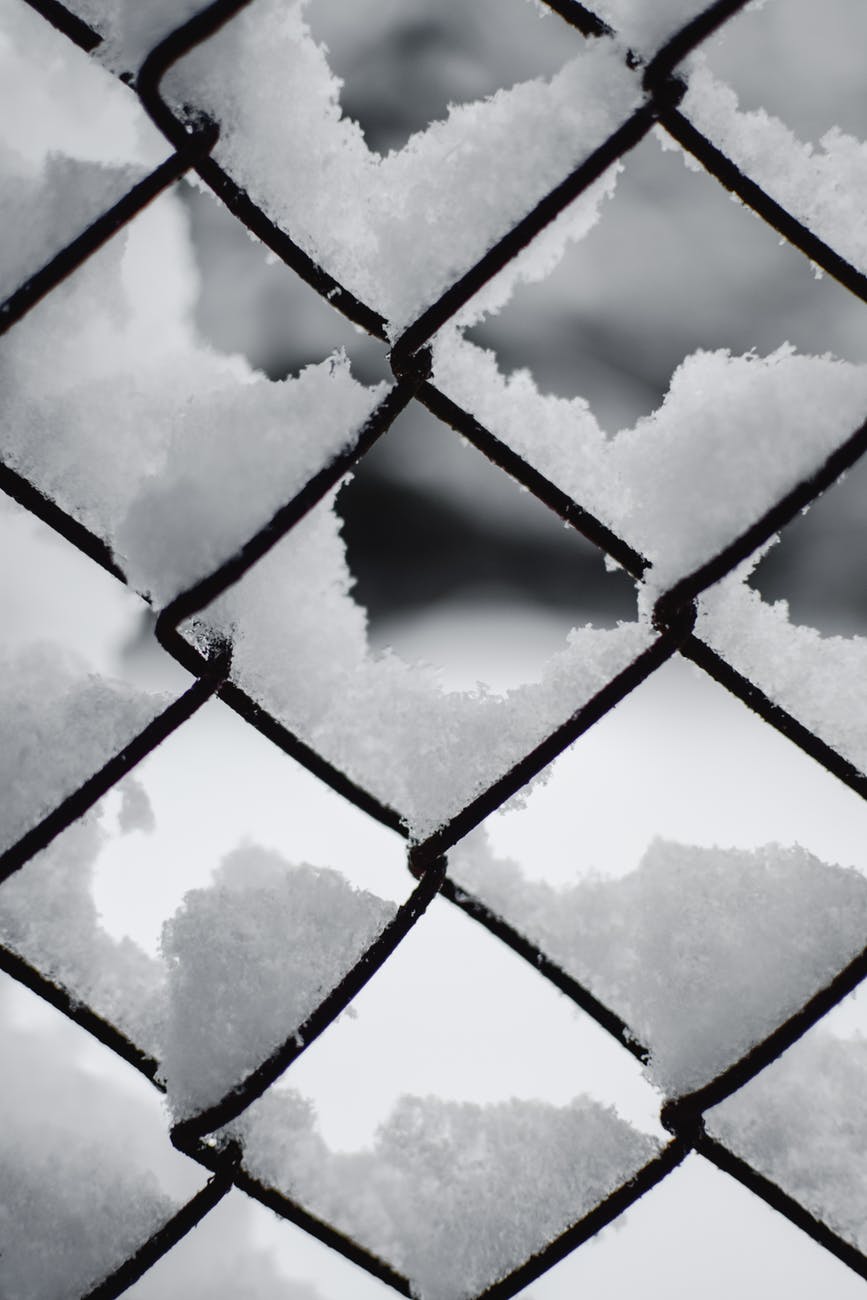
Photo by Eva Elijas on Pexels.com

Weather weirding

We just passed the vernal equinox, and here in the Lehigh Valley (the Lehigh is our resident river, though the Delaware is awfully close) the early jonquils are blooming. As are crocuses, forsythia, ornamental plums; the magnolias are starting to burst their fuzzy, cocoon-like bud scales. These vernal events seem somewhat ahead of schedule–not by much, but enough for a nature-nerd like me to notice.

I also notice the redwing blackbirds arrive earlier than they used to. Twenty-five years of keeping a garden journal provide evidence of that.

We live 340 feet above sea level in zone 6A, or what used to be zone 6A–we’re definitely trending warmer, despite occasional fierce storms that drop deep snow unexpectedly, despite weeklong stretches of winter temperatures below 15 degrees F. Summers linger longer and are either much wetter or much drier than “average,” and overall degree days for the past 15 years are above historical averages. Indeed, 2020 was the warmest summer on record here; I checked. Told you I was a nerd.

When my daughter lived in Asheville NC about 12 years ago, I noticed the rain, as well as flourishing vines, and lichen, on so many of the trees. She said that the Blue Mountains in that area are a temperate rain forest, but the humidity bothered her less than here in eastern PA because of the higher altitude: Asheville’s at about 3000 feet elevation. In the last 8 years or so, I’ve noticed the same tree-clinging lichen in my region–a new development. I have lived here over 30 years and had never seen it before. Another thing I notice is how much more vigorous the vining plants, many of them non-native, have become and how rapidly they shoot up into the overstory, choking off the tops of tulip poplars and oaks and pulling down the trunks of dead ash trees. The growing season has lengthened a bit, which is worrying from an environmental perspective even if it means I may eventually be able to grow camellias and figs.

And I can’t deny finding some of the milder weather pleasant, especially the sounds of tree frogs filling the nights earlier in the year. They soothe me at the end of day. Yet these crucial amphibians are very much at risk as the world warms. I may have little choice about whether we can return to cooler, damper summers, but I can make choices about how I live in the world and about what matters. It bears keeping in mind as I work the soil for another season in my garden.

~

witch-hazel’s yellow threads // flung by warming gusts // where crocuses emerge

~

oh! they cheer me : jonquils emerging : green leaves spearing brown leaves

Conventional

It’s been a long time since I attended a convention, concert, or any large event. Thanks to covid, longer than usual. This year, I’m braving the Association of Writers & Writing Programs’ annual conference–in person, next week–since it’s being held near me, in Philadelphia, this time. Never one for large crowds or rooms full of strangers, given my natural inclination to internalize or curl up in a corner with a book, I have nevertheless attended AWP in the past and have found it supplies me with creative energy in the form of writers I need to read, intellectual ideas I want to explore, and reasons to keep writing.

~

The conference provides a good place to meet up with fellow writers I know mostly “virtually” via social media or email, and to see folks who live far from me; it also features well-known writers in readings, panels, and conversation–always an excellent experience. I’ve blogged about past conferences (if you’re interested, type “AWP” in the Search form on this page, and a bunch of posts will come up). Attendees do not have to be academics or involved in creative writing programs to attend. I’m excited!

Meanwhile, the month of March does its typical lunge and feint, volt, and passe arriere as it heads toward springtime…I never know what to expect, weather-wise. Today: mild and almost 70 F. I’m hoping we get a string of 50-degree days that permit some garden preparation. But then again, that’s always what I hope for in March.

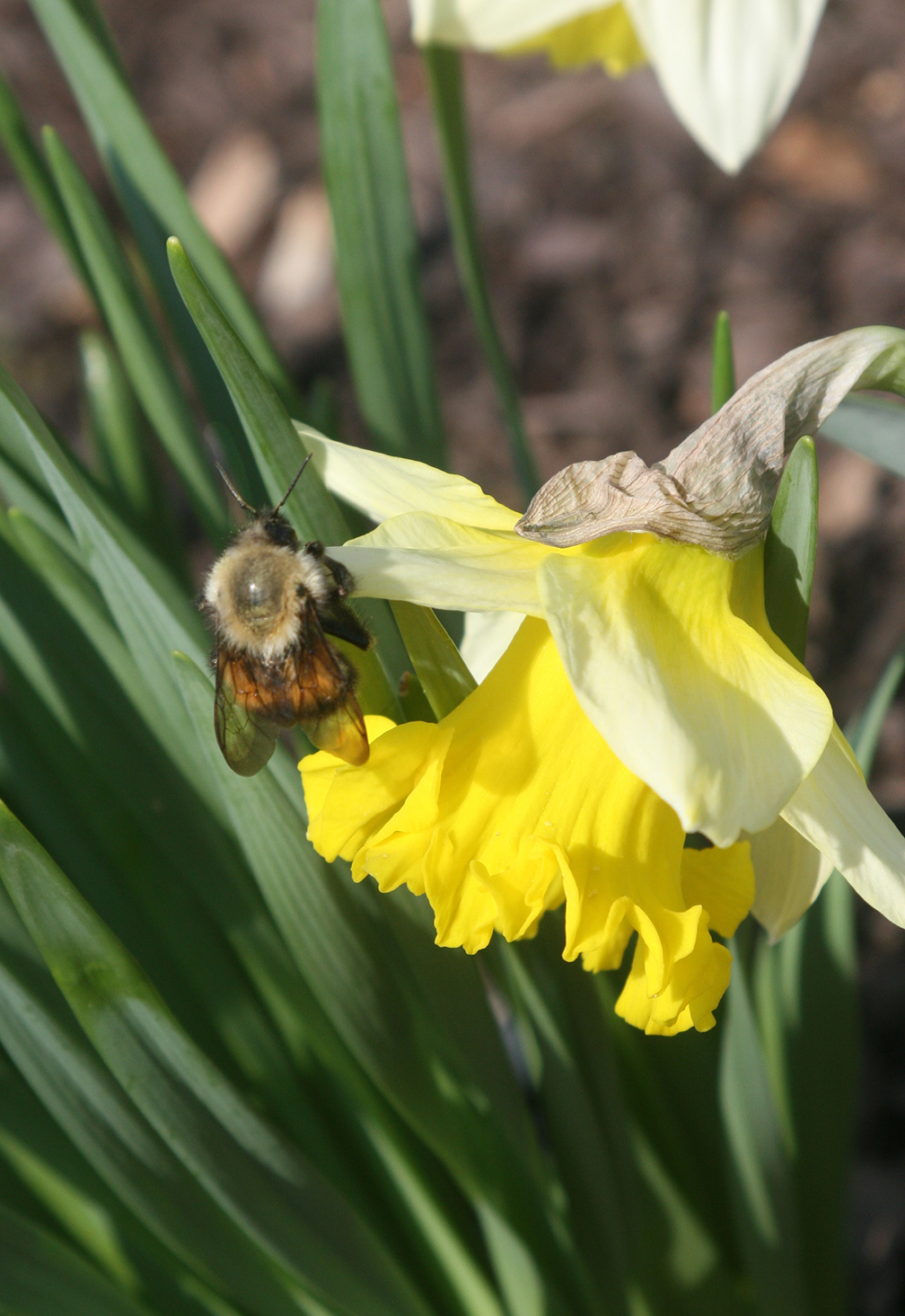
New in the outdoor garden this week: the first bumblebees have emerged. There’s one in this photo, amid the iris reticulata–

bumblebee, just left of center; iris reticulata

~

My tomato seeds have sprouted in their little seed-starting pots by the sunny window. Gardeners must be optimists. I guess I learned that from my dad.

Synthesis

“The current moment” has a way of inserting itself into poetry I write, not just these past weeks but always. I look at my poems written in the wake of the 9/11/01 attacks and can see reflected in their pacing, tension, or imagery some aspects of the anxiety of those days. Not that I wrote much poetry that employed that current moment as a topic or narrative…just that the numb dread, surprise, and confusion managed to enter in. Poetry can contain and convey those hard-to-describe emotional tensions. Ambiguities. Conflicted feelings. Multitudes.

Poetry, by its nature, requires synthesis. For example, metaphor is one type of synthesis. In Carl Sandburg’s poem “Good Morning America,” he famously says that “Poetry is the achievement of the synthesis of hyacinths and biscuits.” (But then, he also says “Poetry is a pack-sack of invisible keepsakes./ Poetry is a sky dark with a wild-duck migration./ Poetry is the opening and closing of a door,/ leaving those who look through to guess about what is seen/ during a moment.”) Make of it what you will.

A few posts back, I mentioned my dad has been showing up in my poems recently. That’s still occurring. This one doesn’t have a title yet, as I’m still mulling it over and will probably revise the whole poem down the road. The initial impulse for the poem had nothing to do with my father or the war in Europe, and we do not have any daffodils in bloom right now. But there they are.

~

[Verge]

On the road’s verge, geese stand looking unctuous,
	vaguely irritable as I pass them
going 50 on the route I’ve taken for decades
and this time I recall two years back, when my dad
	was failing, how eagerly I sought any sign
of seasonal change—
	early-flowering witch hazel, or crocuses, quince,
swells in daffodils’ green emergence 
while inside myself the slow emergency of his dying
	began to open from probable to imminent.
I drove south idly; through the windshield I 
	looked forward to nothing, as my mother
talked of nothing when he floated in his haze of pain
and Dilaudid while holding one hand over his head
	as though he could, with his fingertips, pull
the ache from his left ear over his head and into the room
	where it might exit.
Now, the exodus occurs elsewhere, in refugee waves
of people whose minds and bodies lug their different pains
	across other kinds of borders.
My father’s experience of earth has ended,
	his baptism complete. His birthday was in April.
	See there, along the roadside? Daffodils.


~~

Relevant, possibly

~~

Of note: I’m happy to have a poem in Scoundrel Time, a journal I enjoy reading for work that’s relevant to the contemporary moment. Here it is; please read it, and read the other wonderful poems in Scoundrel Time: “A Brief History of Kyiv.”

~~

This poem also came to mind, for different though possibly related reasons. It will appear in The Red Queen Hypothesis when that book (my second full-length collection) gets into print. I was writing many poems in various forms at the time. The poem’s story is second-hand, the we a personified plural community of human beings, one repeated line taken from, you’ll recognize, A Tale of Two Cities–there’s a reason for the allusion as well.

Somehow, may all be well. Somehow, may each of us find some happiness.

~~

Variations on a Line of Dickens
			(Belarus, 1985)

It was the best of times, it was the worst
of times, when nothing seemed to go our way,
though happiness is what we wanted. First

we stood in endless queues, outside, and cursed
the lack of cheese or bread; our pals would say
it wasn’t the best of times, it was the worst.

We’d swill cheap vodka, harshening our thirst,
highlighting deprivations of each day,
when happiness was all we wanted. First

we’d press our bodies close enough to burst
the paper bag of lack. Kisses could not stay
our own best times, but it was the worst

thing to let go. Our lips still pursed,
the tastes of sex would linger and relay
that happiness is what we’d wanted; first

times were the best, solid, immersed
in flesh and heat—forget the fray—
those were the best of times, and yes, the worst.
Happiness was what we wanted first.

~~


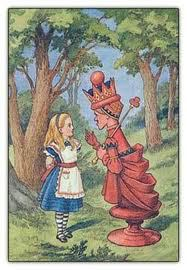
Sir John Tenniel, of course.

What poetry says

My dad was a newshound. Always had the radio on and newspapers: New York Times, Philadelphia Inquirer, Camden’s Courier-Post. I grew up watching the Viet Nam War on the 6 o’clock nightly news. I am fortunate enough not to have lived through war in my own country, but I read a good deal of fiction–and wars supply natural conflict for plots, either as background or foreground. I found it a little too easy to put myself in the situations of the characters in novels.

Also, I was of a Cold War generation. The threat of nuclear warfare loomed, and we drilled for that eventuality in our school hallways the way children today drill for active shooters.

Dread. I get it.

Many friends and colleagues have been posting poems on social media the past week, as poems about the useless pain of war can be recycled generation after generation without becoming irrelevant. Really, that fact alone ought to teach us that armed conflict offers nothing but suffering; but when have governments ever listened well to what poetry has to say?

What follows is a work of the imagination, a poem I drafted in 1990, if my records are correct, and revised last in 2008, after which it was published online in a now-defunct literary magazine. Reading it, I realize that with a few changes, it could become a poem about a pandemic as easily as about a war.

~~

DURING WARTIME

First we lose
our certainties
and some of our trust.
The rest depends on events,
our nearness to the front.

Cities feel it earliest,
a dry panic, rations,
the irrational becoming
stuck, continually,
in our throats.
We practice
not being hysterical,
learn to live without
bacon, or oranges.
On worship days,
silence and weeping.

Life in hills and farms goes on
more quietly than before,
difficult situations held
as they usually are
like a straw between teeth.

The last things lost
are nonetheless changed:
a bounty of curls
on the pillow of a once-shared bed
turns grey. 
Linen closets, kitchen cabinets,
the child’s pale room
have altered, become simpler,
more desperate.

When infrastructures fail—
rails, roads, electricity— 
we are merely afraid;
it’s when simple things leave us
we have lost all our wars.


(1990/2008) Ann E. Michael

What war does

Shocks us. Even when we expect it.

Rattles the cages of the ordinary.

We made friends with several Ukrainian folks when my husband worked there years ago. We keep in touch; ever since the seizure of Crimea in 2014, we have been worried despite our friends’ apparent unconcern. But life was normal. On Monday, Y. called to discuss a recent job offer; should she take the position with a big corporation? On Thursday, she called at 9 pm (pre-dawn in Kyiv) to say she could hear bombing over the city and was thinking of hiding in the woods near her suburban house.

Now, she’s trying to get to Poland.

What rattles me is the way this reminds me of September 11, 2001, when things were initially so mundane and typical and then…not.

Here’s a poem from a visit we made to Lavra-Kiev in more peaceful, warmer, sunnier times. May such times return to all of us, and soon:

https://aboutplacejournal.org/issues/the-future-of-water/praise/ann-michael/

That need to publish? –eh…

The hazel’s buds are about to open, first yellow of the season; red-winged blackbirds have returned; this morning, several flocks of snow geese in Vs high above me. Then, a brief but crazy-wild snow squall. Yes, it is February.

What I find myself assessing lately is “the need to publish” thing. I feel a reckoning coming on, personally, in which societal changes are implicated–and my age, as well.

Let me backtrack.

When I first started writing poetry seriously (reading, studying, crafting, workshopping), publishing was a paper-only endeavor that involved typing and retyping poems, sending them with SASE (self-addressed, stamped envelope) to various literary magazines and journals both Major and minor, and waiting for up to a year for rejection or acceptance. The acceptances were necessary if I wanted a book publisher to take my work seriously, or to have an academic institution consider me as worthy of hire, or to apply for higher-stakes literary grants and opportunities. The game, as it were, operated on those hierarchies: journal publications, chapbooks, solo collections, college stints.

I did a bit of that, though not enough, I suppose. I got my chapbooks and solo collections (see books here) and a fair number of poems in actual (and, now, virtual) print. But ambition ain’t exactly my middle name; my college work has not been tenured and doesn’t fall under the creative writing category–I run the writing center at my university, where it’s all about grammar, spelling, documentation, essay structure. I enjoy the work, but it is not poetry.

Back to poetry publication: the new assessment is about whether I care anymore.

I’m theoretically close to retirement, though academia lets us continue to our dotage if we wish. [See The Chair.] Will further publications, or higher-status publications, enhance my position at the university? No. That ship, as the saying goes, has sailed. Anyway, it was more of a daysailer than a cruise liner. And will further publications, online or in print, keep me in royalties in my retirement years? You jest, my friend! Poetry adds little to the income balance sheet.

Furthermore, the current state of literacy requires social media presence; virtual journals abound, and many of them are fantastic (seek them out! read them!). Their editors respond slightly more rapidly than lit mag editors did in the 1980s, and though there’s sometimes a submission fee, the price has not escalated much more than postage has (and is in some cases lower). But submitting to journals even online nonetheless consumes a sort of energy and time commitment that not all of us have. Or are willing to make to keep ambition going.

So. My current assessment suggests I’m past the point where it matters much where the poems appear, although I personally love poetry BOOKS and will continue to get my books in print if I can. This assessment allows me to say, “I hereby forego Submittable, etc., for the most part and will send out poems to journals if asked, and otherwise…” Hmmm. Otherwise, what?

Maybe post them here? As I did two years ago during National Poetry Month. I could do that again. Something to consider. Since I no longer have much to gain, I could at least continue my audience here.

photo: Hernán Gonzalo Pereira Palomo

Readers, if you want to weigh in on this concept, I’m all ears.

Psalms, Job, & poetry

I have been learning much and enjoying Robert Alter’s The Art of Biblical Poetry; as much as I found his texts on biblical narrative intriguing, this book appeals to me more not just on the levels of scholarship, history, and explication but because he clearly loves and understands poetry. Which cannot be said about every scholar who writes about the Old Testament books (and they are many).

For example, Alter recognizes that trying to categorize biblical poetry into formulaic genres is useful only in the most general way, because the most enduring (poetically ‘best’) verses persist as significant and special because they are excellent poems. Which means they may not follow stereotypical genres or fit the “given conventions of style” of a type of poem. Indeed, he refers to the author of Job’s Voice from the Whirlwind and the prophetic author known as Deutero-Isaiah as geniuses. Then he provides evidence of this genius through explications that rely not only on scholarship and historical sources and contextual information but through the beautiful poetry itself.

Convention gives writers of both verse and prose a solid framework in which to construct their own discourse, but good writers always exert a subtle pressure on convention…remaking it as they build within it.

Robert Alter

Paradoxes and “radical ambiguities” abound in these ancient poems, and the urgent ideas they chose to convey through poetry manage to feel significant even today, thousands of years later. The fictive aspect of poetry–its imaginative spur–appears in the biblical imagery of (imagined) apocalypse, (imagined) utopia, (imagined) peace and bounty. [Non-believers might add: (imagined) god.]

Alter writes with some wit and considerable modesty, though maybe it’s false modesty since he’s clearly attached to his arguments concerning the Masoretic text, translations of biblical Hebrew, and the structure and syntax of these poems. At any rate, his style permits him to write for the non-scholar. Much appreciated by this non-scholar!

Poetry…is a particular way of imagining the world–particular in the double sense that poetry has its own logic, its own ways of making connections…and because each system of poetry has certain distinctive semantic thrusts that follow the momentum of its…habits of expression.

Robert Alter

I gleaned from this book some approaches to writing poetry that remain useful today, things I’ve heard mentioned in interviews with contemporary writers, methods I have employed in my own work without recognizing their long lineage. Then again, I spent many hours in church pews when I was growing up, listened to many an Old Testament reading from the pulpit, and sang hymns with lyrics often drawn from those passages. I suppose the forms have plowed grooves in my brain.

Plow: Akkadian_seal_Agricultural_scene_Louvre_Museum

In which my dad appears

When does bereavement permit the writer to get back to the writing process? I have had quite a few conversations about this topic in the past few decades, and the answer’s pretty obviously “It depends.” I think of Donald Hall writing during Jane Kenyon’s illness and death and afterward–the stunning poems of Without. When my friend David Dunn died, I wrote immediately and often, sorrow emerging through elegies and remembrance. But I was younger then, and less experienced in the arena of bereavement.

During my mother-in-law’s two-year decline toward dying, I found myself writing about the challenges we faced–physical, emotional, communicational (that’s not a word, but I’m leaving it here all the same). Afterward, I could not/did not write. What interferes?

Why my thoughts turn this way: because, lately, my dad keeps turning up in my poem drafts.

I did not write much last year and did not submit any work.* For some reason, though I blogged and wrote long emails to friends and read many inspiring books, I did not feel particularly creative. But I wouldn’t have associated that semi-arid year with my father’s death; I figured my creative void was more about covid and an increase in chronic fatigue symptoms.

To jump start myself this year, I signed up for an online workshop (see this post). It has helped–I’ve drafted more poems in five weeks than I wrote in five months last year. But there’s been a peculiar outcome to these poems: despite widely differing prompts, source poems, and initial processes, my dad or something I connect with him appears in almost a third of the new drafts. I wonder what my subconscious is doing behind my day to day routine. Is this a response to bereavement, or a sign that I’ve accepted his death, or a reminder to self of what a huge loss it has been to me?

Not that I have a definitive answer to any of those questions. I do feel grateful for his appearance, though. He had a good sense of humor and loved to sing–nice things to have in a poem.

~

Thanks, Dad.

~

*Well, almost no work. Thanks to Marilyn Hazelton, editor of red lights tanka journal, I did submit tanka poems in 2021; and she accepted a few for this season’s edition (print only).