Neglecting the work

It seemed to me to have been a long time since I devoted serious focus to my creative work–I mean in terms of organizing, keeping track, revising, submitting to journals, compiling a draft manuscript of newer work…the so-called business of poetry. I resolved therefore to spend a weekend at the task. Alas. The weekend revealed to me the extent of my benign neglect: ten years of not-really-being-on-the-ball.

inflating-clipart-beach-ball-6

I do not consider myself a particularly prolific poet, but I found myself faced with well over a ream of poetry pages, many poems only in their second or third draft and far from “finished.” Maybe an average of 70 poems a year for ten years. Do the math: this is not a weekend’s work. [le sigh]

Where to begin? There is no beginning. After an hour or so of trying to prioritize the various components of the job, I gave up and just started at whatever had become the top of the pile. Analysis: which drafts had any glimmer of possibility? Some erstwhile poems could easily be culled into the “dead poems file” I keep under the cabinet with the dust bunnies. Others required considerable revision.

Fascinating process, despite aspects of tedium. I encountered poems I forgot I’d composed. I looked at the dates I began and revised them, tried to discern where my thoughts and feelings were at the time. Somehow, going through poems in no way resembles looking at old photographs–it’s not that sort of memory jog. Indeed, the poems are not involved with the memory part of my brain but with the creative part.

And that is exactly what I have been neglecting: the creative, imaginative, intuitively analytical side of myself.

In the process, I found a chapbook manuscript to submit–I had completely neglected it–and several worthwhile poems. I have no idea yet how much further I can get into the pages of past poems, and whether I might fashion another manuscript from the lot. But I’ve decided the work should not be neglected.

And I have a lot of catching up to do!


Vocation, avocation

Somewhere recently–was it the Sunday New York Times?–I read an opinion essay about how recent surveys of US citizens indicate that we have fewer hobbies than we have had in years past. The columnist wondered whether that lack is due to a zeal to be the best at whatever we engage in–the best jogger we can be, the most avid cyclist, the best collector, knitter, paper-crafter, woodworker, violinist, what-have-you. She suggested we’ve somehow lost the joys of being hobbyists: amateurs who do or create something because it is fun or relaxing, or because trying to learn a new skill makes us feel good. A true hobby is something we don’t have to be perfect at, because that is not the point.

As my students wrestle with the tasks of college and their concerns about their futures, the concept of vocation arises often. What to do with a life? Earn enough money to live reasonably comfortably, even if the job is not a passion? What if it’s not even satisfying? Should people choose a bearable career and find enjoyment in avocations? Or persist at what they love even if society doesn’t always reward the path they’ve chosen? Or–the options are legion.

~

I believe in vocation as passion, and I also practice hobbies. My career is in higher education, and I enjoy and learn from my job. My vocation is writing, particularly writing poetry; my passion lies in that direction more than any other, but poetry has not been a career path in my case.

~

My hobbies have evolved over the years. For decades, gardening has kept me happily occupied out of doors–but I have no need to become a Master Gardener, and my gardens are often minor failures in one respect or another. The garden, however, soothes me, distracts me from anxieties, helps me to become a better observer, teaches me much. When learning about plants, I got interested in botany and wild flower identification, so I am a more informed hiker and nature-saunterer than I used to be.

IMG_5633

garden photo: pepper, sassafras leaf © 2018 by Ann E. Michael


Photography’s also a hobby I pursue, an interest of mine since my late teen years (back before digital). The view through the frame has always intrigued me, as well as the opportunities that different lens lengths offer the photographer as to framing and focus. I especially enjoy macro lenses. It’s fun to zoom in closely on insects, flowers, and small areas of everyday objects. Photography encourages different types of observation.

The earliest interest I can recall having is art: painting and drawing in particular. From the time I was tiny, even before I entered kindergarten, I loved to draw and paint and to look at art in books and museums. During my teen years, I studied art at Fleisher Art Memorial in Philadelphia and headed to college thinking I would minor in the fine arts. My talent did not match my aspirations, and a thorough self-analysis at around age 20 led me to recognize I could be creative more successfully in other ways…by that time, I was writing more seriously than I was painting.

But now? I have taken up painting in acrylics. Mostly sketches of clouds. There’s no pressure on me to do well; I can paint many mediocre pictures of clouds and feel relaxed in the process, meditative, observant, a casual learner.

cloudsketch

mediocre acrylic sketch of clouds, by Ann E. Michael

~

As I wrap up this post, I realize that my career and my hobbies have encouraged observation from multiple and new perspectives. And my vocation? Poetry practically relies upon the writer’s ability to switch into creative and imagined points of view, as well as to have the opportunity for closely-observed objects and experiences.

Vocation, avocation, passion, career. I count myself lucky.

Seen from above

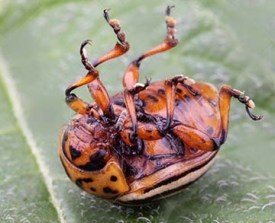
Wislawa Szymborska’s poems are in my head today, prompted by finding a dead beetle on my porch. Novice entomologist identifies dead bug, then thinks of poems.

~

Seen from Above

Translated by Stanislaw Baranczak and Clare Cavanagh

A dead beetle lies on the path through the field.
Three pairs of legs folded neatly on its belly.
Instead of death’s confusion, tidiness and order.
The horror of this sight is moderate,
its scope is strictly local, from the wheat grass to the mint.
The grief is quarantined. The sky is blue.

To preserve our peace of mind, animals die
more shallowly: they aren’t deceased, they’re dead.
They leave behind, we’d like to think, less feeling and less world,
departing, we suppose, from a stage less tragic.
Their meek souls never haunt us in the dark,
they know their place,
they show respect.

And so the dead beetle on the path
lies unmourned and shining in the sun.
One glance at it will do for meditation —
clearly nothing much has happened to it.
Important matters are reserved for us,
for our life and our death, a death
that always claims the right of way.

~

In Joanna Trzeciak‘s translation, the second stanza begins:

For our peace of mind, animals do not pass away,
but die a seemingly shallower death

…a phrasing that evokes more clearly (to me) how humans use a sort of euphemistic, possibly spiritual phrase for being dead. And in this translation, the last stanza reads:

So here it is: the dead beetle in the road
gleams unlamented at the sun.
A glance would be as good as a thought:
it seems that nothing happened here.
Important supposedly applies only to us.
Only to our life, only to our death,
a death which enjoys a forced right of way.

Both translations are lovely, but I think I prefer the Trzeciak version, though I would be hard-pressed to say why; and I certainly cannot compare either to the original, since I do not know Polish.

What I love about this poem is its perspective, as reflected in the stances of title and stanzas. Literally, the speaker is above–looking down at a beetle husk. Tidiness in an insect’s demise–as opposed to our own. Then the point of view shifts, suggesting we humans are “above” the animals, their deaths less upsetting to the cosmos. But we are the cosmos, in our egotistical narcissism; and then, at last, death reminds us how unimportant we are…no matter how we think of ourselves.

20775536-dead-colorado-potato-beetle-belly-up

Wet year

This year seems the wettest locally in some time. Flash floods, gray days, soggy fields, mildew in the garden (and everywhere else). Annual average rainfall per year in my region is about 50″. We have already received 107″ at just past the equinox.

Yet it has been even damper elsewhere in the USA: I have friends and family in the Carolinas, which felt the brunt of Hurricane Florence.

Despite my complaints, I prefer rain to drought. After all, one of my books is titled Water-Rites.

I’m posting the draft of a new poem today. Thankful for the sounds that comfort me.

~

All night, even as rain pounded
the crickets called and called
their high-pitched throb offering
a different perspective
on the downpour’s
thrum, a bass string’s thump
on windows, roof, the dark’s
wild fullness that we don’t
understand and thus fear.

Shiver of screech owl, damp in its
hickory-tree perch
sad dreams, body aches, waking
into memory. We animals
amid bedsheets, sweaty and tossed,
find ourselves alert, listening.
Rain drums down in long bands
and crickets sing.
~

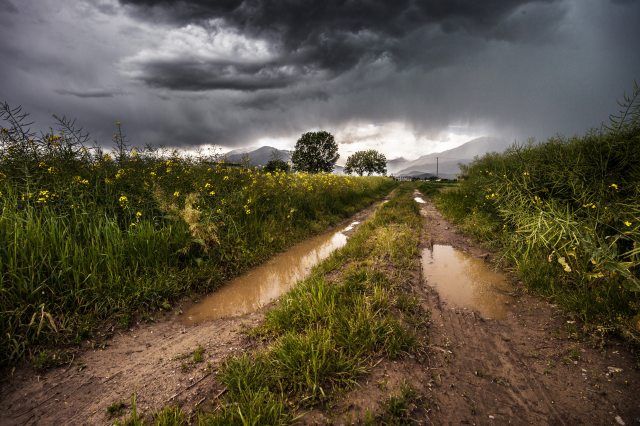
country-lane-field-meadow-1551.jpg

image thanks to Pexels


Reverie, with interruption

On the first warm, sunny, not-horribly-humid day in a long time, to reward myself for marking up a pile of student essays, I lay in the hammock and looked up at the clouds. The clouds are amazing today, shifting, fast-moving, likely thanks to Hurricane Florence far to the south.

I wanted reverie, but I got spotted lanternflies instead, which interfered with my admiration for the clouds. Dozens of the creatures were aloft on this mild afternoon.

IMG_5605

They are a recent invasive species to our region; their appearance causes concern because they use fruit trees, mast trees, grapes, and hardwoods as host plants when they cannot find their traditional host, ailanthus. We have no ailanthus on our property, but we do have oaks, hickories, maples, beeches, and many scraggly cherry, walnut, and mulberry trees along the hedgerow and into the woodlot. Development in the valley–housing developments, business plazas, parking lots–coupled with stress from climate weirding, has been hard on trees. We already have diseases that have damaged the Pennsylvania ash, hemlocks (PA’s state tree), and dogwoods. I notice weakened bark on many trees. The droughts and the too-much-rain cycles, and unusual, high winds with storm fronts, plus road-widening, contribute to considerable loss of trees.

I lay in my hammock under the trees and worried about the lanternflies. Which accomplished nothing (I think of a James Wright poem at this point…).

What was there not to despair about? So much anxiety surrounds me. Even the damned bugs. If only starlings were to take a liking to spotted lanternflies, I mused.

A butterfly went past. I looked down at the zinnias blossoming their stems off in the garden and felt pleased to count four monarchs there. It has been a good year for monarch butterflies in my yard, and green darners and other dragonflies, and hummingbirds–which used to be quite uncommon visitors here. The little brown bats are returning each dusk, recovering slowly from the decimation of white-nose virus.

The balance may seem off in many ways. But there are restorative moments.

Even if “I have wasted my life.”

monarch.ann e michael

Monarch on tithonia blossom


…Some rain must fall

Longfellow wrote that “Into each life some rain must fall” (“The Rainy Day“). The poem is an extended metaphor; here in my valley, the rain has been actual, physical, moist, sopping, wringing, drizzly, humid, soaking, and all the rest.

The metaphorical hasn’t been absent, either.

So this week, my post consists of other writers’ posts. Explore, please. All of these links offer much to enlighten the reader.

https://www.daletrumbore.com/unthinkable

Now Hold On There; or Slowing the Revision Process

On first looking into Shenandoah’s submissions

Barberous

http://www.writerintheworld.com/2018/09/03/cathedrals-and-yurts-a-reprint/

Feeder streams

A friend and I had a conversation about storytelling and human connectedness, relatives and family myths. We recognize that with age and relationships come references and allusions–some that operate only within the family system, others that interconnect with the wider social world. The televised funerals of some celebrated US citizens (Aretha Franklin, John McCain) offer excellent examples of how various eulogists–family, colleagues, close friends–endeavor to extend their feelings about the person to others. The best eulogies tell stories. It’s how human beings learn about one another, how we connect, bond, and cohere. The process reminds me of feeder streams that follow gravity and the earth’s geological patterns to wend their ways to join a river.

A river enlivened my childhood. Several rivers, in fact–the Hudson, the Delaware–but the one that comes to me at this moment is the Eel River in Indiana, pictured in my recent post here. By coincidence, just this week Streetlight, an online literary review, published my poem “Eel River Meditation.” In less cheerful news, someone whose presence I associate with South Whitley, IN has entered hospice care. These associations summon memories that carry me into that realm of family tales, rituals, jokes, sorrows, generational mythology.

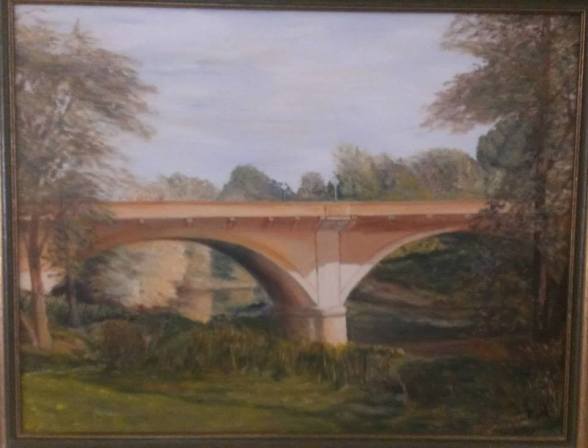
My grandmother lived beside the Eel. A self-taught artist, she painted the bridge over the river many times, in all seasons. It must have steadied her sense of being in the world, of being in place; certainly, her paintings evoke that place, a small Indiana town, in those of us who knew and loved her.

And what could be more metaphorical than a bridge? Than a river? Than the changing seasons?

Locally, this rainy summer in my valley region, the feeder streams are full to overflowing and rushing to the Lehigh River, flooding the low-lying marshy areas, stranding the occasional cow or motorist. The fall semester has begun, and the garden’s mostly abandoned to the aforementioned weeds. My mind and heart are full, too. Maybe there will be poetry.

Eel River Bridge Edna Michael

South Whitley’s Eel River bridge, early summer. Edna Michael


Parsing the garden

To parse is to analyze components–in linguistics, we parse a sentence, in computer science, we parse coded commands. In the literary analysis of a poem, a reader may divide a line or phrase into its parts of speech and then analyze the components (or look at an unusual expression or syntax in a line) to try to interpret meaning or to expand on possible readings or meanings…the semantics behind the tokens of image, grammar, metaphor, allusion, sound, punctuation, placement upon the white space of the page.

Today, I pushed the metaphor by parsing my garden.

The weather from July onward has been hot, humid, and unusually wet. The corn and the beans in local fields were happy; but much in my vegetable garden reveals, with parsing, specific summer details of stress and the gardener’s neglect.

IMG_5601.jpgToo much rain during ripening time led to cracked tomato skins and viruses in the vines. The zucchini did well for a time, then succumbed to powdery mildew. The beans didn’t mind the weather, but I had a plague of voles whose small depredations worked some cumulative damage–they nibbled a number of plants at the stem base, which meant a slightly less abundant yield, of course. Cucumbers offered lots of fruit initially, then downy mildew set in. I harvested one of the two cabbages with only minor slug damage, and the fat variety of carrots grew well (with no sign of whiteflies); but there were lots of bugs on the kale this summer and, given the intense heat, I had a short lettuce season.

And then, there are weeds, which offer many details about the weather conditions…and the fact that the gardener gave up and stopped pulling weeds when the soil devolved into heavy mud and who then refused to brave the task in the numerous over-95 degree F days that weren’t rainy. Today, I began a list: nutsedge; crabgrass; English plantain; pigweed; puncturevine; bindweed; galinsoga; creeping thistle; multiflora rose; horseweed; knotweed; spotted spurge; rabbitfoot clover; virginia creeper; japanese stiltgrass; wintercreeper; mugwort; solidago; wild aster; chicory; poison ivy; not to mention various sorrels and clovers and Queen Anne’s lace…and others I have yet to identify.

If I were to parse each weed, I could detail its likes and dislikes as to soil, growing conditions, root systems, pollinators & pollination strategies, seed dispersal methods, attractiveness to birds or rodents (see seed dispersal methods), and eventually could compile a meaningful ecological and environmental semantics for the little plot that is my backyard truck patch. No doubt I’d learn a great deal about the garden, but no doubt I have done so already–if less exhaustively, less “scientifically.” Would the garden then become more meaningful to me?

It’s a thought experiment; I’ve no intention of trying it, though I do think it would yield interesting results. In the many years I have worked the soil, I have written poems that, perhaps, do parse the garden. That will have to be interpretation enough for my part.

overlay

Interesting sky above the garden.

River of poetry

I attended a lively and unpredictable poetry reading/performance recently, No River Twice. The poets who participate in the group reading develop the concepts at each performance, endeavoring to find meaningful and entertaining ways to permit audience members to sense an active engagement with poets and to experience poems more vividly. It appears to be an evolving performance process, and I enjoyed myself!

Grant Clauser explains the idea on his blog. Most of the poets involved have at least some acting or performance background. They are also active as mentors, instructors, advocates for the arts, and “working poets,” by which I mean they get their work published and performed and are constantly writing, revising, and reading the work of other poets in the service of learning new things.

The poets who performed in Phoenixville, PA, on Friday evening are as follows, but I understand the line-up may change from event to event.

Ethel Rackin

Hayden Saunier

Chad Frame

Cleveland Wall

Bernadette McBride

Joanne Leva

Grant Clauser

Kudos to these folks, who presented a varied and exciting performance. Let’s hope there are more to come.

1978 South Whitley IN, Eel River

South Whitley, IN. Eel River Bridge, 1978.


Grammar


Steven Pinker‘s early book, The Language Instinct (1994)–controversial among linguists, psychologists, social anthropologists and probably semiotics philosophers–is nonetheless relatively easy for the interested non-scholarly layperson to read. Pinker has since become well-known for his best-selling books, TED talks, and willingness to engage in lively debates on controversial topics such as violence in society and his claims for the embodied brain, scientifically-supported atheism, and rational culture. [Totally off topic, but I’m a great fan of his current wife’s novels and philosophy books–Rebecca Goldstein–what an amazing mind she has! Not that Steve Pinker is a slouch in that department, either…an intellectual power couple indeed. But I digress.]

The Language Instinct got me thinking more broadly about grammar, especially as the semester is about to begin and I’m once again wrestling with how to teach conventional writing skills to under-prepared, newly-minted college freshmen. I harbor no intentions of talking to them about linguistic theories. But I do want them to understand that they can already express themselves perfectly well verbally, with the help of body language (even students who are still learning English; even students who have told me that they have learning disabilities). The tool they need to succeed at the college level is the skill of writing that employs enough agreed-upon conventions–prescriptive grammar–to convey clear ideas to the standard reader.

Lots of assumed definitions there: who is the ‘standard’ reader? How many and which ‘conventions’ are enough, and who is it that agrees upon them? I have to let the students know that the answer is: “It depends.” They are seldom very pleased to hear it, but human beings are nothing if not adaptable.

~

After defending slang, split infinitives, the ‘verbing’ of nouns, and other shibboleths, Pinker–in a chapter denigrating language mavens (hence his Jeremiah example toward the end of this excerpt)–writes:

The aspect of language most worth changing is the clarity and style of written prose. Expository writing requires language to express far more complex trains of thought than it was biologically designed to do. Inconsistencies caused by limitations of short-term memory and planning, unnoticed in conversation, are not as tolerable when preserved on a page that is to be perused more leisurely. Also…a reader will rarely share enough background assumptions to interpolate all the missing premises that make language comprehensible. Overcoming one’s natural egocentrism and trying to anticipate the knowledge state of a generic reader at every stage of the exposition is one of the most important tasks in writing well. All this makes writing a difficult craft that must be mastered through practice, instruction, feedback, and–probably most important–intensive exposure to good examples…a banal but universally acknowledged key to good writing is to revise extensively…Anyone who does not appreciate this necessity is going to be a bad writer. Imagine a Jeremiah exclaiming, “Our language today is threatened by an insidious enemy: the youth are not revising their drafts enough times!”

Indeed, I agree with him here. Taking the time to read good writing frequently, and taking the time to revise carefully when writing pretty much anything (even a Twitter post) would go a long way toward improving anyone’s writing.

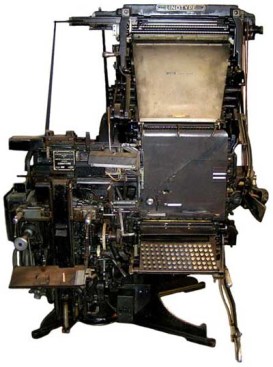
linotype

Mergenthaler’s Linotype machine

We do need concise, standardized, well-revised written texts, especially when we are relaying new information, instructing others how to do something, or convincing our professors that we comprehend the fundamental theories of the coursework. That’s not “grammar,” the magical tool that my students think they somehow missed learning in grades K-12, it’s craft, attention, and revision–with a few prescriptive rules, enough to level the ground on which the we lay our communicative foundations.  The rest is work.