Jargon & rhetoric

This is a kind of continuation of my last post, in which I alluded to euphemism and jargon and the weightiness of words. Herein, I take the unpopular stance and argue that the Centers for Disease Control‘s suggestion that proposals avoid certain words is not entirely about censorship but about rhetoric and persuasion and in this case–given the makeup of the current Congress–was actually appropriate. This is a situation in which jargon–wording–makes all the difference in the persuasiveness of an argument.

The CDC needs to send its annual proposals for research, for agency budgeting, and more to Congress; and each set of documents requires Congressional Justification. If the Congress does not agree to certain proposals, those which have justification withheld will not be funded. (It is possible that many citizens, myself included, are not fully informed as to how these government-funded agencies operate.) Therefore, the possibly-skeptical audience must be convinced of the value of these proposals.

~ ~

letter I


f this were an essay for my students, I would prompt them to think about the audience for their arguments. A writer can employ jargon effectively to help persuade a skeptical audience. Use the terms of the discipline, I tell them. That usage may seem superficial, but it actually works to prove to the audience that you know what they are seeking; you are a member of that community, you know the lingo, you’re on that side and your research will advance that cause.

It may be that your research is something well beyond the audience’s understanding, but you know how to sound like one of them; so, chances are, they’ll get on board with whatever you are conducting.

Even if they have no idea, really, what it is you’re proposing. Even if what you are proposing in fact runs counter to the audience’s ideology, effective proposal writing can hide the fact.

The CDC, from what I have been reading, has not banned those seven words nor the research or public policies concerning them; instead, the agency is cautioning its researchers and policy proposal writers to avoid language that would ring the wrong bells in the ears of this particular Congress’s majority ideology. I see nothing wrong with that. In fact, as a person who guides others in writing arguments based upon research, I encourage it.

Gotta know your audience, or your proposal will fail no matter how excellent its logic, science, and methodology may be. I hope the resourceful writers at the CDC will find ways to convince our Congress to keep the agency and its research funded. A future Congress may be less sensitive to evidence-based information. In the meantime, use the jargon in proposals–whatever works! But use the best words, and the most clear and accurate words, in other forms of discourse.

#7words

7wds


Weight of words

Words are making the news again–this time, the list of seven words that the Centers for Disease Control has been told may make the Center’s research proposals less likely to be approved by the government’s budgeting agencies and which should be avoided in reports to Congress.

Futurism and The Washington Post reported on the purported ban, and a CDC official responded to clarify that the words’ negative connotations were discussed as “part of a suggestion to use words and phrases that ‘might be more likely to win support for the CDC’s budget in the current Congress.’ The idea is that favorable word choice could help ease the budget’s passage through Congress.” Watch your words, scientists!

Words matter. Anyone who has ever written a grant proposal has first of all to learn the appropriate jargon and phrases that the funders expect. Job applicants need to suss out the keywords that a potential employer has submitted to its application software.

~

Then there are euphemisms–a pernicious variety of jargon that obscures, elides, or otherwise weakens meaning--misleading, mostly, euphemisms take the punch out of a sentence. I heard just this morning the term “fatals” in the description of a train accident: “There were three fatals and numerous injuries we haven’t yet accounted for,” said a safety official. Fatals used in this way is a “functional shift” (see Oxford blog). The adjective has become a noun, and the noun has become a euphemism for “deaths.”

Officials may rationalize that language used this way softens the blow somehow. I see it as another method of obfuscating fact and in particular, minimizing or hiding death. Deaths are too real, too weighty; the fact of death is a thing we would rather deny. Just as we might deny that there are vulnerable populations in our citizenry. Or that the scientific method requires evidence.

For some poetry that responds to the use of words, check the cdcpoems blog here.  And Paul E. Nelson’s poem in Rattle, here.


Fully human

A student who grew up in Viet Nam and arrived in the USA just two years ago scheduled an appointment with me for assistance in revising her final paper for Philosophy.

My job is to help her with her articles, subject-verb agreement, verb tense, and plural forms and uses, and when to use a capital letter for proper nouns. I also assist students like her with claims, thesis statements, and rhetorical structure–but I am not a “content tutor.” Of course, I often understand the content and find it interesting to observe how young people interpret, say, literature or philosophy.

In this case, Western philosophy, in English, as interpreted by a person raised in a culture quite different from the Western university system norm.

Philosophy 109 challenges many native-born and US-educated freshman students; taking this course as an English-learner with very little “Western” experience must be ridiculously difficult. So I first assessed how the course had been going for her, and she said, “So-so.” What had been most difficult? Note-taking, she said. With the texts she could take her time, translate, and eventually tease out the ideas; but class lectures were really hard. In addition, she struggled with the concept of opposition and rebuttal as structured in the philosophical argument.


Her assigned argument for the term paper was: “The arts, sciences, and philosophy are valuable because they help us to become fully human.”

The paper began with her assertion that the arts make us more fully human because they are beautiful to behold and inspire in us joy and appreciation.

“Is the best art beautiful?” I asked. She said yes, and I asked her, “Is it only art’s beauty that makes us human and good?”

“Not only,” she said, after a moment of hesitation. “Sometimes–sad is beauty. Sad is not good, but sad also makes us human.” She hesitated again and then went on: “I think good art, and good science, has both sides. I think this but it isn’t in my paper. Should I put it in my argument?” We agreed to work on a sentence or two that might express her interpretation more completely while heeding the general conventions of Introduction to Western Philosophy.

Sometimes, syntax is content.*

Without exception (well, almost), I learn so much from student interpretations of ancient concepts. Rather than rolling my eyes and scoffing at how little they know, I’m searching their perspectives for what it is I ought to know about them and their experiences. The stance of most older authorities is that young people must integrate themselves into our norms and conventions; but we will age out of our power base, at which point we’d be better off recognizing their norms and points of view and exercising our neurons by learning how to adapt to the next set of conventions.

Philosophy and the arts will stay around. I have no doubts about that. The ways in which human beings interpret them may change; all to the good–stasis would destroy philosophy and art, thus keeping us from our potential to be fully human.

~


*[You might want to read Sister Miriam Joseph’s classic text, The Trivium, for a deeper explanation of how to approach ‘mastery’ of the liberal arts and learning.]


Whittling

Recently, as I was on the road through the suburban edge of a small city, I noticed something unusual. Sitting on the grass, under a large pine tree, a child of about nine or ten was whittling. Absorbed in his task, he ignored the traffic going by; he had no cell phone or mobile device, no electronic game. He simply remained intent upon the knife and the stick in his hands, shaving off layers of wood.

Seeing him brought back memories of my own childhood. I loved to whittle. I had a Girl Scout pocket knife, and there were plenty of twigs littered around the yard, streets, and sidewalks where I lived. Whittling occupied minutes of boredom, when no friends were around to play with, when I did not feel like reading or had run out of books for the time being (we didn’t always get to the library soon enough for me!). On camping trips with the Scouts or with my family, I whittled for a sort of purpose: pointy sticks on which to spear hot dogs or marshmallows. I attempted to fish as the native people did, with spears–an endeavor that never brought success. Several times, I tried to whittle fishing hooks.

Most of the time, however, whittling served no particular purpose. I shaved away at a stick until it was too slender to remove any more wood safely. I whittled to see how slim a stick I could make. I whittled to pass the time until something more interesting occurred.

While whittling, I imagined things. Told myself stories, remembered books and characters, wondered what would happen if…thought up inventions that might be useful or fun, dreamed up games to play with friends, pictured far away or fantasy places and how I would explore them. Probably I looked as intent and absorbed as that boy under his pine tree.

I noticed him because he wasn’t engaged with an electronic device. I noticed him because he did not notice me, or any of the vehicles zipping past his front yard. I noticed him because I identified with his busy hands and intent mind. There is a kind of Zen experience that can come through the process of whittling: busy hands busy mind; followed by busy hands, imaginative mind; followed by busy hands, quiet mind.

It has been awhile since I have done any whittling. But I have a few nice, sharp pocket knives in the house. Maybe I’ll try it again soon.

~IMG_5050.JPG

The beloveds

In my last post, which featured a draft of a new poem, I should have mentioned my indebtedness to Gregory Orr and to the King James version of the Bible, as well as to Rudyard Kipling for the affectionate phrase “O Best Belovéd.” *

It’s fascinating, the inflections of English–and the way some of our archaic forms of speech still show up, such as the extra syllable pronunciation option for a word like beloved. I appreciate, too, the connotation of one whose emotional being feels connected to another person. We nurture those connections when our children are young, when we fall in love, when we feel intense compassion for another person–sometimes, even, when the person has died and the feeling of being a beloved and having that beloved near linger.

My own best-beloveds fall into all of those categories. I believe I can say I have a full heart.

~

As my last two posts featured poems of sadness, I wish to change things up. This one’s a love poem and a food poem, a cozy piece for the approaching darker weeks.

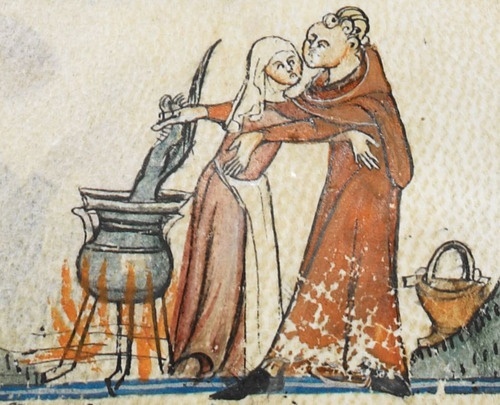
stewcook


Says the Stew Cook to Her Belovéd

Cat’s leaped on the kitchen counter, pawed a walnut from the bowl.
Liter of red wine waits for dinnertime—can’t say I’m not tempted, though.

Low sun highlights the bottle’s deep maroon while I make stew:
turnips, potatoes, garlic’s liquor, bay-leaf—needs only you.

Cool weather calls for firelight and whatever cooks long.
This cook longs to influence your taste, your tongue.

Since night’s expanded its acreage, taking over December,
we can build upon the dark, fill nooks with aromatic hours.

Come taste soup, share coriander scent, sip from this spoon.
Lick clean the bowl, my love, cover pots, come to bed soon.


~


~~  * I recognize, however, that for many many readers, the word Beloved will most closely be associated with Toni Morrison’s daring, beautiful, wrenching novel by that title–a work I highly recommend.

Lament

Today, another draft of another poem, also recent. Next, I think I’ll move to older work…material that I haven’t submitted for publication (or that I have submitted but has not been accepted). For now, though–this recent, perhaps too-fresh, lament.

~ ~ ~

The Work of the Body as It Ceases

Before we know ourselves
the body exerts itself, pulses,
lungs open into breath
blood sings with that air.

Unless there is ache
or ecstasy, the body labors
unnoticed while we tend
to other forms of work.

Look, now, at the last days
when the reliable diligence
of heart, lungs, kidneys halts
under strain the body can’t abide.

The throat cannot do its job
though body needs sustenance
and consciousness yearns
to say something unconveyable.

There is work always.
The long labor of maintenance
which, being humble, produces
no outcome except living.

The body’s nothing if not persistent
even as it dies, as vision narrows
and breathing weakens.
Those lively nerves? They settle.

Slowing is also work, as is
decay: work of a new sort
to which the workhorse body
can adapt in the quiet room

where those who loved the body
during its years of industry
do the work of mourning
which does not ever cease.

~

sunset1

Lacunae

With some encouragement from friends and colleagues, and with some trepidation, I am posting for the next few weeks some unfinished poem drafts and some poems from my Red Queen Hypothesis manuscript. That’s the plan, anyway. Plans, especially creative writing plans, seem often to go awry.

Given that my last two posts concern how we tell stories and what interrupts us from our narratives, I present herewith a draft of a poem concerning just that. I experiment here with gaps in form; I think of erasure poems (see Dave Bonta’s erasure poems on Via Negativa or Tracy K. Smith’s “Declaration”) though this is not one–the “erasure” here is internal, a series of neurological gaps and stutters.

I don’t know if the poem works as is, could use more tweaking and re-arrangement, or is so confusing as to be far off-base. Perhaps that depends upon the reader.

~


Lacunae

Writing self

Among the students I have tutored over the years was a young woman recovering from a traumatic brain injury. Writing was difficult for her on several levels. Reading on the screen or page tired her eyes and made it hard to focus; while using voice-activated software helped for that part of the writing issue, it did not resolve her larger cognitive loss: she found she could no longer tell a story. The ability to tie together research, concepts, and chronological moments to compose a logical narrative evaded her.

As we worked together, I learned how writing can restore the self. She began to reflect, through writing, on her process and her memories and to tether things together on the page so that they “made sense” to me–her sounding board. When something made sense to me, she would re-read it and decide if it reflected what it was she had been trying to say. Gradually, she felt more restored to herself, a slightly altered-by-trauma self, but a cohesive self who could tell a story again.

~

When I tutor students who are multilingual, particularly if they are fairly new immigrants here, I find that writing plays a similar role in reflecting or re-creating a self. These students learn to work and write using American English as their mode of persuasive communication, and in the process they develop as people who live in the United States and who consciously employ those terms, phrases, writing techniques, and concepts. They are much more conscious than “native” speakers about the fact that they are using Americanisms and writing in an American style; what they end up with is a self that they can deploy when necessary in American society.

~

Brain diseases, strokes, and dementia dismantle the story-telling ability. Whether we use the metaphor of braiding, warp & weft, or nuts & bolts, we mean that story has structure–and in dementia, structure comes undone. With that structural demise all too often comes the unraveling of the self. Each gap weakens the links that give us our own story-made self and leaves the human bereft of that consciousness we rely upon for being. The person whose brain has stopped constructing self stories is no less human, physically; but the self–that sentient, much-valued ego–disappears.

When I am with a hospice patient whose mind has stopped composing narratives, I see that the narrative of pain and envy and sorrow seems to depart. Is there a story that contains only peace? Could that even be a human story?

I don’t know what to make of all of this.

IMG_5015

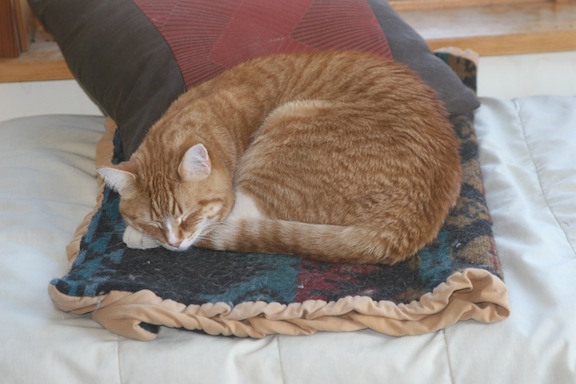
Sometimes, I wish I had the peace and confidence of a house cat.

The narrative vein

Every time there is a crime, journalists seek the story.

Police talk about putting together the story of the perpetrator. The person’s story assists in determining motive. Motive can assist in solving a crime or prosecuting the perpetrator.

Stories require conflict. What is a drama or novel without plot? There is a whole world of plot for narratives, but they tend to need conflict somewhere.

The narrative vein in poetry follows the same story source, although in poetry much can be compressed. There are nonetheless implications of conflict, sometimes powerfully so.

I have posted before about human beings as “The story-telling animal.” Brian Boyd and Daniel Dennett and others note the ways in which stories help us to understand ourselves and others.

I begin to think that storytelling gives us not merely a method for examining cognition, but that perhaps telling stories=human sentience. That perhaps we would not be sentient if we were not aware of stories, able to invent them, or try to recall our own memories in a storytelling fashion. We could be human beings without them, but we could not be sentient.

This is just a story I’m creating for myself in this moment.

This is my own story about sentience, consciousness, and compassion through understanding of narrative persons, personas, and perspectives.

At the same time, I find I wonder:

Do we need better stories?

33414458

Gratitude

Friday morning, I had the opportunity to spend an hour with high school students at our college-sponsored poetry festival for teens. I also got the chance to hear visiting poet Patrick Rosal read poems, talk about poetry, and answer student questions. The young people found Rosal engaging and inspirational.

My “workshop” group talked about apologies: what the word’s etymology is, what its connotations are, whether they’d ever felt sorry and what about, blame and forgiveness, excuses and reasons. I gave them four poetry examples. They really liked what they perceived as the the “sorry/not sorry” stance in William Carlos Williams’ poem “This Is Just to Say.” That a short, century-old poem resonates with 15-year-olds pleases me immensely; and I’m glad I could introduce them to it.

I decided to write a gratitude response poem to Dr. Williams, following his style.

~

Thus, I also extend my apologies to the poet.

~


This Is Just to Say

Three plum pits
on a white
dish
testify to
that cold
juicy sweetness

Those seeds
met soil
and grew

Those plum trees
flower
even now


~