Spotting the White Elephant: Ukraine on the Literary Map of the World

Here is a Fulbright-award-winning comparative lit scholar–Iryna Shuvalova–writing about Ukrainian poetry. I have been watching events in Ukraine (I have friends there); this essay includes some ways poetry and self-expression–and the lively poetry “scene” in Ukraine (not much translated into English)–connect with political events.

“One of the most touching videos from Ukraine’s “Euromaidan” events is the one, in which Serhiy Nigoyan, a member of Ukrainian Armenian community, recites the lines of Taras Shevchenko’s poem “Caucasus”. On January 22, Serhiy was killed by the members of the pro-government armed forces.”

Poetry can be dangerous.

poetryinternational's avatarPoetry International Online

Recently, among the riots in the streets of Kyiv and general unrest in the country, the current Ukrainian government has done two notable steps in recognition of the significance and weight Ukrainian poetry has in the affairs of the nation. The first step was to arrest a young poet together with his two friends and imprison them under alleged incrimination of “organizing mass riots”. The second step was to shoot the Secretary of the National Writers’ Union in the head: thankfully, with a rubber bullet. In light of these two accidents I could not help giving in to the urge of briefing the global community on the present state of literary affairs in the country, where the art of writing is obviously held in such great regard by the officials.

Spot the Question Mark

This country the size of France, squeezed between the European Union in the West and Russia’s…

View original post 1,558 more words

Spring cycle

This morning, five deer grazed languidly at the farthest edge of the meadow near the treeline. Some minutes after the small herd moved away, a lone doe hopped into view.

She was familiar to me. I have posted about her before–the doe with the missing leg, whose home base is located in our area. The University of Michigan’s Museum of Zoology website says odocoileus virginianus (the white-tail) lives an average of two years in the wild, but our semi-suburban region lacks large predators (other than cars) and offers quite a bit of protection. Maximum lifespan in the wild is 10 years, and I know that this particular doe is at least eight years old by now. She seems as spry as ever; very likely she is gestating another fawn.

The deer are pests in many ways–gardeners despair of deer depredations of ornamentals and native plants alike, and we also worry about their role as hosts of Lyme disease. Nevertheless, the deer and I co-exist peacefully, and their appearance at the fringe of the grassy field has signaled spring this year as they emerge from having “yarded up” in their camouflaged territory during the deep, snowy winter. They reestablish their familiar trails through the vines, thorn bushes, and grasses.

And there is something soothing about the cyclicality of the roving deer, the reappearance of their well-worn paths…even about my annoyance at finding the crocus leaves cropped and the branches of the pear trees nibbled.

Also, do forgive the pun–but what could be more endearing than this sight from May of 2011?

ann e michael

When foraging, females leave their offspring in dense vegetation for about four hours at a time. While waiting for the female to return, fawns lay flat on the ground with their necks outstretched, well camouflaged against the forest floor. Fawns withhold their feces and urine until the mother arrives, at which point she ingests whatever the fawn voids to deny predators any sign of the fawn.


Symbiosis: Lichen, moss, John Donne

lichenslate~

Lichen on slate makes a kind of mandala, a small moon, or star, of mutualistic symbiosis–because lichens are amazing compound organisms: a fungus and an alga, although apparently there can even be three living, botanical parts to some lichens. I find this amazing. Unsurprisingly, “Reproduction can be tricky for a compound organism,” because which organism’s reproductive directive does a composite organism adopt? Some explanations can be found at this site, the homepage of THE book on lichens by Irwin Brodo and Sharon and Stephen Sharnoff.

It is spring. The rain brightens up the mosses, and photosythesizing organisms begin to turn green. Bryophytes lack a vascular system, so they cannot draw water up through capillary action via xylem cells. They have to absorb water instead, and that is why mosses generally need moist, shady places in order to thrive.

Mosses decay, adding more moist humus to keep the soil damp or to extend the reaches of creeks very gradually, which is good for the riparian ecology and for the moss. A more metaphorical symbiosis, but we could stretch the concept.

japanesemapleSymbiotic relationships fascinate me, partly because of the evolutionary brilliance–nature is so “wise”–and partly because symbiosis is richly metaphorical if one’s inclined to think that way (which I am). For example, my personal sense of the relationship between art and poetry feels symbiotic: the disciplines “need” one another, help one another out, in terms of how I imagine and structure my world.

I do not think the world needs me, but I need the world; that’s dependency, not symbiosis. But mutualism–human beings need that reliance on one another. We are community-building creatures for all our harping on being self-reliant and independent. “No man is an island.” That over-used phrase (along with the over-used phrase that closes the same poem) is worth revisiting in Donne’s original:

No man is an island,
Entire of itself,
Every man is a piece of the continent,
A part of the main.
If a clod be washed away by the sea,
Europe is the less.
As well as if a promontory were.
As well as if a manor of thy friend’s
Or of thine own were:
Any man’s death diminishes me,
Because I am involved in mankind,
And therefore never send to know for whom the bell tolls;
It tolls for thee.

~

“Any man’s death diminishes me/because I am involved in mankind.” Would that more of us would remember these lines, and consider how they inform the poem’s lovely and significant purpose.

Leading the witness

Please forgive me if my recent posts are devoted more to teaching than to poetry, gardening, and speculative philosophical thinking–the semester end approaches, and I am endeavoring to ascertain whether my students have acquired any new knowledge about poetry and literary analysis. There are these supposedly-evaluative items known as “grades” which I must register for the college administration.

Spring and AllSo, exactly what, if anything, have they learned thus far? Considering that for the first few weeks of class I practically had to apply forceps to their vocal chords to get them to speak in class at all, let alone express a thought concerning poetry, most of them have progressed. Only a few students volunteer to answer a question I pose or offer an opinion in response, but when I look one of them in the eye and ask “What do you say?” I now get an answer instead of an embarrassed shrug.

This is headway indeed. Granted, the method I have used to initiate response might more accurately be called “leading the witness,” as opposed to Socratic inquiry. Most college sophomores I’ve met are so stymied by the whole genre of poetry that the classic method of advancing knowledge through inquiry results in nothing but puzzled silence and guessing, most of the time. I soften the approach by suggestions that, I hope, will lead to inference on the student’s side but that do not give away exactly what I am looking for. Because I do not always know, myself, what I am seeking. Because I want, once in awhile, to be surprised and delighted by a student’s inference–usually a point of view I have not previously considered (because I am not 19 and not a literature novice).

One of the things I love most about good poetry is the opportunity to be surprised, and perspective shifts offer the unexpected. I can lead the witness, perhaps, but I cannot lead all 30 witnesses (or whatever number of them happen to be paying enough attention to be led). The student I call on will respond directly and then inspire other, slightly variant, responses from classmates.

A discussion may actually ensue! Oh, joy!

I try to take note of which students seem to be engaging most actively so I can somehow calculate that into the evaluation, but I have not really developed an effective way to indicate the hoped-for “a-ha!” moment into a grade.

Theoretically, grades are objectively based upon a carefully-constructed rubric that reflects what the student knows about the discipline or subject area. I have therefore invented criteria, percentages, and the like for assessment as required by academic best practices–or at least by academic protocol. Having been always a student at seminar-style, narrative-evaluation-based higher education institutions, I admit that I find the typical grading methods disheartening and arbitrary.

Meanwhile, I continue leading the witnesses until the end of the semester.

~

By the way: It is April, and once again National Poetry Month. Please, go out and purchase a book of poetry. Or borrow one from the local library. Shout your barbaric yawps into the springtime air!

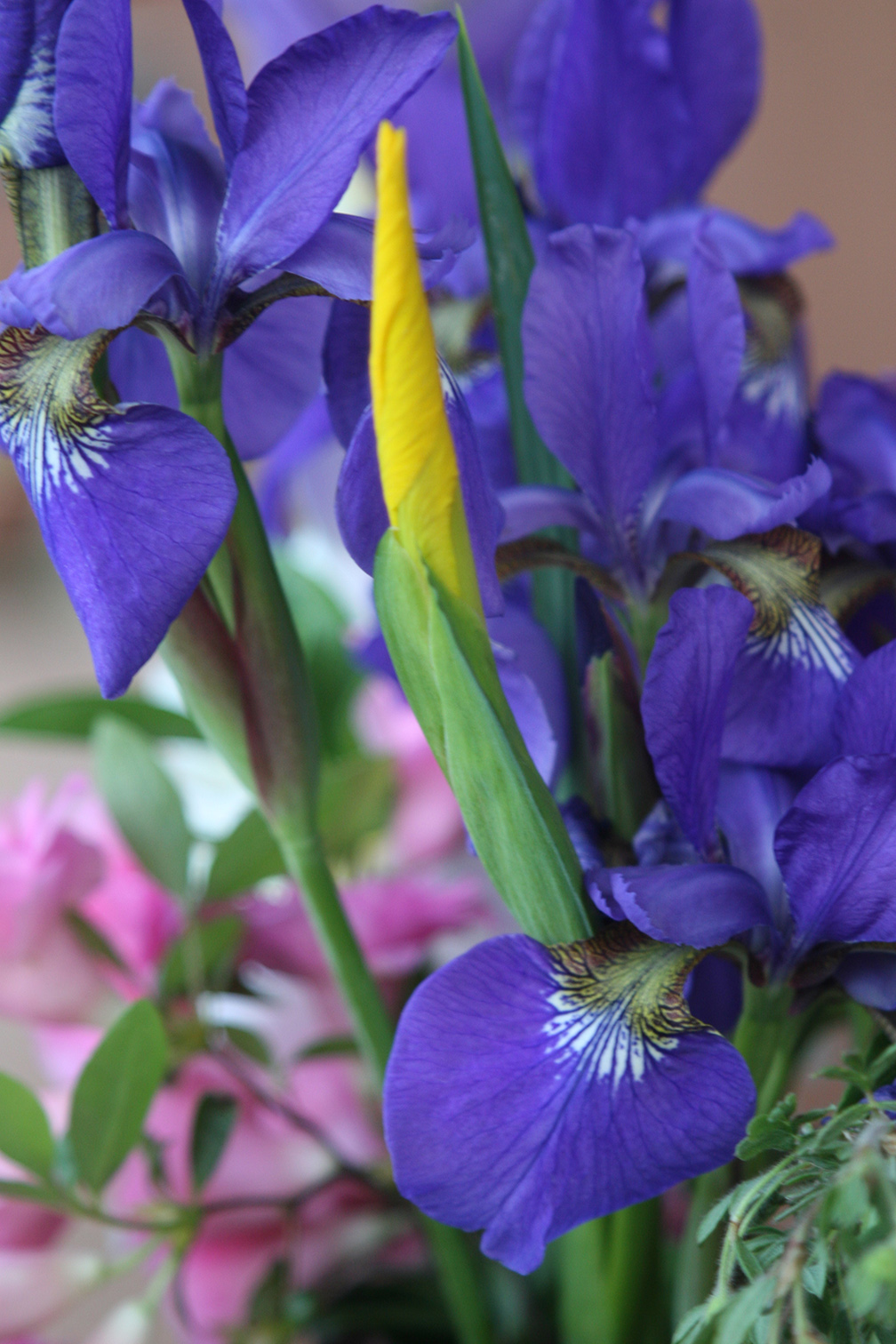
IMG_0575Iris reticulata

Michael and Maguire April 27th

An upcoming event. :)

information's avatarFox Chase Review

The Fox Chase Reading Series is pleased to present our Featured Poets/Writers Reading on April 27th with Poets Ann E. Michael and Dan Maguire at Ryerss Museum and Library, 7370 Central Avenue, Philadelphia, Pa. 19111. Host: Rodger Lowenthal.  The reading will begin @ 2pm in the second floor gallery of the museum. The features will be followed by an open reading

michael

Poet, essayist, librettist, and educator Ann E. Michael is Writing Coordinator at DeSales University. Her work has been published in many journals, including Poem, Natural Bridge, Ninth Letter, Runes, Diner, Sentence, Slant, ISLE, The Writer’s Chronicle, Schuylkill Valley Journal of the Arts and others, as well as in numerous literary anthologies. She is a past recipient of a Pennsylvania Council on the Arts Fellowship in Poetry. Her chapbooks include More than Shelter, The Minor Fauna, Small Things Rise & Go, and The Capable Heart. Her full-length collection, Water-Rites, is…

View original post 90 more words

Memorial

snowdrop

At last, the snowdrops: spring has deigned to return.

Renewal, rebirth–and remembrance.

~

In a post from 2011, I wrote about poet Chris Natale Peditto, a long-time friend who had recovered from a serious cerebral arteriovenous malformation that resulted in a temporary loss of his abilities to read, write, and speak.

Chris died in November of 2013, just before his 70th birthday. This afternoon, I will be attending a celebratory event in his memory in the city he loved and left, Philadelphia. We will be reading his poetry, letters, and prose, speaking poems aloud as he loved to do. There will be many artists of many kinds attending this gathering, and we will be honoring his place among us.

Outside this morning, a pelting rain, expected to clear a bit later today. A weather report that suits the mood.

Ink art

Last weekend, I went to New York with friends to see the Ink Art exhibit at the Metropolitan Museum of Art. The art, all of which is contemporary (the oldest artist represented was born in 1953), has been installed in the museum’s extensive Asian galleries alongside ceramic, sculptural, religious, and paper works going back centuries.

The rationale behind this juxtaposition, says the museum’s site, is to point up “how China’s ancient pattern of seeking cultural renewal through the reinterpretation of past models remains a viable creative path. Although all of the artists have transformed their sources through new modes of expression, visitors will recognize thematic, aesthetic, or technical attributes in their creations that have meaningful links to China’s artistic past.” That certainly proved true for me; and I cannot decide which was more intriguing, the similarities or the differences.

The young artists in Ink Art employ age-old cultural tropes: the triptych, the scroll, woodblock printing, calligraphy, moody landscapes, ideograms, ink, and repetition. The resonance with Chinese heritage is palpably authentic and is often employed in the service of criticism, mostly criticism aimed at the destruction of cultural icons and of the environment (some of the represented artists are exiles). Mounting the exhibition in the Asian galleries meant that the visitor confronts the historical and the contemporary simultaneously.

In Yang Yongliang’s “View of Tide,” the artist uses digital photography collaging to replicate the mood of an ancient Chinese landscape scroll which, on closer inspection, reveals that the austere and mystical imagery of sea and mountains has been composed of smokestacks, highways, powerlines, and the like. I found this work powerful as commentary and shocking in the best possible way.

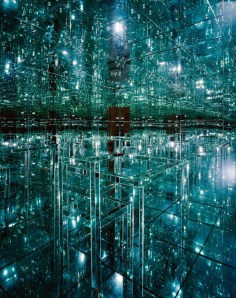
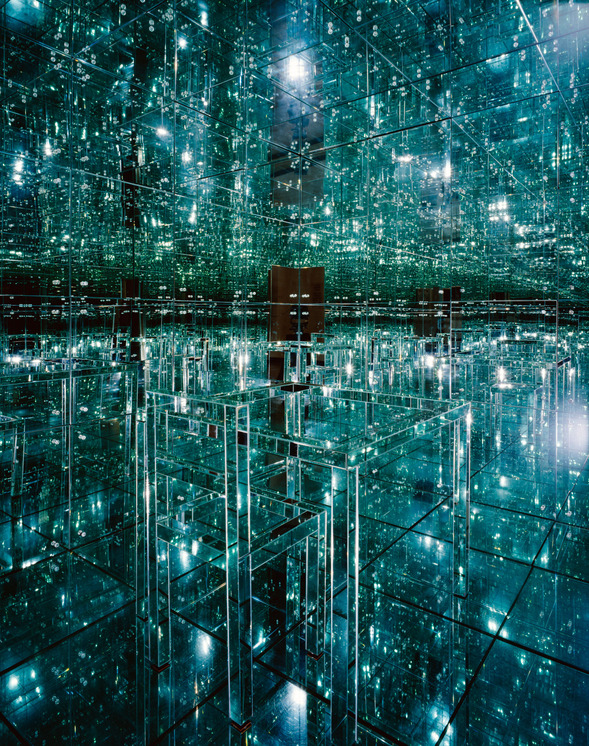
Being a word person as well as a visual art appreciator, I was especially drawn to the section of the exhibit called “The Written Word.” The highlight of this section is Xu Bing’s installation “Book from the Sky”. My friends and I–avid readers all–entered this room and felt shivers of recognition and joy at the concept of a room-sized, descending, ascending, wall-to-wall book. (I urge my readers to click on the link for a peek.) The information plaque notes “while the work is inspired by the form and typography of traditional Chinese woodblock publications, faithfully replicating every stylistic detail of traditional Chinese printing, not a single one of its roughly 1,200 characters—each printed with type hand-carved by the artist—is intelligible. Each of these imaginary characters conveys the appearance of legibility but remains defiantly undecipherable.” The paradox and the beauty of the concept are amazing; in addition, I find it oddly thrilling to think of the imagination and the craft and simple hard work Xu Bing put into creating meaningless calligraphic pictograms, cutting them into woodblocks, and repetitively setting up the careful lines in rows on long scrolls.

What emerges when the scrolls are installed on ceiling, walls, and floor manages to be indecipherable but not meaningless. There is in fact much opportunity for meaning in “Book from the Sky,” and for discussion and interpretation and playfulness.

One example: after reading about “Book from the Sky” and taking in the environment for awhile, my friend Mark commented, “Imagine if you were a beginner learning Chinese script, and you encountered this room. You might just spend hours in here trying to figure out whether you could read any of it…I mean, if  you hadn’t read that it was indecipherable. Or even if you had that knowledge, maybe you’d spend a long time here thinking that at least something in all this text meant something you could translate. Wouldn’t that be awfully frustrating?”

Or maybe that’s the point?

Carved type for “Book from the Sky” by Xu Bing

~~

Conceptual metaphor. Art. Thinking. Decipherability; communication. These are large ideas, and crucial ones in the scope of human community. Without art–how can we encounter such metaphors? How would we share them?

Enter the philosophy paper…

My “day job” at a small university is part administrative, part teaching, part assessment, and largely tutoring in writing. The last of these requires a peculiar balancing act, because my directive says I must not tutor discipline content; I have to tutor students toward “clear expression” while staying within the areas of grammar, spelling, vocabulary use, assignment interpretation, thesis writing, paper structure, and documentation. As a job description, that all sounds quite clearly delineated and objective enough, but writing well cannot happen when the writer fails to understand content material. Enter the Philosophy paper.

In any discipline, it’s difficult to separate tutoring “clear expression” in terms of grammar and vocabulary without also tutoring content. With philosophy that process is especially challenging, because to a large extent, philosophical understanding (content) relies on grammar (rhetoric). A student can contradict himself simply by neglecting to type the word “not” in a sentence, rendering his attempt at argument void. Or a student may announce she will use one approach to prove her claim and then prove the claim, quite adequately, with a different (and opposite!) approach.

This bust resides in the Louvre, and was found here: http://www.humanjourney.us/greece3.html

This bust resides in the Louvre, and was found here: http://www.humanjourney.us/greece3.html

Cases like these cause me to ponder. How can I coach the writer without offering a content-based answer? Philosophy itself supplies the method: inquiry.

“So, you say here that because Locke believed in Natural Law, he would not apply Natural Law in the case of the social contract. Can you explain that statement? Because it seems as though you are contradicting yourself, unless you accidentally added the word ‘not’ or unless you have more to say after this sentence…maybe, why he would not do so?”

“Here, you do a pretty good job explaining why beauty is in the eye of the beholder, although you need to pay more attention to your use of the comma. But back at your claim in paragraph one, you say you will prove beauty is transcendent–and your definition of transcendent doesn’t work with your argument in paragraph three…do you mean beauty is not transcendent? Did you forget a word, or are you missing a paragraph of explanation?”

When the science students or economics students bring papers to me, it is, I admit, much easier for me to stick to grammar and mechanics. The same sorts of logical structure or argument issues crop up, however. Sometimes, I feel as though I am right on the borderline, and sometimes I think I’ve teetered a bit too far into content tutorial–especially when the students are writing about history, philosophy, literature, or philosophy. Yet would any philosopher disagree that you cannot completely disentangle grammar logic from any other kind of logic? They stem from the same root.

The wildest moment

This morning we were visited by thousands of starlings, whirring in a murmuration of wings and twittering enough to raise quite a din. I was wrapped in a warm robe and standing on the back porch because my vegetable garden patch is finally free of snow, and I just wanted to remind myself that the earth lies waiting (and spring will indeed arrive). I heard the flocks arriving, not an uncommon occurrence this time of year, but had never observed such a huge group in my yard and treeline before. And they came so close! Spinning past me at eye level, five feet away.

I felt almost as if I were among them, and for the first time could see how individual birds suddenly reverse themselves–pivoting on a pinion-tip–followed by some in the group while others swooped away on a different arc. There seemed to be flocks within the general flock, each with its own pattern of loop or zig-zag, rushing level or stopping briefly on the muddy grass, some settling, some leaping, their flight paths intersecting…others taking a second or two to hover in the air as if deciding which invisible line to pursue.

The noise floored me. I felt my whole body respond, eyes wide, heart racing: awe, or elation, not fear. I noticed the neighbors’ cat, who often spends hours on my sunny back porch, had backed himself into a corner and was sitting alert but a bit cowed by the loud, wild activity of the birds.

Here’s a short article from Wired that includes a video and some links to research on the physics and dynamics of starling flocks, including the delightful theory of “critical transitions” which smacks of metaphorical possibilities I think I must explore in a poem someday soon.

I’ve looked for videos of starling murmurations, and there are many–but most of them show the flocks from a distance and leave off the noise of the birds, substituting new age music (see below). For me, part of the experience is aural. Too bad I did not have the means to capture today’s wildest moment; that must be left to the imagination.

Thing and All: Reading W. C. Williams Spring and All Through a Thing Theory Lens

Ok, herewith a little concatenation between the imagist “thingness of things” and phenomenology can be read into this critical blog post by Tom Holmes. Not all readers will want to bear with the academic, linguistic, and scholarly analysis here; but for those who do, it’s worth a read. I like the rather ridiculous but genuinely honest idea of “Thing Theory” in poetry.
Here’s an example: “Williams is rendering things, and the rendering is accomplished through the imagination rendering things physical as they are, or rendering their opacity and not their transparency.” So it’s crucial to examine relationships (subject-object relationship, etc.). I concur with Holmes’ assertion that the reader is asked–or required–to “re-see” the thing in question; note how point of view, perception, necessarily gets involved in that process. The re-seeing is a kind of re-creation within the poem’s recreational aspects (pun intended). And the poem becomes a Thing made of words, which of course is what a poem is…among other “Things.”
Holmes’ essay may suggest some controversial ways of reading and interpreting Williams and other poets. Have at that. :)

thelinebreak's avatarThe Line Break

Below I read William Carlos Williams Spring and All through a Thing Theory lens in an attempt to understand “Thing Theory.” My understanding of Thing Theory may not be complete, so if you have suggestions and/or want to clear up any of my misunderstandings, please leave a comment below.

//

Thing and All 

A Sense of Things: The Object Matter of American LiteratureIn Bill Brown’s “Introduction” to A Sense of Things: The Object Matter of American Literature, he makes a comment about Williams Carlos Williams and Williams’s Spring and All when he writes, Williams “seems to understand the process of wresting things away from life and experience to be the essential dynamic of the artist’s endeavor” (2). Later on, however, Brown misunderstands the meaning of Williams “no ideas but in things,” a quote from Williams that appears a few years later than Spring and All in the poem “Paterson.” In that misunderstanding, Brown also misses out on…

View original post 4,950 more words