Abstraction, evolution, & sky-beauty

I awakened this morning to a sunrise of surpassing beauty. As I drove to work, I remembered that the first poems I recall ever writing were about the wind and about dawn–perhaps I wrote other poems as a child, but these two are the only ones I remember: poems that celebrated something I found lovely in nature.

After the vivid morning sky, we had a day of rain; and on my commute home, a compelling sunset bookended the working day. I call these skies “beautiful” and would definitely regard my experience of looking at them as aesthetic.

And yet, it’s only the sky, some clouds, the sun, phenomena that science has explained. What makes it beautiful?

photo: Beejay Grob

photo: Beejay Grob (North Carolina coastal sky)

David Rothenberg’s 2011 book Survival of the Beautiful: Art, Science, and Evolution has accompanied me for the past week; I have been reading it when I can find time to read and to cogitate. Rothenberg speaks directly to the question of what makes us experience beauty, whether beauty is a human-only construct, and from where the qualities of aesthetic experience arise. He explores among other things whether beauty (especially in the form of art) evolved along with us, what makes it timeless (if it is indeed timeless), and whether our grounding in nature as earthly beings formed the grounding for what we deem beautiful.

And he considers symmetry and biology and abstract art and math and music. There’s quite a good deal of synthesis and speculation going on in this book.

~

Rothenberg writes that he is interested in whether humans’ developing education in abstractions–concepts and abstract arts–might produce an outcome that increases our appreciation of things in nature and the cosmos. He writes:

It might seem this century has freed us from interest in any kind of constricting form or function in art, but I want to test out a different theory: that abstraction in the arts has made us find more possible beauty in the natural world…as art exalts pure form and shape, the laws of symmetry and chaos found in mathematics and science seem ever more directly inspirational. Aesthetically, we become more prepared to see beauty where before we saw only the clues of beauty, its glimmers or possibilities…our minds are more attentive to an abstract kind of beauty that we can discover but not necessarily build or create.

It takes him several chapters to braid together the many strings of his interdisciplinary inquiries; but the upshot is that while I feel he does not answer the questions he begins with, he does deepen the reader’s thought process about art, beauty, and the evolution of ideas as well as of organisms. He says the interesting discussion lies not with what is or is not art, nor how to evaluate the individual merit of works, but rather “how artistic expression changes how we think in ways only art can accomplish.”

~

In light of Rothenberg’s musings on how natural-feeling abstract art can be, here are some examples: Barlow, Ellis, (contemporary) and Klee (modern).

Rothenberg concludes with some ambiguity about aesthetics and evolution, which suits his book-length and life-long explorations on the interweavings of these ideas; but he adds with certainty that “[b]iology is not here to explain away all that we love in terms of the practical and rational. That is not how nature works. Nor should we shrink from our natural astonishment at the magnificence evolution has produced.”

~

He mentions John Cage’s work and approach to composing, and I think Cage’s main point in so much of his work is getting us to listen, to see, getting us to be attentive. Viz Rothenberg’s words quoted above, maybe an integration of abstraction does open us to be more attentive to the beauty that exists in the world without any artist making it. We could not, in the past, have appreciated the fractal values of river deltas viewed from airplanes; and perhaps only natural (or trained) artists noticed how the twigs of a tree reiterate the shapes, angles, and curves of the branches, boughs, sometimes even bark. Now we know about Mandelbrot sets and fractal geometry, and those abstractions can generate beautiful patterns. Now we know the Fibonacci sequence of numbers–an abstraction–appears in snail shells and sunflower seed-heads.

We do not have to be mathematicians, chemists, art critics, environmental scientists, physicists, sculptors, violinists, composers, dancers, college professors or biologists to recognize patterns and symmetries, or to find that slight variations in the pattern enhance the experience through the kind of surprise and delight that I discover in great poems.

We just have to be attentive.

~

sunset1

Art, story, story, art

Yesterday, I attended a reading by former US Poet Laureate Kay Ryan in a more intimate setting (a luncheon) than I’ve ever been privileged to hear her at in the past. An audience member asked her how she would define art. Alas that I don’t write quickly enough to have taken her words down verbatim, but she offered a lovely answer.

She said that if a person cannot really be happy without doing it, and cannot keep from needing to do it, and if it nourishes or gives back to that person in ways nothing else can–then that “it” is art, in her opinion.

~

I suppose art also ought to speak to others, but I am not sure that is as necessary as art critics think it is.

~

Speaking of critics, and of art, I was impressed with Hilary Mantel’s 1998 novel The Giant, O’Brien for reasons that made a few critics rather lukewarm about it. The author is best known for her amazing historical works, well-researched and full of believably human perspective. O’Brien is a departure in several respects although still historical fiction. I read this book as an ambiguous moral tale, a myth, a story about stories (and art) and a depiction of ways the Enlightenment created significant losses in the midst of its gains. So I was less bothered by the exaggeration of certain personalities or minor plot gaps. O’Brien, a storyteller of the most shamanistic/primitive sort, also possesses a modern (Enlightenment) intellect and an artist’s “intuition.” But he never achieves fame, or the goal of restoring a beloved pub–the place he learned his craft–and dies painfully and slowly, impoverished and nearly abandoned.

As O’Brien nears death, Mantel writes that there comes “a point in fatigue or pain when logic slowly crumbles from the world, where reason’s bricks sieve to crumb. Where content flits from language…and departs.” And her character, the giant–who embodies in his hugeness the epitome of mythical narrative, the kind that sustains us even in dire poverty–eventually comes to the conclusion that the poor among us lose all. Of the poor man, he muses:

Stories cannot save him. When human memory runs out, there is the memory of animals; behind that, the memory of the plants, and behind that the memory of rocks. But the wind and the sea wear the rocks away; and the cell-line runs to its limit, where meaning falls away from it, and it loses knowledge of its own nature. Unless we plead on our knees with history, we are done for, we are lost. We must step sideways, into that country where space plaits and knots, where time folds and twists: where the years pass in a day.

What within us plaits and knots and folds and twists but the brain itself? We pass along our knowledge and, more importantly, our stories. That is done from brain to brain through language and music and art, even as the individual brain comes to the end of its viability and vitality. We step sideways into another person’s brain, just as O’Brien’s listeners memorize his tales, his cadence, his figurative speech. So, in the end, O’Brien is wrong.

~

I attended a funeral today at which the officiant encouraged us to keep the departed alive in our hearts and for the future by telling stories he had told or by relating stories about him to anyone who might listen. I know I have previously written about this idea in conjunction with readings and philosophers and art and literature. The more I encounter it, the truer it seems to me.

The bereaved spouse at this funeral is a person who is losing her own story through senile dementia, though she has some occasional awareness of her memory loss. Her ability to carry on her husband’s narrative is already deeply diminished or perhaps completely gone.

These are among our risks.

~

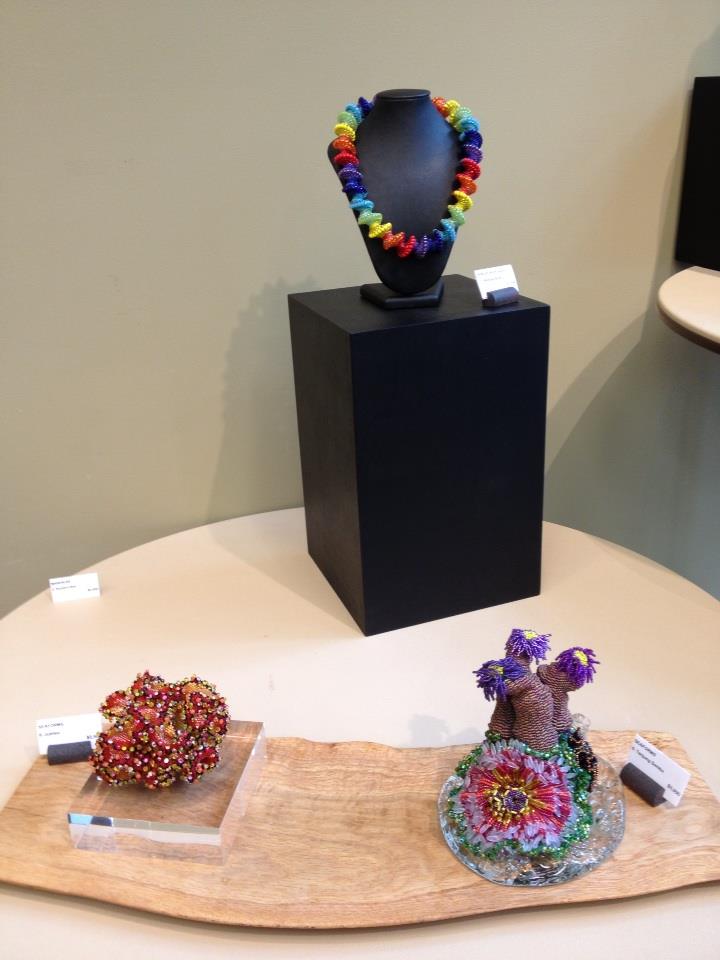
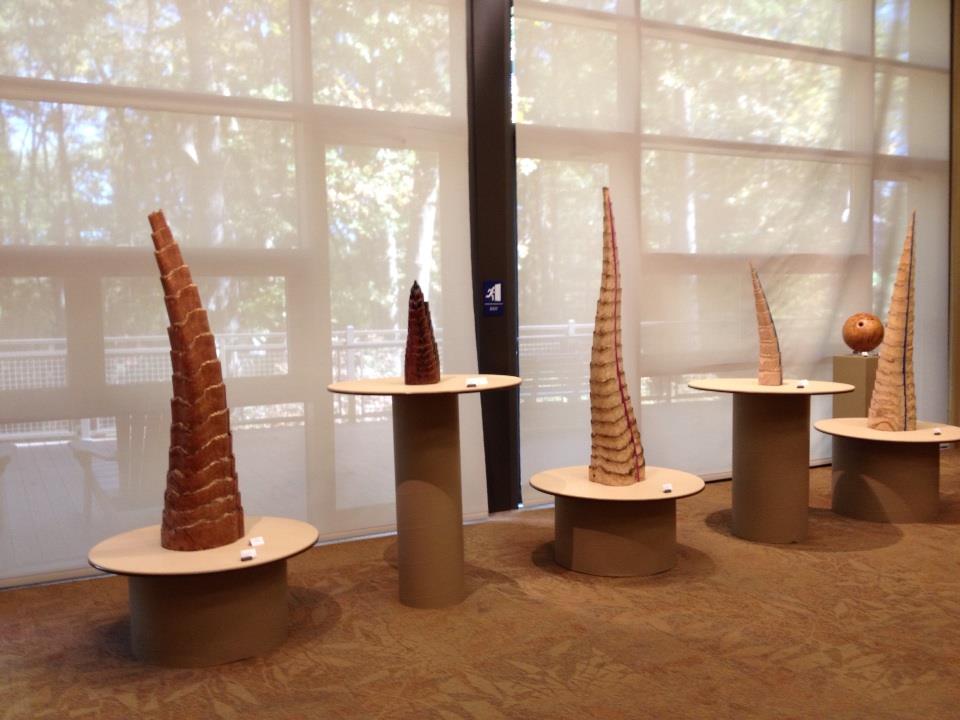
These words brought to mind my long-time friends, the craft-artists David Ellsworth (turned and other wooden forms) and Wendy Ellsworth (beaded forms). This month, for the first time in their many years together, they have a joint exhibit in the gallery space at Jenkins Arboretum (Devon, PA). The photos below are snapshots Wendy took, and their individual work is best viewed in person or on their studio website. [Contact the artists for permissions, photos, information about workshops and talks.]

Wendy Ellsworth's seaforms, and a necklace

Wendy Ellsworth’s seaforms, and a necklace

Wendy's "Sunset" (with David's turned-wood frame/container)

Wendy’s “Sunset” (with David’s turned-wood frame/container)

David Ellsworth's "Emergence" series

David Ellsworth’s “Emergence” series

I have known Wendy and David for over 25 years, and I can testify that the work each of them does fits Kay Ryan’s description of art. They are artists, and their work nourishes both of them–and nourishes us, the beneficiaries, as well.

~

For today, these are my stories.

www.ellworthstudios.com

Er – sur –

Mary Ruefle writes, in her book of “lectures,” Madness, Rack, & Honey: “I remember being so young I thought all artists were good, kind, loving, exceptionally interesting, and exemplary human beings.”

I was a child like that. It’s good to know there was at least one other. We grow up to know that such artists are far from common. But they do exist.

Each time I learned a “bad” thing about an artist, poet, or writer I loved, I felt a little deflated. Something was being taken away from my idea of the person who made such wonderful work.

Later, I rather empathized with Roland Barthes’ theorizing about the death of the author. Not because I was necessarily post-modern but because sometimes, I wanted the artist-as-person to be erased so that I could go back to loving the art-as-art. This was a juvenile way of thinking about both human beings and about art.

But: the lure of erasure…

~

Ruefle muses about time, about art, literature, and the human being. Her assays to determine what endures among us often feel a bit cryptic or aphoristic at the first encounter. The wisdom in them, and the layeredness–and the awareness of what is “missing” in her texts–evolved in my own mind as I read her book, slowly.

She has used erasure as a means to expression and to beauty, as it happens. Examples of her erasure poems appear on The Poetry Foundation’s website here.

~

The closing epigraph of Madness, Rack, & Honey (is it an epigraph if it falls at the end of the book?) is from Samuel Pepys’ Diary following the Great Fire “…an abundance of pieces of burnt papers were cast by the wind as far as Cranborne; and among others she took up one…which was a little bit of paper that had been printed, whereon there remained no more nor less than these words: “Time, it is done.”

Time.clock

~

For Dave Bonta’s interpretation of erasure poems–based upon Pepys’ diary–see via negativa here.

~

“Exhibit 13,” by Blue Man Group, follows an abundance of pieces of burnt papers cast by the wind, as well.

Virtual, physical, personal

~

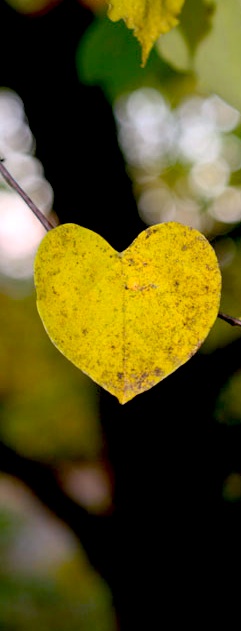
Redbud leaf in fall

Through the blogosphere, I’ve met some fascinating and talented people. The virtual connection, although I have learned to value its scope and immediacy, generally seems a bit wanting in connection for me. Even though I tend toward introversion, my favorite way to connect with people remains face-to-face. [Go ahead, call me old-fashioned.]

In the days of listservs and message boards, I first began “meeting” colleagues online. I signed up for the Women’s Poetry listserv (Wom-Po), which is still active today. One of the best things about that list, besides the fact that I learned a great deal about poetry/women’s poetry/teaching poetry/contemporary and historical female poets, is that I met many of my colleagues in person while attending writer’s conferences, readings, and similar events.

What joy for a person like me, who tends to be a bit reserved about meeting new people. For introverts, a virtual introduction and conversational exchange online–even just recognizing a name on the listserv–has made possible a route to social icebreaking at conferences like AWP.

This past Saturday, another virtual connection joined the realm of the physical when I got the chance to meet–in person–artist Deborah Barlow at the opening of her show at Morpeth Contemporary gallery. I’ve seen her artwork on her homepage; but as is often the case, viewing the work in person was revelatory and beautiful. And meeting the artist herself–also revelatory and beautiful!

I recommend her blog, Slow Muse, which has alerted me to many a terrific book on creative thinking, the creative process, and poetry as well as introduced me to several wonderful contemporary artists’ work.

As the seasons undertake the dying-toward-renewal process, I welcome musings and inspirations. The shining, textural depths of Barlow’s paintings offer another way of looking. As do good books and sunny mornings on the back porch.

Poetry and art

A colleague pointed out art critic Holland Cotter’s New York Times piece as a must-read for me with my interests in both disciplines. Here is the link to Cotter’s essay in the “First Crush” series the Times runs: Cotter August 13, 2013.

Cotter says the first love was language, specifically poetry, especially Longfellow and Dickinson.

“If you fall for Dickinson early, you’re committed to language for life, and almost unavoidably to Dickinson’s kind of language. It’s more concrete than just words on a page or in the air. It’s language as a physical material, a substance so concentrated that you can all but hold it in your hands, turn it over, feel its textures.

And it’s addictive. Once in your system, it’s impossible to shake, like a neurological imprint. In my experience, Longfellow’s intensely visual poetry was like a mural or a movie. You just wanted to stand back and let it happen to you. Dickinson’s language was visual, too, but in a startling, flashbulb way — a bang of illumination after which your vision took time to adjust to normal light.

Poetry, in general, made me sense that language could be about big, urgent subjects, the kind that ruffled even a 9-year-old mind. Will everyone I love always be here? If not, where, exactly, is heaven, and what does it look like? Perhaps most important to a writer in formation, Dickinson’s language felt personally usable. It made you want to write, made you think you could. So I did, just for the pleasure and power of creating pictures from words.”

What can I add but “Amen to that”?

It interests me greatly, though, that Cotter made his trajectory from poetry to art; my path went the other direction. I began with a fascination for and study of art and ended up as a writer.

Overlaps and linkages, interdiscipline & creativity. Big, urgent subjects…a kind of power. That’s art.

Tension or rebellion?

In my few available moments during which I can write about being intellectually engaged and curious, I’ve been working on this post. It’s been a “draft” on my dashboard for some time as I work on it. For background, recall that I was reading Octavio Paz’s prose and Dave Hickey’s essays in The Invisible Dragon.

~

Rubber-Band-Shooter_preview_featured

~

Both writers take up the concept of beauty in art. They approach the topic in different ways, of course, but both make note of the requirement for tension in the work of art. The tension can be of anticipation, expectation, surprise, or of opposition and rebellion. The need for anticipation and turns or surprise in poetry reminds me of Robert Bly’s idea of the “leap” in poetry–in fact, Paz is one of the poets Bly uses as an example of “leaping poetry” in Bly’s classic 1972 tract, Leaping Poetry. I infer that these emotion-forms are related to one another and that aesthetics involves at least some connection between experience (physical, emotional) and mind.

[For now, I will not take up the possibility of calm, contemplative, no-tension beauty.]

Instead, it is intriguing to consider the ways Paz and Hickey interconnect regarding the idea of rebellious art. Also, there’s an agreement between them–not literally, as they are not responding to one another at all–concerning art that is funded by governments. Both critics contend that way lies danger.

Hickey’s essays in The Invisible Dragon were sparked by the controversy of Robert Mapplethorpe’s U.S. NEA-funded photographs. These photographs are beautiful, Hickey says, though art critics of the 1990s dismissed the “beautiful” aspect of the work and concentrated on its “message,” while many other viewers considered the images pornographic and offensive. Hickey says, essentially, to hell with the message; look at the art: is it beautiful, or not?

Hickey writes:

My point here is that there are issues worth advancing in images that are worth admiring–that the truth is never plain nor appearances sincere. To try to make them so is to neutralize the primary, gorgeous eccentricity of imagery in Western culture since the Reformation: the fact that it cannot be trusted, that images are always presumed to be proposing something contestable and controversial. his is the sheer, ebullient, slithering, dangerous fun of it. No image is inviolable in our dance hall of visual politics. All images are potentially powerful. Bad graphics topple good governments and occlude good ideas. Good graphics sustain bad governments and worse governments. The fluid nuancing of pleasure, power, and beauty is serious business in this culture.

Hickey’s prose is such fun! And so provocative. He asserts that Senator Jesse Helms (who began the noisy movement to de-fund the NEA’s support of work such as Mapplethorpe’s) was the only public figure who really “got” what Mapplethorpe’s homoerotic pictures were saying: they really were a rebellion, a transgression–a purposeful confrontation with social norms. That’s what many artists and poets do: throw a wrench into the usual mundanities of life and make viewers or readers pause, react, reflect.

Mapplethorpe’s choice of images just happened to be considered sexually transgressive; and Hickey says that because the USA is a democracy, Helms’ right to protest was as valid as the photographer’s right to make the images in the first place. Hickey loved that there was potential for real discovery in that moment, and gives art critics and academics a hard time for retreating into ideas of First Amendment and artistic self-expression and meaning over beauty. He claims that when it comes to the US democratic culture of the arts, “whatever we get, we deserve–and what we get most prominently is ignored, disenfranchised, and instructed. Then we are told it is ‘good’ for us.” But what is good for us by the standards of a bureaucratic culture is not the original contract between the image and its viewer, even though that is the interaction that ignites the spark of awe we feel when we encounter great art.

“In fact, nothing redeems but beauty, its generous permission, its gorgeous celebration of all that has previously been uncelebrated.”

Hickey lambasts Americans for somewhat mindlessly appreciating what we are told is great art. “In our mild appreciation,” he writes, “we refuse to engage the argument of images that deal so intimately with trust, pain, love, and the giving up of the self.”

Paz’s chapter on the image in poetry dovetails with the argument of images and the intimacy thereof. That’s the contract the viewer or reader makes with the artwork or the poem: we agree to be, potentially, moved; to make ourselves possibly vulnerable to rhetoric, to pain, to love, to beauty, to sudden awareness of what has been overlooked, ignored, oppressed, made alien.

Through image. Through tension. Through a state of contrariness and forbidden looking: rebellion.

~

In a week or so I do plan to spend more time on Paz, because I find his essays on poetry enlightening on an intellectual and on a more basic/fundamental level. Hickey’s work on beauty relates to writing but is more specific to the visual and plastic arts. I do recommend Hickey for his humorous but incredibly observant role as a socio-cultural commentator on contemporary USAmerican pop culture, academic culture, political culture, and democratic-capitalist thinking. He’s accurate and insightful even when I don’t completely agree with him. He believes whole-heartedly in discourse and discovery through democratic discussion of multiple viewpoints. Check him out. You will want to argue with him.

Here’s something lovely

…from Maria Popova at the Brainpickings site: book loving and writing and art and literacy and library connect to produce this event/display at the New York Public Library. I was in the city just last week–rats, I missed this. (But I did see Ken Price at the Metropolitan Museum of Art and spent part of a lovely afternoon at Untermyer Park again).

~ Please click on the links! (I know they’re kind of hard to see on this theme)~

MEANWHILE…

I’m on blogging hiatus again while I get accustomed to my work week and while we prepare for the Goschenhoppen Folk Festival (or on Facebook here) this coming Friday and Saturday. Not a time to get much writing done, nor much reading.

A festival participant prepares apples for drying

A festival participant (19th c) prepares apples for drying

Young apprentices (18th c) at work

Young apprentices (18th c) at work

Hail and Heidegger

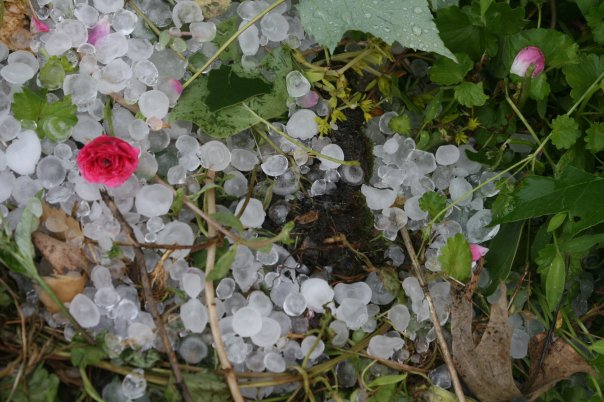
hail and roses

Another freakish, brief summer storm swept through–this time bringing wind, fog, downpours, and hail. Not a gardener’s favorite weather system under any circumstances. Some years ago, a June 9 hailstorm literally decimated (reduced by 10%…though I think it was more like 25%) my gardens and produced the mammatus cloudforms that show up on my “About” page. Yesterday’s hailstorm was–thankfully–not as damaging. Most of the plants will recover fairly rapidly, I think.

~

Meanwhile, I’m trying to educate myself a bit more on the history of phenomenology as it relates to poetry, art, and poetics by reading a bit of Martin Heidegger. This is a backwards chronology, but I’m not feeling ready to take up Husserl yet. Heidegger’s also problematic because of his early embrace of the Nazi party (he resigned early, too, in 1938, but never made a full repudiation). I understand that great thinkers can nonetheless be very flawed human beings. Michael Wheeler’s thorough essay in the Stanford Encyclopedia of Philosophy touches on some of the contradictions and covers Heidegger’s major work. But I am reading Hofstadter’s translation of “Poetry, Language, Thought” and six other shorter essays, such as “What Are Poets For?” and “The Origin of a Work of Art.” Actually, it is hard to consider the first text as an essay. It’s more like a poem in aphorisms. An excerpt:

~

When through a rent in the rain-clouded
sky a ray of sun suddenly glides
over the gloom of the meadows .  .  .  .

We never come to thoughts. They come
to us.

That is the proper hour of discourse.

Discourse cheers us to companionable
reflection. Such reflection neither
parades polemical opinions nor does it
tolerate complaisant agreement. The sail
of thinking keeps trimmed hard to the
wind of the matter.

From such companionship a few perhaps
may rise to be journeymen in the
craft of thinking. So that one of them,
unforeseen, may become a master.

~

Almost Confucian, no?

~

Later in his life, Heidegger moved on from his earlier philosophizing on the ontology of being (he pointed out the need to define “exist” as a premise in any such inquiry) and began to suggest that art exists within the materials/tools of the artist as well as within the artist’s being and abilities, all in a perhaps simultaneous collection of conditions. Wheeler says, “poiesis is to be understood as a process of gathering together and fashioning natural materials in such a way that the human project in which they figure is in a deep harmony with, indeed reveals—or as Heidegger sometimes says when discussing poiesis, brings forth—the essence of those materials and any natural environment in which they are set.”

Heidegger writes, for example, that “a true cabinetmaker…makes himself answer and respond above all to the different kinds of wood and to the shapes slumbering within wood—to wood as it enters into man’s dwelling with all the hidden riches of its essence. In fact, this relatedness to wood is what maintains the whole craft. Without that relatedness, the craft will never be anything but empty busywork…” Wheeler calls this manifestation of the art within the materials (which the artist must understand in order to use her talents and tools to bring forth) a “process of revealing.” Kin, I suppose, to the words often attributed to Michelangelo: I saw the angel in the marble and carved until I set him free.

~

Art, gardens, weather, poetry, the craft of thinking…all processes of revealing and transformation. “We never come to thoughts. They come to us.”ann e. michael hail foot

“The difference between Despair/And Fear”

~

Events such as the tsunamis in Indonesia and Japan, devastating earthquakes or hurricanes that result in high death tolls, industrial accidents that destroy communities—these seem impossible to control and blame is hard to place, even in the latter case. News coverage in such situations tends to focus on damage and recovery efforts, then shifts to the next drama. Tragedies wrought by specific human perpetrators, however, become media spectacles here in the USA. The same few seconds of terrible footage repeatedly fill television and computer screens; viewers feel drawn into the activities of SWAT teams and reporters and the compelling speculations of forensic psychologists, terrorism experts, social commentators, politicians, witnesses. There are heated exchanges on social media forums.

~

I’m beginning to believe societies get the popular culture they want or, alas, deserve (late Rome’s “bread and circuses,” anyone?). The circuses give us what society’s members, apparently, want to consume. Art, however, offers what they need, whether or not they want it. During times of media frenzy, when the culture in which I live seems numbed by “infotainment” and nonstop visual and audio coverage of tragic events, I find myself turning to art—usually poetry—for grounding, for solace, for affirmation of the human spirit and for a way to confront human truths.

~

I do not suggest that poetry necessarily comforts. Often, it wears me ragged, forces me to wrestle with ambiguities, to question my values. Sometimes, art brings me to tears.

I do not consider these results to be negative results. These reactions are human reactions; I am reminded of my humanity through my engagement with art.

A good little anthology for times of grief is The Handbook of Heartbreak, edited by Robert Pinsky. Pinsky’s selections cover the human spectrum of sorrows: broken romances, dead pets, war, disaster, family and social losses and the desolate emptiness of depression, sorrow that is concrete and existential, spiritual and personal and cultural.

~

Speculation is something inquisitive minds do well, but it is easy to believe our speculations, to forget they are merely imaginings that may or may not be valid. When a crime becomes a widely-broadcast web of information blips, the suspect is forejudged in the court of public opinion; I feel concerned about our nation’s commitment to the concept of innocent until proven guilty in a court of law (how on earth will that be possible?). What irks me most about media coverage of the Newtown, Virginia Tech, Aurora, Tucson, Boston Marathon, Columbine and other killings is the retreat into a kind of contorted deductive reasoning based on imaginative constructions of human intent and purpose—the search for motivation that drives the forensic end of these crimes becomes a news story led by experts who imply they can get to the truth. But can we ever know the truth? Each human being is unique and ultimately unexplainable, and often the way we are best reminded of that fact is through art: fiction, theater, paintings, poetry. On his New Yorker blog, Adam Gopnik notes:

Experts tell us the meaning of what they haven’t seen; poets and novelists tell us the meaning of what they haven’t seen, either, but have somehow managed to fully imagine. Maybe the literature of terrorism, from Conrad to Updike (and let us not forget Tolstoy, fascinated by the Chechens) can now throw a little light on how apparently likable kids become cold-hearted killers. Acts of imagination are different from acts of projection: one kind terrifies; the other clarifies.

~

We need clarity.

~

I might add that in my day job, I work with young people between the ages of 17 and 24, day in, day out. These young adults experience varying levels of frustration, confusion, numbness, fear, anxiety, excitement, need for risk, need for security, withdrawal, social discomfort, and inner turmoil. I cannot look at the perpetrators of recent civilian massacres without thinking of my students. I do not mean that I am wary or that I think one of my students might snap; what I mean is that I feel compassion for the conflictedness each human being is capable of feeling and that I understand all too well that not all of us are capable of contending with that conflict.

Some of us can accomplish through acts of imagination the confrontation with what terrifies or numbs us. These people include our artists. Those who cannot express or embrace the confrontation are at risk of projecting the inner conflict, fear, or insecurity elsewhere, as Gopnik makes clear.

Can art make us safe? We live in the world: not an inherently safe place. I think if we embrace what art offers us we will not be in retreat from the truths of the human experience but will learn to confront truths, even those that are uncomfortable. Art gives us insight, a step toward understanding. Can art grant us clarity? I think so.

Therefore, Emily Dickinson (305):

The difference between Despair
And Fear—is like the One
Between the instant of a Wreck—
And when the Wreck has been—

The Mind is smooth—no Motion—
Contented as the Eye
Upon the Forehead of a Bust—
That knows—it cannot see—

~


Mortise & tenon

In a post late last year, I examined a Gerard Manley Hopkins poem for the way the lines and images might be considered as hinges. Another metaphor for how poems work–one I have been churning in my mind for a couple of years now–is joinery of another kind: mortise and tenon. What joinery does in woodworking is allow the cabinetmaker to connect separate pieces of wood together in such a way as to allow a little movement as the wood responds to temperature and moisture changes. Good wood joinery requires experience and thoughtful attention, as there are often additional challenges such as connecting end grain to long grain. Amateurs resort to screws, nails, and glue to cobble projects together because joinery takes time to learn and requires technique and practice that the average DIY “carpenter” does not possess.

True craftspeople learn, practice, and employ conventional joinery techniques and often develop their own signature styles. The craft of woodworking parallels the craft of poetry: there are tools and techniques, strategies and conventions, patterns to follow, and inventions and innovations to create. Both crafts join together materials that seem alike (wood to wood, words to words), and yet it can be damned hard to get those connections to hang together solidly and make a coherent and stable whole.

~

Odate's

Odate’s “Pride of New England” [1982] photo: Laure Olender

~

My friend Toshio Odate was trained as a shoji maker and has worked as an educator, artist (sculpture), and craftsman-in-wood for most of his 82 years. Possibly his best-known book is the practical but also spiritual Japanese Woodworking Tools: Their Tradition, Spirit and Use. This text will teach you how to choose, care for, sharpen and use traditional Japanese hand tools, meanwhile illuminating the history and spirit of the woodworking craft in Japan. Toshio reveres the work of humans, the human touch, the effort of making that goes into a handmade object; and his sculptural pieces reflect his passion. The large sculpture above, Pride of New England, stands on his property under the hardwood trees and above the nearby creek. Nothing holds these huge slabs and trunks of wood together but hand-cut joints: mortise and tenon, mostly.

~

I’m going to try to explain a connection between poetry and joinery through a brief examination of the poem “Whereof the Gift Is Small” by Maxine Kumin. This poem appears here, and I think you ought to check out the link to a Q & A on this poem, as it is enlightening and amusing (as Kumin so often is).

Whereof the Gift Is Small

       Henry Howard, Earl of Surrey

And short the season, first rubythroat
in the fading lilacs, alyssum in bloom,
a honeybee bumbling in the bleeding heart
on my gelding’s grave while beetles swarm
him underground. Wet feet, wet cuffs,
little flecks of buttercup on my sneaker toes,
bluets, violets crowding out the tufts
of rich new grass the horses nose
and nibble like sleepwalkers held fast—
brittle beauty—might this be the last?

~

This lovely small poem is framed by phrases from Henry Howard, Earl of Surrey’s sonnet “The Frailty and Hurtfulness of Beauty,” so right away we have an old poem joined to a new one; and as Kumin admits in her commentary on the piece, “Picking lines from others’ poems is hazardous and I don’t recommend it.” Woodworkers will recommend that old, seasoned wood not be joined to green wood for practical reasons. Good reasons, too. But that does not mean one should never attempt it or that it cannot be successfully done. A master like Maxine Kumin can succeed–but with caution.

How might one approach the joinery of words as apparently distant from one another in tone or image as “sneaker” and “rubythroat”? The grave of the gelding (a gap, into which something solid may be placed) gives the reader one opening. There is also the stepping-down aspect of the images, each connecting to the next. The bird appears higher in the poem, quite literally, up there with the lilacs fading on their tall stems; but the alyssum blooms much lower to the earth, as do the bleeding hearts where the bee is busy. The grave and beetles take us deeper. Then, up ever so slightly, to the low-growing buttercups and the damp cuffs of the speaker’s trousers and the noses of still-living, grazing horses…with a “brittle” reminder that this season is short (“the gift is small”). If you are familiar with Surrey’s poem, there’s a marvelous resonance here, though I feel Kumin’s tenor is a bit less cynical than Surrey’s.

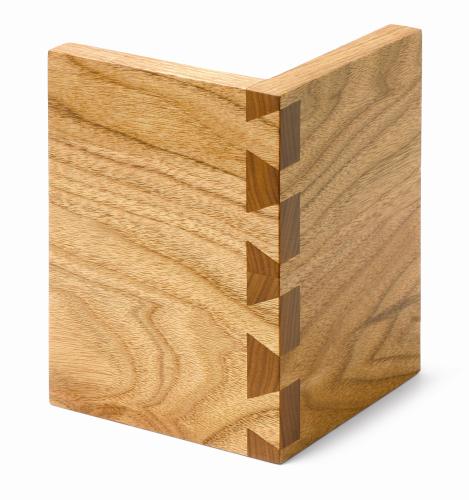
dovetail joint

dovetail joint

Kumin’s poem is not a full sonnet, and some of her end-rhymes are slant. A modernity pervades her piece, yet the older poem’s language and sensibility are evoked nonetheless. How elegantly she achieves this balance. I think the first joint in the poem appears at line 4, at which point the nature imagery of the first three lines, which could incline to the romantic, solidly connects with the real fact of death. This line also introduces us to our speaker: the gelding is “my” gelding. Line 6 provides another clear connection: the speaker here exists very much in the present moment, wearing sneakers, noticing the buttercups. This line fits into the poem like a well-cut dovetail, linking the pastoral descriptions with the reflective mode the speaker turns to after observing the horses. And there, between the em dashes, we find Surrey’s “brittle beauty,” a tenon that fits the space and holds the entire brief poem together.

Good joinery is often invisible except to those who appreciate the work and take the time to look for it. Toshio solved the engineering challenge of constructing his sculpture through a process of reflection, experiment, experience, and revision. How like a poet’s work that seems to me! When I told him I feel his work is analogous to poetry, he was initially flabbergasted. Maybe the surprise stemmed from a difference in the approach to poetry across cultures, or maybe from a difference in the way a plastic artist perceives a largely abstract art like poetry. Maybe I could not explain my idea adequately to a person for whom English is not a first language. Actually, I’m not certain he believed there is as much human touch and hand-work involved in poem-making as there is in woodworking or the sort of made-by-hand sculpture Toshio does. We agreed not to fully understand one another.

About a year later, I attended a special event at his home, a celebration of the Object as Being, for which I composed a poem. That summer, he called and said, “I think maybe I understand now what you mean.”

~

endnote: If you’re interested in learning more about Toshio Odate, here is a 1996 article from The New York Times and a 2009 blog post (including a short video) from Tom’s Workbench, as well as a short on making shoji screens–from Martha Stewart’s network.