About art (a poem)

While trying, I fear in vain, to tidy up and organize my poetry files, I came across this poem composed before 1997. Despite its flaws, I decided that rather than revise I should post it here, because it offers a narrative about how a person–shall I specify, this particular person–might come to love the wide, multicultural, historical, spiritual, experimental, transcendent “world” of art.

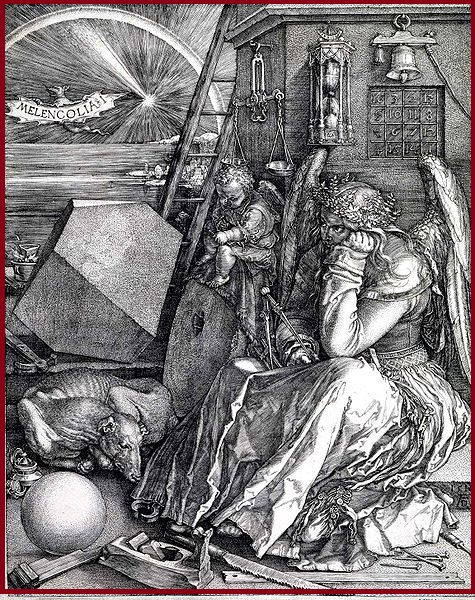
Melencolia_I_(Durero)
A Life Saved by Art

The library’s card catalog led me
to shelves of art books: oversized, glossy-paged,
crabbed with tiny, inarticulate commentary
about volume, form, structure,
perspective, light and shadow,
innovation and rebelliousness
and the emotive content of the line.

What did it mean? I was eleven.
I made a hagiography based upon
the beauty of still things, life arrested,
mid-gesture, on canvas, wood, stucco,
merging all my saints and artists into
a collage of stories as naive
as Rousseau’s jungle scenes–

but I believed Rousseau, and Breughel
and the intimacies of Rembrandt’s Bathsheba
and the endless processions of amazed Magi
through the narrow streets of precarious Italian towns
and Degas’ women tying up their hair
and the rich invitingness of Gauguin’s flowers
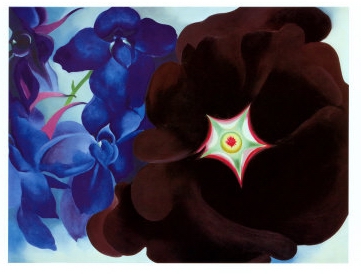
and the stark heart of Georgia O’Keeffe–12-01-05MagiFraAngelico

I believed I would learn to comprehend my life,
put it into perspective through
Giotto’s tiny and exquisite backgrounds,
Dürer’s precise grids, believed I would discover
an understanding of the abstract.
I wanted to be transformed through art,
the sanctity and structure of the line,
and, through them, out
of the coming confines of adolescence.

I forget so much of what I learned,
but still I possess Arles, and Athens,
the buff-colored pages of
Da Vinci’s notebooks, ink and ideas:
ink which now sprawls abstract upon the page
while I consider the emotive content
of each line–and brilliant fields of color
daubed in wild and perfect order:
a moment, a childhood, a life
saved by art.black-hollyhock-blue-larkspur-georgia-okeeffe

~ © 1997 Ann E. Michael

~

There are better poems about art (even by me); but I treasure the yearning outlook this piece suggests, and its tendency toward overstatement as well.

Synthesis & coincidence

&&001“and per se and”

Ah, synthesis! The conjoining and combining of objects, ideas, theories, values and systems, arts, media, experiments, research, disciplines, metaphors, symbols, rhythms, patterns, DNA, et (“&”) cetera.

Synthesis can be planned, hypothesized, purposeful–and it can be spontaneous, unexpected, coincidental. There are times when I feel as though the overlapping and intertwining of experiences seems to have been somehow “planned by the cosmos” (or some higher power); but coincidences occur more often than we think, especially when our consciousness is primed to make connections.

I have primed my own brain, recently, to synthesize thinking about aesthetics, neuroscience, the arts, philosophy and consciousness. So it should not surprise me–though it does!–that the books I have recently been reading connect many threads of my thought, including other recent readings. For example, Martha Reineke’s Intimate Domain: Desire, Trauma, and Mimetic Theory is an exploration of family “romance” in psychoanalytic theory that draws on Freud and Girard; but because Reineke uses Girard’s early writings as her basis, she cites Merleau-Ponty and phenomenology quite often. Furthermore, mirror neurons and the place and operations of consciousness appear in her claims and explorations in this (difficult) text. Mirrors and mimesis, minds and spirits…Gabrielle Starr’s Feeling Beauty, which I’ve mentioned in recent posts, examines the art-body-mind connections in neurological domains and mentions, more than in passing, the phenomenological aspects of the experience we term “art.” Arthur Danto’s The Transfiguration of the Commonplace: A Philosophy of Art (1983, though I read it last month) also wove itself into my thinking as I read Starr’s more current book. In addition (oh, there’s always an “in addition” with synthesis), I am re-reading Csikszentmihalyi’s classic, Flow: The Psychology of Optimal Experience. The states humans experience when we work hard at challenges we enjoy, such as art-making, are deeply connected to our brains and also rooted in our bodies.

So there is a coming-together, a process not unlike chemical bonding, that all of these texts and ideas produce in my mind. This post is one outcome, I suppose. But there will be others.

~

From Carl Sandburg’s “Tentative (First Model) Definitions of Poetry” (1928): “Poetry is the achievement of the synthesis of hyacinths and biscuits.”

387236_10201085579685937_1062169370_n


Change the mind

“The only job of the poet is to destabilize and expand language. This is how poetry changes the world—not by grand ambition or the lauding of critics. It takes the plodding, unending effort of many to alter line by line, phrase by phrase, word by word the way we describe ourselves and everything around us. This is how we change perception. This is how we change the mind.”  —Jaswinder Bolina (in Poetry Foundation: “The Writing Class”  )

Words to mull over. How do we change perception? Is the change of mind correlated with a change in mind–potential alterations of the brain’s structure or synaptic system? If we destabilize language, do we necessarily alter perception?

Although the book is not an easy read, Starr’s Feeling Beauty: The Neuroscience of Aesthetic Experience offers interdisciplinary research into how the brain may be altered by powerful aesthetic experience, or at any rate, how the brain responds to these experiences in ways that lead some researchers to believe the brain can be changed by art. Not just by those who create art, but by those who encounter it.

I encountered Bolina’s essay (see link above) a week or so after I completed reading Starr’s book, and the consilience–to borrow a scientific term–seemed powerful. The ideas have not yet cohered in my own mind, but perhaps in time I will have more to say on this topic.

Meanwhile, I revel in the juicy possibilities of changing mind through art.


Difficult writing?

Here’s Will Buckingham on writing and difficulty. Worth a read! I don’t know how to embed the blog into my post, so here’s the link.

http://willbuckingham.com/the-pleasure-and-difficulty-of-writing/

Writing can indeed be a pleasure–most of the time! There are periods of difficulty when I feel frustrated, but those periods make for puzzles and challenges; and I enjoy puzzles and challenges. They push me, force me to stretch a bit, engage with what’s not so simple or superficial, change my perspective, alter my expectations and assumptions, discover something new. I learn from these experiences. I would not want life to be easy all the time, nor would I want creative writing to be easy all the time. Although it’s pleasing to lie in a hammock on a mid day and sip a cold drink and listen to the birds and read a book…pleasure also encompasses inventive challenges. Motivation. Inspiration. Different forms of joy.

Buckingham mentions a biography of the writer and artist Tove Jansson, best known in the USA for her Moomintroll series but clearly a creative artist of the first rank. I’d put this book on my reading list, but it is at present only available in Finnish! Marina Popova at Brainpickings has posted some of Jansson’s vivid illustrations of Alice in Wonderland here.

On the pleasures of difficult reading, please see my past posts here, here, and here.

Mimesis

Mimesis: “Imitation, in particular. 1.1 Representation or imitation of the real world in art and literature”… “a figure of speech, whereby the words or actions of another are imitated” … “the deliberate imitation of the behavior of one group of people by another as a factor in social change” (OED).

“Nature creates similarities. One need only think of mimicry. The highest capacity for producing similarities, however, is man’s. His gift of seeing resemblances is nothing other than a rudiment of the powerful compulsion in former times to become and behave like something else. Perhaps there is none of his higher functions in which his mimetic faculty does not play a decisive role.” —Walter Benjamin (“On the Mimetic Faculty,” 1933)

~

From time to time, I mull over mimesis and its role in human learning. Research on animal behavior since Benjamin was writing has somewhat undermined his assertion that the “highest capacity for producing similarities” belongs to human beings, but the concept remains generally accurate. What I notice among my students, however, is the human ability to perceive differences. My students much prefer to focus on what makes things different than on what makes them similar, but perhaps the reason is that similarities seem so obvious (due to our capacity for “producing similarities”) that we take them for granted. I introduce poetry to my students as an ancient art derived from exactly what, no one is certain, but likely from invocation or ritual or song or the human desire for narrative–and I tell them that it has been carried along through history by, among other compelling things, mimesis–that mimetic faculty we possess that makes us want to repeat or copy, in order to learn, to love, to pass along, to entertain, to communicate, to enjoy. We can look in the mirror and see another human’s face, or our own faces slightly changed through the process of copying another.

The mimetic urge has a long history among those people who intellectualize. Theories of Media (Univ. of Chicago: W. J. T. Mitchell) glossary offers a concise but comprehensive “mimesis” entry authored by Michele Puetz–the article in which I found the Benjamin quote above. (By the way, the Theories of Media glossary project is a great resource!) As I looked through my go-to philosophy resources, though, I was left with the distinct impression that the concept of mimesis has moved from the realm of the philosophical–Plato and Aristotle are our main thinkers on mimesis in the philosophical arena, so that’s pretty far back–and into the realms of sciences, both social and biological. Mimetic response has been researched, and speculated upon, by psychologists, cultural anthropologists, and neurologists (see the initial excitement about “mirror neurons” in this 2006 New York Times article). The term has found considerable employment in the writings of Rene Girard, whose writings span cultural anthropology, literary criticism, psychology, theology, and philosophy.

Writes Gabriel Andrade, in the Internet Encyclopedia of Philosophy:

“Girard believes that the great modern novelists (such as Stendhal, Flaubert, Proust and Dostoevsky) have understood human psychology better than the modern field of Psychology does. And, as a complement of his literary criticism, he has developed a psychology in which the concept of ‘mimetic desire’ is central. Inasmuch as human beings constantly seek to imitate others, and most desires are in fact borrowed from other people, Girard believes that it is crucial to study how personality relates to others.”

Clearly, human psychology and biology cannot be simplified to mere reflection and copying, but it is equally clear that the metaphor of mirroring can be fruitful as we explore the complexities of mind and consciousness, culture and art. Sometimes I take on the role of educator; and when I do so, I recognize the need for student learners to imitate, to hear information repeated, and to attempt to create their own “similarities.” Sometimes I take on the role of poet; and when I do that, I am clothed in centuries of form, rhythms, sounds, similes, stylings and borrowings and references: copies and reflections, altered through time.
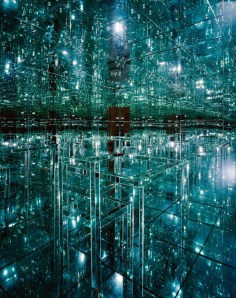
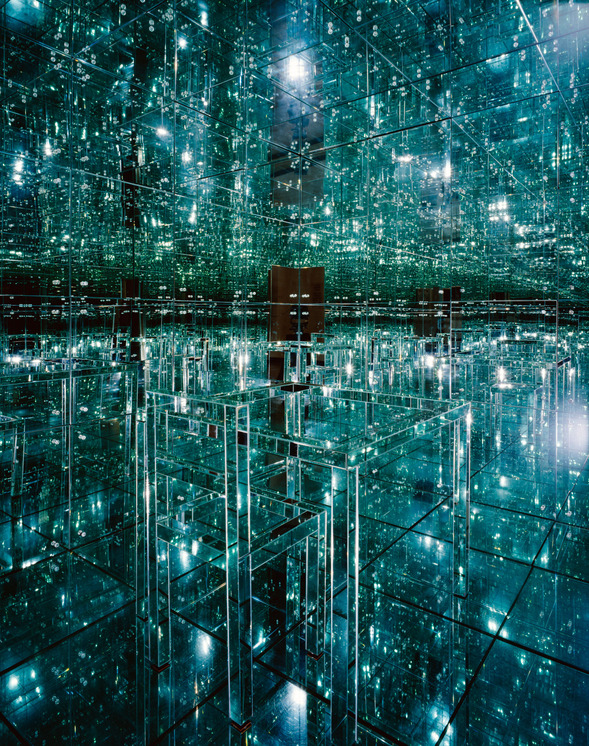
Mirrored Room by Lucas Samaras

Mirrored Room by Lucas Samaras Photo: © Albright-Knox Art Gallery/CORBIS

~
A brief aside: When I was eight or nine years old, I went with my parents to an art museum–it may have been the Chicago Art Institute–and there was an installation of Lucas Samaras’ piece “Mirrored Room.” [See the photo at left.] I was deeply impressed by the mirrored room, partly because it was inside this artwork that I finally understood, metaphorically, the concept of infinity. I was awed by the many diminishing selves I could see, the way a single “I” could change (in size), and by the tricks of light and how easily one could get lost in such a small space.

The mirrors copied me.

Mimesis implies something active, a borrowing, a taking–a kind of theft, on the one hand, and a kind of tribute or ritual motion on the other. It is also inherently continuous. The behavior does not stop at the first copy; it is carried on, perhaps through generations, like DNA.

Here is the brilliant Anne Carson:

“[It’s] what the ancients mean by imitation. When they talk about poetry, they talk about mimesis as the action that the poem has, in reality, on the reader. Some people think that means the poet takes a snapshot of an event and on the page you have a perfect record. But I don’t think that’s right; I think a poem, when it works, is an action of the mind captured on a page, and the reader, when he engages it, has to enter into that action. And so his mind repeats that action and travels again through the action, but it is a movement of yourself through a thought, through an activity of thinking, so by the time you get to the end you’re different than you were at the beginning and you feel that difference.”

~

Carson describes how I feel when I’ve read a poem or novel that moves me deeply. For that matter, it is how I feel when I find a work of visual art, or a play or dance, that seems to speak with immediacy to my own sense of experience, which arouses my passion, compassion, or emotion and alters my entire psyche for awhile– “by the time you get to the end you’re different than you were at the beginning and you feel that difference.”

Sometimes I even manage to compose a poem that gives me that sense of feeling different than I was at the beginning. On those rare times, I may look at myself in the mirror and see a changed face.


Symbiosis: Lichen, moss, John Donne

lichenslate~

Lichen on slate makes a kind of mandala, a small moon, or star, of mutualistic symbiosis–because lichens are amazing compound organisms: a fungus and an alga, although apparently there can even be three living, botanical parts to some lichens. I find this amazing. Unsurprisingly, “Reproduction can be tricky for a compound organism,” because which organism’s reproductive directive does a composite organism adopt? Some explanations can be found at this site, the homepage of THE book on lichens by Irwin Brodo and Sharon and Stephen Sharnoff.

It is spring. The rain brightens up the mosses, and photosythesizing organisms begin to turn green. Bryophytes lack a vascular system, so they cannot draw water up through capillary action via xylem cells. They have to absorb water instead, and that is why mosses generally need moist, shady places in order to thrive.

Mosses decay, adding more moist humus to keep the soil damp or to extend the reaches of creeks very gradually, which is good for the riparian ecology and for the moss. A more metaphorical symbiosis, but we could stretch the concept.

japanesemapleSymbiotic relationships fascinate me, partly because of the evolutionary brilliance–nature is so “wise”–and partly because symbiosis is richly metaphorical if one’s inclined to think that way (which I am). For example, my personal sense of the relationship between art and poetry feels symbiotic: the disciplines “need” one another, help one another out, in terms of how I imagine and structure my world.

I do not think the world needs me, but I need the world; that’s dependency, not symbiosis. But mutualism–human beings need that reliance on one another. We are community-building creatures for all our harping on being self-reliant and independent. “No man is an island.” That over-used phrase (along with the over-used phrase that closes the same poem) is worth revisiting in Donne’s original:

No man is an island,
Entire of itself,
Every man is a piece of the continent,
A part of the main.
If a clod be washed away by the sea,
Europe is the less.
As well as if a promontory were.
As well as if a manor of thy friend’s
Or of thine own were:
Any man’s death diminishes me,
Because I am involved in mankind,
And therefore never send to know for whom the bell tolls;
It tolls for thee.

~

“Any man’s death diminishes me/because I am involved in mankind.” Would that more of us would remember these lines, and consider how they inform the poem’s lovely and significant purpose.

Ink art

Last weekend, I went to New York with friends to see the Ink Art exhibit at the Metropolitan Museum of Art. The art, all of which is contemporary (the oldest artist represented was born in 1953), has been installed in the museum’s extensive Asian galleries alongside ceramic, sculptural, religious, and paper works going back centuries.

The rationale behind this juxtaposition, says the museum’s site, is to point up “how China’s ancient pattern of seeking cultural renewal through the reinterpretation of past models remains a viable creative path. Although all of the artists have transformed their sources through new modes of expression, visitors will recognize thematic, aesthetic, or technical attributes in their creations that have meaningful links to China’s artistic past.” That certainly proved true for me; and I cannot decide which was more intriguing, the similarities or the differences.

The young artists in Ink Art employ age-old cultural tropes: the triptych, the scroll, woodblock printing, calligraphy, moody landscapes, ideograms, ink, and repetition. The resonance with Chinese heritage is palpably authentic and is often employed in the service of criticism, mostly criticism aimed at the destruction of cultural icons and of the environment (some of the represented artists are exiles). Mounting the exhibition in the Asian galleries meant that the visitor confronts the historical and the contemporary simultaneously.

In Yang Yongliang’s “View of Tide,” the artist uses digital photography collaging to replicate the mood of an ancient Chinese landscape scroll which, on closer inspection, reveals that the austere and mystical imagery of sea and mountains has been composed of smokestacks, highways, powerlines, and the like. I found this work powerful as commentary and shocking in the best possible way.

Being a word person as well as a visual art appreciator, I was especially drawn to the section of the exhibit called “The Written Word.” The highlight of this section is Xu Bing’s installation “Book from the Sky”. My friends and I–avid readers all–entered this room and felt shivers of recognition and joy at the concept of a room-sized, descending, ascending, wall-to-wall book. (I urge my readers to click on the link for a peek.) The information plaque notes “while the work is inspired by the form and typography of traditional Chinese woodblock publications, faithfully replicating every stylistic detail of traditional Chinese printing, not a single one of its roughly 1,200 characters—each printed with type hand-carved by the artist—is intelligible. Each of these imaginary characters conveys the appearance of legibility but remains defiantly undecipherable.” The paradox and the beauty of the concept are amazing; in addition, I find it oddly thrilling to think of the imagination and the craft and simple hard work Xu Bing put into creating meaningless calligraphic pictograms, cutting them into woodblocks, and repetitively setting up the careful lines in rows on long scrolls.

What emerges when the scrolls are installed on ceiling, walls, and floor manages to be indecipherable but not meaningless. There is in fact much opportunity for meaning in “Book from the Sky,” and for discussion and interpretation and playfulness.

One example: after reading about “Book from the Sky” and taking in the environment for awhile, my friend Mark commented, “Imagine if you were a beginner learning Chinese script, and you encountered this room. You might just spend hours in here trying to figure out whether you could read any of it…I mean, if  you hadn’t read that it was indecipherable. Or even if you had that knowledge, maybe you’d spend a long time here thinking that at least something in all this text meant something you could translate. Wouldn’t that be awfully frustrating?”

Or maybe that’s the point?

Carved type for “Book from the Sky” by Xu Bing

~~

Conceptual metaphor. Art. Thinking. Decipherability; communication. These are large ideas, and crucial ones in the scope of human community. Without art–how can we encounter such metaphors? How would we share them?

Steel roots: Flower Show

Steel Roots series, Steve Tobin, at the Philadelphia Flower Show 2014

Steel Roots series, Steve Tobin, at the Philadelphia Flower Show 2014

Terrific place for Steve Tobin’s steel roots sculptures: this year’s annual Philadelphia Flower Show. Usually, I attend–and this year’s theme is art!--but circumstances prevent it this time. But the PHS (Philadelphia Horticultural Society) has an up-to-date website, and the Flower Show has its own Facebook page; so I can attend virtually without braving the icy roads and the crowds. I will, however, miss the marvelous olfactory thrill of walking into the main hall and getting stunned by the scent of fresh flowers.

Spring is a long time coming this year. I still can’t see anything but snow in my garden. Here’s hoping for thaw and the charming sight of snowdrops blooming…

Curiosities & stories

Here’s James Delbourgo’s recent article in Chronicle of Higher Education (I read the Chronicle regularly, if that’s not already obvious) about collections of oddities. While the article itself is sometimes a bit maddening (what is his main idea here?), it put me in mind of Mantel’s The Giant, O’Brien and of collections my friends have accrued. Toshio Odate, for example, has some fascinating accumulations he keeps in clear acrylic boxes, and some of his art constructions feature curious things: a favorite of mine is a large frame displaying every pair of sneakers his son wore as a child.

Edmund de Waal wrote movingly about objects and collections in his book The Hare with Amber Eyes. Several months ago I promised myself I’d get back to the topic of objects and their stories, but it has taken me awhile to resume my meditations on the subject. As a child, I loved wandering slowly through the world, stopping and dawdling and picking  up acorns, buttons, marbles, leaves, whatnot. Sometimes I would arrange these found objects into tiny houses, or float them on puddles, or arrange them on my windowsill. I might imagine stories around them, drawing on Andersen’s “Thumbelina” or the song “Froggie Went A-Courting.”

"Swiss Shoot the Chutes" by Joseph Cornell

“Swiss Shoot the Chutes” by Joseph Cornell

Not too many years later, when I encountered Joseph Cornell’s work, I was enchanted. His boxes contained mysteries, stories, possibilities, and fears; and they were achingly beautiful to me. Not unsurprisingly, Cornell’s work gets a mention in Delbourgo’s piece, which is partly a review of Brian Dillon’s book Curiosity: Art and the Pleasures of Knowing.

From the Chronicle essay:

Curiosity, Dillon proposes, is a way of knowing that looks askance. It draws attention to the unexplained or overlooked fragment, to invite us, if possible, to look sideways and look closely at the same time. As such, its promise of knowledge is ambiguous. Does curiosity seek to unmask the strangeness that absorbs its attention, or is it an invitation to luxuriate in that strangeness? Does it carry an inherent Baconian injunction to go further and illuminate, or does it recommend the alternative pleasures of not knowing?

I like those inquiries and feel they may inspire some poetry. Later, while considering the way some collectors, particularly wealthy or scientifically-minded ones, made detailed lists of the oddities, Delbourgo notes that

Dillon suggests that such lists also constituted “a kind of story,” but do they? The list is an open form, not a closed and completed one. Curiosity collections could absorb countless new objects precisely because they didn’t propose a coherent narrative about them. Unlike spoils that tell of conquest, curiosities don’t preach and don’t teach. What makes them curious is their oblique relation to the world in which they’re embedded. And yet, as a matter of historical fact, early-modern Europeans accumulated curiosities in no small part through trade, colonization, and war…

The 18th-2oth century ascendancy of science and the current trend of interdisciplinary art-tech-science aesthetics gets a mention in the article, too:

Curiosity and wonder—distinct terms but often used interchangeably—turned out to be interwoven with theology, civility, craftsmanship, nature’s playfulness…Curiosity thus helped dethrone the modern fact from its hegemony over the history of science.

Again a connection with de Waal, and also with the work my brother has been doing in reconsidering the skull collection of Samuel Morton (and other early modern anthropological collectors). In the case of many people who collect ‘curiosities,’ there are thorny questions of ethics vs. the ‘value’ of extending knowledge or awareness. The political, the legal, the ethical–these can conflict with curiosity in many forms it can take, from the problematic Rauschenberg  sculptural combine “Canyon” which features a stuffed bald eagle, to the superficial thrill that gets us to sit through an adventure movie even if we can guess the ending.

Curiosity is basically an exploratory response, as psychologists term it, which covers a vast arena of animal and human perceptions of the environment to orient us to potential situations and to prepare us for behavior/action. In the late 1950s and early 1960s, D.E. Berlyne studied what I call curiosity quite extensively, including some exploration into art and aesthetics though mainly concentrating on the reactive responses that make us susceptible to enjoyment or evaluation of art, humor, literature. (He published, in 1954, A Theory of Human Curiosity, which I think I must read after I read Dillon’s book).

But now I am drifting far from my topic of stories and objects. Probably that’s Delbourgo’s influence, as his essay wanders a bit, though the author cites some books I plan to add to my to-read list; for that, I am grateful, but I would prefer to look at how objects inspire stories, or make the need for stories. There’s the sun in the sky each day, and it leaves each night. We make up a story about that, or about why the leopard has spots or why there are stars in the sky.

Here’s something from my own collection of curiosities, a wooden ampersand from an antique type magazine. &&001And there’s a story I could tell about it which would be more or less ‘true,’ but there are better stories yet to be invented.

Or, tell the story of Cornell’s “Observatory Box.”

http://www.thisisnotacraft.com/

“Observatory Box,” Joseph Cornell

Lyric time

I’m currently savoring–as slowly as possible, as it is a short book–Mark Doty’s “World into Word” essays in The Art of Description. The text has been gently pushing my thoughts back toward matters of poetry.

I always think of Doty’s style, in prose and poetry, as precise and almost studied, though the studied-ness doesn’t feel overbearing but reflective; a naturalness remains that keeps the poems “hospitable” (as he puts it).

In his essay on Bishop, “The Tremendous Fish,” Doty examines the various forms of observation and focus or perspective that contribute to any work of art, although here he is of course honing in on the lyric state of mind. These passages seem to me to hearken to Bachelard (see here and here) on the temporal:

What is memory but a story about how we have lived? …there is another sort of temporality, too, which is timelessness. In this lyric time we cease to be aware of forward movement…it represents instead a slipping out of story and into something still more fluid, less linear: the interior landscape of reveries. This sense of time originates in childhood, before the conception of causality…

Self-forgetful concentration is precisely what happens in the artistic process–an absorption in the moment, a pouring of the self into the now. We are, as Dickinson days, ‘without the date, like Consciousness or Immortality.’ That is what artistic work and child’s play have in common; both, at their fullest, are experiences of being lost in the present, entirely occupied.

fest7~

This is, in addition to relating to Bachelard’s concepts on reverie, a form of mindfulness that would not be out of place in Zen and would be recognizable to any artist familiar with the creative “zone.”

I’m reminded of a popular colloquialism of the 1970s: “zoning out.” Generally, the phrase signified not paying attention, being slightly stoned, out of touch: negative connotations. Yet there were people who used the term in a more positive way to mean “in the zone”–an acceptable, if “flaky,” zinging of the mind into a calm or creative space.

A space where poets might wander in “self-forgetful concentration.”

~

Let’s go…