“Be critical, and sing”

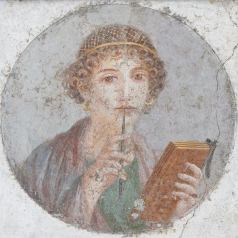
pompeiian woman-writer

The poet C. D. Wright died in January of this year. She was an American original. She was a critical thinker of the first order, an experimenter.

For no apparent reason, I thought of her when I saw this fresco painting (unearthed in Pompeii) of a woman with a stylus and book. Something in the thoughtful musing look in this portrait suggested a critical eye, analysis, consideration–a keen and penetrating intelligence. She will reflect before she writes, but she has opinions she  is not afraid to share.

A collection of Wright’s pronouncements, which she combined and arranged in a sort of extended prose poem, was published as “69 Hidebound Opinions.” The hidebound is both tongue-in-cheek and earnest; typical, really, of Wright’s work. I’ll post the link and also share a few that I find intriguing.

“69 Hidebound Opinions” by C. D. Wright.

Here’s #22:

“To opt to be a poet, is to have some resolve. It leaves you free–to sing as you will, with the lungs god gave you–even if no one but god might hear. It leaves you that naked and obligated to sing your best. Suzuki teaches that ‘in the beginner’s mind there are many possibilities; in the expert’s mind there are few.’ Beginner’s mind then, is not only where you start, but where you must remain. It is what will keep you–long after you have children, job, house, dog, too many keys on your ring–free.”

Number 27:

“An atmosphere of depression will arouse artists’ attention over an atmosphere of prosperity nearly every time. Because it derives from consciousness, art is critical. Also true, ruins are beautiful to us; the Blues make us feel good; it is through the wound that we perceive the body whole.”

Yet, #42 says, “It is left to the poets to point out the shining particulars in our blunted lives like the strands of blue lights Cotter, Arkansas, draped every haunting Christmas from one empty storefront to the empty storefront across the street for eight unoccupied blocks.”

Number 41 resonates deeply: “It is poetry that remarks on the barely perceptible disappearances from our world such as that of the sleeping porch or the root cellar. And poetry that notes the barely perceptible appearances.”

An aside: [I want to write about the sleeping porch, which I loved in my early childhood and which hardly exists anymore. I’d like to sleep on one again, build a house that has a sleeping porch. Also, my joy at discovering my former neighbor had–and used–a root cellar; his joy at discovering the young person new to the neighborhood was fervent about her truck patch.]

“53

Poetry is the language of intensity. Because we are going to die, an expression of intensity is a necessity.

Extended awareness, isn’t that central to the art?”

No. 67–

“Gradually one comes to fathom exactly what it is one has chosen–what is poetry. Poetry avails itself of the listener, the watcher. Whether called upon to emancipate, comfort or forecast, poetry responds. The possibility that the poem you were born to write, will not join you on the porch this summer or the next, looms taller than the sunflowers and the hollyhocks. It could have taken the fork to the river or ended up at the slaughterhouse. It could have died as quietly as the moth on the screen. Or just borne itself up on the breeze. Who can say. This is the poet’s choice: to attend a presence no one else was aware of, to spend the better part of a lifetime preparing for an arrival, that could not occur but for her attention, that would not in fact otherwise make its blaze on this world.”

waterpaper


I close with #51: “Now that I am beyond the initial paralysis of calling one’s first teachings into question, I am left with: be critical and sing.”


In memoriam

Ariel Dawson, 1959-2013

I recently learned that a friend who was hugely significant in my life once, but with whom I had lost touch for 15 years, no longer walks the same earth that I do; in fact, Ariel Dawson died in 2013, unbeknownst to  me.

Ariel Verlaine Dawson

Ariel Verlaine Dawson

It is hard to lose friends, but losing the friends of one’s youth–those intense, passionate friendships that teach human beings how to navigate the world of human relationships–that loss cuts in a different way. For Ariel is perhaps the reason I am a writer. No–I would have become a writer. She is the reason I decided it was possible to be a poet. She amazed me with her vocabulary, her insights, her evaluative reading, her positively voracious and precocious reading, her charm, her gentle goofiness, her forthrightness, her neurosis; she seemed to fear nothing (but that wasn’t true); she had published poetry in real journals before she was 17 years old; she read Rilke and Yeats; had affairs with well-known poets; spent years fathoming Jung. In 1994, she wrote an opinion piece for what is now AWP’s Writer’s Chronicle responding indignantly to Dana Gioia’s article “Can Poetry Matter?”–a piece that started quite a dust-up among defenders of what has been termed “new formalism.”

Ariel had always been the sort of person who chose to disappear and then to reappear, to my joy, months or years later to take up the friendship without pause–and often without explanation for her absence. She had her reasons, and I respected that; but I missed her.

Ariel, 1977 or 78

Ariel, 1977 or 78

~

In the early 1980s, my (also late) friend David Dunn and I were publishing chapbooks under the small-press name LiMbo bar&grill Books. We approached Ariel for our second-ever chapbook: Poems for the Kazan Astrologer. She was, at the time, teaching creative writing at Old Dominion University. We were very happy with the outcome, but we had no good method of distributing the books. I may still have a box of 25 or so of these books somewhere in my attic.

Then Ariel became more intensely interested in Jungian psychology, though it had long been a passion of hers.

In subsequent years, she wrote less and less poetry and stopped submitting her work for publication. The response to her Writer’s Chronicle opinion was, I think, a bit shocking to her, though I know she stood by her opinion. She just decided, perhaps, that she felt more at home in the world of Jung and his followers.

During the past decade I have often tried tracking her down, imagining the internet would find her. My job at the college has made me a rather adept online researcher, but all that ever showed up was a listing for her psychotherapy practice in New York City. The number was incorrect.

Then, my father became very ill and other issues crowded my mind. Searching for a friend who clearly wanted to remain anonymous in an electronic era was not a priority.

Besides, I always assumed that Ariel would suddenly re-emerge, call me–my phone number remains the same as it was last time I saw her–and mention she was going to be in the area, and could she stop by? That’s how it had been before. And I’d be thrilled to see her, and we’d talk about poetry and art, and politics and pets, cheese, philosophy, psychology, parents, wine…

I assumed incorrectly. That’s what happens with assumptions. Just this past week, when I finally found myself with some spare time, I tried an internet search again. And found her “electronic obit” online, and the fact that she’d died in February of 2013.

~

I have no words to express how this information feels to me.

And also–

~

Arthur Cadieux, 1943-2015

Arthur Cadieux in 1978, a photo taken by Jim Terkeurst.

Arthur Cadieux in 1978, a photo taken by Jim Terkeurst.


279519_2290955317647_6522544_o

Arthur 2011, Eastport, Main

Arthur in 2015. Photo Elizabeth Ostrander.

Arthur in 2015. Photo Elizabeth Ostrander.


~

Arthur Cadieux was my art teacher at Thomas Jefferson College in the late 1970s. He and his wife, Helene, were exceptionally kind to young adults who had an interest in art and in observing the world around them. We had dinner at their house in Michigan and at their loft apartment in New York City. Years later, after Helene’s tragically early death, and after Arthur had moved back to Maine, he let me stay at their cottage on Leighton Point (he lived in a smaller house in town) so that I could have a personal “writing retreat.” He deeply understood the creative person’s need for reflection, evaluation, thought, imagination, boredom, and occasional moments of lively talk.  The universe needs people like Arthur Cadieux, talented and generous, who are constantly pushing their own boundaries. Many of us who benefited from his friendship will miss him. Arthur’s paintings can be found at his website, arthurcadieux.org.

~

May they be free from suffering and causes of suffering.
May they never be separated from the happiness that is free from suffering.
To endure

I have been contemplating the word endure, particularly in relation to my continuing curiosity about consciousness and in relation to physical enduring when the body is in pain.

Reading an excerpt from Husserl (the first proponent of transcendental phenomenology) that–admittedly, taken out of context–places consciousness in relation to time, I realize endure implies the concept of time itself even though time doesn’t make an appearance in its etymology (see below). Husserl writes:

Every temporal object has a duration…but in the type that is duration we have a distinction between the expanding, flowing duration and the momentary durations.

He suggests that there are “filling-in” types of duration, or time-phases, that arise to create “a continuous consciousness of unity whose correlate is an unbroken unity,” giving us the impression of sensuous unity in time. I wonder if our sensations of  physical pain operate in the synapses of the brain in somewhat the same way: momentary (acute), and filling in over time or flowing (chronic).

When we suffer, we call upon endurance to sustain ourselves. The verb form connotes the negative more commonly, such as to endure oppression, abuse, harassment, pain, humiliation. It is an active verb.

etymology: late 14c., “to undergo or suffer” (especially without breaking); also “to continue in existence,” from Old French endurer (12c.) “make hard, harden; bear, tolerate; keep up, maintain,” from Latin indurare “make hard,” in Late Latin “harden (the heart) against,” from in- (see in- (2)) + durare “to harden,” from durus “hard,” from PIE *dru-ro-, from root *deru- “be firm, solid, steadfast”

Nonetheless, strength is also implied, a resilient firmness that people tend to value. What is the current perspective on being steadfast? Is it to harden (become stubborn and inflexible) or to be solid? Don’t we admire the person who has endured much and yet, one way or another, lived life as it presented itself however hard the circumstances? And are those positive or negative traits, as our culture views them? Customs endure. Prejudices endure. When we call someone a “hard person,” it is seldom a compliment. Yet being steadfast is generally considered a virtue.

It’s interesting to note that the adjective form of endure has a more positive connotation–

enduring (adj.) Look up enduring at Dictionary.com

“lasting,” 1530s, present participle adjective from endure.

An enduring work of art; an enduring love. Something that defies time by lasting through those temporary durations and through the fillings-in. We human beings wonder whether our consciousness, what many have called our souls, are enduring in the sense of expanding over time and past the demise of our corporeal selves. But great literature, great music, great art suggests there are many ways to endure.

In the New Year, my hope is to become attentive to what endures; to extend compassion and love more widely and more deeply; to read good books and take in good works of art; to be good at what I do reasonably well, tending to myself and to others with as much grace as I can muster. Some years challenge us more than other years. Let us choose to endure.

Love is all you need


Responses

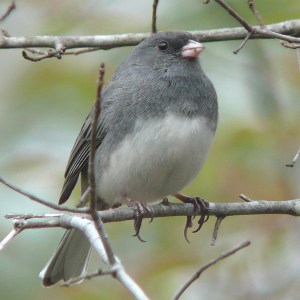
The semester is over, and the juncos have returned to my back yard. One thing I have trouble assessing after teaching my class is whether the students have made any inroads into learning the difference between a fact and an opinion, and argument and a disagreement, an interpretation and an analysis. But a response can be any of these things.

Recently I have been entertained by Rebecca Solnit’s responses (as opinion). She’s made a bit of an earnest-minded internet buzz with her brief essay concerning Esquire magazine’s “80 Books All Men Should Read.” [As an aside, I really enjoyed her early book Wanderlust: A History of Walking.] Her opinion piece on Lithub is smart and funny, and she irked many readers; yet I do not see how anyone can argue with her final paragraph:

…that list would have you learn about women from James M. Cain and Philip Roth, who just aren’t the experts you should go to, not when the great oeuvres of Doris Lessing and Louise Erdrich and Elena Ferrante exist. I look over at my hero shelf and see Philip Levine, Rainer Maria Rilke, Virginia Woolf, Shunryu Suzuki, Adrienne Rich, Pablo Neruda, Subcomandante Marcos, Eduardo Galeano, Li Young Lee, Gary Snyder, James Baldwin, Annie Dillard, Barry Lopez. These books are, if they are instructions at all, instructions in extending our identities out into the world, human and nonhuman, in imagination as a great act of empathy that lifts you out of yourself, not locks you down into your gender.

Roth, Caine, Miller– “just aren’t the experts you should go to” if you want to understand half the human species; I love that tongue in cheek understatement. I also love her list of “heroes,” although it doesn’t hurt that she names among them many of my own heroes. She says she reads and re-reads work that she has opinions about–and admits her opinions may not align with the generally-accepted opinions. Which is fine, since she reminds us, quoting Arthur Danto, art can be dangerous, risky, uncomfortable, as long as it means something.

She does raise the point that “[y]ou read enough books in which people like you are disposable, or are dirt, or are silent, absent, or worthless, and it makes an impact on you. Because art makes the world, because it matters, because it makes us. Or breaks us.” In this way, she reminds us that readers are people who may have perspectives that vary from one another, particularly as to the social, psychological, or artistic merit of a piece of literature. Lolita, for example. That’s one book she mentions that evoked considerable response from Lithub commenters.

Rebecca Solnit’s response to her detractors–or “volunteer instructors,” as she calls them at one point–and her willingness to walk around the Himalayas with a medical team (recounted in a recent New Yorker piece) count as reasons her work has moved to the top of my to-read pile of books. I think I will start with Men Explain Things to Me and A Field Guide to Getting Lost.


Focus

On what do I focus when I write a poem?

This question has occurred to me before, usually under the guise of someone asking the ever-vague “What inspires you to write?” Focus differs from inspiration. For me, focus seems to derive from observation and is a process of discovering meaning.

Focus helps me understand what it is I’m experiencing and to decide how to express it. I focus when I need to make decisions; in the case of writing a poem, the decision might be one of craft approach or of imagery, or a realization that the poem needs a turn to create tension or resolution. What is the hub of the poem, the real kernel at its core? To make a poem “work,” I have to have a sense of what that might be.

This type of emphasis is a form of concentration. I think we learn from focusing; it teaches the value of close study, a skill needed for analysis. It can also be a reminder of what is outside the area of attention. Focus needs context, or it ends up as navel-gazing.

For a visual example, consider Andy Goldsworthy‘s “Rain Shadows,” which are among the most transitory of his ephemeral works.

The opposite of making a snow angel, in these conceptual art pieces–and he would object to me calling them by that term–the artist lies on a sidewalk and waits until a light rain falls just enough to leave his figure on the ground. Of course, in no time, the rain fills in the figure, so he documents the “shadow” with a photograph.

Goldsworthy talks about the process, in a recent interview with Terry Gross (see link below).

I just concentrate on the rain. I’ve learned so much about rain — the different kinds of rains, the rhythms of rains. And people will say, “Oh, why don’t you just use a hose pipe?” That would be totally pointless. The point is not just to make the shadow, it’s to understand the rain that falls and the relationship with rain and the different rhythms of different rainfalls.

The “art” in Goldsworthy’s rain shadows–he also does this with snowfall–consists in a focus, a learning, a process that the viewer cannot participate in. Which is kind of weird. Unless, of course, seeing his rain shadows prompts other people to try making them, during which they will learn about rain’s rhythms and varieties.

In this way, Goldsworthy encourages focus and close attention to the world in which we live. I think I will file that under “inspiration.”


What I see

When I trek to New York City these days, I generally go for non-tourist reasons; my sister lives in Manhattan. It’s a day trip, and I don’t always avail myself of visits to big-city attractions–instead, I “hang out” with my sister and her family, which tends to mean home-cooked dinners in her apartment and walks around her neighborhood, greeting neighbors in the coffee shop or on the sidewalk. Often, that’s interesting enough, as she lives near Ft. Tryon Park and The Cloisters. On my most recent visit, however, we decided to take the A train south to tour the new Whitney Museum of American Art. It’s located at the base of the Highline Park, with views southward to the new World Trade Center and westward over the Hudson (making our evening visit gloriously pink-hued during summer sunset).

We spent a little over two hours at the museum, and our initial assessment was that both of us prefer the building itself as an architectural experience over the old Whitney building designed by Marcel Breuer. It isn’t all that much “prettier” from the outside; but the interior gallery set-up is more pleasant, light-filled, and navigable by patrons.

The opening show’s titled “America Is Hard to See,” a line culled from a slightly ironic Robert Frost poem (see an excerpt below). And the top floor gallery included a famous painting by e. e. cummings, so my poetry hopes were raised. The 8th floor of the museum was stunningly curated; I had high expectations for the rest of the galleries though, in the end, my reaction was decidedly mixed.

Thanks to Lederman copyright 2015. see whitney.org

Thanks to Lederman copyright 2015. See whitney.org

Levels 7 through 5 follow a chronological order, roughly, in terms of historical and cultural developments from the early 20th century to the present. This is a bit arbitrary, as artists alter their styles, and even their genres, over time–and some artists’ work spans decades, gaining and losing cultural momentum as fashions and criticism also change. As a result, there are clusters of pieces that cover similar themes but do not necessarily speak aesthetically to one another on the gallery walls. This was most obvious in the Viet Nam era gallery, which struck me as garish. The purpose in terms of education and theme was fine, but the aesthetics of the room as a display of art just did not convey, to me, what it might have in another perhaps less chronological arrangement.

Nonetheless, as far as getting visitors acquainted with American contemporary art, the new Whitney may be overall more successful than its predecessor. The former building’s galleries were arranged by donor collections and often had too much of the same, or else too little cohesion, and relied on the visitor’s being already reasonably familiar with contemporary art and art criticism. The exterior platforms of “outdoor galleries” (sculptural pieces) are impressive, though you may want to avoid the exterior stairways if you have a fear of heights.

I am happy to note that Calder’s Circus remains on display, along with the old and, by contemporary standards, poorly-produced video of Calder playing with these creations. I loved this piece as a kid and my own children also loved it.

~

Excerpt from “America Is Hard to See,” by Robert Frost

Had but Columbus known enough
He might have boldly made the bluff
That better than Da Gama’s gold
He had been given to behold
The race’s future trial place,
A fresh start for the human race.
He might have fooled them in Madrid.
I was deceived bywhat he did.
If I had had my way when young
I should have had Columbus sung
As a god who had given us
A more than Moses’ exodus.
But all he did was spread the room
Of our enacting out the doom
Of being in each other’s way,
And so put off the weary day
When we would have to put our mind
On how to crowd and still be kind.

The people on the streets and in the subways and in the neighborhoods were uniformly kind on this warm summer evening. Even when we got in one another’s way. That’s what I saw.

~

Clouds

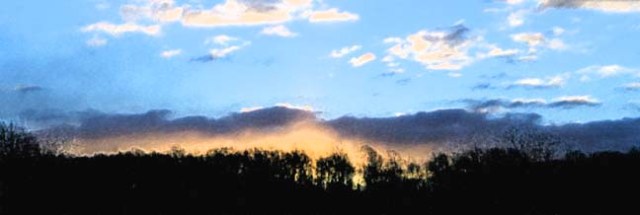
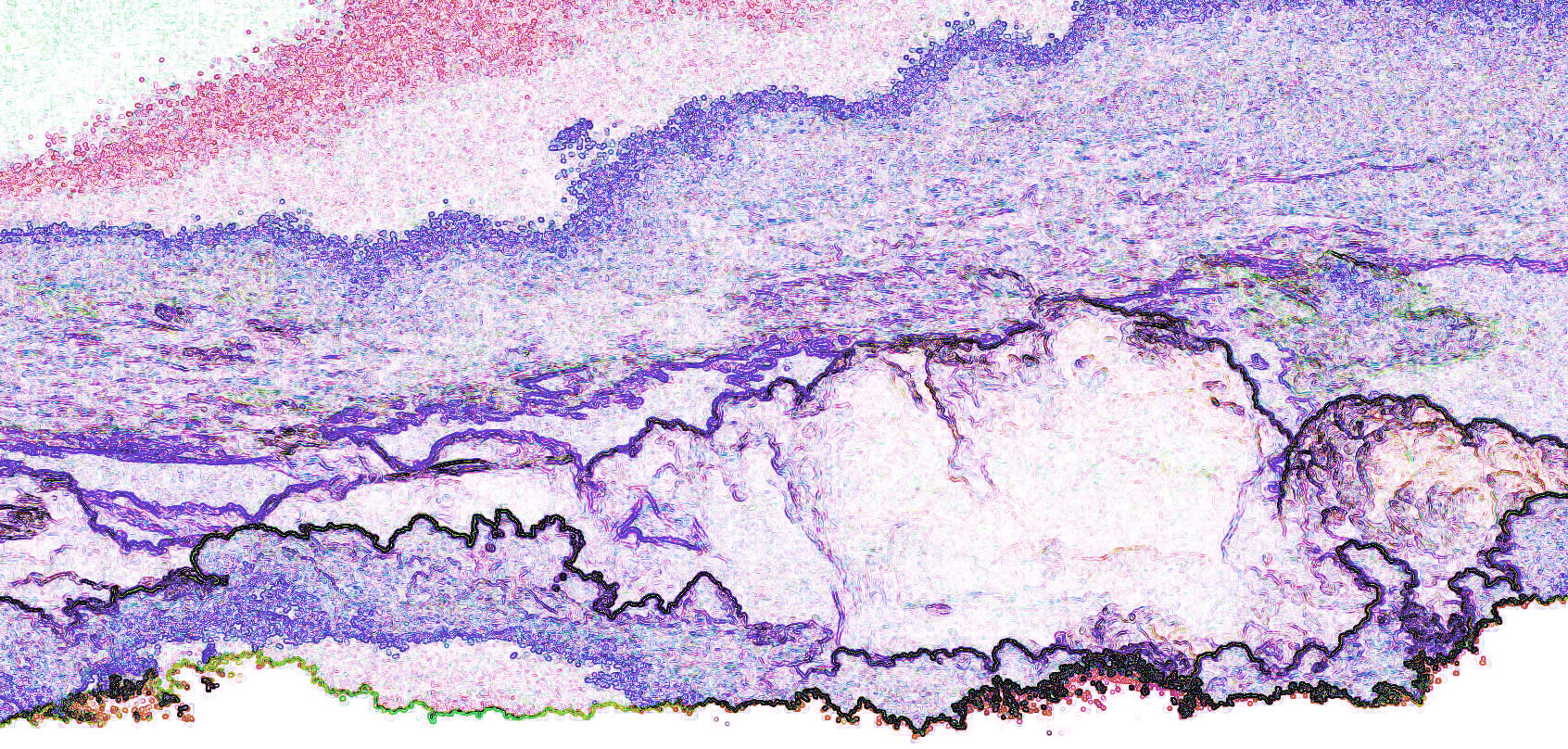
Mid-summer, and the sudden swift storms pass through. Indoors during the excessively warm rains, I try to write a bit. And I play around with clouds on Photoshop.

abstract1

impasto-like


abstact2

outlines

~

But the real sky is truer and more beautiful, ultimately.


IMG_1650~

IMG_1654


9th as new

Last week, I tutored a student on a music appreciation paper in which she was asked to review a concert-going experience. Her family background is culturally rich–but not rich in terms of the Western cultural canon. She had heard the name Beethoven; but until this class, as a sophomore in college, she had never listened to his music. She attended a concert that featured a Liszt sonata, two brief Schubert pieces (Ständchen and one other), and Beethoven’s Symphony No. 9.

Because I cannot remember not knowing Beethoven’s music, I kind of envy this young woman’s revelations in the concert hall; what must it be like to hear Beethoven’s 9th symphony, for the first time, as a 19-year-old? I may not be familiar with all of the master’s works, but my parents had some of the symphonies on vinyl back in the 1960s. We listened to classical music on the radio and in church; even commercial television featured famous musical phrases. My sister and I liked dancing around the living room every weeknight to The Huntley-Brinkley Report’s closing theme (2nd movement Beethoven’s 9th).

portrait by Joseph Karl Stieler

portrait by Joseph Karl Stieler

~

Initially, she and I went over the structure of a review and how it resembles an analysis paper. She had used musical terminology reasonably well, and we had grammar and mechanics to work on. What she liked best, she said, was the part with the singers. She found the third movement “a bit boring. I kept wondering if this was the end.” But the fourth movement excited her: “It was really like a celebration or something, and you could see the expressions on the faces of the singers and the musicians, that they were so into it. Like, you kind of wanted to stand up for it, you know?”

Yes, I know–that’s how I have felt when I have heard the piece in concert.

~

Our discussion went on after our work on the paper’s mechanics had ended, though, because she asked me why courses like this one are required for college. Her major is early childhood education, and she says her parents asked her how a course on classical music has anything to do with teaching 4-year-olds.

It turns out I had more to say on that than I realized. Bless her heart, this student was eager to listen. [I have to admit that isn’t as common a response as one might wish.] Many of my friends, I said, are teachers or former teachers; they are among the smartest, most open-minded and curious people I know. They pay attention to contemporary culture and they read about history. They get allusions and references and make clever jokes and know all kinds of things and also, they admit what they do not know and are eager to learn about. They’d play Beethoven for kindergarteners and let them dance to the fast movements and ask them how it feels to hear the slower, sadder late quartets. They might have the children finger-paint to Beyoncé or twirl like leaves to Vivaldi’s “Autumn” or use round colored stickers to make their own “Starry Night” pictures or recite a poem that’s fun to say out loud. Culture is education.

And there’s more, I told her, that has to do with you as a person who understands the culture you are part of. You have to know about politics, especially local and state politics, because teachers need to understand how legislation and budgets can affect income and careers. You might feel uncomfortable in your job if you don’t get your colleagues’ allusions or feel you cannot participate equally in their conversations when the subject turns to culture, history, museums, music, art, policies and fiscal issues. It is fine to admit what you do not know or have not yet been exposed to–but it helps to know where you stand and to show you want to learn.

You’ll learn from your students, too. If you really want to be a good teacher, I said, you will never want to stop learning. Maybe you will reach a point where you don’t need to know a whole lot more about Beethoven, but you will want to explore other subjects. So when you take the required fine arts courses, the required literature courses, the courses in philosophy and math and all that other stuff, realize how all of it will get into your brain somehow, maybe touch a nerve here or there, and help you become a terrific teacher.

Besides, isn’t it beautiful? Even the boring parts…have you ever experienced anything like that before?

“No, honestly,” she said. “I wasn’t sure I was up for it, but it was worth it.”

Online reading, online learning

I blog, therefore I am part of the digi-technological consciousness.

Here’s a situation Descartes might have had fun imagining…have we invented our own “evil genius” in Boolean or algorithmic forms? I won’t venture there, as I am not tech-savvy or social-media savvy enough to philosophize around tech aspects of modern culture; though, yes, I do use portal systems when I teach; I do use (limited) forms of social media for communication and to publicize my work; I do take part in the networks community online; my poems and essays appear in online journals; I read blogs and online journals although in general I prefer paper, especially for book-length works.

It isn’t as if I don’t consider the intellectual challenges these communication platforms offer. It would be silly to ignore them. They are not going to go away any time soon. One question is, however, to what extent should I employ or embrace them?

~

Recently, I’ve had a poem published in Carbon Culture Review, an online and print journal that states, as part of its mission, that the publication “advocates a creative, thoughtful and visually appealing dialogue about our complex relationship to technology. We strive to promote the work of those who employ technology and utilize technological designs and terms in art and literature.” The Intersection of Technology + Literature + Art, says the masthead; interdisciplinary in scope–that’s something I find fascinating, so I’m happy to report a rather atypical poem of mine has found a place in the new issue (“21st Century Research”).

I read Chronicle of Higher Education online and have linked to several of its essays in past posts. Lately, I find much of interest in Hybrid Pedagogy, a fairly new digital source about technology, teaching, radical re-thinking of the educational framework, and exploring the possibility of intentional, compassionate connections between teachers and students–even in the digital world. Here’s a recent essay that appeals to me: “Teaching as Wayfinding.” I am still wrestling with the challenges of how to create a genuinely interactive and personal learning space in the classroom, let alone via distance education. There is so much to learn, and welcoming interdisciplinary synthesis into the discourse of the humanities offers intriguing potential.

~

Speaking of the interdisciplinary: I am pleased to report that The College of Physicians of Philadelphia chose one of my poems, “How the Body Works” as an honorable mention in its Poetry Month contest celebrating medical/health themes in poetry. [You can also check my Events page for information and tickets.]

The College, a professional medical organization founded in 1787 (same age as the U.S. Constitution), is also the site of the Mütter Museum, which has a terrific slogan: “Are you ready to be disturbingly informed?” The College boasts a library of historic significance.

It’s a great venue for a reading, and if you are in the area, please join us. My brother says the food is really good, too–the ticket price includes a dinner. How festive is that!?

Barnacles, finches’ beaks, art

Cirripedia, the barnacles, occupied Mr. Charles Darwin for many years, even though his extensive studies of the class are not what he’s famous for (except among cirripedists). The average layperson knows Darwin as the man who came up with the theory of evolution–though that is not strictly what he did, and none of his books bear that title. After the publication of On the Origin of Species and The Descent of Man, and the subsequent and ongoing controversies that followed, pretty much everything in the world could be–and has been–examined “under an evolutionary lens.”

The original “lens” involved finch beaks, pigeon-breeding, and early geology studies. It was fueled also by taxonomy, anatomy, and barnacles, by a member of the landed gentry who stayed at  home, more or less, for 45 years after his five-year journey on the Beagle. A scholar, an “armchair naturalist” by today’s standards; a genius.

finch beaksMany people who interpreted what evolution suggested went off the deep end one way or another, which is what happens with ground-breaking ideas. Both critics and supporters re-interpreted and often misinterpreted Darwin and the implications of his work, as well, all of which means he accomplished something truly significant. Why not, therefore, examine fundamental human traits to see whether evolutionary currents can be discerned? Certainly Darwin and a few of his contemporaries speculated that altruism might have an evolutionary basis, a concept that was taken up, debated, and temporarily dismissed in the 1960s-70s; recent neurobiological and genetic studies have brought the possibility of a biological basis for kindness back into discussion (see also Damasio).

There is also the question of art (and aesthetics, though taste seems more likely to be social than biological–but who knows?), which brings me to Denis Dutton’s delightful book The Art Instinct: Beauty, Pleasure, and Human Evolution.

Rather than summarize my responses to his thought-provoking and rather convincing arguments, I’m posting some quotes. These are ideas I find juicy to consider; perhaps other readers will feel similarly.

~

Wondrous aesthetic experiences are possible in the absence of a sense of larger community: the response of an individual to a beautiful landscape, for instance, …or to a recording of the Goldberg Variations heard in solitude. If the arts were intrinsically social in the way that social-cohesion theory claims, people…would prefer standing in a crowd to see a painting in a museum, rather than standing alone.

Because of sexual selection, the arts retain an incorrigible sense of being made by one individual person for another…the motives of art, as even Darwin knew, are ancient and complicated–directed toward a community perhaps, but also created to captivate an audience of one.

~

The artist…probes the content of human emotional life with an eye toward articulating, or making clear, a unique emotion, an individual feeling.

Can you imagine taking [a] pill to save the expense of concert tickets, or even the time spent in listening to a recording of the piece? The answer is very likely to be no, and the reason tells us something about the nature of artistic expression. It is not just the emotion as bare feeling we want from art, it is the individual artistic expression of emotion–how emotions are revealed in the art, through technique, structure, balance, and the blending of sounds….Yes, we want feeling from art, but not as an end for which the art is a means: with art, the means is the end itself.      [italics mine]

~

Extending Darwin’s original suggestion, I believe this intense interest in art as emotional expression derives from wanting to see through art into another human personality: it springs from desire for knowledge of another person….talking about art is an indirect way of talking about the inner lives of other people.

~

All of the above excerpts are from Denis Dutton, The Art Instinct, 2009.

http://taxo4254.wikispaces.com/file/view/darwins_barnacles.jpg/274764236/409x262/darwins_barnacles.jpg

wikispaces.com/file/view/darwins_barnacles.jpg