Studio. Space.

Contemporary artist and blogger Deborah Barlow writes: “A studio, like a womb, is a vesseled space, a geolocation from which one’s work, intentionally free of its context, can emerge.” http://www.slowmuse.com/2013/11/25/up-stairs-in-sight/

In another recent post, she talks about artists’ decisions about whether or not to offer studio tours, and art critics’ decisions about whether or not to visit studios. The critics she mentions (Saltz and Smith) prefer not to see the studios of artists whose work they are reviewing. The sense I get is that the critic needs more objectivity–a disinterestedness–and that a working artist’s studio is a personal space, one through which perhaps the critic might learn too much (context? biography? vulnerability? …one wonders).

I wrote my graduate thesis on how time works in poems, and for a long time I considered writing a followup on space in the poem, particularly the kind of vesseled, nested, interior space to which Barlow alludes (and Bachelard, in The Poetics of Space).

What spaces are conducive to the creative process? Such variety! I have friends who love to write in diner booths or cafes, and others who need complete silence, no distraction (Annie Dillard wrote in a closet; Robert Frost in a shed). One writer I know must be in bed to write. Another must be outdoors. The place matters to many people–but not to all of them.

Writing’s different from painting, sculpting–arts that require at least a few tools at hand.

But some of my writing friends need a computer, or a candle; a pencil and a legal pad, or a fountain pen and a spiral notebook; a bookshelf; darkness; classical music, or the blues.

I don’t really have a studio these days. Maybe it is time I lent my mind to carving out a creative space? –Somewhere nestled, vesseled, interior: (A Room of Her Own).

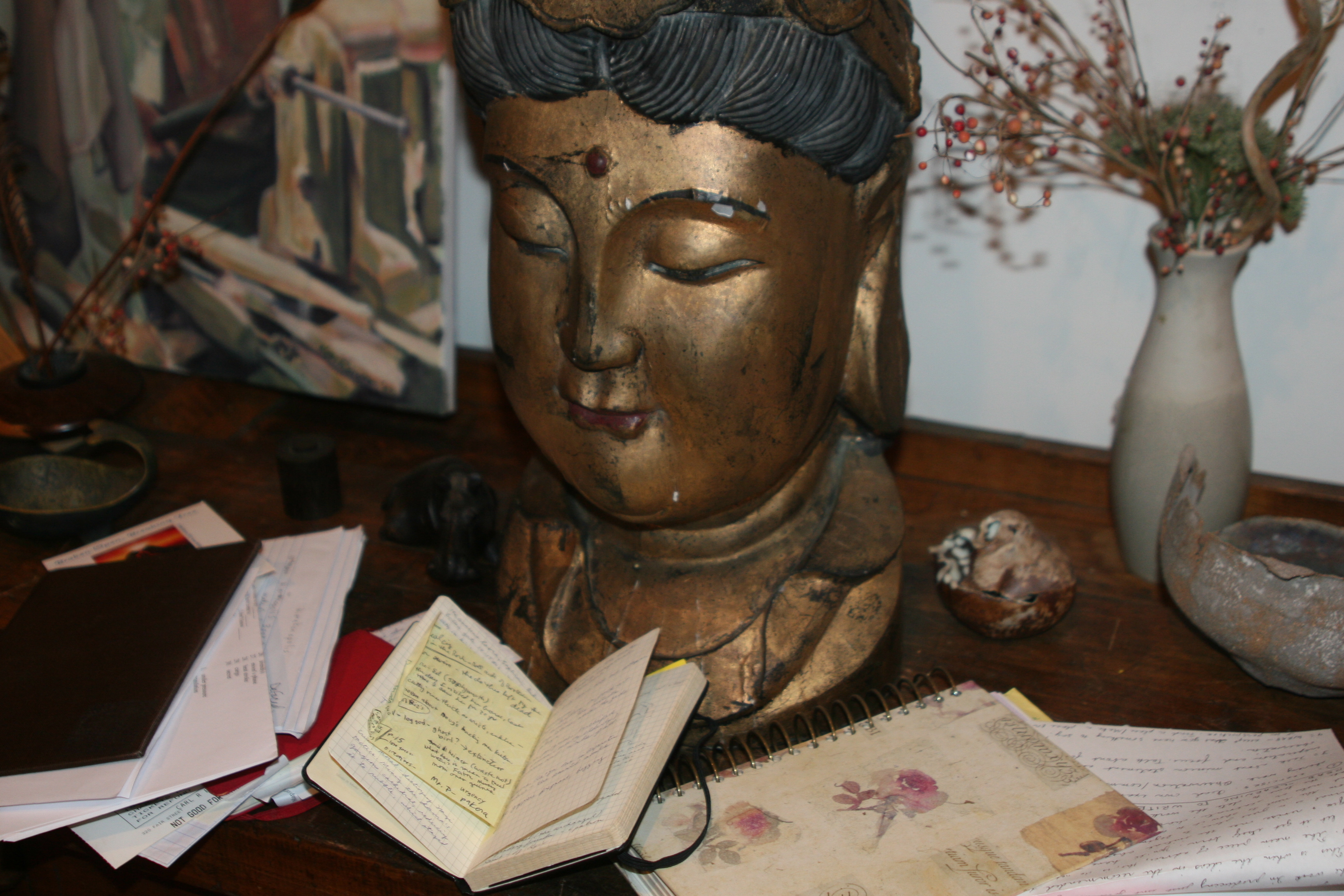
Below: A location…space, intentionally free of context.  :)

IMG_0252

Story of an object

In a previous post, I quoted Edmund de Waal about the stories that objects can “tell” us. In his book, those objects were things made by human beings; the story of the netsuke was not separate from the stories of the people who acquired them. His book did not examine the stories of the people who sculpted the netsuke, as there was no way to trace them that would not have required years of research. A fiction writer or poet might speculate on the possibilities of the lives of the ‘makers,’ however. That is part of what creative writers do.

There are also those “natural” objects that surround us and which can tell stories–or inspire human beings to imagine and tell their stories. For example, every origin myth contains some aspect of telling the story of the earth or sun, stars or mountains, seas, skies, moon.

After some online discussion with artist and writer Deborah Barlow, I considered the story of an object as having tactile and temporal aspects in some cases, and the object as “residue” of an event–or life. Ephemera, correspondence, tokens…many potential stories.

And, of course, works of art. If you follow this blog at all regularly, or check the archives or the Art[s] tab/page, you can tell I think often about art, its stories, artists, and their stories.

For example, a journal or notebook that an artist or writer uses can be a tool, repository, memory-jogger, inspiration-minder, sketchbook, Rolodex

It occurred to me that my poetry journals, which I’ve been keeping for decades, contain potential stories/poems but are also objects with their own stories to tell–which may or may not be “my” stories, though they necessarily intersect with whatever my story is.

objects, stories

objects, stories

~
Some examples. Tactile, visual, textual.
Inspiration, possibly.

Images captured in several ways.

Necessary–yes. For me.

~

Where do your stories reside? What object or objects seem to require the act of story-making? By which I mean, which objects fire that urge in you?

Sublime beauty

In his book Survival of the Beautiful, David Rothenberg says perhaps it was the evolution of an abstract aesthetics in art (abstract work as beautiful) that enabled human beings to begin to see natural things as beautiful in themselves–as opposed to the Romantic view that human yearning and elevated sensibility could best be encountered while experiencing Nature or Classicist ideas that found natural things corrupt and irregular, in need of perfection into better-proportioned objectification. In History of Beauty, Eco allows the Romantics their view of the sublime but says that in the late 17th c “the Sublime established itself in an entirely original way, because it concerns the way we feel about nature, and not art.” His text offers the paintings of Caspar David Friedrich as an excellent example, paintings that depict people as observers of the Sublime:

The people are portrayed from behind, in such a way that we must not look at them, but through them, putting ourselves in their place, seeing what they see and sharing their feeling of being negligible elements in the great spectacle of nature…more than portraying nature in a moment of sublimity, the painter has tried to portray (with our collaboration) what we feel on experiencing the Sublime.

I love the idea Eco parenthetically notes here: with the viewer’s collaboration. These paintings permit us to enter into the experience as the great preponderance of the artistic canon did not. Some critics suggest the environmental “movement” (in the USA, at least) owes its lineage to Leopold via Thoreau through Darwin, Wordsworth, and the German Romantics.

Friedrich’s work tends a bit over the top for my personal tastes, but I do think some of his best work (notably The Wanderer above the Mists, Woman on the Beach of Rugen, Moonrise by the Sea) does exemplify a sense I have experienced myself in natural surroundings when I feel myself a “negligible element” amid the remarkable scope of the cosmos and the world.

In the USA, at about the same time as the German Romantics, the paintings of the Hudson River school evoke some of the same sense of nature-as-sublime. (Frankly, I prefer Thomas Cole to Friedrich.)

~

This, too:

“The sense of the Sublime is a mixed emotion. It is composed of a sense of sorrow whose extreme expression is manifested as a shudder, and a feeling of joy that can mount to rapturous enthusiasm…while it is not actually pleasure…”   Friedrich von Schiller, On the Sublime (tr. Alastair McEwen)

~

“Poetry might be defined as the clear expression of mixed feelings.” I am pretty sure W.H. Auden said that. Which, by the way, gets us into the territory of the Sublime as described by Schiller.

~

In Japan, in the 17th century, Matsuo Basho composed haiku, some of which demonstrate the sense of the Sublime (without being Romantic at all)–i.e. that sense of rapture tinged with the shudder of grief or the feeling of awareness of one’s negligibility:

A wild sea-
in the distance over Sado
the Milky Way.

~

paintdaub
I stand on my back porch; I am small and negligible, the sky is large and Sublime.

Abstraction, evolution, & sky-beauty

I awakened this morning to a sunrise of surpassing beauty. As I drove to work, I remembered that the first poems I recall ever writing were about the wind and about dawn–perhaps I wrote other poems as a child, but these two are the only ones I remember: poems that celebrated something I found lovely in nature.

After the vivid morning sky, we had a day of rain; and on my commute home, a compelling sunset bookended the working day. I call these skies “beautiful” and would definitely regard my experience of looking at them as aesthetic.

And yet, it’s only the sky, some clouds, the sun, phenomena that science has explained. What makes it beautiful?

photo: Beejay Grob

photo: Beejay Grob (North Carolina coastal sky)

David Rothenberg’s 2011 book Survival of the Beautiful: Art, Science, and Evolution has accompanied me for the past week; I have been reading it when I can find time to read and to cogitate. Rothenberg speaks directly to the question of what makes us experience beauty, whether beauty is a human-only construct, and from where the qualities of aesthetic experience arise. He explores among other things whether beauty (especially in the form of art) evolved along with us, what makes it timeless (if it is indeed timeless), and whether our grounding in nature as earthly beings formed the grounding for what we deem beautiful.

And he considers symmetry and biology and abstract art and math and music. There’s quite a good deal of synthesis and speculation going on in this book.

~

Rothenberg writes that he is interested in whether humans’ developing education in abstractions–concepts and abstract arts–might produce an outcome that increases our appreciation of things in nature and the cosmos. He writes:

It might seem this century has freed us from interest in any kind of constricting form or function in art, but I want to test out a different theory: that abstraction in the arts has made us find more possible beauty in the natural world…as art exalts pure form and shape, the laws of symmetry and chaos found in mathematics and science seem ever more directly inspirational. Aesthetically, we become more prepared to see beauty where before we saw only the clues of beauty, its glimmers or possibilities…our minds are more attentive to an abstract kind of beauty that we can discover but not necessarily build or create.

It takes him several chapters to braid together the many strings of his interdisciplinary inquiries; but the upshot is that while I feel he does not answer the questions he begins with, he does deepen the reader’s thought process about art, beauty, and the evolution of ideas as well as of organisms. He says the interesting discussion lies not with what is or is not art, nor how to evaluate the individual merit of works, but rather “how artistic expression changes how we think in ways only art can accomplish.”

~

In light of Rothenberg’s musings on how natural-feeling abstract art can be, here are some examples: Barlow, Ellis, (contemporary) and Klee (modern).

Rothenberg concludes with some ambiguity about aesthetics and evolution, which suits his book-length and life-long explorations on the interweavings of these ideas; but he adds with certainty that “[b]iology is not here to explain away all that we love in terms of the practical and rational. That is not how nature works. Nor should we shrink from our natural astonishment at the magnificence evolution has produced.”

~

He mentions John Cage’s work and approach to composing, and I think Cage’s main point in so much of his work is getting us to listen, to see, getting us to be attentive. Viz Rothenberg’s words quoted above, maybe an integration of abstraction does open us to be more attentive to the beauty that exists in the world without any artist making it. We could not, in the past, have appreciated the fractal values of river deltas viewed from airplanes; and perhaps only natural (or trained) artists noticed how the twigs of a tree reiterate the shapes, angles, and curves of the branches, boughs, sometimes even bark. Now we know about Mandelbrot sets and fractal geometry, and those abstractions can generate beautiful patterns. Now we know the Fibonacci sequence of numbers–an abstraction–appears in snail shells and sunflower seed-heads.

We do not have to be mathematicians, chemists, art critics, environmental scientists, physicists, sculptors, violinists, composers, dancers, college professors or biologists to recognize patterns and symmetries, or to find that slight variations in the pattern enhance the experience through the kind of surprise and delight that I discover in great poems.

We just have to be attentive.

~

sunset1

Art, story, story, art

Yesterday, I attended a reading by former US Poet Laureate Kay Ryan in a more intimate setting (a luncheon) than I’ve ever been privileged to hear her at in the past. An audience member asked her how she would define art. Alas that I don’t write quickly enough to have taken her words down verbatim, but she offered a lovely answer.

She said that if a person cannot really be happy without doing it, and cannot keep from needing to do it, and if it nourishes or gives back to that person in ways nothing else can–then that “it” is art, in her opinion.

~

I suppose art also ought to speak to others, but I am not sure that is as necessary as art critics think it is.

~

Speaking of critics, and of art, I was impressed with Hilary Mantel’s 1998 novel The Giant, O’Brien for reasons that made a few critics rather lukewarm about it. The author is best known for her amazing historical works, well-researched and full of believably human perspective. O’Brien is a departure in several respects although still historical fiction. I read this book as an ambiguous moral tale, a myth, a story about stories (and art) and a depiction of ways the Enlightenment created significant losses in the midst of its gains. So I was less bothered by the exaggeration of certain personalities or minor plot gaps. O’Brien, a storyteller of the most shamanistic/primitive sort, also possesses a modern (Enlightenment) intellect and an artist’s “intuition.” But he never achieves fame, or the goal of restoring a beloved pub–the place he learned his craft–and dies painfully and slowly, impoverished and nearly abandoned.

As O’Brien nears death, Mantel writes that there comes “a point in fatigue or pain when logic slowly crumbles from the world, where reason’s bricks sieve to crumb. Where content flits from language…and departs.” And her character, the giant–who embodies in his hugeness the epitome of mythical narrative, the kind that sustains us even in dire poverty–eventually comes to the conclusion that the poor among us lose all. Of the poor man, he muses:

Stories cannot save him. When human memory runs out, there is the memory of animals; behind that, the memory of the plants, and behind that the memory of rocks. But the wind and the sea wear the rocks away; and the cell-line runs to its limit, where meaning falls away from it, and it loses knowledge of its own nature. Unless we plead on our knees with history, we are done for, we are lost. We must step sideways, into that country where space plaits and knots, where time folds and twists: where the years pass in a day.

What within us plaits and knots and folds and twists but the brain itself? We pass along our knowledge and, more importantly, our stories. That is done from brain to brain through language and music and art, even as the individual brain comes to the end of its viability and vitality. We step sideways into another person’s brain, just as O’Brien’s listeners memorize his tales, his cadence, his figurative speech. So, in the end, O’Brien is wrong.

~

I attended a funeral today at which the officiant encouraged us to keep the departed alive in our hearts and for the future by telling stories he had told or by relating stories about him to anyone who might listen. I know I have previously written about this idea in conjunction with readings and philosophers and art and literature. The more I encounter it, the truer it seems to me.

The bereaved spouse at this funeral is a person who is losing her own story through senile dementia, though she has some occasional awareness of her memory loss. Her ability to carry on her husband’s narrative is already deeply diminished or perhaps completely gone.

These are among our risks.

~

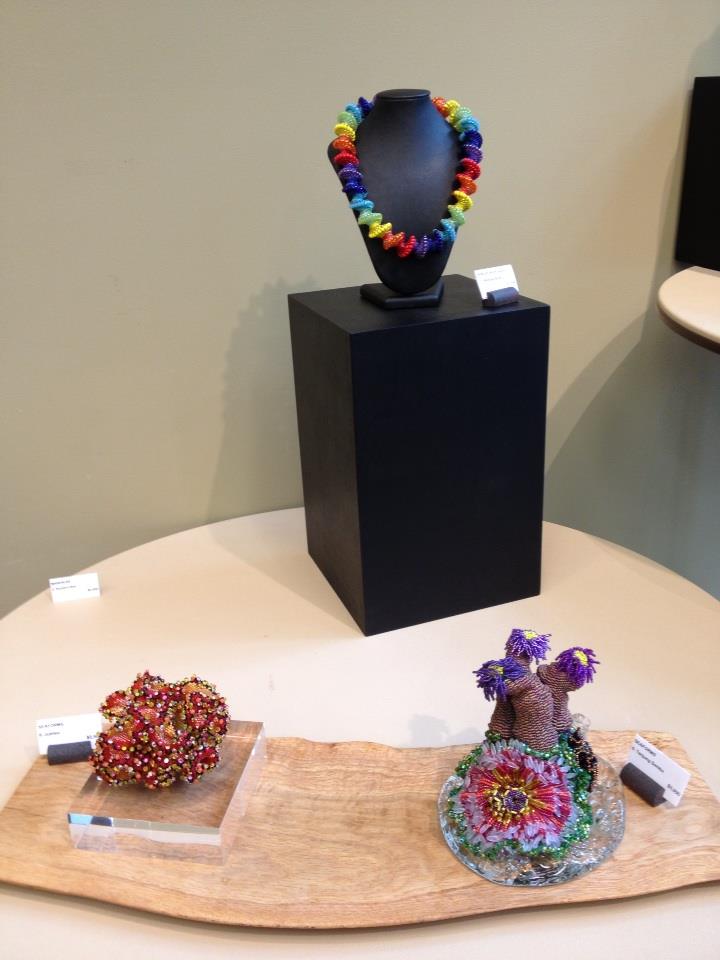
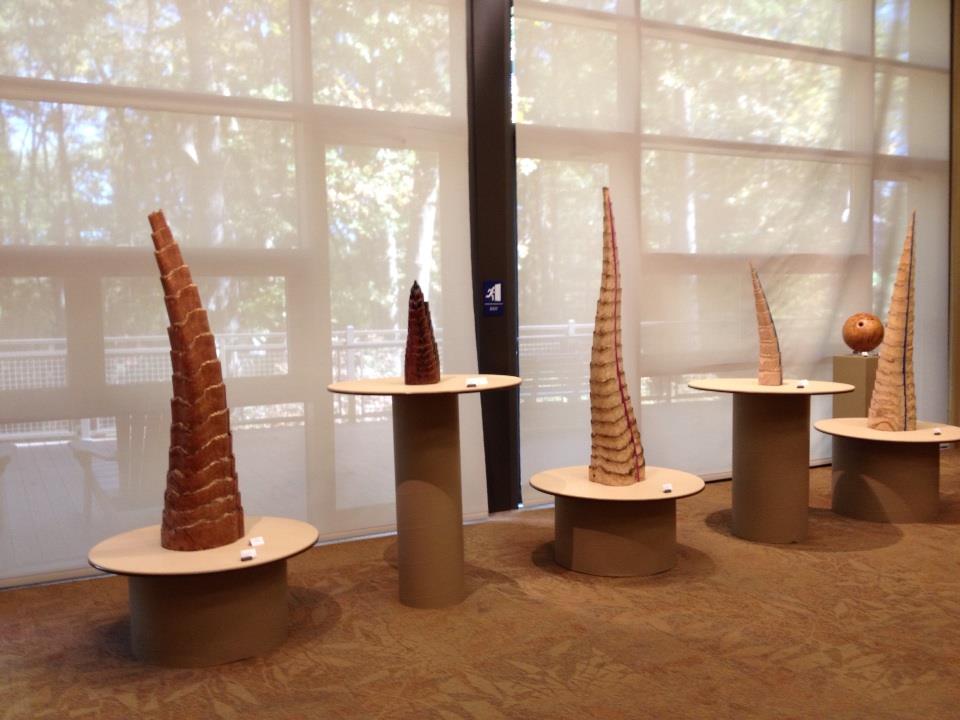
These words brought to mind my long-time friends, the craft-artists David Ellsworth (turned and other wooden forms) and Wendy Ellsworth (beaded forms). This month, for the first time in their many years together, they have a joint exhibit in the gallery space at Jenkins Arboretum (Devon, PA). The photos below are snapshots Wendy took, and their individual work is best viewed in person or on their studio website. [Contact the artists for permissions, photos, information about workshops and talks.]

Wendy Ellsworth's seaforms, and a necklace

Wendy Ellsworth’s seaforms, and a necklace

Wendy's "Sunset" (with David's turned-wood frame/container)

Wendy’s “Sunset” (with David’s turned-wood frame/container)

David Ellsworth's "Emergence" series

David Ellsworth’s “Emergence” series

I have known Wendy and David for over 25 years, and I can testify that the work each of them does fits Kay Ryan’s description of art. They are artists, and their work nourishes both of them–and nourishes us, the beneficiaries, as well.

~

For today, these are my stories.

www.ellworthstudios.com

Er – sur –

Mary Ruefle writes, in her book of “lectures,” Madness, Rack, & Honey: “I remember being so young I thought all artists were good, kind, loving, exceptionally interesting, and exemplary human beings.”

I was a child like that. It’s good to know there was at least one other. We grow up to know that such artists are far from common. But they do exist.

Each time I learned a “bad” thing about an artist, poet, or writer I loved, I felt a little deflated. Something was being taken away from my idea of the person who made such wonderful work.

Later, I rather empathized with Roland Barthes’ theorizing about the death of the author. Not because I was necessarily post-modern but because sometimes, I wanted the artist-as-person to be erased so that I could go back to loving the art-as-art. This was a juvenile way of thinking about both human beings and about art.

But: the lure of erasure…

~

Ruefle muses about time, about art, literature, and the human being. Her assays to determine what endures among us often feel a bit cryptic or aphoristic at the first encounter. The wisdom in them, and the layeredness–and the awareness of what is “missing” in her texts–evolved in my own mind as I read her book, slowly.

She has used erasure as a means to expression and to beauty, as it happens. Examples of her erasure poems appear on The Poetry Foundation’s website here.

~

The closing epigraph of Madness, Rack, & Honey (is it an epigraph if it falls at the end of the book?) is from Samuel Pepys’ Diary following the Great Fire “…an abundance of pieces of burnt papers were cast by the wind as far as Cranborne; and among others she took up one…which was a little bit of paper that had been printed, whereon there remained no more nor less than these words: “Time, it is done.”

Time.clock

~

For Dave Bonta’s interpretation of erasure poems–based upon Pepys’ diary–see via negativa here.

~

“Exhibit 13,” by Blue Man Group, follows an abundance of pieces of burnt papers cast by the wind, as well.

Virtual, physical, personal

~

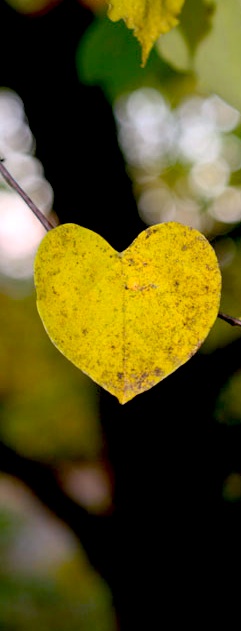
Redbud leaf in fall

Through the blogosphere, I’ve met some fascinating and talented people. The virtual connection, although I have learned to value its scope and immediacy, generally seems a bit wanting in connection for me. Even though I tend toward introversion, my favorite way to connect with people remains face-to-face. [Go ahead, call me old-fashioned.]

In the days of listservs and message boards, I first began “meeting” colleagues online. I signed up for the Women’s Poetry listserv (Wom-Po), which is still active today. One of the best things about that list, besides the fact that I learned a great deal about poetry/women’s poetry/teaching poetry/contemporary and historical female poets, is that I met many of my colleagues in person while attending writer’s conferences, readings, and similar events.

What joy for a person like me, who tends to be a bit reserved about meeting new people. For introverts, a virtual introduction and conversational exchange online–even just recognizing a name on the listserv–has made possible a route to social icebreaking at conferences like AWP.

This past Saturday, another virtual connection joined the realm of the physical when I got the chance to meet–in person–artist Deborah Barlow at the opening of her show at Morpeth Contemporary gallery. I’ve seen her artwork on her homepage; but as is often the case, viewing the work in person was revelatory and beautiful. And meeting the artist herself–also revelatory and beautiful!

I recommend her blog, Slow Muse, which has alerted me to many a terrific book on creative thinking, the creative process, and poetry as well as introduced me to several wonderful contemporary artists’ work.

As the seasons undertake the dying-toward-renewal process, I welcome musings and inspirations. The shining, textural depths of Barlow’s paintings offer another way of looking. As do good books and sunny mornings on the back porch.

Poetry and art

A colleague pointed out art critic Holland Cotter’s New York Times piece as a must-read for me with my interests in both disciplines. Here is the link to Cotter’s essay in the “First Crush” series the Times runs: Cotter August 13, 2013.

Cotter says the first love was language, specifically poetry, especially Longfellow and Dickinson.

“If you fall for Dickinson early, you’re committed to language for life, and almost unavoidably to Dickinson’s kind of language. It’s more concrete than just words on a page or in the air. It’s language as a physical material, a substance so concentrated that you can all but hold it in your hands, turn it over, feel its textures.

And it’s addictive. Once in your system, it’s impossible to shake, like a neurological imprint. In my experience, Longfellow’s intensely visual poetry was like a mural or a movie. You just wanted to stand back and let it happen to you. Dickinson’s language was visual, too, but in a startling, flashbulb way — a bang of illumination after which your vision took time to adjust to normal light.

Poetry, in general, made me sense that language could be about big, urgent subjects, the kind that ruffled even a 9-year-old mind. Will everyone I love always be here? If not, where, exactly, is heaven, and what does it look like? Perhaps most important to a writer in formation, Dickinson’s language felt personally usable. It made you want to write, made you think you could. So I did, just for the pleasure and power of creating pictures from words.”

What can I add but “Amen to that”?

It interests me greatly, though, that Cotter made his trajectory from poetry to art; my path went the other direction. I began with a fascination for and study of art and ended up as a writer.

Overlaps and linkages, interdiscipline & creativity. Big, urgent subjects…a kind of power. That’s art.

Tension or rebellion?

In my few available moments during which I can write about being intellectually engaged and curious, I’ve been working on this post. It’s been a “draft” on my dashboard for some time as I work on it. For background, recall that I was reading Octavio Paz’s prose and Dave Hickey’s essays in The Invisible Dragon.

~

Rubber-Band-Shooter_preview_featured

~

Both writers take up the concept of beauty in art. They approach the topic in different ways, of course, but both make note of the requirement for tension in the work of art. The tension can be of anticipation, expectation, surprise, or of opposition and rebellion. The need for anticipation and turns or surprise in poetry reminds me of Robert Bly’s idea of the “leap” in poetry–in fact, Paz is one of the poets Bly uses as an example of “leaping poetry” in Bly’s classic 1972 tract, Leaping Poetry. I infer that these emotion-forms are related to one another and that aesthetics involves at least some connection between experience (physical, emotional) and mind.

[For now, I will not take up the possibility of calm, contemplative, no-tension beauty.]

Instead, it is intriguing to consider the ways Paz and Hickey interconnect regarding the idea of rebellious art. Also, there’s an agreement between them–not literally, as they are not responding to one another at all–concerning art that is funded by governments. Both critics contend that way lies danger.

Hickey’s essays in The Invisible Dragon were sparked by the controversy of Robert Mapplethorpe’s U.S. NEA-funded photographs. These photographs are beautiful, Hickey says, though art critics of the 1990s dismissed the “beautiful” aspect of the work and concentrated on its “message,” while many other viewers considered the images pornographic and offensive. Hickey says, essentially, to hell with the message; look at the art: is it beautiful, or not?

Hickey writes:

My point here is that there are issues worth advancing in images that are worth admiring–that the truth is never plain nor appearances sincere. To try to make them so is to neutralize the primary, gorgeous eccentricity of imagery in Western culture since the Reformation: the fact that it cannot be trusted, that images are always presumed to be proposing something contestable and controversial. his is the sheer, ebullient, slithering, dangerous fun of it. No image is inviolable in our dance hall of visual politics. All images are potentially powerful. Bad graphics topple good governments and occlude good ideas. Good graphics sustain bad governments and worse governments. The fluid nuancing of pleasure, power, and beauty is serious business in this culture.

Hickey’s prose is such fun! And so provocative. He asserts that Senator Jesse Helms (who began the noisy movement to de-fund the NEA’s support of work such as Mapplethorpe’s) was the only public figure who really “got” what Mapplethorpe’s homoerotic pictures were saying: they really were a rebellion, a transgression–a purposeful confrontation with social norms. That’s what many artists and poets do: throw a wrench into the usual mundanities of life and make viewers or readers pause, react, reflect.

Mapplethorpe’s choice of images just happened to be considered sexually transgressive; and Hickey says that because the USA is a democracy, Helms’ right to protest was as valid as the photographer’s right to make the images in the first place. Hickey loved that there was potential for real discovery in that moment, and gives art critics and academics a hard time for retreating into ideas of First Amendment and artistic self-expression and meaning over beauty. He claims that when it comes to the US democratic culture of the arts, “whatever we get, we deserve–and what we get most prominently is ignored, disenfranchised, and instructed. Then we are told it is ‘good’ for us.” But what is good for us by the standards of a bureaucratic culture is not the original contract between the image and its viewer, even though that is the interaction that ignites the spark of awe we feel when we encounter great art.

“In fact, nothing redeems but beauty, its generous permission, its gorgeous celebration of all that has previously been uncelebrated.”

Hickey lambasts Americans for somewhat mindlessly appreciating what we are told is great art. “In our mild appreciation,” he writes, “we refuse to engage the argument of images that deal so intimately with trust, pain, love, and the giving up of the self.”

Paz’s chapter on the image in poetry dovetails with the argument of images and the intimacy thereof. That’s the contract the viewer or reader makes with the artwork or the poem: we agree to be, potentially, moved; to make ourselves possibly vulnerable to rhetoric, to pain, to love, to beauty, to sudden awareness of what has been overlooked, ignored, oppressed, made alien.

Through image. Through tension. Through a state of contrariness and forbidden looking: rebellion.

~

In a week or so I do plan to spend more time on Paz, because I find his essays on poetry enlightening on an intellectual and on a more basic/fundamental level. Hickey’s work on beauty relates to writing but is more specific to the visual and plastic arts. I do recommend Hickey for his humorous but incredibly observant role as a socio-cultural commentator on contemporary USAmerican pop culture, academic culture, political culture, and democratic-capitalist thinking. He’s accurate and insightful even when I don’t completely agree with him. He believes whole-heartedly in discourse and discovery through democratic discussion of multiple viewpoints. Check him out. You will want to argue with him.

Here’s something lovely

…from Maria Popova at the Brainpickings site: book loving and writing and art and literacy and library connect to produce this event/display at the New York Public Library. I was in the city just last week–rats, I missed this. (But I did see Ken Price at the Metropolitan Museum of Art and spent part of a lovely afternoon at Untermyer Park again).

~ Please click on the links! (I know they’re kind of hard to see on this theme)~

MEANWHILE…

I’m on blogging hiatus again while I get accustomed to my work week and while we prepare for the Goschenhoppen Folk Festival (or on Facebook here) this coming Friday and Saturday. Not a time to get much writing done, nor much reading.

A festival participant prepares apples for drying

A festival participant (19th c) prepares apples for drying

Young apprentices (18th c) at work

Young apprentices (18th c) at work