Manuscripting redux

I have read reams of advice and guidance on how to choose poems for a collection, how to order them, whether to construct an arc in a poetry collection, and so on. I have also had the excellent personal input of good poets and mentors in the process, all of which leaves me deeply grateful and still stumbling when I once again begin the process.

One challenge is excess. I have put off revising for collection for a few too many years, and now I need serious critique and culling; thus, I didn’t know where to begin (as I mentioned in an earlier post). Given a problem, however, creative people tend to develop a method. I chose the simplest one I could come up with: start by pulling all the published work that is not in my previous collections, and see what happens.

What I will discover–in fact, in the early process, already have noticed–is that not all work accepted for publication in a poetry journal reflects my judgment of my strongest poems. Then, too, down the road I will pull some good poems from the evolving manuscript because they do not play well with the others…that is, in terms of tone or subject. As I add things up, I’ll begin to see what might be missing or needed, or I’ll be reminded of an unpublished piece that ought to be included.

This work is exciting. And it takes weeks or months. It will change; my feelings about what I want the collection to say will change.

And then the reading will begin. I will read and re-read the book-as-it-exists and ask generous friends to read and critique the whole.

If I were a more ambitious and organized person, I might approach the manuscript process differently–certainly sooner, and possibly with more of a projected arc in mind from the start. I know that putting together another manuscript will be yet another learning experience, different from chapbook-writing, different from the past books I have composed. The poems differ, too–of course! My perspective, my physiology, my experiences, even my environment, though I have lived in the same house for 20 years.

At this stage, a month or so into the process, a coherence begins to occur. Yes, a book exists in the piles of poems. Probably two books, in fact–but let me begin with abundance (or perhaps, with diminishment) and proceed from there.
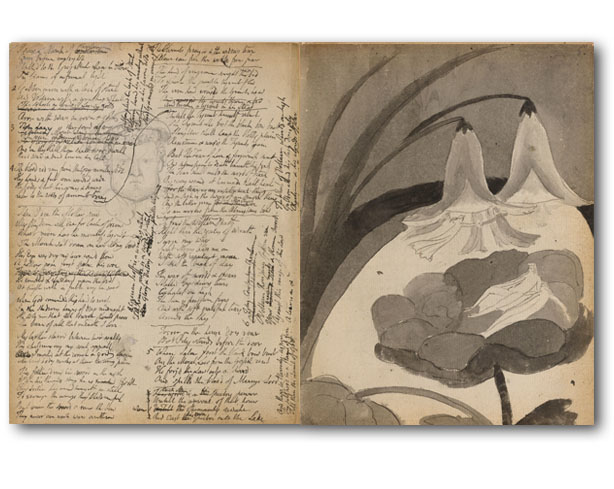
http://www.ebooktreasures.org/william-blakes-notebook/
[Not my manuscript…William Blake’s]

Manuscripting

Something I’ve been thinking about lately: how to organize a collection of poems into a manuscript? I have done it before; after all, I have managed to get several chapbooks and a long collection into the world already.

This slideshow requires JavaScript.


And yet. The difficulty never departs, so I have once again been seeking inspiration and practical advice. The interwebs disclose a bounty of information from experts. There are hundreds of articles and blogs concerning this particular challenge, a challenge that seems unique to poets, though I suppose short story writers may encounter similar concerns when choosing how to organize and what to include in a book. If you find yourself wrestling with this task, encouragement and guidance abound. Here are a few articles to check out:

~

Chicago Review of Books posted this article, asking four poets how they went about the task (and by the way, all four of these books contain wonderful work–definitely worth reading).

Marilyn McCabe’s “megablog” on the process is here.

In 2011, Jeffrey Levine of Tupelo Press posted a lengthy how-to on the Tupelo blog.

For the more scholarly reader on this topic, a lovely in-depth article by Natasha Sajé in The Iowa Review.

Poet & publisher Diane Lockward’s book The Practicing Poet includes not only prompts and craft suggestions but chapters on manuscript organization and getting published.

~

Now I need to take these generous people’s advice.

In print

I have been lucky in print this year. Two literary journals that I’ve long admired, Bellevue Literary Review and Prairie Schooner, published my poems, and so did the newer journal Naugatuck River Review. This is “a big deal” to me, because it is always exciting to be admitted into the pages of a magazine I like and because, despite the advantages of online/cloud-based literary journals, I love print!

There’s something inexpressibly marvelous about holding a book in my hands, turning the pages, and having a physical object–paper, binding, print–to carry with me.

Online magazines, theoretically at least, have a longer reach and can capture more readers (“hits”) than print. Literature requires audience, and the interwebs offer potentially millions of visitors to the poem online; but the operating word here is potential. What’s possible isn’t what generally happens. The readers of online literature, those people who stay on the poem long enough to read it–and then read the next poem, and the next, on-site–are not as legion as we poets might wish.

Through moderate use of social media, I do publicize my own work when it appears online (see links to the right on this page!). I welcomed the appearance of literature on the internet because one of my purposes for writing is to communicate with people. Readers matter to me. Getting my words into the public domain is the only way to begin that process of communication, and though online journals seem like the most ephemeral form of ephemera, they do make it easier for me to “share” (thanks to Facebook, I am beginning to despise that word) the poems or essays I’ve crafted.

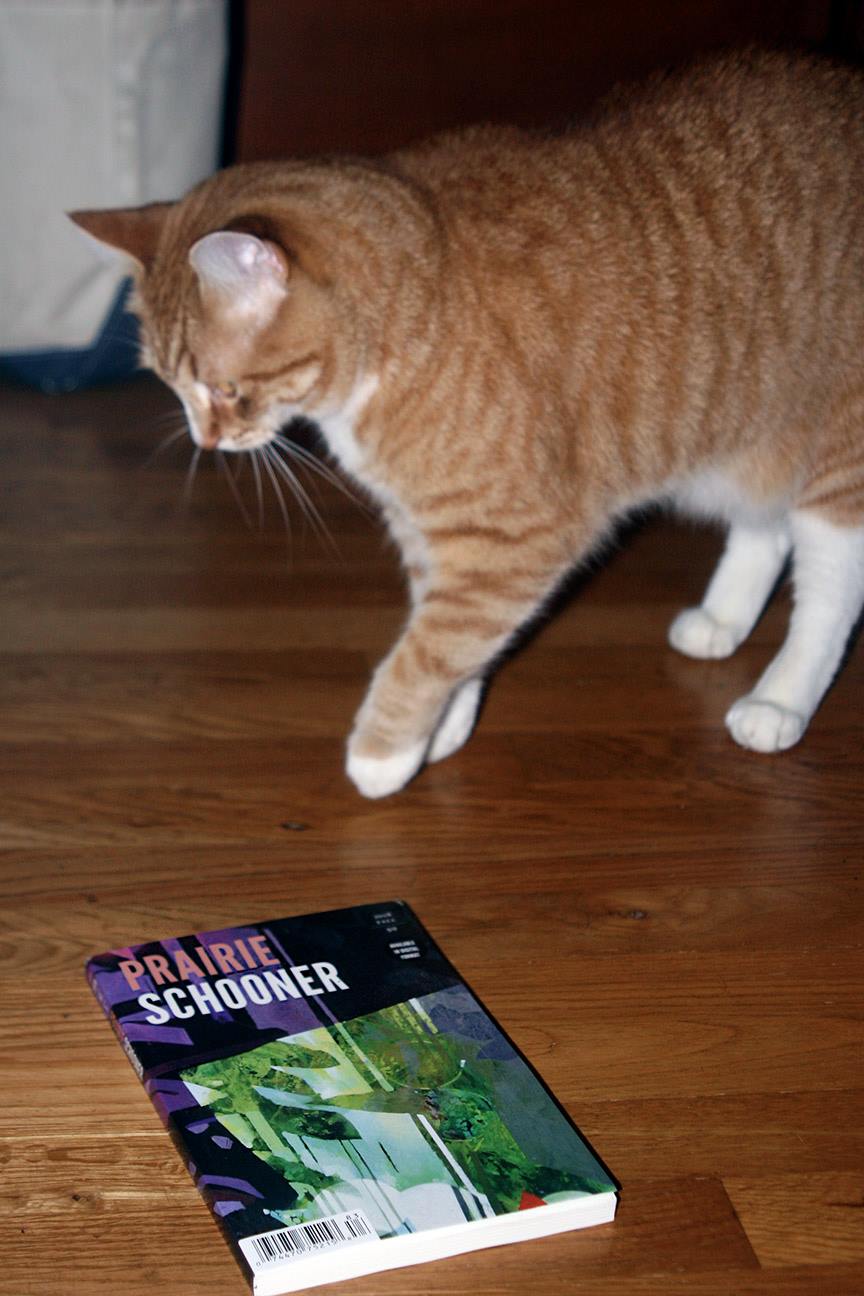
schooner&scooter

Print journals, like books, lack the immediacy of the online publication. They are not interactive in the way some online journals can be (see my recent audiofile and poem in The Maynard as an example), although some print journals are pretty experimental and interactive in quite innovative ways, such as Ninth Letter.

I encourage anyone who reads my blog to check out other bloggers on literature and poetry, and a good place to start is with Dave Bonta’s Poet Bloggers Digest. Searching the internet will open up a world of excellent poetry in carefully edited and curated literary journals.

The internet platform permits poets to read their own work, in podcasts and on YouTube, and to launch videopoems into the world. It has been a boon for poets to find audiences of all kinds, not just people who read poetry journals.

However, my cat will never circle and then settle on an online literary journal. So there’s that…

~

[I tried to snap his photo when he sat on Prairie Schooner, but he jumped up and moved on.]


River of poetry

I attended a lively and unpredictable poetry reading/performance recently, No River Twice. The poets who participate in the group reading develop the concepts at each performance, endeavoring to find meaningful and entertaining ways to permit audience members to sense an active engagement with poets and to experience poems more vividly. It appears to be an evolving performance process, and I enjoyed myself!

Grant Clauser explains the idea on his blog. Most of the poets involved have at least some acting or performance background. They are also active as mentors, instructors, advocates for the arts, and “working poets,” by which I mean they get their work published and performed and are constantly writing, revising, and reading the work of other poets in the service of learning new things.

The poets who performed in Phoenixville, PA, on Friday evening are as follows, but I understand the line-up may change from event to event.

Ethel Rackin

Hayden Saunier

Chad Frame

Cleveland Wall

Bernadette McBride

Joanne Leva

Grant Clauser

Kudos to these folks, who presented a varied and exciting performance. Let’s hope there are more to come.

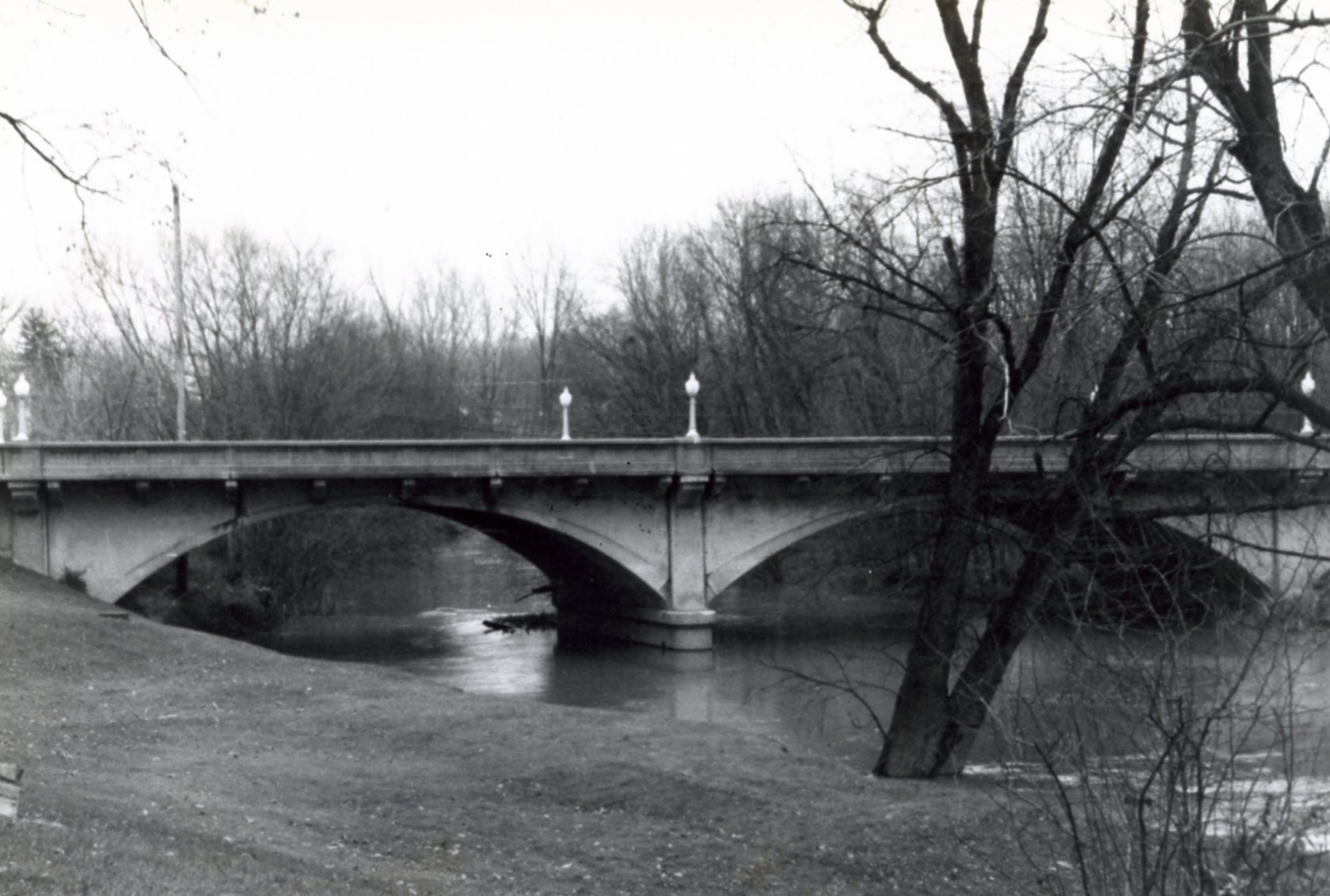
1978 South Whitley IN, Eel River

South Whitley, IN. Eel River Bridge, 1978.


Grammar


Steven Pinker‘s early book, The Language Instinct (1994)–controversial among linguists, psychologists, social anthropologists and probably semiotics philosophers–is nonetheless relatively easy for the interested non-scholarly layperson to read. Pinker has since become well-known for his best-selling books, TED talks, and willingness to engage in lively debates on controversial topics such as violence in society and his claims for the embodied brain, scientifically-supported atheism, and rational culture. [Totally off topic, but I’m a great fan of his current wife’s novels and philosophy books–Rebecca Goldstein–what an amazing mind she has! Not that Steve Pinker is a slouch in that department, either…an intellectual power couple indeed. But I digress.]

The Language Instinct got me thinking more broadly about grammar, especially as the semester is about to begin and I’m once again wrestling with how to teach conventional writing skills to under-prepared, newly-minted college freshmen. I harbor no intentions of talking to them about linguistic theories. But I do want them to understand that they can already express themselves perfectly well verbally, with the help of body language (even students who are still learning English; even students who have told me that they have learning disabilities). The tool they need to succeed at the college level is the skill of writing that employs enough agreed-upon conventions–prescriptive grammar–to convey clear ideas to the standard reader.

Lots of assumed definitions there: who is the ‘standard’ reader? How many and which ‘conventions’ are enough, and who is it that agrees upon them? I have to let the students know that the answer is: “It depends.” They are seldom very pleased to hear it, but human beings are nothing if not adaptable.

~

After defending slang, split infinitives, the ‘verbing’ of nouns, and other shibboleths, Pinker–in a chapter denigrating language mavens (hence his Jeremiah example toward the end of this excerpt)–writes:

The aspect of language most worth changing is the clarity and style of written prose. Expository writing requires language to express far more complex trains of thought than it was biologically designed to do. Inconsistencies caused by limitations of short-term memory and planning, unnoticed in conversation, are not as tolerable when preserved on a page that is to be perused more leisurely. Also…a reader will rarely share enough background assumptions to interpolate all the missing premises that make language comprehensible. Overcoming one’s natural egocentrism and trying to anticipate the knowledge state of a generic reader at every stage of the exposition is one of the most important tasks in writing well. All this makes writing a difficult craft that must be mastered through practice, instruction, feedback, and–probably most important–intensive exposure to good examples…a banal but universally acknowledged key to good writing is to revise extensively…Anyone who does not appreciate this necessity is going to be a bad writer. Imagine a Jeremiah exclaiming, “Our language today is threatened by an insidious enemy: the youth are not revising their drafts enough times!”

Indeed, I agree with him here. Taking the time to read good writing frequently, and taking the time to revise carefully when writing pretty much anything (even a Twitter post) would go a long way toward improving anyone’s writing.

linotype

Mergenthaler’s Linotype machine

We do need concise, standardized, well-revised written texts, especially when we are relaying new information, instructing others how to do something, or convincing our professors that we comprehend the fundamental theories of the coursework. That’s not “grammar,” the magical tool that my students think they somehow missed learning in grades K-12, it’s craft, attention, and revision–with a few prescriptive rules, enough to level the ground on which the we lay our communicative foundations.  The rest is work.


Connections


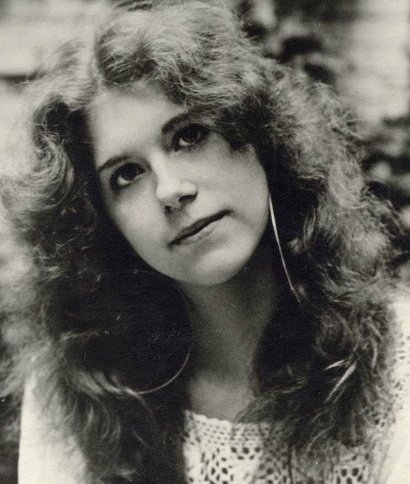
4446_1159463871068_1826910_n

August has arrived and a few of our incoming freshmen are on campus already, as well as students on various fall sports teams who need to get a jump on the competition season. It was quite awhile ago that I was a teenage person entering my first year at college, but each year our students arrive with the same anticipation and excitement I felt. They’re ready to exercise a little responsibility, a little freedom, and to make the kinds of connections–personal, emotional, and intellectual–that will affect the rest of their lives one way or another.

~

In the 1970s, science historian and television broadcaster James Burke created and hosted a show called Connections. I was a fan of the series because I loved the surprising ways discoveries, events in history, people, and accident led to innovations and the criss-crossing of continents and ideas. The interdisciplinary aspect of human culture, of science and the arts, fascinated me as a teen. Those networked ideas have shown up many times through my life.

Connections: The photo above was taken by my fellow student Steve Lohman when we were freshmen. Steve later attended Pratt School of Art.  We lost touch for a long time, and–I have forgotten how–I found his metalwork while I was looking for cover art for my book of poems The Capable Heart.


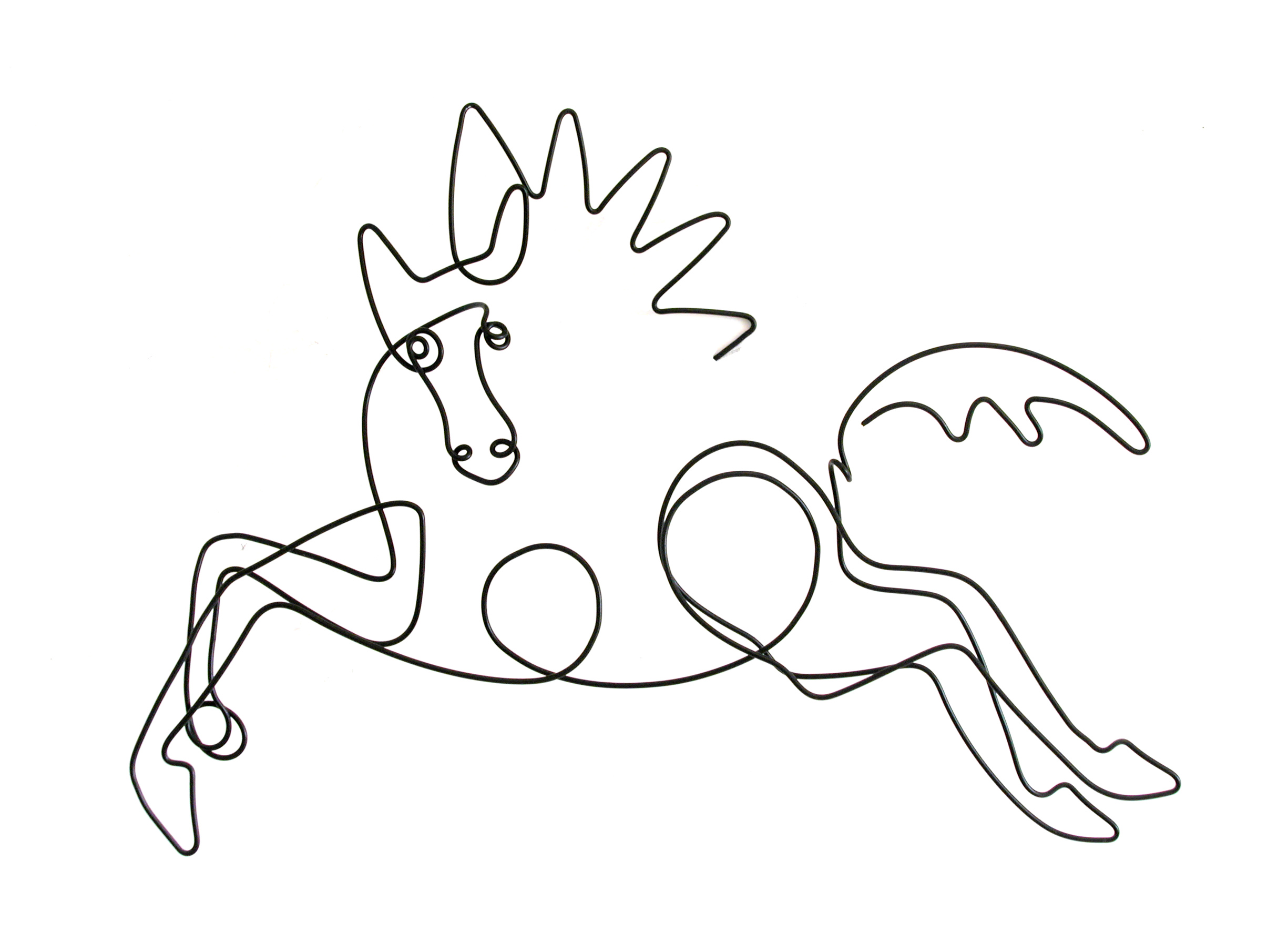
running_horse

Running Horse by Steve Lohman

Connections: I liked Steve’s wireworks, but I remembered him as a photographer. Granted, what a person pursues at age 17 or 18 is easily liable to change–but I was curious about how he started doing sculpture. When he mentioned he’d attended Pratt, I asked if he had ever met Toshio Odate, who taught there for years. “One of my favorite teachers!” said Steve. “I loved his class.”

Connections: My spouse took a job writing for a woodworking magazine, where he met Toshio, who wrote about Japanese tools and woodworking techniques. Meanwhile, Toshio was creating his own works of art at his home as well as mentoring many students. He’s now a long-time friend of ours. (Photo of Odate’s “Pride of New England,” below, by Laure Oleander).

toshio-pride copy

Connections: Neural networks, the embodied mind, the ways writing assists in psychological healing, the twists in a good novel’s plot, the turn in a poem, metaphor, surprise. The unexpected thrills us–unexpected connections fill us with curiosity and a kind of joy, as does the closure.

~

Connections: The commercial creation Thinkhub, invented for teaching, offers yet another example of connections. A cultural thinkhub project based in Toledo, midstory.org has produced my poem “River by River” as a soundscape: click here.

The project researchers found my poem in the anthology I Have My Own Song for It: Modern Poems of Ohio. Look around, folks–connections are everywhere, and we learn from them.


Difficult books, iterum

After some readings on metaphor and language, I tackled A Grammar of Metaphor (1958) by Christine Brooke-Rose. Admittedly, I was hampered in my reading by my lack of facility in the jargon and structure of what used to be, but is no longer, “basic” English grammar. It did help that I have read The Trivium and could refer to it now and again; and of course it helps to have a background in poetry and literature, though not one nearly as thorough as Brooke-Rose’s. I definitely can add this one to the “difficult books” I have enjoyed, and benefited from, reading.

The grammar part of metaphor was not something I took into much account when I studied poetry. Certainly, when I read for pleasure, I do not analyze for grammar. Poets often experiment with grammar–altering syntax purposefully, creating sentence fragments, run-on sentences, new compound words, jarring phrases, all in an effort to make something happen in the poem. That “something” may be sound, dream, argument, exhortation, emotion, surprise, pattern, recognition, or a matter of perspective on outlooks, worldviews, culture, tasks, the personal. I do not read for such insights until I want to return to the poem and find out how the poet managed to make the amazing process of language work upon me.

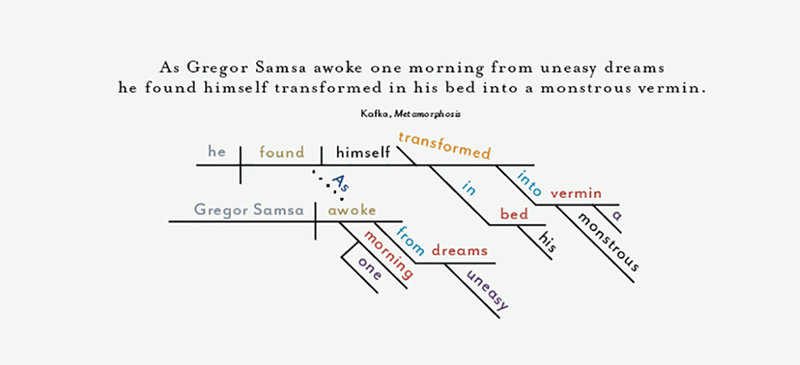
If I were to try parsing a contemporary poem using the Reed-Kellogg system I learned in elementary school, some poems would buck and kick and refuse to reveal their structures. It would depend upon the poem and upon how one interprets such things as line breaks and stanza breaks. I am not convinced the process would really assist most readers in developing an understanding of the poem.

diagram

NPR.org Juana Summers [read here]


Then again, it might. Analytical scholars have taught me many things I would never have thought to investigate on my own.

~

Here’s a post from the 2018 blogroll journey: Marilyn McCabe on mindset–in writing and other things. Also a matter of perspective.

Language acquisition & its opposite

When my children were learning to talk, I developed a fascination with language  acquisition. The process of learning to communicate with other human beings in the lingua franca of the culture (speaking US English to adults) was taking place in front of me. I felt awed by the intelligence required to decipher language and delighted by the myriad ways the process and behavior unfolded. For about a year, I seriously considered enrolling in university to pursue a Master’s degree in some sort of language/linguistics-related discipline.

But I had two toddlers and lacked the energy, time, and money to devote to diligent scholarship of that sort. Instead, I took my usual autodidactic approach: reading and observing. One thing of vivid interest to me at the time was how differently my children each approached “learning to talk.” In retrospect, I recognize that their differences in personality and their differing cognitive strengths made significant impacts upon language acquisition, implementation, expression, and use.

ponchos~


At present, my interests in language revolve about the other end of the lifespan of human communication–the loss of language abilities as people age. The elderly Beloveds in my life are displaying markedly differing changes in how they experience, and express, cognitive gaps. Often the expression of such gaps appears in the way they speak.

This would be the opposite of language acquisition. Memory losses, or slower memory retrieval functions, are common to most adults over age 70; but those issues do not necessarily affect sentence structure, vocabulary, pronunciation, descriptive abilities, and emotive communication through language. Strokes, neurovascular constriction, and Alzheimer’s disease, among other physiological alterations, can exert marked effects on verbal and written communication, however. Hearing loss and diminished vision exacerbate these problems.

All too often, the human being seems “lost” beneath the symptoms or becomes isolated as a result of the immense challenges to human relationships we have taken for granted for decades of being relatively “non-impaired.”

The loss of language skills intrigues me as much as the acquisition; my readings in neuropsychology and neurobiology have taught me that there is so much yet to learn about the brain and how it processes–well, almost everything (but my special interest is communication).

And my experience with people who are aging, or in some cases–my hospice volunteer work–dying, demonstrates on a personal or anecdotal level how uniquely individual each one of us is. How we communicate, how we express ourselves, our neurological processes, our physiology, temperament, environment, genetic makeup…so gloriously complex, random, fascinating.

Maga

The late Edna Smith Michael in 1990. Her language skills stayed quite intact until her last hospitalization.

~

Some recent reading–

Into the Silent Land: Travels in Neuropsychology (Paul Broks); Cure: A Journey into the Science of Mind over Body (Jo Marchant); The Language Instinct (Steven Pinker)

A post I put up awhile back contains my poem “Age as a Foreign Language.” Apropos here, I think.

~

And no, I am not tempted to enroll in further formal study on this topic. But reading suggestions will be gratefully accepted!


Back to metaphor

I recently read James Geary’s entertaining book I Is an Other–The Secret Life of Metaphor and How It Shapes the Way We See the World. Geary takes his title from one of Rimbaud‘s letters, calling this phrase metaphor’s “principal equation”:

Metaphor systematically disorganizes the common sense of things–jumbling together the abstract with the concrete, the physical with the psychological, the like with the unlike–and reorganizes it into uncommon combinations.

I like this definition because it feels more complete than the typical definition of metaphor as a comparison without the use of the adverbial comparative (i.e., no “like” or “as”). Indeed, metaphor probably forms the basis of language itself; while that conclusion’s much debated in semiotics, linguistics, and other scholarly disciplines, common sense and common usage strongly suggest that even thought itself–in terms of how we think internally about the world–employs metaphor as an underpinning.

Maybe I believe so because I’m a poet. Geary, as it turns out, has written some poetry, though he’s best known for his books about words, word origins, wordplay, aphorisms, witticisms, and the like. (He’s also got a TED talk…everybody’s got a TED talk…)

As to poetry, and how metaphor behaves in the poem’s context, I like what Geary says here (although in this excerpt it’s not actually poetry he’s discussing, but rhetoric):

Readers actively retrieve a metaphor’s meaning, just as a punch line requires listeners to resolve a joke’s incongruities for themselves…though the speaker may make the metaphor, the hearer makes its meaning. Hearer and speaker are accomplices; the one unpacks what the other presents. In terms of creativity, producing a metaphor and penetrating one are almost the same act.

I think the above lines go far to explaining why I love to read poetry and also provide implications as to why poems can be so damned difficult to compose. The poet endeavors to create a context and container for an often-unknown audience who will nonetheless need to invest, one hopes willingly, in the process of reorganizing the surprising (metaphor) into the recognizable.

And what a fine task that is!

2011A-rainbow

Imaginative, not imaginary

I have been thinking about the place that a poem makes in the world, the place that a poem is in the world. My recent reading on C.S. Lewis’ Narnia series (see the tail end of this previous post) has led me back to a few of his essays. He felt that good stories–whether fantasy, mythology, allegory, science fiction, or epic narrative–take the reader to threshold spaces that are imaginative, not imaginary.

I think that poetry offers what Plato calls psychagogia— “an enlargement of the soul” in C.S. Lewis’ definition, or see John Joseph Jasso’s dissertation chronicling it as “the idea that rhetoric can lead souls to their own betterment; that is, guide them in an ascent along a metaphysical hierarchy through beauty, goodness, and truth to a fuller participation in being.” Poetry provides such enlargement by permitting the reader to imaginatively undergo transformation via images and places the poem offers, to experience the turn in the poem’s rhetoric, to feel ‘along with’ the poem’s nature. The poem is a threshold at which the reader stands and makes the choice of whether or not to enter.

Granted, that seems a rather allegorical way to think of poetry, but not, I think, an unwarranted perspective.

~

Lewis, by training a medievalist, believed that we need to read “the canon” or, essentially, any and all great literature of the past, in order to have “something to set against the present, to remind us that the basic assumptions have been quite different in different periods and that much which seems certain to the uneducated is merely temporary fashion.” (This is from his 1939 sermon “Learning in War-Time.”) I love reading modern and contemporary literature; but I agree with him that through reading the work of the past, we cross a threshold into a new (to us) perspective. I do not know what the past knows; I have to explore, read carefully, infer, and take nothing for granted. I must take the role of observer before donning the garb of critic. For me, it’s as important to approach literature with beginner’s mind as it is to approach the garden with beginner’s mind. Perhaps this is one reason I have always enjoyed reading history: The past is a place I do not know well and therefore have to find a way to enter into anew.

Lewis continues by noting that the person who reads literature of the past “has lived in many times and is therefore in some degree immune from the great cataract of nonsense that pours from the press and the microphone of his own age.” Given the times in which we live and the nonsense pouring from the microphones of our age (which are legion), it takes a good deal of sorting to find the beautiful and the good–which do exist–amid the resounding chaos. I do not recommend a full retreat into reading Beowulf, the Illiad, or Tolstoy, but tempering my intake of current media with poems and stories reminds me that I ought to question my basic assumptions and the basic assumptions and perspectives of others, including people who lived long ago in eras and cultures about which I know very little.

A good read inclines me toward the imaginative. Whatever arts it may take to get me there, past the imaginary and into imagination, whatever aesthetic form it takes, I am grateful.

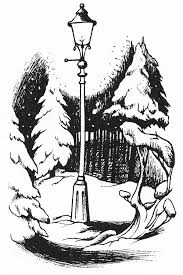
baynesNarniaPauline Baynes’ illustration: Narnia’s lamppost in snow.