Reading in shade

It’s the time of year when, according to the lunisolar calendar, we move from 小暑 xiǎoshǔ–when the heat begins to get unbearable–to 大暑 dàshǔ, the hottest time of the year. It may also be the greenest time: my garden suddenly plumps out huge squash leaves, giant sunflowers, masses of beans, zinnias, basil. The tomatoes are finally burgeoning after a late start. It’s too hot to spend much time weeding and pruning: I harvest what I can and retreat to the shade as soon as possible, where I can read.

A friend recently lent me a book of short stories, Human Sacrifices, by María Fernando Ampuero, an Ecuadoran writer. It’s been ably translated by Frances Riddle, and the stories are startling and harrowing. Not something to check out for a light summer read on the beach, but memorable and thought-provoking. One critic says Ampuero’s work is South American gothic. I don’t agree–and I think it’s kind of a cheesy shortcut in a review–but perhaps that phrase does convey the flavor of some of her stories. Anyway, it’s always a treat to find a writer whose work I’m unfamiliar with and whose work is admirable.

I’ve been taking a break from reading poetry, though that wasn’t planned on my part. July brought a wedding, a death, and some travel; and now, in the intense summer doldrums, I prefer to read for entertainment or information, or just to pass the time. Poetry takes more brain and heart space for me, more “intentionality” or concentration, than most non-fiction books or novels do. This is not to say any other genre is less demanding in and of itself. It’s a personal quirk: I am more attentive when reading poetry than I am when I read other forms of literature, probably because I’m unconsciously (or consciously) endeavoring to learn something of the craft and style and context of poems by other poets. It’s a method of processing how to write poems. But as I have no plans to write fiction or non-fiction, I read such genres for entirely different reasons.

Usually I try to read outside on the porch, in the hammock, on the garden swing. Some days it is just too damned hot and humid, though, and I resort to the air-conditioning indoors. The indoor climate has no flies or gnats but also no bird songs, cicada hums, cricket calls, breezes, scents of summer. Indoors is less than ideal (except in the teeth of winter!).

Recently I’ve added a shade garden where the chicken run was in decades past, under the umbrella of our largest white oak. I haven’t yet added a bench, but a lawn chair suffices for now. Alas, it is a bit buggy, but so is the hammock. The pleasure of summer reading in shade outweighs the inconvenience of the minor fauna…most of the time.

Recuperating

Last week took a lot out of me, many reasons for that, mostly keeping those reasons to myself. I needed some rest from exertion and from social media, so I’m re-reading Les Misérables. In which Hugo seems to be trying hard to convince readers that compassion and goodness can be awakened in the hardest of hearts through the process of gentle persistence and genuine decency. Radical decency, as a friend of mine put it. Well.

I won’t write that off as an impossibility, since lord knows many things that seem impossible are not. But yes, Hugo was writing fiction, and one turns to fiction for escapism but also for reference, and for understanding human actions and feelings, and for perspective, and for information. I just completed Richard Powers’ Overstory, which offers a vast range of perspectives on the above-mentioned and adds ecology and forest infrastructure and the psychology of groups into the mix. Novel-reading has been giving me a sense of overarching historical range that lifts me a bit from my too-close focus on my own small life and my ability to sustain hope and make art. That acts as a form of recuperation, if you’re me.

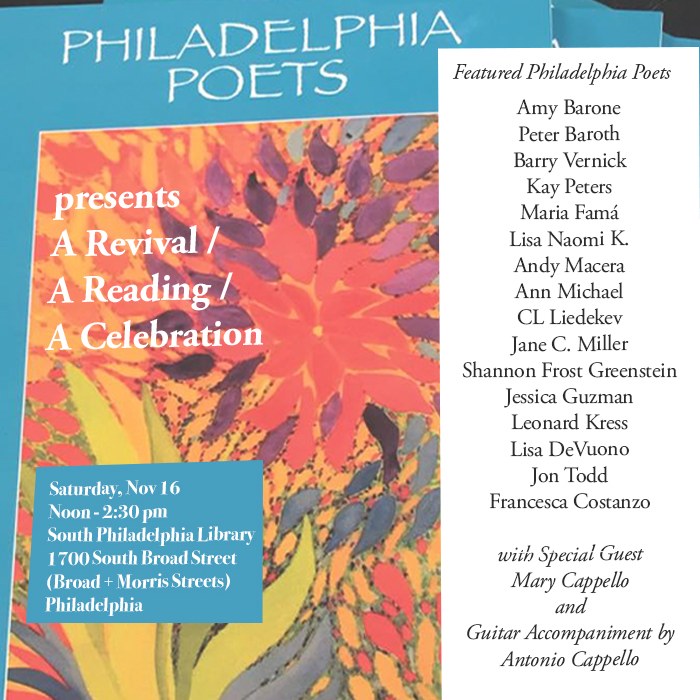
This week, though, happens to be full of poetry. Tomorrow, I’m attending a reading at a nearby public library, where I’ll see many poetry colleagues, the sorts of folks who create a community of local writers. Friday, I’ll be reading with Montgomery County’s Poet Laureate, my friend Lisa DeVuono, at the retirement community where my mother resides. Saturday, I’m heading down to Philadelphia to read with another long-time poetry community in celebration of Philadelphia Poets, a long-running zine established decades ago by the late Rosemary Cappello.

It is good I have had some reading-novels time, and it is good I’ll be having some reading-with-poets time ahead. Both are nourishing to my soul. I haven’t been writing much lately, but I will be eventually. Meanwhile, I’m still waiting for the drought to break…we got a fraction of an inch of rain a couple days ago, and I really hope there is more ahead.

Whatever you happen to need to nourish your own soul, make time for it.

Patterns

I recently finished reading Meander, Spiral, Explode: Design and Pattern in Narrative by Jane Alison, a series of essays that considers the structure of written narratives in fiction, mostly in novels. Alison’s background context is the Western-developed Aristotelian dramatic arc, that “exposition/rising action/climax/falling action/denouement” plot that generally follows chronologically. She then examines several novels, modern and contemporary ones mostly, that don’t adhere to the classic structure.

I’ve read some of the books she looks at, and have decided to put others she mentions on my to-read list, but mostly what I took away from her text is my own recognition that poets have been varying structures for a very long time. I don’t mean just the patterning difference between, say, a sonnet and a pantoum or free verse but a poem’s narrative structure, its approach to chronology, imagery, argument, world-building, and more. When I was reading, I thought of examples of poems that spiral, meander, make wavelets, are fractal in nature, or explode (to use some of Alison’s terminology).

In particular, the cellular or networked ‘form’ of storytelling seems basic to poetry–each cell a room or stanza, interlocking or sitting nearby with space around each one. The space connects as well as makes gaps, leaves room for reflection and recombined connections and new patterns; sometimes the stanzas float like little blocks on the page (or screen)…interrupting the narrative and enhancing it as well. Poetry’s narrative is often collage-like, and I notice this aspect in some newer novels as well–but I read much more poetry than fiction these days. Maybe it’s time to plunge into more novels again? At any rate, Alison’s book has made me reflect on narratives, lyrical narratives, literary structure. Maybe even the structure of a new manuscript? (I ought to get to work on that.)

If you want a taste of this book, you can read part of her opening chapter, which appeared as an essay in The Paris Review, here. I don’t teach in a classroom anymore, but if I were instructing a creative writing class I might put this book on the reading list.

Life story

My current slow-read is K. Setiya’s book Life Is Hard: How Philosophy Can Help Us Find Our Way. While there are many aspects of this philosophical book that interest me and pertain to current or recent experiences in my life, something that gained my attention regarding writing is the author’s suggestion that the concept of failure as a loss is bound up with cultural narratives. If we imagine our lives as arcs with the aim of goals, journeys’ ends, attainment of heart’s desires, finding true love, and the like, Setiya argues, it is too easy to feel that we are failures, and to despair or grieve. Maybe we should not be so caught up in narratives, he suggests.

Hmm. As a poet who writes a good deal of what may be termed “lyrical narrative” work and as a human who loves a good story, I’m more drawn to theories of story-as-essential-to-humans; I’m thinking here of Daniel Dennett and Brian Boyd, about whom I’ve blogged in the past (I will place those links at the end of this post). Nonetheless, poetry is often writing about what is NOT a story; some of my favorite poems have no story per se to tell, yet they move me to reflection and/or to emotional resonance. Hence they feel deeply significant.

Photo by Elliot Ogbeiwi on Pexels.com [Despair]

And if you have happened to click on the links to the right of this page that lead to my poetry online, or purchased and read my books (thank you, dear readers!), you are sure to find several pieces that are not even remotely narrative. As someone who has struggled with self esteem and ambition, and often felt myself a failure, Setiya’s philosophical undoing of the concept that a well-lived or meaningful life entails having “successes” comes as a relief. Whether one decides to accept his idea–I guess that’s up to you. It’s a book worth reading given how anxious contemporary American citizens seem to be and how powerless and despairing we often feel.

Colleagues have often asked why I don’t write fiction, and I respond that much as I love stories, I am no good with plots. It occurs to me that I cannot imagine writing a memoir, either. First, my life doesn’t strike me as being all that interesting, and second–I don’t think of my life in plot lines. It has been, instead, a series of experiences that mainly connect because my body and my ego-self are being carried more or less randomly through life on earth while I observe the world and participate in whatever moment I happen to find myself inhabiting. So it seems I need to locate a book Setiya mentions, Jane Alison’s Meander, Spiral, Explode. Whenever I get around to reading and reflecting on it, I’ll post here.

~

Here are links to posts about art, storytelling, narrative urges, etc.

~

Novels & words

When I was about seven years old, I discovered books offered me a way to immerse myself in adventure and temporarily escape life’s discomforts. Novels, and later, poetry, were the genres I turned to most often. Though I also liked history, science, biographies, and art, there was something about a piece of sustained fiction that enthralled me so deeply I could easily ignore anything around me: the television, my siblings’ bickering, the vacuum cleaner, my parents’ calling me to dinner. In later years, immersed in a book, I risked going late to class or missing my stop on the F train. The only area of my life where I understand what is meant by hyperfocus has been reading.

Then I had children, which changed everything. I remained an inveterate reader, but I found it far easier to get through non-fiction, poetry, essay or short story collections, and literary memoirs than to devote myself to novels. It was simply too easy to get lost in a book of fiction, to wrap myself in those worlds to the detriment of my own. Too easy to become irresponsible to life’s requirements, which were suddenly so many and so urgent. If my situation had been different–let’s say, commuting by train for half an hour or more daily–I might have continued reading a hundred or more novels a year. But I was home in the rur-burbs with two young kids, and I could read only in short spurts throughout the day. Granted, I read a lot of books to my son and daughter, some of which were new to me and most of which were fictional…but a bit below my grade level.

Those children are in their 30s now, but I became so accustomed to the non-fiction genre that only recently have I begun to turn back to my first love, the novel. Granted, I did my reading-all-of-Dickens stint during covid, and I never completely abandoned reading novels; but I got out of the habit. Because my workplace office is now in the library, however, I have been picking up the occasional, usually contemporary, novel that appears on the library’s New Acquisitions display. This is where I found R.F. Kuang’s book Babel, or The Necessity of Violence: An Arcane History of the Oxford Translator’s Revolution. Imagine an alternative Dickensian-era Britain, with the underlying power struggles between education and political power as per Pullman’s His Dark Materials series, and the almost-believable otherworldliness (and creative footnotes) of Susanna Clarke’s fiction…with the late-adolescent outsiders who bond over knowledge that cements the Harry Potter books…and add some genuinely academic background on linguistics and etymology.

That’s about as close as I can describe Babel by means of other books, but what I really enjoyed about the novel is the way it got me thinking about how dismayingly interconnected education and scholarly pursuits are with power structures such as governments, politics, wealth, and colonialism. Kuang deftly shows her readers how the focus on knowledge that her characters love and possess talent for inevitably leads to a narrowness in their perspectives that differs almost dangerously from an uneducated ignorance. They are good young people, but they operate as elites in a fundamentally callous system. The system either corrupts or smothers. The “fun” part of her world construct is that power operates on the use of words: on languages and their etymologies, which are magical enhancements.

But of course, power does hinge on the use of words, doesn’t it?

The question this poses in my mind has something to do with poetry, with the writing of it, the speaking of it, its use of words that are not magic but can carry with them a power to evoke that seems pretty magical at times. Reading this novel was not only entertaining (sad, thrilling, surprising)–it got me, after I’d completed hyperfocusing, to reflect on ideas that twine with the roots of poetry. To me, that’s the best takeaway from any reading experience.

What poetry says

My dad was a newshound. Always had the radio on and newspapers: New York Times, Philadelphia Inquirer, Camden’s Courier-Post. I grew up watching the Viet Nam War on the 6 o’clock nightly news. I am fortunate enough not to have lived through war in my own country, but I read a good deal of fiction–and wars supply natural conflict for plots, either as background or foreground. I found it a little too easy to put myself in the situations of the characters in novels.

Also, I was of a Cold War generation. The threat of nuclear warfare loomed, and we drilled for that eventuality in our school hallways the way children today drill for active shooters.

Dread. I get it.

Many friends and colleagues have been posting poems on social media the past week, as poems about the useless pain of war can be recycled generation after generation without becoming irrelevant. Really, that fact alone ought to teach us that armed conflict offers nothing but suffering; but when have governments ever listened well to what poetry has to say?

What follows is a work of the imagination, a poem I drafted in 1990, if my records are correct, and revised last in 2008, after which it was published online in a now-defunct literary magazine. Reading it, I realize that with a few changes, it could become a poem about a pandemic as easily as about a war.

~~

DURING WARTIME

First we lose
our certainties
and some of our trust.
The rest depends on events,
our nearness to the front.

Cities feel it earliest,
a dry panic, rations,
the irrational becoming
stuck, continually,
in our throats.
We practice
not being hysterical,
learn to live without
bacon, or oranges.
On worship days,
silence and weeping.

Life in hills and farms goes on
more quietly than before,
difficult situations held
as they usually are
like a straw between teeth.

The last things lost
are nonetheless changed:
a bounty of curls
on the pillow of a once-shared bed
turns grey. 
Linen closets, kitchen cabinets,
the child’s pale room
have altered, become simpler,
more desperate.

When infrastructures fail—
rails, roads, electricity— 
we are merely afraid;
it’s when simple things leave us
we have lost all our wars.


(1990/2008) Ann E. Michael

Story as vagabond: Intizar Hussain

Kahani to awara hoti hai. Story is a vagabond…My nani…used to tell me a story in which a girl says to her father, “I love you as much as salt.” My nani didn’t know about King Lear…She belonged to a tradition of storytelling in which space was unbounded and time was fluid; the hero could travel across forests instantly, and ignore borders separating Heaven, Earth, and Hell. Fairy princesses and monkeys spoke classical languages, and trees and birds told stories. This made for a more generous world, and, of course, a more imaginatively vibrant one; and it made the question “What does it mean to be human on this Earth?” a genuinely inclusive one–because the answers had to account for our relations with everything around us. It is because I am an inheritor of this way of thinking and being in which boundaries are always porous, always shifting, that I can accept that there is a grave of a Muslim disciple of Krishna in Brindiban…

~Intizar Hussain, Pakistani (but, earlier in  his life, Indian–from Dibai) fiction writer, from an interview with Alok Bhalla in Manoa journal. [The surname can be spelled either Hussain or Husain in English.]

33414458Bhalla–one of several translators of Husain’s work into English–comments during this interview: “The poet-storyteller is both blessed and cursed; he is exiled from Heaven and the courts, but he understands how integrally he is ‘of this Earth’–that is, secular. This seems to be the tradition in which you have been trying to locate yourself. Isn’t that why both the religious fanatics and the ideologically motivated find it difficult to accept you?”

~

Earth–we are embodied of earth, part of earth, indivisible from our earthliness, and we exist in relation to the things of this earth.

It might be wise to stay mindful of our necessary integration with all things earthly and embodied, to recognize how intricately we are connected. Bhalla, whom I met at this year’s AWP, mentioned that Husain was fundamentally opposed to identity politics; in  his generous inclusiveness, he believed that to define oneself under a single identity forces boundary-relationships with others, that tribalism has led to nationalism and thence to genocide in far too many instances of human history.

Naturally that means he had a fraught relationship with Pakistan itself, and–to quite some extent–with Islam [he upheld the notion of Mussalmani]. He was revered enough and diplomatic enough to keep those boundaries porous and those relationships open.

Few of us will ever be as wise.

~

This lovely issue of Manoa features cover artwork and illustrations by Imram Qureshi, whose work I walked upon at the Met in NYC, roof garden installation, 2013.


Head in a book

I am tackling some fairly difficult texts* at the moment and, when I need to find something less academic, have interspersed them with poetry and short fiction. In the latter genre, Ted Chiang‘s work has been a marvelous discovery for me. His speculative fiction derives its plot points from scientific and mythological sources. Though his writing style differs from hers, much about the short stories reminds me of the late Octavia Butler‘s work. “Understand” is a fascinating perspective on intellect vs consciousness, “Tower of Babylon” a lovely mythology that owes something to Borges, Calvino, archeology, the Hebrew Bible, and torus theory.

As to poetry, I’m reading Moira Egan‘s sometimes hilarious and often authentically moving Hot Flash Sonnets. Although “women of a certain age” can easily relate to the apparent topic of the sonnets, these poems appeal to much more than insight into female physiology or stereotyped emotionality/mood swings; they are about desire of many kinds, about taste and sex and grief, aging and joy–moments the world opens up to us and sings (in sonnet form!).

Yes, I know history is going on around me; and here I am with my head in a book.

It’s better than having my head in the sand. I’m learning something!


*Philosophy in the Flesh; Untranslatable: A Philosophical Lexicon.

Empathy & compassion

quanyin
Quan Yin, bodhisattva or goddess of compassion; the Chinese interpretation of Avalokiteśvara

Sensitive. Or: oversensitive.

These are terms I hear bandied about to describe people who react deeply to anything from wool clothing or sock seams to sarcasm or “charged language.” When I was a child, people told me I was sensitive; initially, I thought that was a kind of compliment, and sometimes that was the intention. The teenager I once was believed that sensitivity made me empathetic and compassionate.

As I matured, however, the term sensitivity took on more negative connotations of the “can’t you take a joke?” sort. Worse yet, the charge of sensitivity came loaded with accusations of narcissism, as in “you take everything personally.” In today’s phraseology, “It’s not all about you.” Under those terms, sensitivity does not resemble empathy.

Empathy is a feeling-response, true. It appears to have a like-kind relationship to sensitivity–but a person must be sensitive to others’ experiences in order to feel empathy; so the similarity’s not as swappable as it first seems. I thought that my feeling-response signaled that I was a compassionate person. Indeed, fiction elicits empathy in me. A lifelong bookworm and early addict to novels, I definitely feel along with the characters of the stories I read. Is it really the experience of others that makes me weep or feel joy as the characters forge through lives such as I will never be able to encounter? Or is it a feeling response to damned good writing?

I ask myself these questions because, given my inquiries into what consciousness is and what poetry does, it seems I have not made clear to myself the differences between sensitivity, empathy, and compassion.

~

My current thoughts on the differences have evolved through reading and writing poetry, not fiction, and through getting older. Nothing like life experience to knock a person’s youthful errors into strong relief.

Here goes:

Sensitivity is the strength of a person’s reaction. That reaction may be physical or emotional and will vary widely from one individual to another.

Empathy always means that one “feels within” another person (from Greek empatheia em- ‘in’ & pathos ‘feeling’); it is an inward response to external stimuli. As Daniel Goleman notes, there are several types of empathy psychologists have identified–here’s a brief article on that topic.

Compassion, while a noun, must be active. I think of it as behavior, as action, as verb in noun form. It is a response or reaction to suffering in others (empathy) that is accompanied by an urgent desire–the word desire isn’t strong enough to convey the feeling–to help alleviate the suffering.

That’s where the activity comes in. Until I feel a desire to act, I am “merely” empathetic and sensitive.

~

Recently, I have begun to recognize that my desire to write poetry is partly compassion-based. Art of any kind is process as well as result, and process is action. Additionally, my career as an educator has compassionate action structured into the job description. There are other ways we–I–can be compassionate in the world. This matters to me.

We can learn from the practice of tonglen: “Breathe in for all of us and breathe out for all of us. Use what seems like poison as medicine. Use your personal suffering as the path to compassion for all beings.” ~Pema Chödrön

And we can live in the world and begin to use our sensitivity to pain, and our sense of empathy, to activate compassion–as a verb.