Curriculum vitae

My year has begun with half a dozen literary journals declining my poems, but it has also begun with a proliferation of new poems–which makes me happy. There are several reasons for a prolific spurt, some of which involve sad events that have turned me toward reflection. While sorrow isn’t a reliable prod for writing in my case, reflection almost always is. Also, attending a workshop is generative for me.

In last week’s session, we read Lisel Mueller’s “Curriculum Vitae,” and Anita asked us to emulate the poem for our own life story. I encourage you to read Mueller’s poem if you are not familiar with it; it’s full of lovely imagery and is so concise and evocative that it stands as autobiography–quite an amazing piece. Also daunting: how to use that poem as a writing prompt? I needed a strategy, so to keep myself as brief and non-narrative as possible, I limited my version to 15 points instead of 20. Then I edited it down several times, taking out as much as possible while leaving things that feel “true.”

What I realized after this practice in form, and after revising it and tightening it up, is that if I were to start again rather than revise–and were to focus on different aspects of my life experience–I could write a completely different, but still true, poem. I could write a dozen completely true and completely different CV poems! I could have used national events that occurred during my life and had greater or lesser impact on me–the Kennedy assassination, the March on Montgomery, Viet Nam War on television, etc. all the way to 9/11 and since then; or I could have focused on friends and family, their appearances and disappearances from my life; or places I lived or traveled…easily a dozen CVs, curated to present a lifetime.

So while the piece I wrote isn’t a “keeper,” not something I would send out to literary journals, the practice of writing and revising it has been remarkably useful (thank you, Anita Skeen!); I’m more aware than ever of how perspective, focus, and image affect narrative. And of how many ways there are to “tell” an experience, which of course is something poets often do: revisit, re-frame, re-imagine an experience, loss/trauma, or relationship using numerous forms, images, perspectives, speakers, and so on.

Which is certainly one reason Anita asked us to try this exercise.

I did not manage to be as lyrical and concise as Mueller, but then I didn’t expect to; she was an amazing poet. From her poem cited above, I especially relate to the line: “At home the bookshelves connected heaven and earth.” It felt like that at my parents’ house, too.

I’ll be brave and post the practice poem, one of many versions of my autobiography.

~

CV, after Lisel Mueller

1. Three weeks before summer solstice, I enter the world. My father considers me the first perfect thing in his life.
2. Underfoot, meadow grass and church aisles.
3. We move from the manse to the city, where my sister goes twice to the hospital and I walk two blocks to school.
4. Suburban house, square and white as a die. We learn to ride bicycles in the street.
5. Bussing and gas shortage, algebra, barefoot girls in summer. My embarrassment at growing too tall, too thin, too bookish, too moody.
6. Early entry into college. When the only thing I wanted was to get away.
7. In Michigan, snow like I had never seen before.
8. Some years of misery, tedious, purposely omitted. But I meet the people who most encourage me to write.
9. Back to my parents’ kind embrace. Celibacy, recalibration, writing.
10. We meet one summer. I write you so many letters. It might be love.
11. Two children 18 months apart, vegetables in the backyard: it is love.
12. Autodidact in the garden, in the world of literature, in child-rearing. There are cats, chickens, guinea pigs, a beloved dog, but I need to return to study and poems.
13. Loss and joy keep me writing, teaching keeps me busy, children grow and travel far. My books see print.
14. Pandemic.
15. My father dies, my mother loses her power of speech, friends start failing, there are dark weeks. Many hours in the garden, growing and grieving. We hold on, uncertain, but whole.

~

Practice makes poetry

I’ve been challenging myself to write 7-line poems lately. Half-sonnets? Not necessarily. Just an exercise in writing a poem in brief. I have used haiku and tanka as brevity/image exercises in the past, and that work has been helpful. While I seldom write poems that are longer than, say, 30-35 lines, practice with conciseness never hurts, especially when my inclination is to go narrative.

I’m not knocking narrative poetry: I love it. Love reading it, love writing it–especially the lyrical narrative. In addition, I’m a big fan of the discursive and tangential in poems and essays (looking at you, Ross Gay). But one does tend to fall into familiar territory, and it’s useful to push away at what’s easy. That means, every now and again, trying something unusual: persona poem, aphorism poem, Spencerian sonnet, cadralor, surrealism, slant rhyme, golden shovel, or an invention of one’s own…something to freshen up the craft.

Many writers I know rely on prompts for imagery, language use, theme, or topic. For some reason, that sort of prompt seldom gets me really working in a new vein, though I can get a poem draft or two that way. Using a form, trying something new with how the words land on the page, is much harder to do (for me)–and therefore, more useful. I honestly want to feel as though I am working at poetry, doing the good and rewarding sort of work during which I learn new techniques and rediscover how craft can deepen meaning.

Real work takes practice. And real practice doesn’t actually lead to perfection. It leads to new explorations and revelations. There’s my wisdom-for-the-day to poets who are just starting out.

practice doesn’t make perfect…

Conferencing, distance

Rather at the last minute, I found out that West Chester University’s Poetry Center was hosting a virtual conference during National Poetry Month. Previous WCU poetry conferences have been in person, and often in June; I used to attend when I had the time and money, since I can drive to West Chester in about an hour. For years, my full-time job has interfered. This time, the fee was low and the panelists and readers were people whose work I enjoy. While I could not attend all of the sessions or enroll in a 3-day workshop, I could at least “zoom in” to many of the events.

I’m glad I did. But before I write about this year’s conference, a brief history of my experience at past WCU Poetry conferences.

Initially, the conference poets focused on formal poetry: writing in forms, meters, and employing rhyme at a time when the major forces in U.S. poetry leaned more toward free verse. Dana Gioia was one of the co-founders, and the conference brought in such writers as Anthony Hecht, David Mason, Rachel Hadas, Marilyn Nelson, Richard Wilbur, Molly Peacock, and Timothy Steele…to name just a few (I haven’t forgotten the others, I just cannot list them all!). If you’re not familiar with them, Google their names and locate some of their poems; their work is considered “formal.” By some. The term itself is rather fraught. I’ll skip that argument for now.

It took considerable bravery on my part to participate in the conference the first time I attended, because I was writing mostly free verse, was not an academic, and was more or less acclimated to being a not-very-ambitious stay-at-home mother. I’d started my MFA program, however, and told my advisor that I wanted to learn the things I’d missed concerning historical patterns of poetry. I loved and grew up with rhymed and metered poems but had no idea how to create them. Hence: the WCU conference, which happened to be near enough that I could get away and back for four days and not have to do too much re-scheduling to accommodate my kids, pets, garden, and spouse.

Frankly, I was intimidated. The poets were all so…accomplished. Most were college professors, many were critics, lots of them had written books–lots of books–and even many of the people attending had won prizes and had significant publications. They were keenly and frighteningly “smart” folks, well-read and well-traveled. But after awhile, I felt more at ease. Sam Gwynn, Molly Peacock, and David Mason were hilarious. Rachel Hadas demonstrated intense and generous listening, and was so kind. And I learned so much (and bought so many books…) that I attended at least four more WCU conferences. Then I got too busy.

The Poetry Center and the conference have changed directorship a few times. For awhile, the late (and wonderful) Kim Bridgford, who later established the Poetry by the Sea Conference, was at the helm; currently, the Center’s guided by Cherise Pollard, who came up with the theme that drove this year’s panels and workshops: The Healing Power of Empathy. Healing and empathy are qualities we need when times are hard and seas are rough. It’s important to remember that healing requires change. It’s a change-state verb. Sometimes those changes feel uncomfortable, painful–and empathy can help, as long as we employ it in an active way (empathy as a change-state).

I managed to draft a sonnet in 15 minutes, thanks to Molly Peacock, and heard some new-to-me voices in poetry, and listened to poets who are deeply engaged in the work and art of poetry discuss their processes, enthuse over their influences, and say what drives their curiosity. I found kindred writers who are, like me, endeavoring to put voice to people with dementia and express the grief we experience as our Best Beloveds lose personality, language, ego-consciousness.

Lesley Wheeler shared the writing prompts her panel put together on her blog, here; she and her four co-panelists (see blog) reflected on feeling across distance, another apropos topic in the current times. It seems we can and do find methods to be human together, even when we are apart. I think of all the letters I wrote when I was in college, and afterward, as I moved around the eastern USA, changed addresses, and tried to keep my friends and family informed as to who I was and what my interests were. In my attic, there are boxes of correspondence written in the days before email. Many of them are now letters from ghosts. Words I will never hear again from living mouths, but a way we kept “in touch” despite, and over, distance. And still do.

Relevance

The virus year has left me questioning the relevance of my poetry practice to the world of literature, such as it is. I have not been sending work to journals. I have not spent much time on revisions nor on going through my work in order to assemble another manuscript (or two).

My father suffered awhile, then died–what can I say? It has been hard to write, especially given the mental challenges of learning a host of new technological platforms and completely redoing my syllabus to adapt to the changed methods of college classroom instruction and tutoring. How does the saying go? “I ain’t as young as I usta be.”

Given that the year has been even more of a media frenzy and social norms chaos than the years preceding it, the word unprecedented has been overtaxed into meaningless syllables; and the word relevance has taken on a sort of socially-annointed value that leaves me certain I have nothing to contribute except more noise. Why bother to write poems? It may be that there are more useful ways I can spend my “senior years.” Reinvent myself as an advocate or mentor in some other field: gardening/environmentalism, education, literacy, hospice care…

Maybe I could just go back to hobbies. Photography, embroidery, sketching and painting, flower arranging, hiking. Or take up some new craft or endeavor. Maybe birding. And am I then somehow engaging in more or less relevant processes?

Garth Greenwell has an essay in a recent Harper‘s, “Making Meaning,” in which he poses questions about the concept of relevance as it relates to art and concludes that he disagrees with “relevance” as a critique criterion, one “that feels entirely foreign…to the real motivations of art.”

If I had a question like that on my mind as I tried to make art, I would never write another word.

Greenwell

These words, to me, are encouraging; while I may not buy into every point of Greenwell’s essay, the fact that someone other than myself (and a better writer than I) wrestles with aspects of relevance confirms my discomfiture as–well, valid? In his case, critics suggesting the less-than-relevance of his fiction are those who think stories about gay men and their sexualities and their stories are too “niche” to be relevant to readers of literature. A far cry from my own form of irrelevance, which is that my poetry is too tame and nature-oriented and dissociated from the suffering, disoriented, unequal, unjust world of human society to be truly relevant to readers. I am no performer, but a writer:

When I consider the subject matter of a work of art, I want to talk; when I consider its form, I want to contemplate.

~

…I do believe in the universal, that some commonness in human experience can be communicated across gulfs of difference, and I believe that art can give us access to it.

Greenwell

The essay is worth reading in its entirety, as some of its assertions deserve discussion. Especially noteworthy is Greenwell’s anecdote about reading and loving Augustine’s Confessions, a text I re-read and still love for many reasons, not one of which is due to religious beliefs. Greenwell says Confessions is still relevant today because of Augustine’s creative and relentless questioning and the ways he expresses his own confusion, “making bewilderment itself a tool for inquiry.” Yes! Among, of course, many other things.

Why do we make art? Maybe just for the challenges it presents, the inward puzzles we invent for ourselves and must solve for ourselves or leave unsolved. I’m looking out my window at snow coming down just now, a wet snow that sits heavily on the pine branches and lends a “clean” look to the surrounding fields and lawns. Relevant takes a prepositional phrase: the snow, the meadows, the hedgerows are relevant to my experience, if to no one else’s; if so, I suppose I compose/make art for myself…and if others find resonance there, the work is done by the reader, or on the reader’s part.

A good definition of art, it seems to me, might be the science of making meaning-making tools.

Greenwell

Diversity of form

“Diversity” is a buzz word among educational institutions these days, and I sometimes get a bit tired of hearing it. Diversity as a buzz word becomes like a dead metaphor; we stop thinking about what it means.

Yet when I am reading about biology or evolution, “diversity” flowers into meaning again.253142_2101392498695_2412222_n

Also, after the reading I recently gave, a thoughtful member of the audience remarked upon how literal and concrete the poems in my first book are–especially compared with some of the more speculative and abstract poems I read in response to the “questioning” theme.

Has my writing become less concrete over the years, I wondered. The response is yes and no. In some respects, my poems convey specific and concrete images and actually-possible events, but a mixing tends to occur between & among the lines. Even in that first book: it is, in fact, about building a house. (Concrete was involved!) As I composed the poems that make up the book, however, I realized how metaphorical the whole idea of house, home, hearth, shelter is. Think of the imagery of a house and ingrained, almost mythical connotations arise. The window. The door. The key. The roof. The rooms (stanza means “room” –even the poem offers shelter).

So back to diversity–there is, in the world of poetry and poetics, diversity of form, just as in biology. There are “set forms” such as the sonnet, which turns out not to be quite as “set” as might be expected (see this entry at The Academy of American Poets and this one by Rachel Richardson at the Poetry Foundation). I love diversity of form and have experimented throughout my life with different strategies of written expression, sometimes sound-based or rhythm-based or image-based or codified by the “rules.” I have also broken the rules just for fun, often to good effect. Free verse, metrical verse, alliteration, allusions, puns…I love them all.

The downside of such play, if this can be considered a downside, is that winging it the way I do–as to formal approaches–means that my collected work does not fit a style. I wonder if that is why my second full-length collection languishes unpublished. It’s entirely possible that the poems in The Red Queen Hypothesis are not very good poems. Critical feedback has suggested that isn’t the problem, though (whew!). The problem may be diversity! Publishers, like most human beings, love to categorize. What does not nestle into categories becomes the odd duck.

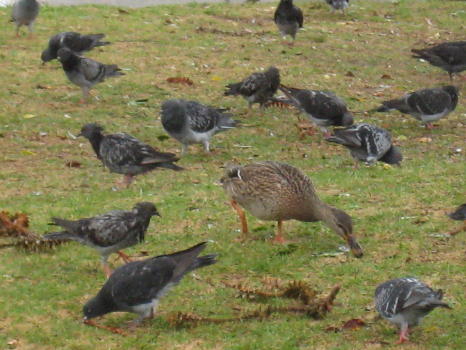
http://asymptotia.com/wp-images/2009/10/odd_duck.jpg

odd duck

The reason I chose these poems for this collection, however, has much to do with varieties. The poems deal with the abstract and the biological, the cosmological and the everyday. They stem from a notion that life evolves continuously, making each object and being individual as part of an ever-changing, meshing, chaotic and– paradoxically, but of course!–unified universe. Uni (one). Verse (a pun). The underpinning of The Red Queen Hypothesis is diversity, though that may not be its theme.

So I am not planning to revise the already-much-revised collection; I’ll just persist in sending it out to publishers while hope springs eternal. In the meantime, I have been pondering where the next set of poems is headed. Possibly along the edges. It will be interesting to find out.