Heaven, hell, & halos

After 30 years, my husband and I still take part in the Goschenhoppen Festival each August. You will find I have mentioned it in many an August blog.
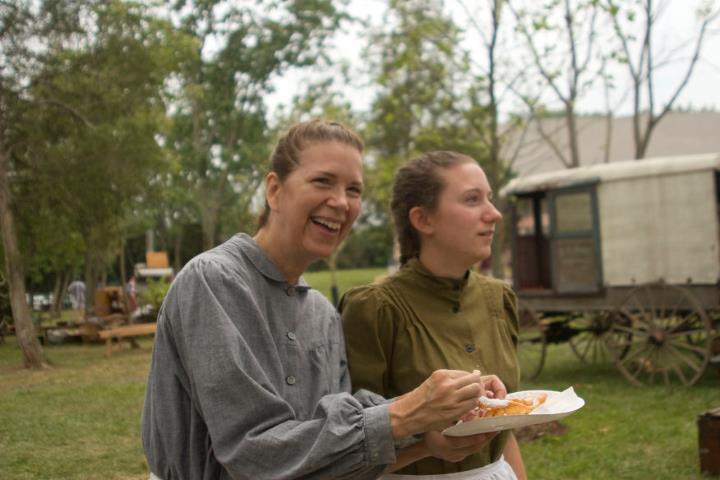
The photo at left is from 2010 or thereabouts, when the festival had newly moved to the park in Perkiomenville, PA, which is where the beautiful Antes House (ca. 1736) is located. My daughter and I were enjoying funnel cake. The park’s trees have grown considerably since then, and there’s more shade for demonstrators (and visitors). We were grateful this past weekend that the sunny days were not as humid as some years and that there haven’t been downpours to churn the parking areas into mud. And though neither of my own offspring could participate this year, it was lovely to see their festival-friends now grown, married–some having kids of their own–and still showing up to volunteer at the two-day reenactment of Pennsylvania German folk life of the 18th & 19th centuries.

My demonstration is in the 19th-c household and foods area, and each year I am assigned a couple of young “apprentices,” girls ages from 12-17 in gingham work-dresses. This year a friend’s daughter was thrilled to be old enough to officially participate. She is full of wondering about life and is the sort of child who poses her questions and speculations aloud. She’s also at the age when she’s taking church classes for confirmation, and she’s interesting to talk with when she wades into her thoughts about Big Subjects. I often find myself telling her that the things she wonders about are puzzling even to grownups. Because it’s true.

Yesterday she asked about someone we knew who had died: “Do you suppose they went to heaven?” Yikes. While it might have been a good opportunity to throw a wrench into religious indoctrination, I felt her parents might not appreciate that. I merely responded that I didn’t see why not. But this little exchange reminded me of my own wrestling with the idea of heaven and hell when I was her age. From fairly early on, I just couldn’t imagine that the cartoonish heaven of winged souls wearing halos was in any way real; and though hell was also mentioned frequently in church liturgy, prayers, and hymns, my dad’s belief in a god who was forgiving made hell seem unlikely. So the information I took in was confusing.

It is no less confusing to me now, but I no longer sweat over it the way I did as a child. Anyway, the conversation with my little friend called to mind a poem I’d drafted after returning from a visit to the Metropolitan Museum of Art’s exhibit “Siena: The Rise of Painting, 1300-1350” which reminded me of how I loved Medieval and early Renaissance art when I was a youngster. All those saints and crucifixions. All that gold and iconography. I must have had a gothic tendency!

This draft may be more about art than about heaven, and more about envisioning than about anything else. It's not a finished poem, but who cares on this bright, late-summer morning?
~


Halos

What interested me most about
paintings of Jesus was
the glow around his head
because I saw such auras everywhere
when sun silhouetted our cat
in the dining room window
or lit up dew on tall grasses.

In later years I studied art
and learned the problem of cheating
light from solid pigments
the paradox of density layered
so some artists applied gold dust
to depict the nimbus gleam.

Yet even my little sister’s
fine blonde curls or the hairs
on my own skin could shine
that way illuminated like crowns
of hickory trees some autumn
morning long in brightness
no art to it at all.

Drying up

….and the drought continues into mid-November. This is a very long stretch of dry weather, and the rivers I’ve crossed recently–the Delaware, the Schuylkill, the Lehigh, the Susquehanna–are looking mighty low. Little islands are showing up in the center of the riverbeds. Tree roots visible along the banks. I found this government website that filled me in concerning the current situation. Looking at the charts, wow.

My low mood continues, for a number of reasons: the recent political news, the continuing wars, my mother’s consistent decline, the drought, my physical distance from my grown children on the other side of the continent, a friend’s death, a bunch of recent poetry rejections, the fact that I can’t go into a store without hearing Christmas music…granted, some of these reasons are not earth-shattering but the effect is, well, cumulative. Han VanderHart’s recent blog post speaks to the rejection, reminding me of things I know and should keep in mind. The challenge is just getting through and occasionally finding delights at which to marvel, for the delights surely endure. Ross Gay’s Book of Delights is my book group’s next selection, a book I’ve read before but which–at this particular moment–will probably benefit me when I re-read it.

I also feel creatively dried-up, and that’s dismaying. Reading novels (see my last post) offers peasant distraction but seldom gets me writing my own work. I’ll never be a novelist. I’ve been reading poetry, online and in books, as I always do; yet right now, the poems I have been reading, no matter how wonderful, have not inspired me to work on my own.

I’m not even revising! This is not my usual self, not my poetry “norm,” not a space in which I feel happy or well-regulated or at least inspired. Perhaps I have encountered the dreaded writer’s block. Or rather, a drought of some kind, an inner sluggishness of the imaginative flow. Despite the glorious stretch of sunny days and moonlit nights, the incessant blue sky reminiscent of those high-altitude desert environments I seem to love, despite these delights, I’m discontented.

How very human of me.

Listen, there’s a trio of redtail hawks along the woodlot. Their nasal “screeee” and their graceful swoops between the bare branches catch my attention. Sunlight on the field tells me, “You could at least get outside and take a walk.” Okay. Can do.

Two falls

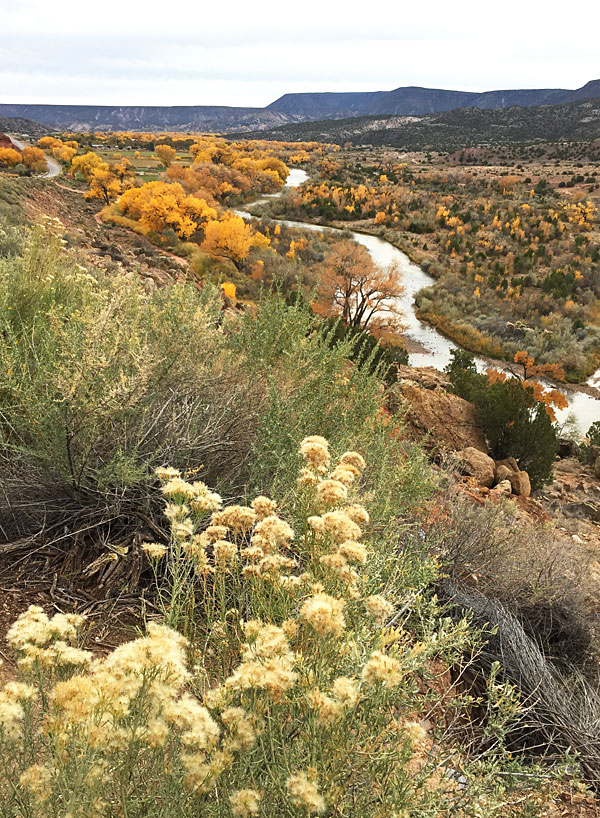
I have experienced two autumns this October: one in New Mexico, one in Pennsylvania. In the American Southwest, high up in the world, the cottonwood trees that hug every available water source were going a brilliant gold while I was there. Any view above a creek or river revealed a winding path of yellow–along the Chama, along the Rio Grande. The tiny-leaved oaks were turning brown-leaved and dropping scads of acorns along the paths. The oranges and reds are mostly there year-round, on the mesas and in the canyons.

It was wonderful to experience a poetry workshop with Anita Skeen and Cindy Hunter Morgan and to learn how books are made by hand, wonderful to draft some poems using color imagery and ekphrasis, wonderful to meet some fascinating people with whom I enjoyed pushing past my/our comfort zones and into art forms we may have been a bit less comfortable with. These are reasons to attend an instructor-led workshop, seminar, or residency. I spent part of last September in New Mexico, but it wasn’t the most spectacular time for autumn coloration–whereas October certainly gleams in northern NM!

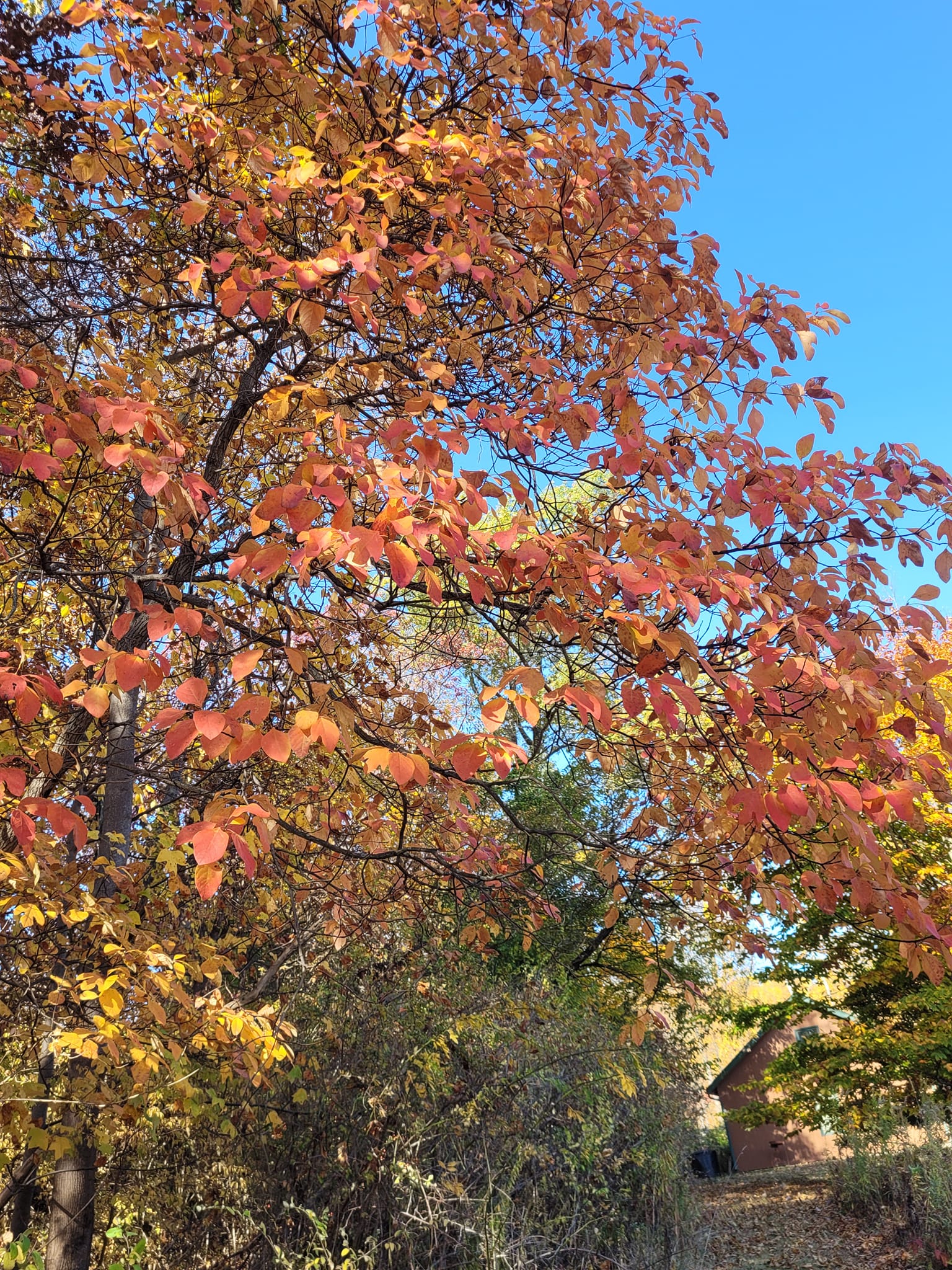
When I returned home, I had missed “peak season” for color in Pennsylvania; my husband said that came a bit early this year because of drought. But it’s still very bright here. The maple leaves haven’t all fallen, most of the tulip trees are still yellow, the hickories haven’t reached peak gold yet, and many of the sassafras are that warm coral color I love so well. The burning bushes? Ours hasn’t dropped its bright fuchsia-maroon leaves. It’s a vivid presence at the corner of the house.

~

Therefore, I have two autumns this year, one sea-level Mid-Altlantic East, and one high-altitude Southwest.

Which strikes me as an abundance of beauty and color. So I am continuing the theme of last week’s workshop. Here’s a new draft of a new poem just for the joy of it. [This fall, those of us in the USA could use a bit of joy.]


I don’t have a title for it yet. Maybe you can help me think of one.

~


The difference between orange leaf color
and orange rock color.
Between the greens of grass and juniper,
the pale dun of meadow’s die-back
and beige sand stretching westward
to the mountains.
Even the clear sky’s blueness
on fair, mild mornings
differs by an almost measurable degree.
Something to do with altitude
and aridity, the science of which
I don’t really understand.
Life’s variations and hues—
striated like cliffs, buttes, mesas,
like hills of maple and hickory in fall—
beautiful and strange.
Even when I close my eyes, color-
memories, all those shades
I can’t define, sift through my skin.
Into blood. Into bone.

Throwing mud

This week, I got the potatoes in the ground; last week, it was spinach. In between, a lengthy late-March cold snap and yes, more rain. But also a visit from a Dear One and a trip to parts of Pennsylvania I seldom have had reason to explore. Although I have lived in PA’s Lehigh Valley for nearly 40 years–longer than I have lived anywhere else–I confess a lack of familiarity with many areas of the Keystone State. Philadelphia and its suburbs I know well, and Reading and Lancaster, to a lesser degree; and our family often visits Gettysburg. We travel west and north to go camping now and then. I’ve been to Pittsburgh a few times and seen Falling Water and the Cathedral Trees and both branches of the Susquehanna River. Penn State just twice, once when I was chaperoning high school sophomores to History Day competitions.

Pennsylvania is a big commonwealth: 46,055 sq miles. It’s a good place for poetry, though I leave it to poets such as Harry Humes and Jerry Wemple (among others–looking at you, Dave Bonta) to explore its varied climate, geography, history, and culture. Mostly I stay within the confines of my own back yard, which is large and varied enough to inform me for a lifetime.

But the Dear One had planned to give her dad a pottery workshop with a well-known potter, Simon Leach, as a 70th birthday gift. That birthday fell during covid, however; the long-delayed weekend in Millheim PA thus did not take place until this past week. I have never placed my hands on a potter’s wheel (though I ought to try it sometime) and just went along for family togetherness and to visit the arboretum at Penn State, slightly out of season but still a very pleasant place to walk, by myself, on a cold but sunny Sunday. It rained on Saturday, so I sat by the fireplace at our B&B and read novels. Could anything be more perfect?

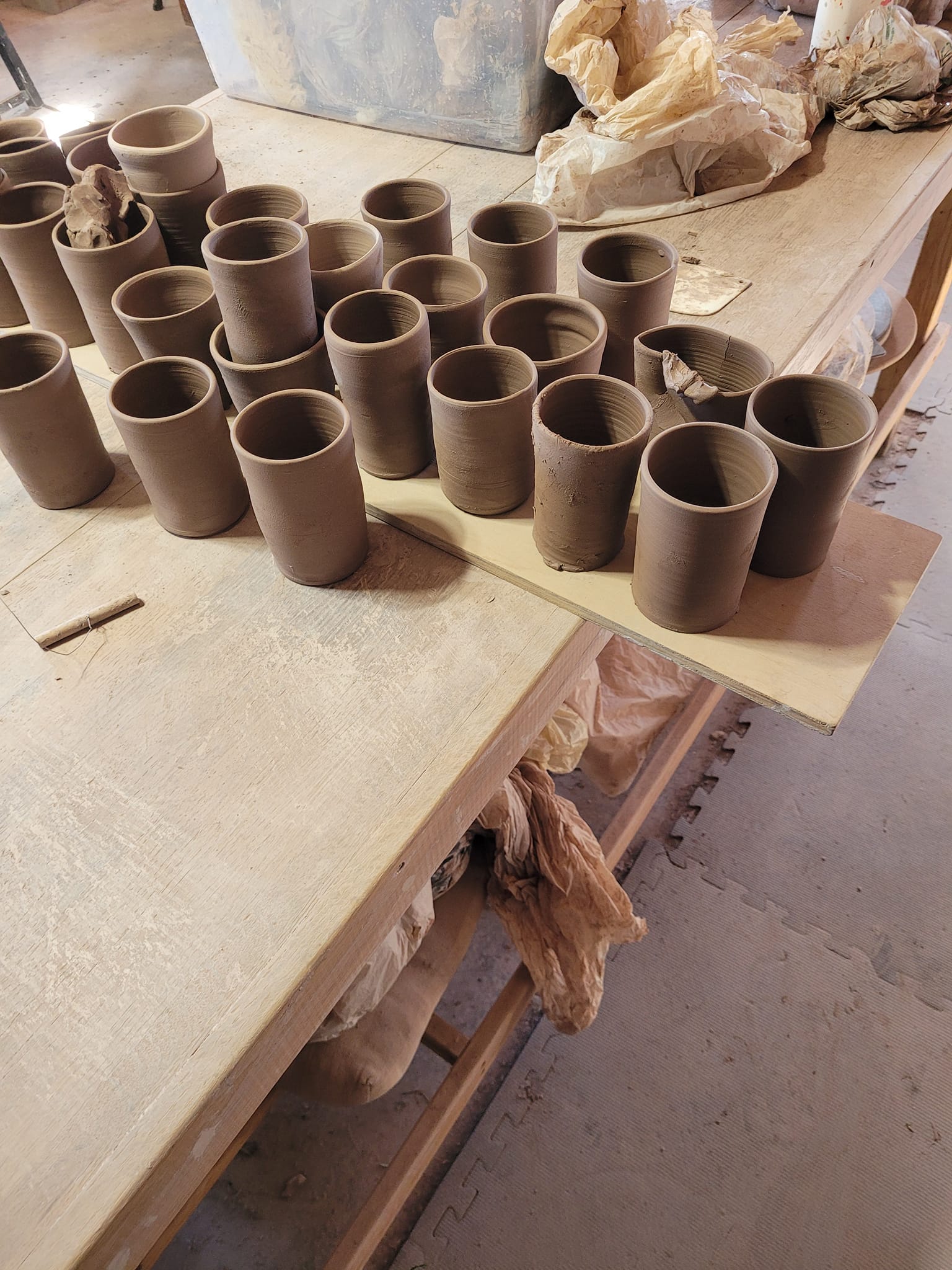
The task of Leach’s workshop was to practice making cylinders. It was a muddy job indeed. Here’s a photo of some of the student results. Dear One is quite adept at cylinders; indeed, she’s a good potter and sells much of her work, a skill she enjoys when she’s not providing emergency medical care to dogs and cats.

Leach uses the slogan “Keep practicing!” Yeah, that’s how you get to Carnegie Hall, right? But it is also how people get better at any skill, even those who are preternaturally talented in music, art, dance, etc. That includes writers. I have to remind myself that it is now time I got back to my routine of writing, revising, and the practice practice practice part of composing poems. The garden, the daughter, the travel, and the novel-reading have been splendid distractions, but as National Poetry Month approaches (April!), I ought to get myself back into routine.

A routine’s generally looked at as mundane–a tedious necessity. It needn’t be that way, I keep reminding myself. It can be as fun and messy and surprising (or frustrating) as throwing mud.

clay cylinder practice in Leach studio

Cover reveal

Earlier this week, I went to a neighboring city–Reading–to record a TV segment for the local station, BCTV, that hosts a program about poetry! The host and interviewer is poet Marilyn Klimcho of Berks Bards (a non-profit poetry group in Berks Co, PA). It was truly pleasant to read a few of my poems in a professional setting (studio), but the best part of the day was just chatting with Marilyn about poems, poets, and poetry. We began our conversation half an hour before the cameras rolled and continued it afterward, so the 25 minutes that were recorded seemed just to be part of a longer, casual discussion.

I appreciated that. I’m part of a long-running critique group, but it’s seldom that I get the opportunity to pick someone’s brain and share ideas, influences, and general enthusiasm about the art of poetry the way I did in grad school. Probably could work on getting more such discussion into my life.

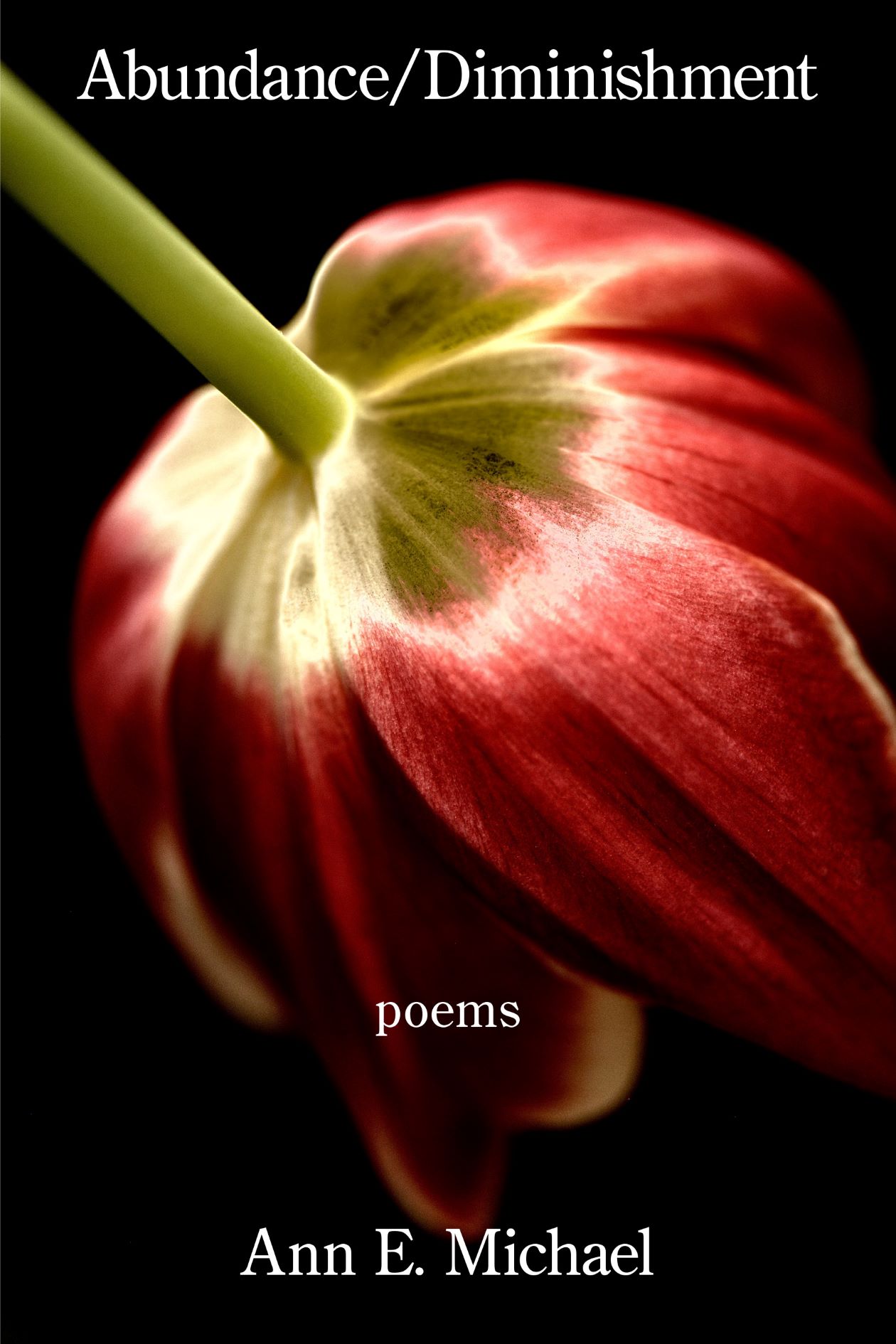
The “Poets Pause” segment will air in March and then reside on YouTube, so I will post that link at some point. It was kind of Marilyn to highlight The Red Queen Hypothesis and to give me a chance to mention my next collection, forthcoming from Kelsay Books later this year. Speaking of which, I do now have a photograph of its cover:

The photo is by Don Schroder, a friend who’s got a website full of lovely images from his numerous travels to the African continent as well as good shots of festivals of many kinds and floral beauties from arboretums and gardens. Go check it out!

The cernuous tulip seems appropriate to several themes I evoke in these poems–elegies and the sense of impending losses but also appreciation of beauty and brevity and life’s many colorations. Initially, I thought that I was using fewer of the animals, plants, weather and the “nature stuff” I tend to populate my poems with, because so many of the poems in Abundance/Diminishment are for or about humans. But…nope, just took another look through the manuscript in the final approval/editing process and realized that I cannot seem to leave the planet’s environment out of my work. I probably should have been a biologist, ecologist, or a science teacher instead of an instructor of English, but oh well.

Frankly, I love the simplicity of this cover, and I’m excited to have the book in print later this year…especially since it took me a decade to get The Red Queen Hypothesis into the world.

Anticipation

February’s coming to a close, and the forecast indicates a chance of snow soon–but the gardener feels stirrings of approaching spring.

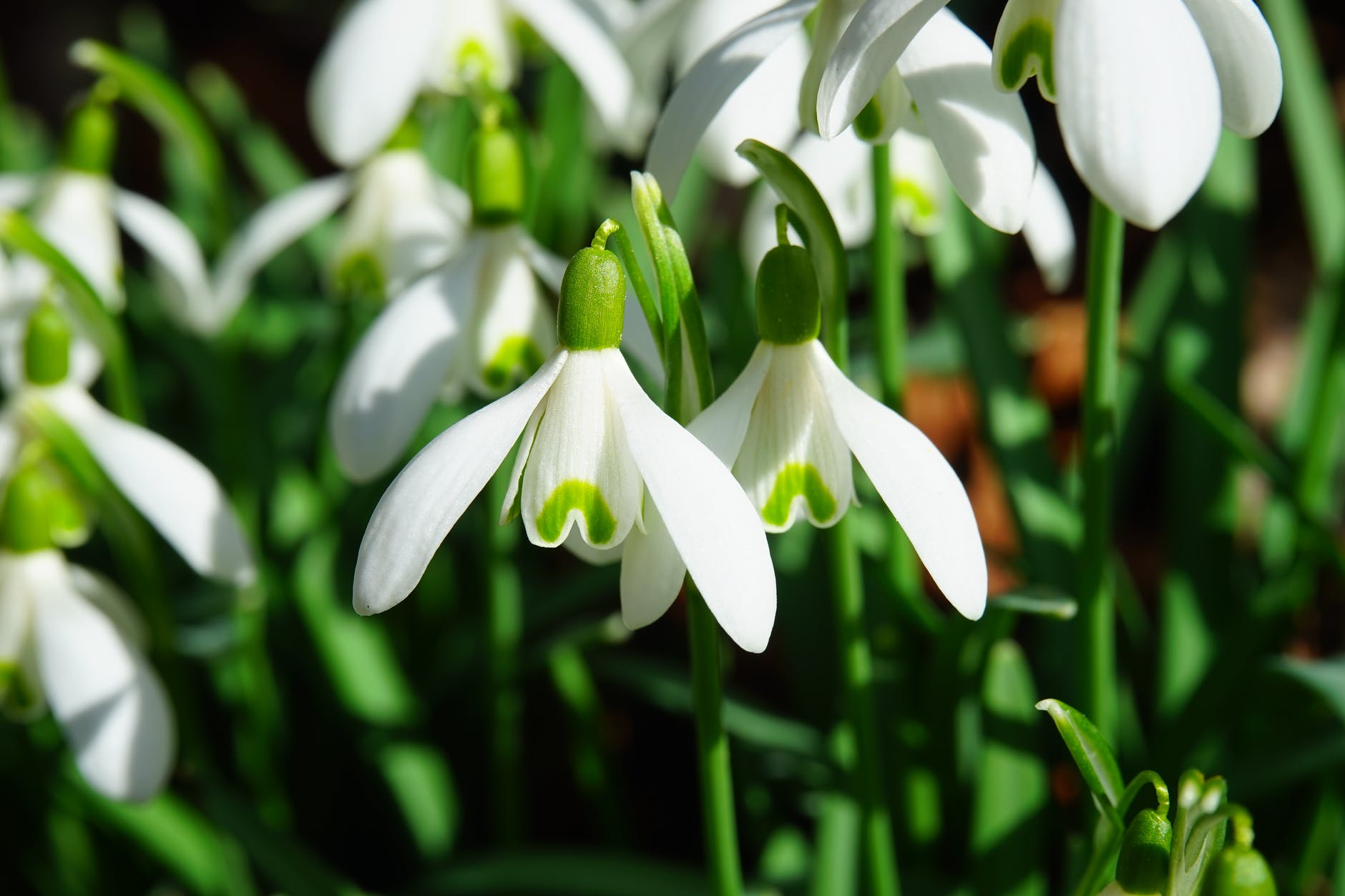
Time to buy seeds, order supplies, plan the garden. Time to mow the meadow before the ground-nesting birds get started on their spring dwellings. Last night the temperatures went well below freezing, but the winterhazel has bloomed. Snowdrops push up from leaf litter: a glimmer of white petals still held close to the stem. Waiting for a string of warm days to open up for the early pollinators.

flowers plant spring macro

Photo by Pixabay on Pexels.com 

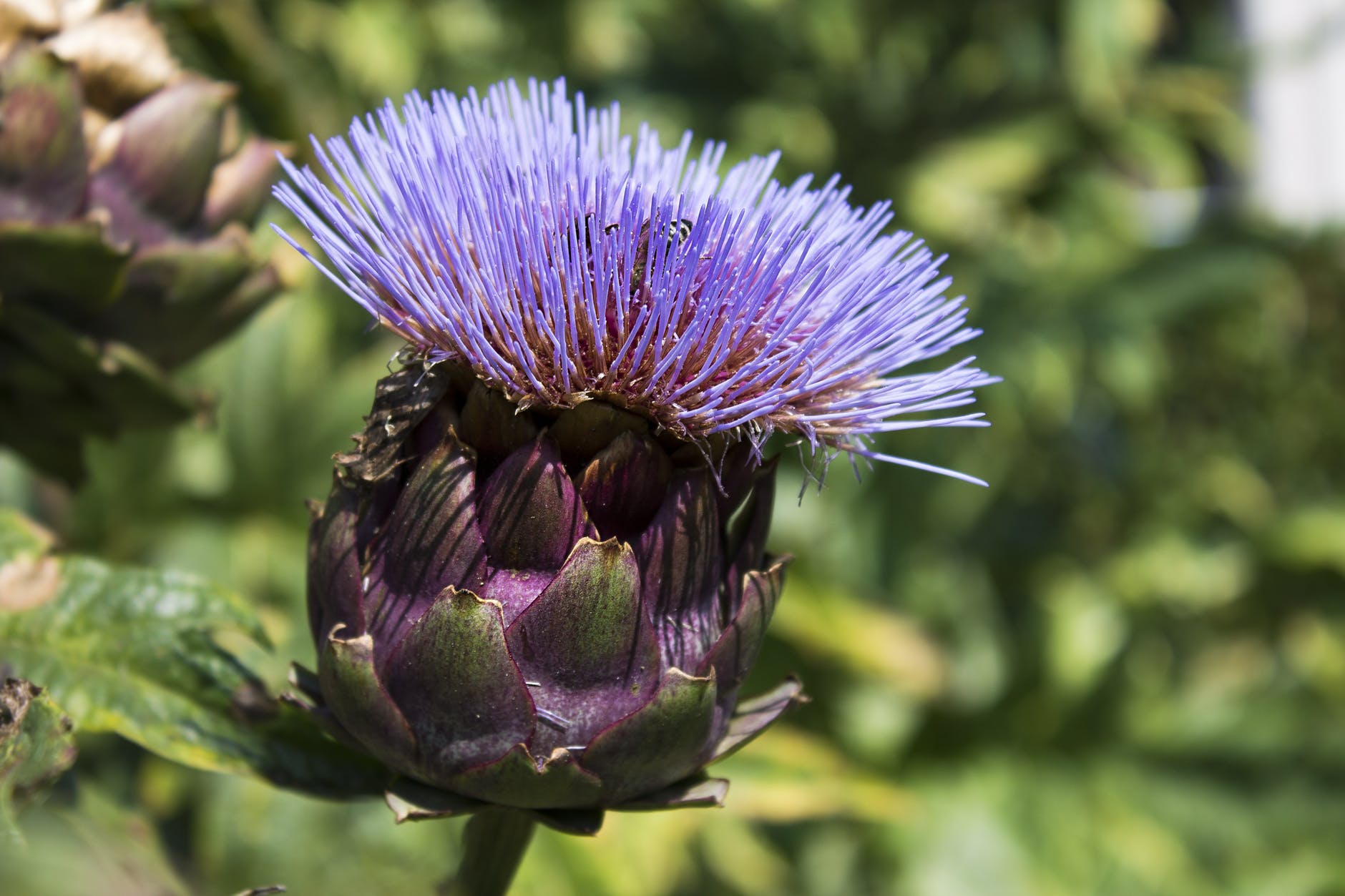
Indeed, the days lengthen at last. Next week marks Spring Break for my college, and with a little more flexible time available, I hope to pin down my garden plans. Each year, I try to incorporate something innovative in the small patch of (mostly) vegetables. This year, I’m tempted to try short-season artichokes.

Thinking about the garden energizes me, gets my creative side jumping. It’s partly the anticipation–will this plant emerge, grow, thrive, fruit? Will voles and insects and viruses attack it? Will the weather cooperate? For example, I’m glad I did not plant potatoes last year–the weather was too wet. Should I take a chance on potatoes this year? (Oh, those tender new spuds lifted from the warm soil in August…)

And tomatoes! So many varieties from which to choose.

IMG_1753

Bounty (our own, in 2015)


Anticipation feels different from expectation, though the two are related. For me, at least, the connotation of the first is more open-ended. Anything can happen, though let’s hope what happens is good. Expectation seems more results-oriented. I am not a results-oriented gardener; I like surprises, I appreciate the education I get even from failures.

Come to think of it, I could describe myself that way as a writer or poet, too: not results-oriented, more intrigued by the things I learn when I work at the writing.

Even when the results do not pan out, even when I finally must give up on a poem that is not working, I learn a great deal about where and why a particular approach fails. This is why writing requires practice, patience, and time to analyze and reflect on what those “results” tell the writer.

Do what works, then push the envelope.

Hmmmm…artichokes in Pennsylvania….

artichoke beautiful bloom blooming

artichoke in bloom : Pexels.com


Devil-bush

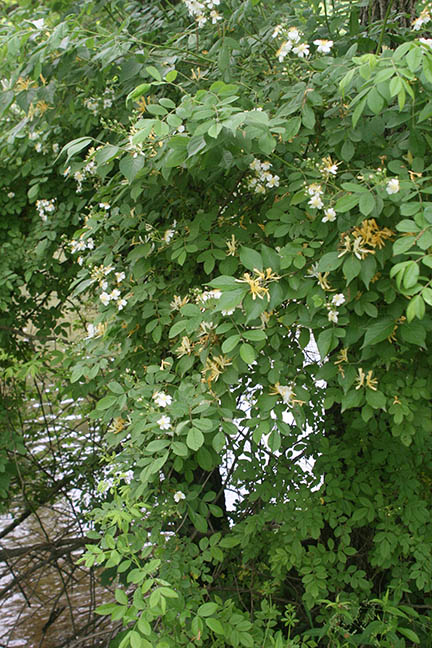
asian rose-amerMultiflora rose: Rosa multiflora Thunbergia ex Murr, is banned in 13 US states, including my own, where it thrives at the expense of native species of many kinds.
Here (at left) it mingles with another invader–Amur honeysuckle (lonicera maackii) along the Tulpehocken Creek in Berks County, Pennsylvania. Amur honeysuckle has not yet made the “illegal plant” list. Both shrubs spread easily because they do not mind disturbed soil and they have attractive berries that birds consume, thus sowing the bushes widely.

I do not know how a plant can be illegal if the birds are our planting culprits; but I do know how hard it is to eradicate multiflora rose, which flourishes in our hedgerow among the sassafras, tulip trees, green ash, white ash, honey locust, wild cherry, walnut, oaks, and maples.

The shrubs are wickedly hard to pull out, as they are stemmy and prickly and have deep roots. We’ve hacked them out of the rocks and pulled them out by chain with our tractor and weed-whacked them and used a machete in the thickets. We have often enlisted our son in our efforts to limit their number along our property line. He refers to the rose as “devil-bush,” having been scourged by its thorns numerous times while endeavoring to cut back or pull out the shrubs. I, too, have shed my blood over its white flowers–not to mention erupted in rashes, because poison ivy frequently entwines itself around the stems of multiflora rose.

Well. They are in bloom now (end of May). And so far, the roses are winning.

~~

The USDA has a page devoted to information on multiflora rose, a “noxious plant.”


House & home

Falling Water

Falling Water

I went on a trip to visit Frank Lloyd Wright’s historic Fallingwater house, which is located in a forested state park area in the southwestern region of the state where I live, Pennsylvania. Pennsylvania is a large state, and in all the years I have lived here I’ve never managed to get to Falling Water; so I was excited. The day we arrived, the weather was perfect, the water was high, and we toured two Wright houses–this one and Kentuck Knob, one of Wright’s last residential design commissions.

Millions of people tour Fallingwater, so the Western Pennsylvania Conservancy folks (who have stewardship of the property) have their hands full maintaining the place, training docents and volunteers, and just keeping crowd control working. Kudos, by the way. They do a good job. Send them donations.

~

At the café (there’s always a museum café), my partner pointed out a letter reproduced on the informational wall–a note from Mrs. Kaufmann, owner of the house. She wrote that initially the home intimidated her a bit, as Wright’s designs tend to force the homeowner to live the way the house dictates, rather than the other way around. Curtains, a typical decor requirement for a 1930s residence in town, were anathema to Wright. In the middle of Bear Run forest, did Mrs. Kaufmann need curtains? No, she eventually decided–the trees provided color and changing light and privacy and were far more interesting than curtains. What initially seemed too austere for her tastes grew on her; she learned to do with less “stuff” and found that the simplicity made the things she did add to the house seem all the more valuable and aesthetically pleasing. The Kaufmanns must really have been special people to embrace the challenges of living comfortably in one of Wright’s homes, indeed, in his most unique residential design.

~

My husband and I designed our current home 17 years ago and have some idea of the compromises owners have to make, most commonly for financial reasons (that was not an issue for the Kaufmanns, who were department-store magnates). As we toured Fallingwater and Kentuck Knob, one thing that hit us is that building codes have changed the way Americans build; you couldn’t get a Wright home design past most local zoning commissions in Pennsylvania nowadays.

For example, 19″ hallways? Nope. 6′ ceilings? I don’t think so. Some of the tight interior stair turns would be disallowed. And, let’s face it, the whole cantilevered balcony situation would set off a hundred bureaucratic red flags.

~

house 2009

My house in snow, 2009.

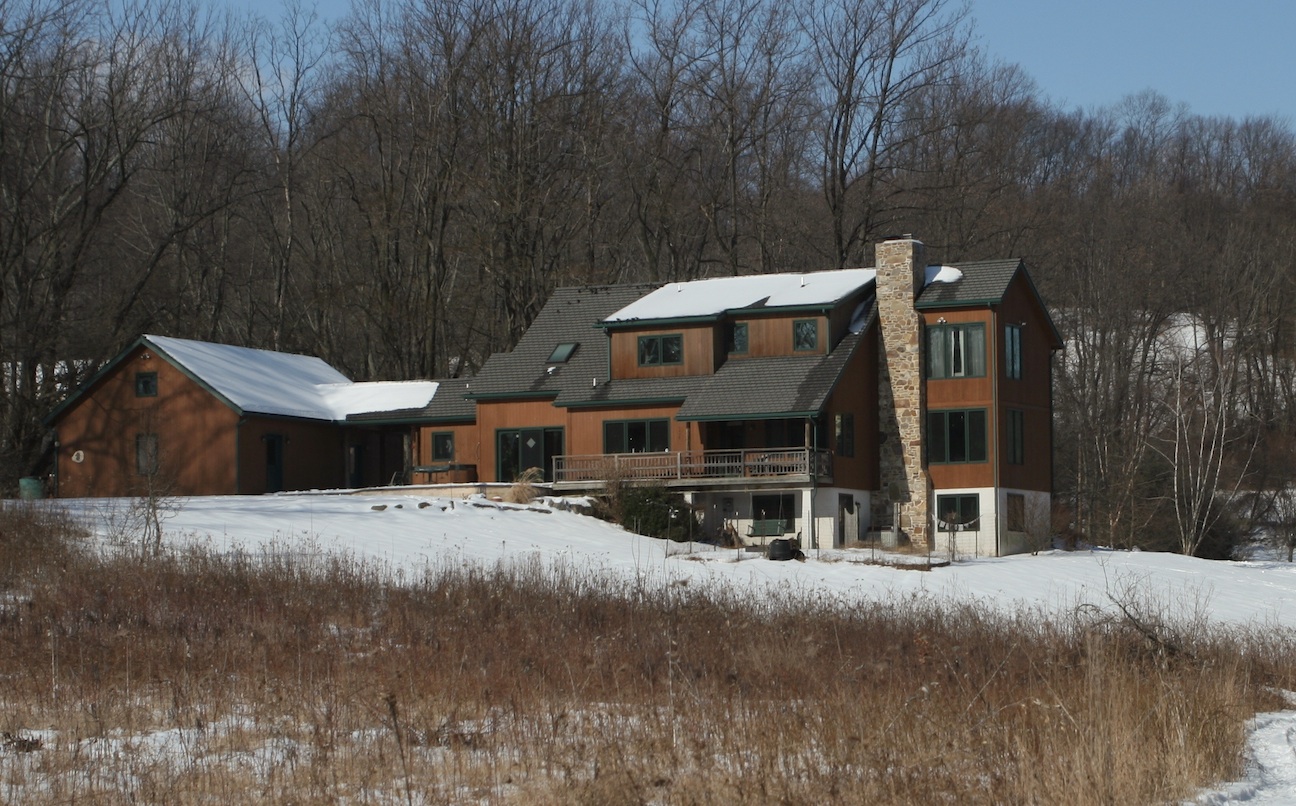
My own house had to agree with the local building code. There was also a budget we really could not exceed. Over the years, we have added to the deck, improved the porch railing, completed building interior doors ourselves, worked extensively on landscaping (first adding to it, then pruning back, then…well, there’s been a bit of mostly benign neglect recently). But we have generally lived comfortably in the house and adapted it to fit our needs, the way most people live in a home. As our living situation changes, with children growing into adulthood and moving away, with fewer pets and no more chickens, with less need for a large vegetable garden, we’re thinking of ways to alter the house. Or even to move out of it, and let some other family have a go at its joys and responsibilities.

Its sensibility leans toward a meadow-type or agricultural feel. That suits the region in which we have settled. Which may be the only way our house parallels Fallingwater: it suits the environment and the region in which it is situated. To me, that is one of the main purposes of good architecture, and the rule most frequently ignored by homebuilders.

~

Our home can boast an improvement over Wright’s houses: it doesn’t leak (I lived in one in Grand Rapids Michigan in the 1970s, and can attest to the leaking factor).  🙂

~

For a 3-D computer-animated “flyby” of Falling Water and a half-hour documentary on its history, see this page (Mental Floss). Pretty interesting!

Hawks & fragments

When I take the commuter bus into New York City and back, I prefer daytime trips because I can count hawks.

I’m not a birdwatcher; but I have noticed, over many years of traveling the route (Interstate 78 Pennsylvania through New Jersey), that the highway offers good predatory-bird landscapes. The bus has large windows and elevates the passengers above the usual traffic lanes, so even though I’m traveling 70 miles an hour, I have a panoramic view through eastern Pennsylvania and north-central New Jersey, where there are scrims of woodlots behind the noise barriers, scrubby undergrowth on medians and embankments, a few cornfields, many high-density housing communities, railroads, creeks, and small county park lands.

I seldom get a close enough look to identify a bird positively; yet from my motor-vehicle perch I can tell a buteo from a harrier or an accipter. The fairly small kestrel is difficult to note, being about pigeon-sized (and pigeons are legion in NJ &NY) but I’ve identified them by their flight pattern. The buteos are most common around here, and from a bus I can’t usually discern a broad-wing from a redtail. But I see them roosting at dusk, or perched, or soaring over the fields and the strip mall parking lots. Twice, I have even spotted a great horned owl in trees along the route.

There are important raptor flyways along this path and into the region just west of where I live: Hawk Mountain is a big birding attraction along the Appalachian Trail. I have counted as many as 18 raptors along an 80-mile stretch of road. The commute takes just under two hours; I am probably the only person on the bus who spends most of her time looking out the windows at what is, admittedly, a rather uninspiring and predictable landscape.

redtail

See below for a link to raptor id at Hawk Mountain

~

51YVrgMy9sL._.jpg

Hawks have been very much on my mind because I recently read Helen Macdonald’s quite wonderful memoir, H Is for Hawk, which I highly recommend.

~

Here are a few fragments of notes I wrote in my journal while I traveled home last Sunday.

what could be a hawk. but isn’t–

paper wasp nests     squirrel dreys (nests of food for hawks!)     leaf clumps      plastic bags[tangled in boughs]

big crows. until they fly.          traffic cameras. the particular angle of them, perched (as it were) above streetlamps.

without binoculars, and in motion. not birdwatching. I scan for raptors.

frozen swamp–The Meadowlands–

snow. out of which phragmite grasses emerge, brown, russet brown. color of redtail feathers.

cranes/high tension wires. canadian geese–also in snow, feeder creeks & streams frozen, Hudson frozen, Delaware frozen.

raptor count NJ 10, PA 4. Four in 16 miles, Pennsylvania.

And yes, I composed a couple of poems during the trip.

But only one of the poems featured hawks.

~ Link to a great page for Eastern US raptor identification

“Local” artists & genius loci

Recently, a friend and I visited our small, local art museum (Allentown Art Museum). The permanent collection there has a few real highlights, which for me include the Frank Lloyd Wright-designed library from the Francis Little House and a limited but fine collection of glass and ceramic decorative arts. Like many smaller US museums, the Allentown Art Museum hosts traveling exhibits that can be eye-opening (last year’s exhibit of Lautrec’s works on paper, currently at Washington Pavilion in Sioux Falls, SD, was one of these).

Currently, Allentown’s museum is featuring work by two artists who employ very different methods, and their styles are so different that it seems silly to compare them: Matthew Daub and Paul Harryn. Both of them live in the region, however, and both might be considered painters of place.

Harryn says he is enthralled by the concept of genius loci, and there’s a decidedly spiritual aspect to his work (as well as a philosophical and poetic aspect; view his site for inklings of these). His “Changing Seasons” series stretched along one wall of the museum gallery, initially seeming like a seamless continuum, though more careful observation proved otherwise. The seasons series anchors the viewer in a temperate region in which the hues and moods of four distinct seasons are markedly obvious by color and light. In these works, the layering and erasing methods he employs are subtle, but some of the larger works depend upon a more visible shifting and experimental approach to media manipulation. The image of “Pacificus” on his website doesn’t begin to convey the experience of his assemblage paintings, which are textural, shifting, very large, and compellingly active. These three “Transcripts” were charming, if less powerful than some of the more layered works:

Transcript series by Paul Harryn

~

The near-monochrome, panoramic watercolors of Matthew Daub’s Maiden Creek series also appealed to me because of place, specific–definite–“realistic” place, if not as obviously spirit of place. This is because I know the roads and streams he depicts very well, have traveled them often; but I have seldom considered them “beautiful” enough for plein air views or photographic compositions (without omitting, say, road signage, utilitarian concrete bridges, highway off-ramps, minivans, and the like).

Daub portrays those items in his photorealistic paintings. What I found revelatory in these works is how genuinely beautiful those familiar roads are when the view or frame changes. The thin horizontal rectangle of Daub’s place-paintings accentuates parts of the composition such as bare tree branches, shadows on the curved roads, the rough texture of municipal concrete next to embankments. Daub’s choice of subject matter reminds me a bit of the later paintings of Charles Demuth, but Daub’s paintings include more of the natural environment surrounding the silos, stairs, and industrial objects.

Aucassiu and Nicolette (1921) by Charles Demuth [public domain, Wikimedia Commons]

Next time I am driving Route 143 near Kempton, I will appreciate the scenery more for having acquired, through Daub, a new perspective on the dull, drab, too-familiar landscape. The aesthetics of road-building, New Jersey barriers, highway ramps, creekside roads, and galvanized silos blend surprisingly well with the brushy trees, gentle hills, and stone barns of Berks County.

~

I’ll close with a poem by Maggie Anderson, from her now, alas, out-of-print book Cold Comfort (1986). Daub’s paintings made me think of this one, though the river is different.

Gray

Driving through the Monongahela Valley in winter
is like driving through the gray matter
of someone not too bright but conscientious,
a hard-working undergraduate who barely passes.
Everybody knows how hard he tries. I’m driving up
into gray mountains and there, it may be snowing
gray, little flecks like pigeon feathers, or what
used to sift down onto the now abandoned slag piles,
like what seems to sift across the faces
of the jobless in the gray afternoons.

At Johnstown I stop, look down the straight line
of the Incline, closed for repairs, to the gray heart
of the steel mills with For Sale signs on them. Behind me,
is the last street of disease-free Dutch elms in America,
below me, a city rebuilt three times after floods.
Gray is a lesson in the poise of affliction. Disaster
by disaster, we learn insouciance, begin to wear
colors bright as the red and yellow sashes on
elephants, whose gray hides cover, like this sky,
an enormity none of us can fathom, though we try.

(© 1986 Maggie Anderson)