“Local” artists & genius loci

Recently, a friend and I visited our small, local art museum (Allentown Art Museum). The permanent collection there has a few real highlights, which for me include the Frank Lloyd Wright-designed library from the Francis Little House and a limited but fine collection of glass and ceramic decorative arts. Like many smaller US museums, the Allentown Art Museum hosts traveling exhibits that can be eye-opening (last year’s exhibit of Lautrec’s works on paper, currently at Washington Pavilion in Sioux Falls, SD, was one of these).

Currently, Allentown’s museum is featuring work by two artists who employ very different methods, and their styles are so different that it seems silly to compare them: Matthew Daub and Paul Harryn. Both of them live in the region, however, and both might be considered painters of place.

Harryn says he is enthralled by the concept of genius loci, and there’s a decidedly spiritual aspect to his work (as well as a philosophical and poetic aspect; view his site for inklings of these). His “Changing Seasons” series stretched along one wall of the museum gallery, initially seeming like a seamless continuum, though more careful observation proved otherwise. The seasons series anchors the viewer in a temperate region in which the hues and moods of four distinct seasons are markedly obvious by color and light. In these works, the layering and erasing methods he employs are subtle, but some of the larger works depend upon a more visible shifting and experimental approach to media manipulation. The image of “Pacificus” on his website doesn’t begin to convey the experience of his assemblage paintings, which are textural, shifting, very large, and compellingly active. These three “Transcripts” were charming, if less powerful than some of the more layered works:

Transcript series by Paul Harryn

~

The near-monochrome, panoramic watercolors of Matthew Daub’s Maiden Creek series also appealed to me because of place, specific–definite–“realistic” place, if not as obviously spirit of place. This is because I know the roads and streams he depicts very well, have traveled them often; but I have seldom considered them “beautiful” enough for plein air views or photographic compositions (without omitting, say, road signage, utilitarian concrete bridges, highway off-ramps, minivans, and the like).

Daub portrays those items in his photorealistic paintings. What I found revelatory in these works is how genuinely beautiful those familiar roads are when the view or frame changes. The thin horizontal rectangle of Daub’s place-paintings accentuates parts of the composition such as bare tree branches, shadows on the curved roads, the rough texture of municipal concrete next to embankments. Daub’s choice of subject matter reminds me a bit of the later paintings of Charles Demuth, but Daub’s paintings include more of the natural environment surrounding the silos, stairs, and industrial objects.

Aucassiu and Nicolette (1921) by Charles Demuth [public domain, Wikimedia Commons]

Next time I am driving Route 143 near Kempton, I will appreciate the scenery more for having acquired, through Daub, a new perspective on the dull, drab, too-familiar landscape. The aesthetics of road-building, New Jersey barriers, highway ramps, creekside roads, and galvanized silos blend surprisingly well with the brushy trees, gentle hills, and stone barns of Berks County.

~

I’ll close with a poem by Maggie Anderson, from her now, alas, out-of-print book Cold Comfort (1986). Daub’s paintings made me think of this one, though the river is different.

Gray

Driving through the Monongahela Valley in winter
is like driving through the gray matter
of someone not too bright but conscientious,
a hard-working undergraduate who barely passes.
Everybody knows how hard he tries. I’m driving up
into gray mountains and there, it may be snowing
gray, little flecks like pigeon feathers, or what
used to sift down onto the now abandoned slag piles,
like what seems to sift across the faces
of the jobless in the gray afternoons.

At Johnstown I stop, look down the straight line
of the Incline, closed for repairs, to the gray heart
of the steel mills with For Sale signs on them. Behind me,
is the last street of disease-free Dutch elms in America,
below me, a city rebuilt three times after floods.
Gray is a lesson in the poise of affliction. Disaster
by disaster, we learn insouciance, begin to wear
colors bright as the red and yellow sashes on
elephants, whose gray hides cover, like this sky,
an enormity none of us can fathom, though we try.

(© 1986 Maggie Anderson)

Negotiating the storm

I have lived and driven vehicles in regions that receive a great deal of snow, but it has been awhile–and I am not as spry as I once was–and I don’t even own a pair of cross-country skis anymore (a favorite winter activity). Being responsible for keeping a house and property and cars and pets maintained while the ice comes down and the snow piles up and the heat stops working and the power goes off has also somewhat dampened my enthusiasm for snowy winters. Plowing and shoveling are no substitute for XC skiing, and harder on the back. Worries about possible frozen pipes or whether the oil truck can get down the driveway (which resembles a bobsled run) shove more leisurely, more inspired thinking out of mind.

iceimage~

Nonetheless, I cannot ignore the beauty of fields and trees in snow or branches rimmed with ice or–as tonight–the cold, bright moon above the cold, white earth. I remind myself that snow is the best mulch. I think of the crocus and narcissus bulbs snug and dormant below the deep drifts. The house we built does its job of upholding us and protecting us. The house, wearing its white hat…

~

A poem from 2007, an experiment in sapphics, that seems appropriate.

Negotiating the Storm

Dawn. I curl away from the ice storm toward you,
your breath cools my face and my hair, the warm room;
Love, we’ve had too few of these moments lately—
other storms plague us.

Ice assaults the windows with droves of needles,
gusts shove over pines and flatten the birches.
I am glad for the weather’s impersonal aspect:
nothing to blame there.

Sleep. The sleet does not suffer indecision.
You don’t have to touch me, just breathing is plenty.
Walls and roof are stolidly doing their jobs,
power is on yet.

Let’s recuse ourselves from the task of judging
guilt or merits the past twelve moths have garnered,
forge a drowsy peace between us and also the
guileless brute outside.

~

© 2007 Ann E. Michael

Turn! Turn! Turn!

I’m thinking of Pete Seeger, who died yesterday at 94 after a full and active life of song and advocacy for peace.

This is one of Seeger’s songs, as sung by the Byrds (1965); it was my favorite song when I was 9 years old. I recognized it was from Ecclesiastes, and I loved the simple tune.

A time to be born, a time to die. Elegy & celebration.

Lyric time

I’m currently savoring–as slowly as possible, as it is a short book–Mark Doty’s “World into Word” essays in The Art of Description. The text has been gently pushing my thoughts back toward matters of poetry.

I always think of Doty’s style, in prose and poetry, as precise and almost studied, though the studied-ness doesn’t feel overbearing but reflective; a naturalness remains that keeps the poems “hospitable” (as he puts it).

In his essay on Bishop, “The Tremendous Fish,” Doty examines the various forms of observation and focus or perspective that contribute to any work of art, although here he is of course honing in on the lyric state of mind. These passages seem to me to hearken to Bachelard (see here and here) on the temporal:

What is memory but a story about how we have lived? …there is another sort of temporality, too, which is timelessness. In this lyric time we cease to be aware of forward movement…it represents instead a slipping out of story and into something still more fluid, less linear: the interior landscape of reveries. This sense of time originates in childhood, before the conception of causality…

Self-forgetful concentration is precisely what happens in the artistic process–an absorption in the moment, a pouring of the self into the now. We are, as Dickinson days, ‘without the date, like Consciousness or Immortality.’ That is what artistic work and child’s play have in common; both, at their fullest, are experiences of being lost in the present, entirely occupied.

fest7~

This is, in addition to relating to Bachelard’s concepts on reverie, a form of mindfulness that would not be out of place in Zen and would be recognizable to any artist familiar with the creative “zone.”

I’m reminded of a popular colloquialism of the 1970s: “zoning out.” Generally, the phrase signified not paying attention, being slightly stoned, out of touch: negative connotations. Yet there were people who used the term in a more positive way to mean “in the zone”–an acceptable, if “flaky,” zinging of the mind into a calm or creative space.

A space where poets might wander in “self-forgetful concentration.”

~

Let’s go…

Poet’s truth

Hilary Mantel writes her protagonist’s view of 16th-C. poet Thomas Wyatt in Bring Up the Bodies:

~

…you trap him and say, Wyatt, did you really do what you describe in this verse? He smiles and tells you, it is the story of some imaginary gentleman, no one we know; or he will say, it is not my story I write, it is yours, though you do not know it. He will say, this woman I describe here, the brunette, she is really a woman with fair hair, in disguise. He will declare, you must believe everything and nothing of what you read… You tax him, what about this line, is this true? He says, it is poet’s truth.

When Wyatt writes, his lines fledge feathers, and unfolding this plumage they dive below their meaning and skim above it. They tell us the rules of power and the rules of war are the same, the art is to deceive; and you will deceive, and be deceived in your turn, whether you are an ambassador or a suitor. Now, if a man’s subject is deception, you are deceived if you think you grasp his meaning. You close your hand as it flies away. A statute is written to entrap meaning, a poem to escape it. A quill, sharpened, can stir and rustle like the pinions of angels.

~

There’s inspiration for you. Now to locate my sharpened quill.

Depression & the creative process

I was recently chatting with a psychiatrist about the creative process, specifically among poets. He admitted that he doesn’t know much about poetry, but I was nevertheless surprised to learn that he believed the stereotype of the poet who works most creatively when depressed.

“You deal with depressed people all the time,” I said. “Do they strike you as particularly motivated to do anything creative?”

He admitted that one hallmark of depression is loss of motivation–to do anything, let alone create expressive art of any kind. So it would follow, I suggested, that a period in which a person is seriously working at what he or she loves would be unlikely to coincide with a full-blown depressive episode.

“What about those poets who write about, say, staring out a window and sadness,” he asked, “They seem to write about being depressed, to express the feelings of depression.”

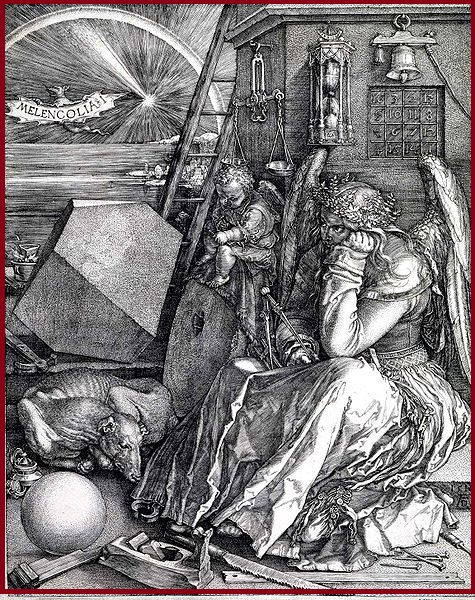
True, some poets experience depression (some commit suicide, too); and some express those feelings in verse. Yet none of the working writers I know who struggle with forms of depression write while in the midst of the “black mood.” They can only write well when the mood has not seized them fully; and while they may try to convey those feelings of the ‘inexpressible,’ they write and especially, revise, the work during more productive hours when melancholia has tapered a bit.

Melencolia_I_(Durero)

Drurer’s Melencolia I (wiki images)

It takes concentration, creativity, and analysis to craft a poem that adequately means what depression feels like. You cannot access such things when you are truly depressed. Some writers want to portray the experience; others want to explain it; still others prefer to write about the desire to escape, or even to embrace, the melancholy; others simply relate what they observe. Trying to pigeonhole all writers who address despair defies reason and suggests that all writers undergo the same feelings and experiences. Excuse me, we are individuals–diversely, wildly, enthusiastically unique.

That said, I cannot make the claim that no one has ever created a great work of art or poem while in the midst of a clinical depression; I merely posit that it’s likely that poetry composed while the author is gripped by existential melancholy will not meet the poet’s own standards.

Lewis Wolpert, a biologist and author, says, “I claim that if you can truly describe what it is like, then you have not had a true depression. It’s an illusion, and completely unlike anything else. When you are immersed in it, you enter a world without reference points, so once you recover it is very hard to relate how you felt.”

A world without reference points–that is the attraction depression might hold for a writer: the creative summons to relate an experience that is essentially beyond description. But most writers are not able to answer that summons while in the depths themselves.

And many writers are not troubled by depression at all. [See this 2012 article from the UK’s Mental Health Foundation for essential insight and clarification of an earlier study–that abstract is here.] The studies do suggest that writers are more likely than the general population to have bipolar disorder, which makes a kind of sense to me: after the sinkhole of a depressive period, the active “manic” phase might permit a writer to accomplish a great deal, including possibly a description of the void. Or it might not.

At any rate, I hope that people–psychiatrists, for example!–eventually recognize that we should not stereotype artists and poets any more than we should stereotype people who have mental illnesses, different accents, or skin color that is dissimilar to our own. What makes artists “different from other people” remains a mystery despite years of research and speculation, and my gut feeling is that the difference has more to do with other aspects of the creative process than it does with depression of any stripe.

Story of an object

In a previous post, I quoted Edmund de Waal about the stories that objects can “tell” us. In his book, those objects were things made by human beings; the story of the netsuke was not separate from the stories of the people who acquired them. His book did not examine the stories of the people who sculpted the netsuke, as there was no way to trace them that would not have required years of research. A fiction writer or poet might speculate on the possibilities of the lives of the ‘makers,’ however. That is part of what creative writers do.

There are also those “natural” objects that surround us and which can tell stories–or inspire human beings to imagine and tell their stories. For example, every origin myth contains some aspect of telling the story of the earth or sun, stars or mountains, seas, skies, moon.

After some online discussion with artist and writer Deborah Barlow, I considered the story of an object as having tactile and temporal aspects in some cases, and the object as “residue” of an event–or life. Ephemera, correspondence, tokens…many potential stories.

And, of course, works of art. If you follow this blog at all regularly, or check the archives or the Art[s] tab/page, you can tell I think often about art, its stories, artists, and their stories.

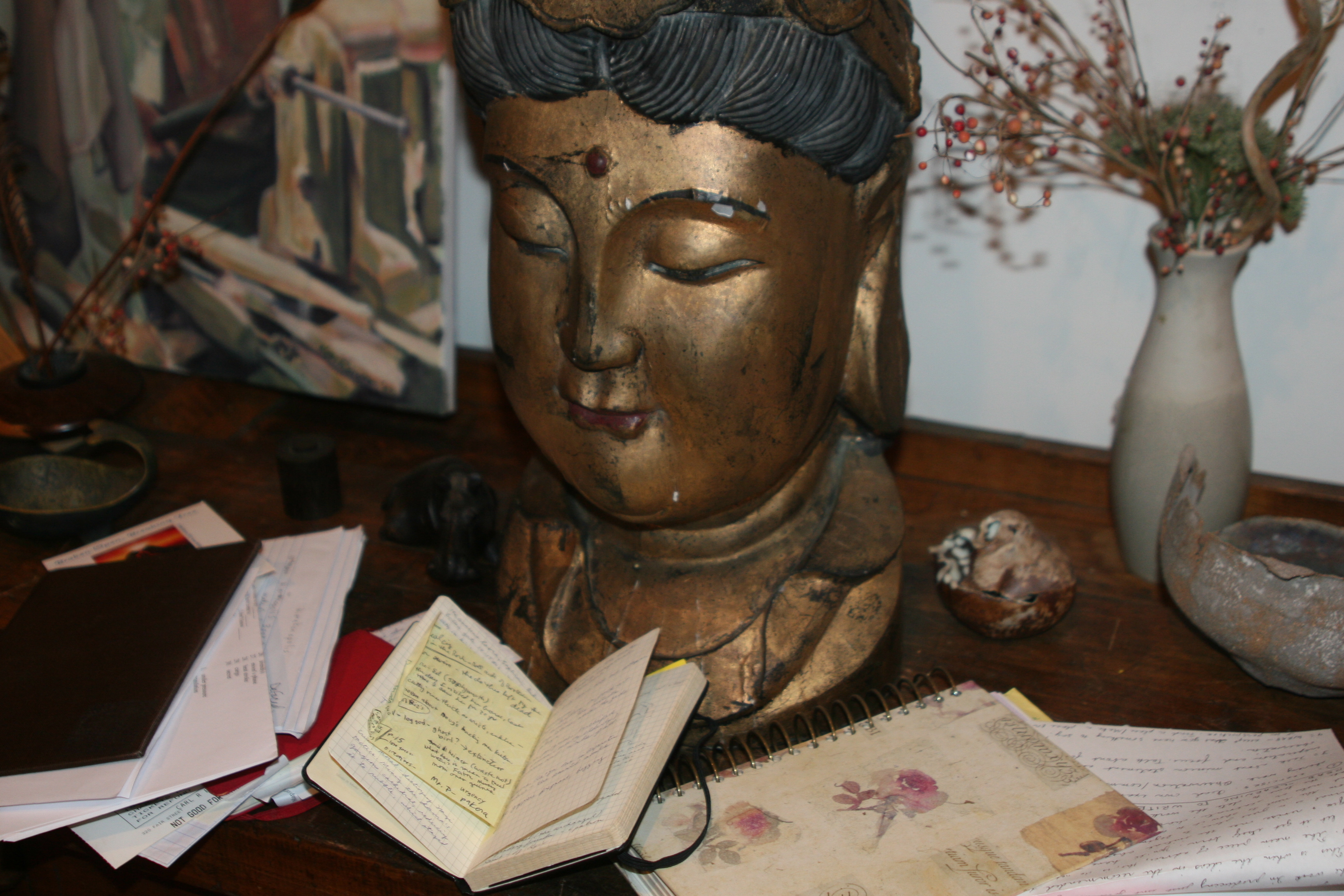
For example, a journal or notebook that an artist or writer uses can be a tool, repository, memory-jogger, inspiration-minder, sketchbook, Rolodex

It occurred to me that my poetry journals, which I’ve been keeping for decades, contain potential stories/poems but are also objects with their own stories to tell–which may or may not be “my” stories, though they necessarily intersect with whatever my story is.

objects, stories

objects, stories

~
Some examples. Tactile, visual, textual.
Inspiration, possibly.

Images captured in several ways.

Necessary–yes. For me.

~

Where do your stories reside? What object or objects seem to require the act of story-making? By which I mean, which objects fire that urge in you?

The poet & the Good

I have recently finished reading Robert Archambeau‘s collection of essays The Poet Resigns and am mulling over the idea of resigning with him.

It’s not that I necessarily want to give up writing poetry but that, in my reflections about where I can do the most good among the community of sentient beings, my work as tutor and teacher almost certainly has an effect both deeper and broader than my work as poet. This “good” hearkens to the ancient Good of Socrates, Plato, and their ilk but also to the sense of mindful “middle way” of the Tao: a practical path between two values that may be incompatible in many ways.

~

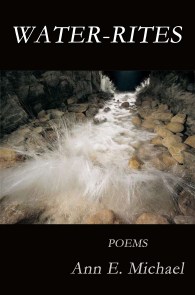
water-rites_coverThe readership for contemporary poetry is small, and my readers number only in the hundreds; among those readers, resonance of any kind–aesthetic, emotional, lyrical–is likely to be limited to a small number of poems. A poem of mine that effects some measure of The Good upon readers represents a minuscule good moving into the world. The net effect, I imagine, hardly registers…not that net effect matters so much. I suppose if a poem of mine moves just one person enough to evince even a small transformation, something has been achieved beyond my individual abilities in the composition of that particular piece.

As a teacher and tutor for the past ten years, my role expands not merely to number of people encountered (few of whom will remember me as an individual) but to the concepts I present to them, most of which will be significant in their lives one way or another–although not immediately, and probably unconsciously. Lately I have been devoting more of my limited energies to this aspect of my life work. Such focus does impede my ability to do creative work of other sorts.

~

This bust resides in the Louvre, and was found here: http://www.humanjourney.us/greece3.html

This bust resides in the Louvre, and was found here: http://www.humanjourney.us/greece3.html

Example: I am reading a little book on philosophy for beginners by Thomas Nagel. The Nagel book is on my table because I have been trying to find simpler ways to talk with students about their philosophy essays. While my main enterprise as writing tutor is to help students to clarify and correct their mechanical weaknesses (sentence and paper structures), it is not always possible to ignore content weaknesses; a student can write correctly about nothing of value–and receive a D or, in the case of Philosophy classes especially, an F.

But understanding philosophy is important.

Now, it is often extremely difficult for beginning writers to express their understanding of philosophical concepts in writing. They are just learning rhetoric and fall into fallacy errors through grammar as often as through thinking. Since I am not supposed to be a content tutor, I have to find ways to tease out what the student understands (or does not understand) and make that idea come through clearly on the page.

Kind of like mind-reading.

[Aside: I have to admit this can take a lot out of me by the end of the day.]

The Nagel book is one of several philosophy primers I have been reviewing to try to find a text to which I can refer my more confused students, the ones who cannot infer the basics from their professors’ lectures or assigned readings. There are academics who might suggest such students do not belong in college in the first place; but I believe in the ideal of an educated populace, and whether or not these students stay in the university through graduation, they can benefit from the discipline of thinking about thinking.

It feels rewarding when, after half an hour of discussion and writing coaching, a young person leaves my office slightly more enlightened. So they tell me, anyway. I know from experience that writing about something helps a person to understand not only the subject but, more importantly, what the writer thinks about the subject.

~

So perhaps my creative energy is better served in the direction of others through tutoring than through poetry; perhaps the former leans more toward the Good. Perhaps I am a better tutor than poet; this is indeed likely, although I have been poet-ing longer than I have been teaching. Then again, not to knock the art of teaching, but writing poetry is much more difficult than the teaching I do. And I get paid to enlighten people through my tutoring.

Not so through poetry. Indeed, Mr. Archambeau–you have gotten me seriously to think about tendering my resignation as a poet, though not without considerably more reflection on the possibility. Writing about the idea has helped me to understand where the Good fits into all of this, and what the middle way might be.

Now, I suppose I could write a poem about the subject…

~

Autodidact as adult student: Goddard & me

In a previous post, I mentioned my peculiar undergraduate experiences at alternative institutes of higher education (The New School) and how being a book-loving autodidact influenced, perhaps even configured, my approach to education. My favored learning strategies led me to a non-traditional graduate school program, as well. Reflecting upon my higher education, I realize that every institution I attended chose alternatives to standard pedagogy–and I am grateful that such colleges exist. The world needs outliers.

A kind of heaven.

The New School’s pedagogy for the “Freshman Year Program” was seminar-based. That worked very well for me. Classes were small, discussion-centered, predicated on the reading of significant original texts–no textbooks. The professor was not a lecturer but a participant-coach and mentor.

The program was only a year long, however, so I had to transfer. There were a number of experimental college programs in the 1960s and 1970s; without the miracle of internet searching, however, they were not easy to locate. I did not find out about St. John’s College, Reed, or Evergreen, for example. I stumbled instead upon Thomas Jefferson College (now defunct) in Michigan.

I completed my undergraduate studies without ever seeing a syllabus. Yet I read more books than the majority of my standard-pedagogy-educated peers and discussed classic and contemporary texts, science and history and literature, in depth with my peers and with scholars. I wrote a lot and did hands-on projects, independent studies, experiments and interviews. TJC drew criticism for its ‘flakiness’ and ‘lack of oversight,’ (some of which, I can attest, was deserved); however, the former college president “described TJC as perhaps too far from the mainstream, but attracting excellent students, noting that ‘Thomas Jefferson College…was sending a larger percentage to graduate school than the College of Arts and Sciences.'” Yes, but in my case it took awhile to get there.

Much water under the proverbial bridge: suffice it to say that in 2000, I returned to college to pursue a masters degree…and I wanted to learn in the kind of environment that suited my style. There were other factors then, as well: two children, for example, and responsibilities I had not encountered as an undergrad. On the other hand, by 2000 I was an adult and more motivated and disciplined than I could ever have been at age 19.

I chose Goddard College for a number of reasons, foremost its small seminar-style instruction, its mix of workshops and instruction, its focus on readings, annotations, mentoring, and community-building among students and faculty–reaching outward into the world at large. The low-residency format only works if the student is independent and self-directed, which–as a returning, “adult” student–I certainly was. I appreciated the school’s more interdisciplinary approach to the creative writing program. We didn’t have to face off, pegging ourselves as poets or fiction writers. And creative non-fiction was taken seriously as a genre to develop voice, style, and depth…it could be studied and parsed. That endeavor of interdisciplinary arts education is true of a few institutions now but was rather new among MFA programs in the late 1990s.

Another college without core requirements, without syllabi, without standard formats. But, like New School and TJC, Goddard offers excellent professors dedicated to students’ intellectual enrichment and personal transformation, small-group discussions, and narrative evaluations. I knew how to balance life’s responsibilities when I enrolled, and I knew what kind of teaching I’d respond best to. How did I learn that? See above. Suits my philosophical, bookwormish, autodidactic approach to–well, practically everything!

Irritation, explanation, interpretation

I had another testy conversation about poetry analysis recently. Hence, this brief explanation, rationale, and license to interpret.

Feeling a mild irritation...

Feeling a mild irritation…

I truly sympathize with people who prefer to avoid any sort of literary analysis; so many times, it is such a badly-taught subject. Nevertheless, it is never a good idea to refuse to learn about something thanks to one or two negative experiences. If that were the case, no one would ever learn to walk (we fell down, we cried, we refused ever to rise up and take another step).

First, let go of the idea that the purpose of literary analysis is to understand exactly what the writer meant. Second, let go of the idea that poetry contains a symbolic hidden meaning.

Instead, recognize the following fairly obvious observations:

1] the poet wrote what he or she meant; the reader can interpret on the reader’s terms.

2] the meaning is in the poem itself.

Poetry is a form of communication, and it is not a detective story. The poet said what he or she said because the poet determined that was the best way to communicate the experience.

Problem: You, the reader, fail to understand the poem. All that means is that you and the poet may be speaking in different terms and that, to you, the poet’s determination of the best way to say what he or she meant does not convey much. Welcome to the world of human interactions.

The reader has choices: turn the page, for example, and ignore the poem. Or read the poem and find its sound or rhythm entertaining. Or read the poem for its summary–the top-line story, if there is one. Or relish the poem’s mood or use of language. Or its images.

Or throw the poem across the room in frustration or anger. Poetry is powerful enough to evoke such responses.

You could also try to examine the poem, look at how the poet uses rhythm or sound or language or image or metaphor or rhyme…you might learn something about how a writer puts a poem together; and even if you do not manage to shoo the “real meaning” out from under a chair, you may be able to come to terms with the poem in your own way.

You are permitted to interpret what the poem means for you.*

~

*CAVEAT: This approach may not get you an A on your analysis paper (though it might), but it will serve to enhance your lifelong appreciation of the poetic art.