Art, story, story, art

Yesterday, I attended a reading by former US Poet Laureate Kay Ryan in a more intimate setting (a luncheon) than I’ve ever been privileged to hear her at in the past. An audience member asked her how she would define art. Alas that I don’t write quickly enough to have taken her words down verbatim, but she offered a lovely answer.

She said that if a person cannot really be happy without doing it, and cannot keep from needing to do it, and if it nourishes or gives back to that person in ways nothing else can–then that “it” is art, in her opinion.

~

I suppose art also ought to speak to others, but I am not sure that is as necessary as art critics think it is.

~

Speaking of critics, and of art, I was impressed with Hilary Mantel’s 1998 novel The Giant, O’Brien for reasons that made a few critics rather lukewarm about it. The author is best known for her amazing historical works, well-researched and full of believably human perspective. O’Brien is a departure in several respects although still historical fiction. I read this book as an ambiguous moral tale, a myth, a story about stories (and art) and a depiction of ways the Enlightenment created significant losses in the midst of its gains. So I was less bothered by the exaggeration of certain personalities or minor plot gaps. O’Brien, a storyteller of the most shamanistic/primitive sort, also possesses a modern (Enlightenment) intellect and an artist’s “intuition.” But he never achieves fame, or the goal of restoring a beloved pub–the place he learned his craft–and dies painfully and slowly, impoverished and nearly abandoned.

As O’Brien nears death, Mantel writes that there comes “a point in fatigue or pain when logic slowly crumbles from the world, where reason’s bricks sieve to crumb. Where content flits from language…and departs.” And her character, the giant–who embodies in his hugeness the epitome of mythical narrative, the kind that sustains us even in dire poverty–eventually comes to the conclusion that the poor among us lose all. Of the poor man, he muses:

Stories cannot save him. When human memory runs out, there is the memory of animals; behind that, the memory of the plants, and behind that the memory of rocks. But the wind and the sea wear the rocks away; and the cell-line runs to its limit, where meaning falls away from it, and it loses knowledge of its own nature. Unless we plead on our knees with history, we are done for, we are lost. We must step sideways, into that country where space plaits and knots, where time folds and twists: where the years pass in a day.

What within us plaits and knots and folds and twists but the brain itself? We pass along our knowledge and, more importantly, our stories. That is done from brain to brain through language and music and art, even as the individual brain comes to the end of its viability and vitality. We step sideways into another person’s brain, just as O’Brien’s listeners memorize his tales, his cadence, his figurative speech. So, in the end, O’Brien is wrong.

~

I attended a funeral today at which the officiant encouraged us to keep the departed alive in our hearts and for the future by telling stories he had told or by relating stories about him to anyone who might listen. I know I have previously written about this idea in conjunction with readings and philosophers and art and literature. The more I encounter it, the truer it seems to me.

The bereaved spouse at this funeral is a person who is losing her own story through senile dementia, though she has some occasional awareness of her memory loss. Her ability to carry on her husband’s narrative is already deeply diminished or perhaps completely gone.

These are among our risks.

~

These words brought to mind my long-time friends, the craft-artists David Ellsworth (turned and other wooden forms) and Wendy Ellsworth (beaded forms). This month, for the first time in their many years together, they have a joint exhibit in the gallery space at Jenkins Arboretum (Devon, PA). The photos below are snapshots Wendy took, and their individual work is best viewed in person or on their studio website. [Contact the artists for permissions, photos, information about workshops and talks.]

Wendy Ellsworth's seaforms, and a necklace

Wendy Ellsworth’s seaforms, and a necklace

Wendy's "Sunset" (with David's turned-wood frame/container)

Wendy’s “Sunset” (with David’s turned-wood frame/container)
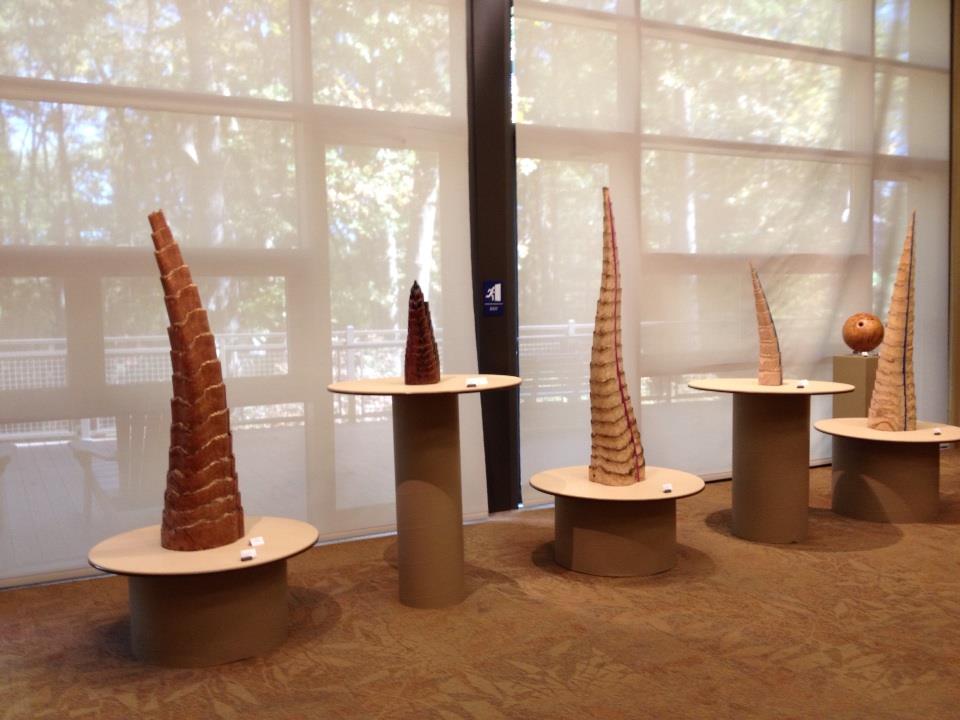
David Ellsworth's "Emergence" series

David Ellsworth’s “Emergence” series

I have known Wendy and David for over 25 years, and I can testify that the work each of them does fits Kay Ryan’s description of art. They are artists, and their work nourishes both of them–and nourishes us, the beneficiaries, as well.

~

For today, these are my stories.
www.ellworthstudios.com

Er – sur –

Mary Ruefle writes, in her book of “lectures,” Madness, Rack, & Honey: “I remember being so young I thought all artists were good, kind, loving, exceptionally interesting, and exemplary human beings.”

I was a child like that. It’s good to know there was at least one other. We grow up to know that such artists are far from common. But they do exist.

Each time I learned a “bad” thing about an artist, poet, or writer I loved, I felt a little deflated. Something was being taken away from my idea of the person who made such wonderful work.

Later, I rather empathized with Roland Barthes’ theorizing about the death of the author. Not because I was necessarily post-modern but because sometimes, I wanted the artist-as-person to be erased so that I could go back to loving the art-as-art. This was a juvenile way of thinking about both human beings and about art.

But: the lure of erasure…

~

Ruefle muses about time, about art, literature, and the human being. Her assays to determine what endures among us often feel a bit cryptic or aphoristic at the first encounter. The wisdom in them, and the layeredness–and the awareness of what is “missing” in her texts–evolved in my own mind as I read her book, slowly.

She has used erasure as a means to expression and to beauty, as it happens. Examples of her erasure poems appear on The Poetry Foundation’s website here.

~

The closing epigraph of Madness, Rack, & Honey (is it an epigraph if it falls at the end of the book?) is from Samuel Pepys’ Diary following the Great Fire “…an abundance of pieces of burnt papers were cast by the wind as far as Cranborne; and among others she took up one…which was a little bit of paper that had been printed, whereon there remained no more nor less than these words: “Time, it is done.”

Time.clock

~

For Dave Bonta’s interpretation of erasure poems–based upon Pepys’ diary–see via negativa here.

~

“Exhibit 13,” by Blue Man Group, follows an abundance of pieces of burnt papers cast by the wind, as well.

In which I discuss the theme of death in literature

~

Victor Brombert offers an octogenarian’s reflections on death, literature, and the creative process (storytelling, history-creating, poetry-inspiring) in a recent Chronicle of Higher Education. I found his musings of interest partly because I have best beloveds who are octogenarians and partly because Brombert is a dyed-in-the-wool humanities professor (professor emeritus of Romance and comparative literatures at Princeton) whose thoughts on mortality cannot help but have been shaped by his long associations with such texts, as well as by his long life and his experiences. “After Omaha Beach, where I discovered that I decidedly did not have a heroic vocation, I also discovered between the hedgerows of Normandy how repellent the smell of dead cows and dead men can be, how repulsive the sight of half-burned tank drivers finished off by machine-gun bullets, their bodies folded over the turrets, or of gunmen and mechanics who had tried in vain to crawl out of escape hatches,” Brombert recalls; then, he reminds himself that he had considerable warnings about war’s savagery–through literature–citing Montaigne and The Iliad. In fact, he says that “the theme of death stood for me in a special relation to literature.”

About death’s “special relationship with literature,” my education agrees with his. Before I ever had much experience with death in the immediate small circle of my own life, I had encountered it in the books I read voraciously. I knew death could be gruesome, sentimental, slow, quick, painful, transformative, pointless. But I was very young, and I did not, could not, fully understand with what I was engaging: the very question of being and non-being, of what comes “after” and if there is an “after,” and if those words as we know them (temporally) mean anything at all.

Brombert says: “I began to understand that all art and the love of art allow us, according to André Malraux’s famous pronouncement, ‘to negate our nothingness.'” His reading, his studies of art and humanist thinking, “elated” him. He felt drawn to Montaigne, whose essays he calls “flexible and meandering” and whose reflections on mortality seemed affirming in that death itself was “subject to laws of transition, passage, natural progression, or process.”

~

Brombert recognized his job as a teacher of literature was a kind of giving voice to the dead. Here, I think of Hofstadter’s conclusion about human consciousness: that it is shared, carried on–in part–by living human beings after the bodily death. Is that troubling, or comforting? Some excerpts:

[W]riting itself was implicitly suffused with the theme of mortality, especially narratives and storytelling in general (the example of Scheherazade of One Thousand and One Nights came to mind) as ways of eluding or delaying the inevitable.

Plato set the tone in the Phaedo when he had Socrates tell his disciples, before drinking the poison hemlock, that true philosophers concern themselves with nothing but dying and death, that philosophy is in fact the study of death. This seemed to me rather excessive.

Though never losing sight of his mortal condition, Montaigne is primarily intrigued by the processes of life, the mutations from day to day, as he watches his own decline and feels, as he puts it, that he is dissolving and slipping away from himself (“Je fons et eschape a moy“). His concern is not with essence or being but rather with transition: “I do not portray being, I portray passing” (“Je peints le passage“). Throughout, his Essays affirm the need to live to the fullest. Yet, in a deep sense, his thought seems prompted by the recurrent sense of the transitory and the perishable.

Kind of dovetails with the concept of impermanence, no?

~

On a closing note, and back to my favorite topic of poetry….Billy Collins has claimed that “the theme of poetry is death.” Like Brombert’s assessment of Socrates’ claim, I’m inclined to think this statement is a bit exaggerated. There’s merit to it, however. Worth thinking about.

Collins’ poem “The Dead” offers one way of thinking about death in a poem; this link will take you to a clever animated version of this poem.

And there’s a nice example of paronomasia: animating the dead!

Science is poetic? A debate

Here’s a video I found entertaining and thought provoking–a scientist, a poet, and a philosopher discuss the intersection (or if there is an intersection) between poetics and science.

This debate hinges on a Richard Dawkins statement: “Science is poetic, ought to be poetic and has much to learn from poets.”

The home site is the Institute of Art and Ideas, which is also worth exploring a bit.

Poetic Theories: Can scientists learn from poets?

Ken Binmore, Mary Midgley, Ruth Padel.

What is your take-away from the discussion? I’m curious about which stance seems most convincing, though I suspect one’s fundamental opinion on such topics isn’t easy to change.

Virtual, physical, personal

~

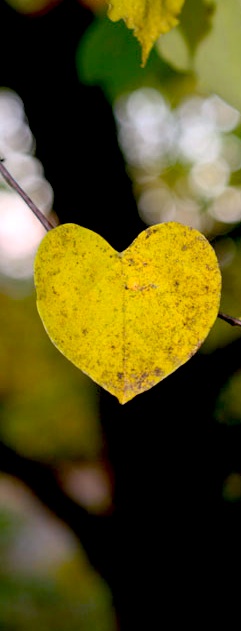
Redbud leaf in fall

Through the blogosphere, I’ve met some fascinating and talented people. The virtual connection, although I have learned to value its scope and immediacy, generally seems a bit wanting in connection for me. Even though I tend toward introversion, my favorite way to connect with people remains face-to-face. [Go ahead, call me old-fashioned.]

In the days of listservs and message boards, I first began “meeting” colleagues online. I signed up for the Women’s Poetry listserv (Wom-Po), which is still active today. One of the best things about that list, besides the fact that I learned a great deal about poetry/women’s poetry/teaching poetry/contemporary and historical female poets, is that I met many of my colleagues in person while attending writer’s conferences, readings, and similar events.

What joy for a person like me, who tends to be a bit reserved about meeting new people. For introverts, a virtual introduction and conversational exchange online–even just recognizing a name on the listserv–has made possible a route to social icebreaking at conferences like AWP.

This past Saturday, another virtual connection joined the realm of the physical when I got the chance to meet–in person–artist Deborah Barlow at the opening of her show at Morpeth Contemporary gallery. I’ve seen her artwork on her homepage; but as is often the case, viewing the work in person was revelatory and beautiful. And meeting the artist herself–also revelatory and beautiful!

I recommend her blog, Slow Muse, which has alerted me to many a terrific book on creative thinking, the creative process, and poetry as well as introduced me to several wonderful contemporary artists’ work.

As the seasons undertake the dying-toward-renewal process, I welcome musings and inspirations. The shining, textural depths of Barlow’s paintings offer another way of looking. As do good books and sunny mornings on the back porch.

Grief, poetry

I think it is important that people read Mark Doty’s deep and appropriate comments on whether (or, possibly, how) poetry can console “a grieving public.” It’s on the Poetry Foundation’s website.

Doty’s poetry has always struck me as particularly powerful at evoking, and embodying, the way the world that is (physical, phenomenological) intersects with the world of the mind (both intellectual and emotional). He is likewise an excellent, reflective, poetic prose writer and memoirist.

On this day, which still sears pretty heavily into the collective and individual consciousness of many U.S. citizens, Doty’s observations about public and private shared grief, and how we “process” such emotions are apt and compelling. Doty begins with Wislawa Szymborska’s heartbreaking, and controversial, poem “Photograph from September 11.” In his commentary, he asks, “What can the artist do, in the face of the dreadful, that which can’t be assimilated?” and says that

To name it is to diminish it and, in the process, to come head to head with the inadequacy of the tools of poetry to circumscribe such experience. It is a gesture recognizable from Neruda’s great poem occasioned by the Spanish Civil War, “I Explain Some Things,” in which he writes that the blood of the children ran in the street “como el sangre de ninos”—“like the blood of children.” There is no adequate gesture, nothing in the arsenals of figuration that will serve; only a terrible plainness of saying, or of pointing toward what cannot be said, can rise to these occasions.

He observes–and I have to agree with him here, “I understand the human need…to give shape to grief, but surely the first response to such a rupture in the fabric of the world ought to be a resonant, enormous silence. To come too quickly to words is, ultimately, a form of arrogance; the easy poem suggests that loss is graspable, that the poet has ready command of speech in the face of anything.”

Elegy takes me awhile. Silence and the awe of disbelief and the need to think come first; indeed, are necessary. For me, perhaps the most stunning September 11 “elegy” is, surprisingly, from Blue Man Group: the mostly wordless video “Exhibit 13.”

Doty moves on: he says, “All poems of public grief are private poems first. If, that is, they are any good, and not merely occasional pieces that serve to mark a moment and reinforce what people already think.” True. And then, these words, which artists are more likely to understand than no-artists, because there is potentially something “hard” in them–

The act of making a poem is a movement from private feeling and perception, the inchoate stuff of experience, into the shared realm of language. At some point along the way, the poet usually becomes less interested in understanding or naming experience, and more intrigued by the words themselves, by the patterned arrangement of sound and silence on the page and in the ear, the pleasures of giving form. And it is a pleasure, poetic making, even when what is being shaped is dreadful.

The aesthetic, the gorgeous, emerging from horror. Isn’t that almost–almost–manipulative? Doty recognizes and disabuses us of that notion by citing his own experience of writing about AIDS:

I was setting things down for myself because I needed to, and then experiencing…that progress toward impersonality which comes with the making of poetry. That must be among the strangest of poetry’s many paradoxes: that we are driven to write by fire and then must distance ourselves to a cool dispassion in order to make those flames burn for anyone else. That is not a heartless thing, or an opportunistic one, to turn your experience into art.

Yes, please read his essay if you are interested in what art is and what it does and how it relates to public experience of any kind.

“I think what the poet must do is pay attention to the nature of subjectivity, to the experienced, lived hour, and trust the paradox that if we succeed in representing that, we may approach speaking to our fellow citizens. I hope so.”  ~Mark Doty

More posts on grieving and art:  Despair&Fear, December 24

Paz and poetic image

“The image is the key to the human condition.”

“Poetry is entry into being.”  ~Octavio Paz

All quotes in text below are from Paz, The Bow and the Lyre

~

Octavio Paz says all great works of art arouse in the spectator (or listener) “constellations of images” which “turn all works of art into poems.” In addition, what we find in the poem is something we already have within ourselves; we could not encounter it otherwise. What would that something within ourselves be? What do all of us possess in common, unique as we are? Paz doesn’t opt for a concept such as “soul” or “spirit” to define what all humans possess within ourselves. His answer is more mysterious but I think more accurate… “Poetry is nothing but time, rhythm perpetually creative.”

Some of us may protest we are not “creative.” But creative in this sense doesn’t mean that one has the ability to create art. It means one has the ability to create the imagined sensation, emotion, or context. All of us do this: the human concept of time, for example, takes considerable imagination–yet we all seem to have an understanding of time in our daily lives, even if our individual perceptions, or cultural perceptions, of time may vary a good deal. Give that idea of time, whatever it may be, a rhythm fueled by “rhythm as transformative change,” and perhaps that would be the origin of art. To encounter and be changed can only occur when something unexpected occurs through the experience.

~

“The image shocks because it defies the principle of contradiction: the heavy is the light. When it enunciates the identity of opposites, it attacks the foundations of our thinking. Therefore, the poem does not say what is, but what could be.”

“Since Parmenides our [Western] world has been the world of the clear and trenchant distinction between what is and what is not…Mysticism and poetry have thus lived a subsidiary, clandestine and diminished life. [As a result] man is in exile from the cosmic flux and from himself.”

(Here, I might suggest that Whitman made a significant attempt to bring those distinctions down.)

~books

Heidegger was still alive and writing when Paz was composing these essays, and Paz suggests that Heidegger had been no more able to reconcile the fact that “Western metaphysics ends in a solipsism” than were Husserl or Heraclitus. Paz adds: “Now, as some of his [Heidegger’s] writings show, he has turned to poetry,” and claims that “in losing our way in the world we have become estranged from ourselves. We have to begin again.”

And how to do so–except via image/imagination?

~

Well, we might examine Eastern thought, which “has not suffered this horror of the ‘other,’ of what is and is not at the same time…in the most ancient Upanishad the principle of the identity of opposites is plainly stated… ‘That art Thou.'”

Image as opposition, reconciled and unreconciled, inferred and stated, heavy and light: “of itself, language is an infinite possibility of meanings.”

This may be why writing good how-to instructions is as challenging as writing good poems. Yet according to Paz, “There are many ways to say the same thing in prose; there is only one in poetry.” Which brings us to a lovely seeming-paradox with which I will end this post:

“The poetic experience cannot be reduced to the word and, nevertheless, only the word expresses it. The image reconciles opposites, but this reconciliation cannot be explained by words…thus, the image is a desperate measure against the silence that invades us each time we try to express the terrible experience of that which surrounds us and ourselves. The poem is language in tension.”

(I might add that Emily Dickinson’s work provides excellent examples of the above.)

Poetry and art

A colleague pointed out art critic Holland Cotter’s New York Times piece as a must-read for me with my interests in both disciplines. Here is the link to Cotter’s essay in the “First Crush” series the Times runs: Cotter August 13, 2013.

Cotter says the first love was language, specifically poetry, especially Longfellow and Dickinson.

“If you fall for Dickinson early, you’re committed to language for life, and almost unavoidably to Dickinson’s kind of language. It’s more concrete than just words on a page or in the air. It’s language as a physical material, a substance so concentrated that you can all but hold it in your hands, turn it over, feel its textures.

And it’s addictive. Once in your system, it’s impossible to shake, like a neurological imprint. In my experience, Longfellow’s intensely visual poetry was like a mural or a movie. You just wanted to stand back and let it happen to you. Dickinson’s language was visual, too, but in a startling, flashbulb way — a bang of illumination after which your vision took time to adjust to normal light.

Poetry, in general, made me sense that language could be about big, urgent subjects, the kind that ruffled even a 9-year-old mind. Will everyone I love always be here? If not, where, exactly, is heaven, and what does it look like? Perhaps most important to a writer in formation, Dickinson’s language felt personally usable. It made you want to write, made you think you could. So I did, just for the pleasure and power of creating pictures from words.”

What can I add but “Amen to that”?

It interests me greatly, though, that Cotter made his trajectory from poetry to art; my path went the other direction. I began with a fascination for and study of art and ended up as a writer.

Overlaps and linkages, interdiscipline & creativity. Big, urgent subjects…a kind of power. That’s art.

Tension or rebellion?

In my few available moments during which I can write about being intellectually engaged and curious, I’ve been working on this post. It’s been a “draft” on my dashboard for some time as I work on it. For background, recall that I was reading Octavio Paz’s prose and Dave Hickey’s essays in The Invisible Dragon.

~

Rubber-Band-Shooter_preview_featured

~

Both writers take up the concept of beauty in art. They approach the topic in different ways, of course, but both make note of the requirement for tension in the work of art. The tension can be of anticipation, expectation, surprise, or of opposition and rebellion. The need for anticipation and turns or surprise in poetry reminds me of Robert Bly’s idea of the “leap” in poetry–in fact, Paz is one of the poets Bly uses as an example of “leaping poetry” in Bly’s classic 1972 tract, Leaping Poetry. I infer that these emotion-forms are related to one another and that aesthetics involves at least some connection between experience (physical, emotional) and mind.

[For now, I will not take up the possibility of calm, contemplative, no-tension beauty.]

Instead, it is intriguing to consider the ways Paz and Hickey interconnect regarding the idea of rebellious art. Also, there’s an agreement between them–not literally, as they are not responding to one another at all–concerning art that is funded by governments. Both critics contend that way lies danger.

Hickey’s essays in The Invisible Dragon were sparked by the controversy of Robert Mapplethorpe’s U.S. NEA-funded photographs. These photographs are beautiful, Hickey says, though art critics of the 1990s dismissed the “beautiful” aspect of the work and concentrated on its “message,” while many other viewers considered the images pornographic and offensive. Hickey says, essentially, to hell with the message; look at the art: is it beautiful, or not?

Hickey writes:

My point here is that there are issues worth advancing in images that are worth admiring–that the truth is never plain nor appearances sincere. To try to make them so is to neutralize the primary, gorgeous eccentricity of imagery in Western culture since the Reformation: the fact that it cannot be trusted, that images are always presumed to be proposing something contestable and controversial. his is the sheer, ebullient, slithering, dangerous fun of it. No image is inviolable in our dance hall of visual politics. All images are potentially powerful. Bad graphics topple good governments and occlude good ideas. Good graphics sustain bad governments and worse governments. The fluid nuancing of pleasure, power, and beauty is serious business in this culture.

Hickey’s prose is such fun! And so provocative. He asserts that Senator Jesse Helms (who began the noisy movement to de-fund the NEA’s support of work such as Mapplethorpe’s) was the only public figure who really “got” what Mapplethorpe’s homoerotic pictures were saying: they really were a rebellion, a transgression–a purposeful confrontation with social norms. That’s what many artists and poets do: throw a wrench into the usual mundanities of life and make viewers or readers pause, react, reflect.

Mapplethorpe’s choice of images just happened to be considered sexually transgressive; and Hickey says that because the USA is a democracy, Helms’ right to protest was as valid as the photographer’s right to make the images in the first place. Hickey loved that there was potential for real discovery in that moment, and gives art critics and academics a hard time for retreating into ideas of First Amendment and artistic self-expression and meaning over beauty. He claims that when it comes to the US democratic culture of the arts, “whatever we get, we deserve–and what we get most prominently is ignored, disenfranchised, and instructed. Then we are told it is ‘good’ for us.” But what is good for us by the standards of a bureaucratic culture is not the original contract between the image and its viewer, even though that is the interaction that ignites the spark of awe we feel when we encounter great art.

“In fact, nothing redeems but beauty, its generous permission, its gorgeous celebration of all that has previously been uncelebrated.”

Hickey lambasts Americans for somewhat mindlessly appreciating what we are told is great art. “In our mild appreciation,” he writes, “we refuse to engage the argument of images that deal so intimately with trust, pain, love, and the giving up of the self.”

Paz’s chapter on the image in poetry dovetails with the argument of images and the intimacy thereof. That’s the contract the viewer or reader makes with the artwork or the poem: we agree to be, potentially, moved; to make ourselves possibly vulnerable to rhetoric, to pain, to love, to beauty, to sudden awareness of what has been overlooked, ignored, oppressed, made alien.

Through image. Through tension. Through a state of contrariness and forbidden looking: rebellion.

~

In a week or so I do plan to spend more time on Paz, because I find his essays on poetry enlightening on an intellectual and on a more basic/fundamental level. Hickey’s work on beauty relates to writing but is more specific to the visual and plastic arts. I do recommend Hickey for his humorous but incredibly observant role as a socio-cultural commentator on contemporary USAmerican pop culture, academic culture, political culture, and democratic-capitalist thinking. He’s accurate and insightful even when I don’t completely agree with him. He believes whole-heartedly in discourse and discovery through democratic discussion of multiple viewpoints. Check him out. You will want to argue with him.

Critique: an anecdote

A group of friends gathers once a month to read and share and critique one another’s poems. They know one another well enough that they can be empathic, honest, and helpful; also, they are trusting enough to bring poems that really aren’t “working.” The critique’s the best way to get some understanding of why a poem is not working.

Recently, one member shared a poem that was somewhat philosophical in its overtones. The rhetoric of the poem was shifting, getting away from her, and she knew it. But she couldn’t figure out why, or how to correct the problem.

The talk moved away from critique and into values–for awhile. So the group was no longer exactly discussing the poem, or poetry, at all.

And yet, through the conversation, the writer recognized where at least part of the poem’s problem lay…which was in image and in structure (as illuminated, perhaps, by value and by rhetoric).

Reason can lead to beauty.