The poet’s “I”

So often, when reading a poem written using the first-person perspective, my initial reaction is to consider the poet as the narrator–even though I ought to know better!

When I revisit the poem, when I analyze or interpret it on a more abstract or intellectual level, my view may alter. Interpretation sometimes leads me to decide that the “I” in a first-person poem may be a persona, a stand-in for the poet, or a perspective not of the poet’s personal experience but imagined or constructed. The foregoing are reasons to read and interpret poems with care and not to conclude, automatically, that the poet is writing from or of her own experience.

This makes poets sound like rather slippery or manipulative characters, employing use of the personal pronoun to mislead readers into believing something that isn’t “strictly true” (whatever that means). If I am telling a story, surely it must be my story; and if it isn’t my story—shouldn’t I confess that to my open-minded, engaged, possibly gullible reader? If a poem falls into the category of lyrical, readers tend to believe that the writer and narrator are one and the same, despite a reminder in the glossary of terms that the narrator who “expresses personal feelings” may be “the poet, the poet’s persona, or another speaker.” In other words—not the poet’s own feelings, despite the apparent authenticity implied in the use of the first-person pronoun.

Readers may feel betrayed by the writer. Yes, that happens. It also happens that rather awful human beings have penned soaring, beautiful, compassionate poems, because people are complicated and flawed and society often harms us.

And perhaps writing, in some complicated way, can redeem us. I’m not entirely convinced of that; but I do know that I have written poems that basically construct an experience or type of feeling I can imagine but do not authentically know, and that the work of having written such poems has felt like an enrichment of my own experience.

I have been asking myself why and how it happens that poets sometimes—often, perhaps—end up composing texts from other points of view, masquerading as their own. There seem to be a couple of reasons, one of which is simply that we practice writing by using our own much-loved poems as models. The lyric poem has a long history, and even autodidactic students of poetry eventually find that the biographies of some of their favorite writers do not correlate perfectly with the works themselves.

The lyric narrative has been around for less time, gradually supplanting the epic by drawing upon the ballad. And it’s here that readers often get confused about who is the “I” that tells the story, especially when emotional expressions of one kind or another enter the narrative.

I have more to say about this aspect of the poetic stance, the poet’s voice, and the lyrical narrative as lived or imagined experience. And about how that sort of thing evolves during the writing and revision process—with an example or two. But that is for another post. Meanwhile, I am mulling.

Image: Monterey Bay Spice Company

Mulling Spices

Edges & outcomes

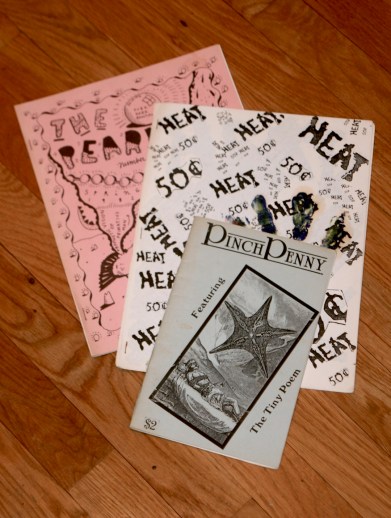
One outcome of participating in a “blog tour” is the opportunity to listen in on what writers younger than I–or newer to the act of being-a-poet–experience in the literary environment of the 21st century. In some ways that has become quite a changed adventure from the early 1980s when the alternatives to major presses and established print journals were little fly-by-night xerox-zines, copied and stapled in runs of under 100. But perhaps not so different from free blogs with just a few dedicated followers; those miniature publications gave me my first print credentials as a poet. Today, I read Lissa Clouser writing of “all the things I’m not” and recalled my own early and uncertain forays at the edges of the literary world.

IMG_5106

xerox-zines, ca. 1982-ish

I now enjoy being outside, observing the edges. It’s more interesting than I realized when I was in my 20s–when edginess was cool, but one might wish to belong with the edgy newcomers. [The paradox of being in the tribe of outsiders.]

Also, I found the garden and the woods and meadows intriguing, and also child-raising, teaching, neuroscience, philosophy. I became a nominal member of many tribes. Including, more recently, the tribe of the aging person and the tribe of the chronically ill–communities that range widely, encompass much, and are fraught with delicious and difficult complexity.

It took me 20 years to get to Arthur W. Frank’s book The Wounded Storyteller, and I might not have found it so useful and illuminating if I’d read it twenty years ago. Now, however, the book’s insights are relevant to my life and to the current moment. Frank powerfully reminds us that as members of the human collective, we need to listen to people; that in time, all of us become wounded storytellers; and, therefore, each of us benefits by learning how to bear human living with a kind of “intransitive hope.” By intransitive hope, Frank means finding a way to be with our suffering in life, recognize that suffering happens, but also to recognize that there are ways to be human that do not end in miraculous cures–that may (and will, eventually) end in death.

And that’s okay. He suggests that healing is a project, not an outcome.

Kind of like writing, you know?

~

“As far as I’m concerned, poetry is the best thing that exists in the universe.”             –-Kaveh Akbar

~

~
~

Writing self

Among the students I have tutored over the years was a young woman recovering from a traumatic brain injury. Writing was difficult for her on several levels. Reading on the screen or page tired her eyes and made it hard to focus; while using voice-activated software helped for that part of the writing issue, it did not resolve her larger cognitive loss: she found she could no longer tell a story. The ability to tie together research, concepts, and chronological moments to compose a logical narrative evaded her.

As we worked together, I learned how writing can restore the self. She began to reflect, through writing, on her process and her memories and to tether things together on the page so that they “made sense” to me–her sounding board. When something made sense to me, she would re-read it and decide if it reflected what it was she had been trying to say. Gradually, she felt more restored to herself, a slightly altered-by-trauma self, but a cohesive self who could tell a story again.

~

When I tutor students who are multilingual, particularly if they are fairly new immigrants here, I find that writing plays a similar role in reflecting or re-creating a self. These students learn to work and write using American English as their mode of persuasive communication, and in the process they develop as people who live in the United States and who consciously employ those terms, phrases, writing techniques, and concepts. They are much more conscious than “native” speakers about the fact that they are using Americanisms and writing in an American style; what they end up with is a self that they can deploy when necessary in American society.

~

Brain diseases, strokes, and dementia dismantle the story-telling ability. Whether we use the metaphor of braiding, warp & weft, or nuts & bolts, we mean that story has structure–and in dementia, structure comes undone. With that structural demise all too often comes the unraveling of the self. Each gap weakens the links that give us our own story-made self and leaves the human bereft of that consciousness we rely upon for being. The person whose brain has stopped constructing self stories is no less human, physically; but the self–that sentient, much-valued ego–disappears.

When I am with a hospice patient whose mind has stopped composing narratives, I see that the narrative of pain and envy and sorrow seems to depart. Is there a story that contains only peace? Could that even be a human story?

I don’t know what to make of all of this.

IMG_5015

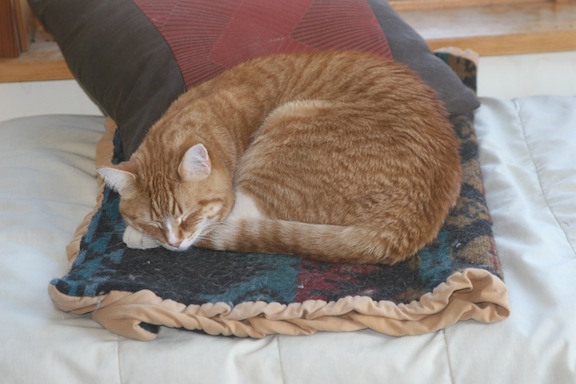
Sometimes, I wish I had the peace and confidence of a house cat.

The narrative vein

Every time there is a crime, journalists seek the story.

Police talk about putting together the story of the perpetrator. The person’s story assists in determining motive. Motive can assist in solving a crime or prosecuting the perpetrator.

Stories require conflict. What is a drama or novel without plot? There is a whole world of plot for narratives, but they tend to need conflict somewhere.

The narrative vein in poetry follows the same story source, although in poetry much can be compressed. There are nonetheless implications of conflict, sometimes powerfully so.

I have posted before about human beings as “The story-telling animal.” Brian Boyd and Daniel Dennett and others note the ways in which stories help us to understand ourselves and others.

I begin to think that storytelling gives us not merely a method for examining cognition, but that perhaps telling stories=human sentience. That perhaps we would not be sentient if we were not aware of stories, able to invent them, or try to recall our own memories in a storytelling fashion. We could be human beings without them, but we could not be sentient.

This is just a story I’m creating for myself in this moment.

This is my own story about sentience, consciousness, and compassion through understanding of narrative persons, personas, and perspectives.

At the same time, I find I wonder:

Do we need better stories?

33414458

Backstory, continued

What brought the idea of backstory to mind was a poem of mine that recently appeared in Peacock Journal’s  print anthology. The poem appeared last year in the journal’s online site. (See: “Imagined Painting of Mary Magdalene Bathing.”)

A friend read the piece and responded to the poem by saying, “This is a beautiful poem. It’s so visual–also, different the second time you read it. And I know how interested you’ve always been in saints and iconography and art, but where did you come up with the idea of imagined paintings? What’s that about?”

This is the best kind of question, as far as I’m concerned. It is a question about ideas, not inspiration or meaning or even craft–though I love questions about craft. It does beg the writer to reveal, however, a bit of the story-behind-the-story/poem/narrative, etc.

“Backstory” may seem self-explanatory. It’s a term used more frequently in drama, particularly screenwriting. Poetry critics are less inclined to employ the concept because–see last post–it is too easy to fall into explaining the poem, which is generally considered a no-no. My friend, however, is a reader and not a poetry critic. I felt free, therefore, to address the question on a personal level.

As my good friend knows, I have been intrigued since adolescence by the art and iconography, the symbolism and the stories of the saints, despite my Protestant upbringing. I love art, aesthetics, and the divinely natural (empirical, phenomenal) World and feel an ambiguous but compelling relationship with myth, religion, history and a culture I cannot escape. And I have imagination.

I began writing about a saints in less-than saintly pursuits. The idea interested me. Surely the saints could be imagined as real human beings, not only as intercessionaries between the human realm and Heaven. I wrote about St. Sebastian purchasing a tunic, Saint Agnes braiding her mother’s hair, and St. Anthony fetching a pail of water. Saints as human beings (rather than as symbols, icons, and religious items) led me to the depictions of saints in art as other-worldly, pure, suffering, or in all ways saintly; and I entertained thoughts of paintings I had never seen but would like to see–theoretically-possible paintings. In the case of St. Mary Magdalene bathing–would Da Vinci have painted it? Rubens? I can only imagine. The poems are a kind of ekphrasis.

I wanted to be a painter when I was a child. This imagining may be as close as I ever get to realizing my youthful ideals.

~

There is not much more backstory than that. None of it leads to meaning or interpretation, although the story above may cement some allusion or confirm referents in the reader’s mind. I hope, however, that the backstory here might interest one or two readers enough that they pick up a book on Renaissance or medieval art, on hagiography or history. Or perhaps someone will go to Amazon.com and purchase the anthology at the link above.

Thank you, friends in literature and imagination.


Poetry & backstory

My primary interests on this site are consciousness, nature, philosophy, the arts, and poetry in particular. Recently, poetry has been taking a backseat to other concerns; but poetry has a way of constantly asserting itself into my consciousness–of whatever that may consist (see previous posts for wrestling with that concept).

I have been reading poetry but not writing about it much and not composing at a productive clip, though I am not feeling “writer’s block.” I have, instead, allowed other events in my life to take over space formerly reserved for writing poems. This is neither bad nor good–it is just the state of affairs at present. Recently, a discussion with a friend brought up an aspect of poetry-writing that I have not spent much time thinking about; and the reason I haven’t is probably because I was warned away from the practice long ago when I first began to write verse.

The practice is “explaining the poem.” Of course, in theory the poem should do its own explaining, and if it requires too much prose telling, then it ought to be fiction or memoir or history or something other than a poem. That’s what my mentors and teachers imparted to me about poetry (all hail received wisdom!), and I do not disagree with this tenet–but having taught classes that introduce people to poetry, let me add a few cautions and qualifiers.

See, there’s explaining, and there’s explaining. One version of explaining the poem is to tell what inspired you, how you started to write it, what you were aiming for in terms of purpose, what you intended to “do” in the poem, and what each of the references means as relates to your life, the nation, culture, religion, or a love affair. If that is what the poet does before reading the poem aloud or presenting it upon the page, then the poet is doing all of the poem’s work for it. Too much information.

If the audience does not understand or appreciate the poem without this sort of explanation, then you have either a failed poem or a failed audience.

Then there are forms of interpretation and analysis by critics, reviewers, or fans; these texts or discussions can be immensely interesting and fruitful but do not involve the poet him or herself, so they do not really qualify as “explanations.” This process is what we try to teach students to do in university literary analysis coursework. Sometimes we encounter lackluster or lazy audiences in the classroom: people who want the professor or the textbook to do all the work of understanding poems for them. Poems are complex, like polymer molecules or neurological wiring. Not easy to explain.

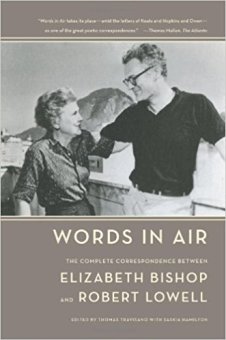
But there are explanations of a kind that can be valuable, even if they are fabishop lowell ltrsr from necessary when one encounters a really terrific poem. There are reasons to learn the backstory of a poem, if such a thing exists for that particular poem (not all poems have one). Anyway, it may be worth asking the poet about it, if she is still living and can answer or if the answer may be deduced from archival materials. We have learned the backstories of a few Elizabeth Bishop poems, just taking one well-known poet as an example (see Words in Air); the stories–in this case, letters–do not necessarily help readers interpret a poem or even understand it any better, but the stories remind us that the poem was initially embodied in the brain of another human being who was undergoing and observing experiences–or leaping into realms of imagination.

More about why that’s a good thing, and more about the embodiment of the human brain, in later posts.


Story as vagabond: Intizar Hussain

Kahani to awara hoti hai. Story is a vagabond…My nani…used to tell me a story in which a girl says to her father, “I love you as much as salt.” My nani didn’t know about King Lear…She belonged to a tradition of storytelling in which space was unbounded and time was fluid; the hero could travel across forests instantly, and ignore borders separating Heaven, Earth, and Hell. Fairy princesses and monkeys spoke classical languages, and trees and birds told stories. This made for a more generous world, and, of course, a more imaginatively vibrant one; and it made the question “What does it mean to be human on this Earth?” a genuinely inclusive one–because the answers had to account for our relations with everything around us. It is because I am an inheritor of this way of thinking and being in which boundaries are always porous, always shifting, that I can accept that there is a grave of a Muslim disciple of Krishna in Brindiban…

~Intizar Hussain, Pakistani (but, earlier in  his life, Indian–from Dibai) fiction writer, from an interview with Alok Bhalla in Manoa journal. [The surname can be spelled either Hussain or Husain in English.]

33414458Bhalla–one of several translators of Husain’s work into English–comments during this interview: “The poet-storyteller is both blessed and cursed; he is exiled from Heaven and the courts, but he understands how integrally he is ‘of this Earth’–that is, secular. This seems to be the tradition in which you have been trying to locate yourself. Isn’t that why both the religious fanatics and the ideologically motivated find it difficult to accept you?”

~

Earth–we are embodied of earth, part of earth, indivisible from our earthliness, and we exist in relation to the things of this earth.

It might be wise to stay mindful of our necessary integration with all things earthly and embodied, to recognize how intricately we are connected. Bhalla, whom I met at this year’s AWP, mentioned that Husain was fundamentally opposed to identity politics; in  his generous inclusiveness, he believed that to define oneself under a single identity forces boundary-relationships with others, that tribalism has led to nationalism and thence to genocide in far too many instances of human history.

Naturally that means he had a fraught relationship with Pakistan itself, and–to quite some extent–with Islam [he upheld the notion of Mussalmani]. He was revered enough and diplomatic enough to keep those boundaries porous and those relationships open.

Few of us will ever be as wise.

~

This lovely issue of Manoa features cover artwork and illustrations by Imram Qureshi, whose work I walked upon at the Met in NYC, roof garden installation, 2013.


Do we change? Can we?

I have blogged about the Myers-Briggs personality inventory–a tool that may or may not be useful to psychologists, depending on whom you talk to. Because my father used the inventory in his studies of people in groups, he “experimented” with his family, administering the inventory to the five of us. I was 17 years old the first time I took the survey; my type was INFP (introvert, intuitive, feeling, perceptive), heavy on the I and the F. Has that “type” changed over the years? The “brief” version of the test now shows me moving in the last category, still P but slightly more toward J (judgment). That makes sense, as I have had to learn how to keep myself more organized and ready for difficult decisions. After all, I am a grownup now.

The personality type does not indicate, however, what sort of thinker a person is. Certain types may tend to be more “logical” in their approach to problem-solving, and others tending toward the organized or the intuitive, but what do we mean by those terms? For starters, logical. Does that mean one employs rhetoric? That one thinks through every possibility, checking for fallacies or potential outcomes? Or does it mean a person simply has enough metacognition to wait half a second before making a decision?

Furthermore, if personality type can change over time (I’m not sure the evidence convinces me that it can), can a person’s thinking style change over time? Barring, I suppose, drastic challenges to the mind and brain such as stroke, multiple concussion damage, PTSD, chemical substance abuse, or dementia, are we so hard-wired or acculturated in our thinking that we cannot develop new patterns?

There are many studies on such hypotheses; the evidence, interpretations, and conclusions often conflict. Finally, we resort to anecdote. Our stories illustrate our thinking and describe which questions we feel the need to ask.

~ A Story ~

high school.jpg.CROP.rectangle3-large

This year, I did the previously-unthinkable: I attended a high school reunion.

We were the Class of 1976, and because our city was directly across the Delaware River from Philadelphia–the Cradle of Liberty! The home of the Liberty Bell and Independence Hall!–the bicentennial year made us somehow special.

Not much else made us special. Our town was a blue-collar suburb of Philadelphia, a place people drove through to get to the real city across the river, a place people drove through to get from Pennsylvania to the shore towns. Our athletics were strong, our school was integrated (about 10%  African-American), people had large families and few scholastic ambitions. Drug use was common among the student population, mostly pills and pot. There were almost 600 students in the class I graduated with, although I was not in attendance for the senior year–that is a different story.

But, my friend Sandy says, “We were scrappy.” She left town for college and medical school, became a doctor, loves her work in an urban area. “No one expected much of us, so we had to do for ourselves,” she adds, “And look where we are! The people here at the reunion made lives for themselves because they didn’t give up.”

It is true that our town did not offer us much in the way of privilege or entitlement, and yet many of us developed a philosophy that kept us at work in the world and alive to its challenges. The majority of the graduates stayed in the Delaware Valley region, but a large minority ventured further. Many of these folks did not head to college immediately, but pursued higher education later on in their lives; many entered military service and received college-level or specialized training education through the armed forces.

ann1975-76?

Does this young woman look logical to you?

I wandered far from the area mentally, emotionally, and physically; but then, I was always an outlier. One friend at the reunion told me that she considered me “a rebel,” a label that astonishes me. I thought of myself as a daydreamer and shy nonconformist, not as a rebel! Another friend thanked me for “always being the logical one” who kept her out of serious trouble. It surprises me to think of my teenage self as philosophical and logical. When one considers the challenges of being an adolescent girl in the USA, however, maybe I was more logical than most.

I find that difficult to believe, but I am willing to ponder it for awhile, adjusting my memories to what my long-ago friends recall and endeavoring a kind of synthesis between the two.

~

The story is inevitably partial, incomplete, possibly ambiguous. Has my thinking changed during the past 40 years? Have my values been challenged so deeply they have morphed significantly? Have I developed a different personality profile type? Are such radical changes even possible among human beings, despite the many transformation stories we read about and hear in our media and promote through our mythologies?

How would I evaluate such alterations even if they had occurred; and who else besides me could do a reasonable assessment of such intimate aspects of my personal, shall we say, consciousness? Friends who have not seen me in 40 years? A psychiatrist? My parents? A philosopher? It seems one would have to create one’s own personal mythology, which–no doubt–many of us do just to get by.

I have so many questions about the human experience. But now I am back in the classroom, visiting among the young for a semester…and who can tell where they will find themselves forty years from now? I hope they will make lives for themselves, and not give up.


Connected

Jonathan Franzen’s The Corrections revolves in part around a family’s interconnected–and expanding–circles of influence (of harm, mostly, but also of steps toward healing) as the “patriarch” begins to lose his health and independence. It’s a depressingly familiar scenario for many of us who have aged parents. I often hear anecdotes from friends and colleagues about how an elderly parent’s decline tears apart family connections and lately have been living the problem a bit more close at hand.

So I am mulling about how we are interconnected, and also about how we decide to narrate our connections: the stories we tell ourselves, the stories we tell others. That’s the poet/observer in me mulling; but I also want to find out more about the psychological side of the equation, so I recently read Christakis’ and Fowler’s book Connected: The Surprising Power of Our Social Networks and How They Shape Our Lives, which takes a social-science and statistical look at what connects human beings to other human beings. 330px-Broad_chain_closeup

Writers are often our keenest social observers, and as it happens, Hungarian poet and writer Frigyes Karinthy wrote a story (“Chains”) that more or less posited the six degrees of separation theory back in 1929. Franzen’s novels tend to explore how even seemingly-minor disruptive or dysfunctional human relationships create butterfly-effect chaos among those connected to it–even among people not closely connected to the ‘disrupter.’

Christakis and Fowler examine much more than the six-degrees theory, such as how those human connections build themselves into social cascades, cultural norms, support systems, clans, families, political parties, and economic outcomes. On the one hand, these claims seem obvious: of course our relationships are based upon shared connections, and of course those relationships have impacts upon our lives. We know this intuitively, but now scientists want to give us proof.

Stuart Kauffman’s book At Home in the Universe offers “hard science” studies (though based upon theoretical computer- or math-based simulations) in physics and biology that suggest random disturbances, or chaos, can create chain or even lattice-like behavior. He suggests that if molecules or genes behave the way the simulations do, the cosmos may continually undergo a sort of self-organization that leads to forming connections.

Hence: life. Or life as we experience it. In which small differences in initial conditions can be amplified into transformational events that do not affect anyone in exactly the same way.

That’s more or less the butterfly effect, but it could not happen in social situations among human beings if we were not so interconnected or interdependent. Social beings require other social beings as support systems: that’s how humans work (with, naturally, the occasional outlier).

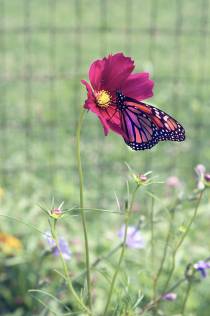
butterflyOur poets, playwrights, and our fiction writers–the narrators of human existence–understand isolation and community in non-scientific but no less valuable and authentic ways. They have been telling us for thousands of years the many ways we are connected.

Maybe what the scientists should do next is read hundreds of years of great literature as evidence of how social networks shape our lives. Science can learn as much from the humanities as the humanities have learned from scientists…

What we, as observant human beings in a chaotic world, intuitively understand.


The skill of grieving

In a recent post, Sigrun of the blog sub rosa pointed me to Poetry Society of America’s page on Natalie Diaz; I’m even going to post the same paragraph she does, in which Diaz states:

When I write, I bring all of my truths, even the Judas-truths that make me feel like the betrayer whose dirty hands are resting on the table for everyone to see, including God. For me, writing is less a declaration of those truths than it is my interrogation of them. Uncovering the darkness in me that led to some of the poems about my brother also lights up the hard, bright way in which I love him and the small wars I wage to win him back…the truths that have built in me a strength and compassion that help me to survive this world. Truth is that little animal we chase and chase until we suddenly glance over our shoulder and realize it has been chasing us all along.

This passage about “uncovering the darkness” and the hard ways in which we sometimes love–maybe with some people, there is no other way to love–interestingly coincides with my recent reading of Stephen Jenkinson’s Die Wise, a manifesto on how we die and how we might die better (wiser) if we carried our darkness better, as Diaz suggests in the passage above. While I am reading Jenkinson for specific reasons around end-of-life concerns, there’s no doubt that there is often poetry in his philosophy that we need to learn the skill of how to grieve and to learn all that such a skill contains, including its “Judas-truths” and its unflinching confrontation with the ways in which death is a gift to us collectively and individually.

Most of us do not see death as any kind of gift, and Jenkinson admits it can be a challenging perspective; he endeavors to persuade the mostly-American or European reader that each of us and each of our societies or cultures would benefit by reclaiming death as a natural sequence in our being in the world.

Claiming or reclaiming death (you might read here: darkness), says Jenkinson, requires us to face the fact that we have no language for dying, not really. He says “we are taught almost nothing about what language to use or why when we are trained for the job [of tending to the dying].” The Dying, he writes, are “them,” meaning they are “not us.” Which makes them outsiders and invisible and yet all of us die; we are all of us dying–and we work so hard to distance ourselves from the fact.

Poetry is a language that, I think, sometimes guides us toward the hard truths, when poetry is well-made and conflicting and sundered with surprise. Poetry isn’t the language that gets us to dying, exactly; but it can do some of the hard work of teaching us how to grieve.

This is not to say that poets or artists are any better at dying than the rest of us. Sometimes the darkness uncovered in the fiction or poem or painting is true and authentic and deep, but the artist does the grief-working well in art and not so well in life’s physical dying process. Artists who choose suicide may be people who suffer pain and can express it artistically without actually learning the work of grief, which differs from suffering. If we learn that anything that does not last forever is meaningless (an idea drummed into many of us through the concept of “eternal life”), we are apt to feel bereft at every loss and may embrace a kind of horrible existentialism. Sometimes our artists strive to overcome the meaningless through lasting works of art, but their personal desire to be somehow immortal may bog them down as death nears.

We admire this artistic striving, but it is a kind of working against our darkness rather than confronting it with the love Diaz mentions. Jenkinson writes: “Dying isn’t the end of true things…It is one of the true things, that is all.” [My italics.]

However, I do believe that art–particularly the storytelling arts–can offer much in the way of teaching us the physical, on-the-level, hard work of grieving. Really good novels and plays can help teach us if no one in our “real lives” does. Even if we weep at the end of the book and wish the author had chosen a different way of ending it. Good poetry that leaves us excited and confused by complexity or blasted with gut-level sorrowing might be teaching us the ways of grief we aren’t learning from our culture.

When a loved one dies, we often get lost, pushed away from grief through the signing of papers and the bland condolences of marginal friends and the plea to move on with our lives. Good poems can keep us dangling in the now of real grief and force us to figure our way through the losses we incur–losses which do not exclude even our selves. Because “death waters the living.” And so does poetry.

http://www.philamuseum.org/collections/permanent/82820.html

Rain [La Pluie] Vincent van Gogh, 1889. Thanks to the Philadephia Museum of Art