Systems

[I am aware that human hair isn’t good nesting material]

Late autumn reveals
oriole’s purse-like nest
constructed of my daughter’s hair.
Breeze touches
what I cannot.
(November 2010)


~

I found this tanka-like poem, written when my daughter was away at college, among some old computer-based file folders I’ve been organizing. It’s one of many old poems of mine I’ve ‘rediscovered’ in the process of trying to keep my poetry systematized. Before I left my job at the university, I imagined that I would manage to organize and update my creative work files during the first year of retirement and keep everything in reasonable order once I had established a system. As if.

It’s not as though I haven’t made progress, made some brave efforts in the direction of archive and revision, culling and filing my drafts and “finished” poems (efforts that are both electronic and paper-based). The fact remains, however, that I do not possess the kind of mind that solves the keeping-track aspects of life very systematically; and, as writing remains a significant part of my life, it suffers from the same inefficiency. I admire artistically-minded people who can keep track of their work using logistically-useful methods that work for them. I’ve read their tips, their essays, talked to them about their systems, tried emulating them. Sometimes parts of their methods are helpful to me, but I lack something. Rigor? Ambition? Energy? The desire to spend the time required?

I keep writing, but I also keep falling behind at staying organized. And then there is the issue of technology constantly updating, so that a method I used in, say, 2015 is not available anymore…unless I invent a bunch of work-arounds. (My long-standing backup method is PAPER, and I still employ it, but I hate file cabinets and folders and don’t use them.) As for spreadsheets? I avoided learning to set them up during my entire career in academia because our department had a brilliantly capable office assistant who did that stuff for us, bless her heart.

All of which means that now and then I cannot locate a draft, a poem I want to revise or to send to a friend, or consider putting into a manuscript. Frustrating. And when I bought a new laptop, I had to decide what files to move from my old desktop; how far back do I want to go? Those poems from 1987, for example–eons ago, as far as computer system lifespans. Yes, I have hard copy from dot-matrix printers. Files originally in AppleWorks and Claris, files that lived on 3.5″ floppy disks. Copies I typed out on various typewriters through the years! Although I’m complaining about it, I realize that in some ways it’s really cool that my poems have undergone so many iterations in terms of tech. It means I have been around awhile and confirms the reasons I think of myself as a writer…and not as an efficiency expert.

~

P. S. I continue to write my drafts with a pen.

Magnificent

Qesra Îshaq Paşa or Ishak Pasha Palace, Ağrı Province, Turkey, Ottoman Empire, 17th c.

For a recent poem draft, I looked up the etymology of the word “magnificent” even though I was fairly sure I knew it. Like many words, its meaning has altered a bit over the centuries, but in this case less so than most: from the old French, from Latin, the root words for “great” and “make,” it formerly referred to great-mindedness, courage, nobility [per the Online Etymology Dictionary] and later gained the additional meaning of splendor or costliness; “Meaning ‘greatness of appearance or character, grandeur, glory’ in English is from late 14c.,” whereas later uses of the word carry connotations of architecture, expensive taste, grand works of a more human variety.

The draft I was working on was about Melville and whales, but of course thanks to stopping to look something up, I went down a research rabbit hole and ended up deciding that the magnificence whales possess would be more of the greatness of appearance sort and perhaps was not quite the way I want to describe whales. But the word did put me in mind of some of the monumental temples, mosaics, palaces, castles, and sculptures I saw in Turkey last month. Many of those are “magnificent,” but they act as reminders of how fleeting human magnificence is, in comparison to whales. Whales evolved into their modern form about 4 million years ago, long before humans were modern humans, let alone building palaces or temples to please the gods, intimidate their enemies or their subjects, or glorify and deify their kings.

The photo below is of the temple and perhaps the tomb of Antiochus I of Commagene (because archaeologists have so far discovered no actual tomb, the existence of said tomb is speculative, though the site is considered to be a hierothesion). The top of the hill is not natural but is a gravel tumulus. Human-made. Gravel hauled up the mountain to increase the size of the mountain and deter potential grave-robbers. Who else would do that work but slaves?

I know the theme’s been written into poetry before, but in these times it seems to bear repeating. Here’s an early draft I’ve been working on, in loose blank verse, in which I invoke a famous poet whose poem on the theme has lasted a mere two centuries. But that’s longer than many an empire has endured.

~

Hierothesion (Nemrut Dağ)

Tomb or temple, likely both, one king’s
angling for a pantheon he’d crafted
on his own, as kings will do when empire
hardens in their veins. They turn to stone.
Minions, memorize my name! (like
Ozymandias, as Shelley can attest).

Tourists scale the tumulus and find,
at sunrise, eagles, lions, and Apollo,
gods of brokenness, unhumbled despite
centuries of disregard. Extinct.

We know him not. And what has made us pause
speaks not of his glory but of our dismay:
how much purely human work, slaves’ toil and toll,
it took, interring him this way, high up
and rubble-laid, to raise him above all.

Where are those workers’ bones? We walk on them.
This we know without a temple or a tomb.


Writing act

Lately, I’ve been experimenting again with prose poems and with very short poems that are not quite tanka or haiku, but not much longer. Six to ten lines. Short lines. Then, the online journal Six Sentences got me intrigued about experimenting with that idea as a prompt–long sentences, short sentences, a mix of both–but only six sentences. I like playing around with words. I enjoy writing almost as much as I enjoy reading, and it’s fun to enjoy what I am doing these days, when so much else seems unenjoyable, sad, fraught, scary (another mass shooting, of children, today).

The garden offers comforts, too. Now we are in the harvest-and-rip-up phase as August nears its close. Lots of tomatoes, still a few green beans, plenty of butternut squash and sweet peppers and basil. It looks as though I will harvest a lot of hot peppers, too; although I only have one plant, it is robust and full of spicy peppers that will get hotter as they ripen. And the summer flowers, those glorious annuals, are lovely this year. We even have more butterflies than usual!

So many people have written about gardens, I sometimes find myself wondering what value there is in it, what could be political or artistic in a garden poem, what could make such a poem dangerous or antisocial. Why it is deemed necessary to yank NEA grants from poets, for example. What is it about the act of writing that makes us outliers? Can it be because any description or observation takes a perspective, possibly personal, possibly outside the norm, potentially widening another person’s viewpoint? And is that dangerous? (Perhaps.) Because a plant or animal or place name might evoke an event or person or symbolize something that might rock the boat–a sunflower for Ukraine, a bald eagle for the USA? Could that be risky? And might the interpretation be incorrect, but the writer assumed guilty of…whatever? (There is nothing new in any of this.)

Here’s a draft of a prose poem that came of my reflecting on such questions.

~~

The Act of Writing

only occurs when pen in hand meets paper, or the act is mere mechanics, pressing typewriter keys and imprinting page, or is virtual, encoded onto disk, on cloud encrypted, ephemeral, the act one of persona, a mood or dream, some moment observed, imagined, a recollection, a heart-stab, a shattered vase, anchors dragged along ocean floor, a plea, promise, letters never sent, a life of pain, a sworn compassion, or love that cannot otherwise be expressed, an argument for understanding. The act of writing rallies, rages, sets forth accusation or denial, sues for mercy, brays at nothing, pointlessly puts forth what’s known but long ignored, unacknowledged, unaccepted, an act political by proxy, being the kind of behavior those in power seek to suppress, who make the act of writing into reams of tedious fine print outlawing every fervent danger that clings to the very act of writing which is the practice of free and conflicted expression even when the reader sees only a description of deep scarlet bougainvillea arching over a poet’s unmarked grave in a landscape of olives and oleander.

~

As you wish

Photo by Ahmed u061c on Pexels.com

Discouragement, a regular visitor to this writer (and many other writers), has settled into the house with me. Summer is often, for me, a time of writing less and doing outdoor and social things more; this year, though spring was lovely despite torrents of rain, summer commenced with the deaths of two long-time friends, and I haven’t been able to shake my low mood. Now the rejection slips are arriving thick and fast, and I’m questioning the value of my work in particular and of creative writing in general. Like, why bother? What am I doing this for? For whom? What’s my purpose? And under what circumstances? Why?

Brooding certainly offers no help, nor does it change “declined” to “accepted.” Creative persons often find themselves questioning their pursuits, so I have good company. (Having just about completed the last book of Remembrance of Things Past, I can report that Proust’s narrator–largely a stand-in for Proust himself–wanders in the dark through wartime Paris pondering his own decision to try being a novelist and feels discouragement and doubts aplenty.)

Somewhere on a social media platform, I encountered these words by Virginia Woolf (from “A Room of One’s Own”): “So long as you write what you wish to write, that is all that matters, and whether it matters for ages or only for hours, nobody can say.” Good perspective, that, to stop being concerned for how long your writing matters, or to whom, as long as what you write is what you wish to write. And then if you don’t submit your work for publication? Maybe that is something you can live with. Rather, something I can live with; at this point in my life, I have had hundreds of poems and essays published, six chapbooks, and three poetry collections…maybe from now on, I should write (as I always have) for myself. Even if my work is not in fashion, or considered irrelevant, or judged as potentially lasting, it is still what I wish to write, what I find necessary to express.

Though one does write to express things, and expression seeks audience. That’s a perspective for another day, perhaps. Meanwhile, back to weeding the garden and picking cucumbers, beans, tomatoes, zinnias, and sunflowers.

Changes & alterations

We built our house here about three decades ago. At the time, I was young and excited about landscaping the place; although I had been growing our own vegetables for years by then, I was fairly new to ornamental gardening. I made mistakes; I underestimated the speed at which shrubs and trees grow; I thought I could keep a handle on invasive species; the world of various bark beetles and aggressive vines was new to me; and I had no idea how hard it would be to manage almost seven acres without, say, a team of landscapers.

Or how rapidly an environment alters when the climate changes, and when cornfields and early-growth wooded areas become housing developments, parking lots, and streets. I have learned a great deal and much looks different now than thirty years ago, but the swallows still return to my garden between April 26 and May 6. My land contains fewer efts in May than it used to, but the gray frogs, spring peepers, wood frogs, and toads make their usual frenzied chorus at mating time each spring.

~

Recent changes have come from the emerald ash borer, which has decimated, or worse, the green ash native to this valley. The huge trees have come crashing down during the past 10 years, making hard work for us even if it does provide a bit of firewood. Cutting, splitting, stacking hardwood isn’t a task I’m much good at anymore. Thirty years ago, maybe…and there does not seem to be any good that comes of this tree loss, which I’ve been mourning each year as we have less and less of a woodlot treeline above the hedgerow and see more and more of the neighboring subdivision.

But on my damp, early-morning walk today, I perceived some changes that I should have expected and that offer a glimmer of hope for native trees and shrubs–despite the proliferation of Russian olive, multiflora rose, Amur honeysuckle, mugwort, wintercreeper, Asiatic bittersweet, mile-a-minute weed, and more colonizing invaders than I can tick off in one blog post. There, beside the tractor path, along the edges of the hedgerow (for edges are where things happen most quickly), I observed more tree saplings than in past years. With the vase-shaped, leafy arcs of green ash absent, sun reaches further through the thickets. And there I spot horse chestnuts starting to push up, tiny walnut trees, oak trees of differing species, “baby” hickories and maple varieties, along with understory’s smaller shrubs and trees like amelanchier, ironwood, redbud, buckeyes.

Granted, most of them won’t survive to maturity, but some of them will–gradually re-making the woodlot unless other disturbances undo the renewal.

I won’t be here in another 30 years to find out, but I find hope in these saplings. I’m also happy to see that the little woodland and field wildflowers such as false Solomon’s seal, jack-in-the-pulpit, wild violets, and mayapples remain. And though I find myself swearing inwardly at the way the Russian olives grow massive along the property line and the invasive bittersweet sends thick tendrils coiling up into the trees, it’s not the fault of the plants that they got here. Humans brought them to North America, and the plants–like European colonists–became a bit too successful in their new homes, pushing out what was here before their arrival. Am I any different, really, than the dandelion or the honeybee? My ancestors came to these shores not so long after those species were imported with earlier “settlers.”

~

The rain we’ve been getting means I haven’t been out weeding in the vegetable garden. After I take my walks, I come inside to dry off and do household chores, or make soup, or work a little on my poetry. I feel excited by a little writing project I have recently given myself, and I’ve also been playing around with drafting prose poems. Next week, I head to the high desert again for further inspiration and a chance to travel with a good friend, visit museums, and spend some time with my daughter. When I return in mid-May, the gardens, the meadow, and the woods will already be much changed.

Reading my contemporaries

The poetry collections I’ve been reading during much of the past year have largely been works of contemporary writers–books that were published during the past two decades, some during the past two years. My focus on such current work was not intentional. After all, there is still so much poetry from the past three or four thousand years that I haven’t yet explored! Grad school, however, was decades ago; that’s when I last studied both contemporary and classic/canonical/influential poems with a specific eye to learning from them. I continue to learn from the poems I read, though. I just don’t take as many notes or write any papers about them these days.

Three collections I read recently have got me thinking about the grittier sonic elements in poetry; the use of scientific, foreign, antiquated, and invented words; wordplay in general as a poetry component; and how sound can push both experiment and meaning in a poem. I’ve been mulling about the task of writing anything that feels “new,” to me or to my readers, and about the challenges more sonic wordplay would mean for me as a writer. I’m saying here I think it would be difficult to do, because it differs from my long-accustomed voice and style. I’m also saying I like a challenge in creative work, and that my style(s) go though changes always, so why not? In creative art of any kind, the passing of years makes a difference in many things. Content (because: experience). Situation (because: life happens). Methods (because: technology and materials). And influence–what I was reading in high school vs. grad school vs. today–though some favorites will always hold a place in my creative mind.

My poems tend to be plain-spoken, although I’ve never been shy about going beyond the standard vernacular to employ a geological term, a botanical name, or a somewhat archaic noun or adjective when it suits the feel and sound of the poem. Most of my poems don’t fall under the description of experimental or edgy. I’m not making waves with language, but some poets are. And my recent reading has me wanting to experiment more. It will mean failing a lot, because I’m working against my habitual methods of composition. I won’t be as good at it as these poets (below) are. What I’m hoping, though, is that the practice of trying more sonic wordplay in my work implants a tracery of that practice onto my poetic voice.

~

So which contemporaries do I mean? More than the three I’ll briefly mention here, for sure (and it is not as if the only poets playing with words and sound are my contemporaries–far from it). However, here’s a start with some examples that I particularly love.

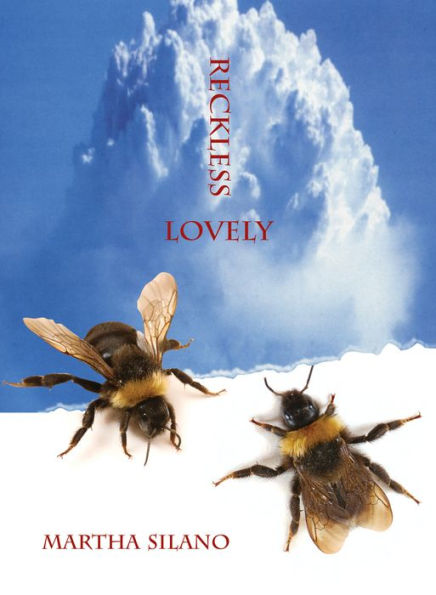
I mentioned Silano’s poetry in a recent post when I appreciated her scientific ideas that meld with an “everyday” life. Reckless Lovely contains many long-lined couplet verses that name objects such as a 64-ounce Big Gulp, Wells-Fargo, Italian Renaissance paintings, or the red spot on Jupiter as the poet observes and speculates on the cosmos that surrounds her. And she invents or alters words that suit her for rhythm, alliteration, sound: “the sfumato is sfumato-ing, the lute-r is lute-ing;” “when most of all that creep-eth/breath-eth buzz-eth/galump-eth sex-eth spar-eth/went AWOL/paving the avenue of asp/the boulevard of bee…” or the totally wild mashup Silano composes in “Summons and Petition for Name Change”:

Dim sum-my dilberry. Down there Daquiri.
Ear of Eden. Eminently Earthy. Empress Gensho.
Fandango-ing funnel. Fox foot. Flamingo.
Geranium in the Gate of the Gourd. Gentian's grin.

~

I find much to admire in Martha Silano’s work even though I often have to look up words (physics and geology nomenclature, usually).

Lesley Wheeler’s most recent book demonstrates her ability with form and sound in a different way, though in “Gran Torino Gigan” the alliteration is as snazzy as Silano’s abecedarian poem above: “Buzzes fade up front,/where beltless adults murmur and smoke//after unfurling musty sleeping bags…in rhizomatic zigzags, with a sharp zipper.” Contemporary technology gets into the poems and, with it, the sounds of our infrastructure, as in “I believe in utility poles, transformers,/lightning arrestors. Subtransmission lines/and static lines. The dead southern yellow pine…” and the theme of fungal connectivity means that we learn some useful and often beautiful mycology terms. Yet Wheeler often relies on shorter words when they suit the tone of the narrative. In a poem dealing with the aftermath of her mother’s death, she writes “No one’s grimmer inside/than me. My bully of a heart wears cheap/scuffed pumps and cusses like a mobster.” The repetition of the word “snow” in “Minus Time” establishes the poem’s pace. So many poems in the collection offer experiments in form!

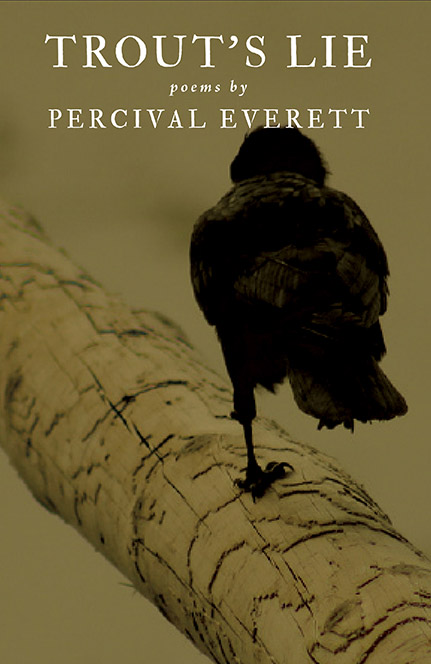
Percival Everett has gained an even stronger following thanks to his novel James, but he’s been writing poetry for years (Trout’s Lie is from 2015). This collection is deceptively simple in language and vernacular: there are surprises. Several poems make allusions to “great poetry of the past” by name or phrase; short lines build and build, twisting the lyric where we don’t think it would go. There are several examples I’d like to give, but this post is getting pretty long. I think I will close with an excerpt from Everett’s “Maybe Even Clouds,” the first section, which begins “Count the marines..”

They look like nice
Boys and bad boys,
From Vermont-and-Montana-
Following-orders-dumbshit-
Non-blinking-soon-
to-kill-soon-to-die boys,
Who might or might
Not, should or should
Not, but never would
Not and never can
not.
Not sure doesn't matter.
Doubt is a penniless
Customer, conscience
Waits for the weather
To change.


National Poetry Month may be almost over, but I’ll keep reading poems. And posting about them. And writing them. I encourage you to do the same, because there is no time in the history of the world when human beings haven’t benefited from poems.
Something like hope

Wintry weeks grind along like the noisy snowplows tearing through sheets of ice this morning. At least we are having a winter, unlike some years. I may not love winter–especially the short, grey days–yet I live in a region that needs it. Indeed, it is February (alas); but in a few weeks I’m liable to notice snowdrops emerging from the dirt. Anticipation stirs my heart. It feels something like hope, although hope is something I feel less inclined to believe in every year. I guess my problem with hope is that it feels like there is human agency invested in the concept, and as I age I recognize how little effect our wishes, hopes, and prayers have upon anything.

Photo from Feb. 9th of last year; as of now, no blossoms yet!

The snowdrops emerge all the same, until such time as they can no longer withstand changes in their environment. There is some comfort in that, for me.

~

Dave Bonta recently reposted (on his Substack and Bluesky accounts) a post by Guy LeCharles Gonzalez called “Why Keep Blogging in 2025?” It’s a lengthy piece (for a post) but brings up some worthy points. He closes with this paragraph, one that I find I heartily agree with–it is why I do what I do:

“Before they became walled gardens, social networks were great places for discovery, and although posts with links don’t get the visibility they used to on the bigger platforms, you shouldn’t be blogging or socializing for scale anyway. Defy Big Social and share those links to your own posts, and to posts you’ve enjoyed. Blogs only die when they’re abandoned by their owners.”

~

Not all of us need to be blogging for scale. That’s a capitalist, celebrity- and status-focused thing that sucks the love and beauty out of poetry, prose, and the arts. We shouldn’t be creating for Big Bucks or Pulitzers but because writing/art is what we love and what we do.

~

Speaking of art…here are three ekphrastic poems of mine, just published in Unleash Lit, which is an online journal that uses a Substack platform.

https://www.unleashlit.com/p/ekphrastic-poems-by-ann-e-michael

Promptings

I have mixed feelings about poetry prompts. There have been times when using prompts has really got me writing and feeling inventive about poetry. I’ve had instructors (and read books) whose prompts seemed terrific for me; but maybe I felt already ‘primed’ for writing, anyway, and it was not so much the prompt itself but the circumstances that led to fruitful drafts. At other times, prompts appear useless, or even–dare I say–insipid. My current belief is that, for me, circumstances and instructor matter more than the cleverness of the prompt. Any prompt can be delightful if only I find myself situated in the mood or feel an urgency to write.

The virtual workshop I’m taking with Anita Skeen opened with a discussion of poems (by Roethke, initially) and then moved to some list-making and prompts. This is not unusual for workshops, and lists are a fine way to begin thinking about poems. The prompts we were assigned employed both lists and a method for drafting a poem. So far, I’ve drafted four or five poems in a week: therefore, success (!) even though only one of the drafts seems to have legs.

I think what happens is that after many, many years of writing poetry (or making any kind of art) one begins to feel a rhythm that is almost circadian–as analogy–that informs a person about flow. I ask myself, “Am I ready to write today?” The answer may not be yes. But if it is yes, then I can just write. No expectations, and it’s okay to use a prompt, or re-write an older poem, or just free-write about whatever moment I happen to be in. Usually, in this frame of mind, I don’t get concerned about writing well. I just start on in.

If the am-I-ready answer isn’t a definite yes, then I may procrastinate or distract myself by cleaning the house or reading a book. I can overcome the “maybe” by turning to work by a poet whose work I find interesting or by experimenting with a prompt. Sometimes, it helps to give myself a deadline of some kind–this is why workshops are often useful!

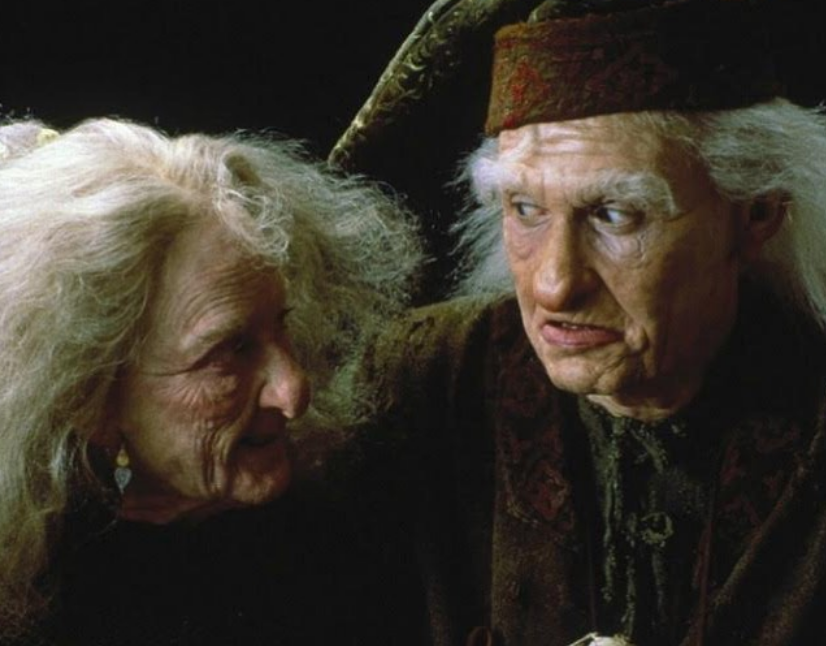
But the answer may simply be, “No, not today.” Sometimes we have those non-creative days. It is alright to have them. Art shouldn’t be about pushing out ideas to get to a “product.” I’m suddenly laughing to myself, thinking of Billy Crystal as Miracle Max in the movie The Princess Bride: “You rush a miracle man, you get rotten miracles.”

At least with writing, one gets a chance to revise.

Carol Kaine & Billy Crystal in The Princess Bride (20th Century Fox, 1987)

If you are a writer, what do you think about the use of prompts?

Breathe

2024 closed with “thundersnow” in my neck of the woods, a weather phenomenon that I find rather thrilling in its strangeness. And the year commenced with the conflagrations in California, not to mention everything else that goes on daily in the cosmos. Oh, the difficulties of life in interesting times.

Photo by Sabian Symbols on Pexels.com

It so happens that I had made plans, and purchased plane tickets, to visit my son in Los Angeles during the week that AWP is holding its annual conference there, in March–that is, assuming the situation in Los Angeles County doesn’t get even worse and assuming his apartment building survives the fires; it hasn’t been easy to keep myself from doom-scrolling and watching updated fire maps. I remind myself that there is not a thing I can do beyond sending money to charities and such, perhaps, and waiting for the winds to change, and that making myself stressed will actually do harm. But I am not one of those Pollyanna types (now termed a “toxic positivity” person, I have recently learned). I’m aware that the world can be hard, and that we may suffer. So, as my yoga and tai chi instructors would tell me:

Breathe.

There’s no point in trying to decide whether this start to the year is auspicious or inauspicious, though if I’m going to go with signs and auguries, I might choose to follow the Chinese year and move my year’s start to January 29, Year of the Wood Snake–and get all this awful stuff (including January 20th) packed into LAST year.

As I noted in my year-end post, a year’s end–or beginning–is arbitrary.

~

As for writing-related resolutions, I make them all the time, not just at the beginning of the year. But in that one respect, the first dozen days of January are going surprisingly well. I’ve been spending more time on revising older–sometimes much older–work, and I have been drafting some new poems. I even submitted just a few things to lit journals and have been making minor progress in the monumental task of culling and organizing my writing files.

Best of all, I enrolled in an online poetry workshop with Anita Skeen through the Friends of Theodore Roethke Foundation, which starts this week. And I registered for an art class in February, so my plans to focus more on my creative work post-retirement are proceeding more or less apace. We balance fear and misery with art.

~

Cloud sketch in acrylics

Whatever works

My last post (here) generated some intriguing feedback and was cause for further reflection about revisions, at least on my part. Because I was writing a poem for a specific person–my son–I got useful information from his response, as well as responses from other readers; so I had the chance to hear back from my audience, however small, and to compare reactions. My son, the “you” in the poem, told me he liked the descriptions and that the piece did a good job evoking the atmosphere of the experience he’d had. He liked the closing lines, too. However, he said that while he had some moments of anxiety during his stint on the military ship, his overwhelming feelings cantered more toward frustration and an almost-constant irritation. He thought I had focused over-much on the anxiety aspect. “Though a person certainly could be feeling exactly that way in those conditions,” he added.

And that’s fascinating, because in earlier drafts I did not work toward evoking anxiety; I was trying to get the details right and to create a sense of annoyance, even anger, at the situation. (Apparently, that is closer to how he responded.) Here’s the “BUT”–but those revisions weren’t making the poem work any better. This is a challenge for many of us writers: when the impetus for writing the poem, and the initial intentions of the writer, don’t resolve into a good poem…and then some alterations–some “fictionalization”–make a better poem, but maybe not the poem the poet set out to write. Do we stay with our initial idea and keep whaling away to make it work as we initially imagined, or do we let the poem move into new territory somewhat removed from initial inspiration if the resultant revisions are more powerful, more believable?

I’m inclined to go with whatever works to make a stronger poem, most of the time. There are other options, though. Sometimes I end up with two or more poems stemming from the same initial idea. A bonus! One prompt I have occasionally used for myself is to re-write an earlier, less-satisfactory poem from a different viewpoint or to focus on a different aspect of the experience. This practice has been awfully helpful, and it keeps me from getting over-invested in the more obscure, personal components of a writing piece.

Photo by Leon Ardho on Pexels.com

Strengthening one’s work takes practice, and possibly a kind of discipline–not to suggest that I am a very disciplined poet, although I wish I were. I do take my practice seriously, though, and revision is a major aspect of my practice, always has been, even when I was a “baby poet” starting out. I never could quite agree with Ginsberg’s famous “first thought best thought,” since my first thoughts are seldom deep, reflective, or in any way excellent; and my first words set on paper are generally equally weak. For me, writing is thinking, in the way of E. M. Forster’s famous quote “How do I know what I think until I see what I say?” Thinking is often flawed, so analysis and critique and revision? They’re required.

Finally, whatever makes the poem better as a poem is worth doing. That’s my opinion: whatever works.