báilù

白露 báilù is the section of the lunisolar calendar that refers to the two weeks before the autumnal equinox; the translation is “white dew.” Misty mornings here and there, damp grass, dew spangling the tent spider webs in the meadow, draping the grasses and goldenrod with white gauze. Brown crickets sing, but the cicadas have left off. Nuthatches return. Squirrels knock walnuts off the branches daily, so there’s a regular thump-thump sound along the treeline. My summer-loving acquaintances bemoan the cooler days and insist summer’s not over until the 21st. My fall-loving acquaintances are picking apples and celebrating the return of pumpkin-spice flavoring to their favorite beverages.

I like the in-between times, the verging of seasons, aspects of change. Change means life, even though the onset of autumn traditionally signals the dying of the year. On my walk this morning, I took photos and made a mental list of changes that are flags of the coming season: acorns on the bough; morning glory still open at noon (in Japanese literature, the morning glory is a signal of autumn’s approach); burning bush shrub going pink; pennants of yellow walnut leaves; ripe wild grapes–deep navy blue, quite sour, and full of seeds; sweet autumn clematis (terniflora) in its whirly seed state, swarming over the hedges; oak leaves, five-leaf vines, and sassafras starting to color; winterberries already red; acorn detritus on the tractor path; pin oak galls (probably thanks to the wasp Callirhytis furva) on a leaf. All of these are mid-September features in eastern PA.

If I were feeling more poetically creative, I might try writing haiku using each of these as the image word. But my current state is fretful. Pulling weeds and taking walks ease my mind a bit. Sitting down to write, not so much. However, reader, I encourage you to try the exercise.

~

Considering the collection

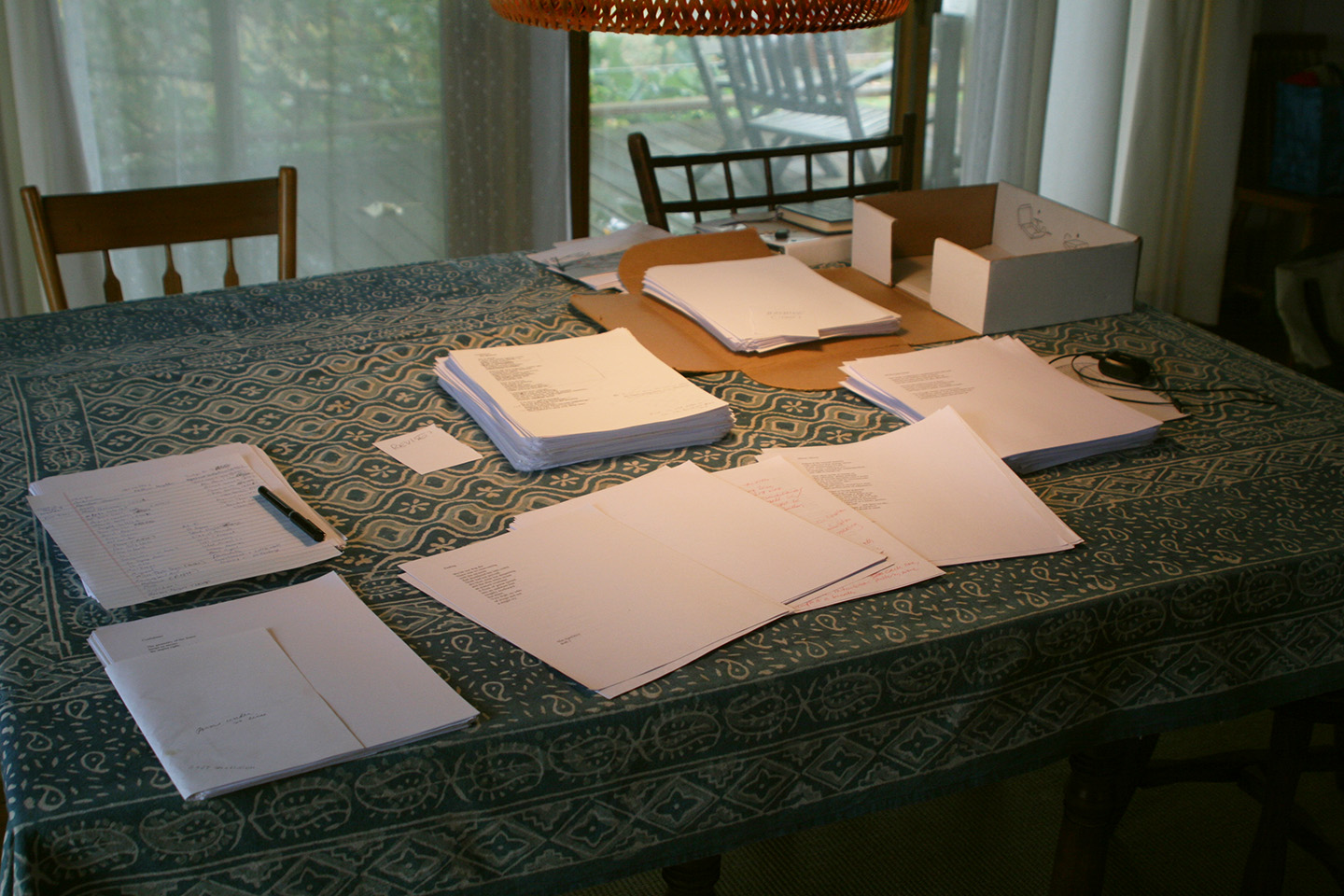
Recently, reading through Dave Bonta’s Poetry Blog Digest, I noticed a few posts on stalling with a manuscript and subsequently clicked on those links and read what other poets have to say about it. Mmm, yeah. I understand the challenges. I have kind of stalled on my next book, too. Or shall I say, neglected my work on it. In fact, today–when I finally thought I had some time to review the draft ms–I could not find it. I had forgotten where I put the printout.

Yes, it resides on my computer. But I prefer to work with hard copy when structuring a collection. And where was the hard copy? I wasted a good half an hour seeking it but finally noticed it peeking from under a pile of other papers. This is not a sign of determined intent.

Why do I allow it to languish? There are so many possible answers to that. The poets who posted (see above) had structural concerns, other things going on in their lives, also a bit of second-guessing and self-doubting. I had eye surgery and covid, but those circumstances did not keep me from drafting new work, only kept me from putting the book together. I recognize now that these tasks involve, for me at least, very different processes, and maybe that is why I’m stalled but not “blocked.” I mean, hooray, I’m writing poems! Which is a process I enjoy, along with revising. But drafting and revising revolve around the process of an interior reflection and creative surge. I wish I could feel that way about putting this collection together, but I don’t. The manuscript-making process is lengthier, broader in scope, requires more critical analysis and a consideration (to a degree) of audience/readership that an individual poem does not. It asks questions of chronology, topic, and forms in aggregate that matter much less when working on one poem at a time.

Perhaps that means I’m not ready to put this collection together yet. Or that I have chosen the wrong theme or mix of poems, and I should reconsider the entire project.

*le sigh*

Maybe I need to take another amble around the garden to clear my head. It’s nice to have that option. It feels more like rejuvenation and less like…procrastination.

~

Depth perception

In second grade, I could not see the blackboard from my desk. My teacher noticed; I went to the optometrist, and thereafter began my worsening nearsightedness. New specs annually for many years, broken frames, ugly frames, though–unlike many of my friends–I never lost my glasses because I could not see at all without them. Somewhere along the way, astigmatism kicked in. In high school, I blamed my ineptness at any sport involving a ball on my astigmatism (contact lenses corrected my nearsightedness but weren’t as effective on the misshapen cornea). But my ineptness was largely due to lack of interest in sports.

And now, encroaching cataract formations mean that I’m getting surgical procedures for the removal of those thickened “cascades” that make it hard to drive at night, read street signs, or discern a cat from a fox in the back meadow. I had my left eye operated on this past week, with the insertion of a medium-length lens that gives me 20/40 vision in that eye: a miracle to me after so many years of blur. I have to wait two weeks before the surgeon does the right eye, and in the meantime I’m discovering the true challenges of poor depth perception. My brain hasn’t adjusted to the changes in my eye, and simple things like walking downstairs or pouring tea into a cup pose unexpected difficulties.

Topping things off, I’ve contracted covid for the first time ever. So I am being extra careful as I walk through my house and into my yard–taking a fall due to bad depth perception would be one more problem I just don’t need.

So I have been considering vision lately, and what it means to perceive, to have differences in perspective, focus, framing. Or different cultural and social “lenses,” as we refer to them when we are teaching students to write compositions in college. It is as easy to trip oneself up metaphorically as physically if one pays no attention to such perceptions.

Today, I feel to ill to spend much time pondering. But I have enjoyed looking at the photos–taken from different vantage points and times of day–of the lovely tree on the other side of the riverbed from Joya. Very healing, as trees can be.

Good w/words

I hear it often from people: “You’re a writer, you’re good with words.”

What I’m reflecting on while in a space where I have the time to reflect is that maybe, some writers are those folks who are not by nature “good with words.” Words, we may have, yes! We love words, love to read, love books, love poetry, love language. But that doesn’t mean that words come easily. We may have to work for and with them, rearrange and revise, check meanings and spellings, consider etymology and new ways of using words.

It may be we wrestle with them and, like Jacob with the Angel, find the process causes injury as well as revelation.

A study by Marc Chagall for his Jacob Wrestling with the Angel, ca, 1963

Writing may be a cat that follows us home when we really have nothing to feed it and our apartment building doesn’t allow cats, but there it is: needy and appealing, sitting on our doorstep.

For many writers, words are hard. As Virginia Woolf wrote, “Oh to be silent! Oh, to be a painter!” Some writers might prefer to be making a non-wordy art. Less energy to expend on how to say.

I know I can speak for a few writers when I state that, at least sometimes, words can be easier to write than to speak. If I’m chatting to somebody about my family or the garden or my opinions about online learning management systems (LMSs), I don’t usually have trouble with words. Those concepts stay within the familiar and the easy-to-express, even among people I barely know. In such conversations, I can be lively, make jokes, have opinions, and tell stories. This is social speech of a casual sort, even when the subjects are often close to my heart (well, not LMSs…).

But many things that are either more philosophical or more deeply reflective, even intimate, evade me when I try to say them in conversation. Questions I have, I may fear to ask. Describing a feeling, sensation, or emergent idea can be so difficult I decide just to stay quiet, listen to what I can glean from others. If my fellow conversationalists are patient and sympathetic and stay with me through more abstract, emotional, or artistic/philosophical topics, I will still find myself losing the thread of my sentences and tapering off into gesture. Gesture covers (badly) what I can’t seem to put into words. Even though I am supposedly good with words.

Later, I may endeavor to express in writing what I wanted to say when I resorted to silence. Writing is not the heat of the moment–there can be revisions, honing of concepts, maybe some research to cover the various vague lacunae during which I’d previously resorted to shrugging. Shall we say: clarification of thought through better words in a better order.* I may never learn to be adept at succinct intellectual conversation, but I can eventually get to compression of language for effect in a written text.

That would be enough. Or maybe it’s as David Kirby writes in his poem “The Wreck of the Edmund Fitzgerald”— “Writing isn’t hard./You just have to be patient. You just have to get/everything right.”

~

*Samuel Taylor Coleridge‘s definition of poetry: best words in the best order.

What are we doing here?

What is a self-directed, multi-disciplinary, eco/environmental artists’ residency? Why are we here? Or, since I can only truly speak for myself, why did I choose to participate in this experience, off the grid in the only true desert in Europe, with people I had never met? Several of my friends have been asking me these questions. I couldn’t really answer in advance because I had no data! I chose to come here partly to get some time alone, partly to visit the land where Lorca lived, and partly because everything would seem new to me.

Not everything seems new to me, as it turns out. Which is also something I expected. For example, my college experiences, both undergrad and graduate, were largely self-directed and multi-disciplinary; what’s changed is that now art disciplines include things like 3-D imaging, computer videos, podcasts, software-as-medium, and the like. Even blogging (here I am, composing creative work for humans to read through a computer screen). For example number two, the artists here are not so different from artists I have met in many circumstances and places over the years: they are curious, intelligent, creative, willing to take risks, and often quite mindful. Another example of things not so new is that, having spent a bit of time in the Albuquerque NM region recently, the lay of the land here and its exceptional flora, fauna, and aridity are not completely alien to my sensibilities.

I’m seeing a number of ideas about xeriscaping, creating fire-breaks, and about stopping erosion and saving water–such as environmental water systems that include basins, ponds, and plants as filters–in process or already in use here at the cortijo. We watered seedlings using water from an in-progress swimming pool near a small natural pond (one of only a very few up in this region) where the natterjack toads were croaking contentedly. The orchard is not producing much, as the trees are still small; but in a few years the farm should be able to get much of its fruit on site.

I’ve learned about the environmental history of this region, too, and how it has changed as the ecological ravages of humans have both worsened it and tried to revive it over centuries. In the Neolithic era, there was more rain. Bison roamed here, and people set up hunting camps in caves. Millenniums later, the Moors settled in the 11th c, built fortresses and small castles up in the hills. The close of the 15th century signaled the rise of noblemen, haciendas, bustling towns and small farms (cortijos)…and major deforestation. During the 19th c, the imperial government instituted a plan to reforest areas of what is now the park, and the economy grew, with more small farmholders; then the economy and population shrank in the 1950s and 60s when the climate became harder to deal with and infrastructure available elsewhere (electricity, paved roads, etc.) hadn’t gotten up to the mountains. People left for the cities. There are many abandoned houses/farm structures here.

Joya-Air explores and promotes sustainability, through mindful conservation and technology that uses fewer resources, along with creativity: art and ecology. The organization is “an advocacy association for ecosystem restoration / rural culture and residency for international contemporary artists and writers.” Simon Beckman is the curator/founder.

People volunteer at and attend or participate in these sorts of residencies and experiences for a host of reasons. For me, it’s a chance to switch perspective, view things from a place far from home, compose poems in a quiet space meant for just that–creative thinking and reflection. To inhabit, however briefly, a place intended to coexist with the flora and fauna, to find out what “off the grid” is like. And to learn new things, all of which contribute to the art of poetry.

Hominid animals

Reading Frans de Waal’s books always gets me thinking about the use of anthropomorphism/personification in poems. When I was studying and first learning about poems, the general thinking from critics seemed to be to treat anthropomorphism, and even personification, as a “no-no” in contemporary poetry. We were not to make trees or grasses or wolves “humanized”–which does make a kind of sense; instead, we were told to observe and describe what we saw with less of a reflection on whether the non-human thing bore resemblance to human things.

For example, the bee was not to love the flower or the hive, nor the ostrich to love a fellow ostrich. A willow shouldn’t sway like a dancer. It should sway like a willow in the wind. There was science behind all this, maybe Skinner’s science but still; and there is Nagel’s bat: how can a person imagine being a bat the way a bat experiences being a bat? I’m not going into reductive materialism here, don’t worry. Just trying to provide some context outside of poetry to suggest there may be forces behind the trend away from anthropomorphism, some of which are valid.

I have always been tempted to title a book The Personification of Everything.

Now science is fairly certain that emotions preceded “rational intelligence” as life evolved and that animals possess traits and behaviors that aren’t so fundamentally different from ours; we are hominid animals. I would add that, as reflective hominids who employ language for reasons beyond basic information, human beings make connections (metaphor, simile, parallelism…) and can observe the “others” in our environs as not always so unlike ourselves. Or dream of inhabiting the lives of those others, or imagine telling stories from those vastly strange (to us) points of view.

So I’m coming around to appreciating anthropomorphism and personification as dwelling in the realm of the imagination that is not the domain of philosopher or scientist. After all, writers have been taking other perspectives on stories for quite some time, especially during the past century. Ophelia’s perspective (Hamlet), Persephone’s (The Odyssey)…Kazim Ali re-writing Icarus’ story (Sky Ward, 2013). Why not, then, write poems using the perspective of the spotted lanternfly, as Robin Gow has done?

One of my favorite short stories by Ursula Le Guin, “Direction of the Road,” takes the perspective of an oak tree. It is about the relativity of time and motion, but one thing the piece brings home–without any preaching–is that human lives are comparatively brief and, dare I add, not as important in the scheme of things as we may believe. Once we can accept that possibility, maybe we can more gently embrace the world and the things of the world.

Vacuum of meaning

Seven months ago, my mother’s handwriting was decipherable–to a degree:

Her script now resembles nothing so much as asemic “cursive”:

Asemic writing is a wordless open semantic form of writing. The word asemic means “having no specific semantic content”, or “without the smallest unit of meaning”. With the non-specificity of asemic writing there comes a vacuum of meaning, which is left for the reader to fill in and interpret. Wikipedia

Her words likewise sound as though they possess no semantic content, but her body language, facial expression, and intonation when she speaks make it clear that there is a unit of meaning in whatever she tries to convey verbally. It amazes me that she doesn’t seem particularly frustrated by her aphasia. Although I can’t know what my response to aphasia would be, I doubt I would be as accepting and unflustered as my mother is.

I think of how Eloise Klein Healey wrote her book of poems Another Phase while experiencing Wernicke’s aphasia after a bout of meningitis. I gave my mom this collection a few years back; she marveled at these short poems, when she was still able to read, deeply impressed that Klein Healey persisted in using words–creating poetry, no less–despite aphasia. Eloise has regained some of her fluency, while my mother can only get worse (her aphasia is due to vascular dementia, from which there is no possible return).

Yet my mother continues to write–to take notes? jot down ideas?–it’s not possible to know, but I find her cribbed, indecipherable cursive here and there on pieces of paper on her desk, and in a notebook in her dresser drawer. It resembles asemic writing now. That habit of recording some aspect of one’s life, or of making lists…it appears that muscle memory can include the small-motor habit of handwriting. I wonder if she is making meaning in some way that I cannot possibly discern, something interior but necessary to her. As a writer, the idea appeals to me. But I also wonder what the point of writing is when there is no audience, so that the act is no longer an act of communication. Does it then become a “vacuum of meaning”?

~

In happier (meaningful?) news, January’s surprisingly full of poetry this year, and I have had time to attend, participate, listen in. Plus it finally feels wintry here. Snow’s coming down, herbal tea warms me in the afternoon, and we’ve lit the fire in our fireplace more than a few times, burning up the dead-fall ash trees that have been coming down around the property the past three or four years. I’m staying inside more than usual, “yin energy” restfulness. And withholding some lovely news for now, awaiting confirmation, enjoying the possibilities ahead.

Vision/revision

Although the word “vision” derives from the Latin visionem, it first appeared in English with the definition of things seen in the mind or via the supernatural. Vision as simply the sense of sight is a later meaning (late 15th c.), and vision referring to foresight dates only to 100 years ago [see https://www.etymonline.com/word/vision#etymonline_v_7835]. The cliché “a vision of loveliness” provides an example of the early, 13th century meaning, as does the phrase “visions of sugarplums.” Poets have long been known for writing about, or being under the influence of, such vision.

When the first flush of poetic vision inspires work that later needs some adjustment, writers turn to revision. According to Etymology Online, revision’s history in English first showed up as a noun in the 1610s: “act of looking over again, re-examination and correction,” from French révision, from Late Latin revisionem (nominative revisio) “a seeing again” … the meaning “that which is revised, a product of revision” is from 1845.” This noun, and its verb form (the act/work/verb-sense of revising), keep me occupied a good bit of the time, especially lately while I’m trying to catch up with a large backlog–20 years of poetry drafts.

And then there’s this: https://www.hopkinsmedicine.org/health/conditions-and-diseases/cataracts#vm_A_20f6f6e1… blurred vision, leading to eye strain, drier eyes, halos around lights at night, trouble reading street signs. Yes, time to get a cataract evaluation, suggests my optometrist. “It’s our legacy,” my brother says, because our dad and most of his siblings got cataracts before age 70; Dad was only 48.

Efforts to correct cataracts apparently date as far back as 600 BCE in India, reports the American Academy of Ophthalmology, but the “father of modern cataract extraction surgery” was Jacques Daviel in 1747; since then, the surgery’s come a long way. I’m not worried about having it done and actually rather eager to see better and not need glasses all the time, though it could be over a year before that happens. In the meantime, the symptoms are irritating but not too significant. I can read books (and drafts of poems) just fine. I just might want to avoid driving in the dark, rainy nights of midwinter.

Johns Hopkins Medicine

Anticipating removal of the thickening, cloudy lens that blurs my visual outlook offers a metaphor for the revision process in my writing. Observation, reflection, critical analysis, problem-solving, intervention, re-envisioning, repair. And perhaps: clarity, if I’m lucky.

Other forms of gleaning

Of the many tasks that lie before me as I work toward restructuring my routine, the past drafts pile must be the most engaging long-term project. Other kinds of odd jobs can be done in brief segments; it doesn’t take more than half an hour to clean out a drawer or closet, throw laundry in the washing machine, or cut back the ornamental grass for the season. Even a big job, like uncluttering the attic, can be done bit by bit once we get the motivation. Those tasks don’t require much critical thinking, no analysis beyond “Do I need this anymore? Can I get rid of it? Can I consolidate it with other items of its kind? What will take this stain off?”

While I can’t say I love organizing and clearing out stuff, it is not really taxing work. Just tedious.

Sorting through the drafts pile isn’t tedious, but it’s monumental and a bit intimidating. The pile of poems dates back as far as 2001 and is made up of probably two reams of paper. It includes hundreds of fairly terrible poems and, if I am lucky, maybe 80-100 poems that have the potential to be meaningful, beautiful, or at least not embarrassingly bad. This pile’s the result of 20 years of procrastination, lack of time, lack of motivation, and generalized disorganization. I admit it! Now I must roll up the proverbial shirtsleeves and get to work: work which requires analysis, criticism, revision, sorting, culling, and–that precious commodity–time. I find I’m unable to accomplish much if I attempt the work in small bits, (though I do break it up into sections, more or less). If I don’t spend at least two hours at a go, I get distracted and indecisive. I read each draft carefully, several times, to assess.

So we’re looking at weeks and weeks here. Maybe months and months, though I hope not.

The way I choose to understand the process is as a type of gleaning and sifting. I’ve got the harvest in–a big pile of poem drafts, maybe ur-poems, maybe seeds of poems, maybe crap. My efforts help me to decide which ideas are interesting, even if the poems themselves are not pulling the weight of an intriguing possibility; which lines and images are worthwhile, even if they don’t operate too well in their current context; which pieces suffer from thoughtless lineation, weird syntax, clunky form, form that doesn’t suit the content, and the like; which poems are far too wordy or else missing vital words for clarity; and which poems are basically not worth putting any effort into because: Boring! Obscure! Derivative! Sentimental! Awkward! Meh! What was I thinking?!

And then, every once in awhile, I find a poem I like and had forgotten about, one that only needs a bit of appropriate tweaking. Eureka moments while wading through my own creative work.

Yes, I should have been doing this sort of gleaning and sifting all along, the way I did when I was first starting out as a poet, 45 years ago. It probably would have made things easier. I notice myself noticing myself, though…noticing my changes as a writer, my little obsessions and my past enthusiasms glimmering in the work, noticing the different ways I have approached Big Themes and smaller ones. There may be something useful in that offshoot of my major poetry drafts excavation. Who can tell?

~

The Gleaners, Jean-François Millet, 1857; image, Los Angeles County Museum of Art

Some awe

In 2015 (I think), I posted about the University of Berkeley’s professor Dacher Keltner‘s studies examining the experience and emotion of awe. Now he has a book, Awe: The New Science of Everyday Wonder and How It Can Transform Your Life. The subtitle’s unwieldy and promises a little much–I’m sensing a publisher’s or publicist’s input there. Keltner’s a psychologist, not a popular self-help author, but whatever…

The ways scientists attempt to study human emotions amaze me with their inventiveness. How does one conduct empirical experiments on anything so wildly subjective? (And honestly, I question whether empiricism is always as objective and reliable as scientists believe it is–though we haven’t developed a better method yet.) This book answers some of my questions about the “how” of studying emotion, which includes a good deal of physiology; after all, human emotions are based in human bodies. Qing Li’s book on forest bathing touches on some of these methods of study as well. Blood pressure, heart rate, breath rate: those can be measured, and there’s exhaustive research that shows how such aspects of our physiology connect with feelings of well-being, even before looking at the roles hormones and neurotransmitters play.

But what about awe? Isn’t that usually a feeling that takes your breath away? That might raise the pulse, that might be fear as easily as joy? Keltner writes about the line between fearful shivers of the Halloween-night kind and goosebumps that appear when humans feel awed. Also our tears–of joy, grief, physical pain, and those tears that we feel when we are “moved” by an act, a place, a work of art. He cites Rose-Lynn Fisher’s photos of tears, which I was happy to see mentioned because I love her work (a poem about those photos appears in my book The Red Queen Hypothesis). He cites Ross Gay’s poems and prose poems/essays of joy and gratitude, in books I happen to love. And Keltner offers an anecdote about poet laureate Robert Hass and the “whoa moment” that arises in “myriad cultural forms.”

Among those forms is poetry, and here’s where this text got me considering what I love in reading poetry and what I may be aiming for when writing it: the term he uses is everyday awe.

Deep awe–I’m not enough of a genius with words to create a sense of deep awe with a poem, though I admire the geniuses who have been capable of such art. But everyday awe? That’s a feeling with which I’ve been familiar since my childhood and which I have never lost sight of. For me, it arises from my favorite pastime: observation. The fog-mantled tent-spider web in tall grass, the sparrows sipping from city-street potholes, the toddler showering his baby sister with dandelion flowers, the smell of honeysuckle early in June, or campfires or cinnamon. Sea spray in my face. Sand in my shoes. The way my mother’s 90-year-old skin stretches and smooths when I stroke her arm. Skunk cabbage unfurling with the morning sun behind it. These things I can write about; the words are everyday words, and this is my everyday world. That, for me, is where the art of poetry and the experience of living intersect.