Useful avoidance

Trapped inside with the air conditioner on for over a week, I sat by my bookshelves going through the poetry books in my library. I’m re-reading, assessing which books I truly want to keep because I turn to them often or learn something each time I read them, which books I keep for sentimental reasons (maybe I know the author personally), which ones to keep because they are signed copies, which ones are long out of print and I would never be able to replace them. Some of them remind me strongly of places or eras in my life: I bought this one in a small bookshop in Grand Rapids MI, or this one at Barnes & Noble when it was just one store on a NYC street corner, or these at the storied and much-mourned Gotham Book Mart or St. Mark’s Bookshop. What are good reasons to keep books when I really have to downsize? It’s not an easy task, and the first of many in the process of getting rid of stuff so my kids won’t be stuck doing it. Besides, I enjoy re-reading these books. My children are not as enthusiastic about poetry as I am, so it makes sense that someone who loves the works on the shelves be the one who makes such decisions. It feels good to be surrounded by the words of wonderful writers when the outdoors is brutally hot and humid, and every joint in my body aches.

Surrounding myself with other people’s books also acted as one more way of avoiding my own creative work. Sometimes, though, waiting around and doing nothing on a project ends up bringing clarification or new ideas. It can prove useful. I have been stalled on my in-progress manuscript, so a month or so back I asked someone to take a look at it–and then I got caught up in doing other things. Like getting cataract surgery and having covid, and then it was gardening in full swing under sweltering weather, and then the bookshelves… I wasn’t exactly procrastinating, but neither was I actively working on, or even thinking about, the collection.

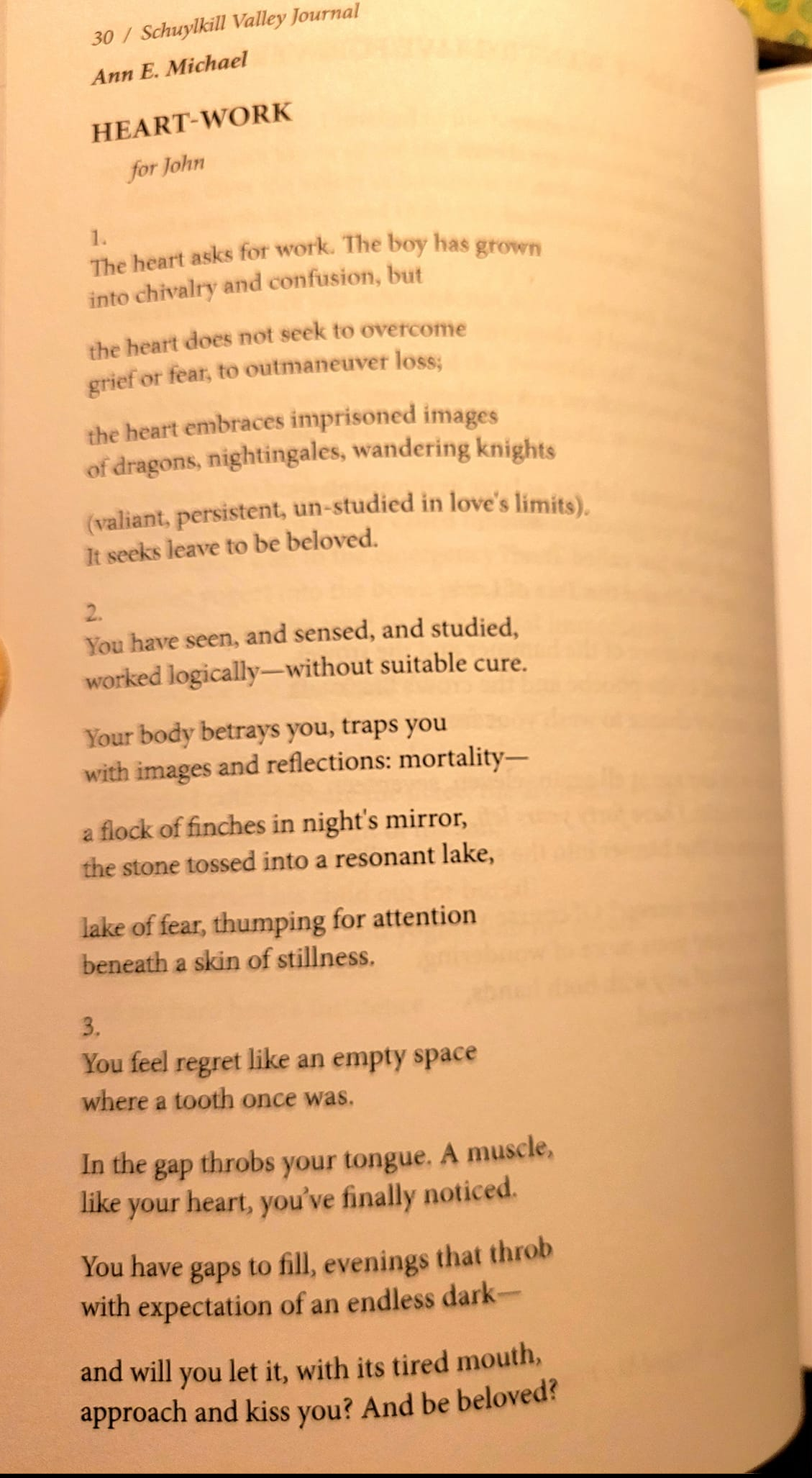
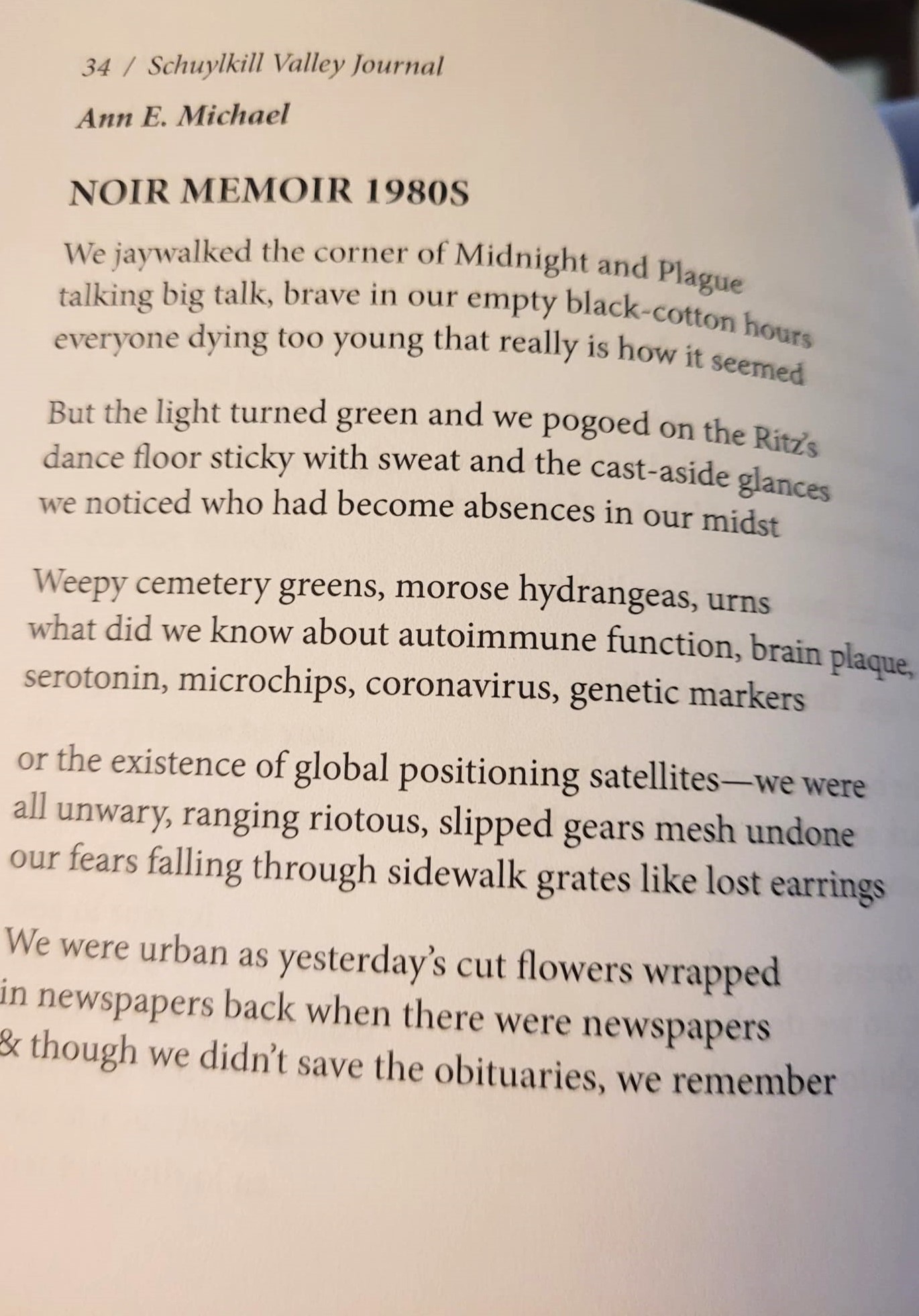
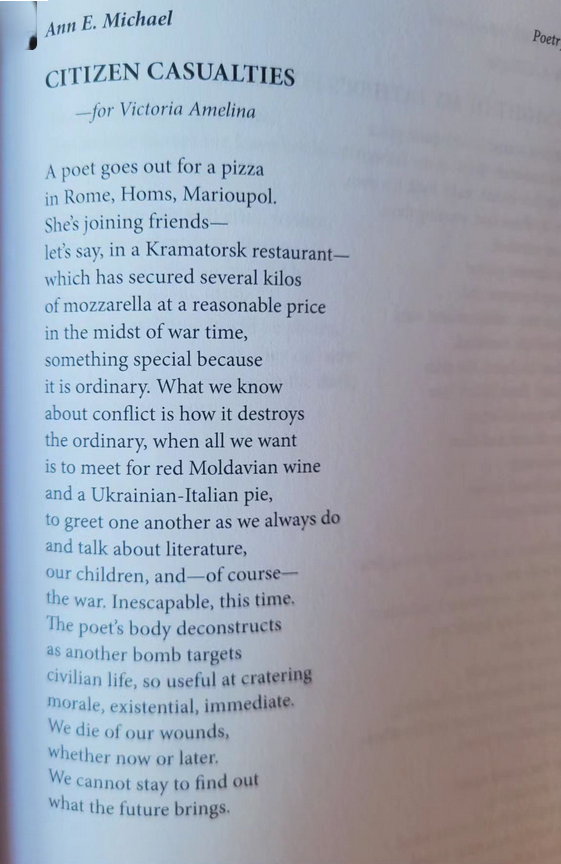
Acquired when I was much younger, and cool bookshops abounded.

And one night recently–during a much-needed rainstorm–I got a brainstorm! I realized I was trying to pack too many topics into what really should be a manuscript more closely focused on how people who love one another vary in their relationships to old age and death, and on how the contemporary social and medical aspects of the aging process pull us in uncomfortable directions, often distancing us from those relationships. So yes, there should be family poems, hospice poems, biblically-influenced poems, and dealing-with-everyday observation poems. Also some poems of hope and love, poems reminding me (and readers) of the need for compassion in all dealings. But the draft had 92 poems in it, far too many; and some were there just because I like them or they’d been published in a good journal. Which are actually not good enough reasons to include a poem in a collection, according to most of the editors I know.

I am back to thinking about the manuscript and digging up potatoes–a nice crop this year–instead of culling the poetry books because, thank goodness, the heat wave’s subsided a bit. But in the process of this non-routine summer I have allowed numerous weeds to flourish and set seed; all the more work for NEXT year’s gardening, but it’s been too hot to deal with said interlopers. I like to believe the weeds and I are reaching a sort of understanding, but it is not really a compromise. All the concessions have been on my part. [Note: weeding a personal library is less physically taxing but not really any easier.]

Speaking joy

When my children were learning to talk, I remember finding the process of language acquisition so amazing that I briefly considered going back to college to study it. I have two children about 18 months apart in age; many of my friends had babies the same time I did, so I had a range of small children to listen to and be amazed by. Each child seemed to develop their own method of learning to talk, beyond the general similarities among human beings that many scientists and linguists have studied. I wondered what made those small differences–the way parents spoke to the child or to one another? The temperaments of the children? Exposure to music or grandparents, older siblings, the radio??

I can admit that I was an exhausted young(-ish) mother, but also so intrigued. I wanted to learn as my children were learning. There was such excitement and joy–it seemed as though every new day brought further leaps in communication as my kids discovered pronunciation, verbs, adjectives, vocal stresses, and body language to convey what they were noticing, experiencing, needing, complaining about. As a lifelong learner, autodidact, and amateur researcher, I found myself reading up on language and its acquisition and history.

A few moments stay vividly in my memory. One summer day when we had a sun shower, my barely two-year-old son pointed up to the sky and announced, “Sun out. Rain coming down.”

I think of that with joy every time we get a sun shower. Over 30 years later.

~

Now, I’m trying to find the same fascination, the same learning-endeavor, with my mother’s loss of speech. I want there to be some joy or benefit in this reversal of language, something I can take away from it other than a deep sense of losing the person she was. This has meant reading books about dementia, aphasia, aging, and all the rest. It’s meant trying ways to get her attention and jog her memories when visiting her; talking with her caregivers; and reminiscing with my siblings, as well as conferring with them about her current situation as it evolves.

It’s meant finding some humor in the inevitable mix-ups that happen when communication gets woefully impaired. It has also meant finding peace, or comfort, in just sitting beside my mother in silence, holding her hand in her quiet room. She was always a fairly reflective person–capable of hilarity and chattiness, but more often keeping things to herself. Maybe revealing her thoughts some time later. Now? Who can tell. I find that I return from my visits with her feeling increasingly reflective myself, wondering where she “goes” when her attention seems to wander, wondering what she would say, if she could. I find myself wanting to research, even more than I have, information on neurology and cognition and what happens when the neural synapses that lead us to language begin to get trimmed away.

Not everyone who gets past 90 experiences such neural shut-downs in the language-generating parts of the brain; I know several folks who were, and are, quite fine with speech and thinking into their late 90s! Alas that my mom isn’t one of them. My task is to find joy in whatever her moments of being are at present while she is still physically among us. Not always an easy task, it sometimes saddens me. But joy tempers sorrow, just as sorrow so often tempers joy.

Momma. If you could only read this, or understand me when I say it: I love you.

Sweltering

I do not much care for air conditioning, and I believe it is bad for the environment; yet I admit I’m grateful for it lately, as I reside in one of the many regions of the USA that’s been enduring dangerously high temperatures for more than a week straight. I feel lucky that we’re not struggling with the heat wave–that we can shut up the windows and turn on the AC. We’re also in an earlier-than-usual drought situation though the air feels muggy and humidity has been as high as 98%.

My garden needs water every day; I generally water in the evenings because that is when the garden is in shade. The barn swallows swoop around me as I make sure the tomato and cucumber plants’ roots are getting a deep soaking. While I water, I watch for insects–fireflies, moths, dragonflies. And for bats, which have returned but aren’t as numerous as they once were. It’s pleasant for me that there are fewer mosquitoes and gnats, but I’m concerned about a drop in the number of junebugs and moths, and even (yes) mosquitoes. The heat and drought have taken a toll on all kinds of wildlife.

This morning, a pair of finches dive-bombed a squirrel that was up in the pear tree, chasing it far into the hedgerow. It may have been after the unripe pears, but squirrels also sometimes eat songbird eggs or chicks, especially when the squirrels are nursing kits or when there’s a lack of other food. The deer are so thirsty and desperate for greens that they’ve eaten every last hosta in my landscape, including the ones right up at the house foundation. They are consuming plants they have overlooked before, but I can’t blame them. Since it has been so miserable outside, I haven’t picked black raspberries this year; I’m sure the deer are happy about that. But I do wish they’d eat the poison ivy, wintercreeper, oriental bittersweet, and honeysuckle vines…that would make my landscaping tasks easier!

I’ve kept a garden journal for 30 years. If you have a garden, you don’t need to be an environmental scientist to recognize that the climate is undergoing changes. This is not a political statement but a fact. Everything right now is stressed–including the gardener! The stress enters into my consciousness and, I suppose, into my creative life. My poem drafts of the past week have been a bit on the bleak side.

Here’s a draft of one of the 7-line poems I was working on last week. Suits the weather, I guess.

~


Sweltering

A description accurate for the days past solstice
when even the wind lies sweating in a hammock
unable to rise for a brief turn around the block.
Blackbirds slow their trills, robins shelter in shade,
all the tasks we should tend to we leave undone.
Hours of lethargy seep into skin and set up house,
keeping us damp, achy, sunburned with the blues.

~


Transformation & intention

During the past few weeks, I have been reading–one at a time, with pauses–the essays in Ross Gay’s book Inciting Joy. His earlier book (The Book of Delights) was easier, a bit less complicated. About, you know, gratitude–even though he describes his father’s death in the first essay of that one. He gets to something about grieving in the 13th “Incitement” of this book, however, that made me put the text down and say to myself: This is what I have been trying to get my poems to do for some time now.

(I did pick it up again and finish reading it, by the way.)

He insists that we remember how transforming grief is. Not can be, but is. Always: “When that one thing [that we grieve] changed, everything changed. Light through the trees in October now different. The sound of the playground…cooking a meal. The future. The past. All of it changed. That is what the griever is metabolizing.” He points out this metabolizing can’t be timed, that grieving pays no attention to whether it has been a day or a year or decades: “It seems to me that grief is not gotten over, it is gotten into. And the griever teaches us, or reminds us, there is no pulling it apart. Because grieving, alert to connection, is never only one person’s experience.”

Maybe we grieve for one person, or one beloved companion animal. Maybe we grieve that our youth is over, that our children are grown, that our favorite mom & pop store has been razed to make way for a Starbucks. Or perhaps we grieve for our planet, as Greta Thunberg does: “You have stolen my dreams and my childhood with your empty words…People are suffering. People are dying. Entire ecosystems are collapsing.” There are so many reasons why we feel loss. Loss is what life offers us, loss but also transformation. I think what Gay tries to say in his recent essays is that because there is something to sorrow that we all can connect with, our grief itself can connect us, give us understanding–maybe even joy.

A complicated kind of joy. A joy that acknowledges that life can be tough and sad. And instead of reeling away from people who are clearly–and sometimes not so clearly–suffering, we could connect instead, even though we are also terrified of suffering. Maybe that is another reason I became a hospice volunteer years ago, after my dad had been in and out of the ICU frequently, even though I had spent my childhood and many of my adult years being frightened of death and dying.

Good poems offer readers that sense of connection, which Gay and others sometimes refer to as mycelial (Lesley Wheeler in her poems, Robin Wall Kimmerer in her books and Merlin Sheldrake in his, the movie “Fantastic Fungi”…among others). My favorite poems by my favorite poets, now that I think about it, have always had that effect on my heart: recognition of connectedness with other humans or with other beings, with the environment, with the past-and-future, with (thank you, Walt Whitman) the Kosmos. The recent interactions I had and connections I found at the Joya residency cemented this fundamental awareness, that all of us are part of our huge, interconnected experiences in life.

Of course, writing strong work isn’t easy, doesn’t often happen; but here’s the place in our mutual social connectivity where intentions really do matter–because the intention impels us to work, practice, and dream. The intention is to create and, through whatever we create, to extend our human network. NOT our much-ballyhooed “social networks.” Those can go to hell (and we can’t take ’em with us).

Anyway, such are my intentions for working in the world of words, of poetry. And that’s also the reason I read so much poetry, in case you were wondering.

~

https://www.smallwoodlandthings.com/ Heather Brooks, artist

Practice makes poetry

I’ve been challenging myself to write 7-line poems lately. Half-sonnets? Not necessarily. Just an exercise in writing a poem in brief. I have used haiku and tanka as brevity/image exercises in the past, and that work has been helpful. While I seldom write poems that are longer than, say, 30-35 lines, practice with conciseness never hurts, especially when my inclination is to go narrative.

I’m not knocking narrative poetry: I love it. Love reading it, love writing it–especially the lyrical narrative. In addition, I’m a big fan of the discursive and tangential in poems and essays (looking at you, Ross Gay). But one does tend to fall into familiar territory, and it’s useful to push away at what’s easy. That means, every now and again, trying something unusual: persona poem, aphorism poem, Spencerian sonnet, cadralor, surrealism, slant rhyme, golden shovel, or an invention of one’s own…something to freshen up the craft.

Many writers I know rely on prompts for imagery, language use, theme, or topic. For some reason, that sort of prompt seldom gets me really working in a new vein, though I can get a poem draft or two that way. Using a form, trying something new with how the words land on the page, is much harder to do (for me)–and therefore, more useful. I honestly want to feel as though I am working at poetry, doing the good and rewarding sort of work during which I learn new techniques and rediscover how craft can deepen meaning.

Real work takes practice. And real practice doesn’t actually lead to perfection. It leads to new explorations and revelations. There’s my wisdom-for-the-day to poets who are just starting out.

practice doesn’t make perfect…

Milling & worthiness

Probably because I have been stalled on my manuscript (see previous post), I’ve been reading blogs and speaking with friends about the whole “project” of publishing poetry books. People sure have widely varying opinions. It had occurred to me there would likely be some controversy over this even in a world as small as poetry; but I am surprised at how heated poets, and publishers, can get concerning the whys, whens, and hows of poetry collections. Whether a poet’s work is ready, for example, or–as some folks might put it–worthy of a book or chapbook, and when in one’s “career” is the time to put a book out into the world…and whether the time it takes and the costs of submitting and contest fees are worth the effort or act as a barrier to the underfunded, the less-known, and the uninitiated (or to people who just are not very good poets).

Where a writer is in her poetry (career, journey, artistic path, life, whatever) surely makes a difference in whether or when she pursues manuscript-making. Some folks suggest getting a chapbook out as soon as one has enough good poems because a chapbook looks good on a poet’s CV. Others insist it is better to wait and get work published poem-by-poem in journals and literary sites.

Some poetry publishers are more selective than others, so writers new to the process are likely to feel discouraged when they keep getting rejections from these “top tier” places. There are publishers who are less selective, but sometimes writers get warned away from having their manuscripts produced by a so-called poetry mill. “Get your books accepted and published by the best-regarded publishers,” they’re advised; a chapbook-mill press will not look as good on the CV.

But getting that manuscript accepted by the best-regarded place can take a long, long time. (Speaking from experience!!) What to do?

I’d advise poets who want to compile a manuscript to think about what the purpose of doing so is. There are more reasons than you might realize. Are you trying to get a job in a creative writing program? Are you trying to stand out in the crowd? Do you want to publish mostly for your friends and relatives? Or for yourself? Do you need publication in order to stay on the tenure track? Does your manuscript represent the creative output of a difficult time that you want to make art from and share with others? Are your poems gathered together in order to inform, to argue/convince, to entertain, to be relevant in the moment? Is your manuscript a kind of personal document, a memoir in verse and, if so, do you view it as important for other people who may relate to your experiences? How crucial is is to have the book published soon? Do you think it is important to have the book be a prizewinner?

These are just a few things to consider. Other reasons abound. And at any rate, thinking about what you want your book to be or do or accomplish should help you to decide the where and how of getting it into print. Or if that is even necessary. These days, poets can garner quite a few readers by having poems that get posted online in literary blogs, journals, social media platforms, and other sites. Do you really need, or care about, having a book? What makes the process “worth it”?

Then there’s self-publishing–which, thanks to Lulu, Amazon, Blurb, BookBaby, and similar businesses is not that hard to do–and which no longer carries quite the stigma of “vanity presses” (though if you are trying to get tenure, I’d advise against this choice). Not all of us feel up to learning the ins and outs of templates and design limits that these businesses offer. Some presses began their lives as ways to self-publish or to publish the work of a poet whose work wasn’t getting much attention; Lamont Steptoe started Whirlwind Press (now defunct) to publish Dennis Brutus‘ poetry, then started publishing his own work, then morphed the press into Whirlwind Magazine for several years. Of course, there is no promotion at all; poets have to do their own PR even with some very good presses, and self-publishing requires even more.

Photo by Pixabay on Pexels.com

Then there are the “mills” I mentioned earlier. These would be poetry publishers that, critics note, are less “discerning” than the hard-to-crack literary presses. The ones I know of are not as predatory as vanity presses and are easier to work with than the Amazon-style self-publishing route. Some of them offer promotional advice or social media activity, and some may invite their authors to participate in regional group readings. And in fact, I have had one book and a chapbook or two published by presses I’ve heard referred to as mills. I suppose the publishers might object to the characterization, but it doesn’t bother me.

My feelings on getting my books in print have evolved over the years, and I think that they should. I am no longer a young poet new to the challenge of getting my poems into magazines (they were all print when I was starting out) and thinking about whether I wanted to work in the creative writing field or not. As it turns out, while I did earn an MFA, I never really used it in the academic area where I ended up. But I attend writing conferences, engage in critique, send my work out for publication–singly and in manuscript form–which are all parts of the poet’s career (if you can call it a career).

At this point in my life, I want to make books! I love books, and I love reading poems in books and not on a screen of any kind. It doesn’t matter to me if my books win prizes (though one did!) or are published by top-tier literary presses (er, no…), or if they ever result in my earning anything from my writing (not yet…). Yes, I want my manuscripts to be worthy–by which I mean that a few readers find something of value and enjoyment in them. On balance, that seems good enough for me.

~

Considering the collection

Recently, reading through Dave Bonta’s Poetry Blog Digest, I noticed a few posts on stalling with a manuscript and subsequently clicked on those links and read what other poets have to say about it. Mmm, yeah. I understand the challenges. I have kind of stalled on my next book, too. Or shall I say, neglected my work on it. In fact, today–when I finally thought I had some time to review the draft ms–I could not find it. I had forgotten where I put the printout.

Yes, it resides on my computer. But I prefer to work with hard copy when structuring a collection. And where was the hard copy? I wasted a good half an hour seeking it but finally noticed it peeking from under a pile of other papers. This is not a sign of determined intent.

Why do I allow it to languish? There are so many possible answers to that. The poets who posted (see above) had structural concerns, other things going on in their lives, also a bit of second-guessing and self-doubting. I had eye surgery and covid, but those circumstances did not keep me from drafting new work, only kept me from putting the book together. I recognize now that these tasks involve, for me at least, very different processes, and maybe that is why I’m stalled but not “blocked.” I mean, hooray, I’m writing poems! Which is a process I enjoy, along with revising. But drafting and revising revolve around the process of an interior reflection and creative surge. I wish I could feel that way about putting this collection together, but I don’t. The manuscript-making process is lengthier, broader in scope, requires more critical analysis and a consideration (to a degree) of audience/readership that an individual poem does not. It asks questions of chronology, topic, and forms in aggregate that matter much less when working on one poem at a time.

Perhaps that means I’m not ready to put this collection together yet. Or that I have chosen the wrong theme or mix of poems, and I should reconsider the entire project.

*le sigh*

Maybe I need to take another amble around the garden to clear my head. It’s nice to have that option. It feels more like rejuvenation and less like…procrastination.

~

Back to the garden

Late spring weather, mild and pleasant; lettuce and spinach ready and quite tasty, strawberries, asparagus–all the early harvest, with mulberries ripening on the trees and tomatoes starting to blossom. I have weeding to do, and it’s a task I don’t mind when the weather cooperates. Later on in summer, when the days get humid, hot, and blazing–then I am no fan of weeding. But on perfect days in early June, weeding is one of those mindless puttering tasks I can attend to while half-daydreaming.

I’m thinking about task-oriented work and creative work as opposed to wage-based work thanks to Jenny Odell’s second book, Saving Time: Discovering a Life beyond the Clock. Weeding’s one of those forms of work one does when it is necessary–the time it takes, and the best time to do it, don’t conform to clock schedules but to environmental ‘schedules,’ which vary. Too rainy? I don’t weed. After the soil has dried a bit and the weeds are sprouting like crazy? Time to weed. Too dry and hot? Not time to weed. Yet if I were a wage-paid groundskeeper and my boss said, “Get weeding today, $14 an hour, don’t waste your time,” I would have to weed, to look busy, to keep busy. Even though it might be a poor time to accomplish that particular task.

I’m no longer on the clock, at least in terms of wage-earning, but that socially-ingrained urge to keep busy and accomplish things and meet deadlines? That’s hard to move away from. Ill with covid, I kept complaining to myself that I wasn’t accomplishing anything. By which I guess I meant housekeeping, gardening, laundry, cooking, submitting work to journals, making plans for summer events, visiting my mother, taking walks, going to the gym…but really, it’s rather strange to think of such things as accomplishments. They’re not even work, per se, just tasks. They don’t have time constraints; doing them only becomes necessary when I run out of clean clothes, or need to eat or harvest spinach before it bolts.

Odell later addresses the sort of care-giving work that can’t really be broken into wage-based tasks, though industries do try that. Nurturing children, caring for livestock, being a teacher, social worker, farmer, artist: sure, some people do wage-work for these jobs, but hourly accountability doesn’t suit such work well, tends to distort the varying needs of the moment and the fallow or less-busy times that are just as crucial to accomplishing “good work” as the more rushed times are.

An artist needs down time. So does a Certified Nursing Assistant. So do farmers and teachers. And parents!

…and gardeners. We have all winter to do less and plan more, and then we have to respond to the weather and the circumstances around us as the circumstances require. Warming trends from climate change, floods or droughts, invasive beetles, viruses, weeds. What cannot be changed must be adapted to; didn’t we learn that from Darwin? If I have a job, as far as the garden goes, it is learning to balance things so that my effects on the earth are sustainable, harming the earth’s balance as little as possible–providing for pollinators and birds and amphibians, and also for my family.

It’s a difficult task and not clock-measurable, but more rewarding than most jobs are.

~

Because I like this song, and Mitchell’s lines about being billion-year-old carbon and getting ourselves back to the garden, here she is:

~

Jewel

Joya’s curator/founder Simon Beckman requests an artist’s statement from the residents, and mine is below. Compared to many of the resident artist statements, mine seems quite brief–artists often have complex conceptual ideas to describe and rely more on images, so their statements (words!) are often lengthier. I’m a writer, but I’m a poet; concise use of words ought to be my metier.

La jolla, and la joya, mean “the jewel” but also–especially the latter spelling–refer (geologically) to a bowl-like valley. The description is both physically and metaphorically apt, and provides context for the poem below my statement.

~~

In wild places, some part of me that’s not domestic surfaces. I experience a rise in my level of awareness regarding my surroundings, an apprehension in the etymological sense of “a seizing upon, laying hold of; understanding” (Etymology Online). In canyons, caverns, riverbeds, forests—yes, in the desert, too—I respond wholly differently from the way I encounter unfamiliar human-made spaces. While at Joya-AiR, I encountered both: new environments that I’m integrating into my inner ecology. New forms of art. That process of integration, an exciting one, will continue long after my residency here has ended.

It has been such a pleasure to interact with artists whose mediums vary from my own. I was the only poet in this group, and the opportunities I’ve had to learn more about the visual arts have been amazing and useful. My first loves were sketching and painting, and although my longtime practice has been writing, imagery has ever been vital to my creative work. I thank them for their generosity of spirit. What artists can offer to one another is an aspect of themselves through their perspectives as well as their mediums and works. This kind of giving and exchange strikes me as quite personal and enriching. It is something we can do for the world, too.

The extensive work that Simon and Donna have been doing here to make the place both welcoming and ecologically sustainable impresses me and confirms my conviction that with creativity, open minds, and persistence, humans can manage to live more cooperatively with the planet and damage it less—even, perhaps, help it to heal itself.

I will keep the images of Cortijada Los Gázquez with me for a long time.

~~

Jewel

…implies what is small, exquisite, bright.
At even higher altitudes, glassy glacial pools
shine at the caldera’s ridges.
Here, the hills’ aridity offers nothing
but shallow canyons where once
a river coursed, twisting around a cavity
anchored by holm oak and Aleppo pines.
The pinsapos sway in late afternoon,
their cones studded with hardy seeds.

Almond and olive trees dot pale clay soil.
No desert is ever gentle—what survives
must be temperamentally suited to the climate—
but what’s cradled in these ancient mountains
seems gentler than most. Night’s stars,
exquisite. Evenings of ruby, amber, amethyst.
Days that define bright. And when rain descends,
however briefly: everything gleams.


[Cortijada Los Gázquez, Vélez Blanco, Spain]


Depth perception

In second grade, I could not see the blackboard from my desk. My teacher noticed; I went to the optometrist, and thereafter began my worsening nearsightedness. New specs annually for many years, broken frames, ugly frames, though–unlike many of my friends–I never lost my glasses because I could not see at all without them. Somewhere along the way, astigmatism kicked in. In high school, I blamed my ineptness at any sport involving a ball on my astigmatism (contact lenses corrected my nearsightedness but weren’t as effective on the misshapen cornea). But my ineptness was largely due to lack of interest in sports.

And now, encroaching cataract formations mean that I’m getting surgical procedures for the removal of those thickened “cascades” that make it hard to drive at night, read street signs, or discern a cat from a fox in the back meadow. I had my left eye operated on this past week, with the insertion of a medium-length lens that gives me 20/40 vision in that eye: a miracle to me after so many years of blur. I have to wait two weeks before the surgeon does the right eye, and in the meantime I’m discovering the true challenges of poor depth perception. My brain hasn’t adjusted to the changes in my eye, and simple things like walking downstairs or pouring tea into a cup pose unexpected difficulties.

Topping things off, I’ve contracted covid for the first time ever. So I am being extra careful as I walk through my house and into my yard–taking a fall due to bad depth perception would be one more problem I just don’t need.

So I have been considering vision lately, and what it means to perceive, to have differences in perspective, focus, framing. Or different cultural and social “lenses,” as we refer to them when we are teaching students to write compositions in college. It is as easy to trip oneself up metaphorically as physically if one pays no attention to such perceptions.

Today, I feel to ill to spend much time pondering. But I have enjoyed looking at the photos–taken from different vantage points and times of day–of the lovely tree on the other side of the riverbed from Joya. Very healing, as trees can be.