Reading poems

In the midst of a pandemic, we have poetry. Pragmatists ought to be listened to, and scientists as well; and poets? Let us not ignore them. It is April, National Poetry Month, and poets offer readers much in the way of reflection, consolation, compassion, entertainment, satire, humor, joy, grief, and the shared experience of being human. All things that are of use at any time, but especially when times are uncertain.


Last April, I challenged myself to write a poem a day and posted the drafts on this blog. That turned out to be a useful experience, but I feel no need to repeat it. This year, I want to post about some new(ish) books of poetry. Not critiques or book reviews, just what the poems evoke for this particular reader.

~

First up– Lynn Levin‘s The Minor Virtues, 2020, Ragged Sky Press. The cover’s appropriate to the month: a lovely image of dogwood blossoms. And I have to admit that what drew me into the book is the charming mundanity of the first few poem titles, in which the speaker is tying shoelaces or buying marked-down produce. Most of the poems in the first section begin with a gerund phrase and place the reader in a present-progressive act of doing something. The poems here feel so grounded in reality (quite a few are sonnets), often humorous–grabbing the wrong wineglass at a banquet, trying to think about nothing–that I immediately settled in to the pages.levin_tmv_cover

The topics, or the reflective closures, move toward seriousness at times; her poem “Dilaudid” shook me awake and left me in admiration for a number of reasons (some of them personal resonance–but). Levin’s humor tends to be intellectual–wordplay, allusions, wry asides–and I revel in that sort of thing. Her approach to craft also works for me, because she’s usually subtle going about form or rhyme schemes, so I enjoy the poem for what it says and means and then enjoy it again for how it’s structured and inventive.

I mean, that’s one way I read poems. There are other ways. Some books carry me pell mell through word-urgency or the writer’s rage or passion and some build lyrical intertwining networks of imagery and some make their own rules and some stagger me with their innovation. And I may have to be in the right mood to read a collection.

I was in the right mood to read Levin’s book. It was a good way to begin National Poetry Month in the midst of stay-at-home mandates, taking me gently through a “normal life” and reminding me of all that is surprising there, the riddles and the unexpected, the minor virtues and the actions we take as we practice them. Whether or not we think of them as virtues.


Miscellany

I reside in one of the Pennsylvania counties under “shelter in place” advisory, but I can work from home; also, we live on almost 7 acres, so outdoors activities continue. The buds bloom. The insects waken, goldfinches molt to their bright yellow, the magnolia tree bursts into blossom. The meadow is muddy, and vernal pools appear in the hedgerows.

Today, a miscellany of links and virtual or reading-related forays.

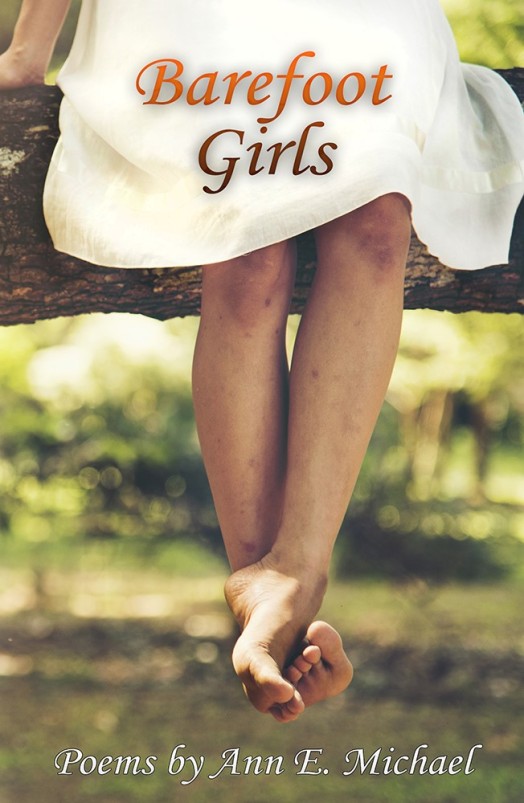
My new chapbook, Barefoot Girls, can be purchased at https://prolificpress.com/bookstore/chapbook-series-c-14/barefoot-girls-by-ann-e-michael-p-317.html

(Here I am as a barefooted teenager)

bfg

1975, New Jersey, USA

Poets House is offering live workshops (video) and has a great archive of past readings. Check them out. https://poetshouse.org/

Dave Bonta continues to compile fascinating writing-related blog posts. From his site, you can link to many other poets and writers who are pondering pandemics and etc: https://www.vianegativa.us/2020/03/poetry-blog-digest-2020-week-12/

~

Meanwhile, I am still making my way through the 910 pages of The William H. Gass Reader, a selection of some of the prolific writer-critic-novelist-philosopher’s essays and excerpts. I love his piece on the book as a container for consciousness, and I suspect I’ll be saying more about that in future.

~

Two friends have come down with the coronavirus; it’s no joke, people, take the slow-down seriously and “level the curve.” Please.

Finally, here is a photo of the wonderful hospice staff at the in-patient unit where I volunteer (though, for now–no volunteers are permitted in the hospital to assist, so these folks are doing it all themselves, bless them!).

thumbnail

❤   ❤   ❤


Memoir-ish

While we are self-isolating, how about reading books? As it happens, I have a short chapbook of poems that’s being released just in time for National Poetry Month. Here are some thoughts.

~

I enjoy reading memoirs–a well-written memoir reads like fiction or poetry, with interesting perspective and description revolving around not an entire life but one event or series of events that has a dramatic arc the way fiction does–and, often, some of the same ambiguities. Now that my chapbook on adolescent New Jersey girls in the 1970s is coming out (March 26, Prolific Press), however, I realize that readers are likely to interpret these poems as memoir. After all, I was indeed a teenager in south Jersey in the 1970s. That being the case, I might go only so far as to call these lyrical narrative poems memoir-ish.

barefoot girls cover

What people who read poems often forget is that the poem does not necessarily reflect the poet’s experience, only her interpretation, only the potential or the possible–the imagined. Poets choose personas as narrators when we endeavor to imagine other people’s insights, points of view, or experiences. Or even other beings’ or objects’ “points of view.” But of course, we can only imagine–we cannot really know anyone else’s lived experience. That gives poets and fiction writers and dramatists room to speculate, pretend, imagine: “What must it be like?”

This booklet tries to evoke various voices from a collective past but, I hope, will feel familiar to anyone who has ever been an adolescent. These poems emerged from Bruce Springsteen songs, from memories, from rumors, from attending a class reunion,  from experiences my 21st-c students had, and from my imagination. I filled in some gaps and created perspectives that would certainly not have been my own when I was a teen. And yet, any writer’s disingenuous if she claims her characters or narrators have nothing to do with her own perspective, that everything she writes is completely made up; if that were true, readers would feel left out. There would be nothing in the poem to relate to, nothing from which to derive personal meaning or insights. No “Aha!”

Any poem that can be called lyrical takes up the close point of view. Any narrative poem tells a story of some kind. An example is Patricia Smith’s book Blood Dazzler. Readers find it easy to believe that Smith resided in New Orleans, was there when Hurricane Katrina hit, because the poems are so authentic and personal–fierce, believable voices describing the devastation and its particular toll  on elderly and non-white citizens. But Smith did not live in New Orleans, and it doesn’t matter. It is an excellent and shattering work all the same.

Here’s one of Ren Powell’s posts on the unreliable narrator of our own lives. What we writers work with, often, is evoking the emotional memory, which isn’t the same as other ways humans recall events.

Yet it often fells more “true.”

~

Normality: it’s not a thing

Yesterday, I was happily puttering in the vegetable garden, prepping soil and setting up raised beds and sowing peas. We had a visitor who is 26 years old and not a gardener, so I teased her by saying, “If the Apocalypse happens, come to us–I’ll have food!”

“This is the Apocalypse,” she responded. Joking, sort of, not really. She’s anxious, and I understand. When I was between 21 and 26 years old (and living on almost no money in New York City), a virus swept through and rapidly killed some of my beautiful, talented, young friends–a virus about which medical science had no firm understanding and few ways to diagnose, screen, or treat. And no vaccine.

It was frightening. There were also the hostage crisis in Iran, gas shortages, and a rise in nationalist and fundamentalist/apocalyptic/anti-feminist rhetoric that led to a polarized presidential election and divisiveness among neighbors (all of which was partly the inspiration for Margaret Atwood‘s The Handmaid’s Tale).

Am I less frightened now? Yes. Does that make me less cautious about “social distancing” and public gatherings? No–although I would say I am perhaps less freaked out than most people I know. We went to the local diner last evening; I met a friend at a coffee shop. My workplace has asked staff to go to our offices, so I’ll be there tomorrow even though the students will not. They are finishing the semester online, as are so many other university students.

Looking back at the past couple of years, it seems we live in a time of plague and fire and politically difficult situations; but that’s the way the world has ever been. Many times have felt like end times to those enduring the uncertainties that come with changed routines and dangerous events, natural and human-created. Here we are, raking the garden, hoping there’ll be harvest.

I think of Samuel Pepys, the diarist, and the London of his life and times. Times of plague and fire. All of which makes Dave Bonta’s Samuel Pepys erasure poems project about as relevant as can be! Also of relevance, Jeannine Hall Gailey on Slate.com about love in a time of coronavirus.

When my young friend asserted that this is the Apocalypse, I wanted to assure her that, at very least, she’ll be eating some of my garden veggies this summer. To let her know that normal’s just a word we made up that, when you think about it, has a very shifty continuum for a definition. Also, I wanted to give her a hug.

But–you know–social distancing.  🙂

IMG_5601

Garden painting

The image on the right is from a book in the Metropolitan Museum of Art’s Department of Asian Art, available through its new digital collection of Japanese illustrated books. It is written in Chinese, however: Jieziyuan huazhuan; Kaishien gaden 芥子園畫傳 and is catalogued as The Mustard Seed Garden Painting Manual (3rd Chinese edition): [volume 3]. I do not read Chinese, but I think the drawing must be of quince in flower. My photo of pink quince blooms focuses on a particularly floriferous branch; in fact, the quince in my back yard is thorny, broken off in places, and often a bit scarce as to blooms–more like the drawing.

The book itself is interesting. It demonstrates and describes how to paint these shrubs. The sketches show the stems as the initial composition, with gaps where the blossoms are later to be painted. Then the blossoms get painted in, and then ragged lines of twigs and thorns to complete the painting. Since I cannot read the text, I interpret the stages from the drawings.

It occurs to me that this approach–one of guessing the stages–feels familiar. It resembles literary criticism; and it resembles the process of reading and re-reading a poem to try to determine its making, which is usually hidden since it takes place in the mind of the poet as she revises.

canvas3

note the gaps…

An analogy here: when I first write down the phrases, images, “inspiration” (if you will) for a poem, there are gaps. These lacunae appear in several forms, sometimes as spaces or blank spots in a sentence, sometimes as an unsatisfactory placeholder word, sometimes as a dash or ellipsis. These marks, or lack thereof, act as reminders to revise, rethink, resolve missing links or relationships in the poem’s developing ovum.

~

Winter makes for gaps. Skeletalizes the trees. Snowfall temporarily erases the known. Clouds cover sun and moon. Even the songs of birds, mostly absent.

As David Dunn, my long-dead friend (another emptiness), would sigh during moments that conversation became too intense or too difficult: “Anyway…”

In a temperate climate, we do need winter. The birds will return.

color birds-blooms1

~

when sap runs red
forcing budding trees into blossom
mating time

~

Cover reveal


barefoot girls cover

Coming this spring from Prolific Press.

~ ~ ~

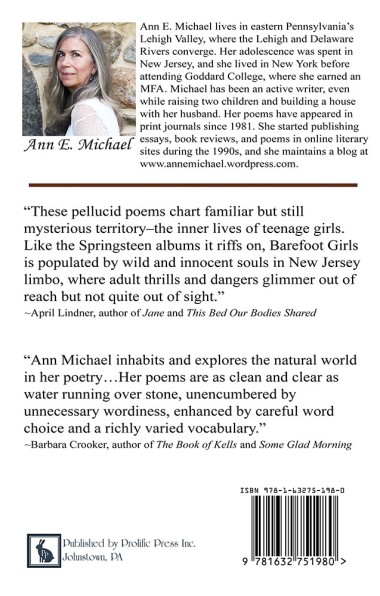
Barefoot-Girls-Cover-Back-MD-1

Observation, memory, & art

Simon Watts has died. Probably you have not heard of him. His father, Arthur Watts, was a talented illustrator for the British magazine Punch, among other publications. My readers are unlikely to be familiar with him, either. His sister, Marjorie-Ann Watts, is an illustrator, novelist, and memoir-writer in the UK. Her books are not readily available in the USA, so my readers probably do not know of her, alas. Simon’s maternal grandmother was Amy Dawson-Scott, aka “Sappho,” poet, novelist, and British literary hostess who founded English PEN. If you have not heard of her, you may have heard of PEN International, a major writers’ organization.

Oh, such interesting relations and associations!

Simon, who turned 90 a week ago, needs an elegy–but I cannot write one, at least not yet. We have been friends for 35 years; and even though he hasn’t lived nearby, we will miss his presence in our lives because he corresponded well. He sent letters, and emails with memoir documents attached, and photos. He kept up with our children even into their adulthood. He called us. We visited. He told the best stories–always mirthful and full of twists. He wrote articles on sailing, boatbuilding, furniture-making, and sent little essay-type memories to his friends and family.

He hailed from England, emigrated to the US in the 50s, and loved Nova Scotia, San Francisco, and Portugal. He has family in the US, Britain, and Australia.

~~

I was scouting about the internet looking at his work and his family’s stories and came upon his father’s article on drawing in black and white, written in 1934 about a year before Arthur’s early death (he died in an airplane accident). This section struck me as so relevant to my own understanding about both sketching and writing–good writing, poetry, journalism–is also, foremost, about observation and memory.

Speaking of memory and observation, how much I wish that I had trained mine more. How I wish I had employed that excellent method of looking at an object, going into another room to draw it, returning to refresh my memory, and so on, until that drawing was completed without it and the object ever having met, as it were. What a training for an artist interested primarily in character, who sees for a minute a face which, if he cannot draw from memory, he will never draw at all!

I believe I am right in saying that, ages before such a thing as photography was even guessed at, this was the method by which Chinese artists were taught … So developed did their powers of observation and memory become by this training that by shutting their eyes, opening them for the fraction of a second, and shutting them again, they could keep in their minds the visual image of what they saw long enough to be able to transfer that visual image to paper. It was in this manner that they were enabled to draw insects and birds in flight, and it is an indubitable fact that, when the camera was invented and ‘instantaneous’ pictures were produced, it was proved by comparison that these artists’ memorisations were perfectly accurate.

Stacks Image 61

I tried that method myself, but, having no stern master to goad me on and, alas that I should have to say it, being constitutionally lazy, dropped it; for it is the most exhausting form of study that I know.

~~

Simon Watts, the son of this artist (a man he barely remembers), inherited somehow–though expressed in an entirely different way–the recognition that we ought to note carefully and recall the world around us, revel in our memories, and share our knowledge and wonder in whatever ways we can.

He saved historic wooden sailboats by carefully measuring them, building his own versions, and reproducing his designs for others to build.

In the photo below, my daughter, at age 14, happily sails the Atlantic off the coast of Nova Scotia in the boat that graces the cover of his plans for Building the Norwegian Pram.


alice-pram 2004

Such memories fall into the category of immeasurably valuable. Right now, this photograph takes the place of any elegy I could compose. Sail on in peace, Simon!


Type


I was looking in my archive files for something I didn’t locate, and I happened upon this.

In 1981, I was a typographer; actually, I was a typographical proofreader who often stepped in when we needed another typographer (or, in a real pinch, typesetter) during rush times. This is one of the many style guide pamphlets the type designer-producers gave out to sell their fonts and as demos for set style and sizing.

When I was working in that field, I loved experimenting with the way words looked in different fonts. Sometimes I’d typeset my poems, or other people’s poems, to get a sense of how they would read on a “real” page (rather than as typewritten text; this predates word-processing and desktop publishing software). Those experiments led me and David Dunn to establish–briefly–LiMbo bar&grill books as an independent arts small press in 1982. I designed and typeset the books with help from my coworkers at various typography companies, and David did the editing.

I still love print text for the feel and look of how different printing and design choices affect the holistic environment of the page. Paper texture. Type size and choice. Gutter width. Titling. Binding, covers, front matter.

At present, I’m not yet a significant consumer of ebooks, so I can’t say whether similar design choices affect the reading experience. Surely there are differences, subtle and obvious. For the experience of reading poetry, from what I’ve seen on ebooks, I prefer print when reading poems. Technology may eventually change my point of view–I’m aware of that and open to it.

Here’s a poem from Red Queen Hypothesis (due out in 2021), designed appropriately as a bookmark by designer Ric Hanisch.

berthold005


Comfort zones redux

What do we mean by “comfort zone”? People use it frequently, especially in self-improvement and creativity-related writing. Has it become an empty phrase? It’s so subjective–which is entirely the point, I suppose. If we can manage to agree on what the idea means, we still must confront the continuum of such a zone. I reflect on my tolerance for aesthetic discomfort often, especially when I am reading or observing creative work. For example, I like listening to jazz; some jazz soothes, some excites, and some takes effort to hear–I have to be in the mood for confrontational experiments with sound such as performances by The Art Ensemble of Chicago.imagesAEC

Similarly, while I love art, I cannot imagine living with “Guernica” on the wall…or Goya’s “The Third of May.” Or anything by Francis Bacon. Some creative works are meant to push viewers out of their comfort zones; some are no doubt as uncomfortable to create as they are to view. A work of art that takes emotional and craft risks puts the artist not only at risk of critical rage or misinterpretation of intentions, but also at the very personal risk of failure.

And that effort is important, that willingness to fail. Without it, nothing invented or imagined can be achieved.

I am not a good painter, and trying to paint clouds or winter trees or landscapes means I am going to paint bad pictures. I have better gardening skills than painting skills, but I love trying a new seed or plant or cultivation method, even though the results often don’t succeed. Pushing the comfort zone has mixed but invaluable rewards.

Poems practically cry out to enter such territory. Often I find that even poems that contain in their lines and imagery moments of hope or great love and comfort simultaneously discomfit me. It fascinates me; how does the poet first compose, then revisit and revise, the poem that must surely be even more uncomfortable to write–to confront? (Search for any anthology on a difficult topic and therein will be many such poems.) Most of us prefer to avoid pain zones, so we stay within our comfort zones.

~

In Zechariah 12:2, the Lord promises terrible punishments for the enemies of Judah. Elaine Scarry approaches the conundrum of pain’s subjectivity (among other things) in The Body in Pain. I find wonder and ideas in the continuum of pain zones, in the concept of pain as punishment versus the concept that life is dukkha and inevitably contains suffering, and many other perspectives that people take concerning anything from mild emotional stress to mental illness, age-related physical problems, various forms of “disability,” and the Wong-Baker FACES pain rating scale.

Here, from WORDPEACE online, a poem of my own that I found uncomfortable to write, and which some readers have told me is uncomfortable to read. Taking the risk:

A Cup of Reeling [for the sufferers]

“Pain is…language-destroying.” Elaine Scarry

It is I am told all in my head but the body how the body loves the head
where language resides in the soft and voluble brain
and hurt undoes every synapse until sweat and stress the bullet
between clenched teeth [as if to aid?] good god deliver me
groan swear-word ululation weep and reeling, eloquence undone.
The crucible my own right leg: fire pulley strain does not allow
gravity or, god, motion, my evidence convincing to me only to me
unavailable to others [no one privy to, spare me, my—agony—
no object but destruction of objects no intention but self-obliteration]
Pain’s constructed in waiting rooms, waiting for morphine
or anything anything; I am animal in pain and sentient in my pain.
Good god who dares believe in me now that I believe in nothing?

~

depositphotos_55589581-stock-illustration-danger-crocodiles-no-swimming-sign

Ways of reading

Conversing about books with a colleague recently, I began to reflect on how readers of literature read. The topic had come up earlier in the day when several students came in for tutoring on literary-analysis papers. In addition, a student in the Education program was devising a curriculum for third-graders; the lesson focus was about “different ways of reading.” I have always loved to read, and I never spent much time considering how I go about it. It just seemed natural to me…and then I encountered academia’s approach to reading and had to reconsider the way I devoured fiction.

My coworker consumes novels the way a literature professor does. He savors passages, re-reads earlier chapters in a novel to find connections with later parts of the book, and looks up references and allusions to be sure he understands the deep context of a literary text. He asks himself questions about what he’s reading. The questions keep him reading and engaged with the words on the page.

That method is how I read poetry. But it is not how I read novels or non-fiction books; those I read at a clip, almost inhaling them, seldom stopping. I read them for pleasure, for fun–I even absorb sad novels and memoirs this way, in a mad whirl of reading enjoyment, caught up in the events and characters and setting of the book in my hands. This is not to say I never look up words, places, references, but generally I do so after I have finished the book. I guess I examine such things in retrospect.

brad-hammonds-flikr-books

brad-hammonds-flikr-books.jpeg

The downside of reading fiction using my own “natural” method is that I tend to come away from a book with a strong sense of whether it was wonderfully-written or moving or amazing, but I cannot explain why it has that effect–how the author managed to get me to  believe in the characters or the world she created with her words alone. When I am reading for fun or information, however, there isn’t any need for analytical levels of cognition. If I forget a detail, I can go back and look for it later. Or forget about it. No great loss.

There are other methods of reading–certainly more than two ways to “get into” a book! The conversation about reading strategies (what feels natural to a literature-consumer, how readers savor a good book, questioning not just the text but also the self reading the words) piques my interest. I suspect some connection with consciousness and cognition, aspects of human-ness I have mulled about in previous posts.

Well, enough for now. I am signing off–to read a good book!