A little green

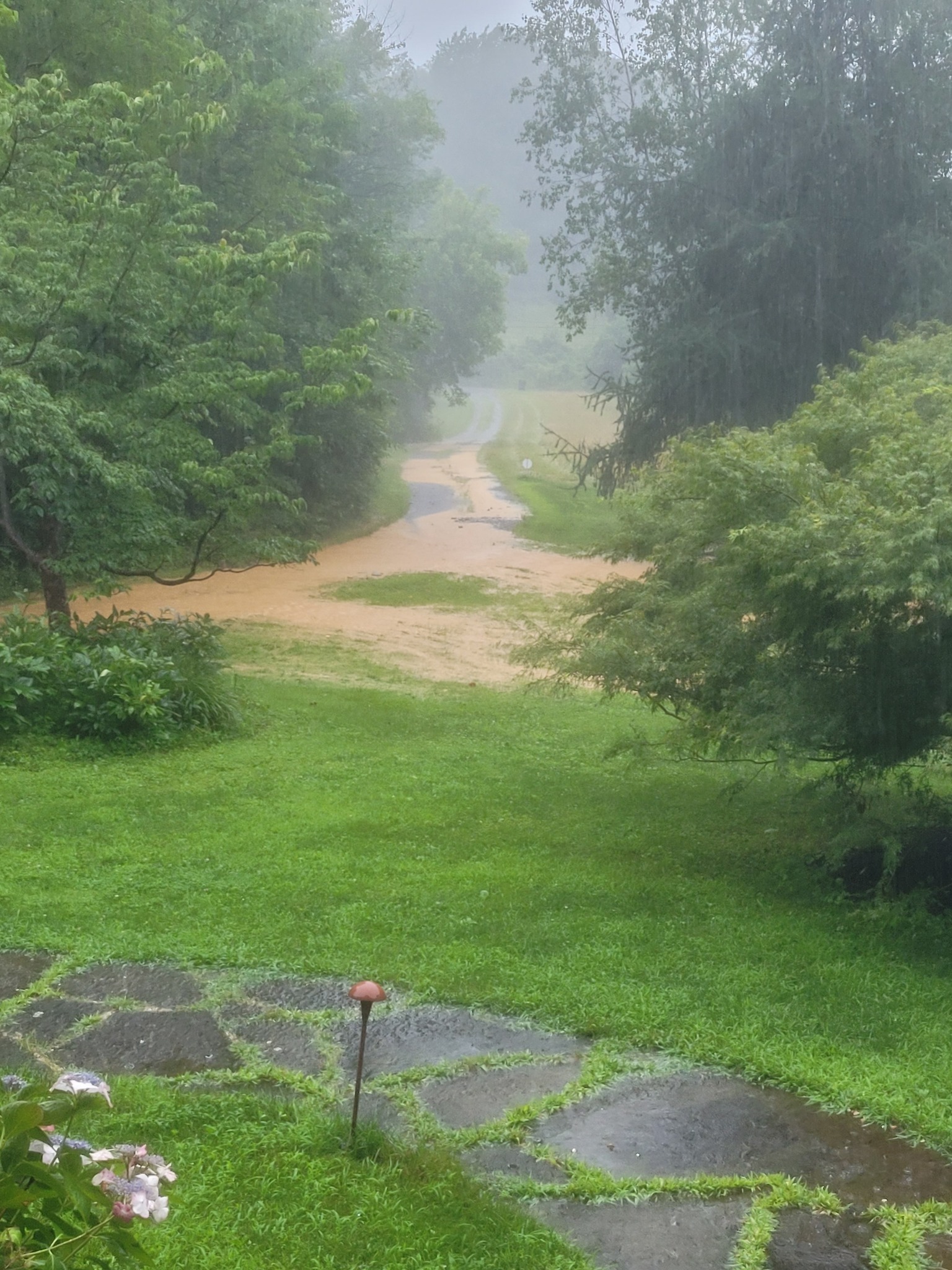
Summer arrived rather suddenly here in the valley. After a rainy May that was a bit cooler than average, June has slapped us with 80° days and sunshine. Not that I am complaining, but it does throw a curve at the vegetable garden’s usual progression.

And all that rain burgeoned into so much verdancy–my eyes almost ache from all the green! We’ve needed the rain (the wettest May on record) to make up for the driest October on record (2024). Nature appears to be doing its best with balancing things out in the face of all we humans have been doing to unbalance it.

Quite a switch from the spring greenery in the mountains of New Mexico, greens that are far less chartreuse in hue, the kind of green you have to be looking for amid the deep jades of pines and the brownish-green cholla. Prickly pears are a bright shade of green but don’t evoke any sensation of lushness. The little-leaf oaks start out with a fresh hue but become very dark, nearly black, as the season progresses.

I was thinking about the hues of the high desert because of our visit to the Georgia O’Keeffe Museum in Santa Fe. One of the galleries there is a display of the artist’s pastel chalks, brushes, and color chips she created for herself to get the palette she felt best represented the landscape she knew. Many shades of ochre, browns, dull oranges, sandy yellow, and that famous turquoise blue of the New Mexico skies–but also the green of cottonwoods in spring, the green of pinyon and ponderosa, the sage green so common among low-growing plants like sage and rabbitbrush.

Try defining the word green.

A little Joni Mitchell to accompany that request:

Back in PA

Last year at this time, I had covid and was languishing in bed, unable to tend to the garden. A regional drought meant I really should have been watering the new plants; and it also kept the weeds firmly rooted, fighting for dominance in the vegetable patch. This year, I timed a trip to New Mexico just when I ought to have been harvesting spinach and planting out tomatoes, beans, and squash. Oops. And then it rained buckets the whole time I was away (much-needed rain, but…). Therefore, the garden situation was not ideal. But garden situations seldom are ideal because Nature does its own thing regardless of my plans.

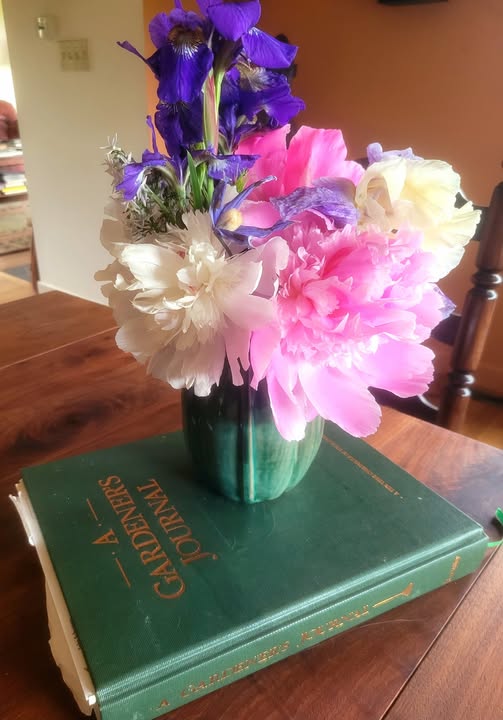
At any rate, eastern Pennsylvania finally moderated its weather enough that I got the weeds and the seeds and transplants more or less under control this past week–“control” being a general term subject to, well, Nature. The peonies bloomed gorgeously on schedule, as did the nefarious multiflora roses and Russian olives that plague the hedgerow. The catbirds and Eastern kingbirds are back; the robins’ first brood has hatched; the orioles are insistent in the walnut trees and brilliant in the garden, chasing the barn swallows. I’m not doing much writing, though I drafted one or two beginnings of poems. Outdoors takes precedence–not that I can’t write out of doors, I often do so. But poems can wait in a way the garden cannot.

And, speaking of poems (and Pennsylvania), I returned from my trip to find this Keystone Poetry anthology awaiting: https://www.psupress.org/books/titles/978-0-271-09990-3.html–the followup to 2005’s Common Wealth anthology, also edited by Marjorie Maddox and Jerry Wemple.

The new anthology, 20 years after the initial one, has poems by about 180 poets–yes, I am one of them–covering the corners and the center of the Keystone State. I like it even better than the first collection, and it is clear the editors learned much from the experience of curating poems and creating a cohesive “experience” of the regions. Granted, since I know both of the editors personally and appreciate their poetry and their visions, I may be biased. But that’s okay. Objectively, I truly get how huge an undertaking this was and how well it has turned out. For educators, there is a section at the close of the anthology full of suggestions for reading, writing critically, and writing creatively based on this anthology, and even in comparison with the previous one. As both editors are college professors who teach creative writing and critical writing, these appendices are well-thought out and worthwhile.

I miss the aridity of New Mexico, which seems to benefit my overall health. And I miss my daughter immensely. But springtime in eastern PA has many compensations, not the least of which are blooming even as I write.

Not a brisk pace

Recently, a physician I see (for fibromyalgia and related conditions) suggested that I need to walk more often because “walking is the best exercise for you and will give you more energy in the long run.” The advice surprised me a little; I love to walk and, except when the weather is very cold or super wet, I walk most days. It turns out that what she meant is that I should be walking for 40 minutes or so “at a brisk pace.” When I asked her to define what she considered a brisk pace, she said two or three miles an hour.

This poses a slight problem for me because while I am happy to walk around my yard, woods, and neighborhood for 30-40 minutes almost daily, I can’t say I do it at a brisk pace. I get distracted and stop to look at things. Bugs. Worms. Toads. Birds. Flowers. New leaves. Nests. Spiderwebs…I loaf along, as Whitman claimed to do. Some days I start out with good intentions to keep up a lively pace, maybe even to the point where I can feel my heart rate going up. And then–was that a redtail hawk overhead? Did I hear an ovenbird? Oooh, the Solomon’s-seal is in bloom!

Today–the walk was very wet, as we’ve just had about 3″ of rain–musing on my not-exactly-exercise ambulations, I thought of this Mary Oliver poem.

Walking to Oak-Head Pond and Thinking of the Ponds I Will Visit in the Next Days and Weeks

by Mary Oliver

What is so utterly invisible
as tomorrow?
Not love,
not the wind,
not the inside of a stone.
Not anything.
And yet, how often I’m fooled–
I’m wading along
in the sunlight–
and I’m sure I can see the fields and the ponds shining
days ahead–
I can see the light spilling
like a shower of meteors
into next week’s trees,
and I plan to be there soon–
and, so far, I am
just that lucky,
my legs splashing
over the edge of darkness,
my heart on fire.
I don’t know where
such certainty comes from–
the brave flesh
or the theater of the mind–
but if I had to guess
I would say that only
what the soul is supposed to be
could send us forth
with such cheer
as even the leaf must wear
as it unfurls
its fragrant body, and shines
against the hard possibility of stoppage–
which, day after day,
before such brisk, corpuscular belief,
shudders, and gives way.

~

At my place, it’s feeder creeks I hear and think I may visit, not ponds, but I identify with the mood of this poem. Walks offer me that joy, that unfurling of leaves, ferns, everything…time to reflect and feel gratitude. If I don’t do quite as well by my heart and muscles as I ought to, maybe my psyche or soul will compensate. If I loaf, it’s a purposeful, sweet loafing, the kind of activity that poets tend to do; it gives me energy of a non-physical sort. (And I think Mr. Whitman would concur.)

Walt Whitman in mid-life, probably a bit younger than I am now.

Changes & alterations

We built our house here about three decades ago. At the time, I was young and excited about landscaping the place; although I had been growing our own vegetables for years by then, I was fairly new to ornamental gardening. I made mistakes; I underestimated the speed at which shrubs and trees grow; I thought I could keep a handle on invasive species; the world of various bark beetles and aggressive vines was new to me; and I had no idea how hard it would be to manage almost seven acres without, say, a team of landscapers.

Or how rapidly an environment alters when the climate changes, and when cornfields and early-growth wooded areas become housing developments, parking lots, and streets. I have learned a great deal and much looks different now than thirty years ago, but the swallows still return to my garden between April 26 and May 6. My land contains fewer efts in May than it used to, but the gray frogs, spring peepers, wood frogs, and toads make their usual frenzied chorus at mating time each spring.

~

Recent changes have come from the emerald ash borer, which has decimated, or worse, the green ash native to this valley. The huge trees have come crashing down during the past 10 years, making hard work for us even if it does provide a bit of firewood. Cutting, splitting, stacking hardwood isn’t a task I’m much good at anymore. Thirty years ago, maybe…and there does not seem to be any good that comes of this tree loss, which I’ve been mourning each year as we have less and less of a woodlot treeline above the hedgerow and see more and more of the neighboring subdivision.

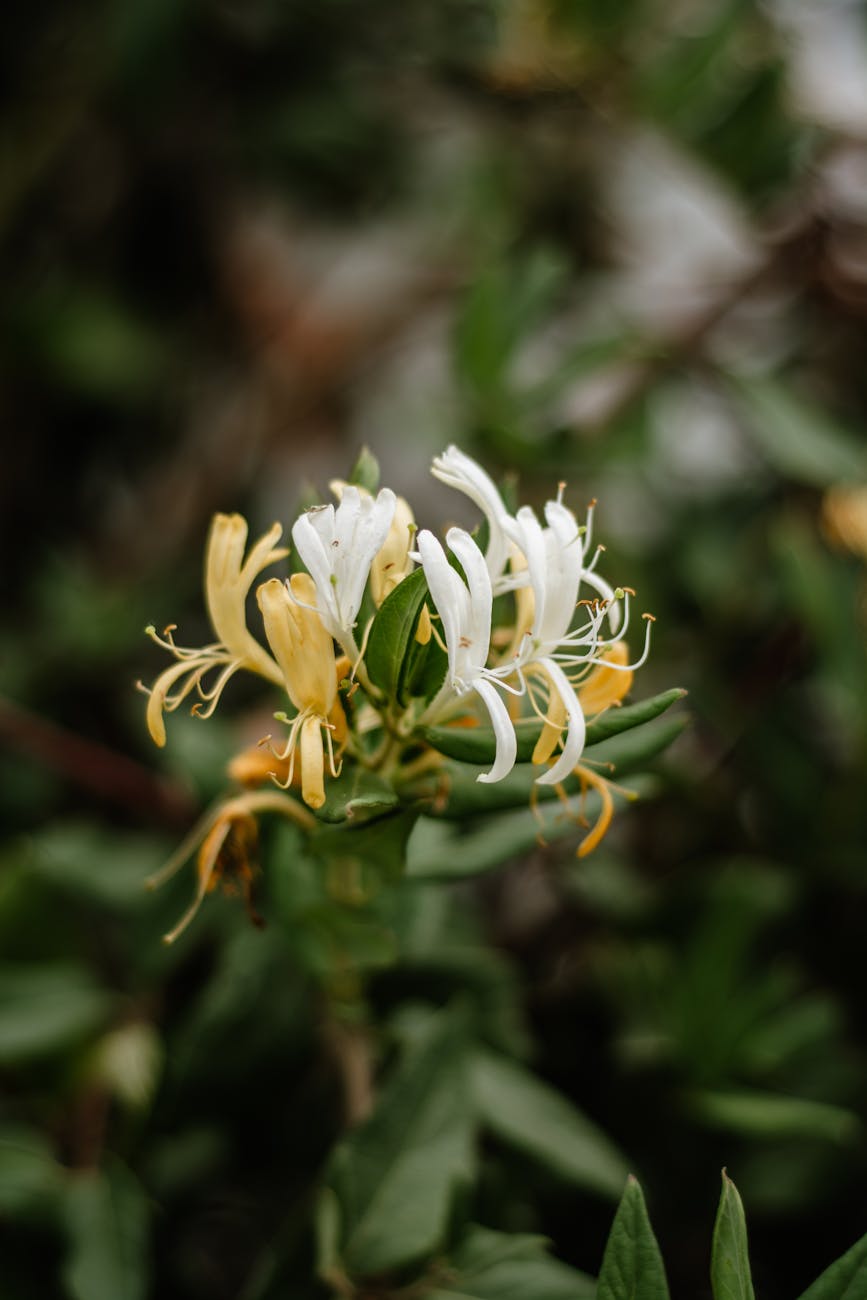
But on my damp, early-morning walk today, I perceived some changes that I should have expected and that offer a glimmer of hope for native trees and shrubs–despite the proliferation of Russian olive, multiflora rose, Amur honeysuckle, mugwort, wintercreeper, Asiatic bittersweet, mile-a-minute weed, and more colonizing invaders than I can tick off in one blog post. There, beside the tractor path, along the edges of the hedgerow (for edges are where things happen most quickly), I observed more tree saplings than in past years. With the vase-shaped, leafy arcs of green ash absent, sun reaches further through the thickets. And there I spot horse chestnuts starting to push up, tiny walnut trees, oak trees of differing species, “baby” hickories and maple varieties, along with understory’s smaller shrubs and trees like amelanchier, ironwood, redbud, buckeyes.

Granted, most of them won’t survive to maturity, but some of them will–gradually re-making the woodlot unless other disturbances undo the renewal.

I won’t be here in another 30 years to find out, but I find hope in these saplings. I’m also happy to see that the little woodland and field wildflowers such as false Solomon’s seal, jack-in-the-pulpit, wild violets, and mayapples remain. And though I find myself swearing inwardly at the way the Russian olives grow massive along the property line and the invasive bittersweet sends thick tendrils coiling up into the trees, it’s not the fault of the plants that they got here. Humans brought them to North America, and the plants–like European colonists–became a bit too successful in their new homes, pushing out what was here before their arrival. Am I any different, really, than the dandelion or the honeybee? My ancestors came to these shores not so long after those species were imported with earlier “settlers.”

~

The rain we’ve been getting means I haven’t been out weeding in the vegetable garden. After I take my walks, I come inside to dry off and do household chores, or make soup, or work a little on my poetry. I feel excited by a little writing project I have recently given myself, and I’ve also been playing around with drafting prose poems. Next week, I head to the high desert again for further inspiration and a chance to travel with a good friend, visit museums, and spend some time with my daughter. When I return in mid-May, the gardens, the meadow, and the woods will already be much changed.

Correspondences

Dear Beejay,

Remember how we used to correspond by email every week? Sometimes more often. You, the best correspondent ever, though we never wrote paper letters–in those pre-internet years, we’d lost touch, moved too often; no postal mail from you until, once we were connected again, you sent me a birthday card. And tomorrow is your birthday. So here’s your birthday email. You see? I didn’t forget.

It remains dry here. That spate of rainy days in early April? Over with and barely a half an inch since then. I’m watering my veg garden daily. Today I sowed another row of spinach. The first and third sowings are doing well, but the second sowing didn’t germinate–can’t figure out why not. The lettuces and other greens are looking good, and the strawberry plants are in bloom. I even took a chance and planted some zucchini seeds. The task of thinning lettuce and carrots is indeed tedious, but it is a lovely day and the air is mild; and frankly, thinning carrots is less tedious than sending poems out to literary journals, I know you’d agree.

I’ve been reading a lot of contemporary poetry. It comforts me somehow, even when the poems are sad or angry poems (that seems to reflect the times, which poetry can do). Your own writing, who has it? Does it exist on some hard drive somewhere? You always were excellent at organizing things. A talent I envy and do not possess.

Anyway, I did a bit of weeding to prep for the tomatoes and peppers when the seedlings are ready to transplant, but I got a late start on them and may not even move them to the garden until after my trip to New Mexico. Right now we’re getting pollen blow here. I expect your pollen blow was over two or three weeks ago, and that the azaleas are past their showy bloom time down there. I know how you love azalea season. And the beach–I guess you won’t get there this year.

I do find myself, at odd moments, wondering about your cats. When our lives were routine and there was nothing of interest to write about, we could always turn to cat anecdotes. Today, my Nessie joined me in the garden while I was working on the carrot patch. The catnip plant in the herb bed has leafed out quite early, and Nessie stretched his whole lean body over it and lolled himself into a snooze-fest, exposing his white belly. You would have laughed. You always called tuxedo cats “Holsteins.” I’m insulted on Nessie’s behalf.

When a person we love dies, I guess there’s an impulse–almost an instinct–to memorialize them, at least among those of us in “Western societies.” Or maybe it is a human impulse, I can’t say. I have written too many poems of elegy, and there will be more; but sometimes, it takes awhile before I feel I have the right perspective or frame of mind to write about them, or about my feelings of loss. Today, so much reminded me of you, Beejay, that I had to write something. If not a poem, then an epistle–the way I used to write to you, of ordinary things, the garden, cats, seasons, poetry.

Happy birthday, wherever you are.

Riches

The past week gave me riches galore; though I am somewhat poorer in the pocket for it, my cup runneth over in about every other way. It’s true that often, lately, I’ve felt that I am living in “interesting times” that are all too much and too awful to contemplate for long. Then again, I could have been alive (possibly quite briefly!) during Boccaccio’s time and weathering the bubonic plague. Thanks to The Decameron, readers later in history have been able to get a picture of what people were thinking about and imagining–or trying to escape–when things were truly terrible all around. And while I’m not pollyanna-ish about the present, I do feel grateful that I live during an era when travel to distant places is possible and rather speedy, that books are readily available, and that some of the wealthy people of the not-too-distant past decided that philanthropy included funding libraries, gardens, and museums for the average citizen to visit and enjoy. Current billionaires, please take note!

What the week entailed was a trip to Los Angeles to visit my eldest child and, while there, to spend a morning at the AWP conference book fair. Riches indeed! I “packed light” to be sure I had space in my carry-on for poetry books, which thankfully tend to be slim paperback volumes. I bought almost 20 books, I confess. So I came home weighted with literary riches, and while at the convention managed to connect (however briefly) with numerous poet colleagues. A shout-out here to Lesley Wheeler, whose book I had to purchase online because Mycocosmic had sold out! Congratulations, and I cannot wait to read it.

My days in LA were limited to four, but my son had curated a things-Mom-would-like-to-do list that included Mom’s necessary down time. It’s terrific to have offspring who are now old enough to respect my limits. [They have not always been so accommodating.]

The list included several lovely meals out, a full day at Huntington Gardens and Library, a day trip up to Santa Barbara, a visit to LACMA to get an “art fix” for me and for my son’s best beloved, who loves art and architecture, and a visit to the amazing Museum of Jurassic Technology which, as far as I am concerned, is basically a series of amazing poetry prompts. I cannot possibly explain it; and the museum’s website is purposely a bit obscure and limited, compared to the immersive experience of going to the place in person. I am still thinking about it and will be for weeks.

The barrel cacti at Huntington

While photo ops abound at the gardens, no photos are permitted in the Museum of Jurassic Technology; I will lead you to the website and just keep you guessing. But among the riches of the last week are germs of new poem drafts. We shall see what emerges.

Four+ days away, and I returned to spring in eastern PA: narcissus, magnolias, glory-of-the-snow, squill, bloodroot, forsythia, ornamental plum. Even more richness. Gratitude for the glory.

Mid-March

Tulip poplars begin to plump out their winter bud scales, where they will leaf out later in spring.

A marsh hawk zips overhead, winging above the treeline and vanishing over the northern hill.

Early ornamentals bloom: crocus, snowdrop, aconite, i. reticulata.

Red-winged blackbirds make the mornings noisy–they have so many different songs and calls that three or four of them sound like multitudes, almost drowning out our year-round singers, the song sparrows. Early migrant passerines have returned, but it’s still winter here. Some bugs have gotten active and are emerging from hibernation or incubation. No bees as yet. When I turn over rotting logs, I find amphibians’ eggs and lots of different varieties of soil centipedes.

And, of course, worms. March’s moon is sometimes called the Worm Moon, and tonight there’s a total lunar eclipse around midnight here in PA. Is that auspicious? It’s also when I will be reading at the Lambertville Free Public Library in Lambertville, NJ. I’m excited to participate in an on-site, in-person reading again…I’ve been hibernating a bit from poetry events, but it is time to get stirring.

At the end of the month, I’m packing up for a brief trip to Los Angeles, where I will be attending one day only of the annual AWP Conference (Saturday’s Book Fair!) and spending the rest of the visit with my son. The conference always offers a terrific infusion of writerly companionship, community, and inspiration. Whereas time with my son offers love, cool places to see and eat and hike, a host of things I didn’t know I wanted to learn, and many moments of hilarity and conversation. It’s hard that he’s so far away–hard for me; I don’t think he minds, he is busy and having fun, which is as it should be.

Also, yes, the whole situation here in the USA is something I never could have imagined as a younger person, when I somehow had an unquestioning faith the US Constitution could actually be workable as an enduring rule of law. That careless people who value money over community could indeed disrupt that 1787 document was always a possibility (the moneyed property owners and slaveholders had their way with the original, after all), but most of us didn’t see this coming–naive, I suppose. Busy with our own concerns. I get it, and maybe we deserve what’s coming, but [ugh]. A concerned European friend recently asked me how I was faring under the stress of these first three months, and I told him that since making art (poetry) has generally been an unconventional act/behavior/response even under the patronage system, my response is to keep making art. Granted, it isn’t much, nothing earth-shattering, not gonna change society that way; but it keeps us observant little non-conformers on our toes, creative, and flourishing in the face of weirdness and oppression.

Which is something we can do. Like early bloomers in the cold days of late winter.

winter witch hazel blooming in snow

Breathe

2024 closed with “thundersnow” in my neck of the woods, a weather phenomenon that I find rather thrilling in its strangeness. And the year commenced with the conflagrations in California, not to mention everything else that goes on daily in the cosmos. Oh, the difficulties of life in interesting times.

Photo by Sabian Symbols on Pexels.com

It so happens that I had made plans, and purchased plane tickets, to visit my son in Los Angeles during the week that AWP is holding its annual conference there, in March–that is, assuming the situation in Los Angeles County doesn’t get even worse and assuming his apartment building survives the fires; it hasn’t been easy to keep myself from doom-scrolling and watching updated fire maps. I remind myself that there is not a thing I can do beyond sending money to charities and such, perhaps, and waiting for the winds to change, and that making myself stressed will actually do harm. But I am not one of those Pollyanna types (now termed a “toxic positivity” person, I have recently learned). I’m aware that the world can be hard, and that we may suffer. So, as my yoga and tai chi instructors would tell me:

Breathe.

There’s no point in trying to decide whether this start to the year is auspicious or inauspicious, though if I’m going to go with signs and auguries, I might choose to follow the Chinese year and move my year’s start to January 29, Year of the Wood Snake–and get all this awful stuff (including January 20th) packed into LAST year.

As I noted in my year-end post, a year’s end–or beginning–is arbitrary.

~

As for writing-related resolutions, I make them all the time, not just at the beginning of the year. But in that one respect, the first dozen days of January are going surprisingly well. I’ve been spending more time on revising older–sometimes much older–work, and I have been drafting some new poems. I even submitted just a few things to lit journals and have been making minor progress in the monumental task of culling and organizing my writing files.

Best of all, I enrolled in an online poetry workshop with Anita Skeen through the Friends of Theodore Roethke Foundation, which starts this week. And I registered for an art class in February, so my plans to focus more on my creative work post-retirement are proceeding more or less apace. We balance fear and misery with art.

~

Cloud sketch in acrylics

Year-end with raven

Last day of the year. Though when the year ends or begins is an arbitrary thing, calendars being a human invention so far as we know, this is my culture’s end date for the approximately 365-day cycle Earth makes around the sun–so I may as well stick with it. Here’s what the close of the year has brought me so far:

A sunny and mild morning post-frost, not uncommon at this time of year.

A Cooper’s hawk calling, hassling the songbirds, as they do. This one’s been hanging about our yard for a week now, sometimes perching right next to the leafless shrubs–it is amazing to watch how they can maneuver through the branches to grab at a finch or sparrow. A lithe and handsome raptor.

A solo Northern mockingbird, boldly eying me as I stood watching it (six feet away) while it gobbled up oriental bittersweet berries.

This surprised-looking tree, framed by horizontal branches–

Mutual disturbance among me and the mourning doves huddled on the ground amid the hedgerow’s vines and leaf-rot. Their sudden flurry startled me as much as I startled them.

Walking along with my Merlin Bird App turned to “sound identification,” I expected to hear the usual characters this time of year: finches, song sparrow, field sparrow, mourning doves, bluejays, crows, starlings, nuthatches, chickadees. Then I heard what sounded like…a raven? Indeed! The app noted “Common Raven,” with the little icon that indicates the bird is a vagrant or may be misidentified. I watched it fly north, over the house. Solo, (whereas early in my walk there was an entire “murder” of crows and they tend to hang about in groups this time of year). This bird was also very large, but too far off to see its beak or the color of its eyes. However, it sounded exactly like the third call recording here. I’m gonna call it a raven.

I found some collages the environment made on its own, much more lively and well-composed than any collage I might try to make.

~

The inner environment today has been focused on yet more revision. I much prefer it to sending poems to journals. It’s playful and creative, if occasionally irritating when a poem refuses my attempted improvements. At present I’m wrestling with a sonnet. Not a bad way to end the year, I reckon.

Chastened & learning

The temperature got wintry this past week, and now I feel inclined to make chili or giambatta, or savory stews with ingredients such as butternut squash, potatoes, beets, eggplant, cannellini beans. Or polenta, maybe–anything that takes awhile to cook, sending up steam and warming the kitchen so it feels toasty when I come in from a walk. I admit to being a wimp about walking in cold weather. I do it; I know walking in any weather is good for me and I bundle up, but my walks are decidedly shorter. Even on sunny days.

Today was not a sunny day.

And to my dismay, the downy woodpeckers are back again, hammering at the wood on our house. The one on the left banged into a window, but generally they cling to the boards. I wish they would drill at the many dead trees along our property line; they’d have more luck, too, if they’re seeking food. By the way, this photo is 10 years old. Now I would know not to handle a wild bird with bare hands because the oils on human skin are not good for feathers. (Three decades of educating myself about my own environment have chastened me–there’s so much I don’t know.)

I also don’t know which of my own poems are any good, or which ones to send to which journals, or whether I should care. It’s oddly heartening–and honestly, NOT schadenfreude! (because I get no pleasure from it, merely a sense of community)–to read in my colleagues’ social media posts that “rejection season” is here. I am not the only one whose poems have returned lately. Lesley Wheeler writes: “Magazine rejections have been trickling in, too, although mostly the please-try-us-again kind, and I know enough about editing now to really appreciate those.” I have had a number of those, too. And I’ve been an editor, so I get it, and I am appreciative. But I am mystified nonetheless–after 40 years, why am I so clueless at this sort of critical analysis? When I sit myself down to submit poems, I tend to find all my work lousy or, looking at the poems I think may be good, realize I lack any idea of where to send them–even though I am a frequent and avid reader of online and print literary journals. You’d think I’d have gleaned something about poetry the way I have learned about my geological region, its seasons, critters, viruses, predators, bloom times, pruning times, sowing/planting times and such.

Equally chastened by poetry’s landscape, I guess!