Bow, lyre, poetics

books~~

I’m reading a collection of essays by Octavio Paz (Mexican poet, 1914-1998), The Bow and the Lyre (published in Spanish in 1956 and translated from the 1967 2nd edition by Ruth Simms).

[I like this photo of him but have not yet tracked down the year and the photographer. I’ll try to do that soon for permissions reasons.]

Paz is so quotable. He’s full of marvelous little aphoristic-sounding phrases such as:

“Poetry reveals this world; it creates another. Bread of the chosen; accursed food. It isolates; it unites.” The first chapter of the book begins with these phrases and images, almost biblical in their parallel rhetorical structure and intentionally paradoxical.

“Obedience to rules; creation of others. Imitation of the ancients, copy of the real, copy of a copy of the Idea. Madness, ecstasy, logos.” Here, he moves to triads… “play, work, ascetic activity…vision, music, symbol.”

Then he moves on to style, metricity, historical antecedents, art. “The unrepeatable and unique nature of the poem is shared by other works: paintings, sculptures, sonatas, dances, monuments. To all can be applied the distinction between poem and utensil, style and creation…the diversity of the arts does not hinder but rather emphasizes their diversity.”

The first chapter is philosophical, a kind of poetics taking a vast history as context and individuality as scope. I might have quibbles with some of his assertions; I might find his metaphors and analogies a bit too facile. But I do find the writing juicy and thought-provoking.

~

A fine essay, I must say, is Paz’s fourth chapter on verse and prose. I could read this text over a few times, I could use it to begin a second master’s thesis or to help me teach an advanced class on poetry. Marvelous work! I especially appreciate his insights into the necessity and diversity of rhythm as culturally/linguistically based. And, as a writer from the USA, I love his thinking about the Americas and Europe, our language precedents and influences, and how Paz interprets their differences. What a terrific, brief but clear, exploration into Eliot and Pound! Into Mallarmé an Baudelaire and Poe and the German Romantics, into Joyce and Neruda and Lorca, and the difference between Spanish-speaking poets of the Americas and those of Spain. What a creative inquiry into the development of free verse in three or four different cultures and eras!

I learned a good deal. More later, I suppose.

Too difficult?

Another difficult book, Poetry, Language, Thought by Heidegger offered me less insight than I’d hoped and irritated me more than other philosophical readings I’ve been perusing lately. I do see a link between Heidegger and Merleau-Ponty, Bachelard, etc.; these essays also connect to linguistic and semiotic philosophies. In the semiotic-etymological vein, however, I much prefer Umberto Eco‘s writing.

Of the essays in Poetry, Language, Thought, my favorites are “The Thinker as Poet,” “Building Dwelling Thinking,” and “The Origin of the Work of Art,” although that last one is problematic in a number of ways. Heidegger uses etymology, history, and his own concept of the fourfold making  up the onefoldedness of being (crucial to his philosophical cosmos but unconvincing to me) to question being and origin. The problem, always, is language. How to express the inexpressible? How can we use words to communicate when we cannot even reasonably define them–there’s no staying-in-place with words. Wittgenstein proves that even so simple a word as “game” has no single, stable definition that can serve as a premise for a logical assertion–yet, he notes, we do not need a definition in order to use the word. [For a ‘cave-man’s explanation’ of this topic, see the section called “Meaning and Definition” in this Wiki article: philosophical investigations.]

Dwelling: a light-house

Dwelling: a light-house

As a poet, I work with words, so these ideas interest me. Heidegger hasn’t helped much, though his discussion of what it means to “dwell in” will stay with me, resonating a bit with Arne Naess’ writing. I also found helpful his assertion that the best meaning for the word truth is unconcealedness. I like the idea that Truth, that vague abstract Big Concept we invoke so often as pursuit or justification, is always and ever present–but that we must un-conceal it, a slight variance in connotation from the usually-cited revealing of truth.

~

Some Heidegger quotes of note:

“Truth is at work in the work [of art]”

“Art…is the becoming and happening of truth. All art is essentially poetry” –because, “poetry is the saying of the unconcealedness of what is.”

~

So onto what irritated me. Among other things, most of all the essay “What Are Poets For?” The discussion stems from a famous line of Hölderlin‘s: “…and what are poets for in a destitute time?” Heidegger proceeds to use this famous inquiry to examine a lesser known poem by Ranier Maria Rilke–in the sort of philosophical critical analysis that drives me bonkers. Granted, this is a personal bias of mine and I won’t go into a rant upon it in this post. But, if you have read Nabokov’s novel Pale Fire, you’ll have some idea of what I mean by interpretation for one’s own purposes. This essay could almost have been Nabokov’s inspiration.

Maybe it’s me, and Heidegger is just too brilliant for my limited depth in philosophy and art. But I am pleased to be leaving him behind now and am already enthusiastic about the lectures and essays in Octavio Paz’s The Bow and the Lyre.

I suppose I ought to stick with poets who philosophize about poetry.

Hail and Heidegger

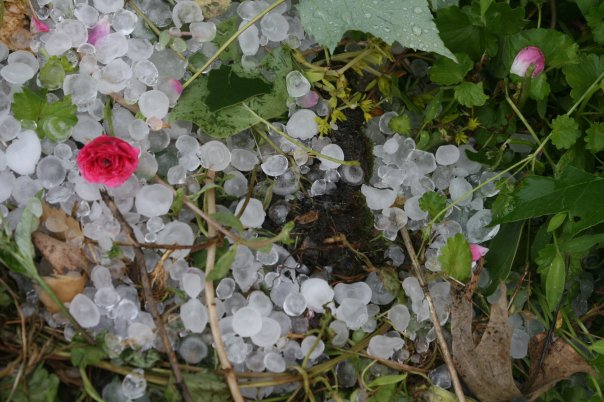
hail and roses

Another freakish, brief summer storm swept through–this time bringing wind, fog, downpours, and hail. Not a gardener’s favorite weather system under any circumstances. Some years ago, a June 9 hailstorm literally decimated (reduced by 10%…though I think it was more like 25%) my gardens and produced the mammatus cloudforms that show up on my “About” page. Yesterday’s hailstorm was–thankfully–not as damaging. Most of the plants will recover fairly rapidly, I think.

~

Meanwhile, I’m trying to educate myself a bit more on the history of phenomenology as it relates to poetry, art, and poetics by reading a bit of Martin Heidegger. This is a backwards chronology, but I’m not feeling ready to take up Husserl yet. Heidegger’s also problematic because of his early embrace of the Nazi party (he resigned early, too, in 1938, but never made a full repudiation). I understand that great thinkers can nonetheless be very flawed human beings. Michael Wheeler’s thorough essay in the Stanford Encyclopedia of Philosophy touches on some of the contradictions and covers Heidegger’s major work. But I am reading Hofstadter’s translation of “Poetry, Language, Thought” and six other shorter essays, such as “What Are Poets For?” and “The Origin of a Work of Art.” Actually, it is hard to consider the first text as an essay. It’s more like a poem in aphorisms. An excerpt:

~

When through a rent in the rain-clouded
sky a ray of sun suddenly glides
over the gloom of the meadows .  .  .  .

We never come to thoughts. They come
to us.

That is the proper hour of discourse.

Discourse cheers us to companionable
reflection. Such reflection neither
parades polemical opinions nor does it
tolerate complaisant agreement. The sail
of thinking keeps trimmed hard to the
wind of the matter.

From such companionship a few perhaps
may rise to be journeymen in the
craft of thinking. So that one of them,
unforeseen, may become a master.

~

Almost Confucian, no?

~

Later in his life, Heidegger moved on from his earlier philosophizing on the ontology of being (he pointed out the need to define “exist” as a premise in any such inquiry) and began to suggest that art exists within the materials/tools of the artist as well as within the artist’s being and abilities, all in a perhaps simultaneous collection of conditions. Wheeler says, “poiesis is to be understood as a process of gathering together and fashioning natural materials in such a way that the human project in which they figure is in a deep harmony with, indeed reveals—or as Heidegger sometimes says when discussing poiesis, brings forth—the essence of those materials and any natural environment in which they are set.”

Heidegger writes, for example, that “a true cabinetmaker…makes himself answer and respond above all to the different kinds of wood and to the shapes slumbering within wood—to wood as it enters into man’s dwelling with all the hidden riches of its essence. In fact, this relatedness to wood is what maintains the whole craft. Without that relatedness, the craft will never be anything but empty busywork…” Wheeler calls this manifestation of the art within the materials (which the artist must understand in order to use her talents and tools to bring forth) a “process of revealing.” Kin, I suppose, to the words often attributed to Michelangelo: I saw the angel in the marble and carved until I set him free.

~

Art, gardens, weather, poetry, the craft of thinking…all processes of revealing and transformation. “We never come to thoughts. They come to us.”ann e. michael hail foot

Beauty & awe–briefly

I have been reading lately (currently Leonard Shlain’s Art & Physics and Donald Revell’s The Art of Attention: A Poet’s Eye), but not much inspired to write. Instead, I work in the garden or sit on the porch and listen to birdsong.

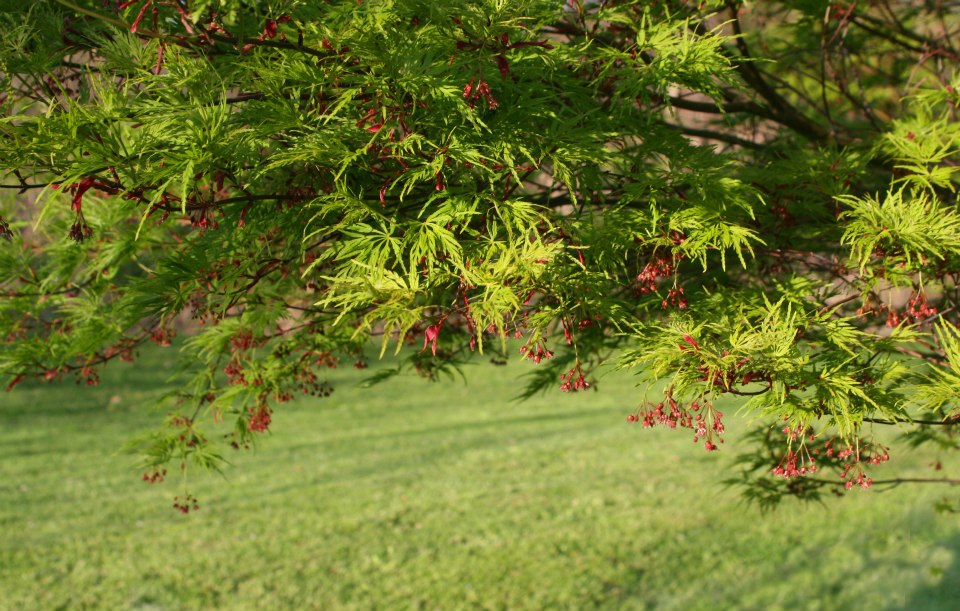
I muse upon beauty. Partly such musing falls under the pursuit of aesthetics: the world of my garden becomes especially beautiful in spring. The sounds birds make seem beautiful to my ears. Water droplets on emerging leaves appear beautiful in the morning light.

japanese mapleThese are phenomena. The world of things I can take in with my senses, process through my body and brain, and create–out of whatever “mind” may be–a concept of the beautiful. The phenomena are not physically affected by my categorization. It is I who am changed, I suppose, by virtue of my aesthetic appreciation of the beautiful.

I am reminded of Kierkegaard:

“Love does not alter the beloved, it alters itself.”

Aesthetic appreciation does not alter the thing-in-itself, it alters the person who finds beauty in the thing-in-itself. If this is so, I am altered by my love of what I deem beautiful.

~

While I was searching the web to find the quote above–I couldn’t quite recall it exactly–I found the Kierkegaard quote on the blog of pastor Jonathan Martin, whose theology I can’t completely get my mind around but whose words (below) reminded me of the Bhagavad Gita:

The most beautiful thing a person will ever see may well also be the most terrifying.

Is this not the nature of true beauty? To not just be soft and delicate, but to be so powerful, so overwhelming, so altogether other from ourselves as to threaten? Beauty does not intimidate, but it can overpower. Beauty is a coup to our senses. It holds an unruly power over us. Beauty can move us, haunt us, carry us, compel us. To feel ourselves beholden to the raw power of something beautiful is to be upended, not just inspired but assaulted.

On the lines of such thinking, we might find beauty in a tsunami, hurricane, earthquake, meteor strike the same way Arjuna feels paralyzed by the awesome beauty of the revealed godhead Krishna.

Perhaps that is why we often find ourselves fascinated by photos of natural disasters. Having lived for a couple of years along the northern end of Tornado Alley in the USA, I fear tornadoes. But they possess a kind of beauty in their awesomeness, if we can remove ourselves from the anguish we feel for people whose livelihoods, homes, and lives are destroyed by the big winds.

I wonder if human beings can ever bear that kind of awe; Martin says it transfigures us, Kierkegaard implies something similar, the Mahabharata and other sacred literature suggest that our bodies and our minds can withstand such revelation but cannot describe or truly comprehend it. It seems to me a kind of spiritual post-traumatic stress disorder! This is the “fear and trembling” of the psyche, whether the mind decides the experience is physical, mental, spiritual, or religious.

And that manner of beauty is not aesthetic.

Martin later writes, “Objectively speaking, the beauty of God is already present in our beloved, whether we recognize it or not. Rather, when we encounter beauty in another person, we are changed–we are transfigured…[those we love] do not become beautiful because we recognize their beauty; rather their beauty makes us beautiful.”

Is this experience awesome or aesthetic? Does the beauty of the azalea, the lilac, make me beautiful because I recognize it as such? Am I altered, fundamentally, in my admiration for an artist’s work, a poet’s words?

~

“The difference between Despair/And Fear”

~

Events such as the tsunamis in Indonesia and Japan, devastating earthquakes or hurricanes that result in high death tolls, industrial accidents that destroy communities—these seem impossible to control and blame is hard to place, even in the latter case. News coverage in such situations tends to focus on damage and recovery efforts, then shifts to the next drama. Tragedies wrought by specific human perpetrators, however, become media spectacles here in the USA. The same few seconds of terrible footage repeatedly fill television and computer screens; viewers feel drawn into the activities of SWAT teams and reporters and the compelling speculations of forensic psychologists, terrorism experts, social commentators, politicians, witnesses. There are heated exchanges on social media forums.

~

I’m beginning to believe societies get the popular culture they want or, alas, deserve (late Rome’s “bread and circuses,” anyone?). The circuses give us what society’s members, apparently, want to consume. Art, however, offers what they need, whether or not they want it. During times of media frenzy, when the culture in which I live seems numbed by “infotainment” and nonstop visual and audio coverage of tragic events, I find myself turning to art—usually poetry—for grounding, for solace, for affirmation of the human spirit and for a way to confront human truths.

~

I do not suggest that poetry necessarily comforts. Often, it wears me ragged, forces me to wrestle with ambiguities, to question my values. Sometimes, art brings me to tears.

I do not consider these results to be negative results. These reactions are human reactions; I am reminded of my humanity through my engagement with art.

A good little anthology for times of grief is The Handbook of Heartbreak, edited by Robert Pinsky. Pinsky’s selections cover the human spectrum of sorrows: broken romances, dead pets, war, disaster, family and social losses and the desolate emptiness of depression, sorrow that is concrete and existential, spiritual and personal and cultural.

~

Speculation is something inquisitive minds do well, but it is easy to believe our speculations, to forget they are merely imaginings that may or may not be valid. When a crime becomes a widely-broadcast web of information blips, the suspect is forejudged in the court of public opinion; I feel concerned about our nation’s commitment to the concept of innocent until proven guilty in a court of law (how on earth will that be possible?). What irks me most about media coverage of the Newtown, Virginia Tech, Aurora, Tucson, Boston Marathon, Columbine and other killings is the retreat into a kind of contorted deductive reasoning based on imaginative constructions of human intent and purpose—the search for motivation that drives the forensic end of these crimes becomes a news story led by experts who imply they can get to the truth. But can we ever know the truth? Each human being is unique and ultimately unexplainable, and often the way we are best reminded of that fact is through art: fiction, theater, paintings, poetry. On his New Yorker blog, Adam Gopnik notes:

Experts tell us the meaning of what they haven’t seen; poets and novelists tell us the meaning of what they haven’t seen, either, but have somehow managed to fully imagine. Maybe the literature of terrorism, from Conrad to Updike (and let us not forget Tolstoy, fascinated by the Chechens) can now throw a little light on how apparently likable kids become cold-hearted killers. Acts of imagination are different from acts of projection: one kind terrifies; the other clarifies.

~

We need clarity.

~

I might add that in my day job, I work with young people between the ages of 17 and 24, day in, day out. These young adults experience varying levels of frustration, confusion, numbness, fear, anxiety, excitement, need for risk, need for security, withdrawal, social discomfort, and inner turmoil. I cannot look at the perpetrators of recent civilian massacres without thinking of my students. I do not mean that I am wary or that I think one of my students might snap; what I mean is that I feel compassion for the conflictedness each human being is capable of feeling and that I understand all too well that not all of us are capable of contending with that conflict.

Some of us can accomplish through acts of imagination the confrontation with what terrifies or numbs us. These people include our artists. Those who cannot express or embrace the confrontation are at risk of projecting the inner conflict, fear, or insecurity elsewhere, as Gopnik makes clear.

Can art make us safe? We live in the world: not an inherently safe place. I think if we embrace what art offers us we will not be in retreat from the truths of the human experience but will learn to confront truths, even those that are uncomfortable. Art gives us insight, a step toward understanding. Can art grant us clarity? I think so.

Therefore, Emily Dickinson (305):

The difference between Despair
And Fear—is like the One
Between the instant of a Wreck—
And when the Wreck has been—

The Mind is smooth—no Motion—
Contented as the Eye
Upon the Forehead of a Bust—
That knows—it cannot see—

~


Comparison as analysis

April may be the cruelest month, may be the time of cherry blossoms hung with snow, may be the time to celebrate poetry–as if we could confine it to one month, those of us who love it–anyway, it is also the last full month of the spring college semester. After endeavoring to impart some understanding of the principles of literary analysis of poetry to my students for the past ten weeks, I assigned a short paper that taught me a great deal. Perhaps it taught my students something, as well.

It occurred to me that metaphor–indeed, most figures of speech–are based upon likenesses, direct or analogous or implied. Yet we Western thinkers are taught to observe differences first and foremost. We learn that red is different from blue, that a ball is different from a block; and I am not disputing those differences. When we speak metaphorically, however, we imply similarity instead. My students default to contrast for analysis and to similarity for description.

There’s nothing inherently wrong with that; it’s very Aristotelian. But what if we turn things 180 degrees? Think of Linnaeus, who classified so many plants and animals; he grouped life forms according to likeness. The differences branched off from the similarities. He described what was overtly or subtly similar, then analyzed for differentiation.

Any two poems have at least a few things in common, so I asked my students to do a comparison-only study, briefly, in a 2-page paper. Initially, they had a great deal of trouble with the assignment. They wanted to contrast. Their interests lay in what was noticeably different about each poem. They genuinely struggled to stay on the topic of similarity, but the outcomes were some of the best papers I have yet had from this class. A student told me that this exercise “really made me think.” Yin-Yang

Fascinating response, really. What does it tell us about our brains, our education, our observational instincts, that we want to stress difference before similarity? Is this a Western civilization thing, or an in-our-DNA-thing? I wonder.

The process that makes a person think, though, is a learning process for certain. Once we can recognize similarities between disparate works of art, we can perhaps recognize similarities between philosophies, religions, human beings. The very differences may become beautiful or intriguing rather than frightening or alien. We may learn to become more comfortable with variety, and more appreciative of it. I know my reading life would be much the poorer if I refused to read, try to understand, or value novels or poems that seemed challengingly “other.” I do not love all of the work I read, but everything teaches me something.

The poems below are very different. In what ways, specifically, are they alike?

Spleen (by Charles Baudelaire, tr. by Robert Lowell)

I’m the king of a rain country, rich
but sterile, young but with an old wolf’s itch,
one who escapes Fenelon’s apologues,
and kills the day in boredom with his dogs;
nothing cheers him, darts, tennis, falconry,
his people dying by the balcony;
the bawdry of the pet hermaphrodite
no longer gets him through a single night;
his bed of fleur-de-lys becomes a tomb;
even the ladies of the court, for whom
all kings are beautiful, cannot put on
shameful enough dresses for this skeleton;
the scholar who makes his gold cannot invent
washes to cleanse the poisoned element;
even in baths of blood, Rome’s legacy,
our tyrants’ solace in senility,
he cannot warm up his shot corpse, whose food
is syrup-green Lethean ooze, not blood.

~ ~
Arrival (by William Carlos Williams)

And yet one arrives somehow,
finds himself loosening the hooks of
her dress
in a strange bedroom–
feels the autumn
dropping its silk and linen leaves
about her ankles.
The tawdry veined body emerges
twisted upon itself
like a winter wind . . . !

~

(These poems are shared under the Creative Commons and are copyrighted by the estates and/or publishers of these poets)

Endemophilia, toponesia, psychoterric states

Thanks to poet Annie Finch, I came across a thoughtful essay in Aeon magazine–an exercise in synthesis and interdisciplinary thinking that connects with Naess and his notion of ecosophy; and with Bachelard and others whose work I have lately been reading and thinking about. Liam Heneghan combines ecology, botany and topography with Winnie-the-Pooh and explores transience and trans-placement from several viewpoints. He looks at how so many of us are transplants, foreign “invaders,” culturally and biologically, and asks us to think about how we feel about place–home-place, in particular.

Not all of us connect with the concept of a home-dwelling anymore; but if we do so, that place is generally closely associated with childhood, observes Heneghan. He cites environmental philosopher Glenn Albrecht and says:

…we do not yet have an adequate vocabulary to address our ‘psychoterric’ states — or how the state of the Earth relates to our states of mind. To balance the negative psychological state of ‘nostalgia’, a couple of years ago Albrecht proposed ‘endemophilia’ (the sense of being truly at home within one’s place and culture — or ‘homewellness’). To balance the term ‘topophilia’, a love of place, Albrecht opposes ‘solastalgia’ — the desolate feeling associated with the chronic decline of a homescape. Solastalgia names the emotions we have at the loss of species and habitats through climate change and other environmental changes. We should all expect a lot more of it.

I do know those feelings, and I feel happy to have terms for them! Yet I argue that we do have an adequate vocabulary for how the state of the Earth relates to our states of mind, and that vocabulary is artistic. I believe the finest expression of these kinds of emotional-memory sensations can be found mainly through art. My task for myself in the coming weeks is to gather a few examples of endemophilia, solastalgia, and other “psychoterric states” in poetry. I’ve already got a few in mind.

Please read Heneghan’s essay if ecopoetics or the notion of homescape appeals to you.

Introversion as character?

Holy pop-psychology, Batman! Introverts are asserting themselves all over the place! At least, you might think so based on current media trending. There was that insightful and rather humorous  2003 article called “The Care and Feeding of Your Introvert” in The Atlantic magazine. More recently, Susan Cain has brought us the book Quiet: The Power of Introverts in a World that Can’t Stop Talking. When popular culture embraces an idea, parodies and simplifications and misinterpretations spawn in the stream of cultural consciousness. Some of these are charming, such as Dr. Carmella’s Guide to Understanding the Introverted, with its hamster-ball analogy. Mostly, the chatter masks any actual usefulness of categorization. Categorization as a method of understanding has had its pros and cons going all the way back to that master of the process, Aristotle.

Batman is copyrighted by DC Comics

Batman is copyrighted by DC Comics

Recently, I’ve been participating in discussions, virtual and face-to-face, around the topic of introversion and extraversion as personality or character traits, and the value or lack of value of the categories as well as the definitions of these words. Popular culture, which perhaps ought to be called majority culture, as usual flattens and simplifies the concepts. “Introverts” are shy and quiet, “extraverts” are sociable and talkative.

Or not. The current psychological meaning of introvert is based on the work of Isabel Briggs Myers and her colleagues and means, broadly speaking, a person “predominantly concerned” with his or her interior thoughts or sensations and less concerned with “external things.” An extravert (sometimes confused with the non-psychological, more general term extrovert), by contrast–naturally–is more concerned with life’s “practical realities” and gains more gratification from what is outside the self.

A friend of mine recently blasted the Myers-Briggs type indicator assessment as being responsible for promoting stereotyped ideas of introverts and extraverts and claimed the assessment is worthless (she used an earthier term). I don’t agree that Myers-Briggs is worthless; like any assessment tool, however, it cannot provide anything more than a snapshot of a personality. It can provide useful insight when combined with careful observation, professional knowledge, and other methods of determining character and personality. Just because Myers-Briggs is probably the most-applied or most-trusted personality assessment tool in the world does not mean it is always accurate or can be interpreted by laypeople…or even by experts. Brief forms of the test online are just that: brief forms, less complex, and therefore–as human beings and the mind and consciousness and personality are exceedingly complex–considerably less reliable as to results.

Then there is the whole concept on which the test, and others like it, are based. Carl Jung posited the notion of two dichotomous pairs of cognitive functions operating in the human psyche, and the test is derived from his initial explorations concerning those dichotomies. Well, that works–if you are a dualist. Not all of us buy into the categorization program, and many skeptics suggest that the world is far more interesting than just pairing opposites can explain.

Yin-Yang

I love the idea of harmony the taoist symbol represents, but my sense of the universe’s fractal and relational saved-from-chaos-by-a-thread “reality” tells me things are not that simple. We simplify them to attempt understanding at the human level, but oversimplification leads to stereotypes and fallacies, outcasts and enemies. Introverts and extraverts can face off and talk about how different they are; but Jung and Myers would remind us that these “types” exist on a continuum, despite the dichotomous origin of the concepts. Some people test out right near the middle of the two; some are only partway between the extreme ends of their type. Furthermore, how one defines these terms makes a big difference in how the types are perceived…and people do change as we develop along our own continua.

My father was an early proponent of the Myers-Briggs assessment and has administered the test to me three times (when I was 17, about 26, and in my late 30s). As I matured, my introversion factor changed slightly. Of course, I could have told him that without the test! I had more time for daydreaming at 17, and fewer external responsibilities. By the time I was nearing 40, I had to deal with some significant external realities: my young children and all the practicalities of external life that child-raising entails. The other aspects the indicator assesses changed a bit less, but there was movement; human beings are not stone carvings, and even stone carvings wear down, break, and change.

My own definition of what it means to be an introvert is that I “recharge” best when I am alone or with another person who is quietly reading or walking or daydreaming alongside me. I do not like being lonely; loneliness can occur even when surrounded by society, however, and solitary hours aren’t necessarily accompanied by a sense of loneliness. After spending a day at work, talking with students and colleagues–activities I enjoy–I need to go up to my room and get out of my work clothes and unwind without immediately chatting about my day. Parties can be fun, but afterwards, I need to spend a little time by myself. Concerts and tourist-clogged beaches can overwhelm me, yet that doesn’t mean I find no joy in attending them. I just need to pad the experience with some quiet time before and afterwards. Some of my family members, though, feel drained when they are quiet for too long. They recharge by socializing, or by making and doing things (ah, those “practical realities”!).

I was considered shy as a child and adolescent, but few of my current friends would say that shyness is one of my most obvious characteristics. These things are matters of environment and perception, not merely of some implacable temperament. In fact, I have several friends who appear much “shyer” than I am but who are extraverts, because they feel a sense of increased energy after social interactions or going to concerts or cities, whereas I need to retire, book in hand, to my quiet chair for recuperation. Ask anyone who knows me and you’ll learn that I love to talk and can be quite gregarious. Sometimes. And after awhile, my need to transmit and receive sort of slows down. After that, I don’t need to have anyone attend to me, converse, or ask me if I need anything. I don’t need interaction anymore–I’m like a cellphone nestled in its charger.

Even a cellphone needs a few minutes when no one is talking. That doesn’t negate its role as a conduit for communication, does it? As any reader can tell from this blog, I am concerned with “interior” thoughts and sensations but speculate on and relate these thoughts to the wider world, which is also my main impetus for thinking these thoughts in the first place.

Enabling & stewardship

The season of seed catalogs is upon us, and I begin to fantasize about all of the vegetables and flowers I want to grow and how I will arrange my small garden area to accommodate them. I imagine having time to keep the rows cultivated and the foliage free of insect pests. Yes, I need to do some work on the fencing. And yes, some terracing might help where the garden’s taking a decidedly southeasterly dip. The asparagus patch finally played itself out, so it will need some restructuring and weeding; I’ll have an opportunity to use that area in a new way.

There’s snow on the garden now. All of this planning is purely speculative on my part. Yet–how clearly I can envision it, in my mind. One of my concerns is whether I’ll feel hale and hearty and energetic enough to get all of this work accomplished!

Ah, my garden-consciousness brings me to the mind-body problem, though perhaps in a more physical way than philosophers encounter it. My conscious mind imagines the garden that does not yet exist. Is that garden real or an illusion? What makes it possible for me to conjure it so vividly? Is it merely memory of past experience? If so, why does my imagination invent a slightly different garden–this year’s ideal? My animal self takes action, physical action (phenomenological action) in order to bring about fruition to feed the physical body that loves the taste of vine-ripe tomatoes and fresh beans and tender lettuces. Do my actions cause the plants to grow? No. I’m more of a steward or a guide. I help them get a better-than-average start.

This sort of thinking brings me around to a (2011?) post by biologist Stuart Kauffman, on the NPR philosophy blog.

Kauffman says:

We think we live in a web of cause and effect. We do. We also live in a web of enabling opportunities that may or may not be seized, and the living world, biosphere up, unfolds in a different way, creating ever new possibilities of becoming.

But these possibilities often can’t be stated ahead of time. No one foresaw Facebook when Alan Turing did his work in the first half of the 20th century. Nor can we foresee all the possibilities of the evolution of life.

Life is not a well-formulated, complex optimization problem to be solved. We do not know all the variables that may become relevant.

Science is my life, and it is wonderful. But science will not ultimately know everything.

In the world of modernity, our values have become badly deformed. Gordon Gekko’s “greed is good” has replaced “integrity, generosity, and courage” as our First World cultural ideal. Modernity does not serve our humanity well, although it does offer enhanced standards of living. We are reduced — to price tags, cogs in an economic system making often useless products in the name of forever GDP growth on a finite planet. The bankers corrupt themselves and our government. Our government does not yet realize that its better job is to enable, not command, to “garden,” to coach, to enable the creativity of its peoples, here and around the globe.

Yes, that’s it. I engage with my environment partly by enabling things to grow or flourish. The term enabling has garnered some negative connotation in recent years due to its use in psychology: we are warned not to enable alcoholics, manipulative people, or those who need to learn some grit and self-motivation. The idea of enabling is, however, essentially positive: to help, to nurture. In fact, I think I prefer to think of myself as one who enables the earth rather than as a steward–though both concepts suggest that we human beings must engage willfully with the world.

We have work to do here on earth. And I am well aware that I do not know, with my garden, “all the variables that may become relevant.” (Past complex variables have included drought, hail, flooding, and beetles.) My small part this year includes serving the land I temporarily inhabit as well as serving myself and my family our favorite foods.

31281_1488041725309_1074892_n

My favorite sources for seed include: Seeds of Change, Territorial Seed Co., Peaceful Valley Farm Supply, and–while less on the organic spectrum, the British firm of Thompson & Morgan for its amazing variety of herbs, vegetables, fruits, ornamentals and grasses from heirloom to the latest hybrids. For American gardeners interested in some truly historical strains, Thomas Jefferson’s Monticello offers quite a selection.

(Photo: a previous year’s garden in May)

Freedom above utility

S. Polgar is mentioned in Tough's book. Her website is here: http://susanpolgar.blogspot.com/

Susan Polgar is mentioned in Tough’s book. Her website is here: http://susanpolgar.blogspot.com/

One of the gifts I received this year is the book How Children Succeed, by Paul Tough. It’s a quick read that dovetails many of my interests: education, psychology, character, motivation, philosophy, & childraising, among others. There are several aspects of the book I could write about here; but today my frame of mind has wrapped around one particular passage having to do–well, in the book, with chess–but metaphorically and personally, with why I bother to write poetry.

In the chapter titled “How to Think,” Tough offers the stories of several chess-for-children programs and connects these endeavors with education, as well as with traits of persistence, grit, and critical thinking skills. He cites examples of chess masters the world over, of child prodigies, and of chess teaching methods; then, he connects these strands with the notion of learning “character.” That’s one of the book’s arguments: that character is learned, made up of other habitual traits, that it is not the same as temperament. One skill that good chess players learn is how to fail, how to overcome confirmation bias in decision-making, and how to immerse themselves through the habit of study (persistence). This does not mean that chess players naturally extend these abilities to other areas of their lives, but they could do so since they do possess these abilities. Tough finds it fascinating that many chess players still manage to screw up other areas of their lives…they do not choose to extend, or apply, their chess traits to things like academics, career, or personal relationships.

So choice (“volition” as he terms it, though he defines volition as closer to willpower) interferes with our application of learned ‘good’ habits. Ah, the old ‘free will’ trap…

~

But I digress.

The part of this chapter that grabbed me is a quote from chess master Jonathan Rowson. He says: “the question of chess being an essentially futile activity has a nagging persistence for me…I occasionally think that the thousands of hours I’ve spent on chess, however much they have developed me personally, could have been better spent…[yet] chess is a creative and beautiful pursuit, which allows us to experience a wide range of uniquely human characteristics.”

Sounds familiar to me. People say the same sort of thing about writing poetry. Then Rowson says chess is “a celebration of existential freedom, in the sense that we are blessed with the opportunity to create ourselves through our actions. In choosing to play chess, we are celebrating freedom above utility.”

Oh, that says it so well. Freedom above utility–choosing to create myself through my actions, which allows me, as poet and as sentient being, to experience all of those messy and sorrowful and complex and delightful human characteristics.

~

I have spent my 10,000 hours writing and am “expert” at it, yet it has brought me not money nor favor nor fame. So why pursue the path? Because it is beautiful and freeing. Because it is my form of gift–I have a small talent that I have labored at, but I am not “gifted” as a writer…yet I can see my way to thinking of my poetry as part of the gift economy Lewis Hyde elaborates upon in his book The Gift (which I’ve mentioned in a previous post). Ambition is not the same as willpower, and I do not have single-minded willpower in the task of promoting my work or my persona as a poet–no “poetry diva” am I. But I do have persistence in this one area: the writing practice and all it entails; and I do have experience with it, and I possess deep and abiding curiosity about poetry and gratitude that it exists and that I can continue to try my hand at it.

Even if it seems futile or pointless or non-productive to some people.

~

As an aside, I note that David Orr’s recent book Beautiful & Pointless: A Guide to Modern Poetry has been both enthusiastically and scathingly reviewed, so I must get to it soon. Perhaps Orr’s work will clarify my thinking on the non-remunerative, generally unacknowledged occupation that chose me long ago.

Or perhaps it does not need clarifying. Perhaps celebration is enough.