The poet & the Good

I have recently finished reading Robert Archambeau‘s collection of essays The Poet Resigns and am mulling over the idea of resigning with him.

It’s not that I necessarily want to give up writing poetry but that, in my reflections about where I can do the most good among the community of sentient beings, my work as tutor and teacher almost certainly has an effect both deeper and broader than my work as poet. This “good” hearkens to the ancient Good of Socrates, Plato, and their ilk but also to the sense of mindful “middle way” of the Tao: a practical path between two values that may be incompatible in many ways.

~
water-rites_coverThe readership for contemporary poetry is small, and my readers number only in the hundreds; among those readers, resonance of any kind–aesthetic, emotional, lyrical–is likely to be limited to a small number of poems. A poem of mine that effects some measure of The Good upon readers represents a minuscule good moving into the world. The net effect, I imagine, hardly registers…not that net effect matters so much. I suppose if a poem of mine moves just one person enough to evince even a small transformation, something has been achieved beyond my individual abilities in the composition of that particular piece.

As a teacher and tutor for the past ten years, my role expands not merely to number of people encountered (few of whom will remember me as an individual) but to the concepts I present to them, most of which will be significant in their lives one way or another–although not immediately, and probably unconsciously. Lately I have been devoting more of my limited energies to this aspect of my life work. Such focus does impede my ability to do creative work of other sorts.

~

This bust resides in the Louvre, and was found here: http://www.humanjourney.us/greece3.html

This bust resides in the Louvre, and was found here: http://www.humanjourney.us/greece3.html

Example: I am reading a little book on philosophy for beginners by Thomas Nagel. The Nagel book is on my table because I have been trying to find simpler ways to talk with students about their philosophy essays. While my main enterprise as writing tutor is to help students to clarify and correct their mechanical weaknesses (sentence and paper structures), it is not always possible to ignore content weaknesses; a student can write correctly about nothing of value–and receive a D or, in the case of Philosophy classes especially, an F.

But understanding philosophy is important.

Now, it is often extremely difficult for beginning writers to express their understanding of philosophical concepts in writing. They are just learning rhetoric and fall into fallacy errors through grammar as often as through thinking. Since I am not supposed to be a content tutor, I have to find ways to tease out what the student understands (or does not understand) and make that idea come through clearly on the page.

Kind of like mind-reading.

[Aside: I have to admit this can take a lot out of me by the end of the day.]

The Nagel book is one of several philosophy primers I have been reviewing to try to find a text to which I can refer my more confused students, the ones who cannot infer the basics from their professors’ lectures or assigned readings. There are academics who might suggest such students do not belong in college in the first place; but I believe in the ideal of an educated populace, and whether or not these students stay in the university through graduation, they can benefit from the discipline of thinking about thinking.

It feels rewarding when, after half an hour of discussion and writing coaching, a young person leaves my office slightly more enlightened. So they tell me, anyway. I know from experience that writing about something helps a person to understand not only the subject but, more importantly, what the writer thinks about the subject.

~

So perhaps my creative energy is better served in the direction of others through tutoring than through poetry; perhaps the former leans more toward the Good. Perhaps I am a better tutor than poet; this is indeed likely, although I have been poet-ing longer than I have been teaching. Then again, not to knock the art of teaching, but writing poetry is much more difficult than the teaching I do. And I get paid to enlighten people through my tutoring.

Not so through poetry. Indeed, Mr. Archambeau–you have gotten me seriously to think about tendering my resignation as a poet, though not without considerably more reflection on the possibility. Writing about the idea has helped me to understand where the Good fits into all of this, and what the middle way might be.

Now, I suppose I could write a poem about the subject…

~

Autodidact as adult student: Goddard & me

In a previous post, I mentioned my peculiar undergraduate experiences at alternative institutes of higher education (The New School) and how being a book-loving autodidact influenced, perhaps even configured, my approach to education. My favored learning strategies led me to a non-traditional graduate school program, as well. Reflecting upon my higher education, I realize that every institution I attended chose alternatives to standard pedagogy–and I am grateful that such colleges exist. The world needs outliers.

A kind of heaven.

The New School’s pedagogy for the “Freshman Year Program” was seminar-based. That worked very well for me. Classes were small, discussion-centered, predicated on the reading of significant original texts–no textbooks. The professor was not a lecturer but a participant-coach and mentor.

The program was only a year long, however, so I had to transfer. There were a number of experimental college programs in the 1960s and 1970s; without the miracle of internet searching, however, they were not easy to locate. I did not find out about St. John’s College, Reed, or Evergreen, for example. I stumbled instead upon Thomas Jefferson College (now defunct) in Michigan.

I completed my undergraduate studies without ever seeing a syllabus. Yet I read more books than the majority of my standard-pedagogy-educated peers and discussed classic and contemporary texts, science and history and literature, in depth with my peers and with scholars. I wrote a lot and did hands-on projects, independent studies, experiments and interviews. TJC drew criticism for its ‘flakiness’ and ‘lack of oversight,’ (some of which, I can attest, was deserved); however, the former college president “described TJC as perhaps too far from the mainstream, but attracting excellent students, noting that ‘Thomas Jefferson College…was sending a larger percentage to graduate school than the College of Arts and Sciences.'” Yes, but in my case it took awhile to get there.

Much water under the proverbial bridge: suffice it to say that in 2000, I returned to college to pursue a masters degree…and I wanted to learn in the kind of environment that suited my style. There were other factors then, as well: two children, for example, and responsibilities I had not encountered as an undergrad. On the other hand, by 2000 I was an adult and more motivated and disciplined than I could ever have been at age 19.

I chose Goddard College for a number of reasons, foremost its small seminar-style instruction, its mix of workshops and instruction, its focus on readings, annotations, mentoring, and community-building among students and faculty–reaching outward into the world at large. The low-residency format only works if the student is independent and self-directed, which–as a returning, “adult” student–I certainly was. I appreciated the school’s more interdisciplinary approach to the creative writing program. We didn’t have to face off, pegging ourselves as poets or fiction writers. And creative non-fiction was taken seriously as a genre to develop voice, style, and depth…it could be studied and parsed. That endeavor of interdisciplinary arts education is true of a few institutions now but was rather new among MFA programs in the late 1990s.

Another college without core requirements, without syllabi, without standard formats. But, like New School and TJC, Goddard offers excellent professors dedicated to students’ intellectual enrichment and personal transformation, small-group discussions, and narrative evaluations. I knew how to balance life’s responsibilities when I enrolled, and I knew what kind of teaching I’d respond best to. How did I learn that? See above. Suits my philosophical, bookwormish, autodidactic approach to–well, practically everything!

Irritation, explanation, interpretation

I had another testy conversation about poetry analysis recently. Hence, this brief explanation, rationale, and license to interpret.

Feeling a mild irritation...

Feeling a mild irritation…

I truly sympathize with people who prefer to avoid any sort of literary analysis; so many times, it is such a badly-taught subject. Nevertheless, it is never a good idea to refuse to learn about something thanks to one or two negative experiences. If that were the case, no one would ever learn to walk (we fell down, we cried, we refused ever to rise up and take another step).

First, let go of the idea that the purpose of literary analysis is to understand exactly what the writer meant. Second, let go of the idea that poetry contains a symbolic hidden meaning.

Instead, recognize the following fairly obvious observations:

1] the poet wrote what he or she meant; the reader can interpret on the reader’s terms.

2] the meaning is in the poem itself.

Poetry is a form of communication, and it is not a detective story. The poet said what he or she said because the poet determined that was the best way to communicate the experience.

Problem: You, the reader, fail to understand the poem. All that means is that you and the poet may be speaking in different terms and that, to you, the poet’s determination of the best way to say what he or she meant does not convey much. Welcome to the world of human interactions.

The reader has choices: turn the page, for example, and ignore the poem. Or read the poem and find its sound or rhythm entertaining. Or read the poem for its summary–the top-line story, if there is one. Or relish the poem’s mood or use of language. Or its images.

Or throw the poem across the room in frustration or anger. Poetry is powerful enough to evoke such responses.

You could also try to examine the poem, look at how the poet uses rhythm or sound or language or image or metaphor or rhyme…you might learn something about how a writer puts a poem together; and even if you do not manage to shoo the “real meaning” out from under a chair, you may be able to come to terms with the poem in your own way.

You are permitted to interpret what the poem means for you.*

~

*CAVEAT: This approach may not get you an A on your analysis paper (though it might), but it will serve to enhance your lifelong appreciation of the poetic art.

Gratitude & Qigong

My mother is still living. I am grateful for that.

My mother and I get along well. In that, we are fortunate.

Furthermore, although she is an octogenarian, my mother is in reasonably good health. Another reason for gratitude.

Her interests are varied, and she’s willing to try new things. My mother has always been quietly innovative about life. She has pursued alternative therapies for health and emotional well-being, read difficult texts, studied disciplines and subjects that challenged her, traveled the world, lived in foreign lands.

Mostly, she has been a care-giver of one kind or another. This past weekend, I took my mother with me to a Qigong and Mindfulness retreat, thinking she could use a couple of days of restorative practices and a little time off from care-giving for others in order to care for herself. In addition to several hours of “medical qigong” (Yi gong), we learned some practices for spiritual qigong (Tao gong), got information about implementing a plant-based diet, observed a tea ceremony, tried our hands at Chinese bamboo brush painting, and followed a labyrinth path in a walking meditation. It was quite a significant conclusion (of sorts) to my recent weeks of thinking about consciousness as presented by various “Western” thinkers on the subject.

Yin-Yang

Kirkridge Retreat Center hosted the weekend. Kirkridge’s organization is dedicated to peace, compassion, and community–to the concerns of social justice and to individual healing. It is a peaceful place, located on a steep, wooded hill. The setting alone fosters a sense of restorative energy. Our teachers were excellent, informative, and full of grace. The meals were terrific. The crickets sang sweetly and the moon shone amidst the clouds. My mother and I felt grateful for the event, the weather, the place, the people, for the breaths animating our bodies and for one another.

Gopnik enters the English major fray

The New Yorker‘s columnist Adam Gopnik contributes his views about why the English major does or doesn’t matter in the blog accompanying a recent issue. He says, in response to apologists (like me) who contend that English, literature, and the humanities generally contribute to a person’s life experience in subtle, long-term ways:

Well, a humanities major may make an obvious contribution to everyone’s welfare. But the truth is that for every broadly humane, technological-minded guy who contributed one new gadget to our prosperity there are six narrow, on-the-spectrum techno-obsessives who contributed twenty.

Then he points out:

Nor do humanities specialists, let alone English majors, seem to be particularly humane or thoughtful or open-minded people, as the alternative better-people defense insists. No one was better read than the English upper classes who, a hundred years ago, blundered into the catastrophe of the Great War. (They wrote good poetry about it, the ones who survived anyway.) Victorian factory owners read Dickens, but it didn’t make Victorian factories nicer. (What made them nicer was people who read Dickens and Mill and then petitioned Parliament.)

Okay, he’s a bit broad and snarky there–but that’s his style. And nonetheless, Gopnik argues for space in society–if not necessarily in the academy–for the study and discussion and obsession with books and literature. He claims that “the best answer I have ever heard from a literature professor for studying literature came from a wise post-structuralist critic” who said the reason he was a literature professor was because he had “an obsessive relationship with texts.”

I would agree with that reasoning, though I am not a post-structuralist, so far as I know.

I believe that education ought to allow us to follow our passions to whatever logical or surprising ends appear. In light of the huge expense of a university education in the USA, however, perhaps the best question to ask is how to motivate citizens to pursue education individually (see my post on autodidacts). Gopnik calls the estimable Dr. Johnson “the greatest English professor who ever lived,” though he never taught in a university and though his title of “doctor” was honorary, and reminds us that other antecedent writers-on-literature, such as Hazlitt and Sydney Smith, “had to make their living doing something else narrowly related.” Colleges at least offer some employment and a modicum of respect to the humanist interpreters and researchers among us, but we need not be employed by the academy to exercise our obsession with books. That can be done on our own.

Dr. Johnson

Gopnik adds this lovely, wise sentence near the close of his column, and I wish I could convey the value of his idea to every college student I advise: “You choose a major, or a life, not because you see its purpose, which tends to shimmer out of sight like an oasis, but because you like its objects.”

Poems, stories, paintings, sculpture, dance, philosophy, books, books, books…I don’t know my life’s purpose, but I know the “objects” that entrance me.

English major argument redux

Yet more weighing-in on why one might wish to choose to major in English as an undergrad, this time from Mark Edmundson:

http://chronicle.com/article/The-Ideal-English-Major/140553/?cid=cr&utm_source=cr&utm_medium=en

Edmundson writes:

Real reading is reincarnation. There is no other way to put it. It is being born again into a higher form of consciousness than we ourselves possess. When we walk the streets of Manhattan with Walt Whitman or contemplate our hopes for eternity with Emily Dickinson, we are reborn into more ample and generous minds.

(He even quotes Heidegger!)

This does not mean all English/literature/humanities folks think alike. In fact, the beauty of it is, we all think differently.

More on the English major

The New York Times commentator Verlyn Klinkenborg recently wrote about the “decline of the English major” in an opinion piece titled “Why the Humanities Still Matter.” I am offering a link to the letters to the editor concerning that essay [which includes a link to the opinion piece as well]:

http://www.nytimes.com/2013/06/28/opinion/why-the-humanities-still-matter.html?emc=eta1&_r=0

Another article, this time in the Chronicle of Higher Education, makes the point that employers often want qualities in their employees that the English major supplies…but that employers may not realize that! (One commenter suggests students major in business or biology or whatever and minor in English).

Those of you new to my blog may wish to look at the archives here on this topic, which include:

“Reasonable, Calming” http://wp.me/p1RDyQ-go

“Just-so” http://wp.me/p1RDyQ-cI

“Defending the Poetry major” http://wp.me/p1RDyQ-6z

“Learning the literary analysis” http://wp.me/p1RDyQ-je

“Philosophy & English are friends” http://wp.me/p1RDyQ-hk

I’m a philosophy and literature major who is also a poet; and I’m not starving to death, and I like my job. Can the cynics please stand down? Learning matters. True education makes us into better thinkers. Society benefits.

End of story. Now, go read a book!

Discourse: talking about poetry

This post is a response to Fox Chase Review‘s post which can be found here: Poetry in Decline?

“G” asked for responses to the need for a revolution in (USA) poetry, stemming from Diane Sahms-Guarnieri’s comments. Her ideas were excerpted, so I may be missing some of her assertions or evidence. In one way, she echoes Dana Gioia’s famous “Can Poetry Matter?” essay and book (1992): that is, in terms of questioning the isolated, academic support of poetry, poetry study, MFAs, and university publishers as elitist and as dampening a wider audience for poetry. While Gioia tends to support the literary canon in general, he stresses in his early essay that poetry has its own specialized, “frenzied” little circle of literary lights but that the art itself no longer exerts much influence on life, culture, and thinking in the USA.

From Gioia’s introduction:

The situation has become a paradox, a Zen riddle of cultural sociology. Over the past half century, as American poetry’s specialist audience has steadily expanded, its general readership has declined. Moreover, the engines that have driven poetry’s institutional success—the explosion of academic writing programs, the proliferation of subsidized magazines and presses, the emergence of a creative-writing career track, and the migration of American literary culture to the university—have unwittingly contributed to its disappearance from public view.

Sahms-Guarnieri further suggests that isolated, academic styles of poetry are partially to blame for poetry’s “decline” among US readers and calls for a return to realism.

I’m not sure “realism” is the answer, because many infusions of style, energy, or revolution that have done poetry good as a whole have not exactly fallen into that category (was Lorca a realist? just as one example). I embrace the idea of the narrative-lyric mode, which may be considered a kind of realism; but I also love many, many other styles of poetry, some of which are “difficult” and not easily accessible to the general reader. The main means through which I learned the diverse structures and approaches to poetry is through reading on my own, autodidact that I am. Yet formal study and literary criticism increased and deepened my passion for this art. I teeter on the fringe of academia though I am a poet who writes outside of the classic academic framework.

I feel compelled to defend the teaching of poetry, though I admit the process is often done badly. Still, one of the things academia does best is to examine the work, and I feel readers who examine what they love more closely will benefit from doing so (rather than taking the “I know what I like” stance). Academics have, since the 1970s, begun seriously to read beyond “the canon,” and that is all to the good. Academia doesn’t produce the best art, however. Knowing how things work in theory does not equal expertise. I know how a bicycle works, but I am pretty sure I couldn’t build one from scratch.

~

The poems that remain timeless are seldom elitist. The problem with the elite is that it eventually falls from grace. When that occurs, the allusions and puns and, often, the entire foundation of the piece get lost. This issue can be equally true of poems that are “realistic.” If the poem offers no recognizable aesthetic, purpose, or sensation, it ceases to be valuable to future readers. Many of today’s poems will suffer this fate–mine among them–and that’s not a bad thing. We don’t get to judge which art is revolutionary, prescient, timeless; later generations make those judgments.

And that is one reason many writers resent academia and university presses: it seems as though these institutions are “at the top of the mountain” and trying to keep their situations exclusive; in other words, they are acting as cultural, literary judges. So they are…in their time. They cannot enshrine themselves for the future. Art doesn’t work that way.

~

Contemporary Poetry Review claims it is there to resuscitate contemporary poetry, which implies poetry’s suffering a near-death experience. I do not think poetry is dying. I think it is changing, which it has always done, because art is responsive to and entangled with culture and therefore defies stasis.

Poetry, like most art, tends to exist on the cultural fringe, where it hangs out with curious, inventive people who bother to seek for it. Some of them look on the mountain top, and some of them look online, or in pubs that host open mics, or at independent bookstores, long may they thrive. With luck, and maybe some encouragement, those people might buy a book or two–including POD-published or self-published books (why not? –and while you’re at it, Water-Rites is still available!). This last point coincides somewhat with Larry Robins’ perspective in the Fox Chase Review piece.

If you really do know what you like, regardless of how you make that judgment, buy a copy of the book. And don’t get it second-hand from Amazon if you can help it–buy from the small press or the author or an indie book shop if you can find one in your area. Read it again and again, and figure out why you like it. Tell someone else. Discuss what you love.

That’s what keeps poetry alive.

water-rites_cover

Concerning the apostrophe

I am not the sort of English enthusiast who makes a habit of ranting over bad grammar. I often feel annoyed at egregious errors; occasionally I go as far as to say “it drives me crazy when (insert common grammar mistake here),” but I understand that living languages change. Evolution is not just for finches, and stasis  cannot be maintained in a complex system of human communication when technology and society and culture constantly create and destroy not only our environments but our methods of communication. Communication takes many forms and reflects the influences of many stresses, common usage being foremost among them.

Common usage may be verbally-based or textually-based or may depend upon references to popular culture or recent history, and it alters language whether we want it to or not. This fluid, flexible aspect of language fascinates me. As a poet, I relish it. As a teacher, I have to allow for compromise now and then.

I am willing to predict, for example, that very soon the accepted pronoun for words such as everyone and anybody is likely to be “they.” The reference was acceptable to Jane Austen and her writing peers, then went out of fashion in the Victorian era, when “he” became the norm–the word “he” is singular, as anyone is; thereafter, educated writers and orators used “he” for the nonspecific singular antecedent.

Of course, such use omits half of the population. Non-gender-specific writing employs “he or she” as the correct pronoun for words like someone. That usage leads to many a tortuous sentence, however. I generally advise my students to change the antecedent noun to a plural form whenever possible and to keep “they” as the pronoun; yet almost all newspapers, many news journals, popular magazines, and certainly most of whatever text appears on the web now employs the pronoun “they” for nonspecific antecedents. I don’t really have a problem with that–Jane Austen was able to make it clear enough whom it was she meant by “they.” Clarity’s what matters.

I do have a beef with the misuse of apostrophes, though. The apostrophe I’m talking about is a punctuation mark, not the poetic apostrophe which addresses someone or something absent or metaphorical. I mean the little superscript mark  that is used for two main reasons:

1. To note an elision (the omission of letters)

2. To indicate the possessive case (barring the silly exceptions hers, theirs, ours, yours and its)

I understand the why behind a noticeable uptick in the number of times apostrophes go missing these days: texting, tweeting, and other shortcuts employed in social media communication. My students are vague about the comparatively simple rules of when to use the apostrophe largely because they never bother using it when they text one another. Furthermore, their customary “proofreader,” SpellCheck, doesn’t always alert its users to this type of error. Computer programs can recognize that dont is not a word, but cant means “sanctimonious talk” or, alternately, a tilt or slope (says Merriam Webster). It is a useful word, but it is not the elision for the word cannot. Furthermore, SpellCheck won’t (elision for will not; wont means habit or custom) be able to correct the typist who uses the wrong form of your/you’re or its/it’s.

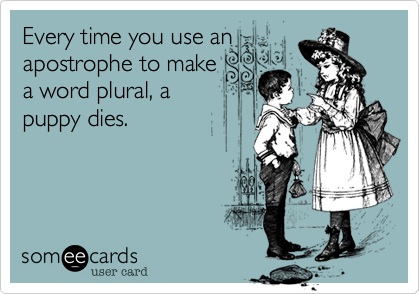
Irksome, yes. But most mystifying to me has been the ridiculously frequent use of the apostrophe to indicate the plural. Surely no one is teaching our second graders to pluralize by adding ‘s to the end of a word. (Teachers who do so should have their certifications revoked!) Recently, when working with a student, I learned one reason this mistake crops up so often in my students’ papers: AutoCorrect. When the typist gets sloppy and tries to add an s to a word that takes a different ending for the plural form (puppy, puppies), AutoCorrect defaults to possessive case. The computer is too dumb to detect the difference, because this is English, and English is damned difficult.

I suppose another reason may be character limits for tweets and texts, but that seems less likely. If people don’t bother to use the apostrophe for elisions, why bother for plurals? “Susie got 2 puppys” conveys the same information just as incorrectly.

Proper use of the apostrophe in English is actually pretty simple–even though computer programs cannot quite figure out the two rules above–and clears up a host of potential ambiguities and misunderstandings. The world could benefit from communication that isn’t studded with misunderstandings.

The warning below is one I use with my students. Sometimes, it even has the effect of becoming a useful reminder. Many thanks to the anonymous teacher who posted it on someecards.com.

puppy dies•NOTE  [Alas, just to complicate things, some editorial styles use the apostrophe to indicate plurals, but ONLY for letters or numbers, as in: “There are four 6’s in this statistical table.”]

Comparison as analysis

April may be the cruelest month, may be the time of cherry blossoms hung with snow, may be the time to celebrate poetry–as if we could confine it to one month, those of us who love it–anyway, it is also the last full month of the spring college semester. After endeavoring to impart some understanding of the principles of literary analysis of poetry to my students for the past ten weeks, I assigned a short paper that taught me a great deal. Perhaps it taught my students something, as well.

It occurred to me that metaphor–indeed, most figures of speech–are based upon likenesses, direct or analogous or implied. Yet we Western thinkers are taught to observe differences first and foremost. We learn that red is different from blue, that a ball is different from a block; and I am not disputing those differences. When we speak metaphorically, however, we imply similarity instead. My students default to contrast for analysis and to similarity for description.

There’s nothing inherently wrong with that; it’s very Aristotelian. But what if we turn things 180 degrees? Think of Linnaeus, who classified so many plants and animals; he grouped life forms according to likeness. The differences branched off from the similarities. He described what was overtly or subtly similar, then analyzed for differentiation.

Any two poems have at least a few things in common, so I asked my students to do a comparison-only study, briefly, in a 2-page paper. Initially, they had a great deal of trouble with the assignment. They wanted to contrast. Their interests lay in what was noticeably different about each poem. They genuinely struggled to stay on the topic of similarity, but the outcomes were some of the best papers I have yet had from this class. A student told me that this exercise “really made me think.” Yin-Yang

Fascinating response, really. What does it tell us about our brains, our education, our observational instincts, that we want to stress difference before similarity? Is this a Western civilization thing, or an in-our-DNA-thing? I wonder.

The process that makes a person think, though, is a learning process for certain. Once we can recognize similarities between disparate works of art, we can perhaps recognize similarities between philosophies, religions, human beings. The very differences may become beautiful or intriguing rather than frightening or alien. We may learn to become more comfortable with variety, and more appreciative of it. I know my reading life would be much the poorer if I refused to read, try to understand, or value novels or poems that seemed challengingly “other.” I do not love all of the work I read, but everything teaches me something.

The poems below are very different. In what ways, specifically, are they alike?

Spleen (by Charles Baudelaire, tr. by Robert Lowell)

I’m the king of a rain country, rich
but sterile, young but with an old wolf’s itch,
one who escapes Fenelon’s apologues,
and kills the day in boredom with his dogs;
nothing cheers him, darts, tennis, falconry,
his people dying by the balcony;
the bawdry of the pet hermaphrodite
no longer gets him through a single night;
his bed of fleur-de-lys becomes a tomb;
even the ladies of the court, for whom
all kings are beautiful, cannot put on
shameful enough dresses for this skeleton;
the scholar who makes his gold cannot invent
washes to cleanse the poisoned element;
even in baths of blood, Rome’s legacy,
our tyrants’ solace in senility,
he cannot warm up his shot corpse, whose food
is syrup-green Lethean ooze, not blood.

~ ~
Arrival (by William Carlos Williams)

And yet one arrives somehow,
finds himself loosening the hooks of
her dress
in a strange bedroom–
feels the autumn
dropping its silk and linen leaves
about her ankles.
The tawdry veined body emerges
twisted upon itself
like a winter wind . . . !

~

(These poems are shared under the Creative Commons and are copyrighted by the estates and/or publishers of these poets)