Wet summers

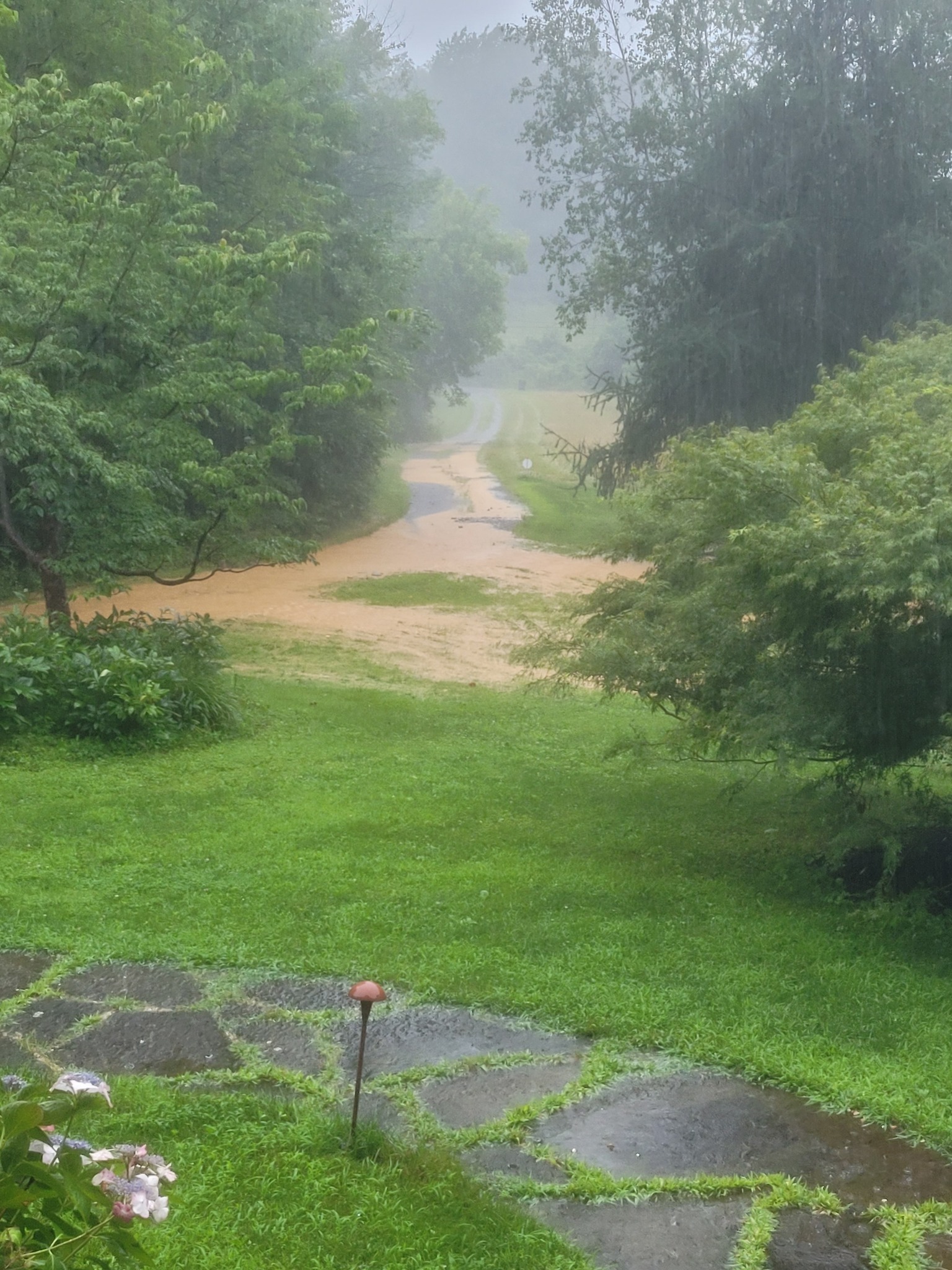
Thunderstorms used to thrill me, and still do–that combination of potential damage with the relaxing sound of rain on trees and rooftops, rain rushing through downspouts, and overcast skies that seem to lull me to sleepiness. Yesterday’s rain was a doozy. We had a flash flood in our front lawn, which has never happened before. But the basement stayed dry, no trees have come down (yet), and we didn’t lose power.

Cracking loud thunderclaps with arrow-straight downpours on hot summer days remind me of childhood. Yesterday afternoon I sat on my porch for an hour just watching the rain and remembering days like this. When we aren’t in drought years, these summer storms appear commonly in the region; yet they always evoke memories of long ago, I suppose because when I was a child I could just sit around watching a thunderstorm instead of, well, doing grownup things. Like working in an office, teaching a class, grocery shopping, laundry, reading emails, whatever I’ve been doing during the past 50 summers.

I spent many a mid-summer week or two in northern Indiana, where this type of storm was common. My grandmother always appreciated them, saying, “They make the corn grow.” Which must also have been true in the coastal plains of southern New Jersey, where I spent the rest of every summer. (Sweet corn is excellent in both regions.)

So, I think of thunderstorms on days so hot we could just run around outside in sundresses or bathing suits, getting doused, or sit on a porch and read while the lightning flashed and the rain came down in torrents. And then have garden tomatoes and corn on the cob for dinner, and go outside after dusk arrived and chase fireflies in the wet grass. These are the kinds of things that I feel nostalgic about, though I am not generally a person who gives much energy to nostalgia. It has been awhile since I had enough unoccupied time on my hands that an hour on the back porch observing the rain seemed like a valuable thing to do.

But it is.

Anyway, here’s a prose poem from my book Abundance/Diminishment that I recalled to myself while I was watching the storm.

~~

Competition, Wet Summers

…so here’s this young woman practically in tears—it’s almost one o’clock
and raining harder than ever, thunder so close it’s practically grabbing us by the
shoulders and the lights dim inside each time the sky goes millisecond-bright.
It doesn’t feel like midday. Every stall is full and the horses aren’t happy.
We can hear the skittish ones hollering, pawing, kicking at the doors. It’s a squall,
I tell Sara; but she’s frustrated, fuming, has her tack cleaned and her dress breeches
on for a three o’clock show she’s convinced won’t happen now that all hell’s let
loose in the form of torrents and flash floods, and there’s a stream coursing from
the south door into the first bay of the stable—it looks like the River Jordan.

The roof leaks at a spot directly above her shampooed and just-groomed mare
and I’ve run out of cheery platitudes and patience; I just walk myself to the barn’s
far end, feel the rain splash up my legs from the puddle at the threshold, dripping
on my neck and face through rotten shingles. The wind stops. It’s a straight-
falling deluge and hot, a no-relief rain with big drops that bubble in temporary
pools of runoff by the wash stalls. The afternoon is green and grey, the puddles
a stirred-up brown, and I remember my former boss—thirty years ago—standing
in the type shop doorway on a day like this one. The look on his face was worse
than Sara’s, not frustration or mutiny but numb desolate recall, slack and empty.

“Man,” he said, “It used to rain like this in ’Nam.”

~

Blue

At one of our local used book stores,* I found a copy of William Gass’ 1976 On Being Blue: A Philosophical Inquiry. Gass writes in a style one might term prolix; but if you are like me and sometimes appreciate lists, wordplay, allusions, lengthy sentences, and fine distinctions in your sentences–as well as humor–while exploring the limits and the stretches of words and language, this book-length essay on the word/concept/color/iconography/sexual innuendo/moody attitude and conflicting meanings of the word blue might appeal. I’ve been feeling a bit on the blue side lately, hence my attraction to the book (though I do like Gass as a writer, as long as I don’t have to read too much of him at one time). And guess? It cheered me! [I will caution the reader who avoids the use of “bad language” that Gass employs such words in this essay, for purely intellectual reasons…]

Granted, my feeling blue has a different tone from other uses of the word: blue postcards, sexual meanings of blue–I’m reminded of the movie “I Am Curious (Blue)” which was considered racy and given an X rating when I was a kid, though the blue in that title referred to the Swedish flag, apparently. My blue is the blue of songs like “Baby’s in Black” or Joni Mitchell’s “Blue” album. Or just that classic music form, the blues.

And I’ll get over feeling this way. That’s what moods are: feelings that come and go, transitory. It always seems as though low moods stay around longer than neutral or cheerful ones, but many scientific studies show that it is our perception and memory of the negatives that make us think we are sadder for longer. Even Wikipedia has an entry on negativity bias, with some sources if you want to check things out yourself. As I age, I realize that bad moods and sad events and past mistakes don’t need to stick around as much as I used to think. A bit of mediation, some practice and readings in Zen and in psychology, a lengthening perspective on life’s vicissitudes, some counseling and even some medicine; whatever it is that’s brought me here, I recognize that before long the depressive hours will lift. Also I know some methods of thinking that assist me to move to more neutral ground.

I will note there are many kinds and hues of blue, enough for Gass to write 112 pages on it and for the word to appear in 85 files of my own poetry during the past 12 years–I did a quick word search just to find out. That is in the files alone, and each file contains many poems. so I can only imagine how much I have over-used the word in my writing life! Certainly, not all of those blues are sad. Many are beautiful, sunny, the blues of blueberries and balloon flowers, the New Mexico sky, mountains and oceans; teal-blues and turquoise, the bright royal blue I like to wear, the pale color of robin’s eggs.

Blue. It has always been my favorite color.

~~

*The bookstore is Apport, in Emmaus, PA. Ben has an active Instagram feed and really cool catalogues of odd books, art, and ephemera.

*The first “blue” above is an encaustic painting by Deborah Barlow; the second is at Bandolier National Monument; the third is of the Blue Ridge Mountains; the last was taken at an inlet bay, maybe in Delaware–I’ve forgotten.

Behind the arts

The regional drought has officially ended, and the rain continues. Ironic, then, that the online site Feed the Holy just posted a poem I wrote near the close of a droughty August: “Zen Gold.” Fireflies and bats, while not abundant, manage to enjoy the recent dampness. The monarch butterflies have returned to our meadow, though I don’t catch sight of them on rainy days. But the moist conditions didn’t dampen the turnout or enthusiasm of local citizens who came out in droves for peaceful “No Kings” protests here…in a decidedly “purple-red” area of Pennsylvania.

Speaking of regional, this weekend I also attended the debut showing of a documentary film about the performing arts community in Bethlehem, PA, formerly famous for Bethlehem Steel Corporation. The film is titled “Rooted,” and it follows that “roots” idea with the planting of trees at arts sites, the metaphor of the mycorrhizal network (see my references to Lesley Wheeler’s latest book–so much overlap!) and the concept of community development. Especially through works of imagination. In the 1970s, when the steelworks was beginning to slow production and lose employees to retirement and business to competitors, small groups of young, talented artists in theater, dance, music, and puppetry started performing in parks, churches, etc…and gradually found inexpensive space in the city to establish themselves and pursue their dreams. Some of those little startups, such as Touchstone Theatre, have been operating, teaching groups of children, entertaining the community, and advocating for the arts for over 50 years.

Godfrey Daniels coffeehouse/listening room and The Ice House (home of Mock Turtle Productions) have been sites for poetry as well as for music and theater-craft. I have participated in and attended poetry and one-act play readings at both of those venues. I don’t live in Bethlehem, but it isn’t too far away from me–still in the Lehigh Valley region. And I deeply appreciate the work that pioneering arts-folks have done, and that arts advocates and teaching artists continue to do, for our area. The people behind the arts deserve recognition.

I’m not the sort of person who networks well; event-planning exhausts me, and preparing for committee meetings and writing grants are not my forte–though I gladly proofread grants and PR materials for local non-profits. Thus I admire the types of people who not only create in the arts but also find creative ways to keep the arts alive through outreach and planning, often in the face of very steep odds (yes, I’m talking funding here, and board membership, and organizing the necessary minutia, and the grind of public relations). God bless them for making space for actors, musicians, dancers, visual artists, sculptors, installation artists, poets, and visionaries of numerous kinds. It’s because of folks like these that I don’t have to travel all the way to New York or Philadelphia to experience lively contemporary arts of many kinds.

You can think of local arts organizations as the independent booksellers of the performance world. You go there to discover stuff that you won’t find on best-sellers lists, for work that’s by new artists, or work that’s been rediscovered, or cool perspectives on the familiar canon of major works by the famous. That has value. That offers inspiration. That gives you the courage to keep on doing whatever kind of art it is you do. Which in my case is poetry, not generally thought of as as performance art–though it once was, and slam poetry events prove it can still be. Maybe I’m a little more of a hermit-in-the-woods writer, but that doesn’t mean I never want to venture out into the wider arts community. And when I do? I’m grateful for the people who have established the beautiful network under my feet.

image: https://truetimber.net/TrueTimber arborists

Perfumes and tunes

This time of year, certain blooms and fragrances evoke my childhood memories. I spent most of my childhood and all of my adolescence in southern New Jersey, along the Delaware Bay; the swampy coastal plains have now largely burgeoned into suburban housing developments, but in the late 1960s there were actual townships with old-fashioned suburbs–the kind with sidewalks–and many a privet hedge that bloomed in early June with small, white spires that gave off a faint scent. In overgrown areas of meadow and scrub, the sweet smell of Japanese honeysuckle perfumed muggy evenings. And while I don’t recall much scent from the mimosa trees in bloom on Harvey Avenue, once those fallen pink blossoms began to rot on the sidewalk, they added a distinct punk that meant summertime. The honeysuckle is blooming here now, making me wonder about the neuroscience behind the sense of smell. Gotta check out these books, perhaps: Kiser reviews four recent books on olfaction.

On a side note, none of these evocative plants are native to the Americas: Ligustrum vulgare, Lonicera japonica, Albizia julibrissin–and yet I associate them with South Jersey. It is almost like a refrain in my memory-mind.

To speak of associations reminds me of Alexis de Tocqueville. I’ll post a quote of his below, one that makes me think of language and poetry and science. But back to refrains:

Musical refrains also run through my brain, evoking memories and nostalgia, or just being irritating “earworms.” At any given time such tunes may include Tchaikovsky’s Serenade for Strings, strains from a late Haydn quartet, one of many Springsteen songs, Marvin Gaye’s version of “I Heard It Through the Grapevine,” or–most confounding of all–the Chock-full-o’Nuts jingle from the 1960s or some similar commercial sloganeering. Why such things wear a familiar groove in the gray matter I don’t know, though Oliver Sacks’ book on music (Musicophilia) and Daniel Levitin’s This Is Your Brain on Music offer some insights, and I’m thinking of reading this one by Samuel Markind when it comes out later this year.

Alas, I’m not gardening because once again the garden is awash in mud, so I entertain myself with endeavoring to discover how/why my brain works (and yours, and anyone else’s), since that’s one of my favorite lines of inquiry when I can’t work outside. I will take a sodden walk later and dwell on possibilities while enjoying the scent of the invasives; I’ll work on some poetry revisions; maybe I’ll listen to music…and freely associate with any and all possibilities. Here, as promised, Alexis de Tocqueville:

“When citizens can associate only in certain cases, they regard association as a rare and singular process, and they hardly think of it.

When you allow them to associate freely in everything, they end up seeing in association the universal and, so to speak, unique means that men can use to attain the various ends that they propose. Each new need immediately awakens the idea of association. The art of association then becomes, as I said above, the mother science; everyone studies it and applies it.”

Honeysuckle photo by Nadiye dabau015fu0131 on Pexels.com

Blackberries

[note] *Hmmm. Somehow, I backposted this post. It was written June 23rd, post-solstice!

Actually, they’re wild black raspberries, someone informed me. They usually ripen around the end of June, and everything eats them–orioles, robins, catbirds, deer, possums, raccoons, possibly even foxes. Black bears, if they’re in the vicinity, though we haven’t seen one here.

Humans enjoy eating them, too. Usually I don’t get more than a few for yogurt or ice cream toppings, but this year–a bonanza. Maybe the canes liked all that rain. Harvesting them is quite a task, because the canes are in the hedgerow thicket and twined about with poison ivy and cat’s-claw and other spiky and rashy flora, not to mention the thorns of the berry canes themselves. And harvesting comes as the hot, humid weather descends on this valley, making the effort a sweaty and uncomfortable one. I always think of farm workers, almost all of them immigrants, who get hired to do this sort of work–the vital work no one else wants to do. They deserve better pay and considerably more compassion than they generally receive. Half a quart of blackberries cost me half an hour of sweat, many scratches, and a swath of dermatitis; but, like Flopsy, Mopsy, and Cottontail, I had bread and milk and blackberries, (for breakfast).

Current mood: harrowing. Aghast. These two poems, though I wrote them many years ago, seem apropos to the moment.

~

Like Thumbelina

Where there’s green foliage
so dense my eyes ache
I spend an hour in shade
snacking on blackberries
the birds haven’t found.
My head hurts from the agonies
of money. The cell phone rings.
Ferns and five-leaf vines
muffle street sounds,
a little colony of feathery mosses
sits under a tree-burl shelf.
I find a hole pressed snugly
against old roots and leaf-mulch.
Like Thumbelina,
I want to curl myself inside
a sassafras leaf, sleep
beneath a toadstool
undiscovered,
unmolested,
temporarily free.

~~
Thicket

Behold the thicket:
it is deep with brambles.
It is blackberries in July,
wineberries in August.
Move, and the thicket
impedes you, catches
your sleeve,
plucks you awake.
The bee is here. The spider.
The thicket is alive, and crawling.
Green with jewelweed to salve
rashes from the thicket’s
poison ivy. Green with prickly
horsenettle, coarse pokeberry,
the brilliant, twining nightshade:
thickets sweat poisons
as well as fruits.
I have brought you here to show
that you can never get through,
not unscathed, not without
brutality of some kind,
the saw, machete, knife.
This tangle no amount of patience
will ever undo—
it will overtake you,
grow into your hair,
invite warblers in to nest,
spiders to unfurl their orbs.
You must learn not to hate
before entering the thicket;
you must acknowledge all its ways
to understand its wild embrace.


A little green

Summer arrived rather suddenly here in the valley. After a rainy May that was a bit cooler than average, June has slapped us with 80° days and sunshine. Not that I am complaining, but it does throw a curve at the vegetable garden’s usual progression.

And all that rain burgeoned into so much verdancy–my eyes almost ache from all the green! We’ve needed the rain (the wettest May on record) to make up for the driest October on record (2024). Nature appears to be doing its best with balancing things out in the face of all we humans have been doing to unbalance it.

Quite a switch from the spring greenery in the mountains of New Mexico, greens that are far less chartreuse in hue, the kind of green you have to be looking for amid the deep jades of pines and the brownish-green cholla. Prickly pears are a bright shade of green but don’t evoke any sensation of lushness. The little-leaf oaks start out with a fresh hue but become very dark, nearly black, as the season progresses.

I was thinking about the hues of the high desert because of our visit to the Georgia O’Keeffe Museum in Santa Fe. One of the galleries there is a display of the artist’s pastel chalks, brushes, and color chips she created for herself to get the palette she felt best represented the landscape she knew. Many shades of ochre, browns, dull oranges, sandy yellow, and that famous turquoise blue of the New Mexico skies–but also the green of cottonwoods in spring, the green of pinyon and ponderosa, the sage green so common among low-growing plants like sage and rabbitbrush.

Try defining the word green.

A little Joni Mitchell to accompany that request:

Back in PA

Last year at this time, I had covid and was languishing in bed, unable to tend to the garden. A regional drought meant I really should have been watering the new plants; and it also kept the weeds firmly rooted, fighting for dominance in the vegetable patch. This year, I timed a trip to New Mexico just when I ought to have been harvesting spinach and planting out tomatoes, beans, and squash. Oops. And then it rained buckets the whole time I was away (much-needed rain, but…). Therefore, the garden situation was not ideal. But garden situations seldom are ideal because Nature does its own thing regardless of my plans.

At any rate, eastern Pennsylvania finally moderated its weather enough that I got the weeds and the seeds and transplants more or less under control this past week–“control” being a general term subject to, well, Nature. The peonies bloomed gorgeously on schedule, as did the nefarious multiflora roses and Russian olives that plague the hedgerow. The catbirds and Eastern kingbirds are back; the robins’ first brood has hatched; the orioles are insistent in the walnut trees and brilliant in the garden, chasing the barn swallows. I’m not doing much writing, though I drafted one or two beginnings of poems. Outdoors takes precedence–not that I can’t write out of doors, I often do so. But poems can wait in a way the garden cannot.

And, speaking of poems (and Pennsylvania), I returned from my trip to find this Keystone Poetry anthology awaiting: https://www.psupress.org/books/titles/978-0-271-09990-3.html–the followup to 2005’s Common Wealth anthology, also edited by Marjorie Maddox and Jerry Wemple.

The new anthology, 20 years after the initial one, has poems by about 180 poets–yes, I am one of them–covering the corners and the center of the Keystone State. I like it even better than the first collection, and it is clear the editors learned much from the experience of curating poems and creating a cohesive “experience” of the regions. Granted, since I know both of the editors personally and appreciate their poetry and their visions, I may be biased. But that’s okay. Objectively, I truly get how huge an undertaking this was and how well it has turned out. For educators, there is a section at the close of the anthology full of suggestions for reading, writing critically, and writing creatively based on this anthology, and even in comparison with the previous one. As both editors are college professors who teach creative writing and critical writing, these appendices are well-thought out and worthwhile.

I miss the aridity of New Mexico, which seems to benefit my overall health. And I miss my daughter immensely. But springtime in eastern PA has many compensations, not the least of which are blooming even as I write.

Plan B (reading)

While I was traveling the high-altitude desert regions, my home valley got its much-needed rain. And the rain continues. And continues. My plan was to get to work on my gardens as soon as I came back, to weed and plant out seedlings. Well, it’s a bit too wet for that. Also chilly and humid and sea-level, and therefore my physical adjustment has been a bit …bumpy. So, Plan B.

The Plan B default for me usually entails spending “down time” reading, writing, or housekeeping, though visiting the library and meeting friends for coffee fall under Plan B, too. Today, since I feel lousy and have a spate of brain fog, reading has been the choice. I still have a few books on the bedside pile that I haven’t gotten to–mostly poetry collections I bought at AWP at the end of March. But also there is Ocean Vuong‘s heartbreaking and beautiful novel-that-reads-like-memoir, On Earth We’re Briefly Gorgeous, that I finally got around to reading, and a back issue of Rattle Poetry a friend gave me–one that was largely devoted to haiku and related forms–that featured a fascinating interview with Richard Gilbert (thank you, Lesley S!). On the poetry-only book list, I read January Gill O’Neil’s Glitter Road, Julie Kane’s Naked Ladies, and Ross Gay’s first collection, Against Which. All quite useful to me in times when I feel bleak and physically frail–there’s humor, sorrow, and bravery in all of these writers’ poems. Though I’m too foggy-headed to write mini-reviews at the moment, I encourage my readers to check these poets out.

Perhaps my next post will be about the lovely time my friend and I had in northern New Mexico, visiting my daughter and Santa Fe, including my opportunity to see Bandelier National Monument again and ponder its environments and history. A trip like that takes some time for me to “digest.” But it was wondrous. And so is a day at home to recuperate in my favorite way: reading.

Not a brisk pace

Recently, a physician I see (for fibromyalgia and related conditions) suggested that I need to walk more often because “walking is the best exercise for you and will give you more energy in the long run.” The advice surprised me a little; I love to walk and, except when the weather is very cold or super wet, I walk most days. It turns out that what she meant is that I should be walking for 40 minutes or so “at a brisk pace.” When I asked her to define what she considered a brisk pace, she said two or three miles an hour.

This poses a slight problem for me because while I am happy to walk around my yard, woods, and neighborhood for 30-40 minutes almost daily, I can’t say I do it at a brisk pace. I get distracted and stop to look at things. Bugs. Worms. Toads. Birds. Flowers. New leaves. Nests. Spiderwebs…I loaf along, as Whitman claimed to do. Some days I start out with good intentions to keep up a lively pace, maybe even to the point where I can feel my heart rate going up. And then–was that a redtail hawk overhead? Did I hear an ovenbird? Oooh, the Solomon’s-seal is in bloom!

Today–the walk was very wet, as we’ve just had about 3″ of rain–musing on my not-exactly-exercise ambulations, I thought of this Mary Oliver poem.

Walking to Oak-Head Pond and Thinking of the Ponds I Will Visit in the Next Days and Weeks

by Mary Oliver

What is so utterly invisible
as tomorrow?
Not love,
not the wind,
not the inside of a stone.
Not anything.
And yet, how often I’m fooled–
I’m wading along
in the sunlight–
and I’m sure I can see the fields and the ponds shining
days ahead–
I can see the light spilling
like a shower of meteors
into next week’s trees,
and I plan to be there soon–
and, so far, I am
just that lucky,
my legs splashing
over the edge of darkness,
my heart on fire.
I don’t know where
such certainty comes from–
the brave flesh
or the theater of the mind–
but if I had to guess
I would say that only
what the soul is supposed to be
could send us forth
with such cheer
as even the leaf must wear
as it unfurls
its fragrant body, and shines
against the hard possibility of stoppage–
which, day after day,
before such brisk, corpuscular belief,
shudders, and gives way.

~

At my place, it’s feeder creeks I hear and think I may visit, not ponds, but I identify with the mood of this poem. Walks offer me that joy, that unfurling of leaves, ferns, everything…time to reflect and feel gratitude. If I don’t do quite as well by my heart and muscles as I ought to, maybe my psyche or soul will compensate. If I loaf, it’s a purposeful, sweet loafing, the kind of activity that poets tend to do; it gives me energy of a non-physical sort. (And I think Mr. Whitman would concur.)

Walt Whitman in mid-life, probably a bit younger than I am now.

Changes & alterations

We built our house here about three decades ago. At the time, I was young and excited about landscaping the place; although I had been growing our own vegetables for years by then, I was fairly new to ornamental gardening. I made mistakes; I underestimated the speed at which shrubs and trees grow; I thought I could keep a handle on invasive species; the world of various bark beetles and aggressive vines was new to me; and I had no idea how hard it would be to manage almost seven acres without, say, a team of landscapers.

Or how rapidly an environment alters when the climate changes, and when cornfields and early-growth wooded areas become housing developments, parking lots, and streets. I have learned a great deal and much looks different now than thirty years ago, but the swallows still return to my garden between April 26 and May 6. My land contains fewer efts in May than it used to, but the gray frogs, spring peepers, wood frogs, and toads make their usual frenzied chorus at mating time each spring.

~

Recent changes have come from the emerald ash borer, which has decimated, or worse, the green ash native to this valley. The huge trees have come crashing down during the past 10 years, making hard work for us even if it does provide a bit of firewood. Cutting, splitting, stacking hardwood isn’t a task I’m much good at anymore. Thirty years ago, maybe…and there does not seem to be any good that comes of this tree loss, which I’ve been mourning each year as we have less and less of a woodlot treeline above the hedgerow and see more and more of the neighboring subdivision.

But on my damp, early-morning walk today, I perceived some changes that I should have expected and that offer a glimmer of hope for native trees and shrubs–despite the proliferation of Russian olive, multiflora rose, Amur honeysuckle, mugwort, wintercreeper, Asiatic bittersweet, mile-a-minute weed, and more colonizing invaders than I can tick off in one blog post. There, beside the tractor path, along the edges of the hedgerow (for edges are where things happen most quickly), I observed more tree saplings than in past years. With the vase-shaped, leafy arcs of green ash absent, sun reaches further through the thickets. And there I spot horse chestnuts starting to push up, tiny walnut trees, oak trees of differing species, “baby” hickories and maple varieties, along with understory’s smaller shrubs and trees like amelanchier, ironwood, redbud, buckeyes.

Granted, most of them won’t survive to maturity, but some of them will–gradually re-making the woodlot unless other disturbances undo the renewal.

I won’t be here in another 30 years to find out, but I find hope in these saplings. I’m also happy to see that the little woodland and field wildflowers such as false Solomon’s seal, jack-in-the-pulpit, wild violets, and mayapples remain. And though I find myself swearing inwardly at the way the Russian olives grow massive along the property line and the invasive bittersweet sends thick tendrils coiling up into the trees, it’s not the fault of the plants that they got here. Humans brought them to North America, and the plants–like European colonists–became a bit too successful in their new homes, pushing out what was here before their arrival. Am I any different, really, than the dandelion or the honeybee? My ancestors came to these shores not so long after those species were imported with earlier “settlers.”

~

The rain we’ve been getting means I haven’t been out weeding in the vegetable garden. After I take my walks, I come inside to dry off and do household chores, or make soup, or work a little on my poetry. I feel excited by a little writing project I have recently given myself, and I’ve also been playing around with drafting prose poems. Next week, I head to the high desert again for further inspiration and a chance to travel with a good friend, visit museums, and spend some time with my daughter. When I return in mid-May, the gardens, the meadow, and the woods will already be much changed.