Arts festival

Early autumn is a lovely time for festivals. The city of Easton, PA–situated on the Delaware River–is hosting its 15 annual Riverside Festival of the Arts. There will be music, art shows, food, etc. on September 22 and 23.


At noon on the 23rd, I will be reading poetry with Diane Lockward at the amphitheater. Next to the river: a perfect site to read from my book Water-Rites.

~

The link is here. Or check the Events tab above.


Poetry, art, & a little bit more about libraries

After writing about some memorable libraries lately, I realize that I have been able to pursue my passions–indeed, discover my passions–largely through the help of these marvelous civic institutions. It is time I brought my posts back to those passions, however, particularly to my love of poetry.

My family introduced me to poetry through nursery rhymes and hymns and taught me to love narratives through story-telling of several kinds, so the foundation for my lifelong love of stories and poems existed before I ever set foot in a library; but books solidified and focused my various enthusiasms, and libraries offered more books than I could hope to read (though I tried!). Libraries led me not only to novels and poems but to books on visual art, art museums, artists, art history, and art criticism. If I couldn’t get to the Louvre or Rijksmuseum, to Venice or to Rome, I could borrow an art book from the library and be on my way via imagination.

When I got to college, I spent many hours in the library on campus borrowing books I couldn’t afford to buy. Few of those books were required for my academic studies; in fact, I don’t recall doing much research for term papers. I was reading up on and diversifying my own interests, often unrelated to coursework. A look back at my undergraduate transcripts reveals only two classes specifically devoted to poetry, but I recall reading many poetry collections in the campus library. As a junior, I had a work-study job in an office in the library basement. When my hours were up, I’d walk upstairs to the stacks.

I was finding my own way to what I loved.

~

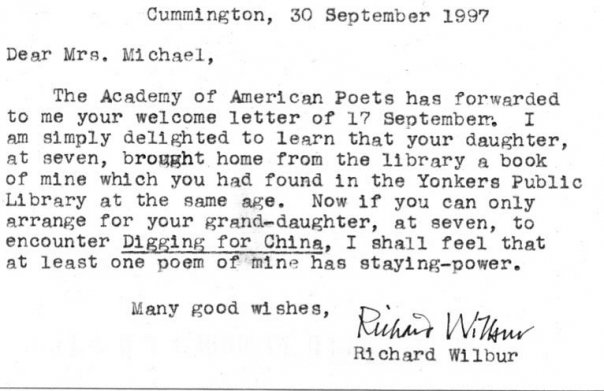
Needless to say, once I had children of my own, we visited the library often. Years ago, I wrote to the poet Richard Wilbur to tell him about my 2nd-grade daughter’s encounter with Digging for China and how, nearly 30 years earlier, I had been fascinated by the book too. He replied with this modest note. June 2009, I saw Wilbur at the West Chester Poetry Conference. What a talented writer, and what a sweet man.

~

Richard Wilbur

Libraries & book love

In my last post, I drifted onto the topic of libraries–and stirred up images of favorite places. Libraries have certainly been among my favorite places and loom large in my childhood memories. Two of those libraries were new when I entered their doors: the Grinton I. Will Library in Yonkers, NY, which opened in 1962 (I first visited in 1964) and the W. Leslie Rogers Library in Pennsauken, NJ, which opened its doors in 1971. I recall a few distinct discoveries even from my first-grade forays to the Yonkers library. It was there I discovered Richard Wilbur’s Digging for China, a book I adored.

Free public libraries represent one of the best uses and most noble purposes of the tax dollars and philanthropic gestures of citizens in a democratic society. These buildings, some grand and some exceedingly modest, harbor banned books and out-of-print books and sections devoted especially to children’s books; a library admits of free speech and liberated thinking for people of all ages. A library, by its very existence, reminds citizens that education matters and that information can be free, can be borrowed, can be disseminated and shared.

When I was a child, libraries were safe places to hide, to explore, and to pursue my own interests–which often varied quite a bit from the interests of my peers. The library in Pennsauken offered me an early education on visual art. I probably borrowed every book in the place that had anything to do with art or artists, from Aesthetic Inquiry; Essays on Art Criticism and the Philosophy of Art to The Agony and the Ecstasy. The library stocked a book chronicling  the letters of Theo and Vincent van Gogh as well as huge, heavy, hard-cover museum books with color plates of famous artwork. Some of these were stamped more than a few times with my library card’s number.

I also borrowed, and read–enthusiastically and, occasionally, dutifully–classic novels that I had somehow learned I “ought” to read. I read a fair number of junky novels, too, and young adult fiction, and children’s books. Even though I was nearly ten when Leo Lionni’s Frederick was published, I loved it and never considered it a “little kid’s book.” Interestingly, Frederick the mouse gathers images and turns them into words. He is a poet. (A word-artist).

Books: Anything, everything, as bibliophile overlaps with autodidact.

Books were my first and often my best teachers, though I have been fortunate enough to have had some wonderful teachers (formal and informal) in my life. One of them, my grandmother Edna Michael, will always be closely associated with libraries in my heart and memory. She was the Story Lady at her small-town library in South Whitley, IN; and my siblings and I spent many hours in the small white building that housed South Whitley’s free circulating books. We read, and we listened to her read. She would don “an olden-times dress” she’d designed and sewn herself, tie on a large matching bonnet, and gather the town’s youngsters in a circle on the library floor for story time.

She always left the library with at least a couple of grownup books for her own reading material. I was proud to be like her.

A few years ago, the town enlarged its library, added a new children’s wing, and dedicated it in my grandmother’s name. Edna Michael, the Story Lady.

I’m pretty proud of that, too.

ann e michael

The South Whitley Library as it was in 1967, with my grandmother in her Story Lady attire.

Poems that help us to endure

I’ve recently completed reading Eugenia Semyonovna Ginzburg’s memoir Journey into the Whirlwind. What has struck me about the memoir is, in particular, Ginzburg’s reliance on poetry as a means to enduring prison, deprivation, oppression.

In several selections, she reiterates how reciting or recalling poetry–Pushkin, Pasternak, Blok, Mandelstam, and lesser-known (to us Westerners) poets such as Tyutchev, Chorny & Nekrasov–gave her hope or encouraged her to keep on in the face of awful situations, or just to remind her that others have endured harsh and terrible conditions and found the means to express themselves despite it all.

I believe poems–and art of all varieties–help us to endure. Some poets who have helped me to endure include Anna Akhmatova, Mark Doty, Mary Oliver, Gregory Orr, John Donne, Yehudi Amichai, Stanley Kunitz, Donald Hall, Emily Dickinson, Adrienne Rich, Marie Ponsot, and others. Too many to name.

Who has helped you to endure? Whose art, whose poetry, whose stories, whose music?

When we reflect on these creations, perhaps we can learn more about ourselves.

“The Atlantic”

 Atlantic by John Sevcik

A few years back, I was privileged to join John Sevcik, his wife Lynne Campbell–who is also a marvelous painter–and a few art students and friends for three lovely days of art talk and plein air painting sessions and terrific food at a beach house in NJ. This painting, by John Sevcik, inspired the following poem, which appears in Water-Rites.

The Atlantic

She and her mother
are knee-deep in water
their backs to the shore

What they discuss
as they look eastward
you cannot hear–

breakers, the wind,
the natter of laughing gulls
cover their conversation

Besides, you are busy
fathoming the sea’s tones
and mixing the sky–

Trying to stake claim
to the reflective shallows
between you and them

At this hour
they are your subjects
as the sea is

and what they say
she will share with you
later. Or she won’t.

It doesn’t matter, you
have set down on canvas
their communion

And your own conversation–
the one between mind’s eye
and artist’s hand.

~~~

Many thanks to John Sevcik for allowing me to post his painting here on my blog. To see John’s other works and find out about gallery showings, visit him at his web page. He is also a teacher, poet, playwright and actor.

Art and “human intelligence”

I’ve gotten almost to the end of Brian Boyd’s intriguing and well-argued book On the Origin of Stories, which makes fairly large claims about sociality, cognition, theory of mind, art, and storytelling (ie, fiction) given an evolutionary perspective (art as adaptation). The first 200 pages lay the foundation for his claims; he provides evidence from the “hard” sciences, most often biology and neurology, and from archeology, anthropology, and psychology, to back up his theory that art is an evolutionary adaptation humans developed in order to live as social animals. And that art is necessary for human cognition in terms of further developing intelligence and the ability to communicate among our peers: it is cognitive play, practice and skill strengthening for mind and muscle.

Big claims, and occasionally hard to “prove” from the hard sciences. I believe he does a good job with that set of proofs, but I’m not a scientist. His claims based on social sciences—anthropology, sociology, psychology—are very convincing; but many people have arguments with those fields because they are so apparently subjective. Most exciting to me is the way Boyd synthesizes neurological findings with evolutionary developments.

Actually, most exciting to me are his chapters on the Odyssey, but that may be because I am a literature geek. He essentially writes a literary analysis of the Odyssey based upon the inferences and findings in the first half of this book (evolution) rather than the customary literary analysis grounded in, say, context or culture of style or theme, ad infinitum. The resulting analysis is, for me, a truly exciting way to look at Homer’s work and why it matters now, as well as why it mattered then.

Boyd comes close to making the assertion that Homer made Socrates possible, and hence all of Western civilization’s philosophy and social intelligence. Of course, he is careful not to go that far in his argument—he steers as far as he can from logical fallacies— but the thought certainly feels planted in the reader’s mind. His argument does suggest that metacognition in human beings is the definer that makes us human, and art as more-than-play separates human from not-human. He also demonstrates that the Odyssey offers great leaps beyond older epics and posits that the author(s) composed the epic for contemporary audiences that were capable of intelligent, sophisticated, “modern” thought processes; the piece is therefore not primitive literature, as some critics claim.

Boyd’s work has also turned my thoughts to how the attributes of attention, perspective and foreknowledge, overturned expectations, audience-sociality, false belief, cooperation and competition work in the poem as well as in narrative. Granted, many poems have a narrative framework, however thinly sketched, but not all of them do. When there is no narrative frame, these other aspects of storytelling (audience expectations in particular) take precedence and can be employed in almost infinite ways, bounded only by imagination and the willingness of the reader to pay attention as the writer earns that attention through a host of innovative or traditional skills.

A last thought…I spent the long weekend visiting octogenarian friends, both of whom are wonderful tellers of stories. The value of such people to human society is priceless:

“Story by its nature invites us to shift from our own perspective to that of another, and perhaps another and another.”  ~Brian Boyd

Outside the (type) box

Many years ago, back when there was a career called typographer, I was one. I apprenticed to typographers because I had superior proofreading skills, a background in art and design, there was a recession, jobs were few, and I was a quick learner. In an essentially blue-collar job, I was decidedly outside the box: I was a 21-year-old female with a BPhil in philosophy and literature. But I was a terrible waitress. So, in desperation, I essentially talked my way into a job at a typeshop in New York.

A voracious reader all my life, I felt attracted to the potential type offered for expression via the medium of words. I’d studied art since the second grade, so the aesthetic side of typography fascinated me, too. I got into the business just as the field was waning due to the innovations offered by phototype methods, digital typography, and the invention of desktop publishing. Nevertheless, typography kept me fed and housed for a few years while I learned to discern the differences between various counters, serifs, descenders, dashes,  x-heights, weights and the rest. I read books on the history of type design and the history of the alphabet itself. My obsession with words and letters kept me inside the typography box, though I suppose I was often more like a stray Caslon e in the Helvetica drawer.

Wood type was no longer in use, but I used to purchase wooden type fonts–the individual letters–and type cases, because they are so folk-art-appealing and so potentially useful. As collectors began to scour flea markets for wooden type, I bought metal fonts and slugs instead; I’m particularly fond of ampersands and dingbats. (If you’re in Wisconsin and you want to see what the age of wooden type in the USA was like, check out the Hamilton Wood Type and Printing Museum.)

Two of the shops I worked at still used metal type occasionally, though they had mostly switched to digitally-mastered film type; and one shop boasted three Linotype machines. Two of the machines worked. The other was there for parts. The typesetters were all WWII veterans, and the smell of molten lead wafted through the building…it really felt like the end of an era. And it was.
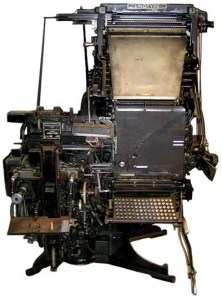
Mergenthaler’s Linotype machine

Working at typeshops engaged my brain in novel kinds of problem-solving and detailed observation, taught me about the lives and careers of men who could have been my great-uncles, satisfied–sometimes–my yearning for aesthetics in the workaday world. An elegant logo or headline still pleases me. I learned about all kinds of odd and wide-ranging things while proofreading, too, while I marked up thousands upon thousands of proof pages; and during my breaks, I read novels. One old-timer at a shop I used to work at told me, “Every proofreader I ever knew read books on his break.” He shook his head as if that were sheer lunacy.

Today, I might note that every computer programmer I know spends his or her break time (and post-work hours) at a computer. It is nice to love something about the work one does for a living.

Typographers today are designers and computer graphics folks who understand how to digitize and digitally set and “cut” fonts for virtual pages. The design tolerances are different, though the challenges of readability and clarity and appropriateness remain. As for proofreaders, there are fewer every year, even though we certainly could use them. AutoCorrect and SpellCheck are woefully inadequate proofreading systems, as I constantly remind my students who don’t know your from you’re or their from there or then from than.

And as for me, I have moved from proofreader and typographer to tutor, instructor, poet…jobs that suit me a bit better, where my quirkiness is more tolerated and thus more conventionally acceptable. I continue to admire thinking and being that is outside of the box, however, and in that spirit I offer you some artwork that moves type outside of its outmoded, old-fashioned box. Click on the cityscapes link to find metal-type cityscapes by Hong Seon Jang. For what artists can do with letters, see also my earlier post on Steve Tobin’s sculpture, “Syntax.”

Fragments…

I just want to re-blog this brief and thought-provoking piece by Michael Klein in Ploughshares:

Notes on Narcissism and the Line

Klein’s musings have inspired me to go back to my drafts of the past year and look more closely at fragments, lines, and the self in the poems.

I’ve also discovered, via Deborah Barlow’s delightful art-centered blog, Slow Muse, the art and prose of Altoon Sultan. Reading and viewing creative pieces and creative critical thinking is a marvelous spur toward one’s own creative endeavors. Although I do risk spending more time online, reading and viewing, than I ought…

Enjoy!

Manet and the Sea: a novice’s view

I wrote this essay about eight years ago while taking a class on writing art criticism with the late William Zimmer. I wrote some more traditional art-crit writing, but I liked this short piece best.

The show “Manet and the Sea” traveled several major museums and was mounted at the Philadelphia art museum in, I think, spring of 2003. My daughter is now graduating from college with a degree in biology.

Manet and the Sea: a Novice’s View

My daughter, Alice, is almost 14. She has decided tastes: a preference for the colors red and purple, for Papillion blue cheese and Belgian chocolates (the darker the better), for anchovy-stuffed olives, for horses, for Gary Cooper and Johnny Depp. She listens to Fats Waller, Tom Lehrer and the Beatles. She has no interest in clothing fashions or in 14-year-old boys. All of this makes her not-your-average teen girl, but she still does not exactly jump at the chance to visit art museums. That’s my department.
Alice therefore exhibited typical teenaged foot-dragging when I bribed her into accompanying me to “Manet and the Sea” at the Philadelphia Museum of Art (expensive chocolate desserts were promised). I attended the show with members of an art criticism class, people she referred to as “art geeks”—not a promising start to our evening together; but that’s what people her age are like and I have learned not to take the sarcasm too personally. She spurned the offer, at the gallery entrance, of a taped audio tour. “Those things are always stupid,” she pronounced. The tour was not exactly stupid; but I did decide, after awhile, that the audio part of the program was the least effective aspect of the exhibit. Alice’s intuition is often pretty canny.

My kid is a widely-read, marginally sophisticated teen who’s been to many art museums but never really shown a huge interest in paintings. On the way to Philadelphia, I asked her if she knew who Manet was; she remembered Monet and Renoir, and Delacroix’s horses, but not Manet. I told her about the scandals that revolved around “Olympia” and “The Luncheon,” and we discussed subjects for art and how those change depending on society’s values. She remembered my passion for medieval art, “all those church-y pictures with saints and halos.” Subjects of the times. But this exhibit would focus on sea paintings, I told her. Boats. Harbors. They’ll be pretty to look at, I said.

And they are. Alice was not particularly taken with the early Dutch naval battle canvases, or with Manet’s “Ship’s Deck,” but most of the other paintings appealed to her. She said of “Ship’s Deck” that “you can tell he knew a lot about boats, but this painting is kind of dull and depressing.” More to her personal tastes was one of Manet’s small, impressionistic canvases, which she returned to admire several times during the evening: “Sailing Ships at Sea” (1864). She liked the abstract but sure brushwork, quick-seeming indications of small boats “with their sails moving the right way” (she learned to sail last summer and is full of the hubris of the newly-informed) and the cheerfully-colored bands of sea and sky. This is a painting she wouldn’t mind looking at every day, she said, as opposed to Courbet’s “The Wave” (1869). She admired the Courbet for its power and deep brown hues, its action—“but it’s almost too much; I would get fidgety having it in my room.” Monet’s “The Green Wave” suited her most among the wavescape paintings. She liked the way the small boats were handling the swell.

Her taste for bright colors does seem to affect her choice of favorite paintings. She liked the vivid blue-and-white poles and bright overall feel of Manet’s “Venice—the Grand Canal” and pointed out to me the small, red sailboat and tiny white seabirds that add to the perfect charm of his “Fine Weather at Arachon” (1871). Color is what appeals to her in the Monet paintings, as well, and was what surprised her most in the Morisot harbor scenes. “Look how much white she used! These are so different from the other paintings,” she observed. “Why do you think she chose to paint those scenes?” I asked Alice. She answered that flags must be fun to paint. Color again.

But tedium sets in, even amid the loveliest gallery of paintings. Alice headed out of the show to view the chanfrons (equine face-armor) in the arms and armor gallery and to wander through the European collections. And after a long wait at a nearby restaurant, she was served a warm, chocolate bread pudding with chocolate sauce, whipped cream and fresh strawberries. I opted for the crème brulée. There is food for the mind, and there’s food for the body; we shared a bit of both. On the ride home, Alice said, drowsily, “All those paintings made me want to take a vacation by the sea.” Yes, Alice—life should definitely imitate art.

Passion, art, doubt

“We work in the dark–we do what we can–we give what we have. Our doubt is our passion, and our passion is our task. The rest is the madness of art.”  ~Henry James

Azar Nafisi cites this James quote in Reading Lolita in Tehran. In her memoir-based ruminations on James, she identifies deeply with James’ ambiguity, a trait in James’ fiction that her Iranian students find complex and difficult. She spends a couple of pages examining the problematic aspects of James’ work that frustrate and puzzle her students even as the same aspects appeal to her. She likes the doubt.

This quote, with its passionate appeal to the task of art, and its uncertainty, likewise resonates for me. My encounters with the ambiguity inherent in art stem from a set of experiences very different from Nafisi’s, and from James’. But our passions are similar in intensity, although I would probably tone down James’ phrase “the madness of art.”

Where did the doubt and the passionate “need to make a task of art” begin? I can probably come up with dozens of possible answers for myself. I’ll mention just one right now, the way I learned to feel about visual art. A framed print of the painting shown here [The Adoration of the Magi, by Fra Angelico and Lippo Lippi] hung on the wall when I was very young. It was the most fascinating object in the house. I spent what seemed like hours gazing at its details, finding the animals among the throngs of people, old men, and young women with their hair in roped braids, children and peasants and half-naked lepers amid the ruins. I knew the story well, but the way it was told in this painting engaged me more completely than any other way I’d absorbed the Christmas narrative. And it was round! It was the only round picture I’d ever seen.

This Adoration moved me, even though I was only six years old. The idealized, pastel paintings of Jesus that hung in the Sunday school rooms were bland and static by comparison; they did not make me want to love the pretty man in the clean robes. But this painting! Even the peacocks adored the Baby Jesus. And yet the picture contained more than adoration and joy. Pain was implicated–the beggars, the cripples–decay was there in the broken-down building. Horses stamped impatiently; some of the people turned away. The whole thing was full of tension and human frailty and doubt as well as gladness.

It strikes me, now, that doubt is one of our tasks; for it is through uncertainty, curiosity, mild skepticism, and a willingness to weather the problems and puzzles of ambiguity that we keep alive our passion for the task of art, to make new, to express, to challenge, and to celebrate. That is what the devoted students in Nafisi’s book manage to cling to as they read “dangerous” books in Tehran. And that’s perhaps what Henry James meant when he stated that we work in the dark.

If the madness of art exerts itself through the tasks, the doubt, and the passionate devotion to doing what we can–well, I can live with that.