Systems

[I am aware that human hair isn’t good nesting material]

Late autumn reveals
oriole’s purse-like nest
constructed of my daughter’s hair.
Breeze touches
what I cannot.
(November 2010)


~

I found this tanka-like poem, written when my daughter was away at college, among some old computer-based file folders I’ve been organizing. It’s one of many old poems of mine I’ve ‘rediscovered’ in the process of trying to keep my poetry systematized. Before I left my job at the university, I imagined that I would manage to organize and update my creative work files during the first year of retirement and keep everything in reasonable order once I had established a system. As if.

It’s not as though I haven’t made progress, made some brave efforts in the direction of archive and revision, culling and filing my drafts and “finished” poems (efforts that are both electronic and paper-based). The fact remains, however, that I do not possess the kind of mind that solves the keeping-track aspects of life very systematically; and, as writing remains a significant part of my life, it suffers from the same inefficiency. I admire artistically-minded people who can keep track of their work using logistically-useful methods that work for them. I’ve read their tips, their essays, talked to them about their systems, tried emulating them. Sometimes parts of their methods are helpful to me, but I lack something. Rigor? Ambition? Energy? The desire to spend the time required?

I keep writing, but I also keep falling behind at staying organized. And then there is the issue of technology constantly updating, so that a method I used in, say, 2015 is not available anymore…unless I invent a bunch of work-arounds. (My long-standing backup method is PAPER, and I still employ it, but I hate file cabinets and folders and don’t use them.) As for spreadsheets? I avoided learning to set them up during my entire career in academia because our department had a brilliantly capable office assistant who did that stuff for us, bless her heart.

All of which means that now and then I cannot locate a draft, a poem I want to revise or to send to a friend, or consider putting into a manuscript. Frustrating. And when I bought a new laptop, I had to decide what files to move from my old desktop; how far back do I want to go? Those poems from 1987, for example–eons ago, as far as computer system lifespans. Yes, I have hard copy from dot-matrix printers. Files originally in AppleWorks and Claris, files that lived on 3.5″ floppy disks. Copies I typed out on various typewriters through the years! Although I’m complaining about it, I realize that in some ways it’s really cool that my poems have undergone so many iterations in terms of tech. It means I have been around awhile and confirms the reasons I think of myself as a writer…and not as an efficiency expert.

~

P. S. I continue to write my drafts with a pen.

Magnificent

Qesra Îshaq Paşa or Ishak Pasha Palace, Ağrı Province, Turkey, Ottoman Empire, 17th c.

For a recent poem draft, I looked up the etymology of the word “magnificent” even though I was fairly sure I knew it. Like many words, its meaning has altered a bit over the centuries, but in this case less so than most: from the old French, from Latin, the root words for “great” and “make,” it formerly referred to great-mindedness, courage, nobility [per the Online Etymology Dictionary] and later gained the additional meaning of splendor or costliness; “Meaning ‘greatness of appearance or character, grandeur, glory’ in English is from late 14c.,” whereas later uses of the word carry connotations of architecture, expensive taste, grand works of a more human variety.

The draft I was working on was about Melville and whales, but of course thanks to stopping to look something up, I went down a research rabbit hole and ended up deciding that the magnificence whales possess would be more of the greatness of appearance sort and perhaps was not quite the way I want to describe whales. But the word did put me in mind of some of the monumental temples, mosaics, palaces, castles, and sculptures I saw in Turkey last month. Many of those are “magnificent,” but they act as reminders of how fleeting human magnificence is, in comparison to whales. Whales evolved into their modern form about 4 million years ago, long before humans were modern humans, let alone building palaces or temples to please the gods, intimidate their enemies or their subjects, or glorify and deify their kings.

The photo below is of the temple and perhaps the tomb of Antiochus I of Commagene (because archaeologists have so far discovered no actual tomb, the existence of said tomb is speculative, though the site is considered to be a hierothesion). The top of the hill is not natural but is a gravel tumulus. Human-made. Gravel hauled up the mountain to increase the size of the mountain and deter potential grave-robbers. Who else would do that work but slaves?

I know the theme’s been written into poetry before, but in these times it seems to bear repeating. Here’s an early draft I’ve been working on, in loose blank verse, in which I invoke a famous poet whose poem on the theme has lasted a mere two centuries. But that’s longer than many an empire has endured.

~

Hierothesion (Nemrut Dağ)

Tomb or temple, likely both, one king’s
angling for a pantheon he’d crafted
on his own, as kings will do when empire
hardens in their veins. They turn to stone.
Minions, memorize my name! (like
Ozymandias, as Shelley can attest).

Tourists scale the tumulus and find,
at sunrise, eagles, lions, and Apollo,
gods of brokenness, unhumbled despite
centuries of disregard. Extinct.

We know him not. And what has made us pause
speaks not of his glory but of our dismay:
how much purely human work, slaves’ toil and toll,
it took, interring him this way, high up
and rubble-laid, to raise him above all.

Where are those workers’ bones? We walk on them.
This we know without a temple or a tomb.


Elegy (dog)

I heard about Laika, the first dog in space, many years ago when I was a child; but on a recent visit to The Museum of Jurassic Technology in Culver City, CA, I learned more about the early space programs in the USSR and the USA and the (mis)treatment of animals chosen for experimental flights. These animals are lovingly portrayed in portraits on the museum’s third floor.

I don’t think I’ve ever written an elegy for my own beloved dog, gone many years now. But I felt moved to write this one. We’re in the All Souls Day period; I don’t know whether dogs have souls, or whether people do, but it seems a good time to do some remembering.

~

Dog in Space

Constrained
while trained,
you kept
your hardworking
heart, your
trusting lack
of expectations.
If you knew
you were to die
it was no different
from the street
except instead
of death from
city’s cold
it was due
to module’s heat.
Re-entry sent
you everywhere,
cosmically dispersed.
Of all the objects
and beings
our kind has
pitched into
outer space
you, Laika,
are most
beautiful
for your
willingness.

~~


Points of view

I ran across something online that made me shudder–and it wasn’t politics or global tragedies but something sillier and more personal. Apparently there was a trend a decade ago of adults reading their adolescent diaries, aloud, in public (see “Mortified”). Ugh. The few times I have been tempted to read any of my old diaries or journals, I’ve stopped after a few sentences. Shuddering. This is less likely to happen with journal entries I wrote in my 30s or later; at least I hear my younger adult self in those words. But hearing the adolescent me, or the young woman of college age? No, thank you. I embarrass too easily.

Yet I found I was thinking today of this passage of Proust’s, which he gives to the character of the artist Elstir:

“There is no man,” he began, “however wise, who has not at some period of his youth said things, or lived a life, the memory of which is so unpleasant to him that he would gladly expunge it. And yet he ought not entirely to regret it, because he cannot be certain that he has indeed become a wise man–so far as it is possible for any of us to be wise–unless he has passed through all the fatuous and unwholesome incarnations by which that ultimate stage must be preceded…We do not receive wisdom, we discover it for ourselves, after a journey through a wilderness no one else can make for us, which no one can spare us, for our wisdom is the point of view from which we come at last to regard the world.”

There’s some comfort in that. I would not call myself wise, but I’m definitely wiser than I was at 15 or 21. I suppose I’m still sometimes “fatuous and unwholesome” (whatever Elstir meant by that), awkward in society, and mistaken in some of my intuitions. But I have discovered myself for myself, with all the pain, sorrow, embarrassment, and joys that such discovery requires, and have developed my own point of view. In addition, I’ve learned that each person holds their own point of view. We don’t all think alike or in concert and may never fully understand one another. That makes the world contentious, yes. And interesting.

Reading Old Diaries

When I wrote about the city
it was as though I knew
I didn’t belong there,
would not thrive—as though
I wouldn’t stay long
and so pressed each line
on page urgently, camera
shutter clicks, each image
framed in fractioned seconds
as people jaywalked and
side-walked, as pigeons
or sparrows alighted to peck
at civilization’s least crumbs,
as young men lovely and
unattainable grew ill, as city
failed to succor any of us,
as my ambition floundered.
Years back. So that what
I recall is what I photographed
or wrote, however inconsistent.
Naively urbane, the city
my youth inhabits lies brittle
in the pages. The past undoes
itself at last. Or I do.

~~
I'm embarrassed to note that I've forgotten where this poem was published. My files are elsewhere at the moment. I'll update if I remember... *It appeared in Loch Raven Review!

Behind the arts

The regional drought has officially ended, and the rain continues. Ironic, then, that the online site Feed the Holy just posted a poem I wrote near the close of a droughty August: “Zen Gold.” Fireflies and bats, while not abundant, manage to enjoy the recent dampness. The monarch butterflies have returned to our meadow, though I don’t catch sight of them on rainy days. But the moist conditions didn’t dampen the turnout or enthusiasm of local citizens who came out in droves for peaceful “No Kings” protests here…in a decidedly “purple-red” area of Pennsylvania.

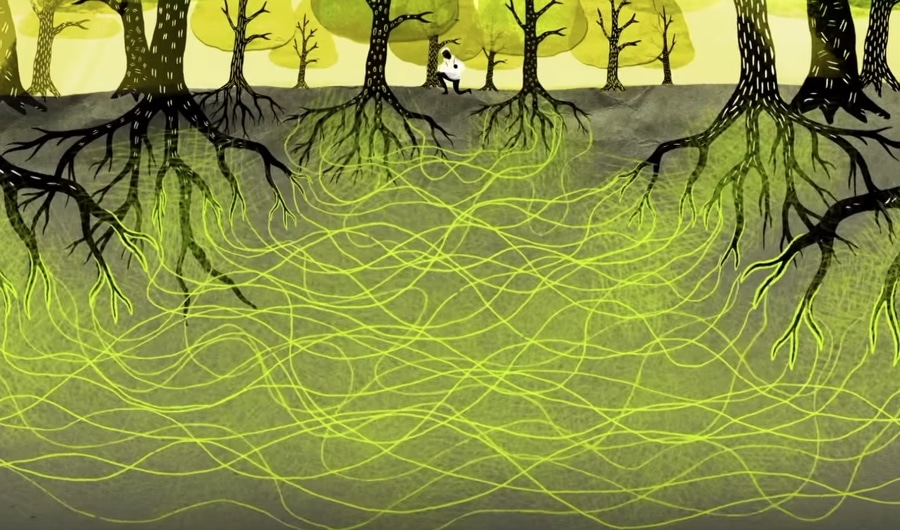
Speaking of regional, this weekend I also attended the debut showing of a documentary film about the performing arts community in Bethlehem, PA, formerly famous for Bethlehem Steel Corporation. The film is titled “Rooted,” and it follows that “roots” idea with the planting of trees at arts sites, the metaphor of the mycorrhizal network (see my references to Lesley Wheeler’s latest book–so much overlap!) and the concept of community development. Especially through works of imagination. In the 1970s, when the steelworks was beginning to slow production and lose employees to retirement and business to competitors, small groups of young, talented artists in theater, dance, music, and puppetry started performing in parks, churches, etc…and gradually found inexpensive space in the city to establish themselves and pursue their dreams. Some of those little startups, such as Touchstone Theatre, have been operating, teaching groups of children, entertaining the community, and advocating for the arts for over 50 years.

Godfrey Daniels coffeehouse/listening room and The Ice House (home of Mock Turtle Productions) have been sites for poetry as well as for music and theater-craft. I have participated in and attended poetry and one-act play readings at both of those venues. I don’t live in Bethlehem, but it isn’t too far away from me–still in the Lehigh Valley region. And I deeply appreciate the work that pioneering arts-folks have done, and that arts advocates and teaching artists continue to do, for our area. The people behind the arts deserve recognition.

I’m not the sort of person who networks well; event-planning exhausts me, and preparing for committee meetings and writing grants are not my forte–though I gladly proofread grants and PR materials for local non-profits. Thus I admire the types of people who not only create in the arts but also find creative ways to keep the arts alive through outreach and planning, often in the face of very steep odds (yes, I’m talking funding here, and board membership, and organizing the necessary minutia, and the grind of public relations). God bless them for making space for actors, musicians, dancers, visual artists, sculptors, installation artists, poets, and visionaries of numerous kinds. It’s because of folks like these that I don’t have to travel all the way to New York or Philadelphia to experience lively contemporary arts of many kinds.

You can think of local arts organizations as the independent booksellers of the performance world. You go there to discover stuff that you won’t find on best-sellers lists, for work that’s by new artists, or work that’s been rediscovered, or cool perspectives on the familiar canon of major works by the famous. That has value. That offers inspiration. That gives you the courage to keep on doing whatever kind of art it is you do. Which in my case is poetry, not generally thought of as as performance art–though it once was, and slam poetry events prove it can still be. Maybe I’m a little more of a hermit-in-the-woods writer, but that doesn’t mean I never want to venture out into the wider arts community. And when I do? I’m grateful for the people who have established the beautiful network under my feet.

image: https://truetimber.net/TrueTimber arborists

Curriculum vitae

My year has begun with half a dozen literary journals declining my poems, but it has also begun with a proliferation of new poems–which makes me happy. There are several reasons for a prolific spurt, some of which involve sad events that have turned me toward reflection. While sorrow isn’t a reliable prod for writing in my case, reflection almost always is. Also, attending a workshop is generative for me.

In last week’s session, we read Lisel Mueller’s “Curriculum Vitae,” and Anita asked us to emulate the poem for our own life story. I encourage you to read Mueller’s poem if you are not familiar with it; it’s full of lovely imagery and is so concise and evocative that it stands as autobiography–quite an amazing piece. Also daunting: how to use that poem as a writing prompt? I needed a strategy, so to keep myself as brief and non-narrative as possible, I limited my version to 15 points instead of 20. Then I edited it down several times, taking out as much as possible while leaving things that feel “true.”

What I realized after this practice in form, and after revising it and tightening it up, is that if I were to start again rather than revise–and were to focus on different aspects of my life experience–I could write a completely different, but still true, poem. I could write a dozen completely true and completely different CV poems! I could have used national events that occurred during my life and had greater or lesser impact on me–the Kennedy assassination, the March on Montgomery, Viet Nam War on television, etc. all the way to 9/11 and since then; or I could have focused on friends and family, their appearances and disappearances from my life; or places I lived or traveled…easily a dozen CVs, curated to present a lifetime.

So while the piece I wrote isn’t a “keeper,” not something I would send out to literary journals, the practice of writing and revising it has been remarkably useful (thank you, Anita Skeen!); I’m more aware than ever of how perspective, focus, and image affect narrative. And of how many ways there are to “tell” an experience, which of course is something poets often do: revisit, re-frame, re-imagine an experience, loss/trauma, or relationship using numerous forms, images, perspectives, speakers, and so on.

Which is certainly one reason Anita asked us to try this exercise.

I did not manage to be as lyrical and concise as Mueller, but then I didn’t expect to; she was an amazing poet. From her poem cited above, I especially relate to the line: “At home the bookshelves connected heaven and earth.” It felt like that at my parents’ house, too.

I’ll be brave and post the practice poem, one of many versions of my autobiography.

~

CV, after Lisel Mueller

1. Three weeks before summer solstice, I enter the world. My father considers me the first perfect thing in his life.
2. Underfoot, meadow grass and church aisles.
3. We move from the manse to the city, where my sister goes twice to the hospital and I walk two blocks to school.
4. Suburban house, square and white as a die. We learn to ride bicycles in the street.
5. Bussing and gas shortage, algebra, barefoot girls in summer. My embarrassment at growing too tall, too thin, too bookish, too moody.
6. Early entry into college. When the only thing I wanted was to get away.
7. In Michigan, snow like I had never seen before.
8. Some years of misery, tedious, purposely omitted. But I meet the people who most encourage me to write.
9. Back to my parents’ kind embrace. Celibacy, recalibration, writing.
10. We meet one summer. I write you so many letters. It might be love.
11. Two children 18 months apart, vegetables in the backyard: it is love.
12. Autodidact in the garden, in the world of literature, in child-rearing. There are cats, chickens, guinea pigs, a beloved dog, but I need to return to study and poems.
13. Loss and joy keep me writing, teaching keeps me busy, children grow and travel far. My books see print.
14. Pandemic.
15. My father dies, my mother loses her power of speech, friends start failing, there are dark weeks. Many hours in the garden, growing and grieving. We hold on, uncertain, but whole.

~

Revising for the personal

I’ve been working on the poem below for 11 months now, and the process has made me think about the purpose(s) of revision, the why of why artists and writers do it. In the case of this poem, I’m revising for entirely personal reasons. My revisions have little to do with creating a stand-out poem that strangers will read and appreciate; I want to tell a particular story about someone I love in a way that might demonstrate, to that person, compassion and some understanding of his feelings. I believe this is a valid purpose for making art, even if it is subjectively personal–ie, not “universal,” not groundbreaking, not timeless.

Certainly, the classic lyric poem, and many narrative lyrical poems, often are addressed to a particular someone. It seems to me that the classic lyrical poem is less based in context, however, and can therefore be read, aesthetically, as more universal. The narrative poem by nature relates its story in a time or place, using contextual descriptions that can become obscure in different eras or locations.

Such is the poem below; it may benefit from some backstory, which I will supply afterward. But read the poem first and maybe let me know if I’m correct. Maybe it will “work” for other readers, maybe not; but it is something I have been wanting to write for my son for awhile now. And he “gets it,” so my purpose has been achieved. 🙂

~

In the Warship’s Belly

How you hated those five days in harbor,
amid steel and cable, fearful each minute but
constrained from showing it.

You prefer to see shoreline and sky.
Discomfort pervaded every hour you spent
on board, walking through hazards,

noting construction, rewiring, repairs;
how you hated the low-ceilinged passages
through which you half-crawled,

wearing neoprene-soled boots and a hard
hat, as anxiety, hyper-alert, worked its
wormy way through your body.

There were power outages that canceled
light completely for unexpected
seconds deep below decks,

then generators’ earthquake roars would
rumble and shake so every wall threatened,
sparks lit up and light returned—

your breath rapid and near wheezing,
tremulous, you inhaled the stale, acrid
diesel-fumed air pushed by industrial fans

through that beast’s belly, that machine
of men’s work, war’s work. Built to threaten
and combat, it felt nothing like a boat, nothing

like the small wooden dinghy of your heart
that sailed the cove, with your little sister,
one summer years ago.
~

Context: When my son was employed doing navigational software de-bugging for a US Navy contractor, the job required a week on board a military ship that was being retrofitted and overhauled in drydock. The assignment took place during covid. He hated almost every minute of the experience and left the job soon after the on-board stint. Due to non-disclosure agreements and national security stuff, he couldn’t really tell us much about why he was so miserable; but he described the circumstances and gave us some idea of how anxiety-producing the tasks were, given the environment and his temperament (which does lean toward the anxious). He was a grown man and quite responsible for himself, so this poem is really about my feelings for him. When those we love are going through unpleasant things, we feel for them.

And here is the dinghy, though it is technically a pram–poetic license.

Verdancy

This report was posted almost a week ago, and the rainless weeks continue; today, fires are climbing their way along Pennsylvania’s forests beside the Delaware River, which looks almost as low as the Rio Grande in Albuquerque when I was there last month. Okay, I exaggerate a bit–but my alarm’s genuine. “No measurable precipitation” here, whereas Valencia, Spain gets a year’s rain in one day and western North Carolina receives 30 inches in two days. This stuff worries me even more than the upcoming election.

I’m not an alarmist, I’m a gardener. When do people start to admit to, and take action about, climate change? (Sorry, rhetorical question.)

~

One theme of the writing workshop I took with Anita Skeen and Cindy Hunter Morgan, as I blogged about here, was color–color as prompt, color as image, color in ekphrastic work, color as inspiration. One prompt was to write about a color you can imagine hating, or a color that you love. It was autumn, and I was in the desert; so I decided to be difficult and write about loving green. Not typically considered an autumn or desert tone, though in fact the high deserts have more green, and in more shades thereof, than most people expect.

Here’s my draft. I used to hate showing unfinished work around, but now I don’t mind doing it. I find the practice of posting/sharing early drafts instructive (and it keeps me mighty humble).

~

Love Is Verdant

Listen, if I were to fall in love again,
it would be with a color: green.
So many variations and hues
ever-changing, surprising me with wilderness,
forest and pine, sage, olive, and moss,
the craziness of chartreuse,
glossy feathers of the teal.
Green as rushes in swamplands, bamboo
on mountains, diverse as rainforests
and summer tundra lichen, yellow-green
of maple leaves early in autumn,
the pitchy green of piñons high up the mesas.
Sure, there have been times I sought for
love that is constant, but now I know better,
for the only constant is change—and green
can accomplish that with as little as breeze
and sunlight, which are likewise things I love.

~

Photo by Pixabay on Pexels.com

Two falls

I have experienced two autumns this October: one in New Mexico, one in Pennsylvania. In the American Southwest, high up in the world, the cottonwood trees that hug every available water source were going a brilliant gold while I was there. Any view above a creek or river revealed a winding path of yellow–along the Chama, along the Rio Grande. The tiny-leaved oaks were turning brown-leaved and dropping scads of acorns along the paths. The oranges and reds are mostly there year-round, on the mesas and in the canyons.

It was wonderful to experience a poetry workshop with Anita Skeen and Cindy Hunter Morgan and to learn how books are made by hand, wonderful to draft some poems using color imagery and ekphrasis, wonderful to meet some fascinating people with whom I enjoyed pushing past my/our comfort zones and into art forms we may have been a bit less comfortable with. These are reasons to attend an instructor-led workshop, seminar, or residency. I spent part of last September in New Mexico, but it wasn’t the most spectacular time for autumn coloration–whereas October certainly gleams in northern NM!

When I returned home, I had missed “peak season” for color in Pennsylvania; my husband said that came a bit early this year because of drought. But it’s still very bright here. The maple leaves haven’t all fallen, most of the tulip trees are still yellow, the hickories haven’t reached peak gold yet, and many of the sassafras are that warm coral color I love so well. The burning bushes? Ours hasn’t dropped its bright fuchsia-maroon leaves. It’s a vivid presence at the corner of the house.

~

Therefore, I have two autumns this year, one sea-level Mid-Altlantic East, and one high-altitude Southwest.

Which strikes me as an abundance of beauty and color. So I am continuing the theme of last week’s workshop. Here’s a new draft of a new poem just for the joy of it. [This fall, those of us in the USA could use a bit of joy.]


I don’t have a title for it yet. Maybe you can help me think of one.

~


The difference between orange leaf color
and orange rock color.
Between the greens of grass and juniper,
the pale dun of meadow’s die-back
and beige sand stretching westward
to the mountains.
Even the clear sky’s blueness
on fair, mild mornings
differs by an almost measurable degree.
Something to do with altitude
and aridity, the science of which
I don’t really understand.
Life’s variations and hues—
striated like cliffs, buttes, mesas,
like hills of maple and hickory in fall—
beautiful and strange.
Even when I close my eyes, color-
memories, all those shades
I can’t define, sift through my skin.
Into blood. Into bone.

Northern stars

Northern Stars (2023) Celestino Marco Cavalli

~

A phosphorescent path
connecting Italy and France
through glowing stones
that look like stars.
A poetic and political action.

~

https://www.celestinomarcocavalli.xyz/work.html

The installation shown here was created by one of the artists I met while at Joya, Celestino Marco Cavalli. The link above will take you to a description of his project. In brief, it is a series of fluorescent-painted stones that follow a trail refugees travel on their way from the Mediterranean, through Italy, and into France. The website does not include the many photographs Celestino took during his 5-month visit there to document the conditions under which emigrants travel–the trash they leave as they abandon belongings, the graffiti and the notes to others they leave in caves and hollows, the prayers they write, the places they shelter from the sun or rain or cold weather. Do the refugees litter the mountain paths? Yes. Do they do so out of desperation? Also yes.

This installation is innovative, compassionate, and political–also problematic; as always, borders between nations are fraught with concerns about each country’s boundaries, laws, rules and regulations. These days, most immigrants taking this trail (through Italy) have come from the global south, where the climate damage wrought by industrial nations has made living in poverty even harder and fostered political unrest. And the immigrants take huge risks–with no guarantees that they won’t be deported, or preyed upon by criminals who exploit their vulnerable status.

I’ve never been a refugee, an exile, an immigrant. I have met quite a few, though–often very young people, students I encountered at the college where I worked, students from Haiti, Dominican Republic, Turkey, Syria, Lebanon, Mexico, Venezuela, Pakistan, Eritrea, Viet Nam, Kenya…and my husband’s stepmother, who arrived at Ellis Island from Austria between the wars. And a colleague who was stranded at college in the USA when the Ayatollah took power in Iran, and a fellow employee from Cambodia, who lost her entire family except for one brother to the Khmer Rouge. Whenever I hear about the politics of immigration (which is often), I think of them: how hard they work, what they sacrificed to get here, how hopeful they are, how challenging their lives have been and continue to be. And their grief.

The following is a persona poem--"A persona poem is a poem in which the poet speaks through an assumed voice" (Academy of American Poets). Celestino's Northern Stars is my "prompt."

~

Refugees

Because we must hide by day
and travel at night, darkness hinders.
The narrow stony trail offers options:
turned ankles, torn skin, or a precipice
that takes us sliding down the mountain,
an avalanche of self, death’s prospect.
No one arrives eager for exile;
we’re just trying to save ourselves,
our families, a few belongings
we used to think were precious.

The way we take may be steep—
everyone knows that metaphor—
what we never expect is how much
it is an unburdening of all
we thought was necessary,
an education in physical need.
Shoes, for instance, more critical
than underwear. Ancestors emigrated
on callused feet without watches
or water bottles. The least cut could
go septic, a child’s wail could betray us
to predators or enemies. Still true.

One by one we let things go, abandoned
in shallow caves with other people’s
remnants, plastic bags and t-shirts,
books, candlesticks, so much trash after all—
even our skins can barely hold what
we need anymore. We arrive shriven,
numb as feldspar, having walked so long.
May we have water? May we rest, with our
children in our laps, and sing the songs
our parents taught us not so long ago.