Imagined discourse, new skills

Despite pandemic restrictions, or perhaps because of them, I have been blessed with poetry the past few weeks. I have attended workshops and readings remotely/virtually, and I’ve participated in a few of those as well as giving one in-real-life poetry reading. I signed up to get the Dodge Poetry Festival’s poetry packet & prompts, and those appear daily in my email. Best of all, poems have been showing up in my mind–I started quite a few drafts in April.

Up to my ears in potential manuscripts (I have at least two books I am trying to organize), I’m also waiting rather anxiously to see whether my collection The Red Queen Hypothesis will indeed be published this year as planned. The virus and resulting lockdowns have interfered with so much. The publication of another of my books matters to me, but it remains a small thing in a global perspective, so I try to be patient.

Meanwhile, I thank poet Carol Dorf of Berkeley CA, who has been kind enough to read through one of my manuscripts and offer suggestions. It’s such a necessary step, getting a reader. I recently enjoyed this essay by Alan Shapiro in TriQuarterly, in which the author reflects on his many years of poetry-exchanges (he calls it dialogues) with C.K. Williams. His words reminded me of my friend-in-poetry David Dunn, who was, for close to 20 years, my poetry sounding board, epistolary critic, and nonjudgmental pal who often recognized what I was going for in a poem better than I did. Shapiro says he feels Williams looking over his shoulder as he writes, even after Williams’ death (in 2015). In a section of the essay Shapiro has an imagined (possibly?) conversation with a post-death Williams, conjuring the remarks his friend might have made in life, or after. I have had such dialogues with David, but not recently. It may be time to try again. Or, as Williams told Shapiro before he died, “Find a younger reader.”

As if that were easy.

Anyway, I continue to learn new things, even things I did not feel particularly curious about, such as Zoom teaching [blech!] and Zoom poetry readings and remote workshops and online discourse. Hooray, new skills to practice! Here’s a taped reading in which I read a few poems from Barefoot Girls, The Red Queen Hypothesis, and a couple of newer pieces. I appear at 31:48 on this video: https://www.youtube.com/watch?v=HFfeoTOVahQ

Though I think you should also give a listen to the other poets, who are worth hearing.

Time to weed the lettuce and spinach rows, time to stoop to smell the lily-of-the-valley. And time to have imagined discourses with my Beloveds.

May brings convollaria into bloom

Wary of unity

It’s true that I appreciate a somewhat calmer political/media cycle, in part because I sense slightly lower levels of anxiety from my friends. I love my friends and feel sad when they express fear and exhaustion. The social and environmental messes we humans have made continue, however, as the pandemic stretches on (my region is still in “extremely high risk” covid territory, though most of the people I know personally have been vaccinated). Many of us continue to endure losses of all sorts. Even if the losses are small ones, cumulatively they aggregate, intensified by the spectre of climate change and virus spread and whatever local bogeymen trawl through people’s lives.

In response to the current difficulties, we keep hearing calls for “unity.” One way politicians and community advocates of all stripes and ideologies endeavor to “make nice” is through the concept of unifying people. It sounds like a good thing, to invoke our similarities and our common human bond in order to achieve…[insert goal here].

I’m wary of calls for unity. It’s not that I’m cynical (maybe a little), and I’ve certainly been idealistic in my time; but long experience and lots of stories and histories and my father’s background in how people behave in groups have led to feeling circumspect about unity. It works with people, yes, but it also leads to the worst aspects of tribalism. To the fostering of rigid ideologies. To acts against outliers, to the construct of evil Others. I’ve recently re-read Reinhold Niebuhr’s prescient and insightful Moral Man and Immoral Society, and his analysis of how humans behave individually versus in groups strikes me as relevant today as it was in 1932. My dad studied with Niebuhr during the latter’s last years at Union Theological Seminary and, reading this book, I find I’m reflecting on the ways this philosopher/theologian influenced my then-young father’s views on humanity.

My dad was an optimist, a Pollyanna, a great believer that God loved each human equally and that there exists in each person the promise of Good (because his God is Good). As my dad matured and experienced more of life and a lot of death, injury, backbiting, illness, pain, misery, in-fighting, and scapegoating–even in the Church–he examined more closely the dynamics of people in groups. Here’s where Niebuhr gets it right, as far as I can tell: people in groups suck.

No, he never says that, and perhaps I overstate. People in groups tend toward tribalism, shunning those who differ in opinion, perspective, or other ways. People in groups lean inexorably toward immoral behavior, even when the group is made up of individually moral people. Again and again, under differing social perspectives, Niebuhr demonstrates that unity thwarts diversity even when group intentions are moral. And, all too often, with immoral results.

My dad never really gave up on the idea that people could successfully deal with different perspectives and goals even in the same group, that there were approaches to group dynamics that would produce win-win outcomes or compromises without sore feelings. In this respect, he was an Enlightenment thinker like Locke. Optimistic, as I’ve said, though I suppose there were times he despaired; indeed, I know there were. Perhaps he recited the Serenity Prayer* to himself when he felt powerless to make a difference. Perhaps the way people in groups behave is one of those things we cannot change and must somehow accept.

For myself, I choose diversity. The earth manages its diversity wonderfully, even when human beings thwart it. Milkweed seeds and thistle find their ways into monoculture cornfields. Plants and insects gradually populate the rubble we make.

When circumstances keep me in a tribe-like bubble, I read books and poems that show me other perspectives, other climes, other social cultures, cities, classes, geographies–other histories than my own. I find ways to explore, in person or virtually, artwork and film work, drama, music, and dances from places I may never visit but without which I would be less attuned to the World. To its wonders, which are many. Insert here, instead of a unified goal all people “should” achieve, Whitman’s “Kosmos” or Hopkins’ “Pied Beauty” with its line “All things counter, original, spare, strange;” or, more contemporary, Vievee Francis’ glorious “Another Antipastoral” that states:

Don’t you see? I am shedding my skins. I am a paper hive, a wolf spider,
the creeping ivy, the ache of a birch, a heifer, a doc.

~

The World, that great unity. That global balancing act. That paradox: Outliers and Others being necessary, and Beloved.

Happy Earth Day, a day late.

~~~

* You may be familiar with the Serenity Prayer, which Niebuhr composed.

Conferencing, distance

Rather at the last minute, I found out that West Chester University’s Poetry Center was hosting a virtual conference during National Poetry Month. Previous WCU poetry conferences have been in person, and often in June; I used to attend when I had the time and money, since I can drive to West Chester in about an hour. For years, my full-time job has interfered. This time, the fee was low and the panelists and readers were people whose work I enjoy. While I could not attend all of the sessions or enroll in a 3-day workshop, I could at least “zoom in” to many of the events.

I’m glad I did. But before I write about this year’s conference, a brief history of my experience at past WCU Poetry conferences.

Initially, the conference poets focused on formal poetry: writing in forms, meters, and employing rhyme at a time when the major forces in U.S. poetry leaned more toward free verse. Dana Gioia was one of the co-founders, and the conference brought in such writers as Anthony Hecht, David Mason, Rachel Hadas, Marilyn Nelson, Richard Wilbur, Molly Peacock, and Timothy Steele…to name just a few (I haven’t forgotten the others, I just cannot list them all!). If you’re not familiar with them, Google their names and locate some of their poems; their work is considered “formal.” By some. The term itself is rather fraught. I’ll skip that argument for now.

It took considerable bravery on my part to participate in the conference the first time I attended, because I was writing mostly free verse, was not an academic, and was more or less acclimated to being a not-very-ambitious stay-at-home mother. I’d started my MFA program, however, and told my advisor that I wanted to learn the things I’d missed concerning historical patterns of poetry. I loved and grew up with rhymed and metered poems but had no idea how to create them. Hence: the WCU conference, which happened to be near enough that I could get away and back for four days and not have to do too much re-scheduling to accommodate my kids, pets, garden, and spouse.

Frankly, I was intimidated. The poets were all so…accomplished. Most were college professors, many were critics, lots of them had written books–lots of books–and even many of the people attending had won prizes and had significant publications. They were keenly and frighteningly “smart” folks, well-read and well-traveled. But after awhile, I felt more at ease. Sam Gwynn, Molly Peacock, and David Mason were hilarious. Rachel Hadas demonstrated intense and generous listening, and was so kind. And I learned so much (and bought so many books…) that I attended at least four more WCU conferences. Then I got too busy.

The Poetry Center and the conference have changed directorship a few times. For awhile, the late (and wonderful) Kim Bridgford, who later established the Poetry by the Sea Conference, was at the helm; currently, the Center’s guided by Cherise Pollard, who came up with the theme that drove this year’s panels and workshops: The Healing Power of Empathy. Healing and empathy are qualities we need when times are hard and seas are rough. It’s important to remember that healing requires change. It’s a change-state verb. Sometimes those changes feel uncomfortable, painful–and empathy can help, as long as we employ it in an active way (empathy as a change-state).

I managed to draft a sonnet in 15 minutes, thanks to Molly Peacock, and heard some new-to-me voices in poetry, and listened to poets who are deeply engaged in the work and art of poetry discuss their processes, enthuse over their influences, and say what drives their curiosity. I found kindred writers who are, like me, endeavoring to put voice to people with dementia and express the grief we experience as our Best Beloveds lose personality, language, ego-consciousness.

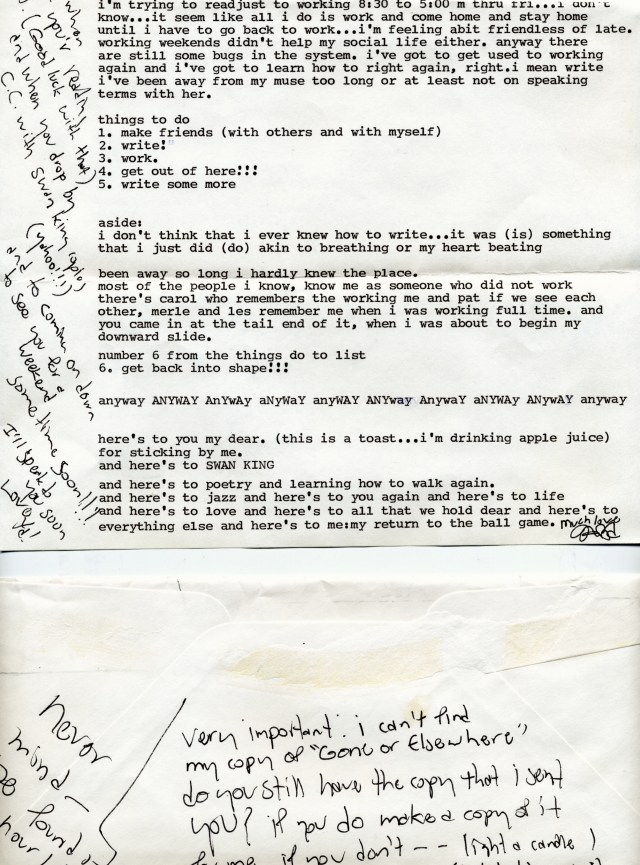
Lesley Wheeler shared the writing prompts her panel put together on her blog, here; she and her four co-panelists (see blog) reflected on feeling across distance, another apropos topic in the current times. It seems we can and do find methods to be human together, even when we are apart. I think of all the letters I wrote when I was in college, and afterward, as I moved around the eastern USA, changed addresses, and tried to keep my friends and family informed as to who I was and what my interests were. In my attic, there are boxes of correspondence written in the days before email. Many of them are now letters from ghosts. Words I will never hear again from living mouths, but a way we kept “in touch” despite, and over, distance. And still do.

Traditions

My dad liked to fly a kite on Good Friday.

I’m not certain how the tradition got started, but I remember as far back as first grade–maybe earlier–his taking us out to a park on Good Friday and sending a kite into the early spring winds. Maybe it was a sort of metaphor for hope, as was the Resurrection, according to his beliefs. Maybe just something to do with the kids when we had the day off from school.

Some years we had more success than others getting the kite aloft. There may be a metaphor in that, as well. What happens when what’s perching on the soul just huddles, dodging the weather and predators? Guano on the ground of the spirit? As a person who gardens, I could really overstretch the symbolism here: fertilization and renewal, so on.

But I haven’t been in the garden for a couple of days–we are having our blackberry frost and it has been chilly. Instead I am thinking about my absent dad and the significance of the holiday in my growing-up years. In church, the purple vestments were switched for white with gold trim on Easter; and my father, in his clerical robe and stole, looked important and shiny behind the pulpit. White flowers, especially lilies, showed up; everyone wore their best spring outfits. I feel nostalgia around these rituals, but they did not settle into my heart and create a believer of me. To my dad’s sorrow. I know my decision to leave the Church grieved him, but he accepted me and loved me all the same. He believed he’d see us in heaven, though he’d admit he had no idea what the afterlife would hold.

Rejoicing in the world’s beauty, the sharing of fellow humans’ suffering, and the way words can express the things that matter–the Biblical poetry–those things have settled into my heart. My consciousness. Hence metaphor and symbol and rhythm, songs of grief and praise.

They rise.

Like the hyacinths and daffodils rising from the half-rotted leaves of previous autumns. Like the flicker rising from the grass after scoring a grub. Like the early morning fog rising as high as the nearby hilltop, then merging into clouds. Like the sprouting kale seeds, the new pea leaves.

Like the thing with feathers. Or a kite.

~

I listened, this afternoon, to Bach’s St. Matthew’s Passion and remembered Good Fridays with my father. That’s all the poetry I have to share today.

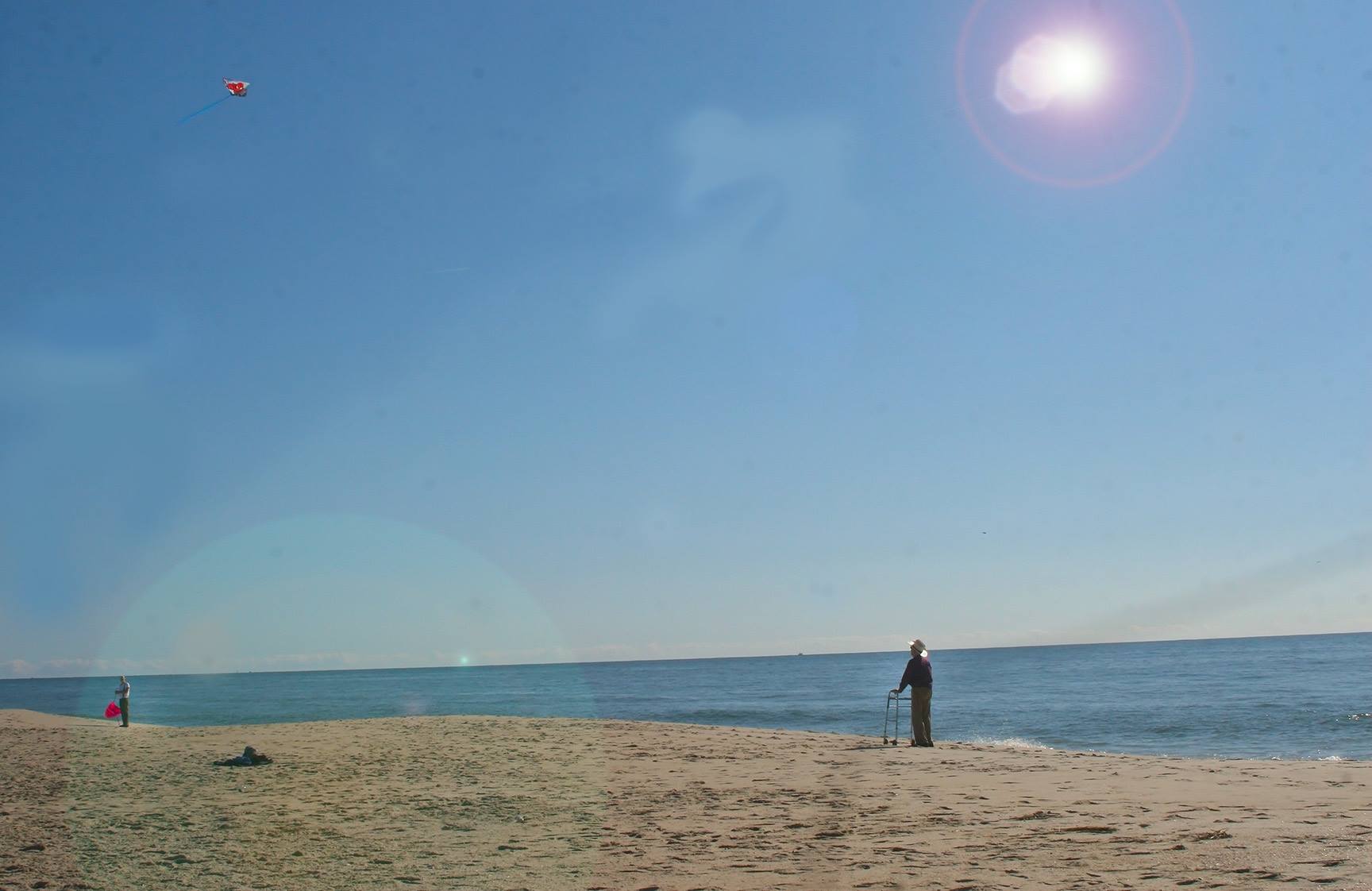
The last time my dad flew a kite was 2016, I think. And it was October, oceanside.

Dad (using the walker, far right) keeps a kite in the air above the Atlantic.

Emergent

emergent (adj.) late 14c., “rising from what surrounds it, coming into view,” from Latin emergentem (nominative emergens), present participle of emergere “to rise out or up” (see emerge).

etymologyonline: etymonline.com

~

Spring equinox.

Very soon–perhaps days from now–the vernal ephemerals will appear. The vernal ephemerals are early spring flowers that thrive low to earth before the trees leaf out: spring beauties, dogtooth violet, squirrel corn, bloodroot, hepatica, and others that look delicate but are, in fact, tough little survivors who have found their ecological niche in the cool days and weak sunlight just post-equinox. We could consider their resilience an inspiration.

Vernal ephemerals sounds to me like a term for sprites, will o’ the wisps, or angels, but it’s a scientific term. I learned it from Tom Wessels (here’s one of his videos on coevolution https://www.youtube.com/watch?v=hCAvBmY7ZgA),* but I have been fascinated by these plants for decades. I have always been the sort of person who walked around with my head either facing the clouds or scanning the earth beneath my feet. Hence, a reason so much of my poetry uses images from nature even when I am not writing about the garden, the meadow, the woods, the sea. My clumsiness a byproduct of my peculiar need to observe the natural environment.

Anyway, hepatica is about as close to a sprite as any blossom I know of.

They aren’t common where I now live. Here, the vernal ephemerals I see most often are trout lily, bloodroot, spring beauty, violets, coltsfoot, trillium. Probably a few others that I’m forgetting because the ephemerals haven’t popped up yet. Still far too cold and a bit dry after a month of snow cover. The emergent greens in my gardens consist mainly of winter weeds, and I’m happy even to see those. Because: green.

“Just a little green like the color when the spring is born” says a line in Joni Mitchell’s song. The green things rise up or out of what surrounds them, coming into view.

I have been keeping under the standing snow, leaf litter, and dross for three months, processing (as the jargon terms it) my father’s death and a new manuscript and a backlog of poem drafts and covid-19 with its attendant disruptions, limitations, and opportunities. But the snow has subsided from all but a few gullies on the north sides of hills; iris reticulata and snowdrops are in bloom, along with the winter-blooming witch hazel. There’s work to do in the garden. Poems to revise. National Poetry Month ahead (April!). It’s the 25th year for this literary celebration.

Time for me, like the skunks and the skunk cabbage and the little ephemerals, to rise out of my surroundings. And take up this blog again? It’s a start. A little green shoot emerging in the chilly sunlight. Hello.

* Thanks to Dave Bonta for the video recommendation

Root

We do not always have words.

Even if language assists in the emergence of consciousness-as-we-know-it, even if the naming of things as sign or metaphor is, as most human beings believe, “uniquely human,” there are the inexpressibles. The things semiotics does not quite register.

Perhaps this obstacle–the obstacle of words themselves–is what made reading David Hinton’s China Root: Taoism, Ch’an, and Original Zen so difficult for me.

~

Vincent Van Gogh, “Tree Roots” Van Gogh Museum: https://www.vangoghmuseum.nl/en/collection/s0195V1962

~

The core practice of Tao seems simple enough, except that our self-identity-based brains do not want to work in that way: not to think of self as “I” at all, but to live in the real world as emergent and ever-changing cosmos watching itself, absent while present, non-being while being, receptive to all change as part of how the cosmos operates, experiencing the hinge of Tao, everything and no-thing. No you or I.

Can I put the concept into words? No. Can David Hinton? Well, sort of (while repeatedly telling his readers that it isn’t possible to put Ch’an into words).

Hinton takes an approach that is partly etymological–based on early and later Han characters in their logograph forms–and partly cultural, namely the influence that Indian Buddhism exerted on existing Tao concepts as Buddhism moved into China during the later Han dynasty. Thus, he divides the text into chapters, each illustrating a significant Ch’an component, practice, or idea.

The logic makes sense, and I have gained a lot of background on culture and Chinese characters in the process; but I cannot call this book an easy read. The blurb says it is “thoroughly gripping” and cites the author’s elegance and clarity. The blurb writer is, however, a Roshi, and thus much more familiar with Zen and writings on Zen than I am. I love the metaphor of the root for many reasons, and that aspect of the book works for me.

~

Another part of the book that resonates with me is the chapter “Rivers-and-Mountains.” After reading Hinton’s explication of the calligraphy and painting meditation practice of long-ago Chinese artists and intellectuals, I have a fuller understanding of Zen as landscape, Zen as poetry, at least as [Hinton theorizes] it was practiced in ancient China. I have always felt drawn into such artworks, and now I have better insight as to why that is.

~

I will have to re-read China Root again and again if I am to understand it, though. Or perhaps just work with more ordinary diligence on landscape meditation made present through poetry.

Even though enlightened awareness–among other things–cannot really be expressed in words. 😉

Festival, virtual

Coronavirus safety protocols continue to affect my teaching at the college and life in general–also, the life of the shared and diverse arts community, near and far. But arts folk are creative folks, by nature problem solvers and think-outside-the-boxers. This weekend, I have been attending the biennial Geraldine R. Dodge Poetry Festival via technological interface (my laptop); it has so far been as mixed and as enlightening an experience as teaching has been for me this semester.

It has been years since I have been at the Dodge in person. Teaching and tutoring are busy for me in October, and I have been free to travel to the festival only once since its move to Newark in 2010. Times have changed, and I have changed. I’m taking notice of what I like and do not particularly like about the virtual platform of the 2020 festival. Bear in mind that I am only marginally tech-savvy and not a person who’s wedded to the screen (television or computer or phone).

First impression, from the “opening ceremony” and an initial panel, is that I like the closeups of the poets–something I seldom had the chance to see when in the crowded auditoriums or tents of past Dodge festivals. As an older attendee, I have to admit I appreciate hearing the readers more clearly. It’s also nice not to have to wait for stumbling about on stage as presenters navigate the stairs, step over wires, chat with emcees, or shuffle through papers and books marked with post-it notes.

There’s a downside, too, of course. I cannot see the holistic figures of the poets, their attire and body language, their posture on the stage. I do not feel the attentive excitement of fellow audience members, hear appreciative murmurs, applause, or the rare but spicy snide remarks. The readings seem somewhat static and prepared (which they have been). The festival thus loses some of its remarkable spontaneity. I suppose I’m referring here to a lost physical community–but all of us should be accustomed to that feeling by now.

On the second night of the event, Pádraig Ó Tuama moderated a panel discussion on the theme “Imagine a New Way” with Martín Espada, Vievee Francis, and Carolyn Forché. The poems were intensely engaging, the readings remarkable; and the discussion among the poets and moderator managed to feel lively and immediate. Oh, notes to take, things I must read, ideas that go ‘pop’ in my head…

The takeaway after day two is that my sense of skepticism about online performance and conference events has begun to wane a bit. True, there is less chance of bumping into colleagues and making connections with fellow poets while grabbing a snack, and the bookstore browsing is not nearly as lovely an experience when the bookstore is online. True, there is much I miss about the hubbub and the buzz of past festival experiences.

Yet it turns out I rather like watching and listening to poets while sitting home in my pajamas and drinking decent, not-overpriced wine in the company of no one but my cat. In fact, at present, the scenario rather suits my mood. And I will be ‘tuning in’ tomorrow.

Short lines, few words

A friend has been sending me the occasional haiku she’s written; she says that the haiku form has kept her busy and creative during a time when her attention feels divided. I am reminded that, in the past, composing haiku has been a useful practice for me, as well–a method of retaining images and moments that might later prove useful in other types of poems..

My colleagues Dave Bonta, Michael Czarnecki, and Marilyn Hazelton, among others, find in haiku and tanka a wide range of possibilities for expression–and compression. Though I suppose that is true for any poetic form or strategy.

I just want to get writing again.

~

This morning I made some attempts at writing again. Writing poetry, I mean–different from my other acts of writing. Writing against frustration, grief, and absence and pain…obstacles, for me, to composition.

If I were a fiercer poet, a fiercer person, I might manage to write in media res, the midst of the goings-on; I might accomplish poems through my anger or sorrow. Instead, I have to wait it out, mull, observe, speculate. It’s just my natural modus operandi.

Maybe I’m lazy, or afraid.

~

No luck with haiku. I wrote a couple of mediocre tanka that might be salvageable once I work on them a bit.

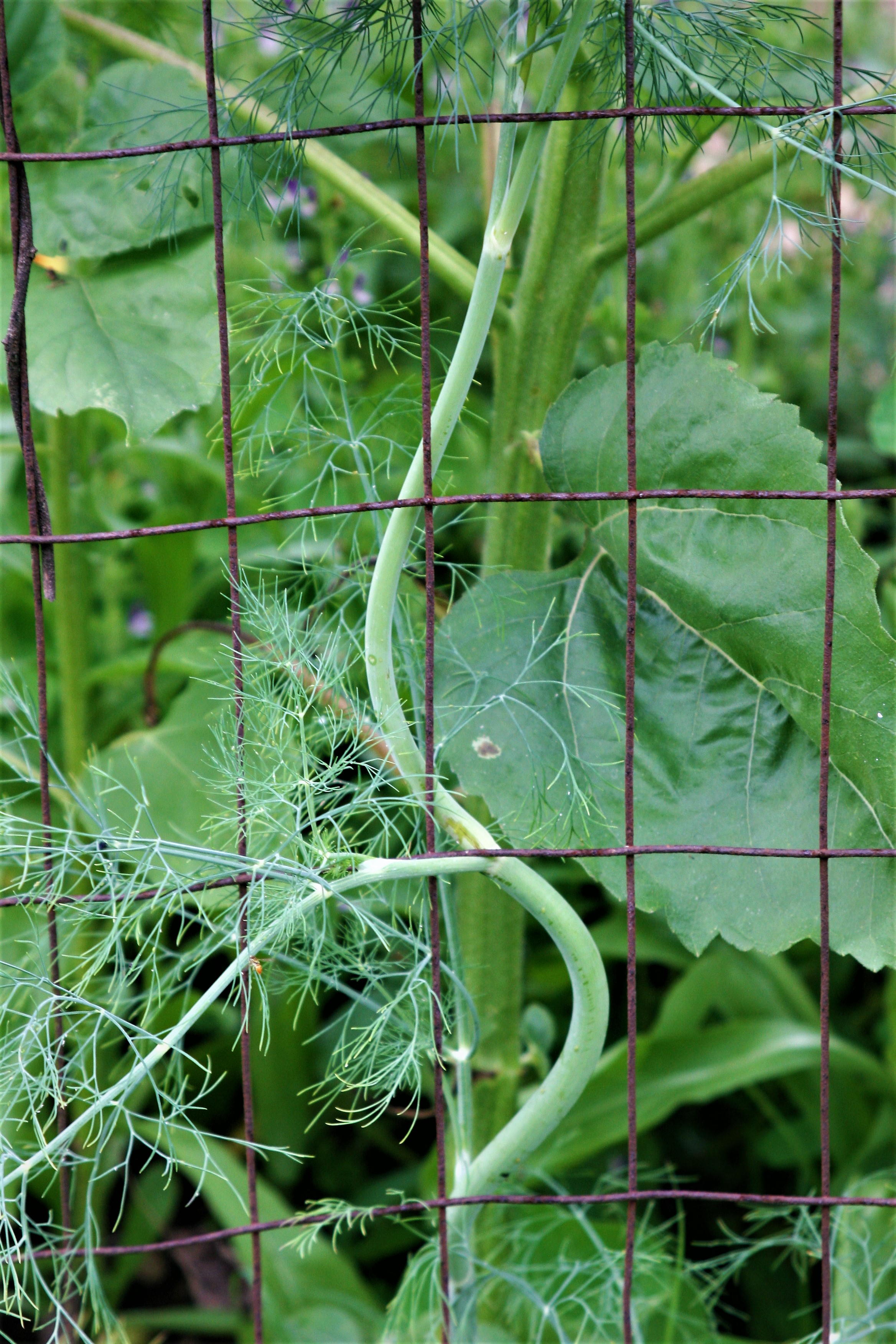
I wrote this–no form, just words. Putting it out there for now, with an illustration. Not exactly haiga, not nearly luminous or complete.

Hey, Muse. This is all I got.

~

Introvert
 
Long-necked gourd
tangled in
its own vine
twists and curls.
There is something
fantastic in its nature,
imprinted in seed,
patterned and tendriled--
an urge to
turn
and flourish
hidden though it is
beneath broad leaves.


zucchino rampicante


Living with history

It’s complicated, history. It engages with things I love, such as art, in complex and often contradictory ways. How did a person with such fascist tendencies write such enduring, challenging work? How could such a misogynist womanizer create paintings of surpassing depth and beauty? Why was a person who was so concerned with the welfare of others so neglectful of his or her family?

Alex Ross, writing about classical music in The New Yorker‘s September 21 issue:

“The poietic* and the esthetic should have equal weight when we pick up the pieces of the past. On the one hand, we can be aware that Handel invested in the business of slavery; on the other, we can see a measure of justice when Morris Robinson sings his music in concert…there is no need to reach a final verdict–to judge each artist innocent or guilty. Living with history means living with history’s complexities, contradictions, and failings…Attempts to cleanse the canon of disreputable figures end up replicating the great-man theory in a negative register….Because all art is the product of our grandiose, predatory species, it reveals the worst in our natures as well as the best.”

People are complicated and contradictory. None is perfect. The worst in our natures can be compelling, even inspirational.

Even in history, where it’s famously said the victors write the verdicts, such verdicts can be overturned, the stories made new, retold from different perspectives, satirized. I love that Ross calls humans “grandiose and predatory” but notes our capacity for creating beauty nonetheless. Rings true in my experience, and sounds a lot like what poets do.

—-

*The terms were coined by semiotician Jean-Jacques Nattiez, with poietic referring to the productive process of art (its creation) and esthetic with the receptive process (its impact upon the listener-viewer-reader).

If you are curious, you can see and hear Morris Robinson singing the bass in Shostakovich’s 14th Symphony on YouTube. (I couldn’t find him singing Handel online).

Break/change

David Bowie famously invites us–or exhorts us–to turn and face the strange. Necessary, especially during times people are wishing things were as they used to be. Change seems a stranger. We don’t want it at our door.

Facing change presents challenges and requires confronting fears. No wonder people resist; yet change is all there is. Without it, not even death (which is all about change). Just stasis. Not-life instead of no-life; un-life.

For now, a break from blogging, from submitting poems to journals, from sending out my latest attempt at a manuscript, from attending readings and conferences and workshops. I might say “it’s all too much” under current circumstances, but the reasons are more complicated and center around transitions of the not-writing kind.

In time, knowing the way my writing process occurs, these transitions will lead to more writing. More poems. Lots of process.

Meanwhile. I’m in the woods. I’m in the garden. I’m even (I think) going to be in the classroom. But it will all look different.

IMG_6972