Play’s the thing

My freshman humanities professor, the brilliant, late Larry Fuchsberg, assigned Johan Huizinga‘s The Waning of the Middle Ages as one of the texts for our course…an unusual choice for American teens in 1975, as was another of our books, Burckhardt’s The Civilization of the Renaissance in Italy. At 17, I found Burckhardt rather slow going stylistically (it was published in 1860, after all); by comparison, Huizinga (circa 1919) was refreshingly clear. I really enjoyed it and learned a great deal. I kept meaning to read his 1938 book Homo Ludens, but for awhile it was difficult to find in libraries or bookstores. Also, I lacked the time to track it down or read it. The premise interested me, though–that we humans evolved our culture from the “pointless, imaginative” urge to play, and that play is fundamental to our learning and our social structures. Also, we are not mechanical beings–the messy frolicsome-ness of people is as necessary for our survival as food, water, and shelter.

“Animals play, so they must be more than merely mechanical things. We play and know that we play, so we must be more than merely rational beings, for play is irrational.” 
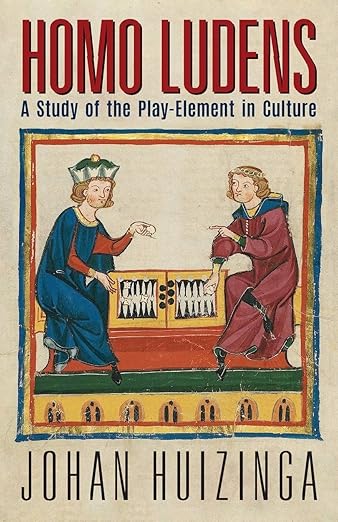
Finally, I’ve begun to read Homo Ludens, and it’s even on Amazon now; also I discovered that it exists online here thanks to Yale University. Fifty years after my initial encounter with the author, I find his thinking just as interesting as I did in college, and just as difficult. As in his other books, Huizinga uses etymology as one of his methods of examining the meaning and culture of play. He was writing for an audience that he assumed was well-educated in the classics, so there are passages in Greek, Latin, and French that neither he nor the English translator bothers to translate for less linguistically-adept readers like me. Fortunately, such passages are brief and are used as sources for his argument, and I’m not reading to find fault with his material. I’m interested in his argument and insights as a whole, and intrigued by his thinking. He apologizes for his lack of sources (ha! There are hundreds of them) because he was “working in haste.” He composed this book in the Netherlands as Germany began to be a serious threat to Europe, and he wanted to get his ideas in print before he was silenced. In fact, his last few years were difficult. He had used his standing as a well-known cultural historian to criticize the Nazis and was arrested in 1942, basically house arrest; he died in 1945 just before the war was over.

I’m only on Chapter 4 but am finding, in the etymological tracings of the words that intersect in meaning(s) for play–game, contest, gambol, gamble, dallying, tournament, match, riddle, performance, frolic, pretending, folly, fun, sport, etc.–fruitful stuff for poetry, for thinking about poems and about how poems work as craft, as poems, and as works of art and imagination. And also, what roles poems may play in culture today, and whether that differs at all from the role poetry played in ancient times. Huizinga writes:

“In the making of speech and language the spirit is continually ‘sparking’ between matter and mind, as it were, playing with this wondrous nominative faculty. Behind every abstract expression there lie the boldest of metaphors, and every metaphor is a play upon words. Thus in giving expression to life man creates second, poetic world alongside the world of nature.”

Language may not be necessary for play but can easily be incorporated into it, and language can become play. Or playful. I don’t know much about Wittgenstein, but I find myself thinking of his theory about words having “family resemblances” that often connect, overlap, shade meanings. So we get jokes, puns, flirting, mocking, and new “rules” for our language use that culture constantly shifts in all kinds of directions. Language is a game-changer, and poets make use of that.

I thank Larry Fuchsberg, musicologist, book-lover, and educator, for introducing me to Johan H. Teachers, you never know how much you may have influenced a student’s life, even decades later.

Magnificent

Qesra Îshaq Paşa or Ishak Pasha Palace, Ağrı Province, Turkey, Ottoman Empire, 17th c.

For a recent poem draft, I looked up the etymology of the word “magnificent” even though I was fairly sure I knew it. Like many words, its meaning has altered a bit over the centuries, but in this case less so than most: from the old French, from Latin, the root words for “great” and “make,” it formerly referred to great-mindedness, courage, nobility [per the Online Etymology Dictionary] and later gained the additional meaning of splendor or costliness; “Meaning ‘greatness of appearance or character, grandeur, glory’ in English is from late 14c.,” whereas later uses of the word carry connotations of architecture, expensive taste, grand works of a more human variety.

The draft I was working on was about Melville and whales, but of course thanks to stopping to look something up, I went down a research rabbit hole and ended up deciding that the magnificence whales possess would be more of the greatness of appearance sort and perhaps was not quite the way I want to describe whales. But the word did put me in mind of some of the monumental temples, mosaics, palaces, castles, and sculptures I saw in Turkey last month. Many of those are “magnificent,” but they act as reminders of how fleeting human magnificence is, in comparison to whales. Whales evolved into their modern form about 4 million years ago, long before humans were modern humans, let alone building palaces or temples to please the gods, intimidate their enemies or their subjects, or glorify and deify their kings.

The photo below is of the temple and perhaps the tomb of Antiochus I of Commagene (because archaeologists have so far discovered no actual tomb, the existence of said tomb is speculative, though the site is considered to be a hierothesion). The top of the hill is not natural but is a gravel tumulus. Human-made. Gravel hauled up the mountain to increase the size of the mountain and deter potential grave-robbers. Who else would do that work but slaves?

I know the theme’s been written into poetry before, but in these times it seems to bear repeating. Here’s an early draft I’ve been working on, in loose blank verse, in which I invoke a famous poet whose poem on the theme has lasted a mere two centuries. But that’s longer than many an empire has endured.

~

Hierothesion (Nemrut Dağ)

Tomb or temple, likely both, one king’s
angling for a pantheon he’d crafted
on his own, as kings will do when empire
hardens in their veins. They turn to stone.
Minions, memorize my name! (like
Ozymandias, as Shelley can attest).

Tourists scale the tumulus and find,
at sunrise, eagles, lions, and Apollo,
gods of brokenness, unhumbled despite
centuries of disregard. Extinct.

We know him not. And what has made us pause
speaks not of his glory but of our dismay:
how much purely human work, slaves’ toil and toll,
it took, interring him this way, high up
and rubble-laid, to raise him above all.

Where are those workers’ bones? We walk on them.
This we know without a temple or a tomb.


Blue

At one of our local used book stores,* I found a copy of William Gass’ 1976 On Being Blue: A Philosophical Inquiry. Gass writes in a style one might term prolix; but if you are like me and sometimes appreciate lists, wordplay, allusions, lengthy sentences, and fine distinctions in your sentences–as well as humor–while exploring the limits and the stretches of words and language, this book-length essay on the word/concept/color/iconography/sexual innuendo/moody attitude and conflicting meanings of the word blue might appeal. I’ve been feeling a bit on the blue side lately, hence my attraction to the book (though I do like Gass as a writer, as long as I don’t have to read too much of him at one time). And guess? It cheered me! [I will caution the reader who avoids the use of “bad language” that Gass employs such words in this essay, for purely intellectual reasons…]

Granted, my feeling blue has a different tone from other uses of the word: blue postcards, sexual meanings of blue–I’m reminded of the movie “I Am Curious (Blue)” which was considered racy and given an X rating when I was a kid, though the blue in that title referred to the Swedish flag, apparently. My blue is the blue of songs like “Baby’s in Black” or Joni Mitchell’s “Blue” album. Or just that classic music form, the blues.

And I’ll get over feeling this way. That’s what moods are: feelings that come and go, transitory. It always seems as though low moods stay around longer than neutral or cheerful ones, but many scientific studies show that it is our perception and memory of the negatives that make us think we are sadder for longer. Even Wikipedia has an entry on negativity bias, with some sources if you want to check things out yourself. As I age, I realize that bad moods and sad events and past mistakes don’t need to stick around as much as I used to think. A bit of mediation, some practice and readings in Zen and in psychology, a lengthening perspective on life’s vicissitudes, some counseling and even some medicine; whatever it is that’s brought me here, I recognize that before long the depressive hours will lift. Also I know some methods of thinking that assist me to move to more neutral ground.

I will note there are many kinds and hues of blue, enough for Gass to write 112 pages on it and for the word to appear in 85 files of my own poetry during the past 12 years–I did a quick word search just to find out. That is in the files alone, and each file contains many poems. so I can only imagine how much I have over-used the word in my writing life! Certainly, not all of those blues are sad. Many are beautiful, sunny, the blues of blueberries and balloon flowers, the New Mexico sky, mountains and oceans; teal-blues and turquoise, the bright royal blue I like to wear, the pale color of robin’s eggs.

Blue. It has always been my favorite color.

~~

*The bookstore is Apport, in Emmaus, PA. Ben has an active Instagram feed and really cool catalogues of odd books, art, and ephemera.

*The first “blue” above is an encaustic painting by Deborah Barlow; the second is at Bandolier National Monument; the third is of the Blue Ridge Mountains; the last was taken at an inlet bay, maybe in Delaware–I’ve forgotten.

Good w/words

I hear it often from people: “You’re a writer, you’re good with words.”

What I’m reflecting on while in a space where I have the time to reflect is that maybe, some writers are those folks who are not by nature “good with words.” Words, we may have, yes! We love words, love to read, love books, love poetry, love language. But that doesn’t mean that words come easily. We may have to work for and with them, rearrange and revise, check meanings and spellings, consider etymology and new ways of using words.

It may be we wrestle with them and, like Jacob with the Angel, find the process causes injury as well as revelation.

A study by Marc Chagall for his Jacob Wrestling with the Angel, ca, 1963

Writing may be a cat that follows us home when we really have nothing to feed it and our apartment building doesn’t allow cats, but there it is: needy and appealing, sitting on our doorstep.

For many writers, words are hard. As Virginia Woolf wrote, “Oh to be silent! Oh, to be a painter!” Some writers might prefer to be making a non-wordy art. Less energy to expend on how to say.

I know I can speak for a few writers when I state that, at least sometimes, words can be easier to write than to speak. If I’m chatting to somebody about my family or the garden or my opinions about online learning management systems (LMSs), I don’t usually have trouble with words. Those concepts stay within the familiar and the easy-to-express, even among people I barely know. In such conversations, I can be lively, make jokes, have opinions, and tell stories. This is social speech of a casual sort, even when the subjects are often close to my heart (well, not LMSs…).

But many things that are either more philosophical or more deeply reflective, even intimate, evade me when I try to say them in conversation. Questions I have, I may fear to ask. Describing a feeling, sensation, or emergent idea can be so difficult I decide just to stay quiet, listen to what I can glean from others. If my fellow conversationalists are patient and sympathetic and stay with me through more abstract, emotional, or artistic/philosophical topics, I will still find myself losing the thread of my sentences and tapering off into gesture. Gesture covers (badly) what I can’t seem to put into words. Even though I am supposedly good with words.

Later, I may endeavor to express in writing what I wanted to say when I resorted to silence. Writing is not the heat of the moment–there can be revisions, honing of concepts, maybe some research to cover the various vague lacunae during which I’d previously resorted to shrugging. Shall we say: clarification of thought through better words in a better order.* I may never learn to be adept at succinct intellectual conversation, but I can eventually get to compression of language for effect in a written text.

That would be enough. Or maybe it’s as David Kirby writes in his poem “The Wreck of the Edmund Fitzgerald”— “Writing isn’t hard./You just have to be patient. You just have to get/everything right.”

~

*Samuel Taylor Coleridge‘s definition of poetry: best words in the best order.

Novels & words

When I was about seven years old, I discovered books offered me a way to immerse myself in adventure and temporarily escape life’s discomforts. Novels, and later, poetry, were the genres I turned to most often. Though I also liked history, science, biographies, and art, there was something about a piece of sustained fiction that enthralled me so deeply I could easily ignore anything around me: the television, my siblings’ bickering, the vacuum cleaner, my parents’ calling me to dinner. In later years, immersed in a book, I risked going late to class or missing my stop on the F train. The only area of my life where I understand what is meant by hyperfocus has been reading.

Then I had children, which changed everything. I remained an inveterate reader, but I found it far easier to get through non-fiction, poetry, essay or short story collections, and literary memoirs than to devote myself to novels. It was simply too easy to get lost in a book of fiction, to wrap myself in those worlds to the detriment of my own. Too easy to become irresponsible to life’s requirements, which were suddenly so many and so urgent. If my situation had been different–let’s say, commuting by train for half an hour or more daily–I might have continued reading a hundred or more novels a year. But I was home in the rur-burbs with two young kids, and I could read only in short spurts throughout the day. Granted, I read a lot of books to my son and daughter, some of which were new to me and most of which were fictional…but a bit below my grade level.

Those children are in their 30s now, but I became so accustomed to the non-fiction genre that only recently have I begun to turn back to my first love, the novel. Granted, I did my reading-all-of-Dickens stint during covid, and I never completely abandoned reading novels; but I got out of the habit. Because my workplace office is now in the library, however, I have been picking up the occasional, usually contemporary, novel that appears on the library’s New Acquisitions display. This is where I found R.F. Kuang’s book Babel, or The Necessity of Violence: An Arcane History of the Oxford Translator’s Revolution. Imagine an alternative Dickensian-era Britain, with the underlying power struggles between education and political power as per Pullman’s His Dark Materials series, and the almost-believable otherworldliness (and creative footnotes) of Susanna Clarke’s fiction…with the late-adolescent outsiders who bond over knowledge that cements the Harry Potter books…and add some genuinely academic background on linguistics and etymology.

That’s about as close as I can describe Babel by means of other books, but what I really enjoyed about the novel is the way it got me thinking about how dismayingly interconnected education and scholarly pursuits are with power structures such as governments, politics, wealth, and colonialism. Kuang deftly shows her readers how the focus on knowledge that her characters love and possess talent for inevitably leads to a narrowness in their perspectives that differs almost dangerously from an uneducated ignorance. They are good young people, but they operate as elites in a fundamentally callous system. The system either corrupts or smothers. The “fun” part of her world construct is that power operates on the use of words: on languages and their etymologies, which are magical enhancements.

But of course, power does hinge on the use of words, doesn’t it?

The question this poses in my mind has something to do with poetry, with the writing of it, the speaking of it, its use of words that are not magic but can carry with them a power to evoke that seems pretty magical at times. Reading this novel was not only entertaining (sad, thrilling, surprising)–it got me, after I’d completed hyperfocusing, to reflect on ideas that twine with the roots of poetry. To me, that’s the best takeaway from any reading experience.

Life-shifts

This week marks one of those “big birthdays”–my mother turns 90. The birthday feels bittersweet; for, in many ways, I have been in the process of “losing” my mother since her diagnosis of vascular dementia in 2017.

Or is it that she is losing? Losing cognition, a sense of time, the words to say…anything at all. She has not yet lost a sense of emotional self, though I know that if her body doesn’t give out first, that will eventually occur. I’ve been through this before, with my mother-in-law. Helping people navigate dementia is a challenging task.

Therefore, as I celebrate her birthday, I also celebrate the goodness of the people (nurses, CNAs) who assist her daily at her skilled-nursing apartment, the social worker who visits with her and brings her mail, the acquaintances who smile and greet her even though they know there cannot be conversation (of any meaningful sort). The doctors and nurse practitioners who find ways to communicate with her about how she feels physically. It cannot be easy, even with someone as even-tempered and pleasant as my mother continues to be.

A funny thing about my mom. When she was my age, we used to tease her and my dad about “getting old.” She’d toss our teasing aside by insisting, “You’re not old ’til you’re 90!” Even with a few health issues, she and my father continued to be curious about the world and the people in it, traveling, going to parties, trying new things (cross-country skiing, Thai cuisine, activities with grandchildren). About 8 years ago, when my dad was ill with cancer and meningitis and going in and out of the ICU, Mom said she felt old. We retorted, “But Mom! You’re not old ’til you’re 90!”

Now she really is 90. Bless her good kind heart. ❤

~

February 26th is just another day, another year–and at this point, my mother has very little sense of time. It is likely that my mother’s life-shifts are in the past, and the next shift (there’s no escaping it) will be death; but who can tell? My mother’s ninetieth feels like a huge shift in my life as her daughter, as an adult, as a mother to grown people, and as a writer in the world. Why this is so, I can’t say. It’s certainly something I’ll be reflecting on often in the coming years, and the reflections emerge in my writing. As I work on revising the poems I’ve drafted in the past 5 years, the topics of aging, mortality, aphasia, and memory keep showing up. Things I can consider myself fortunate, perhaps, to be preoccupied with, rather than being forced into confronting a natural disaster (Pakistan, Turkey, Syria, and others) or war (Ukraine, Syria, and other regions).

Here’s part of a poem I’ve been wrestling with lately.

                       ... --I would untangle
my mother's mind if I could be let access to its
recesses, but those stay hidden like the life in hedge
and meadow, in the woody undergrowth,
unknowns twisted together, impenetrable.
...

How fortunate for me that my mother is not far away, is well-housed and safely cared-for, and has had a long, creative, fruitful life to celebrate this weekend. Nonetheless, the grief inheres. The hardest shift? I miss the person she has been all my life until recently. And yet: here she is. Herself, more impenetrable than ever. And loved.

~

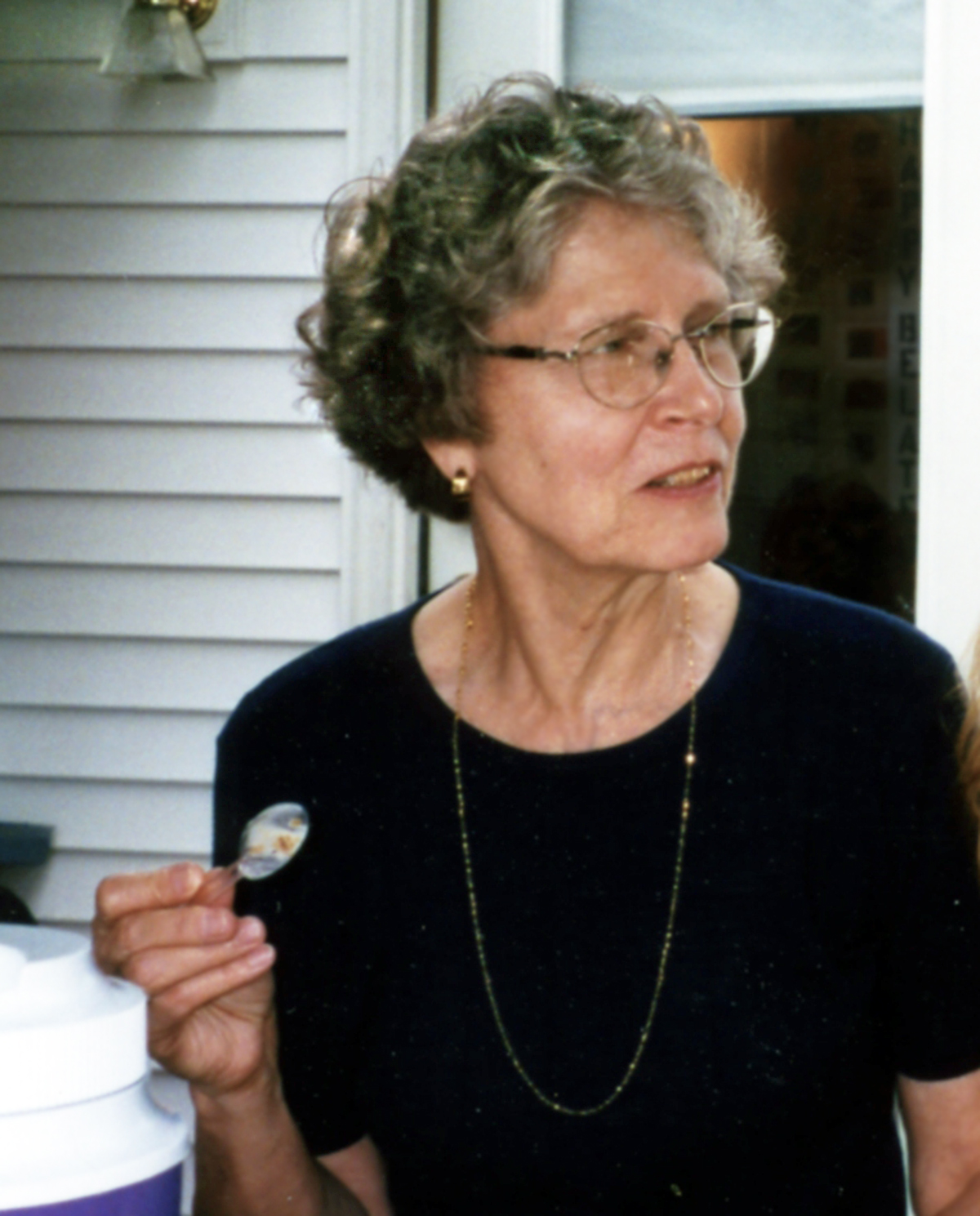
Mom at about my current age–ca. 1998 or ’99.

Words fail, & yet–

On December 24, 2012, I posted about a school shooting. So little has changed.

Words fail. And I work in a classroom setting, as do many of my friends and colleagues, and my children’s friends and colleagues (now in their 30s and willing to be teachers–bless them!). These events are not things we can ignore by staying in our own little bubbles of “it can’t happen here.”

~

Words have failed so profoundly that I’m out in the garden instead, or indoors cleaning my bathrooms or reading books. Books–always my solace when my own words fail.

My latest good read is David Crystal‘s 2004 The Stories of English, already out of date in its last chapter–a fact I’m sure he gleefully acknowledges. I adore his love of how language evolves and find his non-prescriptivist approach refreshing and necessary if we are to keep literacy and communication alive. This book gave me so much information, enriched the knowledge I already have about our language, and made me laugh, too. Granted, it is word-geek humor…but that’s how I roll.

And I needed a few laughs this past week or so. My heart aches; I am sore afflicted for more reasons than I care to explain at present, though the headline news certainly has much to do with my mood. Crystal’s book got me thinking about the course I teach (come fall) and how I’ve already toned down the prescriptiveness in order to convince my students they can write and can be successful with written communication; that they are not “wrong,” just that their audience for written work differs, in college, from high school and from text messaging and other forms of writing. Crystal says we who teach English need to get over the concern about split infinitives and pronoun antecedent agreement and focus on clarity and genuine expression. I have no argument with him there–but many people I know would quibble and complain. And the English lexicon offers us so many options for how to say we disagree!

~

A book about words–but no, a book about human communication through the mediation of words, spoken and written, and how we got to the forms (plural!) of English we now use to express ourselves. There’s a kind of splendid optimism in Crystal’s thinking about language that somehow made me feel a little less low in spirit. Ah, yes. The solace of books.

Few words


red barn     long shadows
rust-colored hawk descends
and vanishes


~

moon above
neighborhood children
sun above hills


~

the day before traveling I am already traveling


For example

Still mulling about how language changes and whether or not I agree with Emerson:

“Language is fossil poetry. As the limestone of the continent consists of infinite masses of the shells of animalcules, so language is made up of images, or tropes, which now, in their secondary use, have long ceased to remind us of their poetic origin.”

Ralph Waldo Emerson

Well, maybe not the tropes’ poetic origin but the words’ cultural origin. Their social origins, because language is inherent in human culture–we must communicate to survive. And if that means language includes words with violent origins or male hierarchical origins or race supremacist origins or nationalistic origins, the words cannot so easily be erased. We use them as they are, regardless of their nasty backgrounds, tropes and metaphors and all. An accretion of meanings alters the words as cultures evolve and change.

That doesn’t mean we should not critique or examine our words.

In a decade or two, terms change. Jargon, technology, politics, culture all exert forces on how we say what we mean. Here’s an example from my own experience as a creative writer. I wrote a poem in 1983 (published in a journal I cannot at the moment recall), a poem about yearning, in which the speaker observes a male-bodied person who dresses as a female. In 1983, the most respectful word to use for such a person was “transvestite.” Hence the title I chose for the poem: “Transvestite on the Long Island Ferry, July.”

Perhaps the person in the poem was not transvestite but transgender (though that was very rare in 1983)–or “gender-fluid.” In my poem, the observer/speaker uses the pronoun “she.” The observer can only speculate and does so on the speaker’s terms. Without the word transvestite in the title, the poem could be more generally understood–as, say, an older speaker watching a young female.

As the writer of this poem, I’m not going to revise its terminology; but I might change the title if I were ever publish it in a collection (this poem, nearly 40 years past its composition, has not appeared in any of my books). Given that, here it is–with a change in title and nothing else. What do readers think?

~~

On the Long Island Ferry, July
 
She leans against the deck rail,
  her red dress an amaryllis
    in a khaki sea.
 
I notice she is unfamiliar with the problem
  of holding a dress down over her backside
    while keeping the wide white sunhat in place—
 
and what to do with the matching bag?
  That kind of awkwardness
    marks her as an amateur.
 
I think, she wants womanliness
  like in the movies—
    La Dolce Vita, maybe—
 
she hasn’t learned, yet, about women.
  I could laugh at her impression,
    but I understand her longing.
 
She stays at the rail, struggling to enjoy flirtation,
  the barfly wind pestering her relentlessly,
    Hey honey, wanna go out?
 
Boozy breezes disarrange her hair,
  grab at her panties,
    try steering her to a quiet corner.
 
But she stays put. I sympathize with her need
  to drink in the restless waters of the Sound,
    feeling new in her body: bright, swirling, real.
 
I watch her from Bridgeport to Long Island
  with a kind of envy, unable to recall
    the last time I longed for anything so completely.


~~

Naming names

A friend sent me the link to this NY Times article and asked my response as a gardener and as a writer who teaches writing. She wondered whether the flower-name Mexican hat (a type of coneflower) is racist, and if a flower resembled a beret and were called French hat, would that be racist?

“This Moth’s Name Is a Slur. Scientists Won’t Use It Anymore.”
https://www.nytimes.com/2021/07/09/science/gypsy-moth-romani-entomological-society.html?referringSource=articleShare

She has given me much to think about. I suppose people ought to use the botanical name to identify such things, but most people aren’t going to refer to gypsy moths as Lymantria dispar. Though if you look at the botanical names, those too bear some consideration as Eurocentric or white supremacist, given their inherent background: so many plants are named for their (colonizing) European “discoverers” or have names that mean “ugly” or “stinky” or, in the case of Lymantria dispar, “ill-suited and unlike.”

The reason Mexican hat (or French hat, for that matter) might be considered racist is that they are inherently stereotypes. Mexico is a huge and diverse place, and not everyone there wears a sombrero any more than all French people wear berets. I suppose we could call them sombrero flowers. That would be naming them by what they resemble. And we could call Dutchman’s Breeches pantaloons flowers. That’s a whole lotta name-changing going on, and the likelihood that everyone will take to the new names? That, only time will tell.

As to gypsy moths, the name was dubbed in a derogatory way–as in, “We don’t want those traveling gypsies around (and that’s what these moths are like).” So, it is a slur. A verbal aggression against Romani people who were already tagged with a name someone else gave them (the etymology of the name is here: gypsy).

Hypothetically, we could continue to call the moths gypsy moths; but when we use the term, we can tell our children (for example) it used to be considered a bad thing to be a gypsy, but the Romani people aren’t bad and neither are the moths–the moths are just being moths and doing what moths do. It’s people who brought them to a place the moths could end up being so destructive that we now have to kill them or discourage them from breeding here. [BTW, it was the white European people who colonized the American continent who brought the moths here.]

Yes, that’s complicated. Most people don’t want to go to the bother of subtle explanations. So sometimes a name change is actually simpler. People complain about “politically-correct language” and changing English into something it shouldn’t be…it can be difficult to keep track of.

But because English is a living language, I expect and generally accept changes to the language as there are changes in our living culture. Am I always happy about “verbing a noun” or use of the words “impactful” and “relatable” or mixing up “lie” and “lay”? Um, no. Does the speed of change make my job more difficult? Why, YES! But if a person makes me aware of sensitivity in language, such as stereotyping, I respect that. It makes me reflect on language and culture.

The beauty of the world in which we reside. Here’s Ratiba columnifer (the flower formerly known as Mexican hat).

https://www.highcountrygardens.com