Key images

I had intended to post on Denis Dutton’s book The Art Instinct: Beauty, Pleasure, and Human Evolution; and I will (I suppose) at some point, because I enjoyed it immensely. Looking through my files, however, I found the transcripts from the initial interview Karen Jogan and Hernán Pereira conducted with me when they were compiling the book So Far…So Close and realized that my answers to some of their inquiries connect with my last post about poetic voice and Kunitz’s thoughts on key images. (The longer, but edited, version of the interview appears in the book).

~~

  1. What colors or aromas remind you of your childhood?

Cinnamon toast, mown grass, onion grass (wild garlic), lily-of-the-valley, cedar-water and pine trees, the scent of a muddy river in summer, wintergreen, play-dough, school paste, steam-irons, fresh peaches, campfires, burning leaves, talcum powder, Pepto-Bismol, air-dried clothes and linens, mimosa blossoms, roses, strawberries.snowdrops

  1. Describe yourself as a child.

I wonder from whose perspective I should attempt to answer this question. I know from others that I was considered to be shy and polite, talkative when comfortable, imaginative. I certainly felt uncomfortable among groups of people, preferring small groups of friends with whom I played make-believe. I made up stories which I told my sister and brother, and when I was old enough to write I made little children’s books that I illustrated and bound in cardboard.

My sister was my best friend, but I spent a good deal of time all by myself. When alone, I walked my dog, climbed trees, played on the swings, sketched and painted, and read books. I really was a bookworm and spent many happy hours with books and in libraries. Being alone was, and still is, deeply satisfying for me—it helps me regain creative energy.

  1. At what moment in your life did you begin to write?

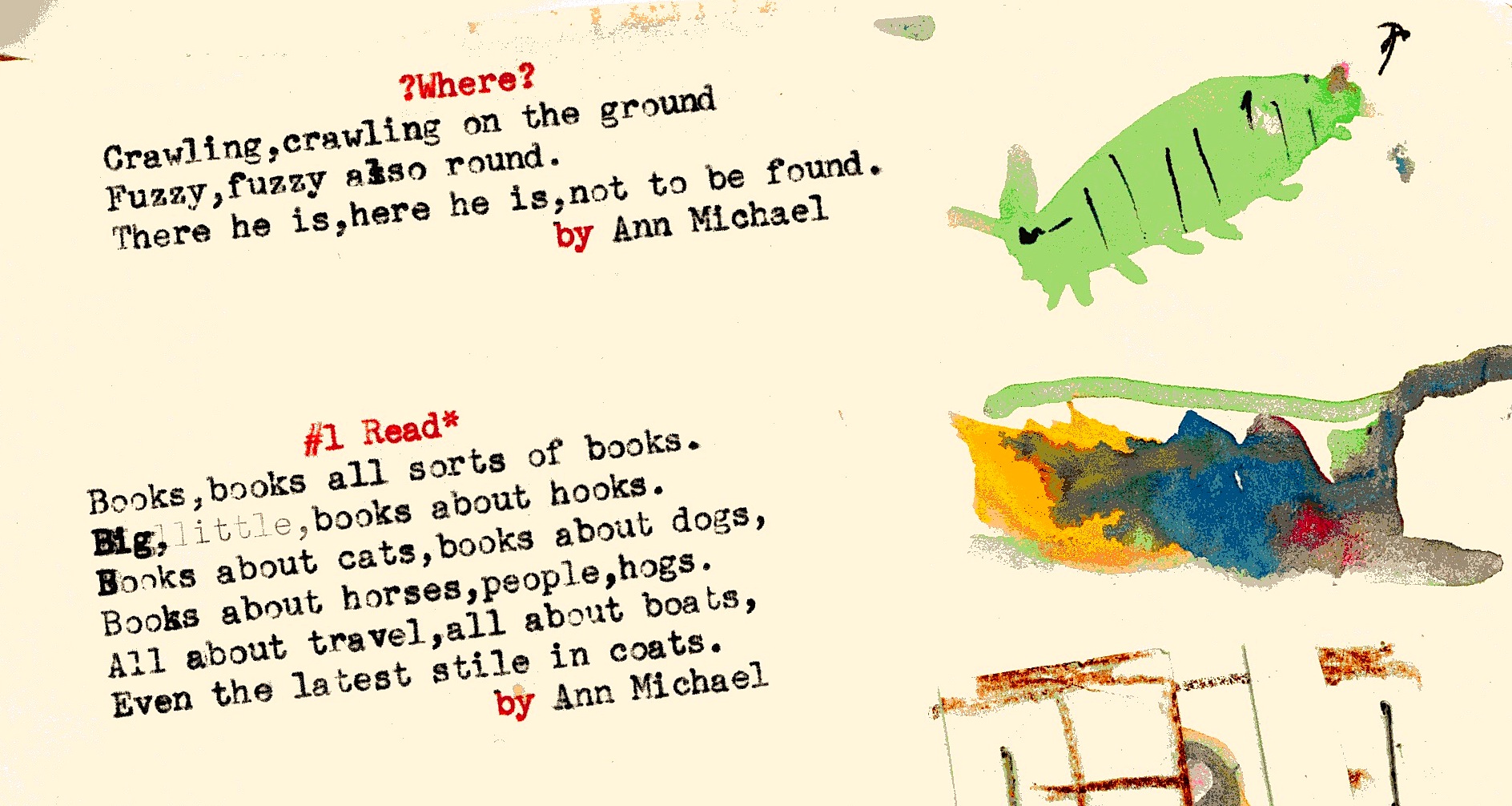
I don’t remember when I began writing. My storytelling began early, and I suppose the writing developed from there. The first story I recall writing down was about a princess; I was in second grade. I felt proud of myself, even though the story was only about three sentences long. Apparently, the poems started when I was about nine. I don’t remember writing poems then, but I recently found some that I had composed and typed up (I was fascinated by the typewriter), and my mother’s notes said I was nine when I wrote them. What I really wanted to be was an artist, but writing seemed natural to me. I started keeping a journal when I was ten…
9yroldpoems010

Rhyming and typing and illustrating and bookmaking– at nine years old.

  1. What influences have been important to you?

Other writers, naturally, but first of all, visual art. From the time I was very small, I’ve loved paintings and sculptures and architecture. Church hymns and Bible verses and nursery rhymes were influential to me, as well as folk music and the lyricists of popular music when I was growing up. I am also influenced by non-fiction work, especially in the sciences, and philosophy. My early poetry influences were Donne, Shakespeare, Blake, and the King James Bible; but then I fell in love with contemporary women writers, then surrealist poets, then Latin American writers, then Asian poetry, then contemporary lyric poems…it goes on and on. It might be easier to say what I have not found particularly influential!

~~

With further reflection, I could go deeper about early images that have become, for me, “key” aspects of my writing voice…a particular landscape, the feeling of an empty nave, bees and birds, milkweed, cloud patterns, my parents singing, my little sister beside me in our shared bed, the sound of a symphony. They may not appear in my poems as such, but these images connect with me in ways I probably don’t understand. What do such keys unlock, I wonder?

~

A good start. Possibly.

My most recent reading material is The Feeling of What Happens: Body and Emotion in the Making of Consciousness, by Antonio Damasio. Damasio is convincingly on the neurological/evolutionary trail to recognizing how consciousness operates and why we have developed it, though he allows for mysteries we do not yet and may never understand.

Damasio is clearly not a dualist who thinks the consciousness can exist separately from the body (one of his previous books is aptly titled Descartes’ Error). He doesn’t address the “soul” in The Feeling of What Happens, but argues that reason requires feeling in order to operate effectively, that feeling is a more “conscious” form of emotion, which is “unknowing” in the sense we call consciousness and is founded upon core consciousness, which is reliant upon the physical organism…a vastly complex array of cells, nerves, you name it, generally self-regulating and not by nature in particular need of a conscious mind.

So next time someone tries to explain why a situation happened and just says, “It’s complicated,” maybe you ought to accept that. Because, apparently, it’s really really really complicated!

http://www.isys.ucl.ac.be/descartes/images/Descartes.gifThat does not keep people like Damasio from trying to track down what goes on in the minds of sentient beings.

Having just read Flow, I immediately thought of what Csikszentmihalyi says about the way true flow experiences depend upon deepening levels of complexity–that’s how we keep from becoming bored by routinization of a task. Dennett suggests that consciousness consists of layers: “multiple drafts,” and Damasio calls the human brain, and the brain-body unit, a series of “systems within systems.” But there is no little self, no metaphorical or actual homunculus, at the very bottom of the system, or at the very top. There are only more and varied connections, he asserts–with profound respect and amazement at what biology has wrought.

I also thought about Csikszentmihalyi’s idea of a life project. Some years ago, I began a journal devoted to exploring my poetic project and learned that I do not really think about my writing as a project per se, at least not in the formal sense of poetics. [Here’s Dorothea Lasky harping on the whole concept of a poetic project, in a bit of refutation aimed at poetry critic David Orr.]

What I think I was doing, in fact, was trying to figure out my life project, in the way Csikszentmihalyi defines that concept. What is my life’s philosophy in terms of guiding tasks, principles, goals, projects, challenges? Is teaching part of the package? Motherhood? Gardening? Writing? Human relationships? Learning? Speaking of human consciousness, do I have a conscious path or goal?

Maybe my goal is to keep on amid the complexity and to relish it as much as possible, since it is unavoidable. And perhaps by accepting the complications, I will find my life becomes simpler. That could be a possible outcome–right?

I think of Reineke writing on Marcel Proust’s narrator and his struggle with status, jealousy, conformity, and desire. I read the Proust novel(s) when I was in my early 20s and found his narrator frustratingly neurotic but also a little too familiar, as my life experiences in many ways mirrored his. Eventually, he learns that the way to cure the pain of desire is to discipline himself to let go of desire itself; (and no, neither Proust nor his narrator were Buddhist).

And what happens when he gains this recognition is that he can write the novel. He develops flow, and a life project.

I am past 50, a good time to establish more consciously what my life project is. I know it involves relentlessly and joyously learning new things. I think it will include poetry in some way. And discipline of some kind, conscious effort. For now, those things constitute a good start.


October focus

69082_1682385823790_1949308_n~

October. I’ve put my vegetable garden to bed, deadheaded and pruned the perennials. The leaves are yellow and red and orange and brown, and the white pines are dropping their old needles. Quieter days, quieter nights: fewer insects, amphibians, and birds making their noises.

Well–there are the danged woodpeckers

I expect to keep this blog less frequently this month, or to make the posts shorter, because I am taking part in what is for me a new endeavor: an online poetry workshop. I am taking a month-long class with Daisy Fried through Providence’s Fine Arts Center, 24 Pearl Street.

Daisy Fried lives in Philadelphia, 24 Pearl St. is in Rhode Island, and my fellow workshop participant-peers live in NH, MA, IN, MC, ME, NY, VA, NJ, VT, CA, AL and IL. Oh, the amazing connectivity of the world-wide web!

I’m somewhat tech-savvy but only to a limited degree, and reading online is still cumbersome for me. Nonetheless, I am curious to see how the virtual critique will work, given that we are not face-to-face as we comment, enthuse, and suggest. Interpretation takes on multiple meanings in an environment such as this one. And whether I can keep on top of the comments and reading! That’s another type of challenge during the academic year for me.

I feel thrilled to be back in the position of student, though. I’m the sort of person who might stay in school perpetually if I could manage it. Even autodidacts sometimes enjoy the camaraderie of peers.

If you are interested in the process, and how it goes for me…I shall eventually report back on these “pages”!


Introspection & narcissism

In August 2014, New York Times writer David Brooks wrote about the differences, if any, between narcissism and introspection. His opinion column explored whether self-questioning and rumination might lead to self-centeredness rather than self-discovery; he begins the column with the concept of the personal journal or diary and whether that practice has value or not. (Certainly there are other methods of introspection, but for a literate society it is writing that first comes to mind).

Citing research from several psychological studies, Brooks states:

We are better self-perceivers if we can create distance and see the general contours of our emergent system selves — rather than trying to unpack constituent parts.

Interestingly, this suggestion more or less jibes with the multiple-levels-of-self version of consciousness as theorized by Douglas Hofstadter and Daniel Dennett.

Writing as a means to recover from trauma or to “make sense of the world” seems most effective when the writer puts some reflective distance between experience and feeling (see The Writing Cure), although James Pennebaker’s research argues that even immediate expressive writing can help psyches and bodies to heal. Brooks outlines three ways, different from the microscopic introspection of the narcissistic diary-entry, that self-reflection can develop into something other than self-absorption.

One of them is narrative, which makes perfect sense to me–human beings are story-makers. In fact, all three approaches to introspection Brooks mentions find expression in poetry, storytelling, fiction-writing, creative nonfiction, and in good journalism.

Creating our narratives from a reflective “step away” from intense analysis helps human beings to navigate the inner and the outer worlds.

I’m seeing this approach in action with my college freshmen this semester. More on that in a later post.

Difficult writing?

Here’s Will Buckingham on writing and difficulty. Worth a read! I don’t know how to embed the blog into my post, so here’s the link.

http://willbuckingham.com/the-pleasure-and-difficulty-of-writing/

Writing can indeed be a pleasure–most of the time! There are periods of difficulty when I feel frustrated, but those periods make for puzzles and challenges; and I enjoy puzzles and challenges. They push me, force me to stretch a bit, engage with what’s not so simple or superficial, change my perspective, alter my expectations and assumptions, discover something new. I learn from these experiences. I would not want life to be easy all the time, nor would I want creative writing to be easy all the time. Although it’s pleasing to lie in a hammock on a mid day and sip a cold drink and listen to the birds and read a book…pleasure also encompasses inventive challenges. Motivation. Inspiration. Different forms of joy.

Buckingham mentions a biography of the writer and artist Tove Jansson, best known in the USA for her Moomintroll series but clearly a creative artist of the first rank. I’d put this book on my reading list, but it is at present only available in Finnish! Marina Popova at Brainpickings has posted some of Jansson’s vivid illustrations of Alice in Wonderland here.

On the pleasures of difficult reading, please see my past posts here, here, and here.

Maximally bent & broken

bent and broken

bent and broken

The linguist/scholar David Crystal writes that “Poetic language is the domain where linguistic rules are maximally bent and broken.”

The context here (in his book The Stories of English) is an explanation of how historians of language accomplish their sleuthing; Crystal notes carefully the differences between written and spoken versions of the same language, not to mention dialects and artistic expression and diversified diction based upon the intended audience, and uncertainty as to region, origin, and date of the manuscripts and texts under scrutiny. He cautions readers not to take linguistic theories and received stories about language evolution too readily; the story is a multitude of stories, examinable from a variety of disciplines and perspectives. Much of the story is ephemeral, being oral/aural and carried on in dialects. A fascinating puzzle, really, full of lacunae and contradictions…and a reminder that when I am in my teaching role, I should remain mindful that Standard English is something of a misnomer. A living language, as Crystal demonstrates, operates on many levels and evolves concurrently with social, economic, religious, and technological trends.

I fervently agree that poetry offers language new routes of expression, a place to expand, warp, and break rules while managing all the same to convey information. The information may be conveyed in surprising ways, though, non-standard ways: neologisms, compound words, old words used in a new fashion, or as a different part of speech. Poetry is a major arena for this sort of experimentation, though not the only one. Further, I am inclined to follow a non-prescriptivist approach to writing  even though my job at the college is to impart the basic rules of Standard English, a task which (alas) tends to involve judging things as less-than-correct or “in need of improvement” for the sake of clarity and general comprehensibility.

Should I therefore be more tolerant of non-standard use of the apostrophe? I’m not quite ready for that, because the resulting texts are still so frequently confusing. The point of good writing is, most often, to convey information–though that could be argued–

~

Crystal points out that much stereotyping of speech patterns and much arbitrary standardizing (to the degree possible) has been due to our creative writers, and compounded by writers’ love-hate relationships with printers (and, later, editors) who rely upon codification. A widely-literate audience benefits from generalized written standards, he notes–but there’s no need to become “Grammar Nazis” despite human beings’ natural inclination to be conservative and, let’s face it, contentious. He takes a sociological all-embracing stance about English, welcoming changes.

Having read this text, I am of the opinion that ours is another of those linguistically-transformative periods of messy additions and alterations thanks, largely, to technologies and the sciences but also to media and particularly social media. [viz, meme. What an adaptable coinage!] As long as I have been teaching, I have reiterated to my students that I am giving them a code, a tool, Standard Written English; the way they speak or write is not wrong or incorrect. It is simply not clear and standardized enough for academic work. Get the right tool for the job!

~

Crystal lauds Samuel Johnson for his zeal for language and languages and dialects, even as Johnson sought to “stabilize the disorder” of English in the 18th C. The author goes on to insert his view that prescriptive, “correct” approaches to the language “prevented the next ten generations from appreciating the richness of their language’s expressive capabilities, and inculcated an inferiority complex about everyday usage which crushed the linguistic confidence of millions” (not to mention enforced class distinctions even further). I need to remember this balance between clarity and variety. I admit I have been a not infrequent eye-roller at the “sloppy, slangy, abbreviated” English of television, tabloids, Twitter, texting, and my students’ lingo. It is refreshing to think of these annoyances as potentially enriching–rather than degrading–to the language I love to read, speak, and write.

When I read poems, I know there are writers who employ archaic words, dialect words, slang words, colloquial syntax, interrupted syntax, irregular capitalization and punctuation, neologisms, invented compound word-phrases, curses, technology terms, scientific jargon, Latin, Spanish, Spanglish, Chinese, obscure place names, alternate spellings (orthography)…and on and on. Some are looking back; others look ahead. Some are encapsulating the moment–now–in the framework of a verse. They bend and break the language in startling, haunting, beautiful, memorable ways. This they can do because a living language allows them to.

Parenthood & writing

My life, in my role as parent, has lately trumped my reading-&-writing time. This happens periodically and is one of the challenges–one might suggest hindrances–of being a writer who has children.

My children are grown, yet the occasional interferences continue. I rush to note that these interruptions can be marvelous; June has been pleasantly subsumed in the marriage festivities of my youngest. My blog plays a decided second fiddle to family. Or third fiddle. Or maybe just a fiddle that sits in the closet for months.

The recent New York Times Sunday Book Review offers two delightful essays on how parenthood affects writers: the columns by James Parker and Mohsin Hamid speak for me on how parenthood has informed these authors’ “writing life.” There is a difference, though it may be only one of small degree, between real life and the writing life. These men demonstrate the interaction, inspiration, and interference well, so I will let their words stand in for mine today. Please do click the link and read the essays.

Meanwhile, I observe with joy and a mixture of feelings (and a certain amount of preparation and planning and organizing) as one of my best beloveds chooses a lifetime partner and the two of them head off together into a shared life. I will be on the periphery. Which is as it should be, I suppose.

Many blessings, daughter.

Image


Enter the philosophy paper…

My “day job” at a small university is part administrative, part teaching, part assessment, and largely tutoring in writing. The last of these requires a peculiar balancing act, because my directive says I must not tutor discipline content; I have to tutor students toward “clear expression” while staying within the areas of grammar, spelling, vocabulary use, assignment interpretation, thesis writing, paper structure, and documentation. As a job description, that all sounds quite clearly delineated and objective enough, but writing well cannot happen when the writer fails to understand content material. Enter the Philosophy paper.

In any discipline, it’s difficult to separate tutoring “clear expression” in terms of grammar and vocabulary without also tutoring content. With philosophy that process is especially challenging, because to a large extent, philosophical understanding (content) relies on grammar (rhetoric). A student can contradict himself simply by neglecting to type the word “not” in a sentence, rendering his attempt at argument void. Or a student may announce she will use one approach to prove her claim and then prove the claim, quite adequately, with a different (and opposite!) approach.

This bust resides in the Louvre, and was found here: http://www.humanjourney.us/greece3.html

This bust resides in the Louvre, and was found here: http://www.humanjourney.us/greece3.html

Cases like these cause me to ponder. How can I coach the writer without offering a content-based answer? Philosophy itself supplies the method: inquiry.

“So, you say here that because Locke believed in Natural Law, he would not apply Natural Law in the case of the social contract. Can you explain that statement? Because it seems as though you are contradicting yourself, unless you accidentally added the word ‘not’ or unless you have more to say after this sentence…maybe, why he would not do so?”

“Here, you do a pretty good job explaining why beauty is in the eye of the beholder, although you need to pay more attention to your use of the comma. But back at your claim in paragraph one, you say you will prove beauty is transcendent–and your definition of transcendent doesn’t work with your argument in paragraph three…do you mean beauty is not transcendent? Did you forget a word, or are you missing a paragraph of explanation?”

When the science students or economics students bring papers to me, it is, I admit, much easier for me to stick to grammar and mechanics. The same sorts of logical structure or argument issues crop up, however. Sometimes, I feel as though I am right on the borderline, and sometimes I think I’ve teetered a bit too far into content tutorial–especially when the students are writing about history, philosophy, literature, or philosophy. Yet would any philosopher disagree that you cannot completely disentangle grammar logic from any other kind of logic? They stem from the same root.

Writing process? Got that. Sort of.

Last year, I was invited into a blog-go-round for writers (see this post). Many thanks to Lesley Wheeler for tapping me for this 2014 blog tour on “the writing process.” I read Wheeler’s 2010 book Heterotopia and was wowed; she’s also the author of  The Receptionist and Other Tales, Heathen, Voicing American Poetry: Sound and Performance from the 1920′s to the Present  and other work. With Moira Richards, Rosemary Starace, and other members of a dedicated collective, she coedited Letters to the World: Poems from the Wom-po Listserv (Red Hen, 2008). We got introduced virtually via the Wom-po listserv.

Lesley is a formidable scholar and critic who writes a wise and witty blog, which you’ll find linked to her answers in the paragraph below this one. Now the Henry S. Fox Professor of English at Washington and Lee University, Wheeler has held fellowships from the Fulbright Foundation, the National Endowment for the Humanities, the Virginia Commission for the Arts, and the American Association of University Women. Wheeler received her BA from Rutgers College, summa cum laude, and her PhD in English from Princeton University. Despite all these amazing academic chops, which could appear intimidating, Lesley strikes me as approachable, generously interested in the wide world (not just ivory towers), and funny.

Click here for her answers to the prescribed questions. Below are my own.

~water-rites_cover

1)     What am I working on?

I have a completed manuscript that I sent out last year, The Red Queen Hypothesis; but I have had a change of heart about it. I am revising it completely. It’s a major renovation, because as I revisited the not-yet-book I found myself re-thinking the purpose of the collected poems. I had originally conceived the manuscript as an experiment in nonce forms, with a biological theme threading the poems together. As I re-read my work, I realized that my thinking, my purpose, for the poems has altered. Let’s just say some major life changes have been underway in the background of my creative efforts, and the influences made themselves felt. The book as originally imagined turns out not to be the book I want to write.

So, what I’m working on this year turns out to be what I was working on last year, only re-envisioned. I did complete (I think!) a collection of poems centering on adolescent girls of the 1970s that is a sort of a girls’-eyes-view of Bruce Springsteen songs–it’s called Barefoot Girls.  I’ll be sending that out to find a publisher.

Meanwhile, I am writing new work which, alas, seems to be rather dark–if you happen to consider poems about mortality to be dark.

2)     How does my work differ from others of its genre?

I would love to say that my poetry is wildly original in approach or style, but it isn’t. If you were to categorize my work as “eco-poetry,” it would be different from the genre because of a quieter rhetoric. If you were to call my poetry “nature poetry,” it would not fit quite comfortably into the genre because of its trending toward the intellectual. My poetry is usually “accessible,” but I don’t eschew the multisyllabic latinate vocabulary at all costs, and my allusions are often a bit arcane. I like form and classic poetic strategies, but I also like to break rules, and I adore free verse and prose poems. What did Stevens say? “All poetry is experimental poetry.” Yes. That.

3)     Why do I write what I do?

Journals, because of Harriet the Spy when I was 10, and ever since. Harriet_the_Spy_(book)_cover

Blogs, to practice the less emotional, more inquisitive side of myself and because I’m an autodidact.

Essays and criticism or reviews, because writing that type of work requires skills my brain needs to exercise in order to do other things, such as be an educator; and because I love to read and think about what I’m reading.

Libretti, because colleagues asked, and new things are compelling to attempt.

Poetry, because I can’t do without it.

4)     How does your writing process work?

Interesting question at this time, as I feel the way I go about writing is changing after many years of pretty solid operational process. It may be that I am getting older or because see above: significant life changes.

One thing hasn’t changed, and that is the need for a certain kind of solitude. Distractions aren’t in and of themselves anathema to my writing process, but the distractions need to be of a non-urgent kind. I don’t mind being distracted by a broad-winged hawk overhead or a siren in the distance or an overheard conversation, but sometimes even a loved one’s “Hello, I’m back from the grocery store!” shifts my focus irrevocably.

[aside: My loved ones do not really understand this effect.]

The way I begin a poem is akin to how I’ve heard mindfulness described. I allow myself to be relatively vacant, and something drops in to fill the moment. I assure you this is nothing like a bolt of inspiration from the blue; and usually all I get is a phrase, a metaphor, an image, an aphorism. But it’s a start. From there, the process is about association, relationships, combinations, experiment, and a certain amount of loopy freedom to write a bad poem if that’s what emerges.

Then, I pause. The draft sits there for days (weeks, months, years) until I decide to start revising poems, which I tend to attack in batches. That’s one thing I do differently these days: revise in bunches the way I did back in graduate school under a time crunch. What I currently notice changing, too, is the way that I enter emptiness. In years past, my favored way was to take a walk or to work in the garden. Physical issues have to some degree limited the amount of time I can spend doing those activities, and finding an acceptable substitute has been hard. I am muddling through, waiting to see what works best.

~

Next up, April Lindner and Zara Raab. They should have their writing process blog posts up sometime in the next 7-10 days; and I am excited to learn what approaches each of them takes.

April Lindner is the author of three Young Adult novels: Catherine, a modernization of Wuthering Heights; Jane, an update of Jane Eyre; and Love, Lucy, a retelling of E. M. Forster’s A Room With a View, forthcoming in early 2015 from Poppy.  She also has published two poetry collections, Skin and This Bed Our Bodies Shaped.  With R. S. Gwynn, she co-edited the anthology Contemporary American Poetry for Longman’s Penguin Pocket Academic series.  April lives near Philadelphia with her husband and sons.

Zara Raab’s latest book is Fracas & Asylum. Earlier books are Swimming the Eel and The Book of Gretel, narrative poems of the remote Lost Coast of Northern California in an earlier time. Her poems, essays and reviews appear in River Styx, West Branch, Arts & Letters, Crab Orchard Review, and The Dark Horse. She is a contributing editor to Poetry Flash and The Redwood Coast ReviewRumpelstiltskin, or What’s in a Name?  was a finalist for the Dana Award. She lives near the San Francisco Bay.

Autodidact as adult student: Goddard & me

In a previous post, I mentioned my peculiar undergraduate experiences at alternative institutes of higher education (The New School) and how being a book-loving autodidact influenced, perhaps even configured, my approach to education. My favored learning strategies led me to a non-traditional graduate school program, as well. Reflecting upon my higher education, I realize that every institution I attended chose alternatives to standard pedagogy–and I am grateful that such colleges exist. The world needs outliers.

A kind of heaven.

The New School’s pedagogy for the “Freshman Year Program” was seminar-based. That worked very well for me. Classes were small, discussion-centered, predicated on the reading of significant original texts–no textbooks. The professor was not a lecturer but a participant-coach and mentor.

The program was only a year long, however, so I had to transfer. There were a number of experimental college programs in the 1960s and 1970s; without the miracle of internet searching, however, they were not easy to locate. I did not find out about St. John’s College, Reed, or Evergreen, for example. I stumbled instead upon Thomas Jefferson College (now defunct) in Michigan.

I completed my undergraduate studies without ever seeing a syllabus. Yet I read more books than the majority of my standard-pedagogy-educated peers and discussed classic and contemporary texts, science and history and literature, in depth with my peers and with scholars. I wrote a lot and did hands-on projects, independent studies, experiments and interviews. TJC drew criticism for its ‘flakiness’ and ‘lack of oversight,’ (some of which, I can attest, was deserved); however, the former college president “described TJC as perhaps too far from the mainstream, but attracting excellent students, noting that ‘Thomas Jefferson College…was sending a larger percentage to graduate school than the College of Arts and Sciences.'” Yes, but in my case it took awhile to get there.

Much water under the proverbial bridge: suffice it to say that in 2000, I returned to college to pursue a masters degree…and I wanted to learn in the kind of environment that suited my style. There were other factors then, as well: two children, for example, and responsibilities I had not encountered as an undergrad. On the other hand, by 2000 I was an adult and more motivated and disciplined than I could ever have been at age 19.

I chose Goddard College for a number of reasons, foremost its small seminar-style instruction, its mix of workshops and instruction, its focus on readings, annotations, mentoring, and community-building among students and faculty–reaching outward into the world at large. The low-residency format only works if the student is independent and self-directed, which–as a returning, “adult” student–I certainly was. I appreciated the school’s more interdisciplinary approach to the creative writing program. We didn’t have to face off, pegging ourselves as poets or fiction writers. And creative non-fiction was taken seriously as a genre to develop voice, style, and depth…it could be studied and parsed. That endeavor of interdisciplinary arts education is true of a few institutions now but was rather new among MFA programs in the late 1990s.

Another college without core requirements, without syllabi, without standard formats. But, like New School and TJC, Goddard offers excellent professors dedicated to students’ intellectual enrichment and personal transformation, small-group discussions, and narrative evaluations. I knew how to balance life’s responsibilities when I enrolled, and I knew what kind of teaching I’d respond best to. How did I learn that? See above. Suits my philosophical, bookwormish, autodidactic approach to–well, practically everything!